Anaes · Airway management
Apnoeic oxygenation and THRIVE
Also known as Apnoeic oxygenation · THRIVE · Transnasal humidified rapid-insufflation ventilatory exchange · High-flow nasal oxygen · NO-DESAT · Pharyngeal oxygen insufflation
Exam-pass apnoeic oxygenation: aventilatory mass flow physiology, preoxygenation/denitrogenation, nasal low-flow NO-DESAT, Patel THRIVE high-flow humidified oxygen, CO2 limits, obesity/obstetric/difficult airway applications, and hard limits (obstruction, aspiration) for ANZCA Final and FRCA.
On this page & tools
Your progress
Saved locally on this device.
8 MCQs with explanations
Target exams
Red flags
Why this is examined / the one-line answer
Safe apnoea time is the clock of every difficult airway viva. Examiners want the physiology in one sentence, the difference between simple nasal O2 and THRIVE, who benefits (obesity, difficult airway, shared airway, RSI adjunct), and the hard limits (obstruction, hypercarbia, aspiration).[1][3]
One-liner: I denitrogenate thoroughly, keep the airway patent, apply continuous oxygen at the pharynx during apnoea — preferably humidified high-flow (THRIVE) when available — to extend the hypoxaemia-free window, while watching CO2 and never mistaking this for ventilation or aspiration protection. [1]
Physiology — aventilatory mass flow
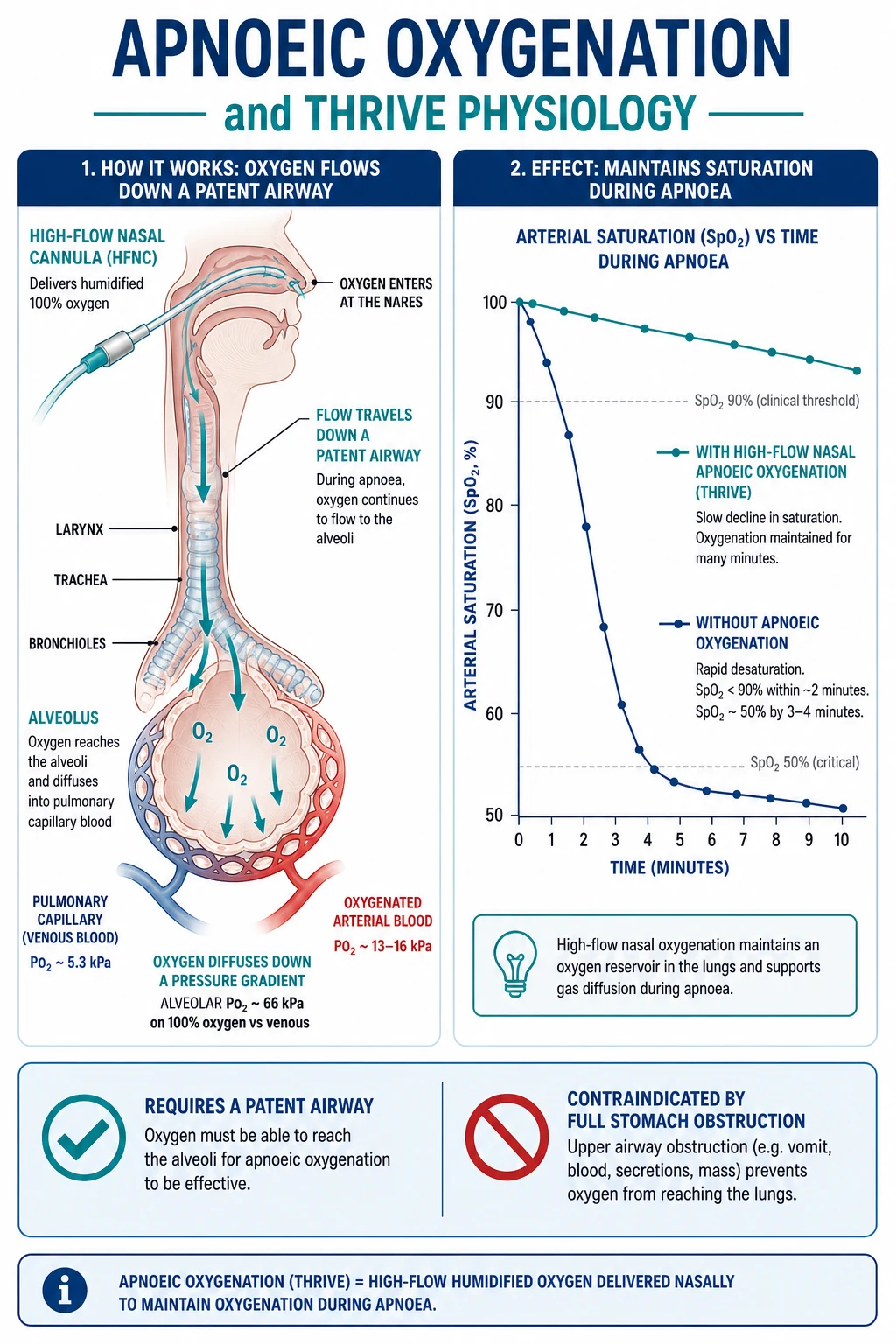
During apnoea, oxygen continues to be taken up from alveoli (~250 mL/min adult resting VO2) while CO2 delivery to alveoli is smaller because most CO2 is buffered in tissues. Alveolar volume tends to fall, generating a sub-atmospheric pressure that draws oxygen from a patent upper airway into the lungs if the upper airway is oxygen-filled. That is aventilatory mass flow — the basis of apnoeic oxygenation.[1][4]
Requirements: patent airway; oxygen reservoir in the pharynx/upper airway; preferably denitrogenated FRC first. [1]
What it does not do: clear CO2 like alveolar ventilation; protect against aspiration; fix complete obstruction; confirm tube position. [1]
Preoxygenation and denitrogenation first
Apnoeic techniques fail if you start from a nitrogen-rich FRC. [1]
- Tight mask, 100% O2, 3 minutes tidal breathing or 8 vital-capacity breaths (classic teaching).
- Head-up / HELP ramp for obesity and pregnancy to raise FRC.
- Target high end-tidal O2 (commonly aim EtO2 ≥0.9 when measurable).
- In the critically ill, standard preoxygenation often fails — add upright position, PEEP/NIV, and HFNO strategies as phenotype demands.[3]
Spectrum of apnoeic oxygen delivery
| Method | Typical setup | Role |
|---|---|---|
| Pharyngeal / nasal low-flow | Standard nasal cannulae 5–15 L/min during laryngoscopy (NO-DESAT concept) | Universal, cheap, delays desaturation |
| THRIVE / HFNO apnoea | Humidified high-flow nasal O2, often 30–70 L/min adults | Longer safe apnoea; some CO2 washout from dead space; better tolerance |
| Oxygen insufflation via catheter | Buccal/nasopharyngeal catheter | Adjunct when HFNO unavailable |
| SGA / mask CPAP | Re-oxygenation between attempts | Rescue when apnoeic O2 fails |
Flows and method choice follow the Patel THRIVE physiology series and modern peri-oxygenation practice.[1][3]
THRIVE — Patel & Nouraei 2015
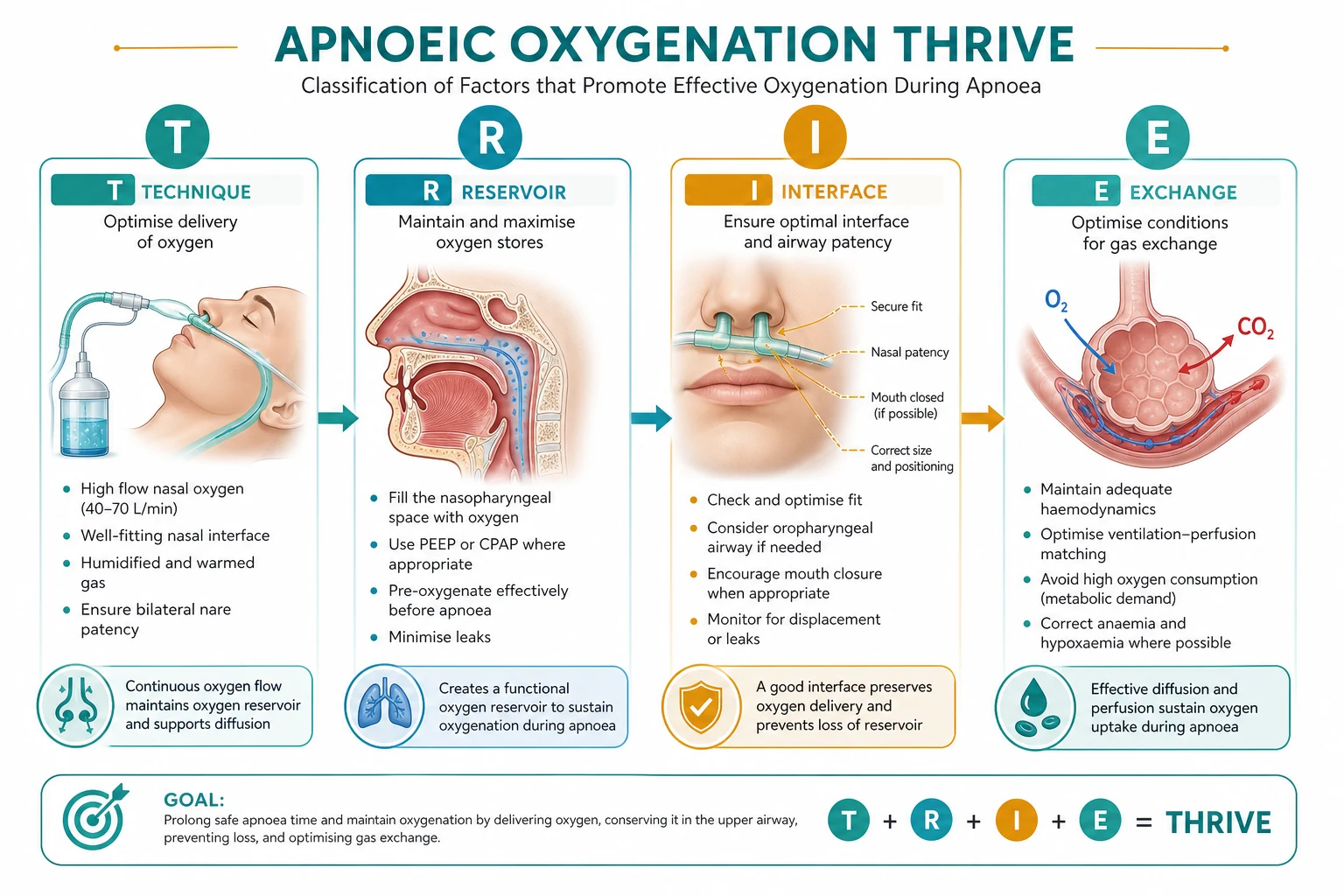
THRIVE (Transnasal Humidified Rapid-Insufflation Ventilatory Exchange) uses commercial humidified high-flow nasal cannulae to deliver heated, humidified oxygen at high flow, extending apnoea time markedly in difficult-airway patients while slowing CO2 rise relative to classical dry apnoeic oxygenation alone — original physiological series demonstrated multi-minute safe apnoea windows in selected adults.[1] Subsequent RCT work compared THRIVE pre-oxygenation with facemask in RSI contexts and broader adoption reviews tracked five-year practice evolution.[2][5]
Practical setup (exam script): [1]
- Apply THRIVE/HFNO before induction; preoxygenate with mouth closed if possible.
- Continue high flow through apnoea and laryngoscopy (cannulae stay on under VL).
- Maintain jaw thrust / airway patency — flow cannot traverse a closed airway.
- Cap time by clinical plan and rising CO2/acidosis risk; secure definitive airway.
- Confirm intubation with waveform capnography. [1]
Safe apnoea time and the CO2 clock
Well-preoxygenated healthy adults may maintain SpO2 for many minutes with apnoeic O2/THRIVE; without it, desaturation can occur in 1–2 minutes, and far faster in obesity, pregnancy, children, sepsis, and lung disease.[1][3]
CO2 rises throughout (~0.3–0.5 kPa/min order-of-magnitude teaching after the initial jump) with progressive acidaemia. Apnoeic oxygenation extends the hypoxaemia clock, not the metabolic clock. Patients with raised ICP, pulmonary hypertension, or severe metabolic acidosis tolerate hypercarbia poorly — plan shorter apnoea. [1]
Clinical applications
- Anticipated difficult airway — calm first attempt with VL/FOI under oxygenated apnoea.[1]
- Obesity / reduced FRC — combine ramp + denitrogenation + HFNO.
- Obstetric GA — adjunct only; still RSI/aspiration plan and OAA/DAS thinking.
- RSI / emergency intubation — peri-oxygenation to reduce peri-intubation hypoxia.[2][3]
- Shared airway / tubeless ENT — selected THRIVE lists with strict CO2 and fire-safety rules.
- Paediatrics/neonates — principle applies; flow rates and equipment must be age-appropriate (leaf detail elsewhere).
Limitations and contraindications (say these unprompted)
- Complete upper-airway obstruction / closed glottis → technique fails.
- Uncontrolled hypercarbia risk (long apnoea, severe acidosis, some neuro cases).
- Full stomach — not a substitute for aspiration precautions.
- Base-of-skull fracture / significant nasal pathology — caution with high nasal flow (risk discussion).
- Does not replace CICO pathway when oxygenation truly fails. [1]
Integration into the airway algorithm
Preoxygenate → induce/paralyse as planned → maintain apnoeic O2 → best first attempt → if failing, re-oxygenate (mask/SGA) rather than endless looks → declare failure early → DAS/CICO. THRIVE reduces time pressure; it does not justify violating attempt limits.[4][5]
Regional practice deltas
ANZ. HFNO widely available in theatres and ICU; THRIVE language familiar in Final airway stations. Pair with HELP ramp for bariatric and obstetric GA.
SAQ answer scaffold
Obese patient for urgent laparotomy. How do you prolong safe apnoea during RSI intubation? [1]
- Position: HELP ramp, head-up.
- Preoxygenate: tight mask or HFNO to high EtO2; consider NIV if critically hypoxic.
- Apnoeic O2: nasal cannulae high flow or THRIVE continued through laryngoscopy.[1][3]
- Airway plan: VL first-line, limited attempts, SGA rescue, CICO ready.
- Limits: patent airway required; watch SpO2 and time; ventilate if saturations fall; aspiration precautions remain.
Viva stem bank and model phrases
Stem 1: “How does apnoeic oxygenation work?”
Model: “Oxygen uptake exceeds CO2 return to the alveoli, so a patent oxygen-filled upper airway supplies gas by mass flow into the lungs and maintains SpO2 during apnoea.”[1]
Stem 2: “What is THRIVE?”
Model: “Humidified high-flow nasal oxygen providing apnoeic oxygenation — and some dead-space CO2 clearance — to extend safe apnoea in difficult airways, as described by Patel and Nouraei.”[1]
Stem 3: “Does it stop CO2 rising?”
Model: “No. It mainly defends oxygenation; CO2 and acidosis still accumulate, so it is a bridge to a definitive airway.” [1]
Stem 4: “Obese parturient — your peri-oxygenation?”
Model: “Ramp, denitrogenate, antacid prophylaxis, RSI, THRIVE/nasal O2 during apnoea, VL, OAA/DAS failed-intubation plan.” [1]
Stem 5: “When does the technique fail?”
Model: “Obstruction, failed preoxygenation, extreme shunt, and when people treat it as a substitute for ventilation or tube confirmation.” [1]
Common traps
- Applying HFNO with an obstructed airway and calling it THRIVE
- Skipping denitrogenation
- Ignoring CO2 in long shared-airway cases
- Using apnoeic O2 as excuse for endless intubation attempts
- Forgetting aspiration risk because “they are oxygenated”
- Claiming THRIVE equals ventilation [1]
FLOW — apnoeic O2 checklist
Physiological orders of magnitude and THRIVE adult flow ranges from the landmark apnoeic oxygenation literature.[1][4]
Examiner mental map
- Mass flow physiology in one sentence.
- Denitrogenate then oxygenate through apnoea.
- NO-DESAT vs THRIVE.
- Who benefits (obese, difficult airway, RSI adjunct).
- Limits (obstruction, CO2, aspiration, not tube confirmation).
- Still obey attempt limits and CICO. [1]
Red flags
[1] [1] [1] [1]References
- [1]Patel A, Nouraei SA Transnasal Humidified Rapid-Insufflation Ventilatory Exchange (THRIVE): a physiological method of increasing apnoea time in patients with difficult airways Anaesthesia, 2015.PMID 25388828
- [2]Mir F, Patel A, Iqbal R, Cecconi M, Nouraei SA A randomised controlled trial comparing transnasal humidified rapid insufflation ventilatory exchange (THRIVE) pre-oxygenation with facemask pre-oxygenation in patients undergoing rapid sequence induction of anaesthesia Anaesthesia, 2017.PMID 28035669
- [3]Weingart SD, Levitan RM Preoxygenation and prevention of desaturation during emergency airway management Ann Emerg Med, 2012.PMID 22050948
- [4]Patel A, Nouraei SA Apnoeic oxygenation and ventilation: go with the flow Anaesthesia, 2020.PMID 32350853
- [5]Sud A, Patel A THRIVE: five years on and into the COVID-19 era Br J Anaesth, 2021.PMID 33546843