Anaes · Depth of anaesthesia & awareness
Accidental awareness under general anaesthesia: NAP5 and prevention
Also known as Accidental awareness under general anaesthesia · AAGA · Intraoperative awareness · Anaesthesia awareness · NAP5 awareness · Awareness with recall
Exam-pass AAGA topic built on NAP5: incidence, risk groups (TIVA, NMB, obstetrics, cardiac, emergency), end-tidal agent alarms, processed-EEG when agent unmeasured, Brice interview, compassionate response, and B-Aware/BAG-RECALL context for ANZCA Final and FRCA.
On this page & tools
Your progress
Saved locally on this device.
Target exams
Red flags
Why this is examined / the one-line answer
Awareness is a high-emotion viva: rare enough to be neglected, severe enough to ruin a life with PTSD. NAP5 (RCoA/APA national audit across UK and Ireland) is the named framework examiners expect — incidence context, risk factors, preventability, and human-factors response.[1][2][3]
One-liner: I prevent AAGA by confirming anaesthetic delivery (ET agent with audible low-agent alarm, or TIVA with depth monitoring and pump checks), avoiding unnecessary paralysis, deepening for high-stimulus moments, and I manage reports with belief, Brice questions, explanation, apology, psychology referral, and incident reporting. [1]
Definition and what NAP5 actually studied
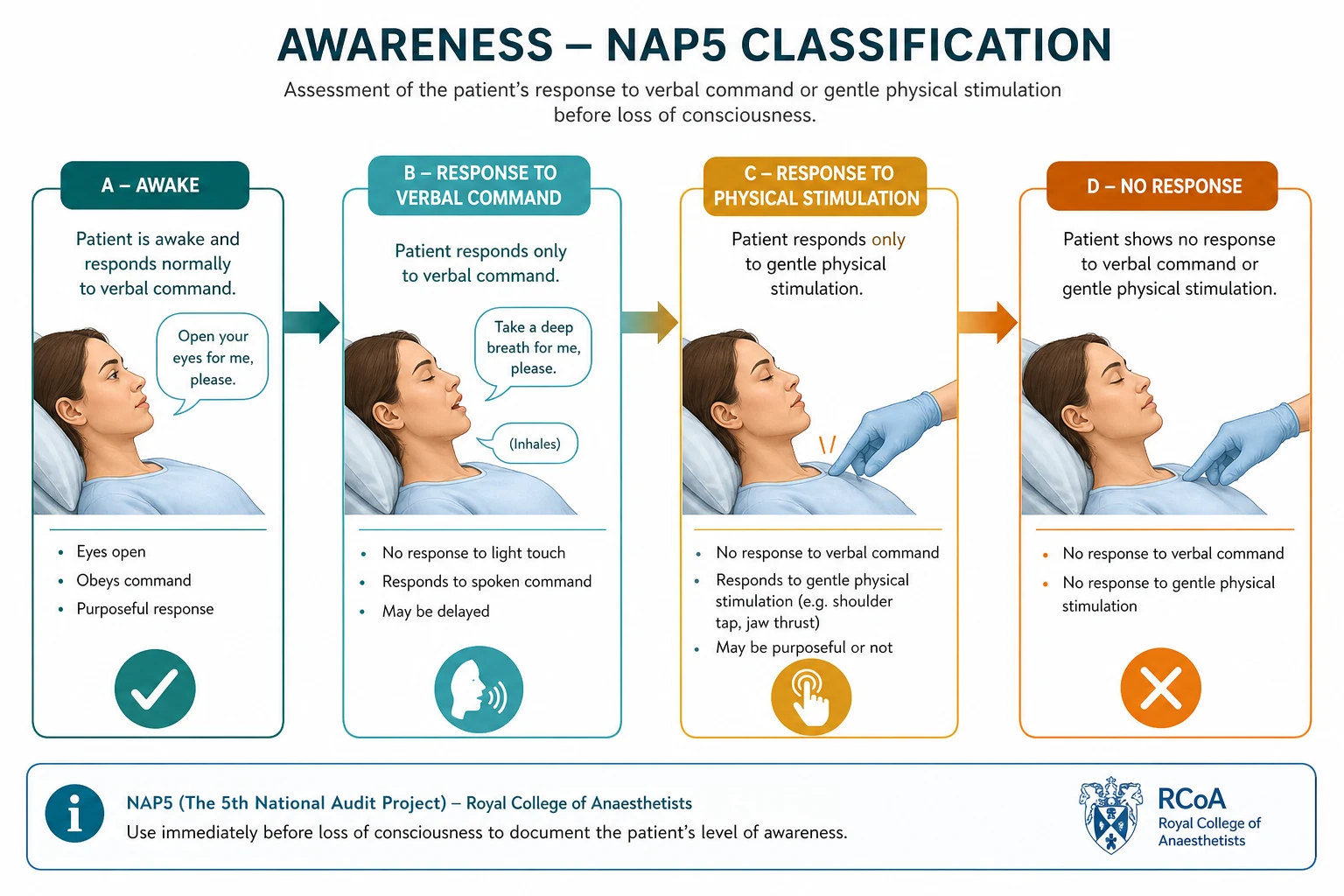
AAGA = explicit (conscious) recall of events during intended general anaesthesia — distinct from dreaming and from implicit memory. NAP5 graded reports (certain / probable / possible) and separated induction/emergence experiences from maintenance awareness.[1][3]
Distress is driven more often by paralysis and helplessness than by pain alone. Sedation cases and ICU “awareness” under incomplete anaesthesia are related but conceptually separate from classic theatre AAGA. [1]
Incidence (exam figures — approximate, quote as NAP5 context)
NAP5 found risk on the order of ~1:19 000 for certain/probable AAGA when structured reporting was used across all GAs — higher in high-risk subgroups (obstetrics, TIVA with NMB, emergency, transfer, cardiac). Older Brice-interview studies reported higher rates (~1–2:1000) because methodology differs. Know both framings and say which definition you are using.[1]
Why it happens — mechanism categories
| Mechanism | Examples | Prevention lever |
|---|---|---|
| Under-dosing deliberate | Haemodynamic instability, category-1 CS, trauma RSI | Depth monitor + clear minimum agent plan |
| Under-dosing accidental | Empty vaporiser, circuit leak, TCI mis-programme, syringe swap | Machine check, alarms, two-person TIVA check |
| Delivery unmeasured | TIVA, shared airway, bronchoscopy | pEEG mandatory teaching + pump vigilance |
| Patient factors | Young, obese, chronic opioids, red hair/MAC variants (relative) | Higher dose requirement suspicion |
| NMB enables silence | Patient cannot move to warn | Avoid unnecessary block; monitor depth |
Neuromuscular blockade is the common enabler: without it, light anaesthesia often declares as movement.[1]
High-risk settings (memorise)
- TIVA / TCI — no end-tidal agent trace
- Neuromuscular blockade
- Obstetric general anaesthesia
- Cardiac surgery / CPB transfer periods
- Emergency / trauma / RSI
- Difficult airway / multiple intubation attempts (interrupted delivery)
- Transfer between locations (disconnected vaporiser/circuit)
- Previous AAGA [1]
NAP5 core recommendations (viva currency)
- Continuous end-tidal volatile monitoring with audible low-agent alarms; never silence as routine.[1]
- For TIVA, use a processed-EEG depth monitor and rigorous pump/line checks (anti-reflux valves, visible drips, dual checking where policy).
- Avoid unnecessary NMB; when used, ensure adequate anaesthesia before and during paralysis.
- Structured consent discussion of awareness risk in high-risk cases (local practice language).
- Departmental pathway for reports: senior review, psychology, incident system.[2]
Depth monitoring evidence in one paragraph
B-Aware (Myles et al.): BIS-guided care reduced confirmed awareness versus routine care in a higher-risk population — supports pEEG as a prevention tool in selected patients.[4]
BAG-RECALL (Avidan et al.): in a high-risk population, a BIS-guided protocol was not superior to an end-tidal anaesthetic concentration (ETAC) protocol for preventing awareness — message: when volatiles are used, ET agent with alarms is powerful; pEEG is not magic and is most valuable when agent cannot be measured.[5]
Exam synthesis: ET agent first-line for volatiles; pEEG strongly indicated for TIVA and high-risk/light anaesthesia; neither replaces clinical vigilance. [1]
Prevention bundle (consultant checklist)
- Machine check: vaporiser full/locked, agent analyser working, low-agent alarm on and audible.
- TIVA: dedicated line, anti-siphon/anti-reflux, pump programmed correctly, depth monitor on before induction, visible infusion.
- Adequate induction dose; maintain during difficult airway; re-dose if intubation prolonged.
- Avoid NMB unless needed; reverse fully at end.
- For unstable patients: vasopressors to allow adequate anaesthetic depth rather than running “empty” anaesthesia.
- High-stimulus moments (knife-to-skin, Mayfield pins, sternotomy): deepen proactively.
- Brice interview if concern; low threshold to ask after high-risk cases. [1]
Brice interview (postoperative detection)
Classic structure (adapt wording): [1]
- What is the last thing you remember before going to sleep?
- What is the first thing you remember on waking?
- Do you remember anything between going to sleep and waking?
- Did you dream during the procedure?
- What was the worst thing about your operation? [1]
Positive answers → senior review same day, not “see your GP”. [1]
Responding to a report (as important as prevention)
- Believe the patient; do not minimise.
- Apologise and explain what may have happened.
- Document verbatim account; review chart for light periods, NMB timing, agent traces, pump logs.
- Offer early psychological support; arrange follow-up (PTSD risk is real).[2]
- Incident report / M&M; share system fixes (alarms, TIVA protocols).
- Consider medicolegal notification pathways per local policy.
Regional practice deltas
ANZ. NAP5 language is fully accepted in ANZCA Final teaching. Depth monitoring expectations track PS standards and local TIVA policies. Metaraminol/vasopressors to support depth in unstable patients is fair viva technique.
SAQ answer scaffold
A patient reports hearing voices and being unable to move during laparotomy under TIVA. How do you manage, and how would you prevent recurrence? [1]
- Immediate human response: believe, apologise, private interview, Brice structure, document.
- Medical review: chart/pump logs, NMB timing, haemodynamics, whether pEEG used/values.
- Support: psychology referral, GP letter, follow-up appointment, incident report.
- Prevention system: mandatory pEEG for TIVA+NMB, pump checklist, teaching, audit.
- Personal practice: never run TIVA without delivery verification and depth monitoring.[1][4]
Viva stem bank and model phrases
Stem 1: “What did NAP5 show?”
Model: “That AAGA is uncommon but often preventable; risk clusters around TIVA, neuromuscular blockade, obstetrics and emergencies; and that systems monitoring of delivered agent and a structured response to reports matter as much as individual skill.”[1]
Stem 2: “TIVA and awareness — your rules?”
Model: “Dedicated line, correct programming, anti-reflux, continuous pEEG, visible infusion, and I treat falling index or clinical signs as light anaesthesia until proven otherwise.” [1]
Stem 3: “B-Aware versus BAG-RECALL?”
Model: “B-Aware supported BIS reducing awareness versus routine care; BAG-RECALL found BIS protocol not superior to an ETAC protocol — so for volatiles, measure and alarm the agent; use pEEG especially when agent is unmeasured.”[4][5]
Stem 4: “Why is paralysis so important?”
Model: “It removes movement as a warning sign and can make EEG interpretation harder — I avoid NMB unless indicated.” [1]
Stem 5: “Patient says they were awake. First sentence?”
Model: “I am sorry this happened; I believe you; I want to understand exactly what you remember and support you.” [1]
Common traps
- Silencing low-agent alarms “for noise”
- TIVA without pEEG “because I watch the pump”
- Running near-zero volatile to protect BP instead of using vasopressors
- Multiple intubation attempts without re-dosing hypnotic
- Dismissing reports as dreaming without Brice structure
- Claiming pEEG alone makes awareness impossible [1]
AWAKE — prevention
Examiner mental map
- Define AAGA and NAP5 certainty grades.
- Risk clusters (TIVA, NMB, obs, emergency).
- Prevention triad (delivery, alarms, pEEG).
- Trial pair B-Aware vs BAG-RECALL.
- Brice + compassionate response.
- Human factors — never blame-only the junior without system fix. [1]
Red flags
[1] [1] [1] [1]References
- [1]Pandit JJ, Andrade J, Bogod DG, et al. 5th National Audit Project (NAP5) on accidental awareness during general anaesthesia: summary of main findings and risk factors Br J Anaesth, 2014.PMID 25204697
- [2]Cook TM, Andrade J, Bogod DG, et al. 5th National Audit Project (NAP5) on accidental awareness during general anaesthesia: patient experiences, human factors, sedation, consent, and medicolegal issues Br J Anaesth, 2014.PMID 25204696
- [3]Pandit JJ, Cook TM, Jonker WR, O'Sullivan E 5th National Audit Project (NAP5) on accidental awareness during general anaesthesia: protocol, methods, and analysis of data Br J Anaesth, 2014.PMID 25204695
- [4]Myles PS, Leslie K, McNeil J, Forbes A, Chan MT Bispectral index monitoring to prevent awareness during anaesthesia: the B-Aware randomised controlled trial Lancet, 2004.PMID 15172773
- [5]Avidan MS, Jacobsohn E, Glick D, et al. Prevention of intraoperative awareness in a high-risk surgical population N Engl J Med, 2011.PMID 21848460