Anaes · Airway management
CICO and emergency front-of-neck access: the scalpel-bougie cricothyroidotomy
Also known as Cannot intubate cannot oxygenate · CICO · Front-of-neck access · FONA · Scalpel-bougie cricothyroidotomy · Surgical cricothyroidotomy · Emergency surgical airway · Plan D
Cannot intubate, cannot oxygenate (CICO) is the ultimate airway emergency — the point at which every non-surgical lifeline has failed and the patient will die within minutes of hypoxia unless the airway is secured through the front of the neck. The Difficult Airway Society 2015 algorithm reaches this point as Plan D, and the Vortex approach reaches it at its central CICO zone, and both specify the same act: the immediate scalpel-bougie cricothyroidotomy. This suite examines the definition and the declaration of CICO, the scalpel-bougie-tube technique in the six-step sequence the viva expects verbatim (laryngeal handshake, transverse stab, turn the blade ninety degrees, pass the bougie, railroad a cuffed tube, confirm with capnography), the equipment pre-assembled in the CICO kit, the reasons the scalpel-bougie technique displaced needle cricothyroidotomy in the adult, the anatomical landmarks and the difficult obese neck, the confirmation and the complications, the human-factor cognitive barrier that made delay the recurring avoidable failure of NAP4, and the simulation training that maintains a competency the clinician may perform once in a career. Anchored to contemporary evidence on the physiological difficult airway, the safety of the emergency intubation, and the maintenance of the airway skill.
On this page & tools
Your progress
Saved locally on this device.
8 MCQs with explanations
Target exams
Red flags
Overview & definition
Cannot intubate, cannot oxygenate — CICO — is the ultimate airway emergency, the point in a crisis at which every non-surgical lifeline has been exhausted and the patient is dying of hypoxia in front of the team. The definition is exact, and the viva expects it verbatim: the patient cannot be intubated by the best operator present after the capped attempts, and cannot be oxygenated by face mask, supraglottic airway, or endotracheal tube. The saturation is falling, the apnoeic, paralysed patient has no reserve, and death or irreversible brain injury follows within minutes if the oxygenation is not restored. There is no further manoeuvre to negotiate; the only remaining act is to secure the airway through the front of the neck[3][1].
Front-of-neck access — FONA — is the umbrella term for the surgical airway performed in this moment, and the technique specified by the modern algorithms for the adult is the scalpel-bougie cricothyroidotomy. The Difficult Airway Society 2015 algorithm reaches it as Plan D, the final plan in the sequence; the Vortex approach of Chrimes reaches it at the central CICO zone, the convergence of the three non-surgical lifelines. The two frameworks share the endpoint and the act, and the teaching is unambiguous: the moment the CICO is declared, the scalpel is used, and the decision is not negotiable[3].
The subject is examined disproportionately because it is the crisis that kills and because the recurring, avoidable failure in the national audits is technical competence's mirror image — the cognitive barrier to performing the act. The 4th National Audit Project (NAP4) of the Royal College of Anaesthetists and the Difficult Airway Society returned the same lesson every cycle: the airway was recoverable, the front-of-neck access was achievable, but the teams hesitated, persevered with a failing technique, or reached for the scalpel too late, and the patient died or was brain-injured. The suite that follows is the answer to that failure — the definition, the technique, the equipment, the human factors, and the training that make the act one the clinician will perform the moment it is indicated[3][2].
The scope of the problem and the NAP4 lessons
CICO is rare but devastating. The reported incidence of the true cannot-intubate, cannot-oxygenate event in the adult anaesthetic population is of the order of one in several thousand to one in ten thousand, and the cricothyroidotomy is performed even less often than that — many anaesthetists and emergency physicians will go a career without performing one on a patient. Yet when it occurs it is the procedure that stands between the patient and the death, and the mortality and the morbidity of the event have made it the most examined single procedure in the airway viva[3].
The NAP4 review of the major complications of airway management in the United Kingdom reshaped the teaching of the front-of-neck access. The leading causes of the death and the brain injury in the CICO events were, in aggregate, avoidable, and they cluster into two themes. The first is delay — the teams persevered with the failing technique, performed a fourth or fifth laryngoscopy, or attempted a needle cricothyroidotomy that failed and cost minutes, while the saturation fell into the range from which the brain injury is irreversible. The second is the wrong technique — the needle cricothyroidotomy, in particular, failed repeatedly in the adult, and especially in the obese, and the audit found that the scalpel-bougie cricothyroidotomy, when it was eventually performed, succeeded[3][2].
Three lessons were drawn directly into the DAS 2015 algorithm and the contemporary teaching. First, the front-of-neck access is performed early — the moment the CICO endpoint is declared, not after a further attempt or a further device, because the delay was the recurring, avoidable failure. Second, the scalpel-bougie technique is the adult default — the needle cricothyroidotomy is not, for the reasons the audit documented and the section below sets out. Third, capnography is mandatory after the cricothyroidotomy — the continuous waveform carbon dioxide trace is the only reliable confirmation that the cuffed tube is in the trachea, and its absence caused unrecognised oesophageal and false-passage intubation in the audited deaths[3][1].
The contemporary emergency and critical-care literature has reinforced the lessons. The safety of the emergency tracheal intubation — in the emergency department, the intensive care unit, and the prehospital setting — turns on the same disciplined sequence, and the front-of-neck access remains the final common act when the sequence fails. The recognition of the physiological difficult airway, examined below, has added the further lesson that the CICO is reached faster in the hypoxaemic, the shocked, and the obese, and that the declaration must therefore be faster still[3][1].
The DAS 2015 Plan D and the declaration of CICO
The Difficult Airway Society 2015 algorithm reaches the front-of-neck access as Plan D, and the discipline of the algorithm is that Plan D is reached the moment Plans A, B, and C have failed — not after a further attempt and not after a further hope. Plan A is the optimised initial intubation, capped at three attempts. Plan B is the second-generation supraglottic airway rescue. Plan C is the final two-person face mask ventilation. Plan D is the CICO endpoint, and the act is the scalpel-bougie cricothyroidotomy, performed immediately[3].
The declaration of CICO is itself a named step of the algorithm, and the viva examines it as a deliberate act. The clinician announces aloud, to the team, that the cannot-intubate, cannot-oxygenate endpoint has been reached — the verbal declaration that shifts the team from the non-surgical sequence to the surgical act, that assigns the person who will perform the cricothyroidotomy, and that triggers the call for the surgical and the senior help. The declaration is the counter to the cognitive failure the audit found most often — the silent perseverance in which the team does not register that the endpoint has been reached until the saturation is in the range from which recovery is unlikely[3][1].
The threshold for the declaration is the criterion the viva expects stated precisely. CICO is declared when the patient cannot be intubated by the best available laryngoscopist after the capped attempts, AND cannot be oxygenated by face mask, supraglottic airway, or endotracheal tube — the conjunction, not either alone. The saturation is falling, the apnoea is uncorrected, and the team has exhausted the non-surgical lifelines. A patient who is being oxygenated through a supraglottic airway, however poorly, is not yet CICO, and the algorithm prescribes the STOP and THINK pause at that point; the scalpel is reserved for the patient who cannot be oxygenated at all[3].
The authority to declare the CICO and to perform the front-of-neck access is made explicit in both the DAS algorithm and the Vortex approach, because the audit found that the authority gradient — the failure of the junior to voice the endpoint or the senior to hear it — was itself a cause of the delay. The most senior anaesthetist present declares the CICO, but any team member is empowered to voice the concern that the endpoint is being approached, and the closed-loop communication that confirms the declaration is a named step of the crisis resource management. The act is not negotiable once the declaration is made[3][2].
Why scalpel-bougie over needle cricothyroidotomy
The choice of the scalpel-bougie cricothyroidotomy as the adult default is the single most important post-NAP4 change in the teaching of the front-of-neck access, and the viva expects the rationale set out in full. The needle cricothyroidotomy — a large-bore cannula inserted through the cricothyroid membrane, connected to a high-pressure jet ventilator — was for decades the taught technique, and the audit found that it failed repeatedly in the adult, and especially in the obese, in the crisis it was designed for[3].
The mechanisms of the needle failure are the substance of the viva answer. The cannula kinks or dislodges — the rigid needle and the soft cannula bend at the membrane, and the ventilation is lost the moment the patient moves or the airway pressure rises. The cannula cannot be placed in the obese neck — the standard adult cannula is too short to reach the trachea through the thick subcutaneous fat, and the operator cannot confirm the intratracheal position. The jet ventilation requires a patent upper airway for exhalation — the oxygen is driven in under high pressure, but the carbon dioxide can only escape through the upper airway, and if the upper airway is obstructed (the very reason the CICO was declared) the jet ventilation produces the barotrauma, the tension pneumothorax, and the failure of the gas exchange. And the needle technique does not provide a cuffed airway — it cannot protect against the aspiration, and it cannot generate the sustained ventilation the difficult lung demands[3][1].
The scalpel-bougie cricothyroidotomy answers each of these failures. The scalpel makes an incision that admits the bougie and the tube directly, and there is no cannula to kink or dislodge. The incision is through the skin and the membrane in one motion, and it works in the obese neck because the tract is created, not cannulated. The cuffed endotracheal tube provides a definitive airway that seals the trachea, protects against the aspiration, and permits the high ventilating pressures the difficult lung requires, with exhalation through the tube. The technique is faster, more reliable, and more definitive, and the audit found that when it was eventually performed it succeeded where the needle had failed[3].
The needle cricothyroidotomy retains a limited role in the paediatric airway, where the cricothyroid membrane is small and the formal surgical airway is technically harder, and the narrow-bore cannula is the recommended rescue in the child below a defined age or size. It is not the adult default, and the candidate who reaches for a needle cricothyroidotomy set in the obese adult has not absorbed the post-NAP4 teaching. The DAS 2015 algorithm specifies the scalpel-bougie technique for the adult without exception, and the contemporary emergency and critical-care literature has endorsed the same[3][1].
The equipment: the CICO kit
The scalpel-bougie cricothyroidotomy is performed with three pieces of equipment — a scalpel, a bougie, and a cuffed endotracheal tube — and the post-NAP4 teaching is that these are pre-assembled in a dedicated CICO kit on every anaesthetic machine, so that the search for the equipment is never the cause of the delay. The audit found that the improvised cricothyroidotomy, in which the operator hunted for the scalpel, the bougie, and the tube across the trolley, failed more often than the kit-based technique, and the structured CICO kit is the direct correction[1][3].
The scalpel is a size 20 blade (a number 20 is the DAS-specified blade; a number 10 or a number 11 is acceptable where the size 20 is not available), held in a size 3 handle, used to make the transverse stab incision through the skin and the cricothyroid membrane. The bougie is the elastic gum bougie (the Eschmann or the equivalent single-use bougie), angled at the tip, used to cannulate the trachea and to railroad the tube. The endotracheal tube is a size 6.0 mm cuffed tube, chosen because the cricothyroid membrane admits a 6.0 mm tube and a larger tube tears the membrane, and because the cuff seals the airway and protects against the aspiration[1][3].
The kit is supplemented by the adjuncts that support the technique. A tracheal hook may be used to maintain the opening once the incision is made, lifting the thyroid cartilage cephalad and stabilising the tract for the bougie. A Trousseau dilator may be used to open the membrane, though the modern technique favours the bougie and the tube over the dilator. The kit is checked on the routine equipment check, and the expiry of the single-use components is tracked; the DAS 2015 standard is that the kit is present, sealed, and identifiable on every anaesthetic machine, and that every anaesthetist knows its location[3].
The placement of the kit is a human-factor decision. The CICO kit is stored in a consistent, marked location — a red bag or a marked drawer — so that the team can locate it under stress, and the algorithm prescribes that the kit is brought to the bedside the moment the airway is recognised as difficult, not when the CICO is declared. The audit found that the kits were present but not found in several of the events, because the storage was inconsistent or the team was unfamiliar with it; the modern standard is that the location is uniform across the department and that the kit is opened in the run-up to the CICO, so that the act is not delayed by the search[1][3].
The scalpel-bougie technique: the six-step sequence
The scalpel-bougie cricothyroidotomy is the technique the viva expects described in the step-by-step sequence, and the candidate who cannot recite it has not passed the airway viva. The technique is the scalpel-bougie-tube sequence, performed in six steps, and the discipline is that each step is completed before the next is begun, with no improvisation and no deviation. The sequence is the DAS 2015 specification, and it is the technique the simulation drills rehearse until it is automatic[3].
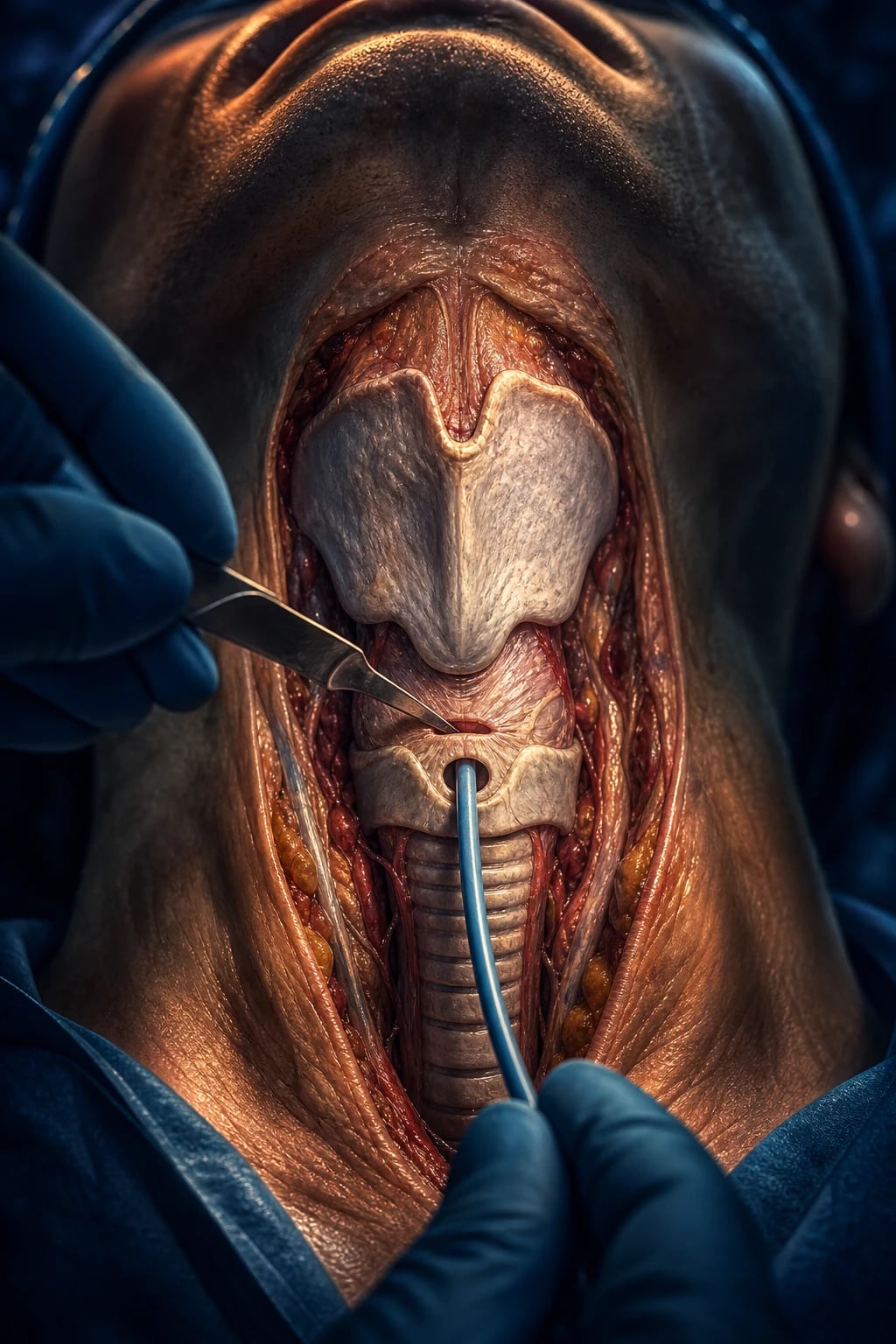
Step one — the laryngeal handshake. The operator identifies the cricothyroid membrane by palpation. The non-dominant hand performs the laryngeal handshake: the thumb and the middle finger grasp the thyroid cartilage at its superior cornua, the index finger slides down the anterior surface to feel the soft depression between the prominent thyroid cartilage above and the firm cricoid ring below — that depression is the cricothyroid membrane. The larynx is stabilised and fixed in the midline by the handshake, and the head is extended to bring the larynx forward. In the obese or the landmark-obscured neck, the membrane may be impalpable, and the section on the difficult neck sets out the rescue[3].
Step two — the stab incision. The operator makes a transverse stab incision through the skin and the cricothyroid membrane in a single motion, with the size 20 scalpel blade held vertically, midline, at the level of the membrane. The blade is advanced until it is felt to pop through the membrane into the airway, and the blade is kept in place — not withdrawn — to maintain the tract. The incision is transverse to avoid the anterior jugular veins that run longitudinally, and the single motion through skin and membrane is faster than the staged cut and more reliable[3][1].
Step three — turn the blade ninety degrees. The scalpel is rotated through ninety degrees to open the membrane transversely, creating the tract that will admit the bougie. The turn converts the stab into a short transverse slit, and the blade is held in the rotated position or the little finger is used to maintain traction on the slit while the bougie is fetched. Alternatively, a tracheal hook is inserted into the incision and the thyroid cartilage is lifted cephalad to hold the opening. The principle is that the tract is maintained — the blade or the hook is not withdrawn until the bougie is in place, because the withdrawal loses the tract and the field[3].
Step four — pass the bougie. The elastic bougie is advanced through the incision into the trachea, angled caudally (towards the carina, away from the pharynx). The intratracheal position is confirmed by the feel: the tip clicks over the tracheal rings as it advances, and there is a hold-up at the carina or a main bronchus when the bougie is advanced far enough. The hold-up and the clicks are the tactile confirmation that the bougie is in the trachea and not a false passage, and the bougie is held in place while the tube is railroaded[3].
Step five — railroad the endotracheal tube. A size 6.0 mm cuffed endotracheal tube is advanced over the bougie into the trachea, railroaded along the bougie through the incision and into the airway. The tube is rotated as it advances so the bevel does not catch on the membrane or the tracheal wall, and it is inserted to a depth that places the cuff within the trachea, typically five to six centimetres. The cuff is inflated, and the bougie is removed. The size 6.0 mm tube is chosen because it admits through the cricothyroid membrane and the cuff seals the airway; a larger tube tears the membrane and a smaller tube does not provide the seal[3][1].
Step six — confirm. The endotracheal tube is connected to the breathing circuit, and the position is confirmed by the continuous waveform capnography — the sustained carbon dioxide trace over several breaths is the only reliable proof that the tube is in the trachea and not a false passage. The chest is observed for the bilateral rise, the saturation is watched for the recovery, and the tube is secured. The confirmation is the same standard as at every other step of the algorithm: the capnography is mandatory, and the absence of the trace means a false passage and a re-siting of the tube[3].
The six steps are the irreducible core, and the simulation drills rehearse them until the sequence is automatic — because the audit found that the technique failed when the steps were improvised, the blade withdrawn, the bougie angled cephalad, or the tube too large. The disciplined sequence, performed the same way every time, is the answer to the failure, and the viva passes on the recitation of it in order and in detail[3][4].
Anatomical landmarks and the difficult neck
The cricothyroid membrane is the anatomical key to the technique, and the viva expects its landmarks and the rescue for the impalpable membrane set out in detail. The membrane is the fibroelastic sheet that spans the gap between the inferior border of the thyroid cartilage above and the superior border of the cricoid cartilage below, in the midline of the anterior neck. It is superficial (covered only by skin and thin fascia, a centimetre or two from the surface in the lean adult), avascular (free of the major vessels, which lie laterally), and palpable (the soft depression felt between the two firm cartilages). These properties are the reason the scalpel-bougie cricothyroidotomy is performed here and not at a higher tracheal ring[3].
The palpation is taught as the laryngeal handshake, and the viva expects the manoeuvre described. The thumb and the middle finger of the non-dominant hand grasp the thyroid cartilage at its superior cornua, stabilising the larynx and drawing it forward. The index finger slides down the anterior surface of the thyroid cartilage, over the prominent laryngeal prominence (the Adam's apple), and into the soft depression immediately below — the cricothyroid membrane. Below the membrane, the finger meets the firm, circumferential ring of the cricoid cartilage, and the contrast between the soft membrane and the firm rings above and below confirms the level. The handshake fixes the larynx in the midline and prevents it from sliding away during the incision[3].
The difficult neck is the obstacle the audit found most often defeated the cricothyroidotomy, and the rescue is a named part of the teaching. In the obese neck, the subcutaneous fat obscures the landmarks, and the membrane is impalpable to the handshake. In the fixed or distorted neck (the cervical ankylosis, the previous surgery, the radiation, the congenital syndrome), the larynx is rotated or tethered, and the midline is lost. In the oedematous or the bruised neck (the trauma, the prolonged prone surgery, the anaphylaxis), the tissue planes are obliterated. In each, the standard transverse stab, made blind, may miss the membrane and injure the vessels or enter a false passage[3][2].
The rescue for the impalpable membrane is the vertical exploratory skin incision. Where the membrane cannot be felt, the operator makes a vertical incision in the midline of the neck, from the laryngeal prominence downward, through the skin and the subcutaneous fat, and then palpates through the incision to find the membrane — the finger feels for the depression between the thyroid and the cricoid cartilages directly, unobstructed by the overlying fat. Once the membrane is identified by the palpation through the incision, the transverse stab through the membrane is made, and the scalpel-bougie sequence proceeds. The vertical skin incision preserves the midline (a transverse blind cut risks missing the level and the vessels) and allows the re-exploration if the first attempt fails, without multiplying the lateral incisions[3].
The ultrasound is the modern adjunct that has reduced the failure rate in the predicted difficult neck. Where the time and the equipment permit (the anticipated difficult airway, the pre-induction assessment, the intensive-care intubation), the ultrasound identifies the cricothyroid membrane before the induction and marks it on the skin, so that the CICO, if it occurs, is performed at the marked level without the search. The ultrasound is not available in the unanticipated CICO, and the technique does not depend on it, but the pre-procedural marking is the standard for the airway predicted to be difficult, and the contemporary literature has endorsed it for the obese and the landmark-obscured neck[3][1].
Confirmation and the post-FONA care
The confirmation of the cricothyroidotomy is by the continuous waveform capnography, and the standard is the same as at every other step of the airway algorithm: the sustained carbon dioxide trace over six or more breaths is the only reliable proof that the cuffed tube is in the trachea. The audit attributed deaths to the failure to use, or to trust, the capnography after the front-of-neck access — the team assumed the tube was in the airway because it was placed through the neck, and the false passage was unrecognised until the saturation did not recover. The capnography is mandatory, and the absence of the trace mandates the re-siting of the tube[3].
The supplementary confirmation supports the capnography but does not replace it. The bilateral chest rise on ventilation, the improving saturation, the tube misting, and the auscultation of the breath sounds are all supportive, but each is fallible in the crisis — the chest may rise with a false passage that ventilates the mediastinum, the saturation may be slow to recover in the profoundly hypoxaemic patient, and the auscultation is unreliable in the noisy emergency. The capnography alone is the standard, and the other signs are the corroborative, not the primary, confirmation[3].
The post-FONA care begins the moment the tube is confirmed. The patient is ventilated with a high inspired oxygen, the haemodynamics are resuscitated (the CICO is often the endpoint of a prolonged crisis with the acidosis, the hypotension, and the hypercarbia, and the post-hypoxic patient needs the cardiovascular and the metabolic support), and the team regroups. The definitive airway is then planned — the cricothyroidotomy is a rescue, and the patient is taken to the theatre or the intensive care unit for a formal surgical tracheostomy or a surgical revision of the cricothyroidotomy, performed by the surgeon in a controlled setting, once the patient is stable. The cricothyroidotomy is not left indefinitely; the formal airway replaces it within the hours[3][1].
The documentation and the debrief complete the care. The CICO event is reported to the departmental airway lead and to the national audit, the technique and the equipment are recorded in the anaesthetic record, and the team debriefs the event — the human factors, the timeline, the lessons — because the CICO is rare and the learning from each event is the substance of the departmental competency. The contemporary teaching is that the CICO is the crisis that the department reviews in the open, and the debrief is the mechanism by which the rare event is converted into the institutional learning[3][2].
Complications of the front-of-neck access
The complications of the scalpel-bougie cricothyroidotomy are the ones the viva expects the candidate to name, and they divide into the early and the late. The technique is performed in extremis, under the time pressure and the imperfect conditions of the crisis, and the complication rate is higher than the elective airway; the audit and the simulation have catalogued the failures and the teaching is built on the avoidance[3].
The early complications are the failures of the technique itself. Bleeding from the incision is the most common — the anterior jugular veins and the small vessels of the subcutaneous tissue bleed, and the bleeding is worse if the incision is off the midline or too lateral; the transverse midline incision and the vertical exploratory incision are the avoidance. The false passage — the tube or the bougie passes outside the trachea, into the mediastinum or the pre-tracheal tissue — is the failure of the membrane identification or the bougie angulation, and it presents as the absent capnography and the failure of the saturation to recover; the avoidance is the laryngeal handshake, the caudal bougie angle, and the capnographic confirmation. The laryngeal or the tracheal injury — the posterior tracheal wall perforation, the cricoid or the thyroid cartilage fracture, the recurrent laryngeal nerve injury — is the failure of the blade depth or the tube size; the avoidance is the controlled stab, the size 6.0 tube, and the rotation of the tube as it is railroaded[3][1].
The barotrauma — the tension pneumothorax, the surgical emphysema — is the complication of the failed needle cricothyroidotomy more than the scalpel-bougie, because the jet ventilation into a false passage or an obstructed upper airway drives the gas under pressure into the tissue planes. The scalpel-bougie technique, with a cuffed tube that vents the exhalation, is far less prone to the barotrauma, and this is one of the reasons it displaced the needle technique. The tension pneumothorax, if it occurs, is recognised by the hypoxaemia, the hypotension, and the asymmetric chest rise, and it is decompressed by the immediate needle thoracostomy in the second intercostal space[3].
The late complications are the sequelae of the airway injury. The subglottic stenosis — the narrowing of the airway at the cricothyroid level, from the cartilage injury and the scarring — presents in the weeks to the months after the event, in the patient who survives, and it is the reason the cricothyroidotomy is converted to a formal tracheostomy and the reason the technique is performed through the cricothyroid membrane and not at a higher tracheal ring (the cricoid is the only complete ring, and its injury stenoses the airway). The voice change and the swallowing difficulty — from the recurrent laryngeal nerve or the laryngeal injury — are the long-term morbidity the follow-up assesses. The contemporary series document the complication profile and the long-term outcome, and the teaching is that the technique, performed correctly, has a lower complication rate than the perception of the crisis suggests[3][2].
Human factors: the cognitive barrier to the cut
The front-of-neck access is decided as much by the human factors as by the technique, and the audit found that the cognitive barrier to the act — not the technical deficiency — was the recurring cause of the delay. The CICO is the moment the anaesthetist must cut the neck of a patient who may be awake to the prospect, and the reluctance to perform the irreversible act, the hope that one more attempt at the laryngoscopy will succeed, and the fear of the error are the cognitive failures that held the scalpel back while the saturation fell[3][1].
The crisis resource management, applied to the CICO, is the set of named steps that overcomes the cognitive barrier. Call for help early — the call that goes out the moment the airway is not straightforward, not when the CICO is declared, so that the senior and the surgical help is at the bedside when the act is needed. Assign the roles — the operator who performs the cricothyroidotomy, the assistant who fetches the kit and holds the bougie, the person who draws and gives the drugs, the timekeeper who calls the saturation and the time since the CICO was declared. Communicate aloud — the declaration of the CICO, the closed-loop confirmation that the scalpel is to be used, the verbalisation of each step of the sequence as it is performed. Use the checklist — the DAS algorithm or the Vortex card on the wall, read aloud, so that the team is held to the structure and the steps are not missed[3][2].
The two cognitive failures the training targets are the fixation error and the authority gradient, and both are acute in the CICO. The fixation error is the perseveration on the non-surgical technique — the fourth laryngoscopy, the repeated supraglottic insertion — while the saturation falls into the irreversible range; the correction is the declared cap on the attempts and the forced move to the front-of-neck access the moment the cap is reached. The authority gradient is the failure of the junior team member to voice the CICO or the senior to hear it; the correction is the explicit invitation to challenge, the closed-loop communication, and the named authority of any team member to declare the endpoint. The audit found that the CICO was often recognised late because the junior could not voice it or the senior would not hear it, and the modern training drills the open declaration as the antidote[3][1].
The simulation is the mechanism by which the cognitive barrier is reduced, and the post-NAP4 teaching has made the FONA simulation a mandatory part of the anaesthetic training. The drill rehearses the declaration of the CICO, the call for the kit, the scalpel-bougie sequence, and the confirmation, on a manikin or a synthetic tissue model, until the act is automatic and the cognitive barrier is lowered by the familiarity. The literature on the simulation is consistent: the clinicians who drill the FONA perform it faster, more correctly, and with less hesitation in the simulated CICO, and the departments that mandate the regular simulation report the better outcomes in the rare real events. The CICO is the crisis that the simulation prepares for, because the clinician may perform it once in a career and the act cannot be learned for the first time on the patient[4][5].
Training, simulation, and maintenance of competency
The maintenance of the FONA competency is a named challenge of the airway teaching, because the technique is performed so rarely on the patient that the skill decays between the events. The audit found that the cricothyroidotomy was performed too rarely for the competency to be maintained by the clinical exposure alone, and the contemporary answer is the regular, structured simulation that rehearses the technique and the cognitive sequence on a scheduled basis[4][5].
The simulation modalities span the fidelity range. The manikin-based drill rehearses the sequence on a low-cost, widely available model — the declaration, the kit, the scalpel-bougie-tube, the confirmation — and it is the standard for the departmental competency check. The synthetic tissue model and the animal tissue models add the tactile fidelity — the pop of the membrane, the resistance of the tissue, the bleeding — and they are the standard for the higher-fidelity training. The in situ simulation — the drill run in the operating theatre or the emergency department, with the team and the equipment of the real event — rehearses the human factors and the system factors (the location of the kit, the communication, the roles) alongside the technique, and it is the modality that catches the latent errors the laboratory simulation misses[5][4].
The frequency of the refresher is the subject of the competency literature, and the consensus is that the FONA skill decays within months without the rehearsal, so the regular, scheduled simulation — quarterly or at least annually, for every anaesthetist and emergency physician — is the standard. The departments that mandate the regular simulation report the higher first-attempt success rates in the rare real events, and the contemporary airway curricula have made the FONA simulation a core, assessed competency, not an optional extra. The end-tidal oxygen and the preoxygenation metric, examined in the related suite, is the other arm of the safety — the measured preoxygenation that buys the time the front-of-neck access runs in[4][5].
The prehospital and the emergency-department CICO is the special case that the training addresses. The CICO in the prehospital setting — the trauma, the trapped patient, the prehospital anaesthesia — is performed by the prehospital physician or the paramedic, with the constrained equipment and the smaller team, and the contemporary series on the maintenance of the prehospital anaesthesia document the role of the structured, rehearsed FONA in the austere setting. The teaching is that the FONA competency is the same across the settings — the scalpel-bougie sequence, the cognitive discipline — and the simulation that maintains it is the standard for the anaesthetist, the emergency physician, and the prehospital provider alike[5][3].
Special contexts: paediatrics, obesity, and the physiological CICO
The CICO in the special contexts tests the application of the core principles, and the viva examines the modifications. The paediatric CICO is the modification of the technique: the cricothyroid membrane is small, the formal surgical airway is technically harder, and the narrow-bore cannula (the needle cricothyroidotomy) retains a role in the younger child, where it is the recommended rescue. The paediatric airway algorithms (the APAGBI and the equivalent) specify the age and the size thresholds at which the scalpel technique supplants the needle, and the viva expects the candidate to know that the adult default does not apply below the threshold. The scalpel-bougie technique is the rescue in the older child and the adolescent, performed with the appropriately sized tube[3][2].
The obese CICO is the context the audit found most challenging, and the modifications are the vertical exploratory incision, the pre-procedural ultrasound marking, and the recognition that the standard needle cricothyroidotomy will fail. The obese neck obscures the landmarks, the safe apnoea period is shortened by the reduced functional residual capacity and the high oxygen consumption, and the patient reaches the CICO faster and tolerates it less. The pre-induction ultrasound marking of the cricothyroid membrane is the standard for the obese patient predicted to have a difficult airway, and the scalpel-bougie sequence, with the vertical incision if the membrane is impalpable, is the rescue. The candidate who defaults to the needle in the obese adult has chosen the technique most likely to fail[1][3].
The physiological CICO is the conceptual advance of the recent emergency and critical-care literature, and it is the discriminating detail that separates the pass from the distinction. The CICO may be reached not because the anatomy is difficult but because the physiology is hostile — the patient is hypoxaemic, shocked, acidotic, or vasodilated, and the apnoea of the induction and the vasodilation of the agent push the patient into the cardiovascular collapse and the hypoxic injury faster than the algorithm runs. The recognition reshapes the management: the preoxygenation is maximal and measured (the end-tidal oxygen is the metric), the induction is modified (ketamine preferred, the dose reduced, the vasopressor delivered with the induction), and the declaration of the CICO is faster because the safe apnoea period is measured in seconds, not minutes[1][4].
The syndromic and the neuromuscular difficult airway — exemplified by the spinal muscular atrophy and the congenital syndromes — combines the anatomical distortion with the physiological fragility, and the CICO in these patients is the crisis that the anticipation is meant to prevent. The contemporary series document the anaesthetic care and the airway management that these patients require across the lifespan, and the teaching is that the anticipated difficult airway, managed with the awake technique or the planned surgical airway, is the strategy that keeps the patient out of the CICO. Where the CICO occurs in the syndromic patient, the scalpel-bougie sequence applies, with the modification that the anatomy may be distorted and the landmarks impalpable, and the vertical incision and the ultrasound are the rescue[2].
The regional anaesthetic alternative is the strategy that removes the airway from the operative plan for a subset of the surgical indications, and the contemporary literature on the fascial plane blocks documents their role in providing the abdominal-wall analgesia that makes the surgery feasible under the regional or the combined technique. The erector spinae plane and the transversus abdominis plane blocks provide the analgesia for a range of the abdominal and the thoracic surgery and the trauma, with the difficult airway plan held in reserve rather than deployed. The regional technique is not the answer to the CICO — the airway plan is still required — but it is the strategy that reduces the number of the patients exposed to the difficult airway in the first place, and it is part of the contemporary difficult-airway teaching[6].
Clinical
- Standard approach
- Evidence-based
Alternative
- Modified technique
- Risk-benefit
Red flags
[1] [1] [1] [1] [1]References
- [1]Ghaffar S, et al. Physiological difficult airway management in the emergency department J Pak Med Assoc, 2026.PMID 42363338
- [2]Black KM, et al. Anesthesia Care, Complications, and Airway Management for Patients With Spinal Muscular Atrophy: A Retrospective Chart Review From a Quaternary Children's Hospital Anesth Analg, 2026.PMID 42363899
- [3]Freund Y, et al. Improving the safety of emergency tracheal intubation Curr Opin Crit Care, 2026.PMID 42170830
- [4]Caputo ND, et al. End Tidal O(2): A Promising New Metric for Optimizing Preoxygenation and RSI Safety in the Emergency Department Acad Emerg Med, 2026.PMID 42340046
- [5]Sheridan B, et al. Maintenance of prehospital anaesthesia using an intermittent bolus regime in blunt trauma patients with a high GCS and hemodynamic reserve: a retrospective cohort study Scand J Trauma Resusc Emerg Med, 2026.PMID 42351216
- [6]Merchant N, et al. Comparing the analgesic utility & safety of erector spinae plane block versus thoracic epidural for multiple rib fracture trauma: a retrospective cohort analysis Injury, 2026.PMID 42361789