Anaes · Depth of anaesthesia & awareness
Depth of anaesthesia: processed EEG, BIS and entropy
Also known as Depth of anaesthesia monitoring · Processed EEG · Bispectral index · BIS monitoring · Entropy monitoring · Anaesthetic depth
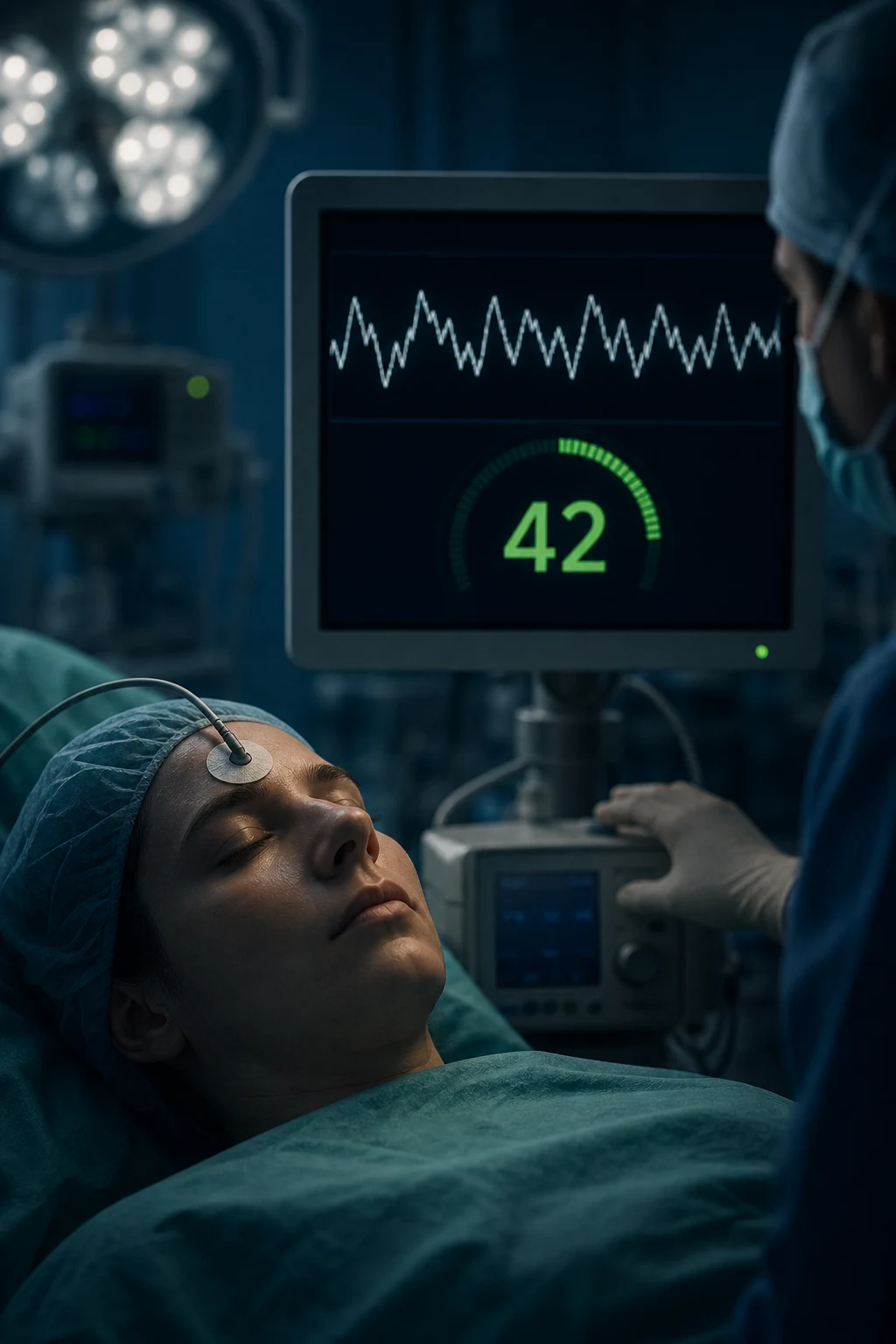
Processed electroencephalogram monitors — the bispectral index (BIS), spectral entropy and related indices — estimate the depth of anaesthesia by quantifying the shift of the frontal EEG from fast, low-amplitude awake activity to slow, high-amplitude, synchronised anaesthetic activity. They reduce the risk both of awareness and of overdose, but only when the dimensionless index is read alongside the raw trace and the clinical signs, because each is confounded by age, electromyographic activity, electrocautery and paradoxical excitation.
On this page & tools
Your progress
Saved locally on this device.
8 MCQs with explanations
Target exams
Red flags

Overview
Depth of anaesthesia is the balance between the risk of too little (awareness, explicit recall of surgery) and too much (haemodynamic and respiratory depression, delayed emergence, and the harm of overdose), and for two decades processed electroencephalogram monitors have aimed to quantify it[1]. The bispectral index (BIS), spectral entropy and their cousins reduce the frontal EEG to a dimensionless number that estimates cortical anaesthetic effect, and the case for making such brain monitoring routine has grown with the recognition that clinical signs alone are unreliable[2]. The index is a guide, not a guarantee: it must be read with the raw trace and the patient, because it is confounded by age, muscle activity, electrical interference and the specific agent used[3][5].
Why monitor depth
Anaesthetic depth was judged for decades by clinical signs — movement, the eyelash reflex, the blood-pressure and heart-rate response to stimulus — but these are indirect and unreliable, particularly under neuromuscular blockade[1][2]. Underdosing risks awareness with explicit recall, a devastating complication, and was the focus of the NAP5 report; overdosing risks haemodynamic collapse, delayed emergence and, in vulnerable patients, harm from prolonged deep anaesthesia[1]. A depth monitor gives an independent, continuous estimate of cortical effect that lets the anaesthetist titrate to the individual rather than to a population average, and the argument that processed-EEG monitoring should be a standard of care rests on closing this gap[2].
The raw EEG during anaesthesia
The unprocessed frontal EEG changes in a predictable sequence as anaesthesia deepens[1][6]. The awake trace is fast, low-amplitude, desynchronised beta and alpha activity; as sedation gives way to surgical anaesthesia the trace slows and grows in amplitude, with dominant theta and then delta activity and spindles; at deep planes, burst suppression (alternating bursts of activity and flat periods) appears, and at the deepest level the trace becomes isoelectric. The processed index is built to mirror this progression: high numbers for the awake, fast trace, mid-range numbers for the slow, synchronised surgical plane, and low numbers for suppression[1]. The value of watching the raw trace is that it shows the actual cortical state and the artefacts the index may conceal.
The processed-EEG index and how it is derived
The bispectral index combines several sub-parameters of the EEG — including the power spectrum, the bispectrum (phase coupling between frequency components), and the beta ratio — into a single dimensionless number from zero (cortical silence) to one hundred (fully awake)[1][6]. Spectral entropy takes a different route, quantifying the irregularity or complexity of the EEG (and, in some devices, the facial electromyogram) and reporting state and response entropy values that fall as the trace becomes more regular under anaesthesia[4][6]. Comparative analyses show the various indices track the same underlying cortical change and are broadly correlated, though they differ in detail and in their response to specific agents and artefacts[6].
The dimensionless index and the surgical range
A BIS of roughly forty to sixty, or an equivalent entropy range, is widely taken to represent an adequate depth for surgical anaesthesia, with values above suggesting lightening and risk of awareness and values below suggesting deep anaesthesia and suppression[1][4]. These ranges are population averages, not thresholds: the right value for an individual is the lowest that produces an adequate depth (no movement or haemodynamic response, an acceptable raw trace) and the highest that avoids suppression, titrated continuously[1]. The index is a continuous guide to titration, used to deepen before stimulus and to lighten as the stimulus recedes, rather than a pass-or-fail number.
Reading the raw trace alongside the index
The single most important habit is to read the index with the raw trace, not instead of it[2][6]. A sudden rise in the index is checked against the trace: a return of fast beta activity with a patient who is moving supports true lightening, whereas a high-frequency artefact from electromyographic activity or electrocautery explains a falsely high index with a slow, deep raw trace. Burst suppression on the trace signals overdose even if the index is in range, and an isoelectric trace demands immediate reduction of the anaesthetic[1]. The trace is the ground truth that disciplines the number.
Clinical use and endpoints
In practice the index guides titration of volatile or intravenous anaesthetic toward a target range, paired with the haemodynamic state and the surgical stimulus[1][5]. During TIVA it is the feedback that closes the loop between the pump's predicted concentration and the patient's actual depth, and it is essential whenever the prediction is unreliable (the elderly, the obese, the critically ill, hypothermia, high-dose or atypical drug)[5]. The endpoints of titration are an index in the surgical range, an appropriate raw trace, no movement or sympathetic response to stimulus, and haemodynamic stability — never the index alone[1].
BIS, entropy and the differences between indices
BIS and entropy differ in their derivation and their responsiveness. Entropy reports a state entropy (over the dominant EEG band) and a response entropy (incorporating higher-frequency facial electromyographic activity, which can give an earlier warning of lightening), and entropy monitoring during propofol sedation produces recognisable sedation profiles[4]. BIS combines spectral and bispectral features and a beta ratio, and its value is independently associated with age, sex and ASA physical status — older patients, for example, show lower bispectral-index values at an equivalent anaesthetic concentration — so the absolute number must be interpreted relative to the individual's baseline[3]. The indices are broadly interchangeable for routine use, and the choice is less important than the habit of reading the index with the trace[6].
Confounders and limitations
Every processed index is confounded, and knowing the confounders is the point of the topic[3][6]. Electromyographic activity from the frontalis raises the index toward the awake range; electrocautery, pacemakers and a displaced or poorly applied sensor distort it; and paradoxical excitation can raise the index during deepening anaesthesia, misleading an operator into thinking the patient is light[6]. The index under-reads with agents that increase fast cortical activity, classically ketamine and nitrous oxide and high-dose opioid, so a "normal" index with these agents does not exclude deep anaesthesia[1]. Children, the elderly and the neurologically injured have age- and disease-specific traces that the adult-derived algorithms approximate poorly, reinforcing the need to watch the raw trace[3].
Impact on awareness and outcome
Depth monitoring reduces the incidence of awareness when applied to high-risk patients and TIVA, where end-tidal anaesthetic concentration cannot be measured, and it reduces anaesthetic consumption and supports earlier emergence[1][2]. It does not eliminate awareness — explicit recall has occurred with an index in the surgical range — because the index estimates cortical effect imperfectly and awareness is not purely a cortical phenomenon[1]. The honest framing is that processed EEG reduces, but does not abolish, the risk, and it does so only when used as one input among several rather than as a guarantee[2].
Making processed EEG routine
The contemporary argument is for processed-EEG monitoring to move from a selective to a routine tool, on the grounds that clinical signs are unreliable, awareness remains possible, and the cost and simplicity of the technology no longer justify its selective use[2]. Future directions include closed-loop titration that feeds the index back to the anaesthetic delivery, multimodal indices that combine EEG with other signals, and the routine teaching of raw-EEG interpretation to anaesthetists so that the trace, not just the number, becomes part of everyday practice[1][2].
Clinical
- Standard approach
- Evidence-based
Alternative
- Modified technique
- Risk-benefit
Red flags
References
- [1]Yu H, et al. Depth of anesthesia monitoring: Current evidence, clinical impact, and future directions J Int Med Res, 2026.PMID 42333677
- [2]Berger-Estilita J, et al. Making brain monitoring routine: why processed EEG monitoring should be standard practice J Clin Monit Comput, 2026.PMID 42247119
- [3]Aasheim A, et al. Association of Age, Sex and ASA Physical Status With Bispectral Index Values During General Anaesthesia: A Large Observational Cohort Study Acta Anaesthesiol Scand, 2026.PMID 42289314
- [4]Popovici SE, et al. EEG-Derived Entropy Monitoring During Propofol Sedation for ERCP: Sedation Profiles, Age-Related Effects, and Implications for Procedure-Specific Target Ranges Medicina (Kaunas), 2026.PMID 42356061
- [5]Taplin CF, et al. The quest for real time propofol monitoring: a review Anaesth Intensive Care, 2026.PMID 42290030
- [6]Vakitbilir N, et al. Comparative analysis of processed EEG indices and entropy-based metrics for assessing anesthetic depth: a scoping review - PRISMA-ScR BMC Biomed Eng, 2026.PMID 42098835