Anaes · Extubation & recovery
Recovery and the post-anaesthesia care unit
Also known as Post-anaesthesia care unit · PACU · Recovery room · Postoperative recovery · Aldrete score · Phase I recovery
Exam-pass PACU hub: structured SBAR handover, continuous monitoring, airway obstruction and hypoxaemia, emergence hypertension/hypotension, Apfel PONV prophylaxis, shivering, OSA-safe recovery, emergence delirium, and Aldrete/PADSS discharge criteria for ANZCA Final and equivalents.
On this page & tools
Your progress
Saved locally on this device.
8 MCQs with explanations
Target exams
Red flags
Why this is examined / the one-line answer
Recovery is where fellowship candidates fail the “soft” stem: they can intubate, but they cannot prioritise the first five minutes in PACU or state discharge criteria without waffle. Examiners want handover content, the common problem bank (airway, hypoxaemia, BP, pain, PONV, shiver, delirium, bleeding), OSA/obesity disposition, and Aldrete by name.[1]
One-liner: I hand over structured and stay until the first observations are stable; I treat airway and oxygenation first; I reverse residual NMB and titrate opioids carefully; I prevent PONV using Apfel risk; I warm and treat shivering; and I discharge only when activity, respiration, circulation, consciousness and saturation meet criteria. [1]
Arrival and structured handover
Use SBAR (or equivalent local tool). Do not leave until SpO2, ECG, NIBP, and airway patency are confirmed. [1]
| SBAR element | Must include |
|---|---|
| Situation | Name, age, procedure, urgency, destination plan (ward/HDU/day-case) |
| Background | Allergies, ASA, comorbidities (OSA/CPAP, cardiac, difficult airway letter), fasting, infection risk |
| Assessment | Anaesthetic technique, airway events, NMB + quantitative TOF ratio, opioids, antiemetics, blood loss/fluids, drains, regional catheters, last antibiotic |
| Recommendation | Pain plan, rescue drugs, CPAP restart, who to call, red-flag observations |
First actions on bay arrival: jaw/airway check → oxygen → monitors on → temperature → surgical site/drain glance → pain and nausea scores when conscious enough. [1]
Monitoring in PACU (phase I)
Continuous pulse oximetry, ECG, intermittent NIBP (continuous/arterial if unstable), respiratory rate and pattern, conscious level, temperature, pain and nausea scores, urine output when relevant, drain/wound check. Capnography for the deeply sedated, high-risk OSA, or residual airway concern. Frequency is highest in the first 15–30 minutes. [1]
Airway and oxygenation — the pass/fail spine
Common mechanisms: tongue obstruction in the semi-conscious patient, laryngospasm, secretions/blood, residual neuromuscular block, opioid hypoventilation, atelectasis, diffusion hypoxia after N2O, negative-pressure pulmonary oedema after obstruction relief, aspiration, rarely PE or cardiogenic oedema. [1]
Immediate response ladder: [1]
- Call help if deteriorating; 100% O2; jaw thrust / chin lift; oral or nasal airway if tolerated; sit up if safe.
- Suction under vision; treat laryngospasm (CPAP, deepen if needed, sux if refractory — same ladder as theatre).
- Quantitative NMM if any doubt of residual block → sugammadex or neostigmine per agent.
- Titrate naloxone for opioid-driven hypoventilation (small increments; reverse pain carefully).
- Escalate oxygen delivery (HFNO/NIV/CPAP) if simple O2 fails; return to theatre/ICU if airway remains unsafe.[3]
Supplemental oxygen treats hypoxaemia but masks hypoventilation — always pair SpO2 with respiratory rate and conscious level. [1]
Haemodynamic problems
Hypotension: residual volatiles/propofol, hypovolaemia/bleeding, neuraxial sympathectomy, anaphylaxis (late), cardiac event, PE. Treat cause: fluids, vasopressors, blood products, surgical review, ALS if needed. [1]
Hypertension / tachycardia on emergence: pain, anxiety, full bladder, hypercarbia, hypoxia, pre-existing HTN rebound, residual hypercarbia, awareness aftermath. Drain the bladder and give analgesia before pure antihypertensives unless there is clear cardiac risk (e.g. aneurysm, cardiac ischaemia). [1]
Arrhythmias: treat unstable rhythms per ALS; search for hypoxia, electrolytes, ischaemia, drugs. [1]
Pain
Multimodal baseline (paracetamol ± NSAID if safe, regional/local already in, opioid breakthrough). Score regularly. Uncontrolled pain drives hypertension, atelectasis, and delirium. For OSA/obesity: avoid background opioid infusions; prefer regional and non-opioid first-line. [1]
PONV — Apfel and treatment
Apfel simplified score (0–4): female sex, non-smoker, history of PONV/motion sickness, postoperative opioids. Risk of PONV rises roughly ~10% / ~20% / ~40% / ~60% / ~80% across scores 0–4 (classic teaching bands).[2]
Prophylaxis: high-risk → multi-modal (e.g. 5-HT3 antagonist + dexamethasone ± second class). Rescue with a different class if prophylaxis failed. Opioid-sparing technique is prevention, not decoration. [1]
Shivering and hypothermia
Hypothermia impairs coagulation, drug clearance, and comfort; shivering multiplies VO2 and can stress the ischaemic heart. Active forced-air warming is first-line. Pharmacological options for refractory shiver include pethidine (meperidine), tramadol, clonidine, or dexmedetomidine (comparative evidence with pethidine exists — quote local protocol).[5] Prevention starts in theatre with temperature monitoring.
Emergence delirium and agitation
Common in preschool children (sevoflurane/ENT) and elderly. Differential: pain, hypoxia, full bladder, residual anaesthetic, stroke, awareness, hypoglycaemia. Protect from self-harm, treat reversible causes, quiet reorientation, parent present for children when safe. Pharmacological rescue (small propofol, dexmedetomidine, or carefully chosen antipsychotic in adult hyperactive delirium) only after ABCs. Overlap with postoperative delirium risk in the elderly (age, cognitive impairment, polypharmacy, pain). [1]
Special groups
| Group | PACU emphasis |
|---|---|
| OSA / obesity | Sit up, restart CPAP, full NMB reversal (TOF ≥0.9), light opioid, monitored bed if high risk |
| Difficult airway | Difficult-airway trolley at bedside until fully awake; low threshold reintubation plan |
| Elderly | Delirium, hypotension, hypothermia, opioid sensitivity |
| Day-case | PADSS pathway: walk, dress, oral intake, escort home, voiding per local policy |
| Neonate/child | Rapid desaturation; laryngospasm readiness; ED vs pain; NAP7 context for neonatal risk culture.[4] |
| Neuraxial | Sensory/motor recovery trajectory, hypotension, urinary retention, PDPH later |
Aldrete score and discharge criteria
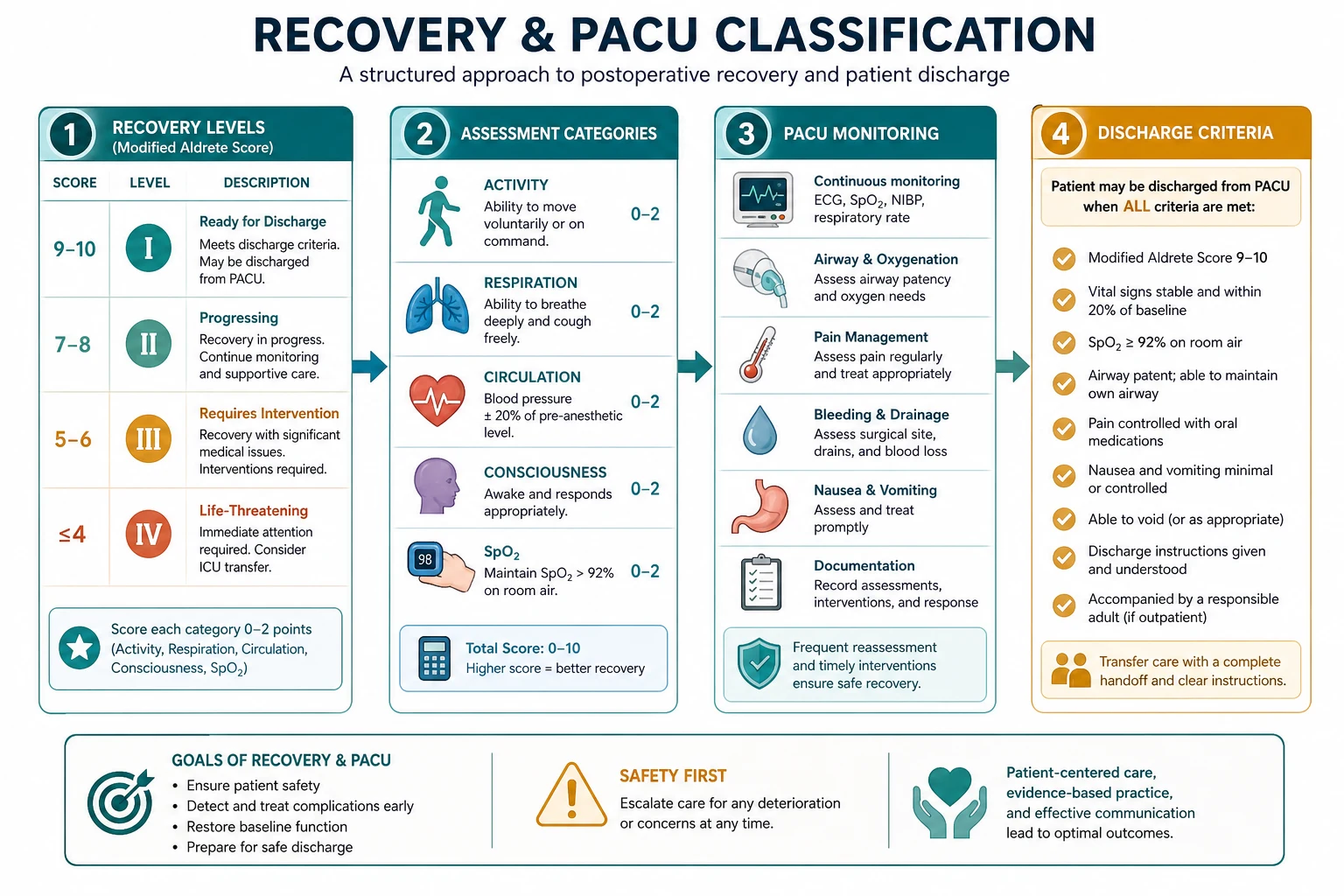
Modified Aldrete (phase I) scores five domains 0–2 each (max 10): activity, respiration, circulation, consciousness, SpO2. Classic discharge threshold ≥9 with no single domain failing safety.[1]
Also require: controlled pain and PONV, no active surgical bleeding, temperature acceptable, drains/lines secured, written plan and receiving-ward capacity. [1]
Phase II / day-case (PADSS-style): ambulatory ability, oral fluids tolerated (where required), responsible escort, written advice, voiding if high-risk retention (neuraxial/hernia — institutional). [1]
Crisis pivots (PACU)
- Complete airway obstruction — open airway, suction, CPAP, reintubate early if needed.
- Suspected residual NMB — quantitative TOF, reverse fully, support ventilation.
- Opioid apnoea — naloxone titrated, airway support, review PCA settings.
- Anaphylaxis in recovery — adrenaline IM/IV per ALS, stop infusions, fluids, call help.
- Post-obstructive pulmonary oedema — sit up, O2/CPAP, diuretic selective, investigate airway event.
- Bleeding / hypovolaemic shock — call surgeon, bloods, MTP if massive, return to theatre.
- Chest pain / ST change — O2, ECG, ASA pathway, cardiology.
- High spinal late presentation — ABC, vasopressors, airway if needed. [1]
Regional practice deltas
ANZ. Aldrete or local PACU score systems; metaraminol common for residual neuraxial hypotension; CPAP restart for OSA is expected language. HDU criteria should be decided before leaving theatre for high-risk OSA/obesity.
SAQ answer scaffold
A 62-year-old after laparoscopic cholecystectomy arrives in PACU SpO2 88% on oxygen, RR 6, TOF not documented. Outline your management. [1]
- ABC: call help, 100% O2, open airway, assist ventilation, monitors, ABG if severe.
- Cause stack: residual NMB (check TOF → reverse), opioid (naloxone titrate), obstruction, atelectasis, pneumothorax, aspiration.
- Disposition: do not discharge until reversed, awake, SpO2 stable; consider HDU if high opioid need/OSA.
- System: document, debrief list practice on quantitative NMM and handover. [1]
Viva stem bank and model phrases
Stem 1: “What is in your PACU handover?”
Model: “SBAR covering airway events, NMB and TOF, opioids, antiemetics, blood loss, comorbidities including OSA/CPAP, and a clear recommendation for destination and rescue.” [1]
Stem 2: “Aldrete components?”
Model: “Activity, respiration, circulation, consciousness, oxygen saturation — aim ≥9 with no unsafe domain before phase I discharge.”[1]
Stem 3: “Apfel score?”
Model: “Female, non-smoker, prior PONV/motion sickness, postoperative opioids — each point raises risk; high scores get multi-modal prophylaxis.”[2]
Stem 4: “OSA patient in recovery desaturates when nurse leaves the bay.”
Model: “Classic obstruction after stimulation stops: jaw thrust, sit up, oxygen, restart CPAP, review residual block and opioids, keep monitored.” [1]
Stem 5: “Hypertensive emergence — first steps?”
Model: “Exclude hypoxia/hypercarbia, treat pain, empty bladder, then consider antihypertensives if still high and at risk.” [1]
Stem 6: “When do you refuse ward discharge?”
Model: “Unstable vitals, incomplete reversal, uncontrolled pain/PONV, bleeding, severe OSA without CPAP plan, or no safe nursing destination.” [1]
Common traps
- Leaving bay before first observations confirmed
- Oxygen without assessing respiratory rate (hidden hypoventilation)
- No quantitative NMM after intermediate/long-acting NMB
- Stacking ondansetron on failed ondansetron instead of switching class
- Treating numbers (BP) without pain/bladder/bleeding search
- Sending high-risk OSA to a dark remote ward on morphine PCA with background
- Discharging day-case without escort [1]
PACU — first-minute priorities
Examiner mental map
- Handover content (SBAR).
- Airway/hypoxaemia ladder including residual NMB and opioid.
- Haemodynamics — treat cause.
- Apfel PONV + multi-modal.
- Shiver/warm; delirium protect.
- Aldrete/PADSS + right destination (ward vs HDU). [1]
Hit those six without waffle and the recovery viva is passed. [1]
Red flags
[1] [1] [1] [1]References
- [1]Aldrete JA The post-anesthesia recovery score revisited J Clin Anesth, 1995.PMID 7772368
- [2]Apfel CC, Läärä E, Koivuranta M, Greim CA, Roewer N A simplified risk score for predicting postoperative nausea and vomiting: conclusions from cross-validations between two centers Anesthesiology, 1999.PMID 10485781
- [3]Weingart SD, Levitan RM Preoxygenation and prevention of desaturation during emergency airway management Ann Emerg Med, 2012.PMID 22050948
- [4]Cook TM, Armstrong RA, Oglesby F NAP7: high mortality risk in neonates and very low risk in children Br J Anaesth, 2025.PMID 39645515
- [5]Kim JW, et al. Comparative effectiveness of dexmedetomidine and meperidine for the treatment of postanesthetic shivering: a propensity score-matched retrospective cohort study BMC Anesthesiol, 2026.PMID 42363066