Anaes · TIVA & target-controlled infusion
TIVA & target-controlled infusion (TCI)
Also known as TIVA · TCI · Propofol infusion · Marsh model · Schnider model · Effect-site targeting · Remifentanil TCI
Exam-exhaustive TIVA/TCI: plasma vs effect-site targeting, Marsh vs Schnider at high level without fake constants, awareness risk and syringe safety, when TIVA is preferred (MH, neuromonitoring, laser airway), and practical pump discipline.
On this page & tools
Your progress
Saved locally on this device.
Target exams
Red flags
Why this is examined / one-line answer
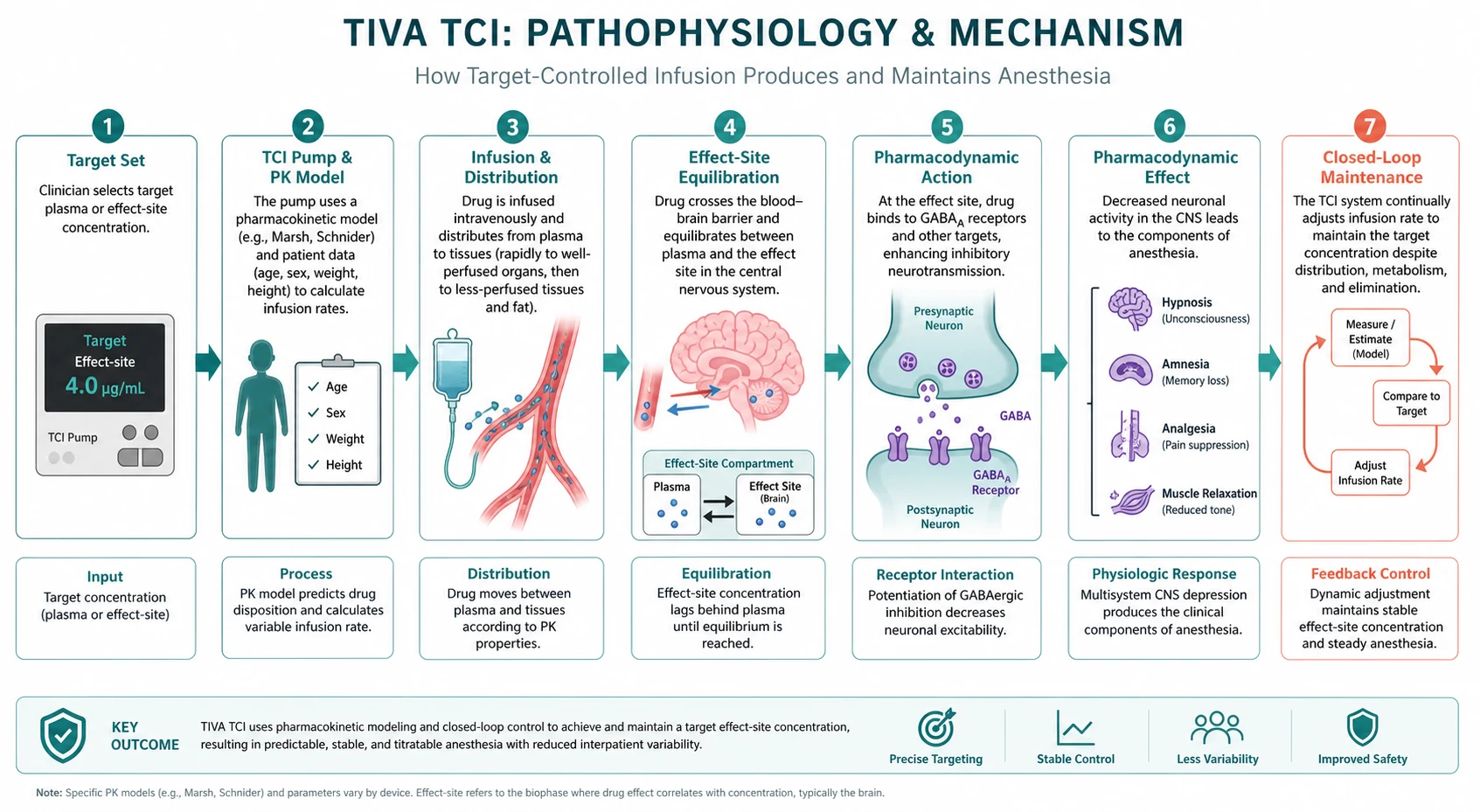
TIVA/TCI is core fellowship material because it combines pharmacokinetics, equipment safety, and awareness prevention. Examiners want plasma vs effect-site, Marsh vs Schnider at conceptual level, when TIVA is preferred, and ruthless syringe/pump discipline. One-liner: I use a validated TCI model with effect-site or plasma targets I can defend, run propofol–opioid infusions through dedicated checked lines, monitor processed EEG because there is no ET agent, and I never leave a pump unattended behind a drape. [1]
Definitions
- TIVA: general anaesthesia maintained solely with IV agents (typically propofol ± opioid ± adjuncts); no volatile/N2O.
- Manual TIVA: mg/kg/h or microg/kg/min infusions without a PK model.
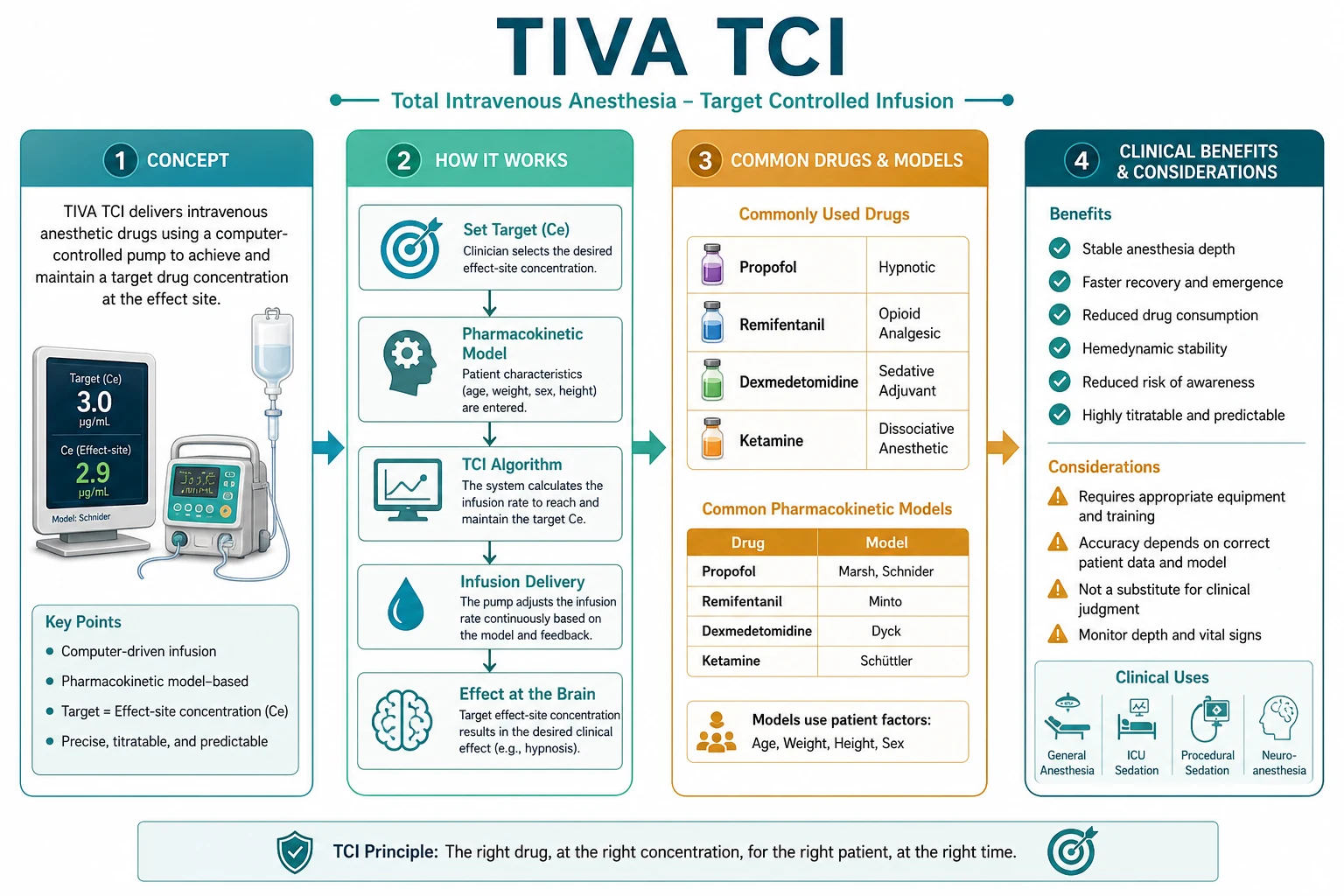
- TCI: pump calculates boluses and variable rates to achieve a target concentration using a pharmacokinetic model.
- Plasma (Cp) targeting: aims at calculated plasma concentration.
- Effect-site (Ce) targeting: aims at concentration at the effect site (brain); uses a ke0 equilibration constant so the pump drives plasma higher briefly to speed onset. [2]
Compartment model (high-level)
Three-compartment teaching model for propofol:
- V1 central (plasma / vessel-rich)
- V2 rapid peripheral (muscle)
- V3 slow peripheral (fat)
- Clearance from V1 (hepatic for propofol; non-specific esterases for remifentanil)
- Intercompartmental clearances Q2, Q3 [3]
TCI solves “what infusion rate keeps Cp or Ce at target?” You do not need to recite every published micro-constant in a clinical viva — you need the concepts and the unit’s licensed model. [1]
Propofol models — Marsh vs Schnider (conceptual)
| Feature | Marsh | Schnider |
|---|---|---|
| Covariates | Primarily weight | Age, height, weight, lean body mass |
| Typical use | Classic plasma targeting; simple | Common for effect-site targeting |
| Age adjustment | Limited | Yes — elderly need lower targets |
| Obesity caveat | Weight choice matters | LBM formulae can misbehave at extremes — follow unit obesity rules |
| Clinical note | Still widely available | Often preferred when Ce targeting used |
Eleveld and paediatric models (Paedfusor, Kataria) appear in modern pumps — say “I use the model my pump is validated/configured for and I understand its limits.” [3]
Do not invent numeric V1 or ke0 values unless you are certain — wrong constants are worse than conceptual honesty. State: I use Schnider effect-site targeting per unit protocol; induction Ce often ~4–6 microg/mL, maintenance ~2.5–4 microg/mL titrated to pEEG and stimulus, reduced in elderly/frail. [1]
Remifentanil TCI
- Common model: Minto (age, weight, height, LBM).
- Teaching effect-site targets: sedation ~1–3 ng/mL; GA analgesia often ~3–8 ng/mL depending on stimulus — titrate.
- Context-sensitive half-time remains short (~3–5 min) even after long infusions.
- Hyperalgesia and acute tolerance possible after high-dose prolonged infusions — plan morphine/oxycodone/fentanyl transition before stopping remifentanil.
- Chest wall rigidity with high boluses — careful in spontaneous ventilation. [2]
Plasma vs effect-site — decision language
| Plasma (Cp) | Effect-site (Ce) | |
|---|---|---|
| What you set | Calculated plasma | Calculated brain concentration |
| Onset | Slower equilibration to effect | Faster clinical onset (pump overshoots plasma) |
| Haemodynamics | Often gentler induction | More hypotension risk at induction |
| Use case | Unstable patients, caution | Standard robust adults, rapid control |
When TIVA is preferred (exam list)
- Malignant hyperthermia risk / MH-susceptible — avoid volatiles (and sux).
- Neuromonitoring (MEP/SSEP) — volatiles suppress signals; TIVA preferred.
- Shared airway / laser airway surgery — no volatile pollution / less ignition issues with open oxygen environments (still laser fire discipline).[2]
- High PONV risk — propofol antiemetic + no volatile/N2O.[3]
- One-lung ventilation debates (HPV) — volatiles inhibit HPV more; TIVA sometimes chosen (practice varies).
- Transfer / remote without vapour — pure practical.
- ICU sedation continuity concepts (separate from theatre TIVA).
- Myasthenia / neuromuscular disease contexts where volatile avoidance preferred (case-by-case).
Awareness risk and monitoring (NAP5)
NAP5 found accidental awareness under GA more associated with TIVA, thiopental RSI, neuromuscular blockade, obstetrics, and transfer — when no volatile ET marker exists, underdosing is harder to spot.[1]
Mitigation checklist:
- Processed EEG (BIS/entropy/SedLine) recommended for TIVA with paralysis — target ranges commonly 40–60 (device-specific).
- Two-person check of drug, concentration, diluent, patient weight/height/age, model, target, units.
- Dedicated propofol lumen; anti-reflux valves; visible running drip chamber / pump screen.
- High-pressure occlusion alarms on; battery charged; mains power.
- Never silence disconnection without cause.
- If in doubt of delivery → bolus propofol, check line, convert to volatile if machine available and MH not contraindicated.
- Avoid covering pumps under surgical drapes without a forced check culture. [1]
Manual TIVA without pEEG and without meticulous dosing is high-risk. [2]
Syringe and pump safety (high-yield)
- Concentration: 1% (10 mg/mL) vs 2% — mismatch kills/awareness.
- Label syringes at preparation; never unlabelled.
- Drug error: remifentanil vs propofol look-alike pumps — different channels clearly marked.
- Dead space: long extension lines delay onset — prime with drug.
- Running into tissues / extravasation — no effect, awareness.
- Shared line with boluses — can push hidden propofol bolus or interrupt infusion.
- Empty syringe mid-case — second syringe ready before empty.
- TCI “stop” when changing syringe incorrectly zeros history on some pumps — know your device.
- Obesity / cachexia — verify which weight the model wants.
- Paediatric — only use paediatric-validated models/pumps. [3]
Practical adult recipe (illustrative — follow unit)
Induction (Schnider Ce example): set Ce 4–6 microg/mL propofol; remifentanil Ce 3–6 ng/mL; wait for loss of consciousness + pEEG fall; then airway.
Maintenance: titrate propofol Ce ~2.5–4 microg/mL and remifentanil to surgical stimulus; reduce before closure.
Emergence: stop remifentanil after long-acting opioid bridge; reduce propofol; ensure neuromuscular recovery.
Adjuncts: ketamine, lidocaine, magnesium, dexmedetomidine — multimodal opioid-sparing (know side effects). [1]
Propofol infusion syndrome (PRIS)
Rare with theatre cases; classic with high-dose prolonged ICU infusions (>4 mg/kg/h for >48 h teaching threshold). Features: metabolic acidosis, rhabdomyolysis, cardiac failure, hyperkalaemia, lipaemia. Stop propofol; supportive care. Mention if asked about long TIVA/ICU. [2]
Special populations
- Elderly/frail: lower targets, slower titration, more hypotension with Ce targeting.
- Children: paediatric models; higher propofol requirements often; awareness vigilance.
- Obesity: model limits; consider adjusted body weight policies per unit.
- Obstetric GA: TIVA possible but RSI logistics and awareness risk high — meticulous dosing; often volatile still used depending on unit.
- Cardiac instability: etomidate/ketamine induction concepts; careful propofol titration; not a place for aggressive Ce overshoot. [3]
SAQ scaffold
- Define TIVA vs TCI; Cp vs Ce (3)
- Marsh vs Schnider differences (3)
- NAP5 awareness risk factors with TIVA (3)
- Pump/syringe safety checklist (3)
- Indications preferring TIVA (3) [1]
Viva stems
“Effect-site vs plasma?” — Ce faster onset, plasma overshoot, more BP drop.
“Marsh or Schnider?” — covariates; unit protocol; Ce often Schnider.
“How do you prevent awareness?” — pEEG, checks, line visibility, second syringe.
“Why TIVA for scoliosis?” — neuromonitoring.
“MH-susceptible dental case.” — TIVA, avoid volatiles/sux, clean machine protocols if any doubt.
“Remifentanil stopped in recovery — thrashing.” — no residual opioid; inadequate transition. [2]
Common traps
- Quoting invented PK constants confidently wrong.
- No pEEG with paralysed TIVA.
- 2% propofol programmed as 1%.
- Single lumen with pressurised bag pushing back into propofol line.
- Assuming TIVA abolishes MH risk if volatile in machine circuit contamination ignored for triggering agents — still avoid volatiles properly.
- Forgetting antiemetic benefit is real but awareness risk is the trade-off if sloppy. [3]
TIVA SAFE
Volatile GA
- ET agent monitor
- Easy depth cue
- MH trigger
- More PONV
TIVA/TCI
- MH-safe (no volatile)
- Less PONV
- Neuromonitoring friendly
- Awareness if pump fails
Danger zone
- Paralysis + no pEEG
- Hidden pump
- Wrong % syringe
- Empty syringe
Integrated exam drill sheet
Sixty-second version
Say the definition, the critical number or sequence, the main clinical use, and the top red flag. Stop. If you cannot do this without notes, the topic is not yet learnable.
Three-minute version
Add mechanism, a comparison table spoken aloud, one special population, and one crisis stem with first actions. This is the standard viva unit.
Ten-minute mastery version
Add equipment detail or procedural steps, evidence limits, second-line options, and a teach-the-junior summary. This is Final long-case depth.
Written SAQ timing
For a 10-minute SAQ, spend one minute planning headings, seven minutes writing, two minutes checking hard stops and units. Headings should mirror examiner dimensions: definition, mechanism or anatomy, clinical application, complications, special situations.
Common mark-losing behaviours
- Lists without mechanisms
- Mechanisms without clinical action
- Doses without route or monitoring
- Landmarks without injury consequences
- Device talk without re-enable or backup plans
- Absolute claims where practice is protocol-dependent
Positive mark-gaining behaviours
- Numbers with units and approximate ranges
- Explicit assumptions for equations
- Side-by-side comparisons
- Named hard contraindications
- Monitoring endpoints
- Clear escalation
Cross-specialty board alignment
ANZCA Primary and Final, FRCA Primary and Final, ABA, EDAIC and FCAI all test these leaves repeatedly because they are portable across subspecialties. A candidate who owns flow physics, electrical safety, neck and neuraxial anatomy, vaporiser principles and core adjunct pharmacology can survive stems in ICU transfer, obstetric haemorrhage, thoracic lists and outpatient dental anaesthesia alike.
Personal rehearsal script
Read the AnswerCard twice. Cover it and rewrite it from memory. Speak the red flags. Draw one table from memory. Answer one hostile interruption. Then move on. Spaced repetition beats marathon re-reading.
Safety culture close
Every technical topic ends in patient safety: do not expand closed gas spaces, do not dilate arteries, do not leave ICD therapies off, do not apply Poiseuille in turbulence, do not ignore conus level, do not tip a full vaporiser back into service without protocol, and do not stack serotonergic weak opioids casually. Knowledge is only exam-pass when it prevents harm.
Red flags
References
- [1]Pandit JJ, Andrade J, Bogod DG, et al. 5th National Audit Project (NAP5) on accidental awareness during general anaesthesia: summary of main findings and risk factors Br J Anaesth, 2014.PMID 25204697
- [2]Frerk C, Mitchell VS, McNarry AF, et al. Difficult Airway Society 2015 guidelines for management of unanticipated difficult intubation in adults Br J Anaesth, 2015.PMID 26556848
- [3]Gan TJ, et al. Fourth Consensus Guidelines for the Management of Postoperative Nausea and Vomiting Anesth Analg, 2020.PMID 32467512