Anaes · TIVA & target-controlled infusion
TIVA and target-controlled infusion: the compartment model
Also known as TIVA compartment modelling · Target-controlled infusion · TCI pharmacokinetics · Marsh model · Schnider model · Eleveld model
Total intravenous anaesthesia by target-controlled infusion delivers a drug to a predicted plasma or effect-site concentration computed from a compartment pharmacokinetic model. Understanding the three-compartment mamillary model, context-sensitive half-time, the named propofol models (Marsh, Schnider, Eleveld) and effect-site targeting is what separates safe TIVA practice from blind infusion.
On this page & tools
Your progress
Saved locally on this device.
8 MCQs with explanations
Target exams
Red flags

Overview
Total intravenous anaesthesia (TIVA) maintains anaesthesia by continuous intravenous infusion rather than by an inhaled vapour, and target-controlled infusion (TCI) is the technology that delivers it: a syringe pump running a compartment pharmacokinetic model calculates the infusion rate needed to achieve and maintain a chosen predicted concentration[2]. The displayed concentration is a model prediction, not a measurement, so the quality of a TIVA anaesthetic depends entirely on choosing the right model, understanding its assumptions, and confirming the result with a depth monitor[3][6]. This topic covers the compartment model itself, context-sensitive half-time, the named propofol models and effect-site targeting, and the clinical advantages and pitfalls of TIVA.
The principle of compartment modelling
After an intravenous bolus, plasma concentration does not fall by simple first-order elimination alone; it falls in phases, because the drug distributes out of plasma into tissues of differing blood flow and affinity, and returns from them later[2]. A compartment model captures this behaviour mathematically: each compartment is a notional volume of uniform concentration, linked to the others by first-order transfer rate constants, with elimination from the central compartment. The model lets a computer predict the plasma concentration at any future moment for any infusion regimen, and therefore solve the inverse problem — what infusion rate achieves a target concentration — in real time[2].
The three-compartment mamillary model
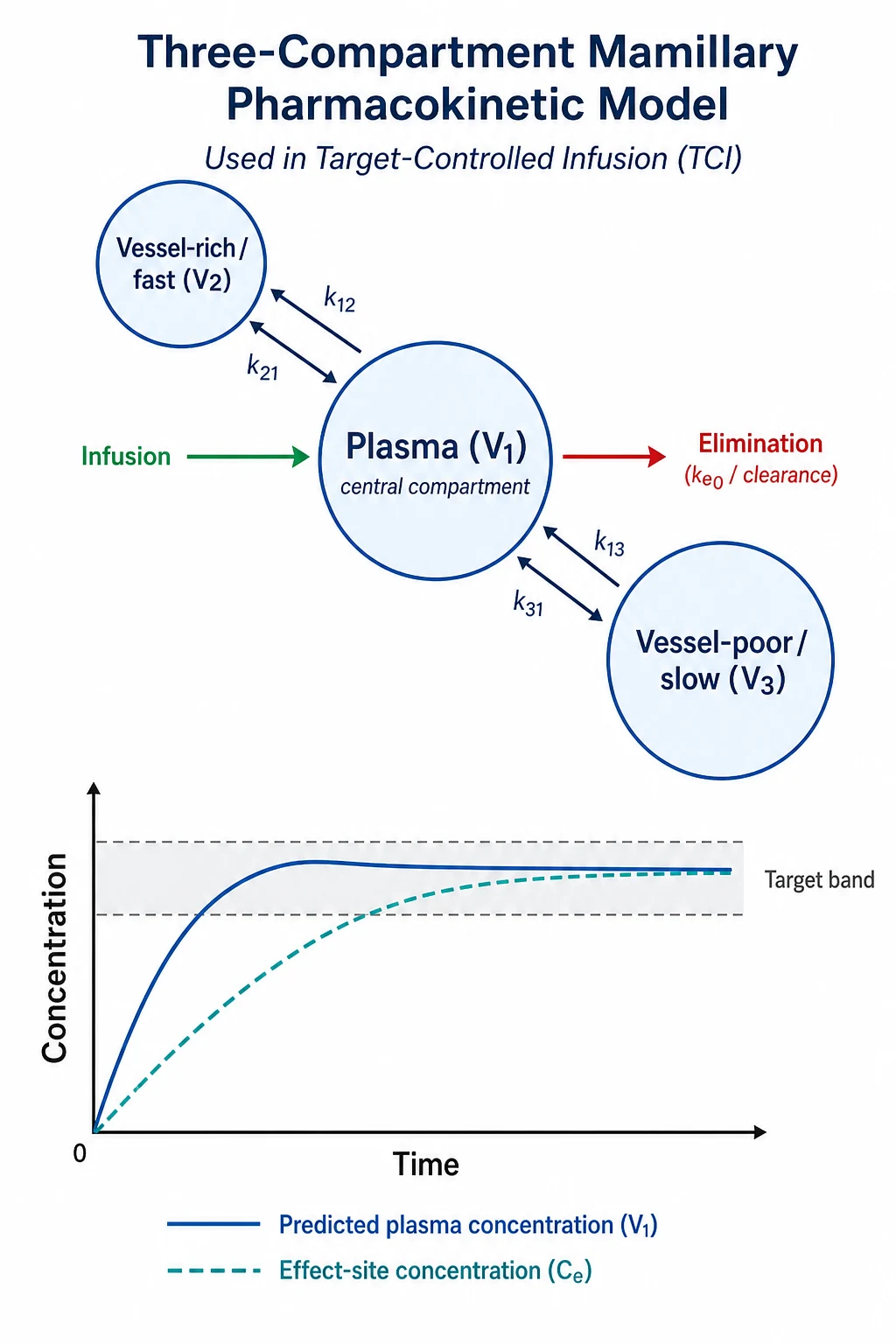
The standard model for propofol is a three-compartment mamillary model[2]. The central compartment (V1) represents plasma and the well-perfused organs; the second compartment (V2) is a rapidly equilibrating, vessel-rich compartment (muscle); and the third (V3) is a slowly equilibrating, vessel-poor compartment (fat). All peripheral compartments connect only to the central one (hence mamillary), and elimination occurs from the central compartment. The intercompartmental rate constants (k12, k21, k13, k31) and the elimination rate constant (k10) define how fast drug moves and is removed. After a bolus, drug rapidly leaves plasma into V2 and is cleared, so the concentration falls steeply; later, return of drug from V2 and slow uptake by V3 prolong the tail. This redistribution is why a single propofol bolus gives a brief anaesthetic and why a prolonged infusion accumulates in the periphery and lengthens recovery[2].
Context-sensitive half-time
Elimination half-life is a fixed property of one-compartment kinetics, but in a multicompartment system the time for the concentration to halve after stopping an infusion depends on how long the infusion ran — the context-sensitive half-time[2]. For propofol, context-sensitive half-time remains short (a few minutes) even after many hours of infusion, which is the pharmacokinetic basis of its use for TIVA and for sedation; for drugs that accumulate in the periphery (thiopental, fentanyl over long infusions), it lengthens markedly with duration. The practical implication is that stopping a long remifentanil infusion still allows prompt recovery (its context-sensitive half-time is short), but a long propofol infusion recovers less briskly than a short one, and recovery time must be planned around infusion duration[2].
Effect-site targeting
Plasma concentration is not where anaesthesia happens — the brain (effect site) is. Effect-site targeting adds an effect compartment (Ce) to the model, linked to plasma by the equilibration rate constant ke0, and targets Ce rather than plasma concentration (Cp)[1][2]. Because plasma and effect-site equilibrate with a delay, an effect-site target lets the pump give an initial overshoot in plasma to drive the brain to target quickly, then settle. The plasma-to-effect-site hysteresis is why effect-site targeting produces faster onset and is preferred for induction, while plasma-targeting is gentler and used where haemodynamic stability matters[1]. The displayed predicted effect-site concentration guides titration to the depth monitor[6].
The named propofol models
Several population pharmacokinetic models compete, each built on different datasets and patient covariates, and they predict different concentrations for the same patient[2][1]. The Marsh model uses total body weight and is the original workhorse; it tends to over-predict in the obese because weight scales volumes linearly. The Schnider model incorporates age, height and lean body mass and is widely used with effect-site targeting; its fixed lean-body-mass formula can mislead in the very obese. The Eleveld model, built on a large pooled dataset spanning adults and children with allometric scaling, is the newest and aims to unify paediatric and adult dosing, and has been clinically validated for high-dose propofol with adaptations[3]. The Kataria and Paedfusor models serve children[6]. A study comparing target concentrations predicted by four different models showed clinically important divergence between them, underlining that the model is a choice with consequences, not a neutral default[2].
Choosing a model: Marsh, Schnider or Eleveld
A prospective comparison of the Marsh and Schnider pharmacokinetic-pharmacodynamic models during anaesthesia showed that they produce different predicted concentrations and different depth profiles for the same nominal target, so the choice influences the anaesthetic[1]. In broad terms, Schnider (often with effect-site targeting) is favoured for induction speed and in younger, normal-weight adults, while Marsh (plasma targeting) remains a robust general-purpose choice. The Eleveld model is increasingly recommended where available because its allometric scaling handles the extremes of weight and age more rationally, and validated adaptations extend it to high-dose use[3]. The rule is to pick one matched model, use the covariates it expects, and not mix models mid-case[1][2].
Model accuracy and its limits
A model is only as good as the data it was built on, and it degrades when the patient deviates from that population[4]. Deep hypothermia and cardiopulmonary bypass markedly reduce the predictive accuracy of the Eleveld propofol model, because hypothermia alters clearance and distribution, so the displayed concentration during cardiac cooling and rewarming must not be trusted[4]. Severe illness, hepatic or renal failure, major blood loss and the extremes of age and weight likewise distort prediction, which is why TIVA always pairs the model with a processed-EEG depth monitor and clinical signs[4][6]. The pump reports a prediction; the depth monitor and the patient report reality.
TCI pump operation and open versus closed loop
A TCI pump implements the model as a microprocessor algorithm: it gives a small initial bolus to reach target, then a declining infusion to replace clearance and redistribution, and it recalculates whenever the target is changed[2]. In plasma-targeting it drives the predicted plasma concentration; in effect-site targeting it drives the predicted effect-site concentration, accepting a transient plasma overshoot. Open-loop TCI (the standard) holds a clinician-set target; closed-loop TCI feeds a depth-monitor signal back to the pump to titrate automatically, an active research direction that reduces variability but is not yet routine[6]. The pump must have anti-reflux valves, a correctly sited and secured line, and low-dead-space tubing, because a disconnection delivers no drug and lightens anaesthesia silently.
Clinical advantages of TIVA over volatile anaesthesia
TIVA avoids the inhalational agents' drawbacks: there is no operating-theatre pollution, no malignant-hyperthermia trigger, less postoperative nausea and vomiting, and smoother emergence for some patients, and TIVA is essential where the airway is shared or unsecured (bronchoscopy, radiation therapy) or where nitrous oxide and high fresh-gas flows are undesirable[5]. Comparative studies of volatile versus propofol-based TIVA, including in the elderly, weigh these advantages against any difference in perioperative neurocognitive outcome, and the evidence does not show a consistent neurocognitive advantage of one over the other, so the choice is individualised rather than doctrinaire[5].
Agents and emerging drugs
Propofol is the mainstay of TIVA, combined with an opioid — most often remifentanil by TCI using the Minto model — to provide analgesia and reduce the propofol target[2]. Remimazolam, an ultra-short-acting benzodiazepine with organ-independent elimination, and ciprofol, a propofol analogue, are emerging TIVA agents with favourable kinetics, though their population models are still maturing; for now propofol with remifentanil remains the standard TIVA combination[2].
Practical setup and target ranges
A typical induction uses a propofol effect-site target of four to six micrograms per millilitre (Schnider) titrated to loss of consciousness and the depth monitor, with a remifentanil target of two to four nanograms per millilitre (Minto) for analgesia, adjusted to the stimulus[2][6]. Targets are lowered in the elderly, the frail and the haemodynamically compromised, where a standard young-adult target causes hypotension, and raised for intense surgical stimulus. Throughout, the depth monitor (a processed-EEG index) confirms that the predicted concentration is producing the intended anaesthetic depth, and the two are titrated together[6].
Clinical
- Standard approach
- Evidence-based
Alternative
- Modified technique
- Risk-benefit
Red flags
References
- [1]Ye J, et al. A Prospective Study of Marsh PK-PD Model and Schnider PK-PD Model During Anesthesia Induction for Obese Patients Undergoing Elective Heart Surgery Pharmacol Res Perspect, 2026.PMID 42286797
- [2]Introna M, et al. Target concentrations of propofol predicted by four different pharmacokinetic/pharmacodynamic models to induce loss of consciousness in neurosurgical patients J Anesth Analg Crit Care, 2026.PMID 42231496
- [3]Lybbert C, et al. Correction: Clinical validation of an adapted Eleveld Model for high‑dose propofol treatments for depression J Clin Monit Comput, 2026.PMID 42360600
- [4]Bartosova T, et al. Deep hypothermia reduces the predictive accuracy of the Eleveld propofol model: Population pharmacokinetic modelling in cardiac surgery Biomed Pharmacother, 2026.PMID 42140058
- [5]Somnuke P, et al. Effect of desflurane versus propofol on perioperative neurocognitive disorders in older adults undergoing major urological surgery: a randomized trial BMC Geriatr, 2026.PMID 42321629
- [6]Ramesh S, et al. Integrated Advanced Monitoring and Target-Controlled Infusion Anesthesia in a Child With Arthrogryposis Multiplex Congenita Cureus, 2026.PMID 42359210