Anaes · Applied anatomy
Airway and larynx anatomy
Also known as Airway anatomy · Larynx anatomy · Laryngeal cartilages · Recurrent laryngeal nerve · Superior laryngeal nerve · Cricothyroid membrane
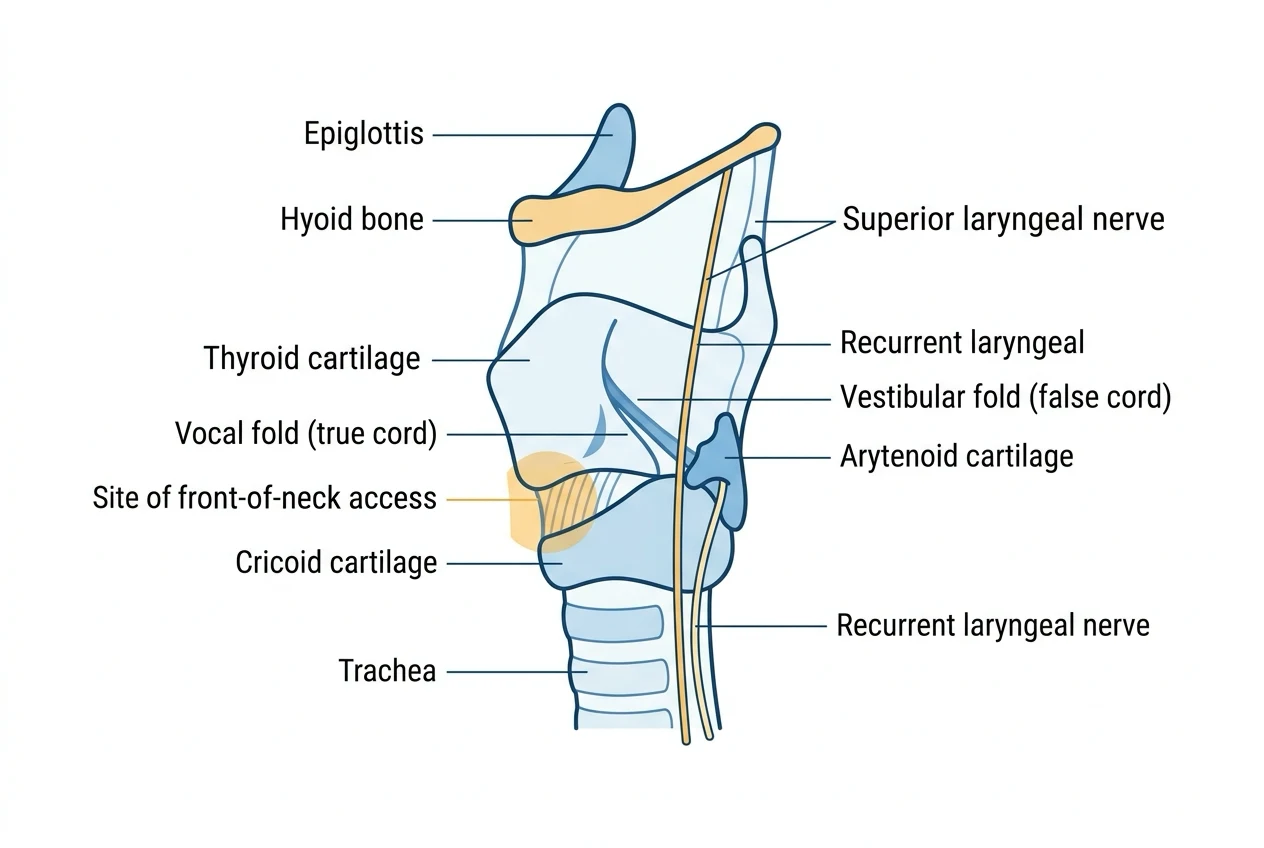
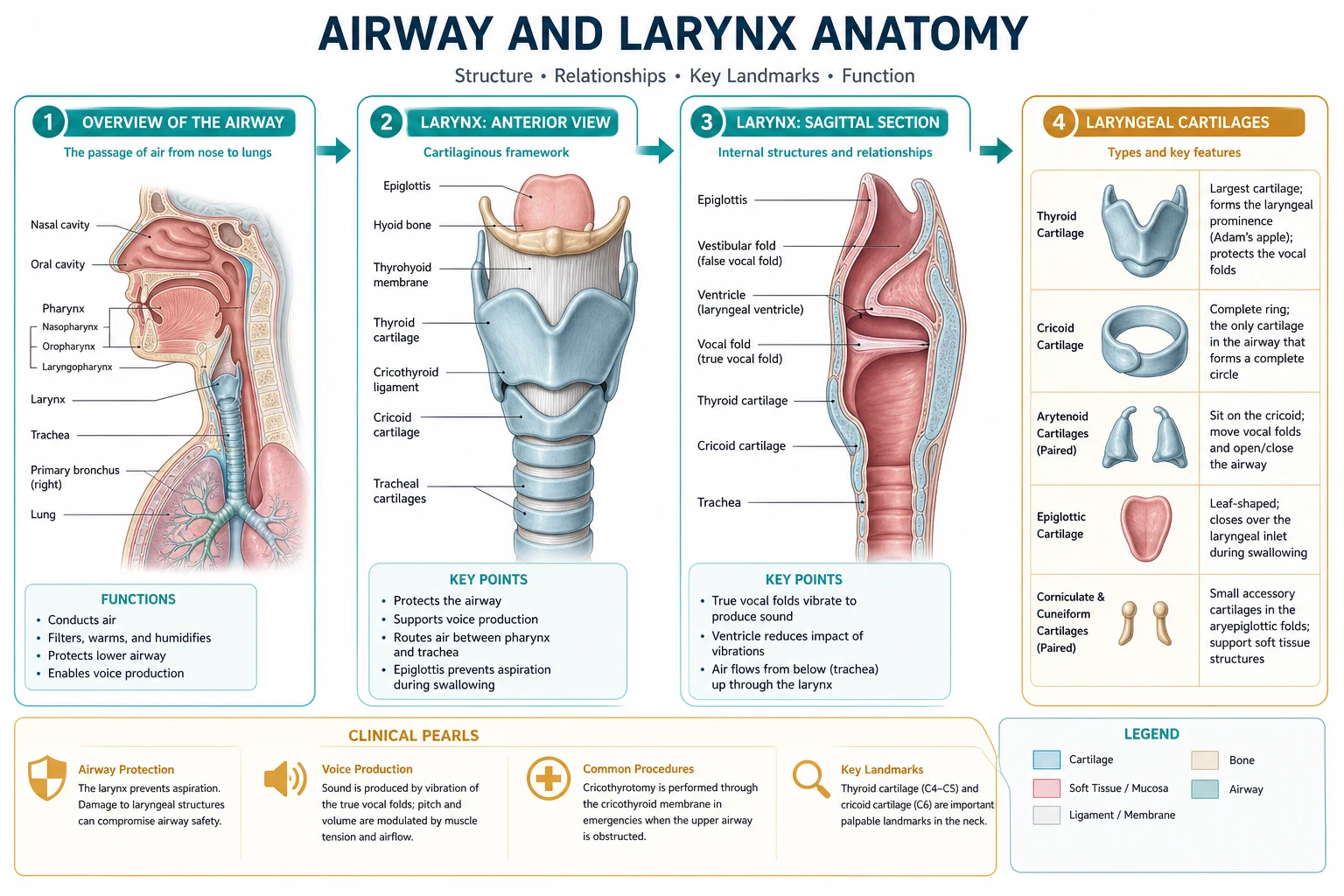
The airway is the anaesthetist's primary organ, and its anatomy underpins every act of intubation, laryngeal-mask placement, front-of-neck rescue and nerve block. The framework rests on six exam-critical ideas. First, the airway runs from the nose and mouth through the pharynx (nasopharynx, oropharynx, laryngopharynx) to the larynx and then the trachea, with the larynx sitting opposite the third to sixth cervical vertebrae. Second, the laryngeal skeleton is built from three single cartilages (thyroid, cricoid and epiglottis) and three paired cartilages (arytenoid, corniculate and cuneiform); the cricoid is the only complete ring of cartilage in the airway and is the key landmark for both the Sellick manoeuvre and a surgical airway. Third, the cricothyroid membrane stretches between the thyroid cartilage above and the cricoid below and is the target for emergency front-of-neck access (cricothyroidotomy). Fourth, the larynx is innervated by two branches of the vagus: the superior laryngeal nerve (whose internal branch is sensory to the larynx above the cords and whose external branch motor-innervates the cricothyroid, the tensor of the cords) and the recurrent laryngeal nerve (which is motor to all the other intrinsic muscles and sensory below the cords); damage to the recurrent laryngeal nerve paralyses a vocal cord in the paramedian position and causes hoarseness. Fifth, the trachea bifurcates at the carina into a right main bronchus that is wider, shorter and more vertical (the site of inadvertent right main-stem intubation and of aspiration) and a longer, narrower left main bronchus. Sixth, the paediatric airway differs structurally from the adult's — a relatively larger tongue and occiput, a higher, more anterior larynx (C3-C4 in the infant versus C6 in the adult), a large U-shaped epiglottis, and the narrowest point at the cricoid (not the vocal cords as in the adult) — which is why uncuffed tubes were traditionally used in young children and why the paediatric airway is more easily obstructed. Built on the recurrent-laryngeal-nerve anatomical-variation study (Triantafyllou 2026), the front-of-neck-access simulation study (Mullally 2026), the paediatric airway neuromuscular-block review (Bonfiglio 2026), the superior-laryngeal-nerve-block and cricothyroid-membrane report (Chen 2026), the ultrasound airway-mapping study (Mallick 2026), the cricoid-fracture laryngeal-trauma report (Uemura 2026), the endotracheal-tube-positioning study (Kufel 2026), and the bedside airway-assessment study (Eltrabily 2026).
On this page & tools
Your progress
Saved locally on this device.
8 MCQs with explanations
Target exams
Red flags
Why this matters
Airway anatomy is the substrate of every intubation, LMA, fibreoptic, tracheostomy and CICO rescue. Primary and Final both test cartilages, membranes, innervation and paediatric differences. [1]
Airway divisions
| Segment | Extent | Anaesthetic relevance |
|---|---|---|
| Upper airway | Nose/mouth → vocal cords | Mask seal, obstruction, nasal intubation |
| Larynx | Epiglottis → lower border of cricoid | Intubation view, FONA, nerve injury |
| Lower airway | Trachea → bronchioles | Tube depth, bronchial intubation, foreign body |
Nasal cavity and pharynx
Nasal cavity: turbinates, richly vascular mucosa (epistaxis with blind nasal tubes). Nasopharynx, oropharynx, hypopharynx (laryngopharynx) meet at the laryngeal inlet. Soft palate, tongue base and epiglottis are the dynamic obstruction points under anaesthesia. [1]
Laryngeal cartilages and membranes
| Structure | Key fact | Clinical |
|---|---|---|
| Thyroid cartilage | Largest; laryngeal prominence | Landmark for superior laryngeal nerve block / cricothyroid membrane upper border |
| Cricoid cartilage | Only complete ring; signet shape | Sellick/cricoid pressure; paediatric narrowest point; surgical airway lower border reference |
| Epiglottis | Elastic cartilage | Paediatric: large, floppy, U/omega shaped |
| Arytenoids | Paired; vocal process attachment | Cord movement |
| Cricothyroid membrane | Between thyroid (above) and cricoid (below) | Emergency FONA / scalpel-bougie / needle cric target |
Intrinsic muscles (motor pattern)
| Muscle | Action | Nerve |
|---|---|---|
| Cricothyroid | Tenses / elongates cords (pitch) | External branch of superior laryngeal |
| Posterior cricoarytenoid | Only abductor of cords | Recurrent laryngeal |
| Lateral cricoarytenoid | Adducts | Recurrent laryngeal |
| Thyroarytenoid / vocalis | Relaxes / fine control | Recurrent laryngeal |
| Interarytenoid | Adducts | Recurrent laryngeal |
All intrinsic muscles except cricothyroid are supplied by the recurrent laryngeal nerve (RLN). [1]
Sensory innervation
| Region | Nerve |
|---|---|
| Above vocal cords | Internal branch of superior laryngeal nerve |
| At / below cords, trachea | Recurrent laryngeal nerve |
| Base of tongue / vallecula (afferent gag/laryngoscopy) | Glossopharyngeal (IX) |
Glottis, trachea, bronchi
- Adult vocal folds meet in midline; rima glottidis is the aperture.
- Adult trachea ≈ 10–12 cm, 16–20 incomplete C-shaped rings, bifurcation at sternal angle (T4/5).
- Right main bronchus: shorter, wider, more vertical → endobronchial intubation and aspirated foreign bodies prefer the right.
- Left main bronchus: longer, more horizontal — relevant to DLT design and left-sided isolation. [1]
Surface anatomy and FONA
| Landmark | Level / note |
|---|---|
| Hyoid | C3 |
| Thyroid cartilage | C4–5 |
| Cricoid | C6 adult |
| Sternal notch / tracheal rings | Tracheostomy zone below cricoid |
| Cricothyroid membrane | Between thyroid and cricoid — emergency access |
Paediatric versus adult airway
| Feature | Adult | Child (esp. infant) |
|---|---|---|
| Larynx level | ≈ C6 | Higher ≈ C3–4 |
| Epiglottis | Firm, leaf | Large, U-shaped, angled |
| Narrowest point | Glottis (vocal cords) | Cricoid (historically taught; still exam standard) |
| Tongue / occiput | Proportionate | Relatively large → obstruction, sniffing needs shoulder roll |
| Tube choice | Cuffed routine | Age formulas: uncuffed ID ≈ (age/4)+4; cuffed ≈ (age/4)+3.5; depth ≈ ID×3 |
Nerve injury patterns
| Injury | Clinical | Context |
|---|---|---|
| Unilateral RLN | Hoarseness; cord paramedian | Thyroid surgery, aortic/chest, difficult intubation trauma |
| Bilateral RLN | Stridor, airway obstruction, may need tracheostomy | Bilateral thyroid surgery |
| External SLN | Voice pitch change (cricothyroid) | Thyroid surgery superior pole |
| Recurrent left RLN long course | Loops under aortic arch | Thoracic/cardiac; left more vulnerable |
SAQ scaffold
- List laryngeal cartilages and identify only complete ring.
- Motor and sensory innervation map.
- Describe FONA landmark technique.
- Right vs left main bronchus and clinical sequelae.
- Five paediatric airway differences with tube sizing formulas. [1]
Viva phrases
- "Which muscle opens the cords?" → "Posterior cricoarytenoid — only abductor; RLN."
- "Where do you cut in CICO?" → "Cricothyroid membrane — thyroid above, cricoid below." [1]
Common traps
- Saying adult narrowest point is cricoid (exam: child cricoid, adult glottis).
- Forgetting cricothyroid is SLN external, not RLN.
- Bilateral RLN injury underplayed as "hoarseness" only.
- Nasal tubes without respect for turbinates/vascular mucosa. [1]
Superior laryngeal n.
- Internal = sensory above cords
- External = cricothyroid only
- Block useful for awake airway
- Injury → pitch change
Recurrent laryngeal n.
- All other intrinsics
- Sensory below cords
- Unilateral hoarseness
- Bilateral stridor
Adult airway
- Larynx ~C6
- Narrowest at glottis
- Firms epiglottis
- Cuffed ETT default
Paediatric airway
- Larynx higher C3–4
- Narrowest at cricoid (exam)
- Large tongue/occiput
- Age-based tube formulas
Red flags
[1]Primary exam expansion — dense examiner pack
Full upper airway functional anatomy for instrumentation
Nasal route: nares → turbinates (inferior most relevant to tubes) → nasopharynx. Risk: epistaxis, adenoids in children, basal skull fracture contraindication to blind nasal. Oral route: lips/teeth → tongue → soft palate → oropharynx. Mallampati visualises palate/tongue relationship only — not full airway exam. Jaw thrust lifts tongue off posterior pharynx via mandibular insertion of genioglossus mechanics. [1]
Laryngeal inlet and visualisation
Vallecula is the pocket anterior to epiglottis — Macintosh blade tip seats here to indirectly lift epiglottis via hyoepiglottic ligament. Straight Miller blade lifts epiglottis directly — preferred neonatal teaching. Aryepiglottic folds bound inlet laterally; posterior is arytenoids. Grade views (Cormack–Lehane) describe glottic visualisation, not difficulty alone. [1]
Cartilage and membrane detail beyond lists
Thyroid cartilage shields; superior cornu near superior laryngeal nerve penetration area. Cricoid signet: posterior lamina protects oesophagus interface for cricoid pressure debates; complete ring prevents collapse — paediatric tube sizing historically uncuffed at cricoid narrowest. Cricothyroid membrane height/width vary — ultrasound mapping useful in obesity/radiation necks.[2][5]. Cricotracheal membrane lower surgical airway option if cricothyroid impossible (advanced).
Intrinsic muscle actions (examiner favourites)
| Muscle | Action | Failure deficit |
|---|---|---|
| Posterior cricoarytenoid | Only abductor | Cannot open cords |
| Lateral cricoarytenoid | Adductor | Incomplete close |
| Thyroarytenoid | Shortens/relaxes | Fine tension loss |
| Cricothyroid | Tenses (SLN external) | Pitch loss |
| Interarytenoid | Closes posterior glottis | Residual posterior gap |
Nerve injury clinical patterns expanded
Unilateral RLN: hoarse, weak cough, aspiration risk mild. Bilateral RLN: stridor, may need reintubation/trach — emergency. External SLN: subtle voice fatigue/pitch. Vagus high lesions: combine SLN+RLN deficits. Left RLN longer course under aortic arch — thoracic/cardiac/aortic aneurysm risk; thyroid surgery both sides risk.[1]
Trachea and bronchi numbers
Adult trachea ~10–12 cm, 16–20 C-shaped rings, incomplete posterior membranous wall (trachealis) — allows oesophageal expansion; erosion risk with overinflated cuffs chronic. Carina T4/5 sternal angle. Right main bronchus: shorter (~2.5 cm), wider, ~25° from midline; left longer (~5 cm), ~45°. Right upper lobe takeoff near carina — right DLT and endobronchial intubation patterns. Tube tip depth adult ~20–22 cm at lips typical starting; auscultate and EtCO2 confirm; imaging if doubt.[7]
Paediatric sizing formulas (exam)
Uncuffed ID ≈ age/4 + 4; cuffed ≈ age/4 + 3.5 (various). Depth ≈ 3 × ID (oral). Leak test historical; modern microcuff practice evolves — state principles: avoid excessive pressure mucosal ischaemia at cricoid. [1]
Front-of-neck access anatomy sequence
Identify thyroid notch → slide down midline to cricothyroid depression → stabilise → scalpel-bougie-tube or institutional CICO protocol. Obesity: ultrasound or deep dissection; do not delay for perfect equipment if hypoxic.[2]. Tracheostomy lower: between rings typically 2–3, more vessels (thyroid isthmus), not first emergency choice if cricothyroid available.
Awake airway block map
Glossopharyngeal: base of tongue/tonsillar pillars (gag). Superior laryngeal internal: pierce thyrohyoid membrane (piriform fossa topical alternative). Transtracheal topical via cricothyroid: recurrent laryngeal territory below cords. Combined with careful sedation for awake fibreoptic.[4]
SAQ: innervation of larynx and clinical sequelae of nerve injury (8 marks)
SLN internal/external functions (2). RLN motor/sensory (2). Unilateral vs bilateral injury (2). Surgical risk contexts (1). Airway management implication (1). [1]
Viva rapid
Q: Only muscle opening cords? A: Posterior cricoarytenoid. Q: Where for emergency FONA? A: Cricothyroid membrane. Q: Why right endobronchial intubation common? A: Right main shorter, wider, more vertical. [1]
High-yield viva battery and numbers lock-in
Landmark vertebral levels
| Structure | Level |
|---|---|
| Hyoid | C3 |
| Thyroid cartilage | C4–5 |
| Cricoid (adult) | C6 |
| Carina | T4/5 |
| Infant larynx | C3–4 |
Sensory map for awake intubation blocks
Nasal: V2 (sphenopalatine). Oropharynx/tongue base: IX. Supraglottic larynx: internal SLN. Infraglottic/trachea: RLN. Combine topical and targeted blocks; sedate carefully preserving cooperation and respiration. [1]
Bilateral RLN injury emergency plan
High suspicion after thyroid surgery with stridor post-extubation: re-secure airway early, nebulised adrenaline adjuncts sometimes, steroids, prepare for tracheostomy if cannot extubate safely, ICU, ENT review. Do not repeatedly fail extubation overnight without a plan. [1]
Full viva dialogue (additional)
Examiner: Describe how you locate the cricothyroid membrane. [1]
Candidate: I palpate the thyroid notch in the midline, slide my finger inferiorly down the thyroid lamina to the depression of the cricothyroid membrane just above the solid cricoid ring, stabilise the larynx, and if landmarks are poor I use ultrasound. That membrane is the emergency front-of-neck access target in CICO. [1]
Examiner: Compare adult and paediatric airways in five points. [1]
Candidate: The infant larynx is higher and more anterior; the epiglottis is larger and U-shaped; the tongue and occiput are relatively large; the narrowest point is the cricoid rather than the vocal cords in standard exam teaching; and oxygen consumption is higher with lower reserve, so desaturation is faster. [1]
Exam traps
- Adult narrowest = cricoid (wrong in standard exam answer).
- Cricothyroid muscle innervated by RLN (wrong — external SLN).
- Left and right main bronchi identical.
- FONA at sternal notch as first choice. [1]
Examiner synthesis paragraph
Airway anatomy is scored as landmarks you can touch and nerves you can map. Cricoid is the only complete ring and the paediatric narrowest point in standard teaching; the cricothyroid membrane is the CICO cut; posterior cricoarytenoid is the sole cord abductor on the recurrent laryngeal nerve; cricothyroid alone is external superior laryngeal. Right main bronchus anatomy explains endobronchial intubation. Paediatric differences — higher larynx, large tongue and occiput, U-shaped epiglottis, high oxygen consumption — explain why infants desaturate and why tube formulas and straight blades appear in every exam. If you can give unilateral versus bilateral recurrent laryngeal injury patterns and a FONA sequence without hesitation, you own the station. [1]
Worked SAQ mark plan — laryngeal innervation (8)
Define superior laryngeal nerve internal sensory above cords and external motor to cricothyroid (2). Recurrent laryngeal motor to all other intrinsics and sensory below cords (2). Unilateral injury hoarseness versus bilateral stridor with airway threat (2). Name at-risk surgery thyroid, cardiac, thoracic and difficult intubation trauma (1). State emergency management priority for bilateral injury is re-securing the airway (1). [1]
Common viva closer: posterior cricoarytenoid only abducts the cords; emergency FONA is the cricothyroid membrane; pull back a tube that ventilates only the right chest before chasing bronchospasm. [1]
References
- [1]Triantafyllou G, et al. Anatomical Variations in Critical Structures in Esophageal Surgery: Implications for Personalized Surgery J Pers Med, 2026.PMID 42346602
- [2]Mullally ME, et al. Evaluation of novel materials for front-of-neck access simulations Anaesth Intensive Care, 2026.PMID 42290043
- [3]Bonfiglio R, et al. Neuromuscular block in paediatric patients undergoing airway management: a narrative review Curr Opin Anaesthesiol, 2026.PMID 41837392
- [4]Chen M, et al. Ultrasound-Guided Superior Laryngeal Nerve Block Combined with Cricothyroid Membrane Puncture for Awake Tracheal Intubation in a Patient with a Laryngeal Tumor: A Case Report and Literature Review Int Med Case Rep J, 2026.PMID 42051408
- [5]Mallick S, et al. Ultrasound-Guided Airway Mapping and Regional Blocks in Post-radiation Cervicofacial Contractures: A Case Report Cureus, 2026.PMID 42211648
- [6]Uemura E, et al. A case of tracheal injury with cricoid fracture due to blunt laryngeal trauma Trauma Case Rep, 2026.PMID 42232471
- [7]Kufel J, et al. Detection, localization, and measurement of endotracheal tube positioning on adults' chest X-ray: developing a prediction model Sci Rep, 2026.PMID 42337351
- [8]Eltrabily H, et al. Improving bedside airway tests accuracy for predicting difficult laryngoscopy using ultrasound-measured skin-to-epiglottis distance J Anesth Analg Crit Care, 2026.PMID 42310819