Anaes · Anaesthetic adjuncts
Adrenaline
Also known as Epinephrine · Direct-acting catecholamine · Alpha and beta adrenergic agonist · Adrenal medullary hormone
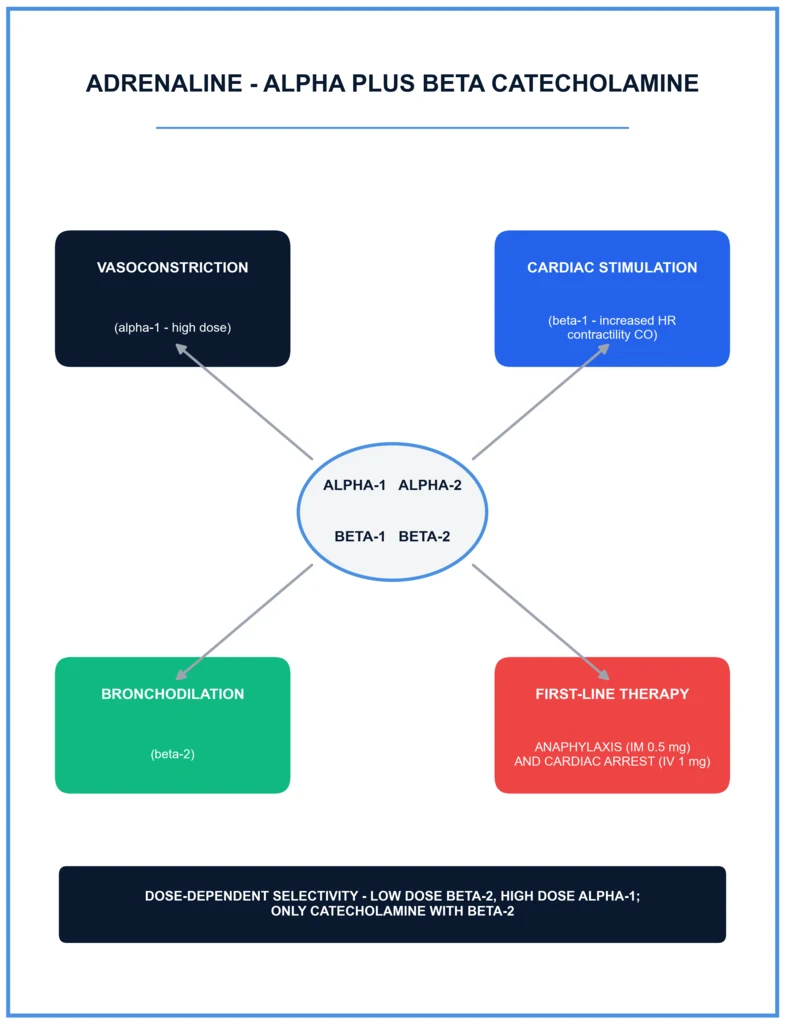
Adrenaline (epinephrine) is the physiological HORMONE of the adrenal medulla and a DIRECT-ACTING catecholamine that is a potent agonist at the ALPHA-1, ALPHA-2, BETA-1 and BETA-2 adrenergic receptors, making it the only endogenous catecholamine with significant BETA-2 activity. Its exam-defining feature is dose-dependent receptor selectivity: at LOW infusion doses (0.01 to 0.05 mcg per kg per min) beta-2 effects dominate (bronchodilation, vasodilation), at MODERATE doses beta-1 and beta-2 effects combine (increased cardiac output with bronchodilation), and at HIGH doses (above 0.5 mcg per kg per min) alpha-1 vasoconstriction dominates (raised systemic vascular resistance) (Dong 2026, Yahya 2026). These three receptor tiers underpin the three great clinical uses: ANAPHYLAXIS (first-line, intramuscular 500 micrograms, where alpha-1 reverses oedema and hypotension, beta-2 bronchodilates and beta-1 supports the circulation — Najem 2026), CARDIAC ARREST (1 mg intravenously every 3 to 5 minutes on the advanced life support algorithm, where alpha-1 vasoconstriction raises aortic diastolic pressure and improves coronary and cerebral perfusion), and SEVERE ASTHMA (beta-2 bronchodilation). Adrenaline is also an inotropic infusion for cardiogenic shock, a local anaesthetic additive (vasoconstriction), and a nebulised agent for croup (Chirumamilla 2026, Parkinson 2026). It has a very short half-life of about 2 to 3 minutes (continuous infusion for sustained effect; metabolised by COMT and MAO), and it is the most arrhythmogenic catecholamine — tachyarrhythmias (ventricular tachycardia, ventricular fibrillation) plus hypertension, myocardial ischaemia, HYPERGLYCAEMIA (beta-2 glycogenolysis), HYPOKALAEMIA (beta-2 cellular potassium uptake) and a LACTATE RISE (beta-2 glycolysis, NOT lactic acidosis) dominate the adverse-effect profile; extravasation causes necrosis reversed by phentolamine (Parkinson 2026). Against noradrenaline, adrenaline uniquely adds beta-2 (bronchodilation, more tachycardia, hyperglycaemia, lactate); against phenylephrine, adrenaline is a broad alpha-plus-beta agonist where phenylephrine is pure alpha-1. The NAP6 audit confirmed neuromuscular blocking agents as the leading cause of perioperative anaphylaxis and adrenaline (intramuscular 500 micrograms) as first-line treatment. Built on the anaphylaxis-in-schools epinephrine law study (Najem 2026), the neonatal septic shock first-line vasopressor trial (Yahya 2026), the refractory malignant upper GI bleeding case report (Chirumamilla 2026), the vasopressor selection and postoperative delirium in older adults study (Dong 2026), the cost and environmental comparison of anaesthetic emergency vasopressors (Parkinson 2026), and the machine-learning intraoperative hypotension prediction model (Liu 2026).
On this page & tools
Your progress
Saved locally on this device.
8 MCQs with explanations
Target exams
Red flags

Overview and definition
Adrenaline (epinephrine) is the physiological hormone of the adrenal medulla and a DIRECT-ACTING catecholamine. It is synthesised from tyrosine via the dopa-dopamine-noradrenaline pathway, with the final N-methylation of noradrenaline to adrenaline catalysed by phenylethanolamine-N-methyltransferase (PNMT), an enzyme highly concentrated in the adrenal medulla. Once released, adrenaline is a potent direct agonist at all four of the major adrenergic receptor subtypes — alpha-1, alpha-2, beta-1 and beta-2 — and is the only endogenous catecholamine with significant beta-2 activity. This breadth of receptor action is what makes it simultaneously a bronchodilator, a cardiac stimulant, a vasoconstrictor and a metabolic hormone, and is the reason it occupies three of the most time-critical slots in acute medicine: first-line treatment of anaphylaxis, the arrest-circulation drug of advanced life support, and a rescue bronchodilator in severe asthma.[5][1]
For the anaesthetist, adrenaline is both an emergency resuscitation drug and a titratable infusion. Its very short half-life of about 2 to 3 minutes means any sustained effect requires a continuous infusion, and its dose-dependent receptor selectivity means that the dominant clinical effect changes as the dose rises — a feature that has to be understood quantitatively rather than in qualitative terms. The cost and environmental comparison of anaesthetic emergency vasopressors by Parkinson placed adrenaline alongside ephedrine, metaraminol and phenylephrine and quantified their relative expense and waste burden, a useful stewardship reference when rationalising the emergency drug tray.[5]
Receptor pharmacology
Adrenaline is a DIRECT agonist at all four major adrenergic receptor subtypes, with no indirect component. This distinguishes it from ephedrine (mixed-acting, dominant indirect noradrenaline release) and aligns it with noradrenaline (also direct-acting), the difference being that noradrenaline has negligible beta-2 activity at clinical doses whereas adrenaline has substantial beta-2 activity.[4]
- Alpha-1 receptor. Arteriolar and venous vasoconstriction, raising systemic vascular resistance, venous return and blood pressure. Alpha-1 also causes pupillary dilation, bladder neck contraction and contraction of the splenic capsule. At high doses this is the dominant haemodynamic effect.
- Alpha-2 receptor. Presynaptic inhibition of noradrenaline release and postsynaptic effects including mild sedation and analgesia. The alpha-2 effect is modest at clinical doses but contributes to the termination of sympathetic overactivity.
- Beta-1 receptor. Positive chronotropy (increased heart rate), positive inotropy (increased contractility), increased atrioventricular nodal conduction, and increased renin release from the juxtaglomerular apparatus. The beta-1 effect is prominent at moderate doses and underlies both the therapeutic cardiac stimulation and the arrhythmogenic liability.
- Beta-2 receptor. Smooth muscle relaxation in the bronchi (bronchodilation), in the skeletal muscle vasculature (vasodilation), in the uterus (tocolysis) and in the gut; plus metabolic effects — glycogenolysis in liver and skeletal muscle, gluconeogenesis, and a cellular potassium uptake. The beta-2 effect is the feature that adrenaline alone possesses among the endogenous catecholamines, and it is the basis of the anaphylaxis and asthma indications.[5]
Dose-dependent receptor selectivity
The single most important pharmacodynamic concept for adrenaline is that its dominant receptor effect changes with the dose, because the four receptor subtypes have different affinities for the drug. Beta-2 receptors are the most sensitive, then beta-1, then alpha-1, so as the concentration rises successive receptor populations are recruited.[4][2]
- LOW doses (0.01 to 0.05 mcg per kg per min). Predominantly BETA-2 effects. Bronchodilation and vasodilation of skeletal muscle beds dominate; the vasodilation can actually lower the diastolic pressure, and the net blood pressure effect may be small or even slightly reduced. This is the dose range used for bronchodilation and for low-level inotropic support.
- MODERATE doses (about 0.05 to 0.5 mcg per kg per min). Beta-1 and beta-2 effects combine. Cardiac output rises through increased heart rate and contractility (beta-1), while bronchodilation and a degree of vasodilation persist (beta-2). Systolic pressure rises (driven by cardiac output) while diastolic pressure may remain stable or fall slightly, widening the pulse pressure. This is the typical inotropic infusion range for cardiogenic shock.
- HIGH doses (above 0.5 mcg per kg per min). Alpha-1 vasoconstriction dominates. Systemic vascular resistance rises sharply, both systolic and diastolic pressures increase, and venous return is augmented by venoconstriction. This is the dose range that supports pressure in vasoplegic shock, and it is the range in which arrhythmia, ischaemia and lactate rise become most prominent.[2]
The practical consequence is that escalating an adrenaline infusion moves the patient across receptor tiers: a low dose that was bronchodilating and mildly vasodilating becomes, at higher dose, a potent vasoconstrictor. In neonatal and paediatric fluid-refractory septic shock, adrenaline is established as a first-line vasopressor option precisely because its alpha-1 tier can be reached by titration when the lower-dose beta-2 tier is inadequate (Yahya 2026).[2]
Anaphylaxis — the first-line drug
Adrenaline is the FIRST-LINE treatment for anaphylaxis and must be given EARLY. The mechanism by which it reverses anaphylaxis maps directly onto its receptor profile, and an examiner will expect this receptor-by-receptor explanation.[1]
- Alpha-1 reverses the oedema and vasodilation that cause upper-airway obstruction, angioedema and hypotension; it constricts the mucosal vasculature and raises systemic vascular resistance.
- Beta-1 supports the circulation with increased heart rate and contractility, countering the distributive shock.
- Beta-2 bronchodilates the lower airway and stabilises mast cells, reducing further mediator release — both central to breaking the anaphylactic reaction. [1]
The correct adult DOSE and ROUTE in anaphylaxis is 500 micrograms INTRAMUSCULARLY, given as 0.5 mL of 1 in 1000 adrenaline into the anterolateral thigh, repeated after about 5 minutes if no improvement. Intramuscular administration is superior to subcutaneous (faster and more reliable absorption) and is safer than intravenous in the spontaneously breathing patient, where the arrhythmogenic risk of a bolus is avoided. Intravenous adrenaline in anaphylaxis is reserved for the peri-arrest or arrested patient, the patient on beta-blockers in whom IM doses are ineffective, or the carefully titrated infusion in a monitored setting. The importance of early IM adrenaline and the role of legislation in improving access to adrenaline in the community was demonstrated by the provincial epinephrine law study of Najem (2026), which showed measurable improvements in epinephrine use for anaphylaxis in schools after a legal mandate.[1]
Cardiac arrest
In cardiac arrest, adrenaline is given at 1 mg intravenously every 3 to 5 minutes during cardiopulmonary resuscitation, as specified by the advanced life support algorithm. The relevant receptor here is ALPHA-1. The goal of adrenaline in arrest is not to restart the heart directly but to increase the aortic diastolic pressure during chest compressions, which improves myocardial and cerebral perfusion and increases the likelihood of a perfusing rhythm being restored after defibrillation. Alpha-1-mediated peripheral vasoconstriction shunts the cardiac output generated by compressions towards the brain and the myocardium.[3]
The evidence base for adrenaline in cardiac arrest supports improved short-term survival (return of spontaneous circulation and survival to hospital admission) but is more equivocal for intact neurological survival to discharge, reflecting the trade-off between improved perfusion and the adverse effects of high-dose catecholamine exposure in the post-arrest brain. Nonetheless adrenaline 1 mg every 3 to 5 minutes remains a standard, guideline-mandated intervention in both shockable and non-shockable rhythms.[3]
Severe asthma and other clinical uses
Beyond anaphylaxis and cardiac arrest, adrenaline has several roles that derive from its beta-2 and its combined alpha-plus-beta actions.[3][5]
- Severe asthma. Beta-2 bronchodilation makes adrenaline a rescue therapy for acute severe asthma unresponsive to standard bronchodilators. It may be given intravenously (as a titrated infusion or small boluses) in the critically ill, or nebulised or inhaled in the less severe presentation.
- Cardiogenic shock. A moderate-dose adrenaline infusion provides combined inotropic and chronotropic support (beta-1) with some vasopressor effect, and is used as an inotrope when other agents are insufficient, particularly in low-output states accompanying acute decompensated heart failure or post-cardiac surgery.
- Local anaesthetic additive. The alpha-1 vasoconstriction produced by very low-dose adrenaline (typically 1 in 200 000 or 5 micrograms per mL) prolongs the duration of local anaesthetic blockade and reduces systemic absorption and toxicity. This is the basis of the adrenaline-containing local anaesthetic solutions used in infiltration, plexus and neuraxial blockade.
- Croup. Nebulised adrenaline produces alpha-1-mediated vasoconstriction of the glottic and subglottic mucosa, reducing oedema and stridor in moderate to severe viral croup, with a transient but sometimes dramatic effect.
- Upper airway oedema and bleeding. The vasoconstrictor effect is exploited topically, for example in refractory epistaxis or malignant upper gastrointestinal bleeding as part of a multidisciplinary approach where adrenaline is used endoscopically to achieve haemostasis while definitive therapy is arranged (Chirumamilla 2026).[3]
Pharmacokinetics
Adrenaline is rapidly metabolised by catechol-O-methyltransferase (COMT) and monoamine oxidase (MAO), and the resulting metabolites (including vanillylmandelic acid and metanephrine) are excreted in the urine. Because of this rapid enzymatic clearance, the elimination HALF-LIFE is very short — about 2 to 3 minutes — which means a single bolus produces only a transient effect and any sustained action requires a CONTINUOUS INFUSION.[5]
Adrenaline is ineffective when given orally because it is destroyed in the gut. It is well absorbed from intramuscular injection (the preferred route in anaphylaxis) and may be given subcutaneously, intravenously, intraosseously, by endotracheal tube (now largely superseded by intraosseous access), or by nebulisation. It does not cross the blood-brain barrier to any important extent under physiological conditions, which is why systemic adrenaline produces peripheral sympathomimetic effects rather than the marked central stimulation seen with ephedrine.[5]
The short half-life has two practical consequences. First, the infusion rate can be titrated up and down with a near-immediate haemodynamic response, making adrenaline one of the most titratable vasopressors. Second, because the drug disappears within minutes of stopping the infusion, there is no protracted weaning tail as there is with longer-acting agents.[5]
Adverse effects
The adverse-effect profile is the necessary consequence of broad adrenergic stimulation, and adrenaline is the MOST ARRHYTHMOGENIC catecholamine in clinical use.[5][4]
- Tachyarrhythmias. Beta-1 stimulation precipitates supraventricular and ventricular arrhythmias, including ventricular tachycardia and ventricular fibrillation, particularly at high infusion doses, in the ischaemic or digitalised heart, and during halothane anaesthesia (where the sensitised myocardium is especially vulnerable).
- Hypertension and myocardial ischaemia. Alpha-1 vasoconstriction can overshoot, producing hypertension and an increased afterload that raises myocardial oxygen demand and can precipitate ischaemia or infarction.
- Hyperglycaemia. Beta-2-driven glycogenolysis raises blood glucose, a relevant effect in the diabetic surgical patient and during prolonged infusion.
- Hypokalaemia. Beta-2 stimulation drives potassium into cells, producing a measurable fall in serum potassium that can be clinically significant over a prolonged infusion.
- Lactate rise. Beta-2 activation stimulates aerobic glycolysis in skeletal muscle, generating lactate that is released into the circulation. This produces a RISE in serum lactate that is a metabolic consequence of the drug, NOT a marker of tissue hypoperfusion or lactic acidosis. Confusing the two leads to unnecessary and harmful escalation of resuscitation.
- Anxiety, tremor and headache. Central and peripheral sympathetic stimulation produces a characteristic restlessness, fine tremor and throbbing headache.
- Extravasation necrosis. Concentrated adrenaline extravasated into tissue causes intense alpha-1 vasoconstriction and skin necrosis. Any extravasation must be promptly treated with intradermal PHENTOLAMINE, an alpha-1 antagonist, to vasodilate the bed and prevent tissue loss; high-dose infusions are best run through a central line where practical.[5]
In older adults, the catecholamine load from adrenaline contributes to the broader question of vasopressor selection and postoperative delirium, where the choice of agent is increasingly considered part of the delirium-risk picture (Dong 2026).[4]
Comparison with noradrenaline and phenylephrine
The adrenaline-versus-noradrenaline and adrenaline-versus-phenylephrine contrasts are standard viva material and must be precise.[5]
Against noradrenaline, both are direct-acting catecholamines with alpha-1 and beta-1 activity. The defining difference is that adrenaline has significant BETA-2 activity and noradrenaline does not. The consequences of this single difference ramify across the whole clinical profile: adrenaline bronchodilates (noradrenaline does not); adrenaline produces more tachycardia and more arrhythmia (noradrenaline, lacking the beta-2 vasodilatory counter-effect, produces a purer alpha-1 pressor response with relatively less tachyarrhythmia); adrenaline produces the metabolic effects of beta-2 — hyperglycaemia, hypokalaemia and a lactate rise — whereas noradrenaline does not. Noradrenaline is therefore the preferred first-line vasopressor for sustained vasoplegic shock (septic, vasodilatory) where pure vasoconstriction without arrhythmia is the goal, while adrenaline is reserved for situations where its beta-2 effect is wanted (anaphylaxis, asthma) or where combined inotropy and vasoconstriction is needed (cardiogenic shock with a vasodilatory component).[5]
Against phenylephrine, adrenaline is a broad alpha-1, alpha-2, beta-1 and beta-2 agonist whereas phenylephrine is a PURE direct alpha-1 agonist with no beta activity. Phenylephrine raises blood pressure by vasoconstriction and produces reflex bradycardia; adrenaline raises blood pressure (at high dose) through vasoconstriction AND raises cardiac output (beta-1) and bronchodilates (beta-2). Phenylephrine is preferred when a pure pressor effect without tachycardia is wanted — for example in aortic stenosis, or in obstetric spinal hypotension where a tachycardia-free, placenta-sparing agent is desired. Adrenaline is far broader and far more arrhythmogenic. The cost-and-environment comparison of these emergency vasopressors provides a stewardship dimension when the clinical profiles are otherwise comparable (Parkinson 2026).[5]
NAP6 and perioperative anaphylaxis
The Sixth National Audit Project (NAP6) of the Royal College of Anaesthetists remains the definitive UK audit of perioperative anaphylaxis and is examined in detail. Its central, exam-relevant findings are that NEUROMUSCULAR BLOCKING AGENTS are the leading cause of perioperative anaphylaxis (accounting for the majority of confirmed cases), followed by antibiotics (with chlorhexidine and patent blue also prominent); that perioperative anaphylaxis carries a significant mortality; and that the first-line treatment is INTRAMUSCULAR ADRENALINE at 500 micrograms in the adult, given promptly into the anterolateral thigh. The audit stressed that adrenaline was underused and delayed in many reported cases, and that early IM adrenaline is the single most important life-saving intervention. The community-level importance of reliable adrenaline access is reinforced by the provincial school epinephrine law study (Najem 2026), which demonstrated that legislation mandating adrenaline availability improved its use for anaphylaxis.[1]
For the anaesthetist, the practical synthesis of NAP6 is: suspect anaphylaxis early in any perioperative hypotension, bronchospasm or rash; call for help and stop the trigger; give IM adrenaline 500 micrograms without delay; give intravenous fluid; and only then consider the intravenous adrenaline infusion for refractory cases. The adverse-effect profile of adrenaline — particularly its arrhythmogenicity — is not a reason to delay IM administration in genuine anaphylaxis, where the risk-benefit balance strongly favours early treatment.[1][5]
Dosage and administration
Adrenaline is supplied in two principal concentrations that must not be confused. The 1 in 1000 solution (1 mg per mL) is the preparation used for INTRAMUSCULAR injection in anaphylaxis; the adult anaphylaxis dose is 500 micrograms, given as 0.5 mL of this solution. The 1 in 10 000 solution (0.1 mg per mL) is the preparation used for INTRAVENOUS administration in cardiac arrest (the 1 mg pre-filled syringe, given as 10 mL of 1 in 10 000). Confusing the two concentrations — for example injecting the 1 in 1000 solution intravenously — is a well-recognised medication error that can produce dangerous hypertension, myocardial ischaemia and arrhythmia.[5]
For infusions, adrenaline is typically prepared as 3 mg or 5 mg in 50 mL of 5 percent dextrose or saline and titrated to a haemodynamic endpoint. The inotropic and vasopressor infusion range spans roughly 0.01 to 0.5 mcg per kg per min (or higher in refractory shock), and the dose-dependent receptor selectivity described above should be applied: at the low end of the range the dominant effect is beta-2 bronchodilation and vasodilation, in the middle it is beta-1 inotropy, and at the top it is alpha-1 vasoconstriction.[2]
For local anaesthetic additive use, adrenaline is incorporated at concentrations such as 1 in 200 000 (5 micrograms per mL). Adrenaline-containing solutions should be avoided in regions with end-arteries (fingers, toes, nose, ears, penis) because of the risk of ischaemic necrosis from intense alpha-1 vasoconstriction.[5]
Clinical selection and current place in practice
Adrenaline is not a general-purpose first-line perioperative vasopressor in the way that metaraminol or phenylephrine are, because its arrhythmogenicity and metabolic effects make it less suitable for the routine correction of anaesthesia-induced hypotension. Its place is in the settings where its unique receptor profile is specifically required.[5][6]
In anaphylaxis and in cardiac arrest, adrenaline is mandatory and non-substitutable. In severe asthma it is a rescue bronchodilator. As an inotrope it supports the failing circulation when other agents are insufficient, and it is a reasonable first-line vasopressor in some forms of shock where combined inotropy and vasoconstriction are wanted. For the routine vasoplegia of anaesthesia, the pure alpha-1 agents or noradrenaline are preferred because they achieve blood pressure support without the arrhythmogenic and metabolic liability of adrenaline. The increasing ability to predict intraoperative hypotension in advance through machine-learning models (Liu 2026) allows the anaesthetist to prepare a vasopressor plan before induction, and in most routine cases that plan will feature phenylephrine, metaraminol or noradrenaline rather than adrenaline.[6]
The practical summary: reach for adrenaline in anaphylaxis (IM, early), in cardiac arrest (1 mg IV every 3 to 5 minutes), in severe asthma, and as an inotrope in the failing circulation; understand that its dominant receptor changes with the dose; respect its arrhythmogenic and metabolic effects; and reserve it from routine perioperative hypotension, where narrower-spectrum agents are safer.[5][4]
Clinical
- Standard approach
- Evidence-based
Alternative
- Modified technique
- Risk-benefit
Red flags
[1] [1] [1] [1] [1]References
- [1]Najem J, et al. Effectiveness of a Provincial Law to Improve Epinephrine Use for Anaphylaxis in Schools in Alberta, Canada: A Pre-Post Study Int Arch Allergy Immunol, 2026.PMID 42360928
- [2]Yahya R, et al. First-line vasopressor therapy in neonates with fluid-refractory septic shock: A systematic review and meta-analysis of randomized controlled trials Am J Emerg Med, 2026.PMID 42361705
- [3]Chirumamilla L, et al. Multidisciplinary management of refractory malignant upper gastrointestinal bleeding in metastatic gastric adenocarcinoma BMJ Case Rep, 2026.PMID 42362336
- [4]Dong T, et al. Vasopressor Selection and Postoperative Delirium in Older Adults: A Propensity-Matched Database Analysis Semin Cardiothorac Vasc Anesth, 2026.PMID 42359892
- [5]Parkinson EA, et al. The Financial and Environmental Cost of Anaesthetic Emergency Drugs: Comparing Ampoules With Prefilled Syringes Cureus, 2026.PMID 42005180
- [6]Liu D, et al. Development and external validation of an interpretable machine learning model for predicting prolonged postoperative ICU length of stay in coronary artery bypass grafting patients using MIMIC-IV 3.1 and eICU-CRD 2.0 BMC Med Inform Decis Mak, 2026.PMID 42365267