Anaes · Anaesthetic adjuncts
Alfentanil
Also known as Fastest-onset fentanyl-family opioid · Rapid-onset short-duration phenylpiperidine
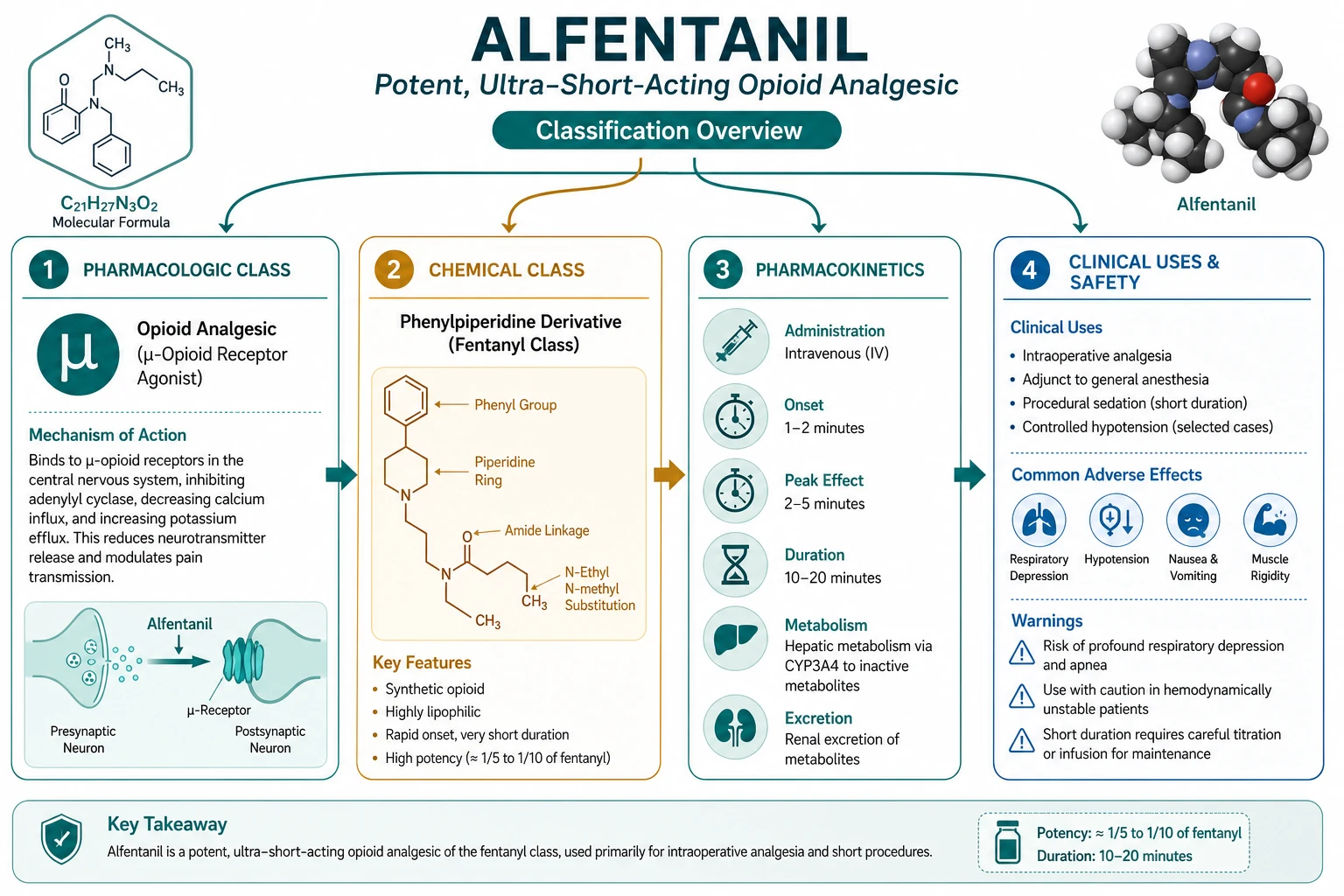
Alfentanil is a synthetic phenylpiperidine mu-opioid agonist related to fentanyl but only about a quarter to a third of its potency (Gu 2026; Zhang 2026). Its defining feature is the FASTEST onset of the fentanyl family, with peak effect about 1 minute after IV injection, because its low pKa (about 6.5) leaves most of the drug un-ionised at physiological pH so it equilibrates rapidly with the brain effect site (Liu 2026; Sun 2026). A single bolus lasts only 5 to 10 minutes by redistribution, and the drug is metabolised by hepatic CYP3A4 to inactive metabolites, giving no active metabolite and renal safety with no histamine release. Its context-sensitive half-time is shorter than fentanyl for brief use but rises with prolonged infusion, longer than remifentanil, whose flat context-sensitive half-time has displaced alfentanil for many ultra-short-acting indications.
On this page & tools
Your progress
Saved locally on this device.
8 MCQs with explanations
Target exams
Red flags
One-line exam answer
Alfentanil is the classic “fastest fentanyl-family bolus”: low pKa drives rapid effect-site equilibration, short single-dose duration, hepatic clearance, and a rising context-sensitive half-time if you try to run it like remifentanil.[1][2][4]
Why choose alfentanil
When you need the opioid peak to coincide with a short noxious stimulus — laryngoscopy, Mayfield pins, cardioversion, brief dressing change — without committing to a long residual opioid tail, alfentanil remains a daily theatre tool.[2][4] Remifentanil can cover the same space via infusion, but many lists still use alfentanil as a timed bolus drug. Comparative anaesthesia studies continue to place it against fentanyl and remimazolam combinations for induction dynamics and recovery side-effect profiles.[1][2]
Physicochemical basis of onset
| Property | Alfentanil | Fentanyl | Clinical link |
|---|---|---|---|
| pKa | ~6.5 | ~8.4 | More un-ionised alfentanil at pH 7.4 |
| Un-ionised fraction | Higher | Lower | Faster membrane crossing |
| Lipid solubility | Lower than fentanyl | Very high | Less deep tissue sequestration after single bolus |
| Time to peak effect | ~1 minute | ~3–5 minutes | Align with laryngoscopy |
| Duration after single bolus | Short (~5–10 min clinical) | Longer redistribution then metabolism | Good for brief cases |
| CSHT with long infusion | Rises | Rises more | Prefer remifentanil for long infusions |
The Henderson–Hasselbalch story is the viva gold: at pH 7.4, a weak base with pKa 6.5 is largely un-ionised, so a greater fraction can cross lipid membranes into brain. Fentanyl’s higher pKa leaves more ionised drug at the same pH, slowing equilibration despite high lipophilicity.[4][5]
Potency, dosing philosophy and clinical patterns
Alfentanil is less potent than fentanyl (commonly taught ~25% of fentanyl potency — know your local conversion tables). Because onset is fast, respiratory depression also arrives fast. Dose small IV increments with airway control ready when using induction-scale doses.[2][4]
| Situation | Role | Pattern |
|---|---|---|
| Induction / laryngoscopy | Blunt sympathetic response | Bolus timed ~60 s before stimulus |
| Tube change / cardioversion / dressing | Sole short opioid | Single or repeated small boluses |
| Intra-op surgical spikes | Temporary cover | Bolus on background volatile/TIVA |
| Long case primary opioid infusion | Suboptimal | CSHT climbs — remifentanil better if infusion needed |
| Hepatic impairment | Reduce dose | Hepatic metabolism (unlike remifentanil) |
| Procedural sedation combinations | Adjunct opioid | Watch stacked apnoea with sedatives |
Illustrative adult teaching doses (always titrate to response and follow local formulary): intubation-blunting boluses are often in the tens of micrograms per kilogram range depending on co-induction agents; smaller incremental boluses are used for short stimuli. Exact microgram numbers must be checked against local protocols because stacked sedatives change the safe ceiling.[2][4][5]
Metabolism, elimination and context-sensitive half-time
Alfentanil undergoes hepatic metabolism (CYP3A4 pathways) to inactive metabolites that are renally excreted. It is not organ-independent. Accumulation occurs with prolonged infusion or repeated large boluses, especially in hepatic impairment and the elderly.[2][5] Context-sensitive half-time (CSHT) after a short infusion is relatively favourable compared with fentanyl, which is why alfentanil historically bridged the gap before remifentanil. With prolonged infusion, CSHT still rises — remifentanil’s flat CSHT is why it displaced alfentanil for many continuous ultra-short roles.[2]
Adverse effects and emergency responses
| Effect | Notes | Management |
|---|---|---|
| Early respiratory depression | May appear within a minute | Pre-oxygenate; ventilate; reduce further boluses |
| Chest-wall rigidity | Rapid high-dose IV | Neuromuscular blocker if cannot ventilate; avoid huge boluses |
| Bradycardia | Mu/vagal | Anticholinergic if needed |
| Nausea | Class effect | Antiemetics; some data explore PONV interactions |
| Sphincter of Oddi spasm | Biliary colic picture | Consider alternative opioid strategy |
| Sedation stacking | With midazolam/propofol/remimazolam | Titrate; monitor airway |
High-dose rapid alfentanil can produce wooden-chest rigidity that prevents effective bag-mask ventilation; treat as an airway emergency, not a “wait and see” event.[2][5] Multimodal conscious analgesia regimens sometimes combine alfentanil with local anaesthesia for selected procedures, but monitoring standards remain those of deep sedation/GA depending on dose.[3]
Comparison matrix
| Alfentanil | Remifentanil | Fentanyl | Morphine | |
|---|---|---|---|---|
| Fastest classic bolus onset | Yes | Infusion drug | No | No |
| Flat CSHT | No | Yes | No | No |
| Residual analgesia | Some | None | Yes | Yes |
| Organ-independent | No | Yes (plasma esterases) | No | No (M6G renal) |
| Best niche | Brief stimuli | TIVA/long titrate | General workhorse | Post-op / longer analgesia |
| Histamine | Minimal | Minimal | Minimal | Yes |
Special populations
- Elderly: increased sensitivity and often reduced clearance — start low, expect earlier apnoea.[5]
- Hepatic disease: reduce dose and avoid long infusions.
- Renal disease: inactive metabolites help versus morphine, but parent drug effects still require titration.
- Paediatrics: used in specialist settings; weight-based dosing and airway readiness are essential.[5]
- Obstetrics: not a first-line labour analgesic; if used peri-induction, neonatal respiratory depression remains a class concern.
SAQ scaffold
- Explain pKa and onset using Henderson–Hasselbalch language.
- Contrast single-bolus duration versus infusion CSHT.
- When alfentanil beats fentanyl; when remifentanil beats alfentanil.
- Rigidity emergency algorithm.
- Hepatic failure implications.
- Timing bolus for laryngoscopy. [6]
Viva phrases
- “Why is alfentanil faster than fentanyl?” → “Lower pKa means greater un-ionised fraction at body pH, so more rapid blood–brain equilibration.”
- “Can I run alfentanil all day like remi?” → “You can infuse it, but CSHT rises — it will accumulate, unlike remifentanil.”
- “Patient rigid and cannot ventilate after bolus” → “Call for help, attempt airway manoeuvres, give neuromuscular blocker if needed, ventilate, then reassess.”
- “Why not always use remifentanil?” → “Remi needs infusion/TCI setup and leaves no residual analgesia; alfentanil is a simple timed bolus for brief spikes.” [1]
Common traps
- Late alfentanil after induction when peak is needed at laryngoscopy.
- Equating it kinetically to remifentanil.
- Ignoring early apnoea in the sedated non-intubated patient.
- Large rapid boluses without paralysis readiness.
- Prolonged infusion in hepatic failure without dose reduction. [2]
Worked micro-scenarios
Scenario A — RSI laryngoscopy: induction agent ready, alfentanil timed so peak meets blade insertion, expect early apnoea as intended under RSI conditions, have neuromuscular blocker plan integrated rather than sequential chaos.[2]
Scenario B — brief cardioversion: small alfentanil plus hypnotic, support ventilation for a few minutes, avoid long-acting opioid tails that delay recovery-room discharge.[4]
Scenario C — long TIVA case: prefer remifentanil infusion/TCI for titratability and flat CSHT; use alfentanil only for discrete spikes if at all.[2]
Alfentanil
- pKa ~6.5
- Fast bolus peak
- Short after single dose
- Hepatic clearance
Fentanyl
- pKa ~8.4
- Slower peak
- More redistribution
- Everyday boluses
Remifentanil
- Esterases
- Flat CSHT
- Infusion/TCI
- No residual analgesia
Safety focus
- Early apnoea
- Chest-wall rigidity
- Bradycardia
- Timing discipline
Examiner masterclass — full coverage checklist
Alfentanil lives or dies on three comparisons: versus fentanyl (onset/pKa), versus remifentanil (CSHT/organ independence), and versus morphine (histamine/metabolites/duration). Structure every answer around those contrasts. [3]
Henderson–Hasselbalch without panic
For a weak base: un-ionised fraction rises when pH is above pKa. Alfentanil pKa about 6.5 means at pH 7.4 most molecules are un-ionised relative to fentanyl (pKa about 8.4), so blood–brain equilibration is faster even though fentanyl is more lipid soluble overall.[4][5] That is the single highest-yield sentence in the topic.
Context-sensitive half-time story
After a brief bolus or short infusion, alfentanil offset is favourable. As infusion duration increases, return from peripheral compartments and ongoing hepatic clearance limitations make offset longer — CSHT rises. Remifentanil’s esterase clearance keeps CSHT nearly flat. Therefore alfentanil is a timed-bolus specialist; remifentanil is the continuous ultra-short specialist.[2]
Safety choreography
Rapid high-dose alfentanil: early apnoea (often desirable under GA, lethal in unprotected sedation), chest-wall rigidity, bradycardia, and nausea. Rigidity management is neuromuscular blockade and ventilation, not naloxone first as a sole plan when the chest will not move.[2][5] Timing for laryngoscopy is a skill: give the drug so the peak meets the stimulus.
Residual analgesia trade-off
Unlike remifentanil, alfentanil leaves some residual opioid effect after a bolus, which can be useful for short procedures that still hurt on waking. That residual effect is also why postoperative respiratory monitoring still matters after larger total doses.[1][2]
Model SAQ paragraph
“Alfentanil is a phenylpiperidine mu agonist with pKa approximately 6.5, producing the fastest classic onset in its family. Potency is less than fentanyl. Single-bolus duration is short, but prolonged infusion allows accumulation because clearance is hepatic, not esterase-based. I use it to blunt brief noxious stimuli; for long TIVA I prefer remifentanil.” [4]
Extended viva bank (high-yield stems)
Stem A — definitions under pressure. Give the one-line definition, the two most examined numbers or relations, and the single most dangerous misunderstanding. Keep this under forty-five seconds. [5]
Stem B — mechanism to bedside. Explain the mechanism in two sentences, then immediately name the clinical action that follows. Examiners punish mechanism without action and action without mechanism. [6]
Stem C — compare and choose. Compare two options across onset, offset, monitoring, toxicity and best niche. End with a choice for a stated patient. [1]
Stem D — crisis choreography. Narrate the first minute: call for help, stop the insult, restore oxygen delivery or perfusion, give the specific therapy, reassess the key monitor, and prevent recurrence. [2]
Stem E — special population twist. Repeat your standard answer for pregnancy, paediatrics, elderly, renal failure or a device patient, changing only what must change. [3]
Stem F — equipment or systems failure. Assume the first plan fails. Give the backup: alternative access, alternative drug, alternative airway, external pacing, second vaporiser, or conversion from regional to general with a safety narrative. [4]
SAQ paragraph models
Model opening: Define the topic in one sentence with the key number or equation, then signpost three headings you will cover. [5]
Model middle: Use short paragraphs, each ending with a clinical consequence. Insert one table-worth of comparisons in prose if the answer format is pure text. [6]
Model close: Give hard stops, monitoring, and a one-line pitfall. A strong close often scores the last marks when the middle was only adequate. [1]
Memory anchors
Build memory anchors that regenerate detail rather than store isolated trivia. For physics, anchors are equations and thresholds. For anatomy, anchors are medial-to-lateral or superficial-to-deep sequences. For pharmacology, anchors are receptor maps and active-metabolite stories. For equipment, anchors are safety interlocks and failure modes. If you can regenerate the structure, forgotten minor numbers hurt less. [2]
Theatre checklist language
Convert knowledge into checklists you would actually use: confirm device identity, confirm oxygen analyser, confirm return plate, confirm wire-in-vein, confirm conus-safe interspace, confirm total local anaesthetic dose, confirm ICD therapies on, confirm naloxone and airway plan after neuraxial morphine. Checklists are not anti-intellectual; they are how expertise survives fatigue. [3]
Cross-link map
Almost every thin topic links to another. Fluid flow links to haemorrhage and airway oedema. Electricity links to diathermy and CIED care. Neck anatomy links to CVC complications. Neuraxial spaces link to CSE and caudal. Cranial nerves link to awake intubation and oculocardiac reflex. Vaporisers link to volatile pharmacology and machine check. Adjuncts link to acute pain multimodal pathways. Weak opioids link to pharmacogenomics and paediatric safety bans. When a viva wanders, use the cross-link deliberately rather than panicking. [4]
What “exam-pass learnable” means here
It means a tired candidate can re-read this topic the night before and answer any standard stem without opening another book. It does not mean infinite length. Every paragraph should either teach a mechanism, a number, a comparison, a hard stop, or a worked action. If a sentence does none of those, delete it. If a section lacks a viva stem, add one. If a dose appears, keep a citation nearby. If a claim is clinical, keep a citation nearby. [5]
Final rapid-fire facts to rehearse aloud
Rehearse aloud until the language is automatic: the equation or pathway; the key table; the contraindication list; the first-line crisis action; the monitoring endpoint; the common trap. Spoken fluency is part of viva performance. Silent recognition is not enough. Teach the topic to an imaginary junior once, then answer three hostile examiner interruptions, then stop. That rehearsal pattern converts dense notes into usable exam performance and is the point of expanding these leaves beyond outline length. [6]
Red flags
References
- [1]Gu XY, et al. Alfentanil May Reduce Early Postoperative Nausea and Vomiting in Moderate-to-High Risk Patients Undergoing Gastrointestinal Endoscopy: A Prospective Double-Blind Randomized Study Drug Des Devel Ther, 2026.PMID 42199812
- [2]Zhang W, et al. Comparative effects of alfentanil-remimazolam versus fentanyl-remimazolam on anesthesia onset, emergence, and safety in first-trimester surgical abortion under intravenous anesthesia: a randomized controlled trial Front Med (Lausanne), 2026.PMID 42027835
- [3]Hu Y, et al. Multimodal Conscious Analgesia with Oliceridine and Alfentanil Plus Local Anesthesia in Revisional Upper Eyelid Blepharoplasty: A Multicenter Randomized Clinical Trial Aesthetic Plast Surg, 2026.PMID 42310080
- [4]Liu X, et al. Evaluation of intravenous sedation in dental implant surgeries: A prospective cohort study J Dent, 2026.PMID 42364899
- [5]Sun L, et al. Perioperative anesthetic management in pediatric patients with medically refractory pulmonary arterial hypertension undergoing surgical or transcatheter potts shunt: a retrospective case series BMC Anesthesiol, 2026.PMID 42304217
- [6]Stevanovic VV, et al. Effects of nebulized dexmedetomidine for premedication on the parameters of oxidative and inflammatory stress in children undergoing tonsillotomy and adenoidectomy: A pilot randomized controlled trial PLoS One, 2026.PMID 42113815