Anaes · Anaesthetic adjuncts
Anaesthetic adjuncts
Also known as Anaesthetic adjuncts · Dexmedetomidine · Ketamine · Lidocaine infusion · Magnesium · Clonidine · Gabapentinoid · Benzodiazepine
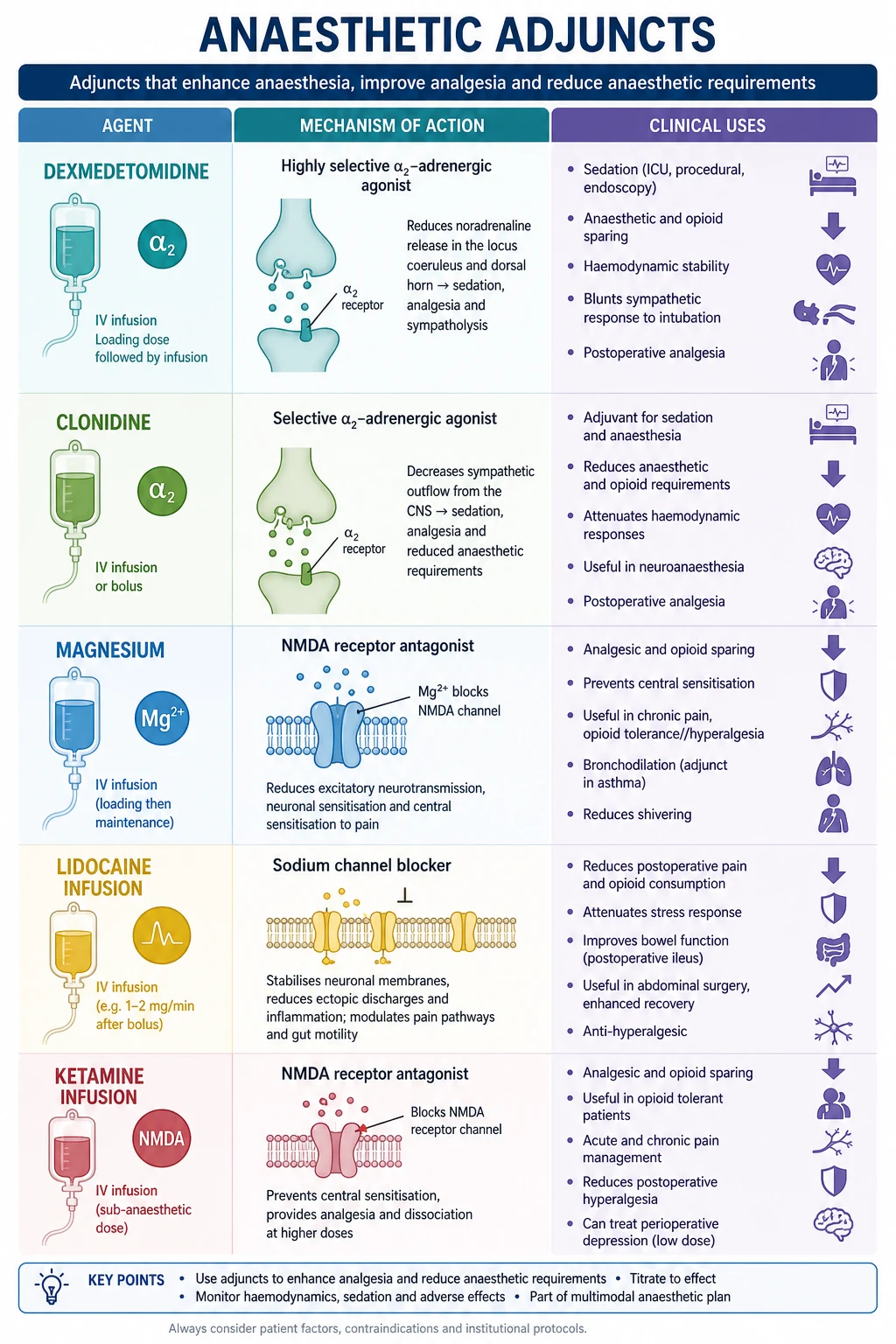
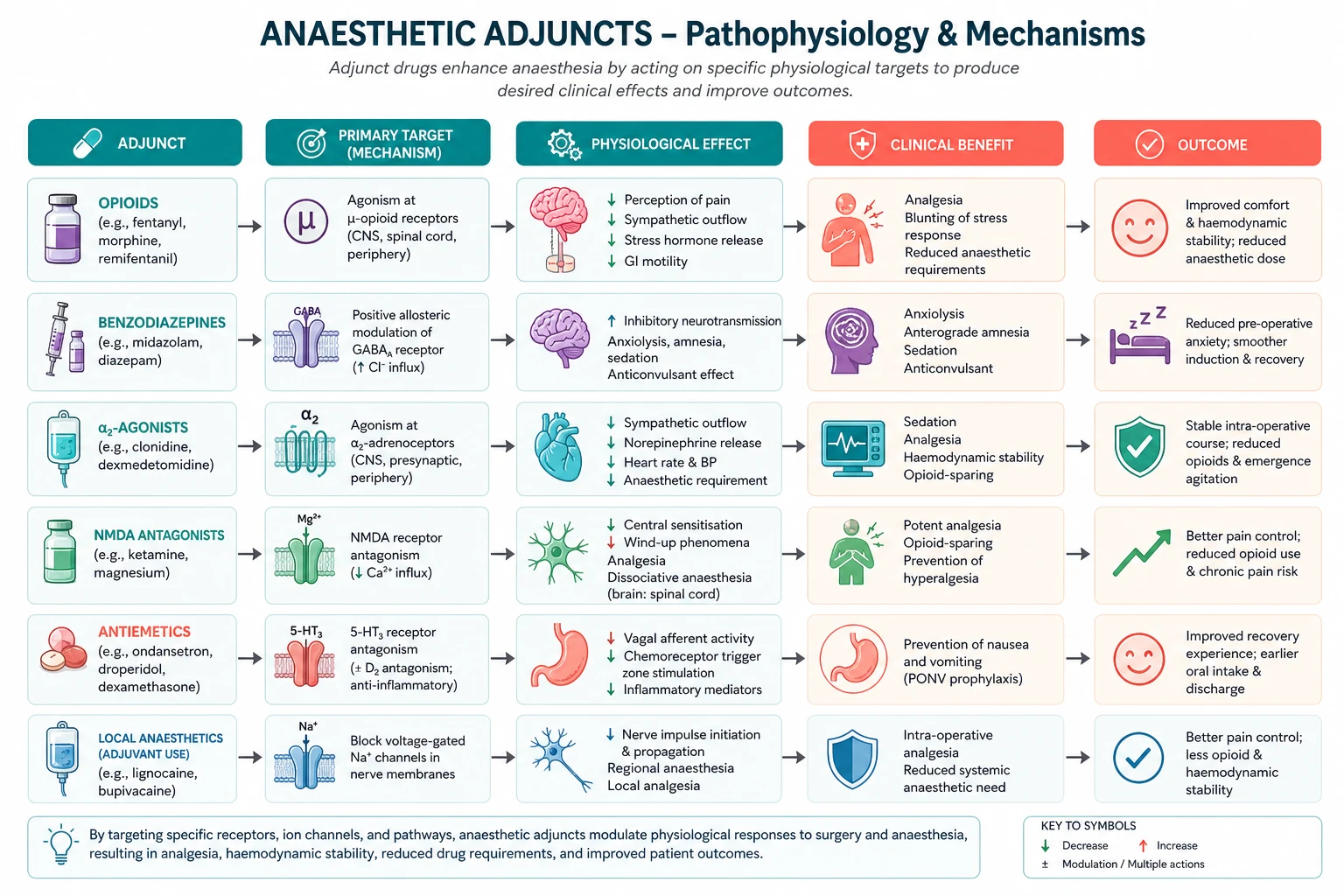
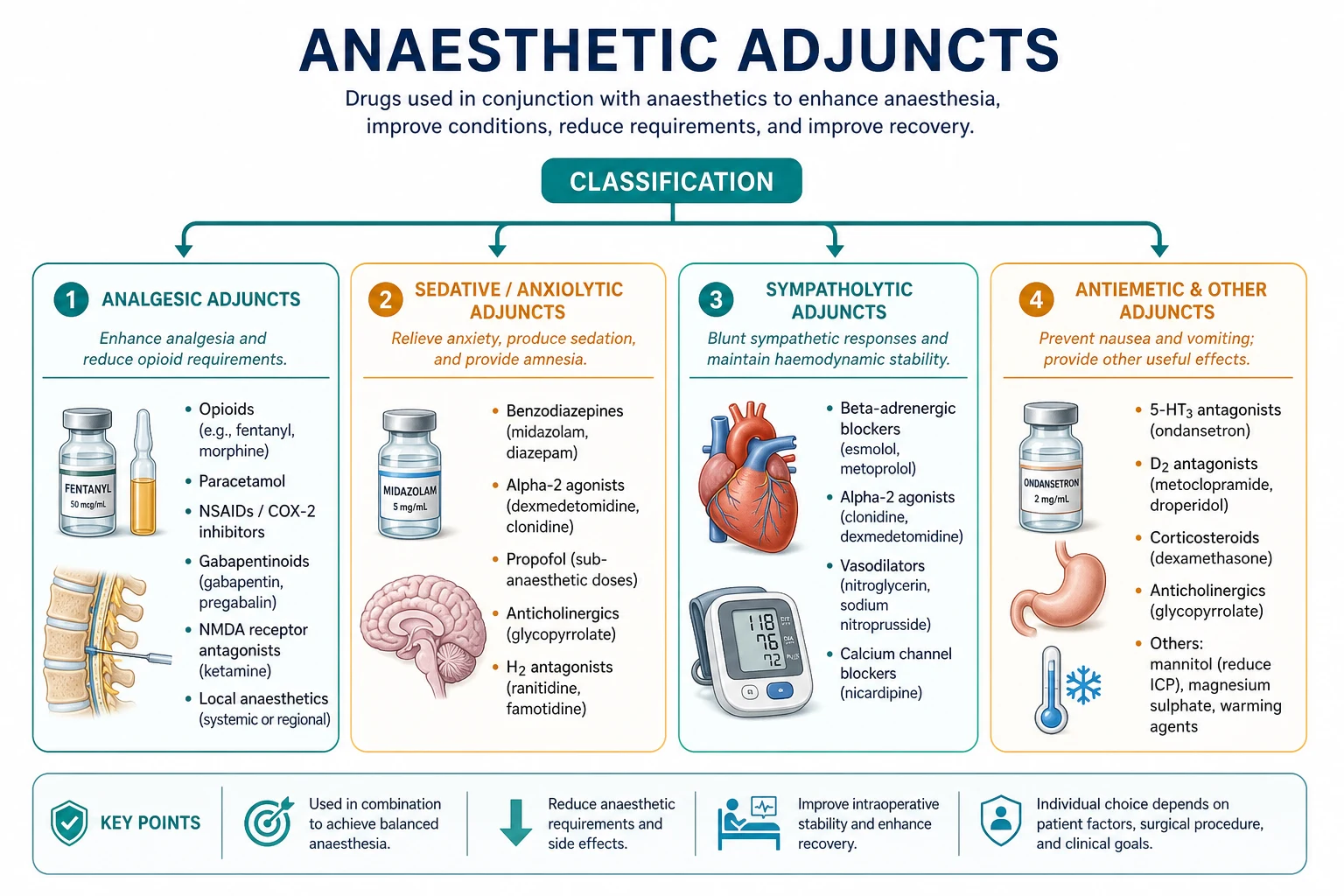
The anaesthetic adjuncts are the agents used alongside the primary anaesthetic to enhance the anaesthesia, the analgesia, the sedation, and the side-effect reduction. The framework rests on the alpha-2 agonists (the dexmedetomidine, the clonidine), the NMDA antagonists (the ketamine, the magnesium), the sodium-channel blockade (the lidocaine infusion), the benzodiazepines (the midazolam), the gabapentinoids, the beta-blockers, and the intrathecal and the regional adjuvants. The multimodal opioid-sparing and the OFA the modern strategy.
On this page & tools
Your progress
Saved locally on this device.
Target exams
Red flags
One-line exam answer
Modern anaesthesia is multimodal. Adjuncts are chosen for a mechanism-matched job — alpha-2 for smooth rousable sedation and MAC sparing, ketamine against hyperalgesia, lidocaine for selected abdominal recovery benefits, magnesium as co-analgesic with neuromuscular consequences, and regional additives for block prolongation — while avoiding polypharmacy without indication.[1][2][3][4]
Why this matters
Examiners test whether you can design an opioid-sparing plan with doses, mechanisms, who should not receive each drug, and how toxicities interact. “Give some ketamine and dex” without numbers or stop rules fails. Postoperative fatigue, bowel recovery, intracranial surgery and orthopaedic neuraxial pathways are all real contexts in which adjunct choice changes outcomes of interest.[1][2][3][4]
Clinical use table — core adjuncts
| Adjunct | Mechanism | Typical perioperative use | Adult dosing guide (order of magnitude; check local) | Key risks / avoid |
|---|---|---|---|---|
| Dexmedetomidine | Selective alpha-2 agonist | Rousable sedation; opioid spare; smooth emergence | Loading often 0.5–1 microg/kg over 10 min (omit if unstable); infusion about 0.2–0.7 microg/kg/h [1] | Bradycardia, hypotension; careful in heart block |
| Clonidine | Alpha-2 agonist | Premed, opioid spare, regional additive | Oral premed 2–3 microg/kg (variable); IV/neuraxial per protocol [4] | Sedation, hypotension, rebound hypertension if chronic stopped abruptly |
| Ketamine / esketamine | NMDA antagonist | Analgesia, anti-hyperalgesia with remifentanil, induction of shock | Analgesic 0.1–0.3 mg/kg boluses or low-dose infusion; induction about 1–2 mg/kg IV [1] | Psychotomimetic effects, secretions; context-specific ICP/IOP cautions |
| Magnesium sulfate | NMDA / calcium-channel effects | Analgesic adjunct; arrhythmia/tocolysis contexts | Common analgesic adjunct 30–50 mg/kg then infusion protocols [3] | Potentiates neuromuscular block; high levels cause weakness and loss of reflexes |
| Lidocaine IV | Sodium channel; anti-inflammatory | Abdominal surgery opioid spare | Bolus about 1–1.5 mg/kg then 1–2 mg/kg/h (cap duration/local rules) [2] | LAST risk; avoid unstable heart block; caution in liver failure |
| Dexamethasone | Genomic anti-inflammatory | PONV prophylaxis; analgesic adjunct | 4–8 mg IV common PONV dose [1] | Hyperglycaemia; infection concerns if repeated high dose |
| Gabapentin / pregabalin | alpha-2-delta calcium subunit | Premed for opioid spare in selected patients | Institution protocols; reduce in renal impairment | Sedation, dizziness, respiratory depression with opioids |
| Paracetamol + NSAID | Central/peripheral COX pathways | Foundation multimodal | Paracetamol 1 g IV/PO; NSAID if no contraindication | Liver dose limits; NSAID renal/bleeding/anastomosis policies |
Alpha-2 agonists in depth
Dexmedetomidine is more alpha-2 selective than clonidine, producing cooperative sedation, reduced MAC and opioid need, and less respiratory depression than GABA agonists at clinical sedative depths. Fast boluses can cause biphasic blood pressure effects: initial hypertension from peripheral alpha effects, then hypotension and bradycardia from central sympatholysis. Clonidine remains useful orally and as a caudal or epidural adjunct for prolonging block, at the price of sedation and hypotension.[4] If the patient is bradycardic and hypotensive on a dexmedetomidine infusion, reduce or stop the infusion before stacking multiple vasopressors blindly — remove the cause.
NMDA antagonists
Ketamine at sub-anaesthetic doses reduces wind-up and remifentanil-associated hyperalgesia and may improve postoperative fatigue metrics in some analyses.[1] Magnesium is a weaker co-analgesic NMDA modulator that also increases sensitivity to non-depolarising neuromuscular blockers — always check TOF before extubation after magnesium-heavy cases, including neurosurgical multimodal pathways.[3]
Intravenous lidocaine
Best evidence niche includes open abdominal surgery for analgesia and return of bowel function when used within protocol.[2] Continuous monitoring, clear stop rules and total amide accounting matter. Never combine casual lidocaine infusions with large fascial-plane local anaesthetic volumes without tracking cumulative dose (LAST).
Regional and neuraxial additives
| Additive | Effect | Notes |
|---|---|---|
| Adrenaline | Prolongs some blocks; IV injection marker | Reduces systemic LA absorption |
| Fentanyl / diamorphine / morphine neuraxial | Segmentally enhanced analgesia | Delayed respiratory depression with hydrophilic morphine |
| Clonidine / dexmedetomidine in block | Prolongs sensory block | Sedation and hypotension possible [4] |
| Dexamethasone (IV or perineural where allowed) | Prolongs analgesia | Local regulatory stance on perineural use varies |
| Sodium bicarbonate | Faster onset some LAs | Precipitates with some mixtures — know compatibility |
Intrathecal adjuvants in lower-limb orthopaedic surgery illustrate the broader principle: benefit is real for block quality and duration, but side-effect profiles (hypotension, sedation, urinary retention, pruritus, delayed respiratory depression) must be anticipated and monitored.[4]
How to build a rational plan
- Foundation: paracetamol ± NSAID if no contraindication.
- Regional where the incision allows.
- Add ketamine if chronic pain, high opioid use, or remifentanil case.[1]
- Add dexmedetomidine if smooth emergence or sedation is needed and heart rate/blood pressure allow.
- Add lidocaine infusion for major abdominal surgery if no contraindication.[2]
- Consider magnesium as co-analgesic when neuromuscular monitoring is reliable.[3]
- PONV: dexamethasone + 5-HT3 ± droperidol as risk indicates.
- Always calculate cumulative toxicity (local anaesthetic, magnesium, sedation stack).
Special populations
- Elderly: reduce gabapentinoids, alpha-2 agonists and sedating stacks; fall and delirium risk.
- Renal impairment: reduce gabapentinoids and magnesium; mind morphine neuraxial metabolites if systemic opioids used.
- Hepatic impairment: reduce lidocaine infusion rates and duration.[2]
- Obstructive sleep apnoea: avoid heavy gabapentinoid–opioid combinations.
- Neurosurgery: magnesium and multimodal strategies are used in selected pathways; coordinate with neuromonitoring and blood-pressure goals.[3]
- Opioid-tolerant patients: prioritise regional, ketamine and non-opioid foundations over ever-higher opioid alone.[1]
SAQ scaffold
- Define adjunct versus primary anaesthetic.
- Table of three adjuncts with mechanism and dose.
- Risks of alpha-2 agonists.
- Why magnesium affects neuromuscular block.
- Design multimodal plan for laparotomy in an opioid-tolerant patient.
- LAST risk when combining IV lidocaine and regional blocks. [2]
Viva phrases
- “What does dexmedetomidine do to MAC?” → “Reduces MAC and opioid requirement via central alpha-2 agonism; watch bradycardia and hypotension.”
- “Why give low-dose ketamine with remifentanil?” → “Attenuates acute tolerance and opioid-induced hyperalgesia via NMDA blockade.”
- “Why check TOF after magnesium?” → “Magnesium potentiates non-depolarising neuromuscular blockade.”
- “Can I run lidocaine and a TAP block together?” → “Only with strict total amide dose accounting and stop rules for LAST.” [3]
Common traps
- Polypharmacy without indication.
- Lidocaine infusion plus large fascial-plane LA volumes without dose accounting.
- Magnesium then surprise prolonged block.
- Gabapentinoids in elderly patients with untreated renal impairment.
- Leaving neuraxial morphine patients unmonitored overnight.
- Fast dexmedetomidine boluses in volume-depleted patients. [4]
Examiner masterclass
High-scoring candidates present adjuncts as a system: foundation analgesics, regional anaesthesia, then targeted systemic adjuncts matched to surgical and patient phenotype. They give approximate doses with units, name toxicities, and state monitoring. They also know when evidence is stronger (ketamine for hyperalgesia/opioid sparing; lidocaine in selected abdominal surgery; magnesium as co-analgesic with neuromuscular caveats) and when it is weaker or more controversial (routine gabapentinoids in every patient).[1][2][3][4]
Worked laparotomy plan example: paracetamol 1 g, NSAID if safe, thoracic epidural or fascial plane block with local anaesthetic dose recorded, low-dose ketamine infusion or boluses if opioid tolerant, consider IV lidocaine only if regional amide load allows, dexamethasone for PONV and analgesia synergy, avoid stacking clonidine and dexmedetomidine and high-dose opioid simultaneously without a reason.[1][2]
Worked remifentanil TIVA plan: expect hyperalgesia risk, give ketamine early, plan transition opioid or regional before remifentanil stops, and do not rely on remifentanil residual analgesia that does not exist.[1]
Worked orthopaedic neuraxial plan: local anaesthetic spinal or CSE, consider intrathecal opioid or other adjuvant per evidence and monitoring capability, avoid excess sedation that masks compartment syndrome symptoms, and document the plan for delayed respiratory depression if hydrophilic opioid used.[4]
Dexmedetomidine
- Alpha-2 selective
- Rousable sedation
- Bradycardia/hypotension
- Opioid/MAC sparing
Ketamine adjunct
- NMDA block
- Anti-hyperalgesia
- Psychotomimetic risk
- Pairs with remi
IV lidocaine
- Abdominal surgery niche
- Infusion protocol
- LAST vigilance
- Bowel recovery signal
Neuraxial opioid
- Excellent analgesia
- Itch/urinary retention
- Delayed resp depression (morphine)
- Monitoring required
Extended viva bank (high-yield stems)
Stem A — definitions under pressure. Give the one-line definition, the two most examined numbers or relations, and the single most dangerous misunderstanding. Keep this under forty-five seconds. [1]
Stem B — mechanism to bedside. Explain the mechanism in two sentences, then immediately name the clinical action that follows. Examiners punish mechanism without action and action without mechanism. [2]
Stem C — compare and choose. Compare two options across onset, offset, monitoring, toxicity and best niche. End with a choice for a stated patient. [3]
Stem D — crisis choreography. Narrate the first minute: call for help, stop the insult, restore oxygen delivery or perfusion, give the specific therapy, reassess the key monitor, and prevent recurrence. [4]
Stem E — special population twist. Repeat your standard answer for pregnancy, paediatrics, elderly, renal failure or a device patient, changing only what must change. [1]
Stem F — equipment or systems failure. Assume the first plan fails. Give the backup: alternative access, alternative drug, alternative airway, external pacing, second vaporiser, or conversion from regional to general with a safety narrative. [2]
SAQ paragraph models
Model opening: Define the topic in one sentence with the key number or equation, then signpost three headings you will cover. [3]
Model middle: Use short paragraphs, each ending with a clinical consequence. Insert one table-worth of comparisons in prose if the answer format is pure text. [4]
Model close: Give hard stops, monitoring, and a one-line pitfall. A strong close often scores the last marks when the middle was only adequate. [1]
Memory anchors
Build memory anchors that regenerate detail rather than store isolated trivia. For physics, anchors are equations and thresholds. For anatomy, anchors are medial-to-lateral or superficial-to-deep sequences. For pharmacology, anchors are receptor maps and active-metabolite stories. For equipment, anchors are safety interlocks and failure modes. If you can regenerate the structure, forgotten minor numbers hurt less. [2]
Theatre checklist language
Convert knowledge into checklists you would actually use: confirm device identity, confirm oxygen analyser, confirm return plate, confirm wire-in-vein, confirm conus-safe interspace, confirm total local anaesthetic dose, confirm ICD therapies on, confirm naloxone and airway plan after neuraxial morphine. Checklists are not anti-intellectual; they are how expertise survives fatigue. [3]
Cross-link map
Almost every thin topic links to another. Fluid flow links to haemorrhage and airway oedema. Electricity links to diathermy and CIED care. Neck anatomy links to CVC complications. Neuraxial spaces link to CSE and caudal. Cranial nerves link to awake intubation and oculocardiac reflex. Vaporisers link to volatile pharmacology and machine check. Adjuncts link to acute pain multimodal pathways. Weak opioids link to pharmacogenomics and paediatric safety bans. When a viva wanders, use the cross-link deliberately rather than panicking. [4]
What “exam-pass learnable” means here
It means a tired candidate can re-read this topic the night before and answer any standard stem without opening another book. It does not mean infinite length. Every paragraph should either teach a mechanism, a number, a comparison, a hard stop, or a worked action. If a sentence does none of those, delete it. If a section lacks a viva stem, add one. If a dose appears, keep a citation nearby. If a claim is clinical, keep a citation nearby. [1]
Final rapid-fire facts to rehearse aloud
Rehearse aloud until the language is automatic: the equation or pathway; the key table; the contraindication list; the first-line crisis action; the monitoring endpoint; the common trap. Spoken fluency is part of viva performance. Silent recognition is not enough. Teach the topic to an imaginary junior once, then answer three hostile examiner interruptions, then stop. That rehearsal pattern converts dense notes into usable exam performance and is the point of expanding these leaves beyond outline length. [2]
Red flags
References
- [1]Al Subhi M, et al. Effect of Perioperative Ketamine and Esketamine on Postoperative Fatigue: A Systematic Review and Meta-Analysis of Randomized Controlled Trials Medicina (Kaunas), 2026.PMID 42356168
- [2]Muntean C, et al. Intravenous Lidocaine as an Adjunct for Postoperative Recovery After Open Abdominal Surgery: A Systematic Review J Clin Med, 2026.PMID 42278931
- [3]Tarimah K, et al. Magnesium Sulfate as a Multimodal Anesthetic Adjuvant in Brain Tumor Surgery: A Systematic Review and Meta-Analysis of Hemodynamic, Analgesic, and Biomarker Outcomes J Clin Med, 2026.PMID 42355804
- [4]Ollosu M, et al. Efficacy and safety of intrathecal adjuvants in lower limb orthopaedic surgery: a systematic review and network meta-analysis of randomised controlled trials J Anesth Analg Crit Care, 2026.PMID 42321879