Anaes · Vasopressors & inotropes
Vasopressors & inotropes
Also known as Vasopressors · Inotropes · Vasoactive agents · Metaraminol · Phenylephrine · Noradrenaline · Vasopressin · Adrenaline · Dobutamine · Milrinone
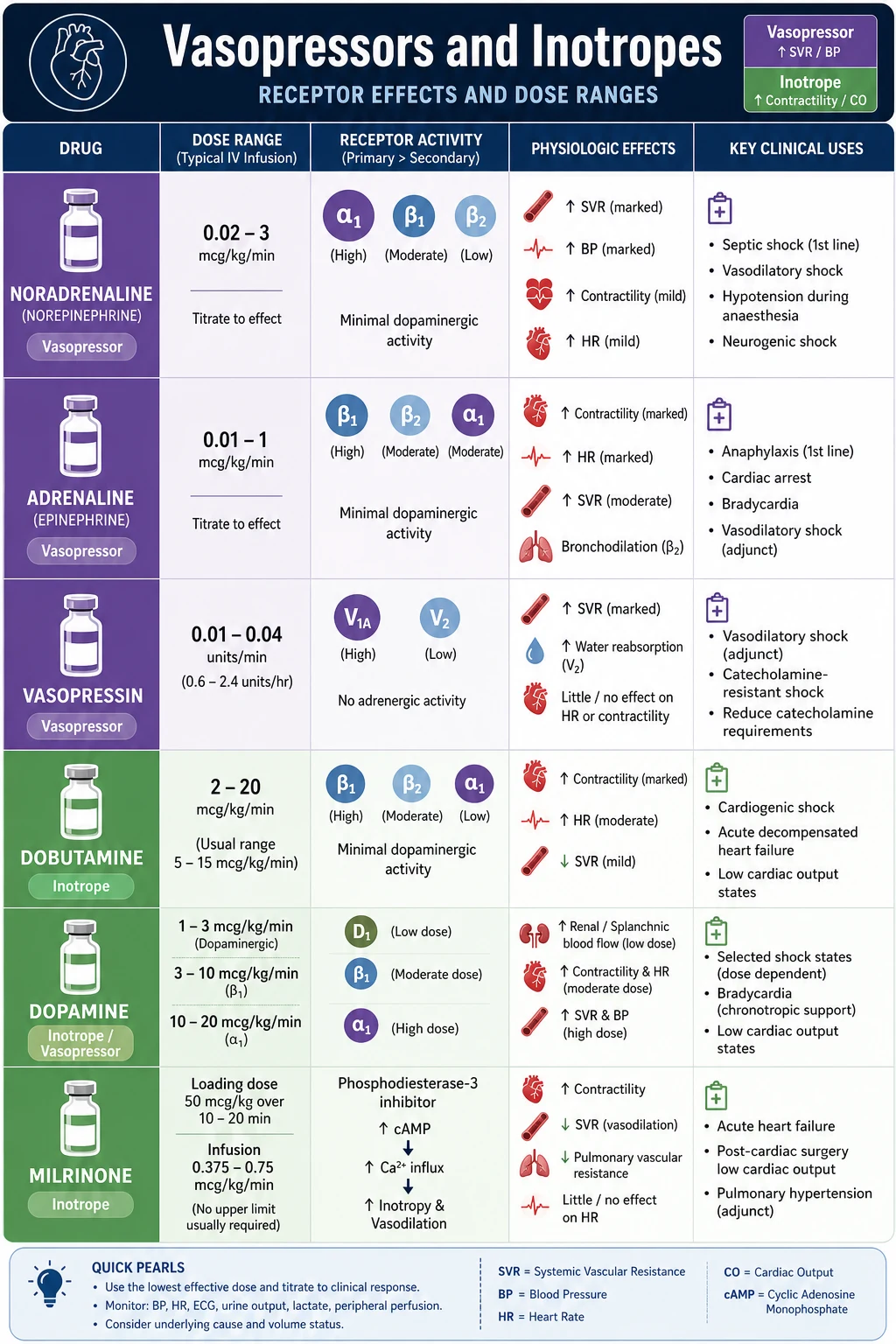
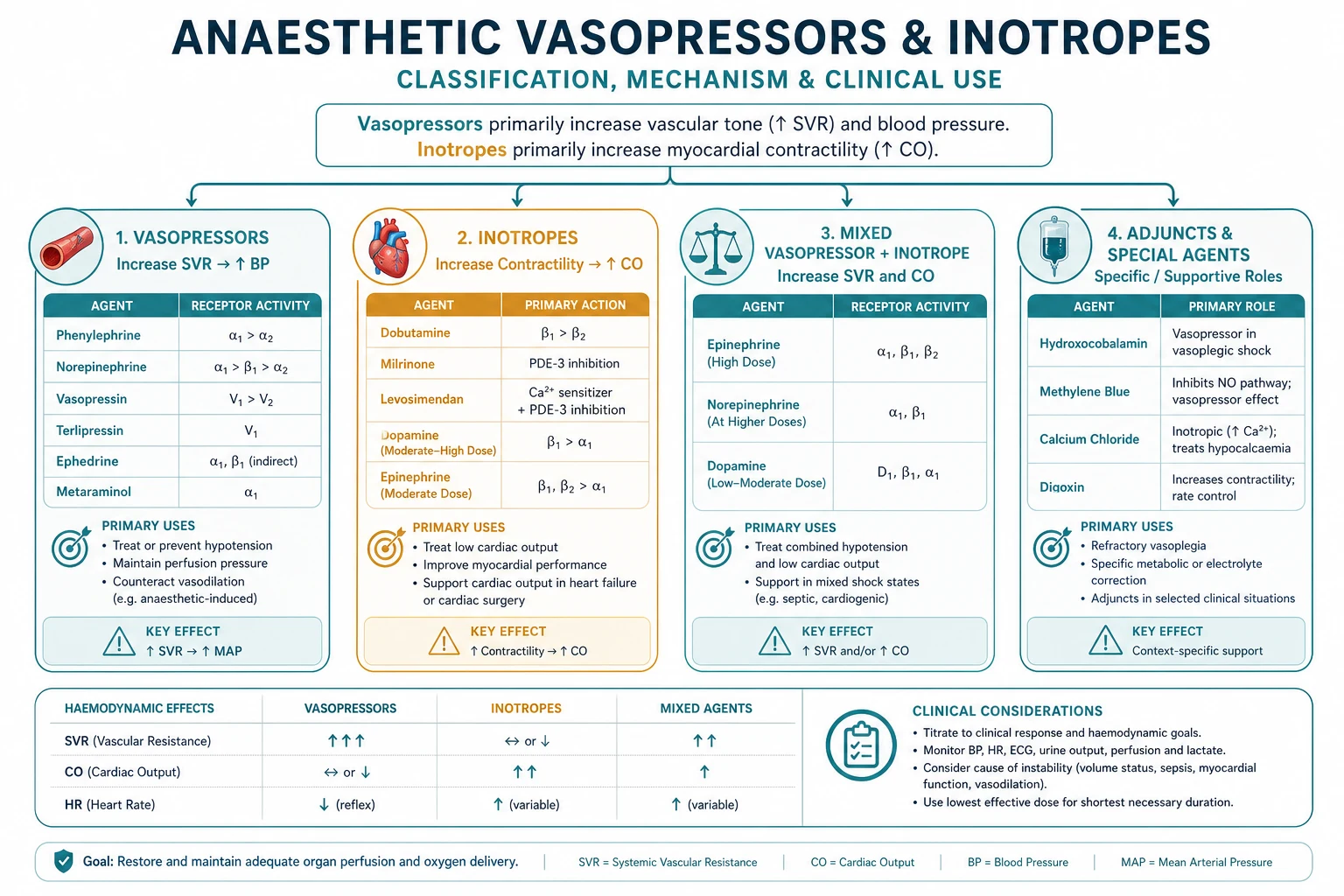
The vasopressors and the inotropes are the vasoactive agents used to maintain the haemodynamic stability in the perioperative and the critically ill patient. The framework rests on the receptor pharmacology (the alpha-1, the beta-1, the beta-2, the V1, the D1), the agents (the metaraminol, the phenylephrine, the ephedrine, the noradrenaline, the adrenaline, the vasopressin; the dobutamine, the milrinone, the levosimendan), the indications (the anaesthesia-induced hypotension, the vasoplegic shock, the cardiogenic shock, the septic shock), and the administration (the bolus vs the infusion, the central vs the peripheral).
On this page & tools
Your progress
Saved locally on this device.
Target exams
Red flags
One-line exam answer
Choose vasoactive drugs by the mechanism of hypotension — vasoplegia, hypovolaemia, bradycardia, or low contractility — never by habit alone. Phenylephrine and metaraminol dominate anaesthesia-induced vasodilation; ephedrine when heart rate is low; noradrenaline for shock; inotropes when the pump fails.[1][3]
Definitions and physiology first
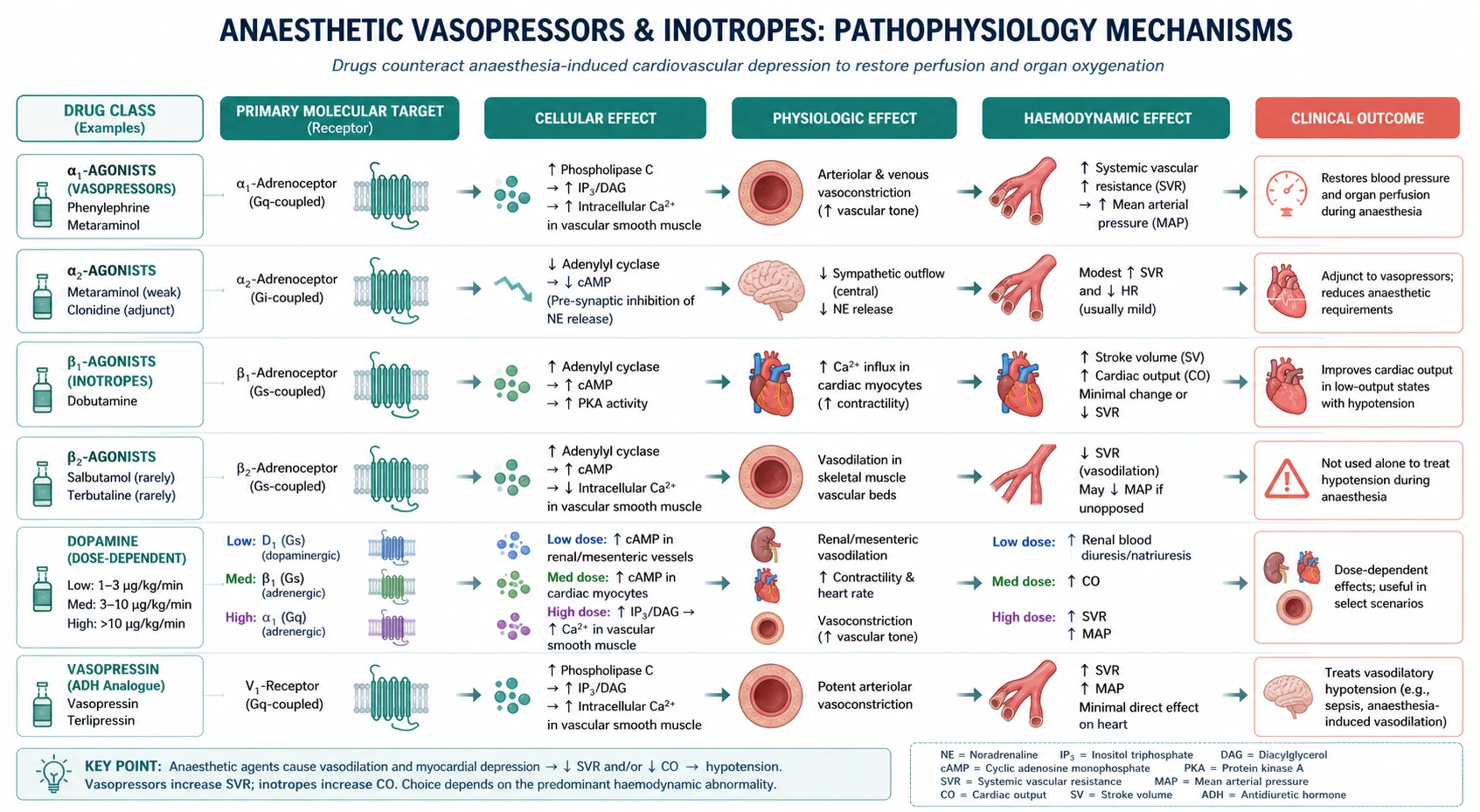
A vasopressor raises blood pressure mainly by increasing systemic vascular resistance. An inotrope raises myocardial contractility. Many agents are mixed: adrenaline has alpha and beta effects; ephedrine raises pressure and heart rate; milrinone is an inodilator. Mean arterial pressure is approximately cardiac output times systemic vascular resistance, so pure vasoconstriction can raise MAP while lowering cardiac output if afterload climbs too far — the classic phenylephrine trap in cardiogenic shock.[1][3]
Hypotension prediction and proactive management matter because even brief intraoperative hypotension associates with organ injury signals in modern observational literature; still, prediction tools do not replace diagnosis of cause.[1] Calcium is not a catecholamine, but ionised hypocalcaemia is a reversible contributor to poor vascular tone and contractility in selected perioperative settings.[2]
Receptor table
| Receptor | Main effect | Clinical result |
|---|---|---|
| alpha-1 | Arterial and venous constriction | Increased SVR and venous return; can increase afterload |
| alpha-2 | Central sympatholysis / peripheral mix | Complex; clonidine and dexmedetomidine related |
| beta-1 | Heart rate and contractility | Increased cardiac output; increased myocardial oxygen use |
| beta-2 | Vasodilation, bronchodilation | Lower SVR; tremor |
| V1 (vasopressin) | Non-adrenergic vasoconstriction | Blood pressure in catecholamine-resistant states |
| DA receptors | Splanchnic/renal variable historically | “Renal dose dopamine” largely abandoned |
Clinical use table — agents
| Drug | Profile | Anaesthesia use | Typical adult pattern (guide) | Cautions |
|---|---|---|---|---|
| Phenylephrine | Pure alpha-1 | Spinal/epidural hypotension; bolus or infusion | Bolus 50–100 microg; infusion titrated [1] | Reflex bradycardia; low CO states may worsen |
| Metaraminol | Direct alpha + some indirect | Common ANZ bolus vasopressor | Bolus 0.5–1 mg titrated [1] | Tachyphylaxis possible |
| Ephedrine | Indirect noradrenaline release + direct | Hypotension with bradycardia (for example spinal) | Bolus 3–6 mg [1] | Tachyphylaxis; MAOI caution; tachycardia |
| Noradrenaline | alpha greater than beta-1 | Septic/vasoplegic shock; many ICU infusions | Infusion via central line preferred (for example 0.05–0.5 microg/kg/min range) [3][4] | Extravasation injury; digital ischaemia if excessive |
| Adrenaline | alpha + beta | Anaphylaxis IM; cardiac arrest; low output niches | Arrest: ALS doses; anaphylaxis IM 0.5 mg adult 1:1000 anterolateral thigh [3] | Arrhythmia; catastrophic if wrong route/dose |
| Vasopressin | V1 agonist | Catecholamine-resistant vasoplegia (sepsis adjunct, post-CPB) | Low-dose infusion per local protocol [3] | Splanchnic ischaemia risk if high |
| Dobutamine | beta-1 greater than beta-2 | Low cardiac output, cardiogenic component | Infusion microg/kg/min titrated [3] | Tachycardia, arrhythmia; may drop SVR |
| Dopamine | Dose-dependent DA/beta/alpha | Less first-line now | Historical dose bands | Arrhythmia; variable response |
| Milrinone | PDE-III inhibitor | RV failure, post-CPB inotropy + vasodilation | Loading + infusion specialist [3] | Hypotension; accumulates in renal failure |
| Calcium | Inotropy / vascular tone | Ionised hypocalcaemia, CPB/protamine contexts | Calcium chloride vs gluconate dosing differs [2] | Arrhythmia if rapid; avoid blind routine calcium |
Anaesthesia-induced hypotension algorithm (learnable)
- Look for cause: deep anaesthesia, hypovolaemia, haemorrhage, anaphylaxis, high spinal, autotransfusion loss, equipment error.
- Lighten anaesthetic if overdose is likely.
- Fluids if hypovolaemic; blood products if bleeding.
- Pick vasopressor by heart rate:
- High or normal HR → phenylephrine or metaraminol
- Low HR → ephedrine (or anticholinergic plus phenylephrine)
- If refractory: escalate to noradrenaline infusion, call for help, consider vasopressin for pure vasoplegia, and re-check for anaphylaxis, occult haemorrhage, or pump failure.[1][3]
- Obstetric spinal hypotension: phenylephrine infusion is commonly preferred in modern obstetric anaesthesia to maintain maternal blood pressure with favourable fetal acid–base patterns compared with pure ephedrine strategies — state your local obstetric protocol.[1]
Shock phenotypes and drug matching
| Phenotype | Physiology | First-line thinking |
|---|---|---|
| Distributive / septic / anaesthetic vasoplegia | Low SVR, often high or normal CO early | Noradrenaline; vasopressin adjunct if refractory |
| Hypovolaemic / haemorrhagic | Low preload | Volume and blood first; temporary vasopressors only as bridge |
| Cardiogenic | Low CO, high filling pressures | Inotrope/inodilator; avoid pure afterload without support |
| Obstructive | Tamponade, PE, tension pneumothorax | Relieve obstruction; pressors are temporising |
| Post-CPB vasoplegia | Profound low SVR after bypass | Noradrenaline ± vasopressin; algorithmised escalation [3] |
Central versus peripheral administration
Potent vasoconstrictor infusions preferably run centrally with continuous arterial monitoring when the patient is sick. Brief peripheral dilute phenylephrine or metaraminol boluses are routine in theatre; watch the IV site. Extravasation of noradrenaline can cause tissue necrosis — early recognition and local protocols (including phentolamine concepts) matter. Peripheral vasoactive infusions are sometimes used short-term with strict safety bundles when central access is delayed, but that is a risk-managed bridge, not a philosophy of convenience.[4]
Special populations
- Obstetrics: phenylephrine often preferred for spinal hypotension; avoid aortocaval compression; treat the cause.
- Elderly / CAD: pure alpha agents may raise afterload and myocardial work — smaller doses, careful titration.[1]
- Beta-blocked patients: may show attenuated heart-rate responses; ephedrine effect can be blunted.
- MAOI / cocaine / indirect agents: care with ephedrine and indirect amines.
- RV failure: milrinone or other pulmonary-friendly strategies may beat pure systemic vasoconstriction alone.[3]
SAQ scaffold
- Define vasopressor versus inotrope with examples.
- Receptor profiles of phenylephrine, ephedrine, noradrenaline, adrenaline.
- Spinal hypotension drug choice by heart rate.
- Vasoplegic shock second-line agents including vasopressin.
- Risks of peripheral noradrenaline.
- Why phenylephrine can worsen cardiogenic shock. [3]
Viva phrases
- “Why might phenylephrine worsen cardiogenic shock?” → “Pure vasoconstriction raises afterload without inotropy; cardiac output may fall further — need an inotrope or inodilator strategy.”
- “Spinal, BP low, HR 45 — drug?” → “Ephedrine, or treat bradycardia, rather than pure phenylephrine alone.”
- “Anaphylaxis first drug?” → “Intramuscular adrenaline 0.5 mg adult into anterolateral thigh — do not wait for an infusion setup.”
- “Refractory post-CPB vasoplegia?” → “Optimise volume and depth, noradrenaline, then consider vasopressin per local algorithm.” [4]
Common traps
- Treating haemorrhage with only vasopressors.
- Confusing adrenaline IV bolus doses with IM anaphylaxis dosing.
- Ignoring reflex bradycardia from phenylephrine.
- Claiming renal-protective dopamine.
- Leaving a noradrenaline infusion running peripherally unwatched.
- Stacking vasopressors without lightening an overdose of propofol or volatile. [1]
Examiner masterclass
The highest scoring answers always diagnose first. Say: “This looks like vasodilated anaesthesia hypotension with heart rate 90, so I will use metaraminol or phenylephrine while reducing anaesthetic depth and checking volume.” Or: “This looks like bradycardic spinal hypotension, so ephedrine.” Or: “This looks like septic vasoplegia, so noradrenaline via reliable access after cultures and source control pathway.” That phenotype language is more valuable than reciting every receptor affinity number from memory.[1][3][4]
If arterial pressure is low and the suction bottle is filling, the first “vasopressor” is a second large-bore IV and blood products. If the patient is anaphylactic, the first drug is intramuscular adrenaline, not a slow discussion about noradrenaline receptor ratios. If the heart is empty on ultrasound, fill it. If the heart is failing, support contractility. Examiners listen for that clinical order. [2]
Post-cardiac surgical vasoplegia deserves a named mental algorithm: exclude bleeding and tamponade, optimise pacing and haemoglobin, noradrenaline for SVR, vasopressin if catecholamine-resistant, and consider specialist adjuncts only within institutional pathways.[3] Calcium correction is for documented hypocalcaemia or specific CPB contexts, not a ritual push.[2]
Peripheral noradrenaline literature and practice are evolving: short, dilute, closely observed peripheral infusions can bridge to central access, but they require site checks, prompt conversion, and extravasation plans.[4] Theatre culture that treats every hypotension with the same 1 mL of whatever is drawn up will eventually harm a bleeding or cardiogenic patient.
Worked stems
Stem 1: Caesarean under spinal, BP 80/40, HR 55, fetal bradycardia emerging. Answer structure: left uterine displacement, fluids, ephedrine or phenylephrine according to heart rate and local obstetric protocol, prepare for high block or haemorrhage differentials, communicate with obstetric team.[1]
Stem 2: Laparotomy for sepsis, noradrenaline climbing, cool mottled periphery. Answer structure: source control urgency, volume responsiveness assessment, vasopressin consideration, inotrope if ventricles failing, avoid pure afterload on an empty heart.[3]
Stem 3: Phenylephrine infusion, HR falls to 40, BP still low. Answer structure: reduce pure alpha drive, treat bradycardia, reassess depth and volume, consider mixed agent strategy. [3]
Phenylephrine
- Pure alpha-1
- Reflex bradycardia
- Spinal hypotension
- May drop CO
Ephedrine
- Indirect + direct
- Raises HR
- Good if bradycardic
- Tachyphylaxis
Noradrenaline
- Shock workhorse
- Alpha ± beta-1
- Central infusion
- Extravasation risk
Adrenaline
- Anaphylaxis IM
- Arrest ALS
- Alpha+beta
- Arrhythmogenic
Extended viva bank (high-yield stems)
Stem A — definitions under pressure. Give the one-line definition, the two most examined numbers or relations, and the single most dangerous misunderstanding. Keep this under forty-five seconds. [4]
Stem B — mechanism to bedside. Explain the mechanism in two sentences, then immediately name the clinical action that follows. Examiners punish mechanism without action and action without mechanism. [1]
Stem C — compare and choose. Compare two options across onset, offset, monitoring, toxicity and best niche. End with a choice for a stated patient. [2]
Stem D — crisis choreography. Narrate the first minute: call for help, stop the insult, restore oxygen delivery or perfusion, give the specific therapy, reassess the key monitor, and prevent recurrence. [3]
Stem E — special population twist. Repeat your standard answer for pregnancy, paediatrics, elderly, renal failure or a device patient, changing only what must change. [4]
Stem F — equipment or systems failure. Assume the first plan fails. Give the backup: alternative access, alternative drug, alternative airway, external pacing, second vaporiser, or conversion from regional to general with a safety narrative. [1]
SAQ paragraph models
Model opening: Define the topic in one sentence with the key number or equation, then signpost three headings you will cover. [2]
Model middle: Use short paragraphs, each ending with a clinical consequence. Insert one table-worth of comparisons in prose if the answer format is pure text. [3]
Model close: Give hard stops, monitoring, and a one-line pitfall. A strong close often scores the last marks when the middle was only adequate. [4]
Memory anchors
Build memory anchors that regenerate detail rather than store isolated trivia. For physics, anchors are equations and thresholds. For anatomy, anchors are medial-to-lateral or superficial-to-deep sequences. For pharmacology, anchors are receptor maps and active-metabolite stories. For equipment, anchors are safety interlocks and failure modes. If you can regenerate the structure, forgotten minor numbers hurt less. [1]
Theatre checklist language
Convert knowledge into checklists you would actually use: confirm device identity, confirm oxygen analyser, confirm return plate, confirm wire-in-vein, confirm conus-safe interspace, confirm total local anaesthetic dose, confirm ICD therapies on, confirm naloxone and airway plan after neuraxial morphine. Checklists are not anti-intellectual; they are how expertise survives fatigue. [2]
Cross-link map
Almost every thin topic links to another. Fluid flow links to haemorrhage and airway oedema. Electricity links to diathermy and CIED care. Neck anatomy links to CVC complications. Neuraxial spaces link to CSE and caudal. Cranial nerves link to awake intubation and oculocardiac reflex. Vaporisers link to volatile pharmacology and machine check. Adjuncts link to acute pain multimodal pathways. Weak opioids link to pharmacogenomics and paediatric safety bans. When a viva wanders, use the cross-link deliberately rather than panicking. [3]
What “exam-pass learnable” means here
It means a tired candidate can re-read this topic the night before and answer any standard stem without opening another book. It does not mean infinite length. Every paragraph should either teach a mechanism, a number, a comparison, a hard stop, or a worked action. If a sentence does none of those, delete it. If a section lacks a viva stem, add one. If a dose appears, keep a citation nearby. If a claim is clinical, keep a citation nearby. [4]
Final rapid-fire facts to rehearse aloud
Rehearse aloud until the language is automatic: the equation or pathway; the key table; the contraindication list; the first-line crisis action; the monitoring endpoint; the common trap. Spoken fluency is part of viva performance. Silent recognition is not enough. Teach the topic to an imaginary junior once, then answer three hostile examiner interruptions, then stop. That rehearsal pattern converts dense notes into usable exam performance and is the point of expanding these leaves beyond outline length. [1]
Red flags
References
- [1]Xie CM, et al. Hypotension prediction index in surgical patients: A systematic review and meta-analysis of randomized controlled trials Medicine (Baltimore), 2026.PMID 42299539
- [2]Miller A, et al. The effect of intravenous calcium administration on haemodynamics in perioperative cardiothoracic surgery and intensive care: A narrative review Crit Care Resusc, 2026.PMID 42016282
- [3]Chatterjee S, et al. Management Algorithm for Vasoplegic Shock after Cardiac Surgery: An Interdisciplinary Collaboration Ann Thorac Surg, 2026.PMID 42309294
- [4]Singh O, et al. Navigating the veins: A comprehensive review of vasoactive agent infusion via peripheral routes World J Crit Care Med, 2026.PMID 42272888