Anaes · Anaesthetic adjuncts
Antiemetics for PONV — 5-HT3 antagonists, dexamethasone, droperidol, NK1 antagonists
Also known as Ondansetron · Dexamethasone · Droperidol · Aprepitant · Postoperative nausea and vomiting prophylaxis · Apfel risk score
Postoperative nausea and vomiting remains the most common cause of patient dissatisfaction after anaesthesia and the anaesthetist controls most of its determinants, so a working command of the four antiemetic drug classes and of the risk-stratified strategy that deploys them is a high-yield applied pharmacology block. The framework rests on five exam-critical ideas: the four classes act at four distinct receptor targets (the 5-HT3 antagonists such as ondansetron block serotonin at the chemoreceptor trigger zone and the gut, the corticosteroid dexamethasone suppresses central inflammatory and prostaglandin pathways, the butyrophenone droperidol blocks dopamine D2 receptors, and the NK1 antagonists such as aprepitant block substance P), and each class has a signature adverse effect the anaesthetist must know (ondansetron prolongs the QT interval, droperidol carries a Food and Drug Administration black-box warning for QT prolongation, dexamethasone is remarkably safe and inexpensive, and the NK1 antagonists are long-acting but expensive); the Apfel score stratifies risk from four simple factors (female sex, non-smoker, history of PONV or motion sickness, and postoperative opioids) and predicts an incidence from about 10 per cent with no factors up to about 80 per cent with all four; prophylaxis is reserved for moderate-to-high-risk patients and is given as combination therapy using two or three agents from different classes, because no single agent is effective enough to use alone in a high-risk patient; and rescue treatment of breakthrough PONV uses a drug from a different class than the prophylaxis, because intraoperative prophylaxis has already occupied the first receptor. Built on the dexamethasone-versus-ondansetron PONV trial (Loomba 2026), the dexamethasone perioperative analgesia review (Pantke 2026), the opioid-sparing anaesthesia and PONV after breast surgery study (Sung 2026), the aprepitant neuroprotection review (Akbarpournikghalb 2026), the immediate versus delayed dexamethasone implantation study (Chen 2026), and the oliceridine versus sufentanil PONV trial (Liu 2026).
On this page & tools
Your progress
Saved locally on this device.
8 MCQs with explanations
Target exams
Red flags

Why this matters to the anaesthetist
Postoperative nausea and vomiting is the single most common complication of anaesthesia and surgery, and it is the complication that patients say they fear most before an operation — often more than pain. Its incidence varies widely with the patient, the surgery and the anaesthetic, from under 10 per cent in a low-risk patient to over 80 per cent in a high-risk patient, and in the unprepared high-risk patient it approaches a near-certainty. Beyond dissatisfaction, it carries real morbidity: vomiting can threaten a fresh surgical repair (straining after intraocular, middle-ear, or neurosurgical procedures), it can cause dehydration and electrolyte disturbance, it can bleed at the operative site from retching-induced venous hypertension, and it delays discharge and readmissions the patient to hospital. The economic burden is substantial, because PONV is the leading cause of unanticipated overnight admission after day surgery.[1]
The good news, and the reason this is a controllable problem, is that the anaesthetist influences almost every determinant of PONV. The choice of anaesthetic technique (total intravenous anaesthesia with propofol is antiemetic; nitrous oxide and the volatile agents are emetogenic), the amount of opioid used (the most powerful single surgical cause of PONV), and the selection and timing of prophylactic antiemetics are all under the anaesthetist's direct control. A modern, well-conducted anaesthetic in a high-risk patient uses a risk-stratified combination of these levers — a propofol-based technique, opioid-sparing multimodal analgesia, and two or three antiemetic agents from different classes — and can bring the incidence down from 80 per cent to single figures. Mastery of the four antiemetic drug classes and of the strategy that deploys them is therefore one of the highest-yield blocks in the applied pharmacology syllabus.[3]
The four drug classes at a glance
Four drug classes dominate PONV prophylaxis and treatment, and they are best remembered as four distinct receptor targets. No single class is effective enough to use alone in a high-risk patient — even the best agent, given as monotherapy, reduces the relative risk of PONV by only about a quarter to a third — so the practical art is to combine them.[1]
- 5-HT3 receptor antagonists (ondansetron, granisetron, palonosetron, ramosetron) block serotonin at the 5-HT3 receptor of the chemoreceptor trigger zone in the area postrema and on the vagal afferents of the gut. Ondansetron is the prototype and the workhorse, given as 4 mg intravenously at induction or at the end of surgery. The signature adverse effect is dose-dependent QT prolongation.[1][6]
- Corticosteroids (dexamethasone) have an incompletely understood antiemetic mechanism thought to involve suppression of central inflammatory and prostaglandin pathways and of the central serotonin response. Dexamethasone is given as 4 to 8 mg intravenously at induction, is inexpensive, is long-acting, and has few adverse effects at single perioperative doses; it also reduces postoperative pain and prolongs regional blocks.[2][5][1]
- Butyrophenones (droperidol) act as dopamine D2 receptor antagonists (with alpha-1 antagonism contributing to their adverse-effect profile). Droperidol is an effective rescue antiemetic in a dose of 0.625 to 1.25 mg intravenously, but it carries a Food and Drug Administration black-box warning for QT prolongation.[1]
- NK1 receptor antagonists (aprepitant orally, fosaprepitant intravenously) block substance P at the neurokinin-1 receptor. They are long-acting (covering roughly 48 hours), are expensive, and are typically reserved for the highest-risk patient as part of triple therapy.[4]
5-HT3 receptor antagonists
The 5-HT3 antagonists are the most widely used and the best studied of the antiemetic classes, and ondansetron is their prototype. They act by blocking the type-3 serotonin receptor at two anatomically distinct sites: the chemoreceptor trigger zone in the area postrema of the medulla (which lies outside the blood-brain barrier and samples the blood for emetic toxins) and the vagal afferent nerve endings in the gastrointestinal wall (which detect the mucosal serotonin released by chemotherapy and radiotherapy damage). By blocking both the central and the peripheral limb of the emetic reflex they are effective against both central (opioid, anaesthetic) and peripheral (gastrointestinal) triggers.[1]
The class includes ondansetron (the prototype, 4 mg intravenously, a short-acting agent with a half-life of about 3 to 4 hours), granisetron (1 mg intravenously, slightly longer acting), ramosetron (0.3 mg intravenously, longer acting still and popular in East Asian practice), and palonosetron (the longest acting of the class, with a half-life of about 40 hours, allowing a single intravenous dose of 0.075 mg to cover the first 24 to 48 hours postoperatively). The longer half-life of palonosetron is its distinguishing pharmacokinetic advantage and a classic exam point — it also exhibits allosteric binding and internalisation of the 5-HT3 receptor, which may explain its prolonged action beyond its half-life alone.[6]
The 5-HT3 antagonists are most effective when given at the end of surgery rather than at induction, because their duration of action is short relative to the duration of the emetic stimulus, and giving them at the end ensures peak effect during the early recovery period when PONV is most likely. Their common adverse effects are headache, constipation, and a mild, transient, asymptomatic rise in liver enzymes, and the serious adverse effect is dose-dependent QT prolongation, discussed under adverse effects. The dexamethasone-versus-ondansetron comparison by Loomba and colleagues is representative of a large evidence base showing that both agents are effective and that they are more effective combined than alone.[1]
Corticosteroids — dexamethasone
Dexamethasone is the corticosteroid used for PONV prophylaxis, and it is one of the most attractive antiemetics in the modern formulary: it is inexpensive, long-acting, effective, and remarkably free of adverse effects at the single perioperative doses used for PONV. Its mechanism as an antiemetic is incompletely understood, but it is thought to act by suppressing central inflammatory and prostaglandin-mediated pathways in the chemoreceptor trigger zone and by modulating the central release and receptor response to serotonin. The onset is slow relative to the other classes — peak antiemetic effect is at around 2 hours — which is why it is given at induction rather than at the end of surgery, so that its effect has matured by the time the patient reaches the recovery room.[2][1]
The standard PONV dose is 4 to 8 mg intravenously at induction. Beyond its antiemetic effect, perioperative dexamethasone has two valuable adjunctive properties that the anaesthetist should know and that the Pantke review of dexamethasone for perioperative analgesia brings together: it reduces postoperative pain (through the same anti-inflammatory and prostaglandin-suppression pathways) and it prolongs the duration of regional and neuraxial nerve blocks when given systemically or as an adjuvant. These opioid-sparing and analgesic effects are an added reason to use dexamethasone, because by reducing opioid consumption it secondarily reduces opioid-driven PONV — a virtuous circle.[2]
The immediate-versus-delayed dexamethasone implantation study by Chen and colleagues is an ophthalmological example of how the timing of dexamethasone delivery conditions its effect, and it illustrates the general pharmacokinetic point that dexamethasone is a slow-onset, long-duration agent whose effect is shaped by when it is given relative to the inflammatory stimulus. In PONV prophylaxis the practical corollary is to give it early — at induction — not at the end. The adverse effects of a single perioperative dose are negligible: the historical concerns about wound infection, hyperglycaemia, and adrenal suppression are dose- and duration-dependent and are not clinically significant at the single 4 to 8 mg intravenous dose used for PONV, although a transient hyperglycaemia in the diabetic patient and a small theoretical wound-infection signal in bowel surgery are worth noting.[5]
Butyrophenones — droperidol
Droperidol is a butyrophenone and a dopamine D2 receptor antagonist, structurally related to haloperidol, and it is one of the oldest, cheapest, and most effective antiemetics available. Its D2 antagonism at the chemoreceptor trigger zone underlies its antiemetic effect, and its additional alpha-1 adrenergic antagonism underlies its principal adverse effects (sedation, hypotension, and the restless or dysphoric emergence that some patients describe). It is particularly effective against nausea and against the opioid-induced form of PONV.[1]
The clinical doses for PONV are small: 0.625 to 1.25 mg intravenously, far below the higher doses once used for neuroleptanaesthesia. At these low doses droperidol is an effective rescue antiemetic and a useful component of combination prophylaxis. It differs from the 5-HT3 antagonists in its adverse-effect profile — it causes sedation and mild hypotension rather than headache and constipation — and it is sometimes preferred in the recovery room for the agitated, nauseated patient where a degree of sedation is welcome.[1]
The dominant issue for the modern anaesthetist is the QT prolongation. In 2001 the Food and Drug Administration issued a black-box warning for droperidol, reporting cases of torsades de pointes and deaths, several at doses at or below the antiemetic range and several in patients with risk factors (long-QT syndrome, electrolyte disturbance, other QT-prolonging drugs). The warning caused a dramatic and sustained fall in droperidol use worldwide, even though subsequent reappraisal argued that the cases were confounded and that the antiemetic doses carried a very small absolute risk. The warning was partially relaxed in 2024, and droperidol has to some extent returned to practice, but the caution is permanent: droperidol is contraindicated in known or congenital long-QT syndrome and must be used with caution in the cardiac patient, the elderly, the electrolyte-depleted patient, and with other QT-prolonging drugs (including the 5-HT3 antagonists — see adverse effects).[1]
NK1 receptor antagonists
The neurokinin-1 receptor antagonists are the newest of the four classes, introduced for chemotherapy-induced nausea and vomiting and then extended to PONV. They act by blocking substance P at the NK1 receptor in the brainstem emetic centres, a different neurotransmitter and a different receptor from the other three classes, which is the basis of their additive effect in combination therapy. The class includes aprepitant (an oral prodrug, given as 40 to 80 mg within a few hours before surgery) and fosaprepitant (the intravenous prodrug of aprepitant, given as a single 150 mg dose at induction).[4]
The distinguishing pharmacokinetic feature of the NK1 antagonists is their long duration of action — roughly 48 hours of antiemetic cover from a single dose, far longer than ondansetron or droperidol. This makes them uniquely well suited to the patient whose emetic risk extends beyond the first postoperative day (major surgery, high opioid requirements, a patient with a strong history of PONV) and to the chemotherapy setting where the emetic stimulus is sustained. The cost is the principal drawback: the NK1 antagonists are substantially more expensive than the other three classes, and this confines their routine use to the highest-risk patient, typically as the third agent in triple therapy.[4]
The aprepitant work by Akbarpournikghalb and colleagues summarises the broader pharmacology of aprepitant, including its neuroprotective and anti-inflammatory actions beyond its antiemetic effect, which are an active area of research. A practical perioperative pharmacology point is that aprepitant is a moderate inhibitor of CYP3A4, and it can increase the exposure to co-administered CYP3A4 substrates — most relevantly, it can roughly double the exposure to dexamethasone, so when the two are combined in triple therapy the dexamethasone dose may need consideration. The NK1 antagonists are otherwise well tolerated, with a low incidence of adverse effects (mild fatigue, dizziness, and headache) and no significant QT effect.[4]
The Apfel PONV risk score
Because prophylaxis is not for everyone, the first step in managing PONV is to stratify the patient's risk, and the standard tool is the Apfel score. The Apfel score is a simplified, validated, four-factor predictor of PONV risk derived from large multicentre datasets, and its strength is that it uses only four simple, pre-or-intraoperative predictors that the anaesthetist can establish in seconds.[3]
The four risk factors are: female sex, a history of PONV or motion sickness, non-smoker status, and the anticipated use of postoperative opioids. Each factor present contributes one point, and the total score (from 0 to 4) predicts the approximate incidence of PONV in the first 24 hours. The incidence rises steeply with each additional factor: about 10 per cent with no factors, about 20 per cent with one factor, about 40 per cent with two factors, about 60 per cent with three factors, and about 80 per cent with all four factors. The non-linear step from two factors (40 per cent) to four factors (80 per cent) captures the multiplicative nature of PONV risk and is the justification for escalating from no prophylaxis through monotherapy to combination therapy as the score rises.[3]
The Apfel score is deliberately simple and it omits some known contributors (long duration of surgery, the type of surgery, volatile anaesthesia, nitrous oxide, postoperative pain) in the interest of bedside usability. These omitted factors still matter and the experienced anaesthetist folds them into the decision: a long volatile-based laparoscopic or gynaecological procedure in a non-smoking woman is high-risk regardless of the score, and the opioid-sparing anaesthesia and PONV study by Sung and colleagues in breast surgery is a representative demonstration of how the anaesthetic technique itself shifts the risk that the Apfel score estimates.[3]
Risk-stratified prophylaxis strategy
The Apfel score converts directly into a prophylaxis strategy, because the benefit of prophylaxis rises with the baseline risk while the cost and the adverse-effect burden are roughly constant. The principle is simple: do not prophylax the low-risk patient, use one agent for the moderate-risk patient, and use combination therapy for the high-risk patient.[3]
- Low risk (Apfel 0 or 1, baseline 10 to 20 per cent): no routine pharmacological prophylaxis. The number needed to treat is high, the cost is unjustified, and the patient is exposed to adverse effects for little benefit. Focus instead on the emetogenic factors under the anaesthetist's control — a propofol-based technique, opioid-sparing analgesia, avoidance of nitrous oxide, adequate hydration.
- Moderate risk (Apfel 2, baseline about 40 per cent): monotherapy with a single agent from one of the four classes. Dexamethasone 4 to 8 mg at induction, or ondansetron 4 mg at the end of surgery, are the common first choices; droperidol 0.625 to 1.25 mg and an NK1 antagonist are alternatives where there is a reason to prefer them.
- High risk (Apfel 3 or 4, baseline 60 to 80 per cent): combination therapy with two or three agents from different classes, because no single agent reduces the risk enough. The standard combination is dexamethasone plus a 5-HT3 antagonist, with droperidol or an NK1 antagonist added as the third agent in the very-high-risk patient. The opioid-sparing and oliceridine-versus-sufentanil work by Liu and colleagues illustrates how the choice of opioid itself conditions the residual risk that the prophylaxis must cover.[6]
The mechanistic rationale for combination therapy is that the four classes act at four different receptors, so their effects are additive and independent. Combining two agents from different classes roughly doubles the relative-risk reduction that either would achieve alone, and combining three can reduce a high baseline risk to single figures. Combining two agents from the same class (for example, ondansetron plus granisetron) is not additive, because they occupy the same receptor, and is not recommended.[3][1]
Rescue treatment of breakthrough PONV
Despite good prophylaxis, some patients — particularly the high-risk patient — will still develop PONV in the recovery room or on the ward, and the treatment of this breakthrough PONV follows one overriding rule: use a drug from a different class than the prophylaxis.[3]
The rationale is mechanistic and practical. The prophylactic agent has already been given and has occupied its receptor; giving more of the same drug (for example, a second dose of ondansetron after ondansetron prophylaxis) produces little additional benefit, because the receptor is already saturated and the failure is not a dosing problem but a receptor-class problem. Reaching for a different class (droperidol after a 5-HT3 antagonist, or an NK1 antagonist after dexamethasone, or a 5-HT3 antagonist after droperidol prophylaxis) attacks the emetic reflex through a new pathway and is far more likely to work. A reasonable interval — often quoted as at least 6 hours, or within the first postoperative day — should elapse before repeating the same class, and even then a different class is preferred.[3]
In practice the rescue armamentarium is the same four classes, used at their rescue doses: droperidol 0.625 to 1.25 mg (a popular rescue because of its fast onset and its useful mild sedation in the agitated nauseated patient), ondansetron 1 mg or 4 mg (if no 5-HT3 antagonist was used for prophylaxis), dexamethasone (rarely a rescue agent because of its slow onset, but useful where it was omitted at induction), and promethazine, metoclopramide, or prochlorperazine as second-line rescue agents outside the four main classes. The oliceridine-versus-sufentanil trial by Liu and colleagues is a reminder that the choice of opioid is itself a determinant of breakthrough PONV, and that an opioid-sparing or opioid-replacement strategy may be more effective than any rescue antiemetic.[6]
Multimodal and opioid-sparing approach
Pharmacological prophylaxis is only one of the levers the anaesthetist controls, and the most effective PONV strategy is a multimodal one that attacks the emetic stimulus at its source rather than relying on antiemetic drugs alone. The single most powerful emetogenic factor under anaesthetic control is the opioid, and the modern approach is therefore opioid-sparing: reduce the intraoperative and postoperative opioid dose as far as analgesia allows, using a combination of non-opioid analgesics and regional techniques to replace it.[3]
The opioid-sparing toolkit has several components. Total intravenous anaesthesia with propofol is itself antiemetic, because propofol has a direct antiemetic effect at sub-hypnotic doses and because avoiding the volatile agents removes an emetogenic stimulus; propofol-based anaesthesia roughly halves the incidence of PONV compared with volatile-based anaesthesia. Avoiding nitrous oxide removes another emetogenic agent, particularly relevant in long cases. Multimodal analgesia with paracetamol, a non-steroidal anti-inflammatory drug, an alpha-2 agonist such as dexmedetomidine, and low-dose ketamine reduces opioid consumption by a quarter to a half. Regional and neuraxial techniques (peripheral nerve blocks, epidural and spinal analgesia, wound infiltration) can eliminate or radically reduce the opioid requirement for a given surgery. The Sung study of opioid-sparing anaesthesia and PONV after breast surgery is a clean demonstration of the principle, and the Liu study of the biased opioid agonist oliceridine against sufentanil extends it to the choice of opioid itself — a mu-biased agonist with less beta-arrestin recruitment may carry a lower PONV burden than a conventional opioid.[3][6]
Alongside these, the simple physiological factors matter: adequate hydration, avoidance of hypotension, adequate treatment of pain (untreated pain is itself emetogenic), and gentle reversal from neuromuscular blockade (avoiding the cholinergic surge of a high neostigmine dose by using sugammadex where appropriate, or by keeping the neostigmine dose proportionate to the block). The Pantke review of dexamethasone for perioperative analgesia captures the analgesic as well as the antiemetic contribution of dexamethasone, which is a bridge between the pharmacological prophylaxis strategy and the opioid-sparing strategy — one drug that contributes to both.[2]
Adverse effects and safety
The adverse-effect profiles of the four classes are distinct and each contains at least one high-yield exam point. The two most important safety themes are QT prolongation (shared by the 5-HT3 antagonists and droperidol) and the cost-versus-benefit question that drives the risk-stratified strategy.[1]
- 5-HT3 antagonists. The principal serious adverse effect is dose-dependent QT prolongation, greatest with ondansetron at the top of its dose range and in the patient with pre-existing long-QT syndrome, hypokalaemia, hypomagnesaemia, hepatic impairment, or concurrent QT-prolonging drugs. The risk of torsades de pointes is small at the 4 mg antiemetic dose in a well patient but rises steeply in the at-risk patient, and ondansetron should be dose-reduced or avoided in the long-QT patient. The minor adverse effects are headache (the commonest, in up to a quarter of patients), constipation, flushing, and a mild rise in liver enzymes. Palonosetron appears to carry less QT effect than the first-generation agents.[1]
- Droperidol. The principal serious adverse effect is QT prolongation with the associated black-box warning. The minor adverse effects are sedation, mild hypotension (from alpha-1 antagonism), and restlessness or dysphoric emergence. The sedation can be a useful property in the agitated nauseated recovery-room patient but is a drawback where a clear emergence is wanted.[1]
- Dexamethasone. Remarkably safe at single perioperative doses. The theoretical concerns are a transient hyperglycaemia (clinically relevant in the diabetic, worth monitoring), a small wound-infection signal in some studies of colorectal surgery (controversial and not confirmed at PONV doses), and adrenal suppression (relevant only with repeated dosing). The perineal or vulval itching or burning sensation sometimes reported on intravenous injection is harmless and self-limiting.[5]
- NK1 antagonists. Well tolerated, with a low incidence of mild fatigue, dizziness, and headache, and no significant QT effect. The principal interaction concern is CYP3A4 inhibition by aprepitant, which can increase the exposure to dexamethasone and to other CYP3A4 substrates.[4]
The single most common and most avoidable adverse-effect trap in PONV prophylaxis is the combination of a 5-HT3 antagonist with droperidol in a patient whose QT status and electrolytes are unknown. Both drugs prolong the QT, their effects are additive, and the combination is the most frequently encountered double-QT scenario in routine anaesthesia. It is not contraindicated — the combination is effective and widely used in high-risk patients — but it should be given deliberately, with an explicit assessment of the QT risk and with correction of hypokalaemia and hypomagnesaemia beforehand.[1]
Special populations
- The elderly. The PONV risk is broadly lower in the elderly than in the middle-aged adult, but the adverse-effect profile of the antiemetics is less benign: the QT prolongation of ondansetron and droperidol is more dangerous in the cardiac disease and polypharmacy of the elderly, the sedation and hypotension of droperidol increase the fall risk, and the dizziness of the NK1 antagonists is more troublesome. Use the lowest effective dose, prefer dexamethasone where possible, and assess the QT risk before combining a 5-HT3 antagonist with droperidol.
- The paediatric patient. PONV is common in children, especially after strabismus surgery, tonsillectomy, and middle-ear surgery, and the 5-HT3 antagonists are the mainstay (ondansetron 0.1 mg per kg). Dexamethasone is effective and also improves post-tonsillectomy pain. Droperidol has largely fallen out of paediatric use since the black-box warning. The NK1 antagonists have limited paediatric data.
- The long-QT patient. Known or congenital long-QT syndrome is a relative contraindication to both the 5-HT3 antagonists and droperidol. Prefer dexamethasone, prefer a propofol-based opioid-sparing technique, and reserve any QT-prolonging agent for the situation where the benefit clearly outweighs the torsades risk, with electrolytes corrected and monitoring in place.[1]
- The diabetic patient. Dexamethasone produces a transient hyperglycaemia that is usually clinically insignificant at a single 4 to 8 mg dose but that may require monitoring and adjustment of the usual diabetic regimen in the perioperative period, particularly in the insulin-dependent diabetic. The 5-HT3 antagonists, droperidol, and the NK1 antagonists have no special diabetic considerations.[5]
- The patient on chemotherapy. The emetogenic stimulus of chemotherapy is sustained and severe, and the NK1 antagonists (developed for this setting) come into their own as part of triple therapy with a 5-HT3 antagonist and dexamethasone. The CYP3A4 interaction of aprepitant with chemotherapeutic agents metabolised by this pathway must be checked before combining them.[4]
- Pregnancy. PONV and hyperemesis of pregnancy are distinct from postoperative nausea and vomiting, but the same drug classes are used. Ondansetron is the most widely used antiemetic in pregnancy; the data on possible teratogenicity are reassuring overall but have been debated, and dexamethasone and the NK1 antagonists are generally avoided in the first trimester where the data are thinner.[1]
Comparison of the four classes
The four classes are best held in mind as a four-by-four comparison, because the discriminating features emerge only in contrast.[1]
- Versus each other on receptor target. The 5-HT3 antagonists block serotonin, the butyrophenones block dopamine, the NK1 antagonists block substance P, and the corticosteroid acts through central inflammatory and prostaglandin pathways. Four different receptors, which is the basis of their additive combination.
- Versus each other on duration. Ondansetron is short-acting (half-life about 3 to 4 hours), droperidol is intermediate, dexamethasone is long-acting, and the NK1 antagonists are the longest (covering about 48 hours). The long-acting agents are better for the patient whose emetic risk extends beyond the recovery room.
- Versus each other on adverse-effect profile. Ondansetron causes QT prolongation, headache, and constipation; droperidol causes QT prolongation, sedation, and hypotension; dexamethasone is remarkably safe with a small hyperglycaemia and wound-infection signal; the NK1 antagonists are well tolerated with a CYP3A4 interaction.
- Versus each other on cost. Dexamethasone and droperidol are inexpensive; the 5-HT3 antagonists (now off-patent) are cheap, with palonosetron somewhat more so; the NK1 antagonists are the most expensive by a wide margin.
- Versus each other on onset. Ondansetron and droperidol have a fast onset (minutes), the NK1 antagonists have an intermediate onset, and dexamethasone is the slowest (peak effect at about 2 hours), which is why dexamethasone is given at induction and the others may be given at the end of surgery.[2][1]
Clinical
- Standard approach
- Evidence-based
Alternative
- Modified technique
- Risk-benefit
Red flags
[1] [1] [1] [1] [1]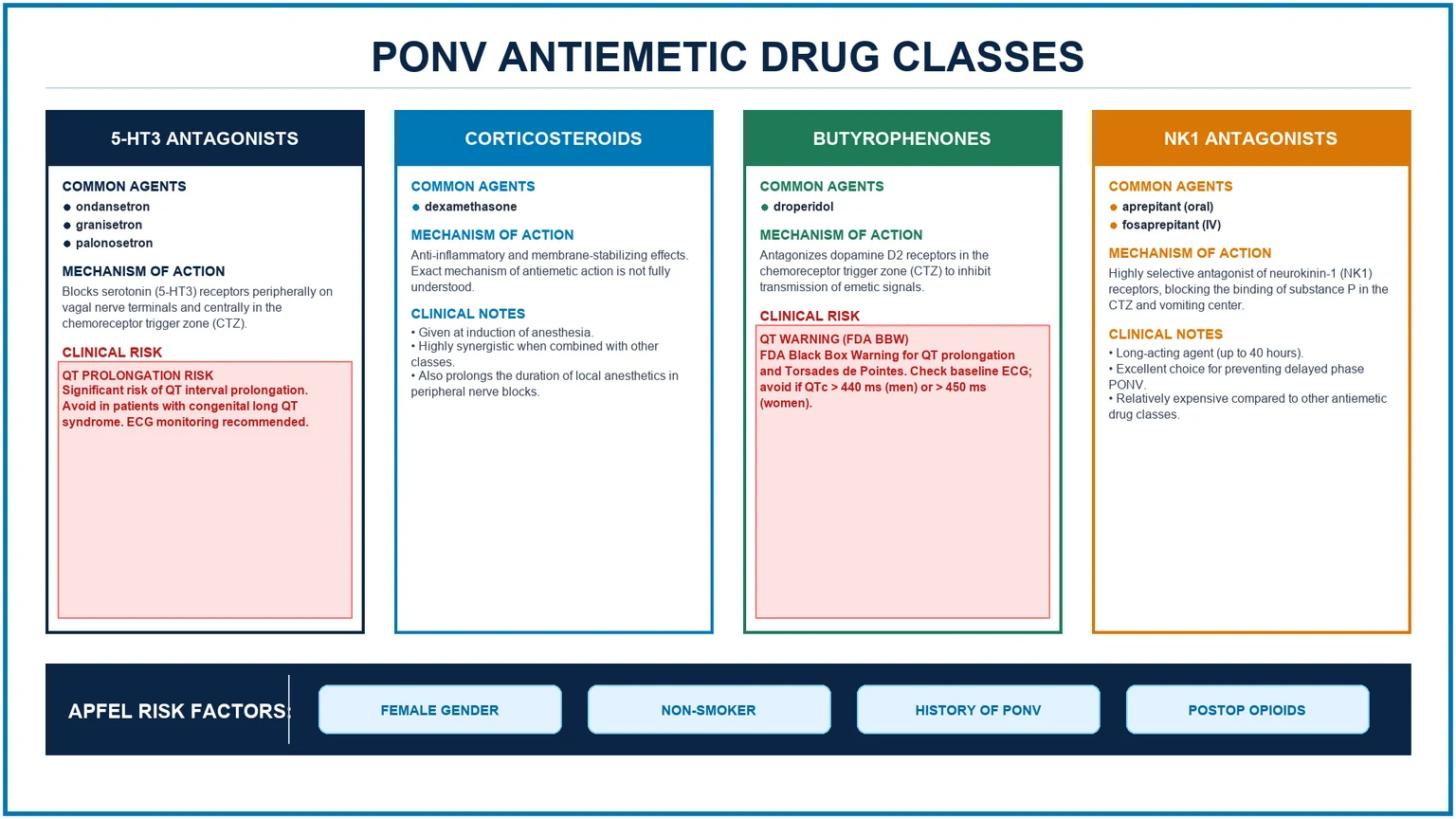
References
- [1]Loomba P, et al. Comparison of Dexamethasone versus Ondansetron for Postoperative Nausea and Vomiting in Laparoscopic Cholecystectomy Ann Afr Med, 2026.PMID 42318980
- [2]Pantke S, et al. [Dexamethasone for Perioperative Analgesia] Anasthesiol Intensivmed Notfallmed Schmerzther, 2026.PMID 42361807
- [3]Sung TY, et al. Effect of Opioid-Sparing Anesthesia on Postoperative Nausea and Vomiting After Breast Surgery: A Single-Center Randomized Controlled Trial J Clin Med, 2026.PMID 42355627
- [4]Akbarpournikghalb L, et al. Aprepitant's neuroprotective effects on methylphenidate-induced biochemical/mitochondrial dysfunction, neuroinflammation, and mood-related behavior alterations Daru, 2026.PMID 42337191
- [5]Chen J, et al. Immediate versus delayed dexamethasone implantation during vitrectomy for diabetic macular edema with secondary epiretinal membrane: A retrospective comparative study J Int Med Res, 2026.PMID 42363796
- [6]Liu F, et al. Impact of oliceridine versus sufentanil on postoperative nausea and vomiting in patients undergoing thyroid surgery: a prospective, double-blind, randomized controlled trial Ann Med, 2026.PMID 42339818