Anaes · Anaesthetic adjuncts
Benzodiazepines in anaesthesia
Also known as Midazolam · Diazepam · Lorazepam · Remimazolam · Flumazenil (antagonist) · GABA-A positive allosteric modulator
Benzodiazepines are the versatile perioperative drug class — the premedicant, the procedural sedative, the anxiolytic, the anticonvulsant, the co-induction agent, and the alcohol-withdrawal treatment — unified by a single molecular mechanism: positive allosteric modulation of the GABA-A receptor. The framework rests on four exam-critical ideas: the benzodiazepine binds at the interface between the alpha and gamma subunits and, unlike the barbiturate, increases the FREQUENCY (not the duration) of chloride channel opening, and cannot open the channel directly — a ceiling effect that makes benzodiazepines safer in overdose than barbiturates; the four agents differ in onset, duration and metabolism — midazolam (rapid, short, with an active metabolite), diazepam (slow, long, multiple active metabolites), lorazepam (slow, long, no active metabolite, the drug of status epilepticus), and remimazolam (ultra-short, ester-hydrolysed, organ-independent clearance with a constant context-sensitive half-time); the class produces dose-dependent respiratory depression that is powerfully synergistic with the opioid, only mild cardiovascular depression, and a signature anterograde amnesia; and flumazenil, the competitive antagonist, reverses the effect but has a shorter half-life than most benzodiazepines, so resedation is the danger and the patient must be monitored for 2 to 4 hours after reversal. Built on the remimazolam-versus-midazolam endoscopy trial (Akram 2026), the remimazolam dental-sedation study (Grossi 2026), the flumazenil benzodiazepine-toxicity review (Segev 2026), the emergence-delirium prediction work (Wang 2026), the intranasal midazolam premedication study (Nacar 2026), the remimazolam ICU-delirium report (Hong 2026), the remimazolam-propofol adjunct trial (Kazokas 2026), and the remimazolam tracheal-stent sedation case (Amagasa 2026).
On this page & tools
Your progress
Saved locally on this device.
8 MCQs with explanations
Target exams
Red flags

Why this matters to the anaesthetist
Benzodiazepines are the most versatile drug class in the perioperative period. No other class fills as many roles: they are the premedication that anxiolyses the patient before surgery, the procedural sedative that makes the bronchoscopy and the colonoscopy tolerable, the anticonvulsant that terminates status epilepticus, the co-induction agent that reduces the dose of propofol, and the treatment of acute alcohol withdrawal and the benzodiazepine-responsive causes of agitation. An understanding of the class — and of the four agents that define it, midazolam, diazepam, lorazepam and remimazolam — is therefore an understanding of much of the everyday pharmacology of sedation and anaesthesia.[5]
The class also concentrates some of the highest-yield pharmacology in the exam. Its mechanism is the positive allosteric modulation of the GABA-A receptor, the single most examined receptor in anaesthesia, and the molecular detail that distinguishes the benzodiazepines from the barbiturates — the benzodiazepine increases the frequency of chloride channel opening where the barbiturate increases the duration — is a classic mechanism question. The pharmacokinetics contrast four agents that span the entire range from the ultra-short remimazolam to the very-long-acting diazepam, and the context-sensitive half-time and the role of active metabolites are examined through this contrast. The synergistic respiratory depression with opioids is a safety lesson that every anaesthetist must carry. And the flumazenil antagonist, with its shorter half-life than the drugs it reverses and its capacity to precipitate seizures, is a classic pharmacology viva. Master the benzodiazepines and a large block of the applied pharmacology syllabus falls into place around them. [1]
Mechanism of action
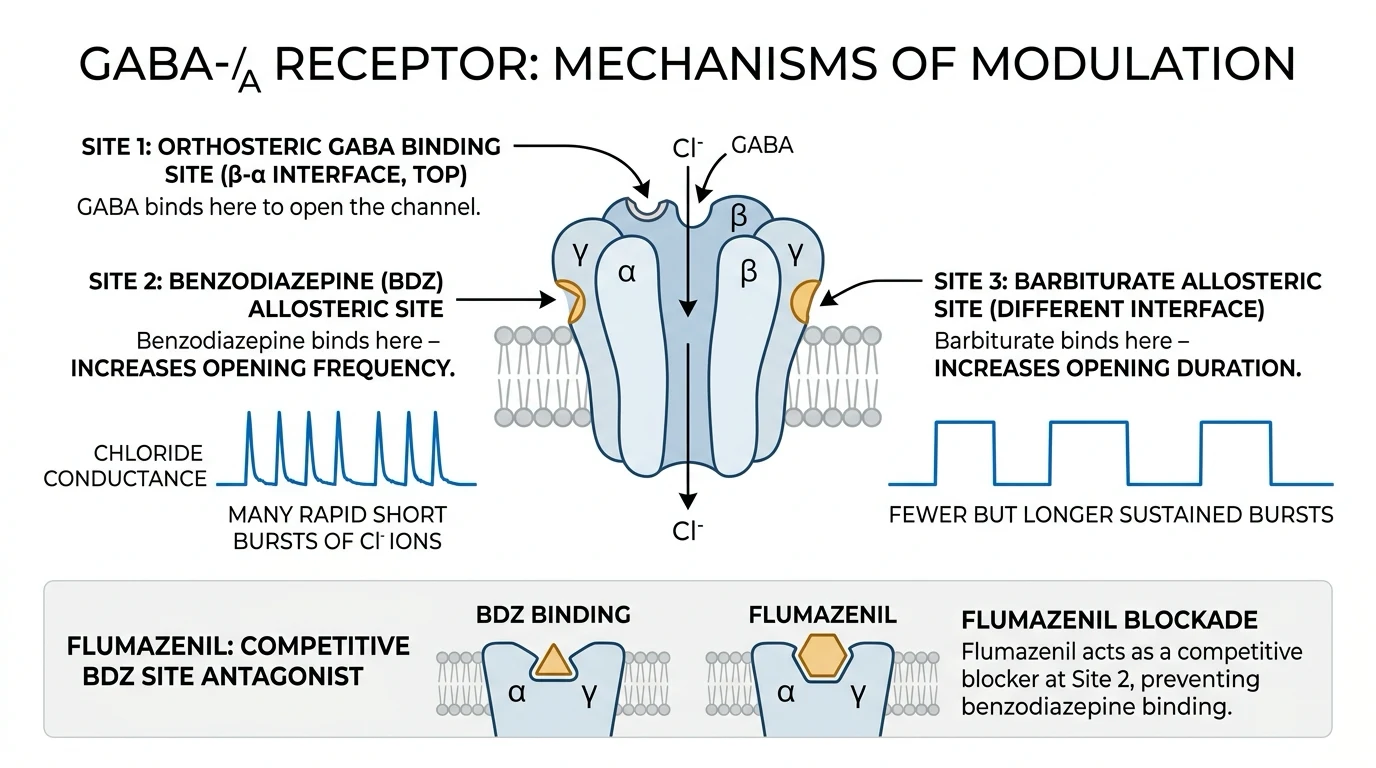
The benzodiazepines are positive allosteric modulators at the GABA-A receptor, the principal inhibitory ligand-gated chloride channel of the central nervous system. The GABA-A receptor is a pentameric assembly of five subunits arranged around a central chloride pore, and the benzodiazepine binds at a specific allosteric site — the interface between the alpha and the gamma subunits — that is distinct from the GABA (orthosteric) binding site and from the barbiturate binding site. Binding of the benzodiazepine to its site increases the affinity of the receptor for GABA, and so potentiates the action of the endogenous transmitter.[7]
The molecular detail that distinguishes the benzodiazepines from the barbiturates is the kinetics of the chloride channel response. The benzodiazepine increases the FREQUENCY of chloride channel opening — the channel opens more often, in shorter bursts, in response to a given GABA concentration. The barbiturate, acting at a different allosteric site, increases the DURATION of each opening — the channel stays open longer. The clinical consequence of this difference is profound: because the benzodiazepine merely increases the frequency of opening and cannot open the channel directly — it requires GABA to be present — there is a ceiling effect on its depressant action. As the GABA concentration falls, the benzodiazepine effect falls. The barbiturate, which can directly open the channel at high concentrations, has no such ceiling. This is the molecular basis of the most important safety property of the class: the benzodiazepines are safer in overdose than the barbiturates, because their maximum depressant effect is self-limited.[3]
The subunit composition of the receptor determines which clinical effect a benzodiazepine produces. The alpha-1 subunit mediates the sedative, amnesic and anticonvulsant effects (the effects targeted by the hypnotic benzodiazepine-receptor ligands and by zolpidem, which is alpha-1 selective). The alpha-2 subunit mediates the anxiolytic effect and the muscle-relaxant effect. The benzodiazepines bind at receptors containing either alpha-1, alpha-2, alpha-3 or alpha-5 subunits (always with a gamma subunit), and the full clinical profile of a benzodiazepine — sedation, amnesia, anxiolysis, anticonvulsant activity and muscle relaxation — is the sum of its actions across these receptor subtypes. [1]
The individual drugs
The four agents differ not in their mechanism — they all act at the same alpha-gamma interface — but in their pharmacokinetics: their onset, their duration, their metabolism and their active metabolites. These differences define their clinical roles. [1]
Midazolam is the workhorse of the class. It is water-soluble at the acidic pH of the ampoule (pH around 3.5), which makes it stable in solution and painless to inject, but at physiological pH the imidazole ring closes and the molecule becomes lipophilic, crossing the blood-brain barrier rapidly. The result is a rapid onset of 1 to 2 minutes after intravenous injection and a short duration of 20 to 40 minutes, driven by redistribution. It is metabolised by CYP3A4 to alpha-hydroxymidazolam, an active metabolite with about half the potency of the parent drug and a longer half-life, which prolongs the duration — particularly in the elderly and in renal failure, where the metabolite accumulates. Midazolam is the agent of premedication, of procedural sedation, and of co-induction.[5]
Diazepam is the original intravenous benzodiazepine. It is highly lipophilic, dissolved in a propylene glycol vehicle (which causes pain on injection and the risk of thrombophlebitis), with a slower onset of 2 to 5 minutes and a long duration. Its duration is prolonged by its metabolism: diazepam is metabolised by CYP3A4 and CYP2C19 to nordiazepam (desmethyldiazepam), an active metabolite with a half-life of up to 100 hours, which is itself metabolised to oxazepam — another active benzodiazepine. The result is a very long context-sensitive half-time and a hangover that can last a day or more, and diazepam is now rarely chosen in anaesthesia where a shorter agent will do. It retains a role in the treatment of alcohol withdrawal, in some seizure contexts, and in procedural sedation where a long duration is acceptable.[3]
Lorazepam is the slow-onset, long-duration, metabolically clean member of the class. It has an onset of 5 to 20 minutes (slower than midazolam because it is less lipid-soluble at physiological pH and crosses the blood-brain barrier more slowly) and a long duration, but it is metabolised by direct glucuronidation to an inactive metabolite excreted by the kidney — there are no active metabolites. This combination of a long duration and metabolic cleanliness makes lorazepam the drug of choice for status epilepticus (where a long-lasting anticonvulsant effect is wanted and the slow onset is acceptable once the IV is established) and a safe choice in hepatic and renal impairment. Like diazepam it is supplied in a propylene glycol vehicle and causes venous irritation. [1]
Remimazolam is the new ultra-short-acting benzodiazepine, designed to do for the benzodiazepines what remifentanil did for the opioids. It is ester-hydrolysed by tissue esterases to an inactive metabolite, giving it an organ-independent clearance and a constant context-sensitive half-time that does not rise with the duration of infusion. It has a rapid onset and a rapid recovery, is reversible with flumazenil (because it acts at the same benzodiazepine receptor), and is approved for procedural sedation (bronchoscopy, colonoscopy) with growing use in general anaesthesia induction and maintenance. The remimazolam-versus-midazolam endoscopy trial and the dental-sedation study establish its procedural role; the tracheal-stent sedation case illustrates its use in a stimulating shared-airway procedure; and the propofol-adjunct trial shows its place in balanced anaesthesia.[1][2][8][7]
Pharmacokinetics
All four benzodiazepines are highly lipophilic and so cross the blood-brain barrier and the placenta readily. Their pharmacokinetic differences — the differences that define their clinical roles — are set by the route of metabolism and the presence of active metabolites. [1]
Midazolam and diazepam are metabolised by the cytochrome P450 system — chiefly CYP3A4 for midazolam, and CYP3A4 and CYP2C19 for diazepam — and both produce active metabolites that prolong the clinical effect. Midazolam yields alpha-hydroxymidazolam (potency about half the parent, half-life longer); diazepam yields nordiazepam and then oxazepam, both active, with the nordiazepam half-life reaching 100 hours. Lorazepam is metabolised by glucuronidation (Phase II conjugation) to an inactive metabolite, and so has no active metabolites and is unaffected by CYP interactions — a property that makes it attractive in hepatic impairment and in the patient on multiple CYP-interacting drugs. Remimazolam is hydrolysed by tissue esterases (the same route as remifentanil and esmolol) to an inactive metabolite, giving it an organ-independent clearance that is unaffected by hepatic or renal function and a constant, short context-sensitive half-time of around 7 to 8 minutes that does not lengthen with infusion duration — the property that makes a maintenance infusion feasible.[1][7]
The onset of effect is governed by lipid solubility and the speed of brain penetration: midazolam (becomes lipophilic at physiological pH) and remimazolam are fast (1 to 2 minutes); diazepam (lipophilic in its own right) is moderately fast (2 to 5 minutes); lorazepam (less lipid-soluble) is slow (5 to 20 minutes). The duration after a single bolus is governed first by redistribution out of the brain and then by metabolism. All four are highly protein-bound (diazepam around 99 percent) and have a large volume of distribution. The elderly have a reduced clearance, an increased sensitivity and a larger free fraction, all of which prolong and intensify the effect — the basis of the dose reduction in this group. [1]
Pharmacodynamics
The benzodiazepines produce a characteristic cluster of effects, all mediated through the GABA-A receptor. [1]
- Anxiolysis. A reduction in anxiety without significant sedation at low doses — the basis of the premedication effect and of the anxiolytic use outside anaesthesia. This is largely an alpha-2 subunit effect.
- Sedation. A dose-dependent reduction in the level of consciousness, from calm wakefulness through drowsiness to sleep. At higher doses the benzodiazepines contribute to co-induction, but they are not full anaesthetic agents and cannot reliably produce surgical anaesthesia alone.[7]
- Anterograde amnesia. A key and distinctive effect. The benzodiazepine impairs the formation of new memories (anterograde, not retrograde) — the patient cannot lay down memory of events after the dose, though pre-existing memory is intact. This is highly desirable in procedural sedation (the patient remembers nothing of an unpleasant investigation) and is an alpha-1 subunit effect shared with the sedative effect.
- Anticonvulsant activity. The benzodiazepines raise the seizure threshold and terminate seizures — the basis of the use of lorazepam and midazolam in status epilepticus.
- Central muscle relaxation. A reduction in skeletal muscle tone via a central (spinal and supraspinal) action, not a neuromuscular junction effect. It is useful in tetanus and in spasticity but is modest in anaesthetic practice.
- Minimal cardiovascular depression. At sedative doses the benzodiazepines produce only a mild decrease in blood pressure and systemic vascular resistance — far less than propofol — and they preserve the heart rate and the cardiac output. This cardiovascular stability is the basis of their safety in the cardiac-compromised patient needing sedation.
- Dose-dependent respiratory depression. At sedative doses alone the respiratory depression is modest, but it is dose-dependent and — critically — powerfully synergistic with the opioid: the combination of a benzodiazepine and an opioid produces apnoea at doses where either alone would barely depress respiration. This synergy is the single most dangerous property of the class in anaesthetic practice.
- No analgesia. The benzodiazepines provide no pain relief whatsoever; an analgesic must always be added for a painful procedure.[5]
Clinical uses and dosing
The clinical roles of the benzodiazepines map onto the four agents and their pharmacokinetics. [1]
- Premedication. The aim is anxiolysis, sedation and anterograde amnesia before theatre. Midazolam is the standard: 1 to 2.5 mg intravenously titrated in the holding area, or 0.5 mg/kg orally (up to around 20 mg) in the child, given 30 minutes before induction. The intranasal route (midazolam 0.2 to 0.4 mg/kg) is an effective needle-free paediatric premedication.[5]
- Procedural sedation. For endoscopy, bronchoscopy, dental and minor procedures, midazolam is given in incremental doses (0.5 to 1 mg IV every few minutes to effect) often with a small dose of opioid (fentanyl). A midazolam infusion of 0.5 to 2 micrograms/kg/min sustains sedation for longer procedures. Remimazolam is increasingly used in this role, giving a faster and more predictable recovery.[1][2][8]
- Co-induction. A small dose of midazolam (1 to 2 mg IV) given before propofol reduces the propofol induction dose by 30 to 50 percent through synergistic GABA-A potentiation, smoothing the induction and reducing the cardiovascular depression. The remimazolam-propofol adjunct formalises this combination for modern balanced anaesthesia.[7]
- Status epilepticus. Lorazepam 4 mg intravenously (0.1 mg/kg) is the drug of choice, because its slow onset is acceptable once the IV is established and its long duration and lack of active metabolites prevent recurrence. Midazolam (10 mg intramuscularly, where no IV is available) is the alternative.
- Acute alcohol withdrawal. A benzodiazepine (diazepam or lorazepam) is the first-line treatment, dosed to symptom-triggered scales (the CIWA-Ar), providing both seizure prophylaxis and symptom control.
- Remimazolam — procedural sedation and TIVA. Remimazolam is approved for procedural sedation (bronchoscopy, colonoscopy, dental work) and is under active investigation for general anaesthesia induction and maintenance (TIVA), where its constant context-sensitive half-time and its reversibility offer advantages over propofol.[1][2][8][7]
Remimazolam — the new ultra-short benzodiazepine
Remimazolam besylate is the most significant addition to the benzodiazepine class in decades, and it warrants its own discussion because it changes what the class can do. It was designed around a single principle — ester hydrolysis — exactly as remifentanil was designed to bring ester-based ultra-short kinetics to the opioids. The molecule retains the benzodiazepine receptor binding (so it produces sedation, anxiolysis and amnesia by the same mechanism as midazolam) but is cleared by tissue esterases to an inactive carboxylic-acid metabolite, independent of hepatic and renal function. The consequences are a rapid onset, a rapid recovery that does not depend on redistribution or hepatic metabolism, a constant context-sensitive half-time of around 7 to 8 minutes that does not lengthen with the duration of infusion, and no active metabolites.[1]
These properties give remimazolam several advantages over both midazolam and propofol in procedural sedation and anaesthesia. Against midazolam, it gives a much faster and more predictable recovery with no accumulation and no active metabolite — the remimazolam-versus-midazolam endoscopy trial confirmed a faster recovery and superior procedure-success profile.[1] Against propofol, it causes less hypotension and less respiratory depression, and — uniquely among the induction agents — it is reversible with flumazenil, giving a pharmacological rescue where propofol has none. The dental-sedation study and the tracheal-stent sedation case illustrate its use in settings where cardiovascular and respiratory stability matter; the propofol-adjunct trial shows it as a component of balanced anaesthesia.[2][8][7]
The limitations of remimazolam are the limitations of the class: it provides no analgesia (an opioid or a ketamine must be added for painful stimulation), it produces the same dose-dependent respiratory depression and the same synergism with opioids as the other benzodiazepines, and it is currently more expensive than midazolam. Its role in ICU sedation and in the elderly is still being defined — the ICU-delirium work notes that the delirium profile of a pure benzodiazepine sedative requires careful evaluation, since benzodiazepines are themselves a risk factor for delirium.[6]
Flumazenil — the benzodiazepine antagonist
Flumazenil is a competitive antagonist at the benzodiazepine binding site (the alpha-gamma interface) of the GABA-A receptor. It binds to the same site as midazolam, diazepam, lorazepam and remimazolam but produces no effect of its own — it has no positive or negative allosteric activity, so it neither sedates nor arouses in the absence of a benzodiazepine. It works purely by displacing the agonist from the receptor, and so it reverses the sedation, the amnesia, the respiratory depression and the muscle relaxation produced by any benzodiazepine.[3]
The dose is 0.2 mg intravenously as an initial dose, titrated incrementally up to a total of 1 to 3 mg to the desired level of arousal. Because it displaces the agonist rather than destroying it, and because the displaced benzodiazepine is still present in the body, the reversal is sustained only for as long as the flumazenil concentration exceeds the benzodiazepine concentration at the receptor. The half-life of flumazenil is 40 to 80 minutes — shorter than that of midazolam, diazepam, lorazepam and remimazolam's active site occupancy — so as the flumazenil concentration falls the benzodiazepine effect returns. This is the resedation phenomenon, the central danger of flumazenil reversal: a patient who appears wide awake 20 minutes after reversal can become resedated and hypoventilate an hour later, after the flumazenil has worn off but the longer-acting benzodiazepine has not. The implication is that a patient reversed with flumazenil must be monitored for 2 to 4 hours after the reversal, and flumazenil reversal is not a licence to discharge.[3]
The second danger of flumazenil is that it can precipitate seizures. In the chronic benzodiazepine user, the receptor is chronically occupied and the GABA-A system is adapted to a tonic benzodiazepine tone; abrupt displacement of this tone by flumazenil unmasks a state of relative GABA-ergic insufficiency that can precipitate a seizure. In the patient with epilepsy, or in the mixed overdose where a pro-convulsant agent (a tricyclic antidepressant) has been co-ingested, the same risk applies. Flumazenil must therefore not be used routinely in chronic benzodiazepine users or epileptics, and never as a non-specific coma-reversal agent in the unknown overdose, where it has caused fatal seizures.[3]
Adverse effects
- Respiratory depression — dose-dependent, and markedly synergistic with the opioid. The single most dangerous property of the class in anaesthetic practice; the combination of midazolam and fentanyl has caused deaths in procedural sedation.
- Hypotension — mild at sedative doses; a small drop in blood pressure and systemic vascular resistance, far less than with propofol.
- Paradoxical agitation — especially in the elderly and in children, where the benzodiazepine can produce agitation, confusion and disinhibition rather than sedation. The emergence-delirium prediction work identifies benzodiazepine premedication as a risk factor for postoperative delirium in the high-risk elderly.[4]
- Delirium in the elderly — benzodiazepines are an independent risk factor for ICU and postoperative delirium, and the remimazolam-ICU-delirium report underscores that this risk applies even to the newer agent.[6]
- Hangover effect — especially with diazepam, whose active metabolites (nordiazepam, oxazepam) accumulate and produce a prolonged hangover that can last a day or more; also with midazolam in the elderly and in renal failure, where alpha-hydroxymidazolam accumulates.
- Thrombophlebitis and pain on injection — with diazepam and lorazepam, caused by the propylene glycol vehicle; midazolam (aqueous) and remimazolam do not cause this.
- Tolerance and dependence — with chronic use; the basis of the withdrawal syndrome and of the seizure risk on flumazenil reversal.
Special populations
- The elderly. The clearance is reduced, the receptor sensitivity is increased, and the free (unbound) fraction is higher, all of which prolong and intensify the effect. The elderly are also prone to paradoxical agitation and delirium. The dose should be reduced by around 50 percent and the drug titrated cautiously; midazolam premedication is often best omitted in the high-delirium-risk elderly patient.[4]
- Paediatrics. Midazolam is an effective paediatric premedicant — 0.5 mg/kg orally, or 0.2 to 0.4 mg/kg intranasally — given 20 to 30 minutes before induction, providing anxiolysis and amnesia and smoothing separation from the parents. The intranasal route is needle-free and well-studied.[5] Children, like the elderly, can show paradoxical agitation.
- Pregnancy. The benzodiazepines are Category C. They cross the placenta, and a dose near term causes neonatal sedation (the floppy baby syndrome — hypotonia, lethargy, poor feeding and respiratory depression in the neonate). Chronic benzodiazepine use in late pregnancy causes neonatal withdrawal. Avoid where possible in the third trimester; a single premedicant dose early in pregnancy is generally regarded as acceptable.
- Renal impairment. The parent drugs are generally safe, but the active metabolite of midazolam (alpha-hydroxymidazolam) accumulates in severe renal failure and can produce prolonged sedation; lorazepam's inactive glucuronide and remimazolam's inactive metabolite are safer in this respect. Reduce the midazolam and diazepam dose and titrate to effect.
- Hepatic impairment. The CYP-metabolised agents (midazolam, diazepam) have a reduced clearance and a prolonged effect; reduce the dose. Lorazepam (glucuronidation) and remimazolam (ester hydrolysis) are preferred, as their clearance is preserved. In severe hepatic failure all benzodiazepines carry a risk of precipitating hepatic encephalopathy and are used only with caution.
Perioperative drug interactions
The benzodiazepines interact with the other perioperative drugs through two main mechanisms — pharmacodynamic synergism at the GABA-A receptor and the sedative axis, and pharmacokinetic interactions at CYP3A4. [1]
The pharmacodynamic synergism is the more important. The benzodiazepines are powerfully synergistic with the opioids at the respiratory depressant axis — the combination of midazolam and fentanyl produces apnoea at doses where either alone would barely depress respiration. This is the single most dangerous interaction of the class and the reason the benzodiazepine-opioid combination requires dedicated monitoring and airway equipment in procedural sedation. They are also synergistic with propofol (and with the other induction agents and the volatile agents) at the GABA-A receptor, reducing the induction dose — the basis of the co-induction technique and of the remimazolam-propofol adjunct.[7] They are potentiated by all the other central nervous system depressants — alcohol, the antihistamines, the barbiturates, the gabapentinoids — and a patient on chronic opioids or with a history of substance use shows altered responses.
The pharmacokinetic interactions centre on CYP3A4. The CYP3A4 inhibitors — erythromycin, clarithromycin, ketoconazole and other azole antifungals, the HIV protease inhibitors, and grapefruit juice — inhibit the metabolism of midazolam and diazepam and can raise their plasma concentration several-fold, producing an unexpectedly deep and prolonged sedation from a standard dose. This interaction is clinically important and is a classic exam question. The CYP3A4 inducers (rifampicin, phenytoin, carbamazepine, chronic alcohol) reduce the benzodiazepine effect. Remimazolam is NOT affected by CYP interactions, because it is cleared by ester hydrolysis — a major practical advantage in the patient on interacting therapy.[1]
Comparison within the class and with other agents
- Midazolam versus diazepam. Midazolam has a faster onset (1 to 2 minutes versus 2 to 5 minutes), a shorter duration, and is water-soluble (no propylene glycol vehicle, so no pain or thrombophlebitis). Diazepam has the very-long-acting active metabolite nordiazepam; midazolam has the shorter-acting alpha-hydroxymidazolam. Midazolam is the standard for anaesthesia; diazepam retains a role in alcohol withdrawal.
- Midazolam versus lorazepam. Lorazepam is slower in onset but longer in duration and has no active metabolite (glucuronidation). Lorazepam is the drug of choice for status epilepticus; midazolam for procedural sedation and premedication.
- Midazolam versus remimazolam. Remimazolam has a much shorter duration, no active metabolites, a faster and more predictable recovery, and a constant context-sensitive half-time that allows a maintenance infusion — but it is more expensive and its role is still being defined.[1]
- Midazolam versus propofol. Midazolam causes less hypotension and less respiratory depression, provides anterograde amnesia (which propofol does to a lesser degree), provides no analgesia (like propofol), and is reversible with flumazenil. Propofol gives a faster, clearer recovery and is antiemetic; midazolam gives a slower hangover-prone recovery. The choice depends on the cardiovascular reserve and the role (co-induction versus primary induction).[7]
- Remimazolam versus propofol. Remimazolam causes less hypotension and less respiratory depression, is reversible with flumazenil (propofol has no reversal), and has a constant context-sensitive half-time independent of infusion duration. Propofol gives a faster recovery after a single bolus and is cheaper and better established. Remimazolam's reversibility and stability are its discriminating advantages, especially in the cardiac- or respiratory-compromised patient and in procedural sedation where the operator is not an anaesthetist.[2][8]
- Remimazolam versus midazolam. Remimazolam offers a much shorter duration, no active metabolites, faster recovery, and a maintenance-infusion pharmacokinetic profile — the same kind of advance that remifentanil brought to the opioids — at a higher cost and with a still-evolving evidence base.[1]
Clinical
- Standard approach
- Evidence-based
Alternative
- Modified technique
- Risk-benefit
Red flags
[1] [1] [1] [1] [1] [1]References
- [1]Akram U, et al. Remimazolam versus Midazolam for Moderate Sedation in Gastrointestinal Endoscopy: A Systematic Review and Meta-analysis of Randomized Controlled Trials Gastrointest Endosc, 2026.PMID 42362034
- [2]Grossi GB, et al. Efficacy of Remimazolam besylate for intravenous sedation in dental procedures for patients with cognitive disabilities: a prospective single-arm observational study BMC Oral Health, 2026.PMID 42363094
- [3]Segev O, et al. Flumazenil in the Treatment of Benzodiazepine Toxicity: The Experience of a Large Urban Tertiary Care Hospital Isr Med Assoc J, 2026.PMID 42298935
- [4]Wang Q, et al. Risk prediction models based on machine learning for emergence delirium in elderly patients undergoing spine surgery: development and validation study BMC Anesthesiol, 2026.PMID 42363038
- [5]Nacar C, et al. Effect of Intranasal Midazolam-Butorphanol Premedication on Sevoflurane Anaesthesia in Traumatised Buzzards (Buteo spp.) Vet Med Sci, 2026.PMID 42319166
- [6]Hong J, et al. Effect of Remimazolam on Postoperative Delirium in Surgical ICU Patients: A Single-Center Prospective Cohort Study Crit Care Res Pract, 2026.PMID 42328302
- [7]Kazokas D, et al. The Effects of Low-Dose Remimazolam Adjunct on Propofol-Remifentanil Anaesthesia in Day Case Gynaecological Surgery: A Retrospective Cohort Study Medicina (Kaunas), 2026.PMID 42356189
- [8]Amagasa R, et al. Tracheal Stent Placement Under Remimazolam Sedation With Preserved Spontaneous Respiration: A Case Report Cureus, 2026.PMID 42311714