Anaes · Volatile & inhalational agents
Desflurane
Also known as 2-(difluoromethoxy)-1,1,1,2-tetrafluoroethane · Fluorinated methyl ethyl ether · Suprane · Most rapid-onset volatile · Heated vaporiser agent · Most pungent volatile
Desflurane is a fluorinated methyl ethyl ether and the most pharmacokinetically extreme of the modern volatile anaesthetics, defined by four exam-critical ideas. Its blood-gas partition coefficient of 0.42 is the LOWEST of any volatile agent, giving the fastest induction and the fastest, clearest emergence of the inhaled agents and making it the agent of choice for day-case surgery, neuroanaesthesia and the obese patient. Its boiling point of 23.5 degrees Celsius means it BOILS at room temperature and cannot be delivered by a standard variable-bypass vaporiser, demanding a special electronically heated pressurised vaporiser (the Tec 6) that holds the liquid at 39 degrees Celsius and 2 atm. It is EXTREMELY PUNGENT, provoking coughing, breath-holding and laryngospasm, so it is NEVER used for inhalational induction and is avoided in severe reactive airway disease. And it is the most environmentally damaging anaesthetic in clinical use, with a global-warming potential of 2540 times that of carbon dioxide and an atmospheric lifetime of 14 years, a cost that has led some institutions to ban or restrict it. Built on the delayed malignant-hyperthermia case report (Seki 2026), the environmental-and-clinical-rationale review (Tamura 2026), the desflurane-versus-propofol neurocognitive trial in the elderly (Somnuke 2026), the environmental-impact commentary (Jayaswal 2026), the banning-desflurane analysis (Mizutani 2026), the desflurane-versus-sevoflurane inflammatory-response study (Adamowitsch 2026), the anaesthetic-depth-methods review (Altinoluk 2026), and the isoflurane-versus-desflurane optic-nerve study (Rajmohan 2026).
On this page & tools
Your progress
Saved locally on this device.
8 MCQs with explanations
Target exams
Red flags
Why this matters to the anaesthetist
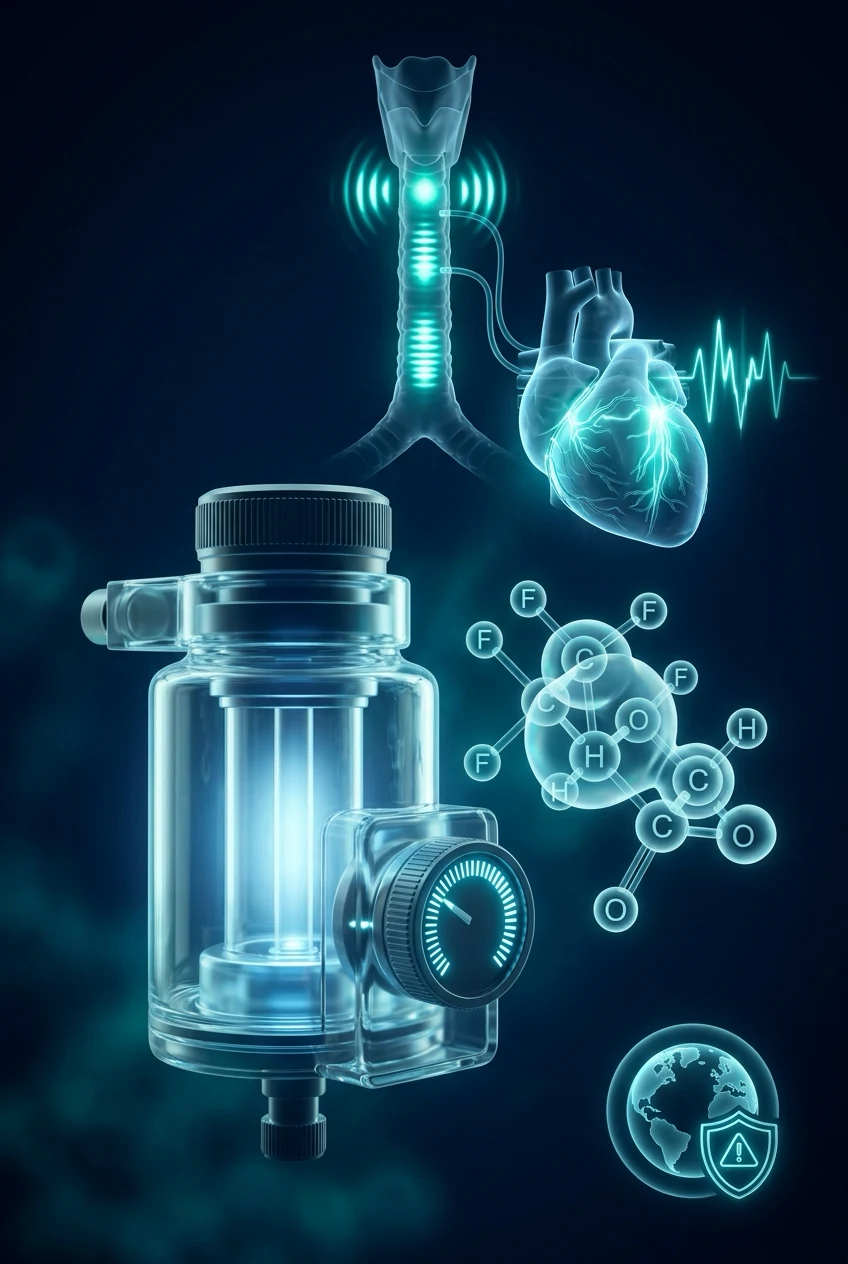
Desflurane is the most pharmacokinetically extreme of the modern volatile anaesthetics, and it concentrates the trade-offs of the inhaled agents into a single drug. It is the fastest — the lowest blood-gas solubility of any volatile means the fastest induction and the fastest, clearest emergence, the property that makes it the agent of choice for day-case surgery, for neuroanaesthesia where a rapid wake-up permits early neurological assessment, and for the obese patient whose high tissue mass slows the recovery of more soluble agents. It is the most demanding of its hardware — a boiling point of 23.5 degrees Celsius means it boils at room temperature and cannot be delivered by any standard vaporiser, demanding the special heated pressurised Tec 6. It is the most pungent — provoking coughing, breath-holding and laryngospasm, so it is never used for inhalational induction and is avoided in the reactive airway. And it is the most environmentally damaging — a global-warming potential of 2540 times that of carbon dioxide and an atmospheric lifetime of 14 years, a cost so high that some institutions have banned or restricted it.[2]
The drug therefore tests the candidate on the central trade-off of modern inhalational anaesthesia: the rapid-recovery benefit versus the environmental cost, and the speed versus the airway and sympathetic irritation. Master desflurane and the principles that govern the whole class — solubility and speed, potency and the Meyer-Overton axis, the heated vaporiser, the sympathetic surge, and the greenhouse-gas footprint — fall into place around it. [1]
Physical chemistry
Desflurane is 2-(difluoromethoxy)-1,1,1,2-tetrafluoroethane — a fully fluorinated methyl ethyl ether. The complete fluorination is the key to its extreme properties: the strong carbon-fluorine bond and the small molecule give it the lowest blood-gas solubility of any volatile, but they also give it a boiling point so low that it is a gas at body temperature and nearly so at room temperature. It is a clear, colourless, non-flammable liquid at room temperature with a boiling point of 23.5 degrees Celsius — a figure that dominates its entire delivery, because at typical theatre temperatures the agent is at or above its boiling point and so cannot be held in a standard variable-bypass vaporiser. [1]
Three physical properties dominate its clinical behaviour. The first is its blood-gas partition coefficient of 0.42 — the LOWEST of any volatile agent, lower than sevoflurane (0.65), isoflurane (1.4) and halothane (2.4). Very little of the inspired agent is taken up into the blood per breath, so the alveolar partial pressure (and therefore the brain partial pressure) rises and falls almost as fast as the dialled concentration is changed, producing the fastest induction and the fastest, clearest recovery of the inhaled agents. The second is its oil-gas partition coefficient of about 19 — a LOW lipid solubility on the Meyer-Overton axis, which corresponds to a LOW potency, so the minimum alveolar concentration is about 6.0 percent in adults, the HIGHEST MAC of any volatile. The third is its EXTREME PUNGENCY — a harsh, ether-like odour far stronger than isoflurane's, that provokes coughing, breath-holding, salivation and laryngospasm in the awake patient, the single property that excludes it from inhalational induction and from use in the reactive airway. [1]
Mechanism of action
The defining pharmacological correlation of the inhaled agents is the Meyer-Overton relationship: the potency of an agent is directly proportional to its lipid solubility, measured by its oil-gas partition coefficient. The more lipid-soluble the agent, the more potent it is, so the MAC is inversely related to lipid solubility, and the product of MAC and the oil-gas coefficient is roughly constant across agents. Desflurane illustrates this cleanly: its low oil-gas coefficient of 19 corresponds to its high MAC of 6.0 percent, while halothane's high oil-gas coefficient of 220 corresponds to its low MAC of 0.75 percent. For a century this correlation pointed to a unitary, non-specific target in the lipid bilayer of the neuronal membrane.[7]
The modern view is that desflurane, like the other volatiles, acts at several specific protein targets rather than at a single one. It potentiates the GABA-A receptor, the principal inhibitory ligand-gated chloride channel of the central nervous system, increasing the chloride channel opening in response to GABA and so hyperpolarising and silencing the neuron — the chief mediator of the hypnotic and immobilising effects. It inhibits the NMDA receptor, the excitatory glutamate-gated cation channel. It activates the two-pore-domain potassium channels (the TREK and TASK families), which hyperpolarise the neuron by allowing potassium efflux. And it potentiates the glycine receptor, the inhibitory channel of the spinal cord and brainstem. No single receptor explains all of the effects; the immobility is mediated largely at the spinal cord (GABA-A and glycine), the hypnosis at the brain, and the analgesic component partly at the NMDA receptor.[7]
Pharmacokinetics
The pharmacokinetics of desflurane are governed by its very low blood-gas solubility. Because the coefficient is 0.42 — the lowest of any volatile — only a tiny fraction of the inspired agent is taken up into the blood on each breath, so the alveolar partial pressure rises almost immediately towards the inspired partial pressure. Since the brain partial pressure follows the alveolar partial pressure, the brain concentration equilibrates within a few breaths, producing the fastest induction and, when the dialled concentration is reduced or the agent is turned off, the fastest recovery of the inhaled agents. This is the same principle that governs sevoflurane (0.65) and isoflurane (1.4), but pushed to its extreme: the lower the blood-gas solubility, the faster the alveolar and brain partial pressures change, and the more controllable the anaesthetic.[3]
Desflurane is excreted overwhelmingly unchanged through the lungs. Only about 0.02 percent is metabolised — virtually none — by the cytochrome P450 enzyme CYP2E1 in the liver. The consequences are all favourable: there is no organic or inorganic fluoride release of clinical consequence, no compound A (a sevoflurane-specific product), and no hepatotoxic metabolites. The agent is very tissue-inert: the rapid wash-in and wash-out, combined with the negligible metabolism, mean that desflurane is the closest thing to a pure in-and-out agent in the volatile class, and the rapid emergence is the basis of its use in day-case surgery, where a fast, clear wake-up shortens the recovery-room stay and the time to discharge.[3]
The low tissue solubility has a particular benefit in the obese patient. In the high-BMI patient the greater fat mass slows the recovery of more soluble agents (isoflurane, halothane) because the agent dissolves into and is then slowly released from the large fat compartment; desflurane's low fat solubility means there is little dissolution into fat, so the recovery remains rapid despite the high body mass. This is the basis of desflurane's preference in obesity, where a fast wake-up is both clinically valuable and harder to achieve with the more soluble agents. [1]
Pharmacodynamics
Desflurane produces a dose-dependent depression of the central nervous system, progressing from sedation through to surgical anaesthesia as the alveolar partial pressure rises. On the respiratory system it is, like the other volatiles, a bronchodilator at steady state, but its extreme pungency means that the initial effect on the airway is irritation rather than relaxation — coughing, breath-holding and bronchoconstriction dominate the first breaths in the awake or lightly anaesthetised patient, which is why desflurane is never used for mask induction and is avoided in severe asthma or COPD. Once a steady state is reached the bronchodilation emerges, but the initial irritant response is the safer clinical assumption in the reactive airway.[6]
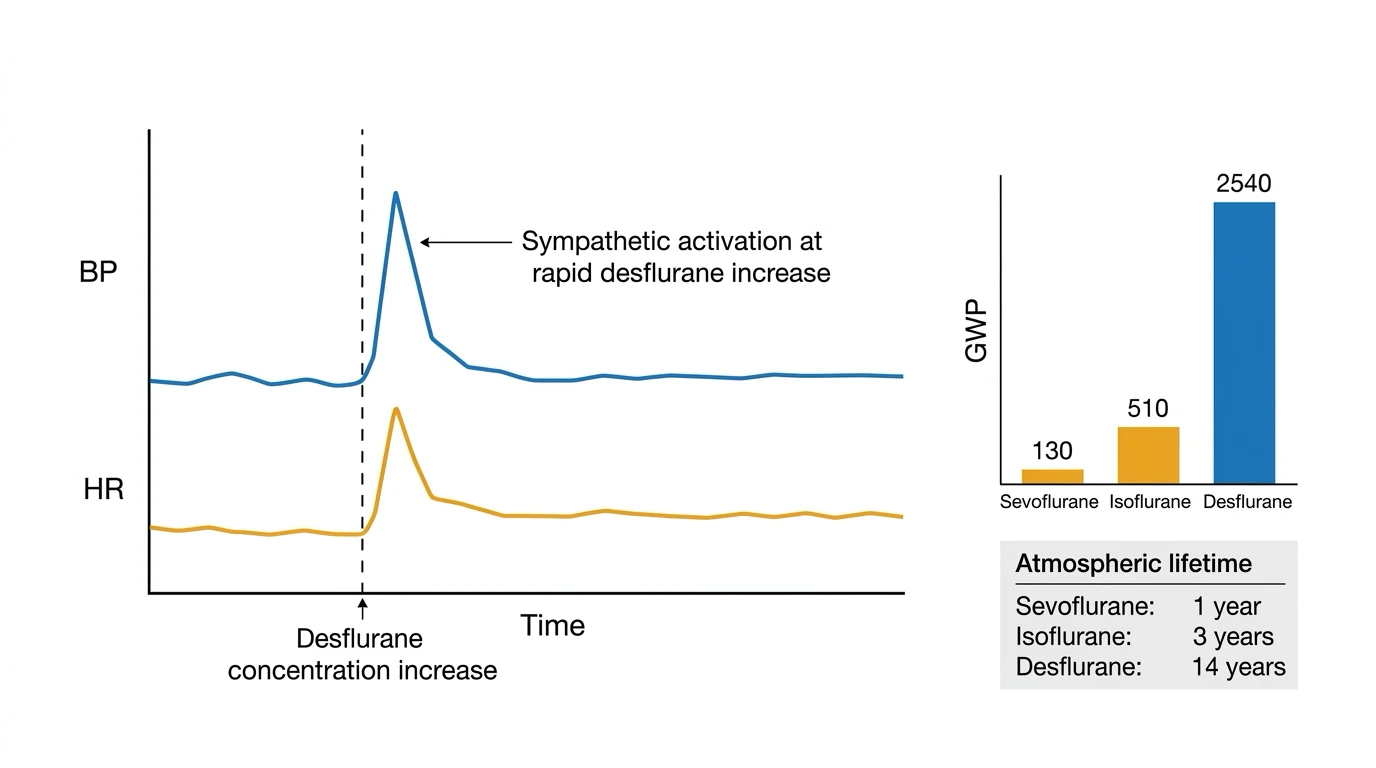
On the cardiovascular system desflurane produces a dose-dependent reduction in systemic vascular resistance and mean arterial pressure, but its distinctive haemodynamic feature is a marked sympathetic activation at concentrations above 1 MAC and during rapid concentration increases. A rapid rise in the dialled concentration — for instance a jump from 1 to 2 MAC — produces a transient tachycardia, hypertension and catecholamine surge that can be dangerous in the patient with coronary disease, where the rise in heart rate and blood pressure increases myocardial oxygen demand. The surge is blunted by increasing the dial slowly, by co-administering an opioid or benzodiazepine, or by avoiding the rapid increases altogether. The desflurane-versus-sevoflurane inflammatory work frames the haemodynamic and inflammatory differences between the two insoluble agents, with desflurane producing a greater catecholamine and inflammatory response at rapid up-titration.[6]
On the central nervous system desflurane reduces the cerebral metabolic rate for oxygen and, at low concentrations, reduces the cerebral blood flow through cerebral vasoconstriction. At high MAC this vasoconstriction reverses and the cerebral blood flow and intracranial pressure rise. The rapid emergence is the basis of its use in neuroanaesthesia, where a fast wake-up permits early neurological assessment. The isoflurane-versus-desflurane optic-nerve work is part of the active investigation of the ocular and neurophysiological effects of the two agents, a consideration in ophthalmic and neurosurgical anaesthesia.[8] Desflurane relaxes uterine smooth muscle (useful for uterine relaxation but a cause of bleeding at high doses) and produces a degree of muscle relaxation that potentiates the non-depolarising muscle relaxants.
Minimum alveolar concentration (MAC)
The minimum alveolar concentration (MAC) is the alveolar concentration of an agent, at one atmosphere, that prevents movement in response to a surgical stimulus in 50 percent of subjects — the median effective dose, the standard measure of potency of an inhaled agent. The lower the MAC, the more potent the agent. For desflurane the MAC is about 6.0 percent in adults — the HIGHEST of all the volatile agents, far higher than sevoflurane (2.0 percent), isoflurane (1.15 percent) and halothane (0.75 percent).[7]
This high MAC is the direct consequence of the Meyer-Overton correlation: desflurane's low oil-gas coefficient of 19 (low lipid solubility) corresponds to a low potency, and a low potency means a high MAC. The practical consequence is that the dialled vaporiser concentration must be high — typically 3 to 9 percent for maintenance — and the vaporiser must be able to deliver a high concentration of vapour, which the heated Tec 6 achieves. MAC is additive (a half-MAC of desflurane plus a half-MAC of nitrous oxide gives one MAC) and is modified by patient factors: the factors that LOWER MAC (so less agent is needed) are increasing age, hypothermia, pregnancy, and the co-administration of opioids, benzodiazepines, the alpha-2 agonists (clonidine, dexmedetomidine), nitrous oxide, and hypotension; the factors that RAISE MAC are infancy and young childhood, hyperthermia, chronic alcohol intake, and hypernatraemia. These modifiers explain why the dialled concentration is titrated to the individual patient rather than set to a single number. [1]
The heated vaporiser
Desflurane's boiling point of 23.5 degrees Celsius is the physical property that dictates its delivery and that most distinguishes it from the other volatiles. At typical theatre temperatures (20 to 24 degrees Celsius) the liquid desflurane is at or above its boiling point, so it boils at room temperature and its saturated vapour pressure is close to one atmosphere. A standard variable-bypass vaporiser — the temperature-and-flow-compensated design used for sevoflurane, isoflurane and halothane — cannot be used, because the boiling liquid would deliver an uncontrolled, near-atmospheric pressure of vapour regardless of the dial setting, and the output would vary wildly with ambient temperature.[2]
The solution is a special electronically heated, pressurised vaporiser, exemplified by the Datex-Ohmeda Tec 6. The Tec 6 heats the liquid desflurane to 39 degrees Celsius and pressurises it to about 2 atmospheres, holding it as a regulated superheated vapour rather than as a liquid that evaporates into a bypass stream. The dialled concentration is then achieved by mixing a metered flow of this pressurised vapour with the fresh gas flow, so the delivered concentration is independent of ambient temperature and is controlled electronically. The vaporiser requires electrical power, has a warm-up time, and alarms if the heating or pressurisation fails — features that have no equivalent on the simple variable-bypass vaporisers used for the other volatiles. The Tec 6 is the exam-critical piece of equipment associated with desflurane, and a candidate who names it and explains the 39 degrees Celsius and 2 atm operating point has demonstrated the key physical-chemistry insight. [1]
Clinical uses
Desflurane's roles are all maintenance roles — it is never an induction agent. [1]
- Maintenance of anaesthesia. A dialled concentration of 3 to 9 percent (about 0.5 to 1.5 MAC, commonly supplemented by nitrous oxide or an opioid) sustains a surgical depth of anaesthesia. The high percentage reflects the high MAC, not a deeper anaesthetic.
- Day-case surgery. Desflurane's defining role. The fastest emergence of the inhaled agents shortens recovery and the time to discharge, which is the basis of its preference in day-case practice where a fast, clear wake-up is the priority.[3]
- Neuroanaesthesia. The rapid emergence permits early neurological assessment after neurosurgery, a major advantage where a delayed wake-up confounds the postoperative neurological examination.[3]
- Obesity. The low fat solubility means a rapid recovery despite a high BMI, where the more soluble agents would be slowed by the large fat compartment. Desflurane is the volatile of choice in the obese patient.
- Cardiac anaesthesia with opioids. Used with a high-dose opioid technique, the opioid blunts the sympathetic surge, and desflurane provides anaesthetic preconditioning (shared with the other volatiles) — but the sympathetic activation must be controlled, and desflurane is chosen here only by the team that can manage the up-titration.
- ICU sedation for rapid wake-up. Where a volatile is used for ICU sedation and a rapid wake-up for neurological assessment is wanted, desflurane's low solubility gives the fastest offset, though the practical barriers (scavenging, the Tec 6, environmental cost) limit this use.[8]
- NOT for inhalational induction. The pungency provokes coughing, breath-holding and laryngospasm — desflurane is NEVER used for a mask induction. Induce intravenously and switch to desflurane after the airway is secured.
Sympathetic activation and airway irritation
The two key disadvantages of desflurane — the sympathetic activation and the airway irritation — are the principal reasons it has not displaced sevoflurane despite its faster recovery. [1]
Sympathetic activation. At concentrations above 1 MAC, and especially during a rapid increase in the dialled concentration, desflurane produces a transient tachycardia, hypertension and catecholamine surge. The mechanism is a direct effect on the sympathetic nervous system and on baroreflex control, producing a rise in plasma catecholamines within minutes of a rapid up-titration. In the patient with coronary disease the rise in heart rate and blood pressure increases myocardial oxygen demand and can precipitate ischaemia — a real hazard if the concentration is increased too quickly. The mitigation is to increase the dialled concentration slowly, to co-administer an opioid or a benzodiazepine (which blunt the catecholamine response), and to avoid the rapid concentration jumps that trigger the surge. The desflurane-versus-sevoflurane inflammatory work documents the greater sympathetic and inflammatory response of desflurane at up-titration, a consistent finding that sets the two agents apart despite their similar recovery profiles.[6]
Airway irritation. Desflurane is extremely pungent. In the awake or lightly anaesthetised patient it provokes coughing, breath-holding, salivation, laryngospasm and bronchospasm. This makes it unsuitable for mask induction (never attempt it — the coughing and laryngospasm are predictable and dangerous) and unsuitable for use in severe reactive airway disease (severe asthma, COPD with bronchospasm), where the initial irritant response can precipitate bronchospasm. The practical rule is to induce intravenously (propofol), secure the airway (LMA or tracheal tube), and only then switch to desflurane — so the patient is anaesthetised and the airway is protected before the pungent vapour is introduced. Sevoflurane is the agent of choice where a volatile is needed in the reactive airway or for a mask induction, precisely because it lacks this irritant property. [1]
Adverse effects
- Airway irritation — coughing, breath-holding, laryngospasm and bronchospasm from the extreme pungency; never for mask induction, avoid in severe reactive airway disease.
- Sympathetic activation — transient hypertension and tachycardia at concentrations above 1 MAC and during rapid up-titration; blunt with slow up-titration and an opioid or benzodiazepine, and avoid rapid increases in coronary disease.[6]
- Malignant hyperthermia — desflurane IS a trigger, like every volatile agent, and must never be given to the known or suspected MH-susceptible patient. The delayed-onset case report is a reminder that MH can present unusually late after a desflurane anaesthetic, so vigilance must be maintained well into the recovery period.[1]
- Carbon monoxide formation — desflurane produces the MOST carbon monoxide of all the volatiles when it passes through desiccated baralyme or strongly desiccated soda lime. The CO can reach dangerous levels and cause carboxyhaemoglobinaemia. Prevent it by changing absorbent regularly, by using modern non-strong-base absorbents, and by turning the vaporiser off when the machine is left standing so a continuous gas flow does not desiccate the absorbent.
- Hepatotoxicity — very rare, and far less than the immune-mediated hepatitis of halothane; not a clinical concern of the same order.
- Environmental — the WORST greenhouse gas of all anaesthetics, the subject of the next section.
- Postoperative cognitive effects — the desflurane-versus-propofol neurocognitive work in the elderly is part of the active investigation of whether anaesthetic choice affects postoperative cognition, an unresolved question.[3]
Environmental impact
Desflurane is the most environmentally damaging anaesthetic in clinical use. Its global-warming potential (GWP) is 2540 times that of carbon dioxide over a 100-year horizon, and its atmospheric lifetime is 14 years — meaning that every molecule released today will still be trapping heat in the atmosphere a decade and a half from now. The comparison with the other volatiles is stark: sevoflurane has a GWP of about 130 and an atmospheric lifetime of about 1 year, and isoflurane has a GWP of about 510 and an atmospheric lifetime of about 3 years. Desflurane is thus roughly 20 times more damaging than sevoflurane per molecule, and its long atmospheric lifetime means the damage persists.[2]
The clinical and ethical response has been decisive. Several institutions and health systems have banned or restricted desflurane, removing it from formularies or requiring a documented clinical justification for its use, on the principle that the rapid-recovery benefit rarely justifies the environmental cost when sevoflurane or a propofol-based TIVA technique provides a near-equivalent recovery at a fraction of the carbon footprint. The banning analysis and the environmental commentary frame the institutional and ethical dimensions of the decision.[4][5] Where desflurane is still used, the harm is reduced by low-flow and minimal-flow techniques (which minimise the total vapour used and the atmospheric release), by mandatory scavenging, and by reserving it for the cases where the rapid recovery is genuinely decisive — the long obese case, the neurosurgical case needing an early wake-up — rather than using it routinely. The central debate — the rapid-recovery benefit versus the environmental cost — is now part of the exam answer on desflurane, and a candidate who addresses it has shown the mature judgement the question is looking for.[2]
Comparison with other volatile agents
- Versus sevoflurane. Desflurane has a lower blood-gas solubility (0.42 versus 0.65), so it gives a marginally faster emergence, but it is MUCH more pungent (sevoflurane is the only modern volatile suitable for inhalational induction; desflurane is never for mask induction), has a higher MAC (6.0 versus 2.0 percent, requiring the heated Tec 6 vaporiser rather than a standard variable-bypass), produces a greater sympathetic surge at up-titration, and is a far worse greenhouse gas (GWP 2540 versus 130). The two give a broadly similar recovery; desflurane is favoured for the rapid wake-up in the long or obese case, sevoflurane for the induction, for routine maintenance, and on environmental grounds. The desflurane-versus-sevoflurane inflammatory work documents the greater sympathetic and inflammatory response of desflurane.[6]
- Versus isoflurane. Desflurane has a much lower blood-gas solubility (0.42 versus 1.4), so it gives a much faster induction and recovery; it is more pungent (both are unsuitable for mask induction, but desflurane is the more irritant); it has less tissue solubility (so a faster offset, especially in the obese); it requires the heated vaporiser (isoflurane uses a standard variable-bypass); and it is a worse greenhouse gas (GWP 2540 versus 510). The isoflurane-versus-desflurane optic-nerve work is part of the comparative neurophysiological profile.[8]
- Versus propofol TIVA. Desflurane gives a fast emergence comparable to propofol, but it carries the airway irritation and the sympathetic surge that propofol lacks, the theatre pollution (a greenhouse-gas vapour that must be scavenged), and it is an MH trigger (propofol is not). Propofol TIVA gives a calmer haemodynamic profile, no theatre pollution, no MH risk, and less PONV, but requires an infusion pump and a target-controlled model. The desflurane-versus-propofol neurocognitive work in the elderly frames the choice in terms of postoperative cognition, an active field.[3]
Clinical
- Standard approach
- Evidence-based
Alternative
- Modified technique
- Risk-benefit
Red flags
[1] [1] [1] [1] [1] [1]References
- [1]Seki H, et al. Desflurane-Induced Delayed Onset of Malignant Hyperthermia: A Case Report Anesth Prog, 2026.PMID 42307544
- [2]Tamura T, et al. Environmental and clinical rationale for the use of desflurane: a review of the literature J Anesth, 2026.PMID 42081124
- [3]Somnuke P, et al. Effect of desflurane versus propofol on perioperative neurocognitive disorders in older adults undergoing major urological surgery: a randomized trial BMC Geriatr, 2026.PMID 42321629
- [4]Jayaswal RP, et al. Comments on: Environmental and clinical rationale for the use of desflurane: a review of the literature J Anesth, 2026.PMID 42319477
- [5]Mizutani K, et al. Banning desflurane: Comments on the article, Environmental and clinical rationale for the use of desflurane: a review of the literature by Tamura et al J Anesth, 2026.PMID 42319476
- [6]Adamowitsch N, et al. Desflurane versus sevoflurane and postoperative inflammatory biomarkers in older adults undergoing minor- to moderate-risk noncardiac surgery Sci Rep, 2026.PMID 42218321
- [7]Altinoluk T, et al. General anesthesia and depth of anesthesia (DoA) evaluation methods in laboratory animals: a comprehensive review Vet Res Commun, 2026.PMID 41843253
- [8]Rajmohan N, et al. Comparison of the effects of isoflurane and desflurane on the optic nerve sheath diameter in elderly patients undergoing robotic-assisted laparoscopic radical prostatectomies in steep Trendelenburg position - A randomised controlled trial J Minim Access Surg, 2026.PMID 42085065