Anaes · Anaesthetic adjuncts
Dobutamine and dopamine
Also known as Beta-1 inotrope (dobutamine) · Dose-dependent dopamine · Synthetic and natural catecholamines · Renal-dose dopamine (disproven concept)
Dobutamine and dopamine are the two inotropic catecholamines most often paired in anaesthesia and intensive-care exams because they share a beta-1 inotropic core yet diverge sharply in their receptor breadth and their adverse-effect profile. DOBUTAMINE is a SYNTHETIC catecholamine whose dominant action is BETA-1 agonism, giving increased contractility and cardiac output while remaining VASODILATING at clinical doses (beta-2 offsets alpha-1, so systemic vascular resistance and pulmonary capillary wedge pressure fall); it causes less tachyarrhythmia than dopamine or adrenaline and is the prototypical inotrope for acute heart failure and cardiogenic shock, and the standard pharmacological stressor for dobutamine stress echocardiography (Dippenaar 2026). DOPAMINE is the natural precursor of noradrenaline and acts both directly and indirectly (the latter by releasing noradrenaline from sympathetic nerve terminals), and its exam-defining feature is DOSE-DEPENDENT receptor selectivity: LOW infusion doses (1 to 3 mcg per kg per min) recruit DOPAMINE-1 (D1) receptors causing renal and mesenteric vasodilation, MODERATE doses (3 to 10 mcg per kg per min) recruit BETA-1 giving inotropy, and HIGH doses (above 10 mcg per kg per min) recruit ALPHA-1 giving vasoconstriction (Routkevitch 2026). The historical low-dose renal-dose dopamine concept has been DISPROVEN: low-dose dopamine increases urine output through D1-mediated natriuresis but does NOT prevent acute kidney injury or improve renal outcomes, and the practice is now discouraged (Routkevitch 2026, Dong 2026). Dopamine is more arrhythmogenic than dobutamine because its indirect noradrenaline release supercharges beta-1 stimulation, and it raises pulmonary vascular resistance (caution in pulmonary hypertension); both drugs share a short half-life of about 2 minutes, metabolism by catechol-O-methyltransferase (COMT), tachyphylaxis after 48 to 72 hours from beta-receptor downregulation, and extravasation necrosis reversed by phentolamine (Parkinson 2026). Dopamine remains a first-line option in neonatal fluid-refractory septic shock (Yahya 2026) and a historically entrenched agent for symptomatic bradycardia, while dobutamine is the cleaner pure inotrope and the stress-testing pharmacological agent; the choice between them is increasingly informed by vasopressor-selection and delirium considerations in older adults (Dong 2026) and by machine-learning prediction of intraoperative hypotension (Liu 2026). Built on the prognostic dobutamine stress echocardiography study (Dippenaar 2026), the spinal cord blood flow and adrenergic challenge study on dopamine (Routkevitch 2026), the vasopressor selection and postoperative delirium study (Dong 2026), the neonatal septic shock first-line vasopressor study (Yahya 2026), the machine-learning intraoperative hypotension prediction model (Liu 2026), and the cost and environmental comparison of anaesthetic emergency drugs (Parkinson 2026).
On this page & tools
Your progress
Saved locally on this device.
8 MCQs with explanations
Target exams
Red flags
Overview and definition
Dobutamine and dopamine are the two inotropic catecholamines most often paired in anaesthesia and intensive-care exams. They share a beta-1 inotropic core, yet diverge sharply in receptor breadth and adverse-effect profile, and the contrast between them is a recurring viva question. Dobutamine is a SYNTHETIC catecholamine whose dominant action is beta-1 agonism, giving increased contractility and cardiac output while remaining vasodilating at clinical doses. Dopamine is the natural precursor of noradrenaline and acts both directly and indirectly, with a dose-dependent receptor selectivity that is the single most important concept to master.[6][1]
For the anaesthetist and intensivist, both drugs are short-acting infusions titrated to a haemodynamic endpoint, and both are used to support the failing circulation. Their very short half-life of about 2 minutes (metabolised by catechol-O-methyltransferase, COMT) makes them highly titratable but demands continuous administration for any sustained effect. They develop tachyphylaxis after 48 to 72 hours of infusion through beta-receptor downregulation, so neither is suited to prolonged use without reassessment. The Parkinson cost-and-environment comparison of anaesthetic emergency drugs provides a useful stewardship reference when rationalising the inotrope and vasopressor tray.[6]
Receptor pharmacology of dobutamine
Dobutamine is a SYNTHETIC catecholamine structurally related to isoprenaline. It is a direct-acting agonist whose dominant action is at the BETA-1 receptor, producing increased contractility (positive inotropy) and a modest increase in heart rate. It has weak beta-2 agonist activity and weak alpha-1 agonist activity, and these two weaker effects are clinically important because they offset one another in the vasculature.[1]
The beta-2 activity produces vasodilation in skeletal muscle beds, while the alpha-1 activity produces vasoconstriction. At clinical infusion doses the beta-2 effect slightly exceeds the alpha-1 effect, so the net vascular effect is mild VASODILATION. This is the central haemodynamic distinction from dopamine: dobutamine lowers systemic vascular resistance (SVR) and lowers pulmonary capillary wedge pressure (PCWP) rather than raising them. Cardiac output rises through increased stroke volume, and the heart rate increases only modestly. Because the beta-1 effect is not amplified by indirect noradrenaline release (dobutamine has no indirect component), dobutamine causes LESS tachyarrhythmia than dopamine or adrenaline, and this is the principal reason it is preferred when pure inotropy is the goal.[1][6]
Receptor pharmacology of dopamine
Dopamine is the immediate biochemical PRECURSOR of noradrenaline, synthesised from tyrosine via dopa. It is a natural catecholamine that acts both DIRECTLY (at dopamine, beta-1 and alpha-1 receptors) and INDIRECTLY (by releasing noradrenaline from sympathetic nerve terminals, particularly in the heart). This mixed direct-plus-indirect action is the key structural difference from dobutamine, which is purely direct-acting, and it is the reason dopamine is more arrhythmogenic.[2][6]
The three receptor families that dopamine engages are the dopamine receptors (D1 and D2), the beta-1 adrenergic receptor, and the alpha-1 adrenergic receptor. D1 receptor stimulation causes vasodilation of the renal, mesenteric, coronary and cerebral vascular beds and inhibits proximal tubular sodium reabsorption, producing a natriuresis. Beta-1 stimulation produces positive inotropy and chronotropy, augmented by the indirect noradrenaline release. Alpha-1 stimulation produces vasoconstriction. Which of these effects dominates at the bedside depends entirely on the dose, and this dose-dependence is the defining concept for dopamine.[2]
Dose-dependent receptor selectivity of dopamine
The single most important pharmacodynamic concept for dopamine is that its dominant receptor effect changes with the dose, because the three receptor families have different affinities for the drug. Dopamine receptors are the most sensitive, then beta-1, then alpha-1, so as the concentration rises successive receptor populations are recruited.[2]
- LOW dose (1 to 3 mcg per kg per min). Predominantly DOPAMINE-1 (D1) effects. Renal and mesenteric vasodilation increases renal blood flow and glomerular filtration, and D1-mediated inhibition of sodium reabsorption produces a natriuresis, so urine output rises. This is the historical basis of the renal-dose dopamine concept — see the dedicated section below for why that concept has been disproven.
- MODERATE dose (3 to 10 mcg per kg per min). BETA-1 effects dominate. Contractility and cardiac output rise, with an increase in heart rate. This is the inotropic dose range, and it is here that dopamine most closely resembles dobutamine in haemodynamic effect, though with more arrhythmia.
- HIGH dose (above 10 mcg per kg per min). ALPHA-1 effects dominate. Systemic vascular resistance rises through vasoconstriction, venous return is augmented by venoconstriction, and blood pressure increases. This is the vasopressor dose range, and it overlaps with the haemodynamic profile of noradrenaline, though again with more arrhythmia and with an increase in pulmonary vascular resistance.[2][4]
The practical consequence is that escalating a dopamine infusion moves the patient across receptor tiers: a low dose that was renal-vasodilating becomes, at higher dose, an inotrope and then a vasopressor. In neonatal and paediatric fluid-refractory septic shock, dopamine is established as a first-line vasopressor option precisely because its alpha-1 tier can be reached by titration when the lower-dose tiers are inadequate (Yahya 2026).[4]
Haemodynamic profiles contrasted
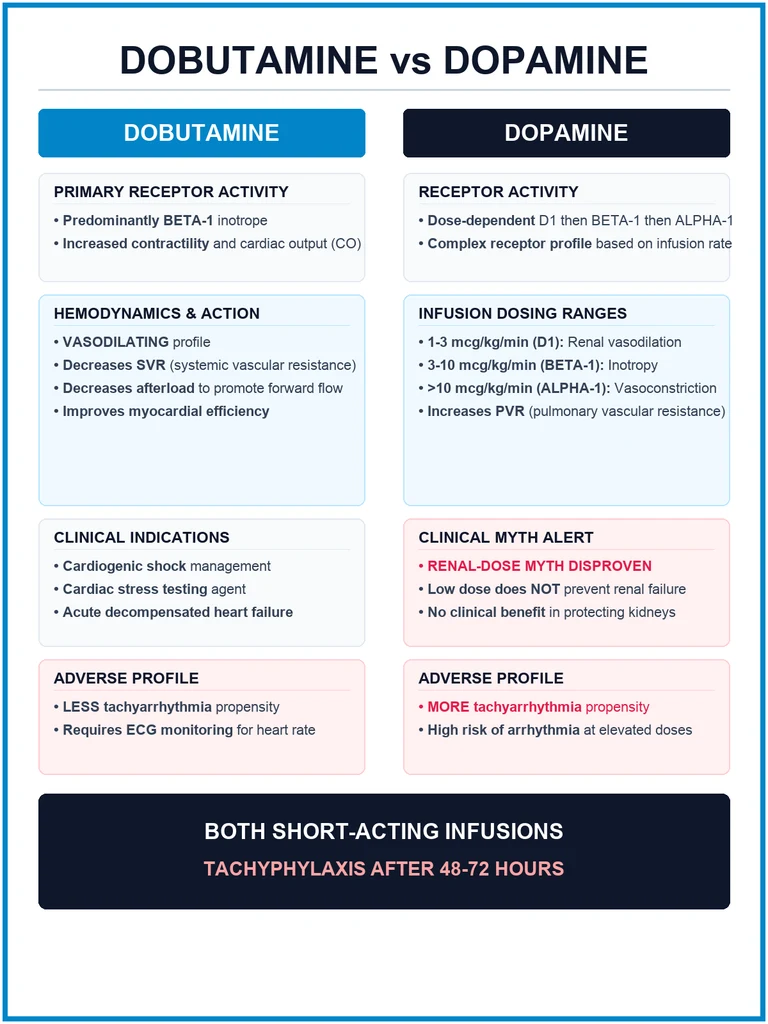
The haemodynamic contrast between dobutamine and dopamine is a standard exam ask and must be precise. Both drugs increase cardiac output through beta-1 stimulation, but their vascular effects and their arrhythmogenic liability differ in ways that drive clinical selection.[3][6]
Dobutamine produces increased contractility and increased cardiac output with a FALL in systemic vascular resistance and a FALL in pulmonary capillary wedge pressure, because its weak beta-2 vasodilation slightly exceeds its weak alpha-1 vasoconstriction. Heart rate increases modestly. The net effect in the failing heart is a higher cardiac output against a lower afterload and a lower filling pressure — a favourable unloading profile. Because dobutamine has no indirect noradrenaline-release component, it causes less tachyarrhythmia than dopamine or adrenaline. [1]
Dopamine at moderate dose produces increased contractility and increased cardiac output with a variable effect on systemic vascular resistance (often a slight rise), a rise in pulmonary capillary wedge pressure, and a more marked rise in heart rate. At high dose it raises systemic vascular resistance through alpha-1 vasoconstriction and raises pulmonary vascular resistance, the latter a significant disadvantage in pulmonary hypertension. The indirect noradrenaline release supercharges beta-1 stimulation, so dopamine is MORE ARRHYTHMOGENIC than dobutamine at every dose tier.[6]
Clinical uses of dobutamine
Dobutamine is the PROTOTYPICAL inotrope for the low-output state where the problem is pump failure rather than vasoplegia, and the standard pharmacological stressor for cardiac imaging.[1][6]
- Acute heart failure and cardiogenic shock. Dobutamine increases contractility and cardiac output while lowering systemic vascular resistance and filling pressure, a combination that suits the failing, congested heart. It is the prototypical inotrope for cardiogenic shock (for example post-myocardial infarction), though it is increasingly used alongside or replaced by alternatives such as milrinone and levosimendan where tachyphylaxis or arrhythmia limits it.
- Pharmacological stress testing. Dobutamine is the standard agent for dobutamine stress echocardiography (DSE) and dobutamine stress myocardial perfusion imaging in patients unable to exercise. Its beta-1 effect reproduces the haemodynamic stress of exercise, unmasking ischaemia through regional wall motion abnormalities or perfusion defects. The prognostic value of dobutamine stress echocardiography was reaffirmed by Dippenaar (2026), confirming its role in risk stratification.[1]
- Weaning from cardiopulmonary bypass. Dobutamine provides short-term inotropic support during separation from bypass in the failing or marginal heart.
- Septic shock with cardiac dysfunction. Where septic shock is complicated by myocardial depression (a low-output component alongside the vasoplegia), dobutamine is added to a vasopressor (noradrenaline) to support contractility without raising systemic vascular resistance further.
Because dobutamine is vasodilating, using it alone in a hypotensive patient whose primary problem is vasoplegia can worsen the hypotension; the correct response is to combine it with a vasoconstrictor such as noradrenaline rather than to escalate the dobutamine dose.[6]
Clinical uses of dopamine
Dopamine's clinical uses map onto its dose-dependent receptor tiers and onto two specific niches where it retains a guideline place.[4][6]
- Cardiogenic shock (historical). Dopamine was historically the first-line inotrope for cardiogenic shock, particularly post-myocardial infarction, on the strength of its combined beta-1 inotropy and, at higher dose, alpha-1 pressor effect. The SOAP II trial and subsequent evidence showed a higher arrhythmia rate and a trend to worse mortality with dopamine than with noradrenaline in shock, so dopamine has been displaced from first-line in most adult shock guidelines, though it remains in use.
- Symptomatic bradycardia causing haemodynamic compromise. Where atropine is ineffective or unavailable, a moderate-dose dopamine infusion (or adrenaline) can support heart rate and blood pressure in symptomatic bradycardia, exploiting the beta-1 chronotropy and the indirect noradrenaline release.
- Neonatal and paediatric septic shock. Dopamine remains a first-line vasopressor option in neonatal fluid-refractory septic shock (Yahya 2026), where its dose-dependent tiers allow titration from inotropy to vasoconstriction, and where the evidence base for alternatives is thinner than in adults.[4]
- Renal-dose dopamine. See the dedicated section below — the low-dose renal-protective use is DISPROVEN and discouraged.[2][3]
The renal-dose dopamine controversy
The renal-dose dopamine concept — infusing dopamine at 1 to 3 mcg per kg per min to protect the kidney through D1-mediated renal vasodilation and natriuresis — was widely taught and widely practised for two decades, and it remains the single most reliable dopamine exam trap. The concept has been DISPROVEN, and the practice is now discouraged.[2][3]
What is true is that low-dose dopamine increases renal blood flow, glomerular filtration and urine output through D1-mediated renal vasodilation and inhibition of proximal tubular sodium reabsorption. What is NOT true is that this translates into protection from acute kidney injury, a reduced need for renal replacement therapy, or improved survival. Multiple randomised trials and meta-analyses (most notably the ANZICS trial by Bellomo and colleagues and the large Australian and New Zealand multicentre study) showed no renal-protective or survival benefit from low-dose dopamine in critically ill patients, and the practice exposes the patient to the arrhythmogenic and other adverse effects of dopamine for no demonstrable benefit. The dopamine challenge data on spinal cord blood flow and adrenergic effects (Routkevitch 2026) reinforce that dopamine is a pharmacologically active catecholamine at every dose tier, including the low-dose tier, and not an inert renal tonic.[2]
The practical synthesis: low-dose dopamine increases urine output but does NOT protect the kidney. A patient who makes more urine on low-dose dopamine is not a patient whose kidneys have been protected. The modern approach to renal protection in the critically ill is adequate perfusion pressure (with noradrenaline), avoidance of nephrotoxins, and normoglycaemia — not renal-dose dopamine. In older adults, the broader vasopressor-selection and delirium picture (Dong 2026) further disfavours dopamine where a narrower-spectrum agent will do.[3]
Pharmacokinetics
Both dobutamine and dopamine are rapidly metabolised by catechol-O-methyltransferase (COMT); dopamine is also a substrate for monoamine oxidase (MAO). Because of this rapid enzymatic clearance, the elimination HALF-LIFE of both drugs is very short — about 2 minutes — which means a single bolus produces only a transient effect and any sustained action requires a CONTINUOUS INFUSION.[6]
The short half-life has two practical consequences. First, the infusion rate can be titrated up and down with a near-immediate haemodynamic response, making both drugs among the most titratable inotropes. Second, because the drugs disappear within minutes of stopping the infusion, there is no protracted weaning tail. Both drugs are ineffective orally because of gut and first-pass metabolism, and both are given by intravenous infusion, typically through a central line for higher concentrations. Neither crosses the blood-brain barrier to an important extent under physiological conditions, though dopamine's central effects (nausea and vomiting through the chemoreceptor trigger zone) are recognised at moderate doses.[6]
A consequence of the shared COMT and MAO metabolism is that both drugs must be used with caution in patients taking monoamine oxidase inhibitors, in whom the noradrenaline released by dopamine (and the slower clearance) can produce a hypertensive crisis. This caution applies particularly to dopamine because of its indirect component.[6]
Adverse effects
The adverse-effect profile of both drugs is the consequence of catecholamine stimulation, with dopamine carrying the greater liability because of its indirect noradrenaline release.[6]
- Tachyarrhythmias. Dopamine is MORE ARRHYTHMOGENIC than dobutamine because indirect noradrenaline release supercharges beta-1 stimulation, precipitating supraventricular and ventricular arrhythmias including atrial fibrillation, ventricular tachycardia and ventricular fibrillation, particularly in the ischaemic heart. Dobutamine also causes tachyarrhythmia but less so, and dobutamine stress echocardiography itself can provoke ischaemia and arrhythmia at peak stress doses (Dippenaar 2026).[1]
- Tachycardia and myocardial ischaemia. Beta-1 chronotropy increases myocardial oxygen demand, and in coronary artery disease both drugs can precipitate ischaemia; dobutamine stress testing exploits exactly this mechanism to unmask ischaemia.[1]
- Increased pulmonary vascular resistance. Dopamine raises pulmonary vascular resistance, so it must be used with caution in pulmonary hypertension, where dobutamine (which lowers pulmonary vascular resistance through beta-2) is preferred.
- Nausea and vomiting. Dopamine acts on the chemoreceptor trigger zone, producing nausea and vomiting at moderate doses — a feature not shared by dobutamine.
- Tachyphylaxis. Both drugs show beta-receptor downregulation after 48 to 72 hours of infusion, so the inotropic effect wanes with prolonged use and the dose must be escalated or the agent rotated (for example to milrinone or levosimendan). Neither drug is suited to prolonged inotropic support without reassessment.
- Extravasation necrosis. Concentrated dopamine (and, to a lesser extent, dobutamine) extravasated into tissue causes alpha-1-mediated vasoconstriction and skin necrosis, more so at the high dopamine dose tier. Any extravasation must be promptly treated with INTRADERMAL PHENTOLAMINE, an alpha-1 antagonist, to vasodilate the bed and prevent tissue loss; high-dose infusions should run through a central line where practical (Parkinson 2026).[6]
In older adults, the catecholamine load from either drug contributes to the broader vasopressor-selection and postoperative delirium picture, where the choice of agent is increasingly considered part of the delirium-risk profile (Dong 2026).[3]
Comparison of dobutamine and dopamine
The dobutamine-versus-dopamine contrast is standard viva material and must be precise. Both are short-acting beta-1 inotropic catecholamines, metabolised by COMT, subject to tachyphylaxis after 48 to 72 hours, and capable of extravasation necrosis. The differences are in receptor breadth, in the mechanism of beta-1 stimulation, and in the vascular and arrhythmogenic consequences.[3][6]
Against receptor profile, dobutamine is predominantly beta-1 with weak beta-2 and weak alpha-1, and no indirect component. Dopamine has a dose-dependent spread across D1, beta-1 and alpha-1, PLUS an indirect noradrenaline-release component. The practical expression is that dobutamine is vasodilating at clinical doses (beta-2 offsets alpha-1), while dopamine is vasoconstricting at high doses and variable at moderate doses. [1]
Against arrhythmogenicity, dopamine is MORE arrhythmogenic at every dose tier because the indirect noradrenaline release supercharges beta-1 stimulation, whereas dobutamine, lacking the indirect component, causes less tachyarrhythmia. This is the principal reason dobutamine is preferred when pure inotropy with the least arrhythmogenic liability is the goal. [1]
Against pulmonary vascular resistance, dopamine raises it (caution in pulmonary hypertension) while dobutamine lowers it through beta-2 activity. [1]
Against the renal-dose concept, low-dose dopamine has a D1 renal effect that increases urine output but does NOT protect the kidney; dobutamine has no such concept attached to it. Both achieve real renal protection indirectly through improved cardiac output and perfusion, not through a direct renal effect. [1]
The synthesis: dobutamine is the cleaner pure inotrope (beta-1, vasodilating, less arrhythmia, the stress-testing agent); dopamine is the broader but more toxic agent (D1 to beta-1 to alpha-1, more arrhythmia, raises PVR, renal-dose disproven) that retains a niche in neonatal septic shock and symptomatic bradycardia.[4][6]
Dosage and administration
Both drugs are administered as continuous intravenous infusions titrated to a haemodynamic endpoint, prepared in 5 percent dextrose or saline. The infusion ranges and the dose-dependent logic for dopamine should be stated precisely.[6]
For dobutamine, the infusion range is 2 to 20 mcg per kg per min, titrated to cardiac output, blood pressure and markers of perfusion. Because dobutamine is vasodilating, a hypotensive response at higher doses is managed by adding a vasoconstrictor (noradrenaline) rather than by escalating the dobutamine alone. For dobutamine stress echocardiography, the dose is escalated stepwise up to about 40 mcg per kg per min (with atropine if the target heart rate is not reached) to reproduce exercise-level stress.[1]
For dopamine, the infusion range is 1 to 20 mcg per kg per min, and the dose-dependent receptor selectivity should be applied: low dose (1 to 3 mcg per kg per min) for the D1 tier (now of historical and exam interest only, not for renal protection), moderate dose (3 to 10 mcg per kg per min) for the beta-1 inotropic tier, and high dose (above 10 mcg per kg per min) for the alpha-1 vasopressor tier. In neonatal fluid-refractory septic shock, dopamine is titrated across these tiers as a first-line vasopressor (Yahya 2026).[4]
Both drugs should be run through a central line where practical, particularly at higher concentrations, because of the extravasation-necrosis risk. The Parkinson cost-and-environment comparison (2026) provides a stewardship reference for the preparation and waste burden of these infusions.[6]
Clinical selection and current place in practice
Neither dobutamine nor dopamine is a general-purpose first-line perioperative vasopressor in the way that metaraminol, phenylephrine or noradrenaline are, because both are inotropes rather than pure pressors and both carry arrhythmogenic liability. Their place is in the settings where inotropic support of the failing circulation is specifically required, and the choice between them is driven by the receptor requirement and the adverse-effect tolerance.[5][6]
Dobutamine is the preferred pure inotrope for the low-output congested heart: it raises cardiac output, lowers systemic vascular resistance and filling pressure, and causes the least arrhythmia of the catecholamine inotropes. It is also the standard pharmacological stressor for dobutamine stress echocardiography and myocardial perfusion imaging (Dippenaar 2026). Dopamine retains a guideline place in neonatal and paediatric fluid-refractory septic shock (Yahya 2026) and in symptomatic bradycardia causing haemodynamic compromise, but has been displaced from first-line adult shock by noradrenaline (which achieves vasoconstriction with less arrhythmia) and from pure inotropy by dobutamine, milrinone and levosimendan.[1][4]
In older adults, the catecholamine load from either drug contributes to the vasopressor-selection and postoperative delirium picture, and agents without central effects are favoured when delirium risk is high (Dong 2026). The increasing ability to predict intraoperative hypotension in advance through machine-learning models (Liu 2026) allows the anaesthetist to prepare a haemodynamic plan before induction, and in most routine cases that plan will feature the narrower-spectrum pressors rather than an inotrope.[3][5]
The practical summary: reach for dobutamine when the problem is pump failure with congestion (low output, high filling pressure) or for pharmacological stress testing; reach for dopamine in neonatal septic shock and in symptomatic bradycardia where atropine has failed; understand that dopamine's dominant receptor changes with the dose; respect that renal-dose dopamine is disproven and dopamine is more arrhythmogenic than dobutamine; and reserve both drugs from routine perioperative hypotension, where vasoconstrictors are safer.[6][3]
Clinical
- Standard approach
- Evidence-based
Alternative
- Modified technique
- Risk-benefit
Red flags
[1] [1] [1] [1] [1]References
- [1]Dippenaar AP, et al. Prognostic value of dobutamine stress echocardiography: A South African experience Cardiovasc J Afr, 2026.PMID 42345272
- [2]Routkevitch D, et al. Response of Spinal Cord Blood Flow to Hypotensive and Adrenergic Challenges: Doppler Ultrasound of the Porcine Sulcal Artery Neurosurgery, 2026.PMID 42340304
- [3]Dong T, et al. Vasopressor Selection and Postoperative Delirium in Older Adults: A Propensity-Matched Database Analysis Semin Cardiothorac Vasc Anesth, 2026.PMID 42359892
- [4]Yahya R, et al. First-line vasopressor therapy in neonates with fluid-refractory septic shock: A systematic review and meta-analysis of randomized controlled trials Am J Emerg Med, 2026.PMID 42361705
- [5]Liu D, et al. Development and external validation of an interpretable machine learning model for predicting prolonged postoperative ICU length of stay in coronary artery bypass grafting patients using MIMIC-IV 3.1 and eICU-CRD 2.0 BMC Med Inform Decis Mak, 2026.PMID 42365267
- [6]Parkinson EA, et al. The Financial and Environmental Cost of Anaesthetic Emergency Drugs: Comparing Ampoules With Prefilled Syringes Cureus, 2026.PMID 42005180