Anaes · Anaesthetic adjuncts
Ephedrine
Also known as Mixed-acting sympathomimetic · Natural Ephedra alkaloid · Indirect noradrenaline-releasing vasopressor · Alpha and beta adrenergic agonist
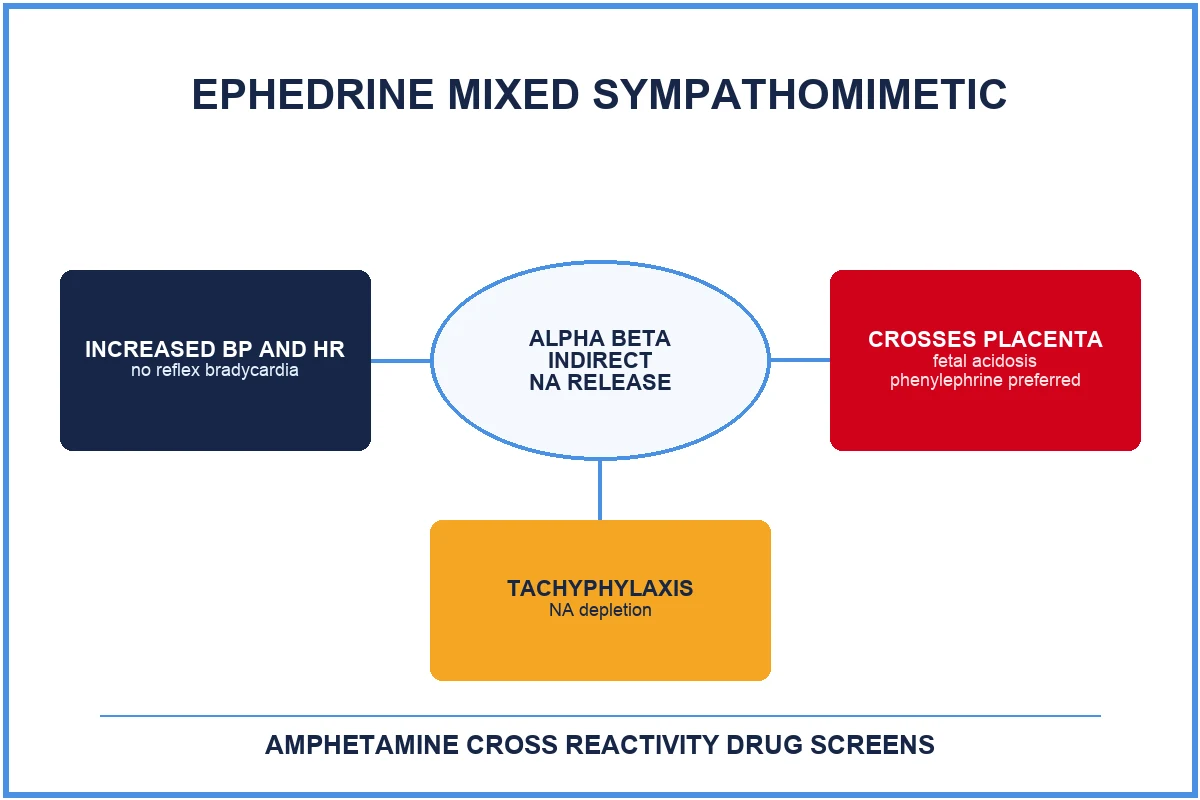
Ephedrine is a NATURAL ALKALOID from Ephedra sinica and a mixed-acting sympathomimetic, distinct from the pure alpha-1 agonists because it raises BOTH blood pressure and heart rate. Its dominant mechanism is INDIRECT — it is taken up into sympathetic nerve terminals and displaces noradrenaline from storage vesicles, on top of WEAK direct alpha-1, beta-1 and beta-2 agonism. The released noradrenaline drives the characteristic rise in heart rate, contractility and cardiac output (beta-1) together with the rise in blood pressure (alpha-1 vasoconstriction plus the cardiac output), which is why ephedrine supports a bradycardic hypotensive patient in a way that phenylephrine cannot. Its exam-defining liability is that it CROSSES THE PLACENTA, where fetal beta-1 stimulation causes tachycardia and a raised metabolic rate that predispose to fetal metabolic acidosis; this is the central reason phenylephrine has displaced ephedrine as the first-line vasopressor for obstetric spinal hypotension. The agent is structurally related to amphetamine and so cross-reacts with amphetamine on urine drug screens (Sainz-Pastor 2026), produces tachyphylaxis as noradrenaline stores are depleted, and has a longer duration of action than phenylephrine at about 60 to 90 minutes after an IV bolus. Built on the amphetamine cross-reactivity study (Sainz-Pastor 2026), the acute right-ventricular failure vasopressor case report (Mohammed 2026), the cost and environmental comparison of emergency vasopressors (Parkinson 2026), the vasopressor choice and postoperative delirium study in older adults (Dong 2026), the maternal-BMI and metaraminol dosing study (Gao 2026), and the machine-learning intraoperative hypotension prediction model (Liu 2026).
On this page & tools
Your progress
Saved locally on this device.
8 MCQs with explanations
Target exams
Red flags

Overview and definition
Ephedrine is a natural alkaloid obtained from the plant Ephedra sinica and is the prototypical MIXED-ACTING sympathomimetic amine. It is pharmacologically distinct from the pure direct-acting alpha agonists used in anaesthesia because it acts by BOTH a direct and an indirect mechanism, and because it raises heart rate and cardiac output as well as blood pressure. These two properties — mixed direct-and-indirect action, and simultaneous alpha and beta stimulation — explain almost every exam point about the drug.[3]
Clinically, ephedrine remains a useful perioperative vasopressor for the hypotensive patient who also has a slow heart rate, where its beta-1 support is an advantage rather than a liability. It has been displaced from its former position as first-line treatment for obstetric spinal hypotension by phenylephrine, primarily because ephedrine crosses the placenta and predisposes to fetal acidosis. It is also a common source of false-positive amphetamine urine drug screens because it is structurally related to amphetamine.[1]
Mechanism: direct and indirect action
Ephedrine is called mixed-acting because it works through TWO mechanisms operating at the same time.[3]
The INDIRECT action is the dominant mechanism and is the one to lead with in an answer. Ephedrine is structurally related to amphetamine and, like amphetamine, is taken up into sympathetic nerve terminals by the uptake-1 (NET) transporter. Once inside the terminal it is transported into the noradrenaline storage vesicles and displaces noradrenaline from them. The displaced noradrenaline leaves the terminal and stimulates the post-synaptic adrenergic receptors — alpha-1 on the vasculature, beta-1 on the heart — producing vasoconstriction and cardiac stimulation. Because this mechanism depends on a finite pool of stored noradrenaline, repeated dosing progressively depletes those stores and produces tachyphylaxis.[1]
The DIRECT action is weak. Ephedrine is a direct agonist at the alpha-1, beta-1 and beta-2 adrenergic receptors, binding them directly but with low affinity relative to noradrenaline or phenylephrine. The direct component contributes some vasoconstriction (alpha-1), some increase in heart rate and contractility (beta-1), and some bronchodilation and metabolic effects (beta-2), but the bulk of the clinical effect is delivered through the released noradrenaline. [1]
This dual mechanism is the key contrast with phenylephrine (a pure direct alpha-1 agonist with no indirect component and no beta effect) and with metaraminol (also mixed-acting, but with a stronger direct alpha-1 component and relatively less beta activity than ephedrine).[3]
Receptor pharmacology
The adrenergic receptor profile of ephedrine is broad, which is the direct consequence of noradrenaline release plus weak direct agonism:[3]
- Alpha-1 receptor (direct and indirect). Vasoconstriction of arterioles and veins, raising systemic vascular resistance, venous return and blood pressure. The alpha-1 effect is weaker than that of phenylephrine or metaraminol because the direct component is only modest and the indirect component is limited by noradrenaline store size.
- Beta-1 receptor (direct and indirect). Increased heart rate (positive chronotropy), increased contractility (positive inotropy), and increased atrioventricular nodal conduction. The beta-1 effect is prominent and is what distinguishes ephedrine from the pure alpha-1 agonists.
- Beta-2 receptor (weak direct). Modest vasodilation in skeletal muscle, bronchodilation, and metabolic effects including glycogenolysis (contributing to hyperglycaemia) and a shift of potassium into cells (contributing to hypokalaemia). [1]
The net haemodynamic effect is therefore a combined alpha and beta response — blood pressure rises through vasoconstriction AND through increased cardiac output, while heart rate and contractility rise through beta-1 stimulation.[3]
Haemodynamic effects
The haemodynamic signature of ephedrine is a rise in BOTH blood pressure AND heart rate, which is the practical opposite of phenylephrine.[3]
- Blood pressure rises, through two additive mechanisms: alpha-1 vasoconstriction increases systemic vascular resistance, and beta-1 stimulation increases cardiac output. The rise is reliable but moderate in magnitude.
- Heart rate rises through direct and indirect beta-1 stimulation, and this is a key distinguishing feature. Unlike phenylephrine, ephedrine does NOT produce reflex bradycardia — indeed it tends to produce tachycardia.
- Cardiac output rises through the combined increase in heart rate and contractility. This is useful in the hypotensive, bradycardic patient but potentially harmful in the patient with a fast heart rate or coronary disease.
- Myocardial oxygen demand rises with heart rate and contractility, which is why ephedrine can precipitate ischaemia or tachyarrhythmias in the susceptible heart, a point reinforced by case reports of vasopressor-related decompensation including acute right ventricular failure in the failing circulation (Mohammed 2026).[2]
Pharmacokinetics
After an intravenous bolus, ephedrine has an onset of action of about 2 to 5 minutes and a duration of about 60 to 90 minutes — substantially longer than phenylephrine (about 5 to 10 minutes) or metaraminol (about 10 to 20 minutes).[3]
Ephedrine is partly metabolised in the liver and partly excreted unchanged in the urine, with a relatively long elimination half-life of several hours. It is LIPID SOLUBLE and so crosses both the blood-brain barrier (producing the central nervous system stimulation that accounts for anxiety, restlessness and insomnia) and the placenta (producing fetal beta-1 stimulation). This lipid solubility and CNS penetration is another point of contrast with the less lipid-soluble pure alpha-1 agonists.[1]
Obstetric use and placental transfer
The obstetric history of ephedrine is one of the most examined topics in the applied pharmacology of vasopressors, and the modern teaching is that phenylephrine is preferred over ephedrine for spinal-hypotension in the parturient.[5]
Ephedrine CROSSES THE PLACENTA readily because of its lipid solubility and relatively low degree of ionisation at physiological pH. Once in the fetal circulation, its beta-1 stimulation produces fetal tachycardia and a raised fetal metabolic rate. The increased metabolic demand, sustained over the duration of the drug effect, predisposes to a rise in fetal lactate and fetal metabolic acidosis. This effect is dose-related and was demonstrated in the classic trials comparing ephedrine with phenylephrine for caesarean-section spinal hypotension, which showed that umbilical-artery pH was lower and base deficit higher with ephedrine. [1]
Phenylephrine, by contrast, does not cross the placenta to any clinically important extent and improves maternal blood pressure without the fetal metabolic penalty. It is therefore the recommended first-line vasopressor for the prevention and treatment of spinal hypotension during caesarean section. Ephedrine is now reserved for the parturient in whom phenylephrine causes excessive bradycardia or in whom a heart-rate-raising effect is specifically wanted. Studies of obstetric vasopressor dosing also show that maternal body mass index affects vasopressor requirements, with higher BMI increasing the dose needed to prevent hypotension (Gao 2026), reinforcing that obstetric vasopressor therapy should be titrated rather than given as fixed boluses.[5]
Clinical uses
The current clinical roles of ephedrine follow directly from its mixed alpha-and-beta profile.[3][6]
- Perioperative hypotension with bradycardia. This is the niche where ephedrine is most useful. When a patient is both hypotensive and bradycardic — for example after a high spinal or epidural, after opioid or beta-blocker pretreatment, or in the vagotonic patient — a pure alpha-1 agonist would raise blood pressure but worsen the bradycardia through baroreceptor reflex, whereas ephedrine raises blood pressure AND supports the heart rate. This is the principal reason ephedrine is still stocked as an emergency theatre drug.
- Hypotension associated with spinal and epidural anaesthesia. Neuraxial blockade interrupts the sympathetic chain, producing vasodilation and a reduced venous return; ephedrine addresses both the vasoplegia (alpha-1) and the chronotropic support (beta-1). It was the historical first-line agent before being displaced by phenylephrine in obstetrics.
- Nasal decongestion. Topical ephedrine produces alpha-1-mediated vasoconstriction of the nasal mucosa and is used in some ear-nose-throat and airway contexts to reduce mucosal bleeding and oedema.
- Hypotension in the surgical patient where intraoperative hypotension is predicted. Machine-learning prediction models can now flag patients at high risk of intraoperative hypotension in advance (Liu 2026), allowing the anaesthetist to prepare a vasopressor plan and consider ephedrine where a heart-rate-supporting agent is wanted.[6]
Adverse effects and tachyphylaxis
The adverse-effect profile is the necessary consequence of broad adrenergic stimulation plus CNS penetration.[1][4]
- Tachycardia and tachyarrhythmias. Beta-1 stimulation raises heart rate and can precipitate atrial or ventricular arrhythmias, particularly in the patient with ischaemic or structural heart disease.
- Hypertension. The alpha-1 vasoconstriction can overshoot, producing hypertension that may be harmful in the patient with a vulnerable vasculature or intracranial aneurysm.
- Tachyphylaxis. Because the indirect mechanism relies on a finite store of noradrenaline, repeated dosing depletes those stores and the pressor response diminishes. This is a defining pharmacodynamic feature and a classic exam point; it contrasts with the pure direct-acting agonists, which do not exhibit tachyphylaxis to the same degree.
- Central nervous system stimulation. Ephedrine crosses the blood-brain barrier and produces anxiety, restlessness, insomnia and tremor. In the older adult this central effect can contribute to postoperative delirium, and vasopressor choice is increasingly considered part of the delirium-risk picture (Dong 2026).[4]
- Urinary retention. Alpha-1 stimulation at the bladder neck increases sphincter tone and can cause urinary retention, relevant in the postoperative patient.
- Metabolic effects. Beta-2 stimulation produces glycogenolysis (hyperglycaemia) and an intracellular potassium shift (hypokalaemia), both relevant in the diabetic patient and during prolonged surgery.[1]
Amphetamine cross-reactivity and drug interactions
Ephedrine is structurally related to amphetamine, and this structural relationship has both forensic and pharmacological consequences.[1]
The forensic consequence is a well-recognised FALSE-POSITIVE amphetamine result on immunoassay urine drug screens. Ephedrine and related sympathomimetics cross-react with amphetamine immunoassays, and the degree of cross-reactivity differs between assays; the Sainz-Pastor study on amphetamine immunoassay interpretation specifically examined differences of reivity with ephedrine and highlighted the need for confirmatory testing by gas chromatography-mass spectrometry or liquid chromatography-tandem mass spectrometry before reporting a positive amphetamine result (Sainz-Pastor 2026).[1]
The pharmacological interactions follow from the indirect mechanism. Monoamine oxidase inhibitors prevent the breakdown of noradrenaline and so potentiate the response to ephedrine markedly, producing a risk of hypertensive crisis; ephedrine should be avoided in the patient taking an MAOI. Tricyclic antidepressants inhibit the reuptake of noradrenaline and also potentiate ephedrine. Conversely, reserpine and other agents that deplete noradrenaline stores attenuate the response to ephedrine and produce an exaggerated tachyphylaxis, because the indirect mechanism has nothing to release.[1]
Comparison with phenylephrine
The ephedrine-versus-phenylephrine comparison is the single most examined vasopressor contrast and must be known precisely.[5]
- Mechanism. Ephedrine is mixed-acting (weak direct alpha-1, beta-1, beta-2 PLUS indirect noradrenaline release). Phenylephrine is a pure direct alpha-1 agonist with no indirect component and no beta activity.
- Heart rate. Ephedrine raises heart rate (beta-1). Phenylephrine lowers heart rate through reflex baroreceptor-mediated bradycardia. This is the clearest haemodynamic contrast.
- Cardiac output. Ephedrine raises cardiac output. Phenylephrine tends to reduce cardiac output slightly because the reflex bradycardia offsets any inotropic effect.
- Placental transfer. Ephedrine crosses the placenta and causes fetal acidosis. Phenylephrine does not cross the placenta to a clinically important extent and does not cause fetal acidosis. This is the basis of phenylephrine being preferred for obstetric spinal hypotension.
- Duration. Ephedrine lasts about 60 to 90 minutes. Phenylephrine lasts about 5 to 10 minutes, requiring infusion or repeated boluses for sustained effect.
- Tachyphylaxis. Ephedrine exhibits tachyphylaxis through noradrenaline store depletion. Phenylephrine does not exhibit meaningful tachyphylaxis.[5]
Comparison with metaraminol and adrenaline
Ephedrine also contrasts with metaraminol and adrenaline, and these comparisons are common in vivas.[3]
Against metaraminol, both are mixed-acting agents with a direct alpha-1 component and an indirect noradrenaline-release component. The difference is in the balance: metaraminol has a STRONGER direct alpha-1 effect and relatively LESS beta activity, so it produces more vasoconstriction and proportionally less tachycardia; ephedrine has MORE beta effect and so produces more tachycardia and a greater rise in cardiac output. Metaraminol is therefore closer to phenylephrine on the alpha/beta spectrum than ephedrine is. Maternal BMI affects the dose of metaraminol required to prevent obstetric hypotension (Gao 2026), and the same titration principle applies to ephedrine.[5]
Against adrenaline, ephedrine shares the broad alpha and beta profile but differs in mechanism. Adrenaline is a PURE DIRECT agonist at alpha-1, beta-1 and beta-2, with no indirect component, and is far more potent. Ephedrine is a WEAK direct agonist whose dominant effect is indirect noradrenaline release. Adrenaline is the drug of choice for anaphylaxis and cardiac arrest; ephedrine is not a substitute for adrenaline in either setting. The cost and environmental comparison of these emergency vasopressors by Parkinson quantified the relative expense and waste burden of adrenaline, ephedrine, metaraminol and phenylephrine, and is a useful reference when discussing theatre drug selection (Parkinson 2026).[3]
Dosage and administration
Ephedrine is administered as the hydrochloride salt. The usual adult intravenous bolus for perioperative hypotension is 3 to 6 mg, repeated and titrated to effect, with a typical infusion of 30 mg in 500 mL of crystalloid run to a haemodynamic endpoint. Onset is about 2 to 5 minutes and duration about 60 to 90 minutes.[3]
It can be given peripherally for short-term perioperative use and does not, at the doses used for bolus correction of anaesthesia-induced hypotension, mandate a central line in the way that high-dose noradrenaline does. The longer duration of action compared with phenylephrine means that a single bolus produces a more sustained effect, which can be either an advantage (less frequent dosing) or a disadvantage (less titratable, and more risk of overshoot hypertension and sustained tachycardia).[3]
Clinical selection and current place in practice
Ephedrine occupies a defined and still-useful place in the anaesthetist's vasopressor toolkit, but it is no longer the default first-line agent in the settings where it was once dominant.[3][4]
In obstetric spinal hypotension it has been displaced by phenylephrine because of the fetal-acidosis problem. For generic anaesthesia-induced vasoplegia where a rapid, titratable, pure vasoconstrictor is wanted, metaraminol and phenylephrine are usually preferred. Ephedrine retains a clear role where the patient is hypotensive AND bradycardic, because in that specific situation its heart-rate-supporting beta-1 effect is beneficial and a pure alpha-1 agent would be counterproductive. In older adults, the contribution of ephedrine's central stimulation to postoperative delirium is an emerging consideration in vasopressor selection (Dong 2026), tilting choice toward agents without CNS penetration when the delirium risk is high.[4]
The practical summary: reach for ephedrine when you want to raise blood pressure AND heart rate together, avoid it when tachycardia, fetal well-being, or delirium risk is the dominant concern, and remember that its effect will fade with repeated dosing as noradrenaline stores run down.[3]
Clinical
- Standard approach
- Evidence-based
Alternative
- Modified technique
- Risk-benefit
Red flags
[1] [1] [1] [1] [1]References
- [1]Sainz-Pastor N, et al. Challenges in the interpretation of amphetamine results: differences of reactivity between immunoassay and immunochromatography Scand J Clin Lab Invest, 2026.PMID 42364133
- [2]Mohammed M, et al. A case report of acute right ventricular failure in a patient undergoing transoesophageal echocardiogram for evaluation of tricuspid regurgitation Eur Heart J Case Rep, 2026.PMID 42339184
- [3]Parkinson EA, et al. The Financial and Environmental Cost of Anaesthetic Emergency Drugs: Comparing Ampoules With Prefilled Syringes Cureus, 2026.PMID 42005180
- [4]Dong T, et al. Vasopressor Selection and Postoperative Delirium in Older Adults: A Propensity-Matched Database Analysis Semin Cardiothorac Vasc Anesth, 2026.PMID 42359892
- [5]Gao X, et al. Effect of maternal body mass index on the dosage of metaraminol for preventing hypotension after spinal anesthesia BMC Anesthesiol, 2026.PMID 42121030
- [6]Liu D, et al. Development and external validation of an interpretable machine learning model for predicting prolonged postoperative ICU length of stay in coronary artery bypass grafting patients using MIMIC-IV 3.1 and eICU-CRD 2.0 BMC Med Inform Decis Mak, 2026.PMID 42365267