Anaes · Intravenous induction agents
Etomidate
Also known as Imidazole induction agent · Carboxylated imidazole · Hypnomidate · Amidate · Etomidate-Lipuro (lipid emulsion)
Etomidate is the only intravenous induction agent that is haemodynamically neutral, and that single property is the source of its clinical identity: it is the induction agent of choice for the patient in cardiovascular compromise — the severe aortic stenosis, the failing left ventricle, the hypovolaemic, the patient in cardiogenic shock. The framework rests on four exam-critical ideas: it is a positive allosteric modulator at the GABA-A receptor (like propofol and thiopental) but it owes its selectivity to the beta-2 and beta-3 subunits, which distinguishes it from propofol; its haemodynamic neutrality — no significant change in heart rate, blood pressure, cardiac output or systemic vascular resistance at standard doses — makes it the safest induction agent for the haemodynamically tenuous; it reduces the cerebral metabolic rate for oxygen and the intracranial pressure while preserving cerebral autoregulation, giving it a role in neuroanaesthesia; and the critical caveat that even a single induction dose inhibits adrenal 11-beta-hydroxylase and the cholesterol side-chain cleavage enzyme, suppressing cortisol and aldosterone synthesis for 8 to 24 hours — the basis of the etomidate-in-sepsis controversy. Built on the etomidate-versus-ketamine emergency-intubation comparison (Andriazzi 2026), the induction-agents emergency-tracheal-intubation review (Zampieri 2026), the oliceridine-etomidate myoclonus work (Lin 2026), the 11-deoxycorticosterone case report (Bhattacharya 2026), the etomidate-oxaliplatin neuropathic-pain study (Chen 2026), the etomidate-analogs design review (Zhao 2026), the caffeine ECT-augmentation study (Ridder 2025), and the remimazolam-versus-etomidate EEG burst-suppression comparison (Cao 2025).
On this page & tools
Your progress
Saved locally on this device.
8 MCQs with explanations
Target exams
Red flags
Why this matters to the anaesthetist
Etomidate occupies a unique place among the intravenous induction agents: it is haemodynamically neutral. Where propofol drops the blood pressure through vasodilation and negative inotropy, where thiopental drops it through myocardial depression and venodilation, and where ketamine raises it through a sympathomimetic response, etomidate leaves the heart rate, the blood pressure, the cardiac output and the systemic vascular resistance essentially unchanged at standard induction doses. For the patient whose cardiovascular reserve is exhausted — the severe aortic stenosis, the critically failing left ventricle, the hypovolaemic, the patient in cardiogenic shock — that neutrality makes etomidate the safest induction agent available, and the default choice of the cardiac anaesthetist for the unstable patient.[2]
Three properties define the drug and drive every exam question about it. First, it is a positive allosteric modulator at the GABA-A receptor, like propofol and thiopental — but its action is selective for the beta-2 and beta-3 subunits, a molecular detail that distinguishes it from propofol and is the basis of the modern search for adrenal-sparing etomidate analogs. Second, it reduces the cerebral metabolic rate for oxygen and the intracranial pressure while preserving cerebral autoregulation, giving it a role in neuroanaesthesia alongside its cardiovascular role. Third — and this is the property that defines its limits — even a single induction dose inhibits adrenal 11-beta-hydroxylase and the cholesterol side-chain cleavage enzyme, blocking cortisol and aldosterone synthesis for 8 to 24 hours. This adrenal suppression is the central controversy of the drug: in the septic patient, whose adrenal axis is already failing, etomidate may worsen the outcome, and the question of whether etomidate is acceptable in sepsis has driven two decades of trials and the modern development of analogs that retain the haemodynamic profile without the adrenal effect.[1][6]
Master etomidate by holding these three in tension: the haemodynamic neutrality that makes it indispensable, the GABA-A beta-subunit selectivity that explains its molecular identity, and the adrenal suppression that limits it. [1]
Physical chemistry
Etomidate is an imidazole derivative — a carboxylated imidazole — and was introduced into clinical practice in 1972 specifically in the search for an induction agent that did not cause the cardiovascular depression of the barbiturates. It is supplied as a racemic mixture, and the R(+) enantiomer is the active form; the S(−) enantiomer is essentially inactive at the GABA-A receptor. The molecule is lipophilic, which allows it to cross the blood-brain barrier rapidly, but it is poorly water-soluble in its native form, so the formulation vehicle is the principal determinant of two of its adverse effects.[6]
Three formulation issues define the practical use of the drug. First, the conventional formulation is a solution in propylene glycol at 35 percent, and it is the propylene glycol — not the etomidate itself — that is responsible for the pain on injection and the venous irritation that are characteristic of the conventional preparation. The propylene glycol vehicle is also mildly histamine-releasing in some patients and can cause haemolysis in vitro at high concentrations. Second, a lipid emulsion formulation (Etomidate-Lipuro), in which the etomidate is dissolved in a medium-chain/long-chain triglyceride emulsion much like propofol, substantially reduces the pain on injection and the venous irritation, and is the preferred formulation where available. Third, water-soluble alternative formulations (for example a cyclodextrin-based preparation) have been developed but are not universally available.[6]
Mechanism of action
Etomidate is a positive allosteric modulator at the GABA-A receptor — the same target as propofol, thiopental and the benzodiazepines. The GABA-A receptor is the principal inhibitory ligand-gated ion channel of the central nervous system: when GABA binds, the chloride channel opens, chloride enters the neuron, and the cell is hyperpolarised and less excitable. Etomidate, like propofol, acts allosterically — at a site distinct from the GABA recognition site — to increase the apparent affinity of the receptor for GABA and so to potentiate the effect of the endogenous inhibitory transmitter. At high (anaesthetic) concentrations etomidate can open the chloride channel directly, in the absence of GABA — the so-called direct agonist effect that accounts for the deep anaesthesia at clinical doses.[8]
The molecular detail that distinguishes etomidate from propofol is its subunit selectivity. Etomidate's action is critically dependent on the beta-2 and beta-3 subunits of the GABA-A receptor: it binds a site within the transmembrane domain at the interface between the beta and alpha subunits, and mutation of a single asparagine residue in the beta subunit (beta-2 N265 or beta-3 N265) abolishes the anaesthetic effect of etomidate in transgenic animal models. Propofol, by contrast, acts more broadly across the GABA-A receptor family and at other targets. This beta-subunit selectivity is not merely a molecular curiosity — it is the pharmacological fingerprint that distinguishes etomidate from propofol, and it is the rationale for the modern medicinal-chemistry programme that seeks etomidate analogs (such as the carboetomidate and methoxycarbonyl-etomidate series) that retain the GABA-A beta-subunit anaesthetic activity but lose the 11-beta-hydroxylase inhibition, thereby decoupling the desirable haemodynamic profile from the undesirable adrenal suppression.[6]
Pharmacokinetics
Etomidate's pharmacokinetics are those of a rapidly redistributed, rapidly cleared ester. After an intravenous induction dose the onset of anaesthesia is 15 to 45 seconds — one arm-to-brain circulation — driven by the high lipid solubility that carries the drug across the blood-brain barrier instantly, with onset limited only by the circulation time. Recovery after a single bolus is rapid, at 5 to 10 minutes, and, as with the other induction agents, this early recovery is driven not by metabolism but by redistribution: etomidate leaves the vessel-rich central compartment (the brain and the well-perfused organs) and distributes into the larger muscle and fat compartments, the plasma and brain concentrations fall, and the patient emerges. [1]
The clearance is high — substantially higher than thiopental — and is achieved by hepatic ester hydrolysis, predominantly by carboxylesterase enzymes, to the corresponding carboxylic acid, which is pharmacologically inactive. This rapid hydrolysis to an inactive metabolite is the second factor (after redistribution) that makes the recovery so rapid and so clear-headed, and it means that there is no active metabolite to prolong the effect. The context-sensitive half-time is very short and rises only minimally with the duration of an infusion, which is the basis of etomidate's suitability as a maintenance infusion — though in practice it is rarely so used, because of the adrenal suppression that would accompany a prolonged infusion (etomidate infusions are contraindicated for this reason). Etomidate is about 75 percent protein-bound (chiefly to albumin), so the unbound (active) fraction rises in hypoalbuminaemia, and the dose should be titrated in the critically ill. A small fraction is excreted unchanged in the urine; the remainder as the inactive carboxylic acid conjugate.[1]
Pharmacodynamics
Etomidate produces a dose-dependent depression of the central nervous system, culminating in the loss of consciousness that defines induction. Several pharmacodynamic properties distinguish it and drive its clinical niche. It is an anticonvulsant in the conventional sense — it raises the seizure threshold — yet, paradoxically, it produces epileptiform activity on the EEG and can activate a seizure focus (see the section on adverse effects); these two facts are not contradictory, and the resolution of the apparent paradox is developed in the section on clinical uses in epilepsy surgery. [1]
On the cerebral circulation etomidate, like the other GABA-ergic agents, reduces the cerebral metabolic rate for oxygen (CMRO2) and, in parallel, reduces the cerebral blood flow and the intracranial pressure by a cerebral vasoconstriction that is coupled to the reduced metabolic demand. Crucially, etomidate preserves cerebral autoregulation — the capacity of the cerebral vessels to maintain a constant cerebral blood flow across a range of perfusion pressures — which, together with its haemodynamic neutrality (so the perfusion pressure itself is preserved), makes it a favoured agent where the intracranial pressure is raised and the systemic pressure is precarious. It produces minimal respiratory depression at induction doses — less apnoea than propofol, though a large or rapid bolus still causes apnoea. It does NOT trigger malignant hyperthermia, and is therefore safe in the known MH-susceptible patient where suxamethonium and the volatile agents are contraindicated.[8]
Cardiovascular effects
The cardiovascular profile is etomidate's defining advantage and the reason the drug exists in the pharmacopoeia. At standard induction doses etomidate produces no significant change in the heart rate, the blood pressure, the cardiac output or the systemic vascular resistance. There is no myocardial depression of clinical consequence, no vasodilation, no sympathomimetic stimulation — the drug is, to a close approximation, haemodynamically neutral. This is in marked contrast to propofol (a dose-dependent hypotension from vasodilation and negative inotropy), thiopental (a hypotension from myocardial depression and venodilation) and even midazolam (a modest hypotension).[2]
This neutrality makes etomidate the safest induction agent for the haemodynamically tenuous patient. It is the drug of choice for the induction of anaesthesia in severe aortic stenosis (where loss of afterload or of sinus rhythm is catastrophic, and where the fixed outflow tract cannot compensate for a fall in preload or contractility), in severe left-ventricular impairment and hypertrophic obstructive cardiomyopathy (HOCM), in hypovolaemia, and in cardiogenic shock. It is the default induction agent in cardiac anaesthesia for the unstable patient, and is widely used for rapid-sequence induction in the critically ill where a propofol- or thiopental-induced drop in pressure would not be tolerated. The minor caveat is that very high doses or rapid boluses can produce a small, transient fall in pressure, so even etomidate should be titrated in the most extreme cardiovascular compromise; but for the great majority of unstable patients the haemodynamic stability it provides is unmatched.[1][2]
The critical adverse effect — adrenal suppression
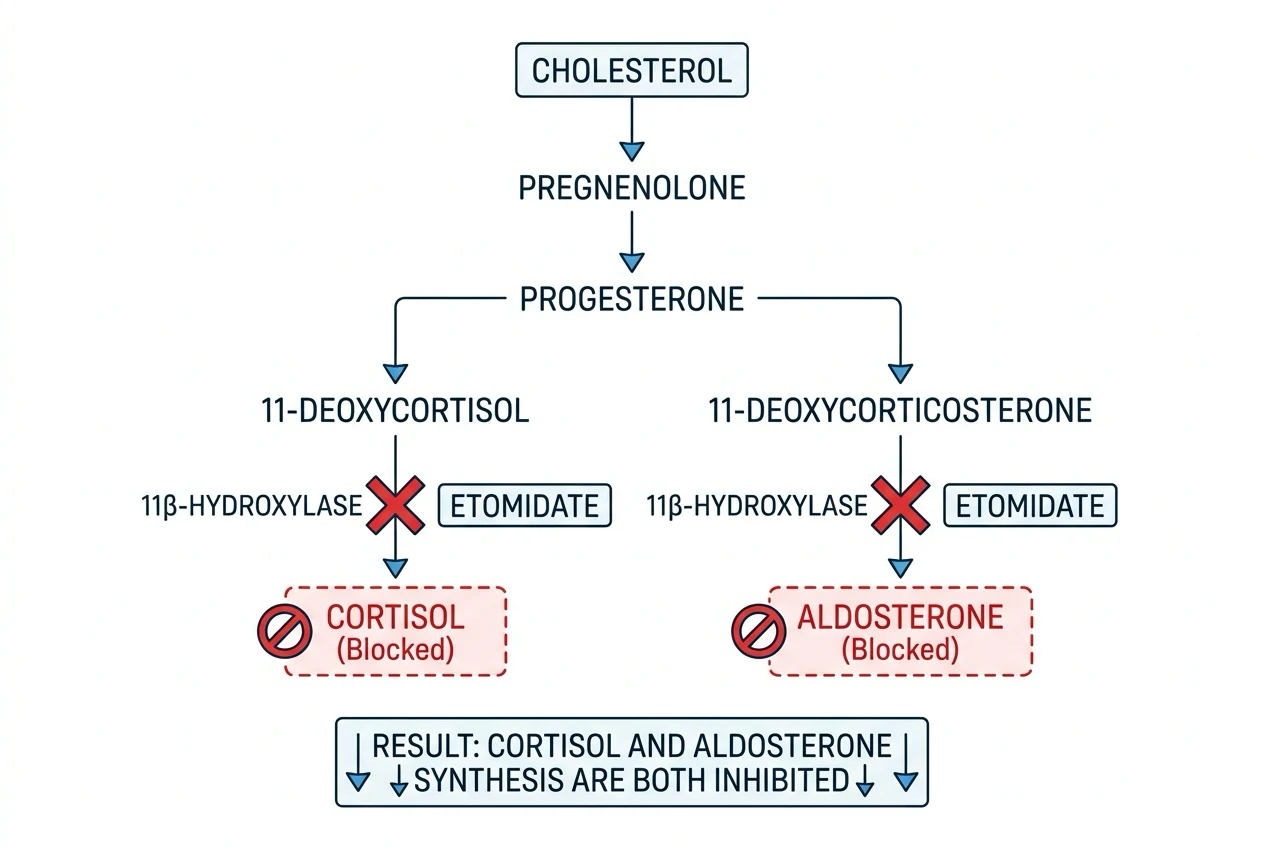
The single most important limitation of etomidate is its inhibition of adrenal steroidogenesis. Etomidate inhibits two enzymes of the adrenal cortex: 11-beta-hydroxylase (CYP11B1), which converts 11-deoxycortisol to cortisol and 11-deoxycorticosterone to corticosterone, and the cholesterol side-chain cleavage enzyme (CYP11A1), the rate-limiting first step that converts cholesterol to pregnenolone. By blocking these enzymes etomidate halts the synthesis of both cortisol and aldosterone, the glucocorticoid and the mineralocorticoid that constitute the adrenal stress response.[4]
The clinical significance is that even a single induction dose suppresses cortisol synthesis for 8 to 24 hours. In the well patient undergoing elective surgery this is of no consequence — the adrenal recovers, and there is no demonstrable harm. In the septic patient, however, whose survival depends on an intact adrenal stress response to mount the massive cortisol surge of septic shock, the suppression is clinically significant: the patient cannot raise the cortisol required to maintain the vascular tone and the catecholamine responsiveness, and observational evidence suggested that this might increase mortality after a single induction dose in septic shock. This is the basis of the etomidate-in-sepsis controversy developed in the next section, and the reason that two randomised trials — the ETCP trial and the ABBA trial (in the broader emergency-intubation literature) — were mounted to settle whether the mortality signal is real.[1][2]
The molecular pharmacology has a constructive consequence: because the anaesthetic (GABA-A) effect and the adrenal (enzyme-inhibition) effect depend on different parts of the etomidate molecule, medicinal chemists have been able to design etomidate analogs — carboetomidate and methoxycarbonyl-etomidate (MOC-etomidate) — that retain the GABA-A beta-subunit anaesthetic activity but do not inhibit 11-beta-hydroxylase, thereby decoupling the haemodynamic advantage from the adrenal liability. These analogs are the subject of ongoing development and represent the future direction of "etomidate-like" anaesthesia.[6]
Other adverse effects
- Myoclonus — the most visible adverse effect. Involuntary, often vigorous, muscle movements occur on induction in a significant minority of patients, and they can be violent enough to dislodge lines, fracture a tooth, or be mistaken for a seizure. Myoclonus is a subcortical phenomenon (it is not an epileptic seizure, and it does not arise from the cortex) and it is reduced by pretreatment with an opioid (fentanyl, alfentanil) or a benzodiazepine (midazolam), or by giving the induction dose slowly. The oliceridine-etomidate work confirms that the opioid modulates the myoclonic threshold.[3]
- Pain on injection — caused by the propylene glycol vehicle (35 percent), not by the etomidate itself. The pain is more severe in a small dorsal hand vein and can precipitate withdrawal. It is reduced by the lipid emulsion formulation (Etomidate-Lipuro), by the use of a large antecubital vein, and by opioid or lidocaine pretreatment with venous occlusion.[6]
- Nausea and vomiting — etomidate is more emetogenic than propofol (propofol is itself antiemetic), and postoperative nausea and vomiting are correspondingly more frequent. An antiemetic is usually co-administered, particularly in the day-surgery or PONV-prone patient.
- Venous irritation and thrombophlebitis — a consequence of the propylene glycol vehicle, and again reduced by the lipid formulation.
- Epileptiform EEG activity — etomidate produces spikes and sharp waves on the EEG and can activate a seizure focus. This is a hazard in the patient with a known seizure disorder who is not being operated on for that focus, but it is advantageous in epilepsy surgery, where it is used to map the seizure focus before resection (see Clinical uses).[7]
Clinical uses and dosing
- Induction of anaesthesia. The standard intravenous induction dose is 0.2 to 0.3 mg/kg, given over 30 to 60 seconds. This is the lowest induction dose of the common IV agents by mass, and it should be titrated to effect, particularly in the elderly and the critically ill.[1]
- Rapid-sequence induction in the haemodynamically compromised. Etomidate is the agent of choice for RSI where the blood pressure cannot tolerate a drop — severe aortic stenosis, severe LV impairment, cardiogenic shock, and the critically ill ICU patient. The adrenal-suppression caveat (below) must be weighed where the patient is septic.[1][2]
- Cardiac anaesthesia. In severe aortic stenosis, HOCM, severe LV failure and the unstable cardiac patient, etomidate is the default induction agent precisely because it preserves the cardiac output, the SVR and the perfusion pressure on which these patients depend.
- Epilepsy surgery — activation of the seizure focus. The paradox of etomidate is that although it is an anticonvulsant in the conventional sense, it produces epileptiform EEG activity and can activate a previously quiescent seizure focus. This property is deliberately exploited in epilepsy surgery, where the surgeon needs to localise the focus for resection: a small, titrated dose of etomidate can bring out the focus for electrocorticographic mapping.[7]
- Procedural sedation and electroconvulsive therapy (ECT). Etomidate has been used for the modified (anaesthetised) ECT, and the caffeine-for-ECT-augmentation literature sits alongside it as a means of enhancing the seizure duration where the seizure threshold is high.[7]
- ICU intubation — controversial in sepsis. Etomidate remains in widespread use for intubation in the ICU, but its use in the septic patient is the subject of the controversy developed in the next section; ketamine is increasingly preferred where the adrenal axis is in question.[2]
Etomidate in sepsis — the controversy
The etomidate-in-sepsis question is among the most debated in critical-care anaesthesia. The mechanism is not in doubt: a single induction dose inhibits 11-beta-hydroxylase and the cholesterol side-chain cleavage enzyme, and adrenal suppression lasts 8 to 24 hours. In septic shock, where the mortality is tightly coupled to the adequacy of the cortisol stress response, silencing that response for up to a day is plausibly harmful, and a series of observational studies suggested an increased mortality in septic patients induced with etomidate. The signal was never large enough to settle the question, and the confounding is substantial (the patient who receives etomidate is by selection sicker), so the question was referred to randomised trials. [1]
The ETCP trial (2022) randomised critically ill patients needing emergency intubation to etomidate versus ketamine and found no difference in 28-day mortality between the two agents, including in the septic subgroup.[2] The broader emergency-intubation literature, including the etomidate-versus-ketamine comparison, now converges on a similar conclusion.[1] The synthesis of the current evidence is that etomidate is acceptable for a single-dose RSI even in septic shock, but that the clinician should consider a stress-dose corticosteroid (for example hydrocortisone 200 mg per day) if etomidate is used in the septic patient, and that ketamine is increasingly preferred as the alternative where the adrenal axis is already impaired or where the clinician wishes to avoid the question entirely.[1][2]
The constructive legacy of the controversy is the modern medicinal-chemistry programme — the etomidate analogs (carboetomidate, MOC-etomidate) engineered to retain the haemodynamic neutrality and the GABA-A anaesthesia while losing the 11-beta-hydroxylase inhibition — that promises, in time, an "etomidate without the adrenal catch".[6]
Special populations
- The elderly. Etomidate is an excellent choice for the elderly patient, precisely because the haemodynamic stability preserves the cerebral and coronary perfusion on which the elderly brain and heart depend, and because the dose can be titrated gently. The dose should be at the lower end of the range and given slowly.
- Paediatrics. Etomidate is safe in children, though myoclonus is more common in the paediatric population and opioid or benzodiazepine pretreatment is advisable. The haemodynamic stability is as advantageous in the sick child as in the sick adult.
- Pregnancy. Etomidate crosses the placenta, and as with the other induction agents the dose for a caesarean-section induction is kept modest and timed for after cord clamping where supplementation is needed. It is a reasonable choice for the haemodynamically compromised parturient.
- Renal and hepatic impairment. Etomidate is safe in both, because the ester hydrolysis produces an inactive metabolite and the clearance is rapid and high; there is no clinically significant accumulation in renal failure, and hepatic ester hydrolysis is preserved until the terminal stages of liver disease.
- The haemodynamically unstable patient. This is the primary indication for etomidate — the severe AS, the failing LV, the hypovolaemic, the cardiogenic-shock patient — where the haemodynamic neutrality is decisive and no other induction agent matches it.[1][2]
Comparison with other induction agents
- Versus propofol. Etomidate is haemodynamically neutral where propofol is hypotensive (vasodilation and negative inotropy); etomidate has no propofol infusion syndrome (PRIS) risk; etomidate produces myoclonus and adrenal suppression where propofol produces pain on injection and PRIS; etomidate is more emetogenic than the antiemetic propofol. Etomidate is the agent of the unstable; propofol is the agent of the well, elective patient and of total intravenous anaesthesia.
- Versus ketamine. Both are used for the unstable patient, but by different mechanisms — etomidate by being neutral, ketamine by being sympathomimetic (and the two have been directly compared in the emergency-intubation trials).[1] Etomidate provides no analgesia where ketamine provides profound analgesia; etomidate causes no bronchodilation where ketamine bronchodilates; etomidate produces no emergence phenomena where ketamine produces hallucinations; and etomidate carries the adrenal suppression that ketamine does not. The adrenal-sparing property of ketamine is an advantage over etomidate in the critically ill, and is one reason ketamine is increasingly preferred in sepsis.[1]
- Versus thiopental. Etomidate is haemodynamically neutral where thiopental is hypotensive (myocardial depression and venodilation); etomidate has a faster, clearer recovery (rapid ester hydrolysis to an inactive metabolite versus thiopental's accumulation); etomidate is more expensive; and etomidate, unlike thiopental, is safe in porphyria (it is not a barbiturate). Etomidate is the agent of the unstable; thiopental is largely historical or status-epilepticus territory.
Clinical
- Standard approach
- Evidence-based
Alternative
- Modified technique
- Risk-benefit
Red flags
[1] [1] [1] [1] [1] [1]References
- [1]Andriazzi VH, et al. Etomidate Versus Ketamine for Emergency Intubation in Critically Ill Patients: An Updated Meta-Analysis and Systematic Review J Intensive Care Med, 2026.PMID 42299661
- [2]Zampieri FG, et al. Induction agents for emergency tracheal intubation in critically ill adults: a systematic review and network meta-analysis Crit Care, 2026.PMID 42121165
- [3]Lin Y, et al. Pretreatment with different doses of oliceridine attenuates etomidate-induced myoclonus during painless gastroscopy: a randomized controlled trial Front Pharmacol, 2026.PMID 42222170
- [4]Bhattacharya O, et al. Normalization of Potassium Despite 11-Deoxycorticosterone Rise During Etomidate Therapy in Adrenocortical Carcinoma JCEM Case Rep, 2026.PMID 41940234
- [5]Chen K, et al. Etomidate Relieves Oxaliplatin-Induced Neuropathic Pain by Regulating AMPK/Nrf2/HO-1 Axis J Biochem Mol Toxicol, 2026.PMID 41937230
- [6]Zhao Y, et al. From target specificity to metabolic efficiency: Design and optimization of etomidate analogues for potential improvement in postoperative outcomes Acta Pharm Sin B, 2026.PMID 42039263
- [7]Ridder MD, et al. Efficacy and safety of intravenously applied caffeine augmentation in electroconvulsive therapy Neurosci Appl, 2025.PMID 41235135
- [8]Cao Y, et al. Comparison of EEG Burst Suppression and Hemodynamic Effects Between Remimazolam Tosilate and Etomidate During General Anesthesia Induction: A Retrospective Analysis Drug Des Devel Ther, 2025.PMID 40927073