Anaes · Anaesthetic adjuncts
Fentanyl
Also known as Synthetic phenylpiperidine opioid · Workhorse intraoperative opioid · Cardiac-anaesthesia opioid · Rising context-sensitive half-time opioid
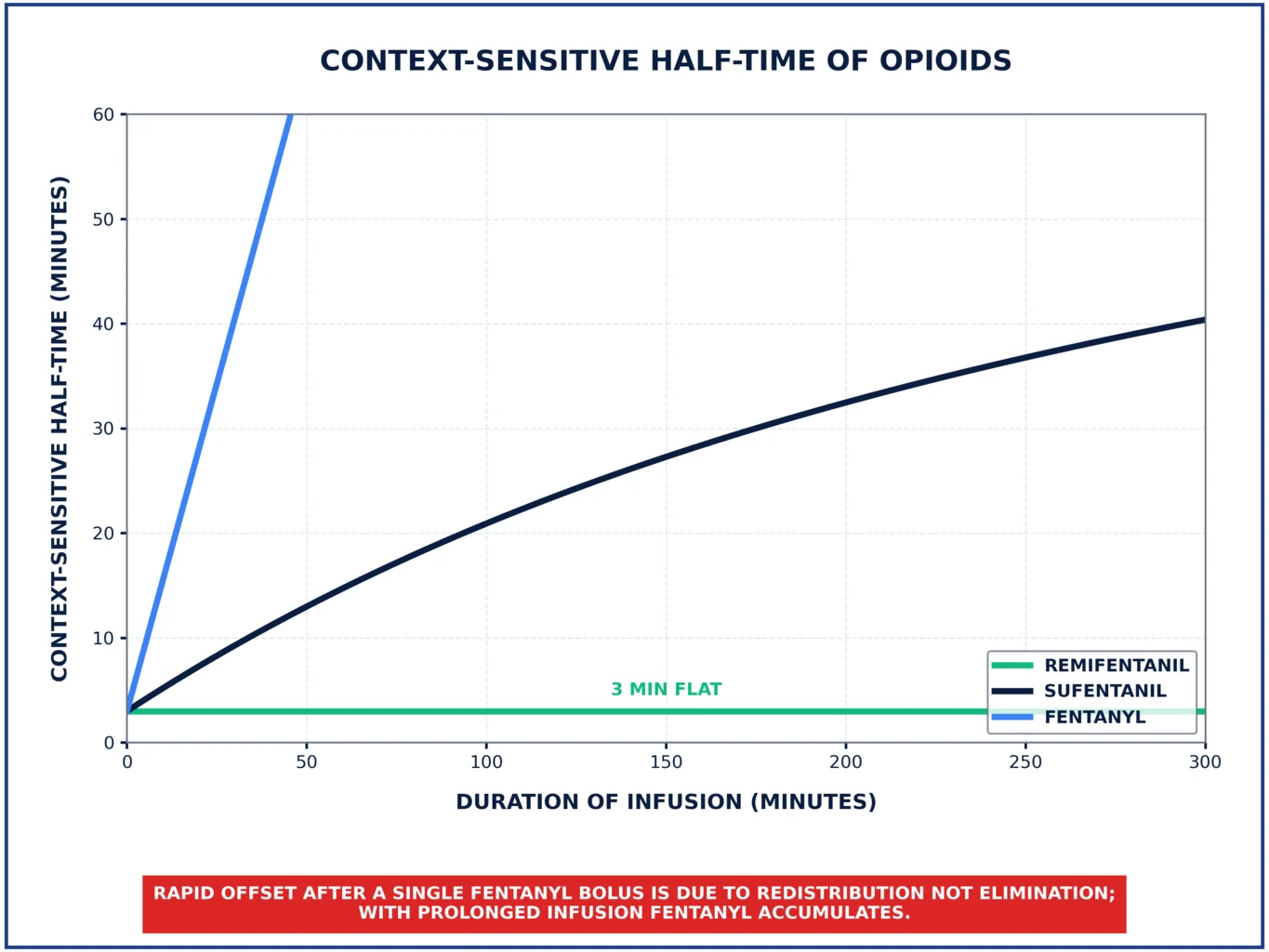
Fentanyl is a synthetic phenylpiperidine opioid and a full agonist at the mu-opioid receptor, roughly 100 times more potent than morphine, and the workhorse intraoperative analgesic (Lewis 2026, Kurowska 2026). Two pharmacological features make it exam-critical. First, it releases NO histamine, so it preserves cardiovascular stability, is the opioid of choice for cardiac anaesthesia and the haemodynamically unstable, and is safe in asthma where morphine is not (Lewis 2026, de Souza 2026). Second, it is highly lipid-soluble with a rapid onset (1 to 2 minutes intravenously) and a rapid apparent offset after a single bolus (about 20 to 30 minutes), but this early offset is due to REDISTRIBUTION from brain to muscle and fat, NOT elimination; with repeated boluses or a prolonged infusion the peripheral compartments saturate, the CONTEXT-SENSITIVE HALF-TIME RISES, and the drug ACCUMULATES, producing delayed and prolonged respiratory depression and slow emergence (Sheridan 2026, Kurowska 2026). It is metabolised by hepatic CYP3A4 to INACTIVE norfentanyl with no active metabolites, so it is preferred over morphine in renal failure, and it is excreted renally. At high doses or with rapid intravenous bolus it can cause chest-wall rigidity (the wooden chest) impairing ventilation, and its respiratory depression and toxicity are reversed by the competitive mu antagonist naloxone (Lewis 2026, Voronkov 2026).
On this page & tools
Your progress
Saved locally on this device.
8 MCQs with explanations
Target exams
Red flags

Overview — the synthetic phenylpiperidine workhorse opioid
Fentanyl is a synthetic phenylpiperidine opioid and a full agonist at the mu-opioid receptor, approximately 100 times more potent than morphine, and it is the workhorse intraoperative analgesic in modern anaesthetic practice.[1][5] Synthesised in the piperidine chemical class (in contrast to the phenanthrene structure of morphine), it was developed in the search for an opioid with the analgesic power of morphine but without its haemodynamic disturbance, and it has become the most widely used intraoperative opioid worldwide. Its combination of rapid onset, profound analgesia, cardiovascular stability and titratability makes it the default opioid for balanced anaesthesia, cardiac anaesthesia and total intravenous anaesthesia, and a reference point against which remifentanil, alfentanil and sufentanil are all described.[3][5]
Mechanism and potency — mu agonism, about 100 times morphine
Fentanyl is a full agonist at the mu-opioid G-protein-coupled receptor, the same receptor at which morphine acts.[5] Mu-receptor coupling to the inhibitory Gi protein inhibits adenylate cyclase, closes voltage-gated presynaptic calcium channels and opens inward-rectifying potassium channels; the net effect is neuronal hyperpolarisation and reduced release of excitatory neurotransmitters (substance P, glutamate, CGRP) from the primary afferent terminal in the dorsal horn, together with enhanced descending inhibition from the periaqueductal grey and rostral ventromedial medulla.[1]
Fentanyl is approximately 100 times as potent as morphine at the mu receptor, a consequence of its high receptor affinity and lipophilicity, and a typical intravenous analgesic bolus is in the microgram-per-kilogram range (roughly 1 to 2 micrograms per kilogram) where morphine is given in milligrams.[5] The qualitative pharmacodynamic profile is identical to morphine — analgesia, sedation, miosis, euphoria, respiratory depression, bradycardia, nausea and constipation — because both act at the same receptor; the differences between the two drugs lie entirely in potency, physicochemistry and pharmacokinetics, not in receptor mechanism.[1][5]
Cardiovascular stability — no histamine; cardiac anaesthesia; safe in asthma
The pharmacodynamic feature that most distinguishes fentanyl from morphine in clinical practice is that fentanyl releases NO histamine.[1] Morphine directly degranulates mast cells to release histamine, producing flushing, urticaria, pruritus and vasodilation with hypotension; fentanyl does not, so it preserves systemic vascular resistance, preload and arterial pressure even at high doses.[1][2]
This single property accounts for fentanyl's central place in cardiac anaesthesia. High-dose fentanyl (doses of 10 to 50 micrograms per kilogram or more) was historically used as the near-sole anaesthetic for cardiac surgery because it produces profound analgesia and ablation of the stress response with remarkable haemonic stability — no histamine-mediated vasodilation, no myocardial depression, and only modest bradycardia — making it the opioid of choice for patients with aortic stenosis, cardiogenic shock, or any state where maintaining afterload and coronary perfusion pressure is critical.[1]
The absence of histamine release also means fentanyl is safe in asthma, where morphine (a histamine liberator) is traditionally used with caution because of the risk of bronchospasm.[1][2] Fentanyl does cause a vagally mediated bradycardia through brainstem vagal nuclei, which is usually benign and responsive to an anticholinergic, but it is the one cardiovascular effect to anticipate.[1]
Pharmacokinetics — lipid solubility, onset, and offset by redistribution
Fentanyl is highly lipid soluble — far more so than morphine — and this physicochemical property is the key to its time-course.[5] After an intravenous bolus, the high lipophilicity drives rapid penetration of the blood-brain barrier, so the onset of action is fast, within 1 to 2 minutes, with a peak effect at about 3 to 5 minutes. This is considerably faster than morphine, which is less lipid-soluble and has an onset of 5 to 10 minutes.[3]
After a single bolus, the clinical effect wanes within about 20 to 30 minutes, giving fentanyl its reputation as a short-acting opioid. The crucial pharmacological point is that this early offset is due to REDISTRIBUTION from the brain (a small, well-perfused compartment) into larger, less well-perfused compartments — skeletal muscle and then fat — and NOT to elimination of the drug from the body.[3][5] The plasma concentration falls as the drug leaves the central nervous system, so the patient wakes and breathes, but the fentanyl has not been metabolised or excreted: it has merely moved. The clearance from the body is in fact relatively slow (terminal half-life of several hours), and this sets up the most important and most examined concept in fentanyl pharmacokinetics, the context-sensitive half-time.[3]
Context-sensitive half-time — rises with infusion; accumulation
The context-sensitive half-time (CSHT) is the time for the plasma concentration to fall by 50 per cent after stopping an infusion of a given duration, and it is the concept that best predicts clinical recovery. The CSHT replaces the older notion of elimination half-life because, for multicompartment drugs like fentanyl, the time-course of recovery depends on how long the drug has been given.[3][5]
For fentanyl, the CSHT is short after a single brief bolus (matching the 20 to 30 minute redistribution offset), but it rises progressively as the duration of the infusion increases.[3] The mechanism is saturation of the peripheral compartments: with repeated boluses or a prolonged infusion, muscle and fat take up so much fentanyl that they are no longer a sink for the drug but become a reservoir, and on stopping the infusion the drug redistributes BACK from the periphery into the central compartment, maintaining the plasma concentration and prolonging the effect. The drug is said to ACCUMULATE.[5]
The clinical consequences are delayed and prolonged respiratory depression and slow emergence after long fentanyl infusions or many repeated boluses — the apparent short action of a single bolus can no longer be assumed. This is the single most important reason that fentanyl, despite its fast single-bolus offset, must be used thoughtfully for long cases, and it is the property that remifentanil was specifically designed to eliminate (see comparison below).[3][5]
Metabolism — hepatic CYP3A4 to inactive norfentanyl; no active metabolite; renal safety
Fentanyl is metabolised in the liver primarily by cytochrome P450 3A4 (CYP3A4) to norfentanyl, an inactive metabolite, and thence to other inactive species that are excreted renally.[1] The pivotal point for exams and practice is that fentanyl has NO active metabolites — norfentanyl has no opioid activity.[1]
This is the key metabolic contrast with morphine. Morphine is glucuronidated to the active morphine-6-glucuronide (M6G), which is a more potent analgesic than the parent and which accumulates in renal failure (it is renally excreted), producing prolonged respiratory depression. Because fentanyl forms only inactive metabolites, it does not carry this risk, and fentanyl is therefore PREFERRED OVER MORPHINE IN RENAL FAILURE (and in significant renal impairment generally).[1]
Two consequences follow. First, the clinically relevant clearance of fentanyl is by hepatic metabolism and then renal excretion of inactive metabolites, so in advanced hepatic failure clearance is reduced and dosing should be cautious, while in renal failure the parent drug is not significantly prolonged (the metabolites are inactive). Second, the absence of an active metabolite means that any prolongation of effect after fentanyl is due to accumulation of the parent drug (rising CSHT) rather than to metabolite build-up.[1]
Routes — IV, transdermal, transmucosal, intranasal, neuraxial
Fentanyl is given by several routes that exploit different properties of the drug:[3]
- Intravenous — the common intraoperative route, given by intermittent bolus or by continuous infusion, exploiting the rapid onset and titratability; the mainstay of balanced anaesthesia and TIVA.[3]
- Transdermal patch — for chronic pain (principally cancer pain and stable chronic non-cancer pain). The patch forms a cutaneous depot in the stratum corneum, from which fentanyl is absorbed slowly over 72 hours, producing steady plasma levels. There is a slow onset (12 to 24 hours to reach steady state) and, critically, a slow offset after patch removal (a subcutaneous depot persists for many hours), so transdermal fentanyl must not be started in opioid-naive patients or used for acute postoperative pain.[1]
- Transmucosal (buccal, sublingual) and intranasal — for breakthrough cancer pain, exploiting the rapid onset across the highly vascularised mucosa, which bypasses first-pass metabolism and gives an effect within minutes.[1]
- Epidural and intrathecal (neuraxial) — preservative-free fentanyl is combined with local anaesthetic for labour analgesia and postoperative epidural analgesia; because it is lipophilic it partitions rapidly into the spinal cord, giving a fast onset but a short duration and a segmental effect, with less rostral spread than morphine.[3]
Clinical uses — intraoperative analgesia, cardiac, neuro, labour, TIVA, chronic
Fentanyl's clinical uses follow directly from its pharmacology:[3]
- Intraoperative analgesia (the workhorse role) — intermittent boluses or a continuous infusion form the opioid component of balanced anaesthesia (with a volatile or propofol), titrated against the surgical stimulus; this is by far its commonest use, including in prehospital and rapid-sequence contexts where an intermittent bolus regime maintains anaesthesia.[3]
- Cardiac anaesthesia — high-dose fentanyl provides profound analgesia and haemodynamic stability for coronary artery surgery, valve surgery and the compromised ventricle, where avoiding histamine release and hypotension is essential.[1]
- Neuroanaesthesia — fentanyl's cardiovascular stability and modest effect on cerebral haemodynamics make it a standard opioid adjunct for craniotomy, used within a balanced technique.[1]
- Labour epidural analgesia — neuraxial fentanyl with bupivacaine gives rapid-onset, reliable analgesia with minimal motor block and no systemic accumulation in the mother or fetus.[3]
- Total intravenous anaesthesia (TIVA) — fentanyl or sufentanil is combined with propofol for infusion-based anaesthesia, particularly where a volatile is to be avoided.[3]
- Chronic and cancer pain — the transdermal patch provides steady background analgesia for opioid-tolerant cancer-pain patients, and within opioid-sparing multimodal protocols fentanyl remains one option among several, balanced against paracetamol, NSAIDs, regional techniques and alpha-2 agonists such as the clonidine-versus-fentanyl approach studied in hernia repair.[2]
Respiratory depression and naloxone reversal
The principal hazard of fentanyl, like all mu-opioid agonists, is respiratory depression.[1] Fentanyl acts on the ventral medullary respiratory centres to reduce their sensitivity to carbon dioxide, shifting the carbon dioxide response curve rightward and flattening its slope, so the patient tolerates a higher arterial partial pressure of carbon dioxide before increasing ventilation; the clinical sign is a slow, shallow, regular breathing pattern and a falling respiratory rate. The depression is dose-dependent, and with a prolonged infusion or repeated boluses the accumulation of fentanyl (rising CSHT) means the respiratory-depressant effect outlasts the apparent offset of a single bolus — a patient who seemed to emerge and breathe satisfactorily may resedate and hypoventilate as peripheral drug re-enters the central compartment.[6]
The specific antidote is naloxone, a competitive mu-opioid antagonist that displaces fentanyl from the mu receptor and rapidly restores ventilation.[6] Naloxone should be titrated to the respiratory rate (and to oxygenation), not to full alertness: the goal is restoration of adequate ventilation, because pushing to full wakefulness precipitates severe pain, acute withdrawal and catecholamine surge, and in the opioid-tolerant patient it is harmful. Because naloxone has a short duration of action (about 30 to 80 minutes), shorter than the respiratory-depressant effect of accumulated fentanyl, resedation is a real risk and the patient must be monitored after reversal; the search for adjuncts that improve opioid-overdose reversal, including kappa-agonist strategies, remains active.[6]
Chest-wall rigidity — the high-dose effect
A characteristic and potentially life-threatening adverse effect of fentanyl is chest-wall rigidity, the so-called "wooden chest".[1] It is a class effect of the potent synthetic phenylpiperidine opioids and is seen particularly with high doses or rapid intravenous bolus administration, and most often in the elderly, the cachectic, and patients with pre-existing rigidity or who are also receiving other CNS depressants. The skeletal muscle tone of the thoracic and abdominal musculature increases dramatically so that the chest wall becomes rigid and ventilation becomes extremely difficult — bag-mask ventilation may be impossible despite a good mask fit and a patent airway.[1]
The mechanism is central mu-receptor-mediated activation of striated muscle, not a direct effect on the diaphragm. Recognition is critical because the problem is purely mechanical: the treatment is a neuromuscular blocking agent (a muscle relaxant such as succinylcholine or rocuronium, which also facilitates intubation), supplemented by naloxone and by positive-pressure ventilation; the rigidity resolves with muscle relaxation and opioid antagonism.[1]
Other adverse effects — bradycardia, nausea, miosis, tolerance and dependence
Beyond respiratory depression and chest-wall rigidity, fentanyl produces the full mu-opioid adverse-effect profile, all sharing the same receptor:[1]
- Bradycardia — vagally mediated, usually mild and responsive to an anticholinergic; relevant in cardiac anaesthesia where heart rate is a determinant of coronary perfusion.[1]
- Nausea and vomiting — fentanyl acts on the chemoreceptor trigger zone; opioid-sparing techniques that reduce the total fentanyl dose lower postoperative nausea and vomiting, the rationale underlying opioid-sparing breast-surgery anaesthesia.[4]
- Miosis — pupillary constriction via parasympathetic Edinger-Westphal nucleus activation, a useful clinical sign of opioid effect and overdose.[1]
- Constipation — reduced gastrointestinal motility via mu receptors in the enteric plexus; relevant for chronic transdermal use.[1]
- Tolerance and physical dependence — develop with repeated administration, underpinning the need for opioid stewardship, and the misuse potential of fentanyl (and its illicit analogues) is a major public-health concern, the toxicity of which has been re-examined in recent pathophysiological work.[1]
Fentanyl versus morphine
The comparison between fentanyl and morphine is among the most examined in opioid pharmacology and rests on four axes:[1][5]
- Chemical class and potency — fentanyl is a synthetic phenylpiperidine, about 100 times as potent as morphine at the mu receptor; morphine is a natural phenanthrene alkaloid of opium.[5]
- Histamine — morphine releases histamine (flushing, urticaria, pruritus, vasodilation, hypotension, caution in asthma); fentanyl does not, and so preserves cardiovascular stability and is preferred in cardiac anaesthesia and in asthma.[1][2]
- Active metabolites and renal failure — morphine is glucuronidated to the active morphine-6-glucuronide (M6G) that accumulates in renal failure and prolongs respiratory depression; fentanyl is metabolised by CYP3A4 to inactive norfentanyl, has no active metabolite, and is preferred over morphine in renal failure.[1]
- Kinetics — fentanyl is highly lipid-soluble with a rapid onset (1 to 2 minutes) and a rapid offset after a single bolus (about 20 to 30 minutes) by redistribution, but it accumulates with prolonged infusion (rising CSHT); morphine has a slower onset (5 to 10 minutes) and a longer but more predictable duration (3 to 5 hours) without redistribution-mediated accumulation of the same kind.[3][5]
Fentanyl versus remifentanil
The comparison with remifentanil turns on a single, exam-defining pharmacokinetic property — the context-sensitive half-time:[5]
- Chemical class — both are synthetic phenylpiperidine opioids and full mu agonists; remifentanil is an ester, fentanyl is an amide-type piperidine.[5]
- Context-sensitive half-time — remifentanil has a FLAT context-sensitive half-time of about 3 to 4 minutes that is independent of infusion duration, because it is rapidly hydrolysed by non-specific plasma and tissue esterases (organ-independent metabolism); fentanyl's CSHT RISES with infusion duration because it accumulates in peripheral compartments and is cleared only by hepatic CYP3A4.[3][5]
- Practical consequence — remifentanil does not accumulate however long it is infused, so the patient recovers within minutes of stopping it regardless of duration, making it ideal for very long cases, for neurosurgery where rapid wake-up is essential, and for procedural sedation; fentanyl accumulates, so after a long infusion its offset is slow and unpredictable and respiratory depression may be delayed.[3]
- Potency and use — remifentanil is about as potent as fentanyl and is given only by infusion (its ultra-short action makes bolus-only use impractical); fentanyl is versatile across bolus, infusion and non-IV routes.[4][5]
Clinical
- Standard approach
- Evidence-based
Alternative
- Modified technique
- Risk-benefit
Red flags
[1]References
- [1]Lewis T, et al. Acute Fentanyl Toxicity:From Opioid-Induced to Hypoxia-Mediated Pathophysiology J Neurophysiol, 2026.PMID 42333655
- [2]de Souza PMF, et al. Opioid-sparing analgesia with clonidine versus fentanyl in inguinal hernia repair: a randomized clinical trial Hernia, 2026.PMID 42364024
- [3]Sheridan B, et al. Maintenance of prehospital anaesthesia using an intermittent bolus regime in blunt trauma patients with a high GCS and hemodynamic reserve: a retrospective cohort study Scand J Trauma Resusc Emerg Med, 2026.PMID 42351216
- [4]Sung TY, et al. Effect of Opioid-Sparing Anesthesia on Postoperative Nausea and Vomiting After Breast Surgery: A Single-Center Randomized Controlled Trial J Clin Med, 2026.PMID 42355627
- [5]Kurowska K, et al. Hold on tight: the kinetic profiling of opioid receptor ligands using the CORAL-MD J Cheminform, 2026.PMID 42363184
- [6]Voronkov M, et al. Does Kappa Agonism Improve Reversal of 'Tranq-Dope' Overdose? Evidence from a Rodent Model Pharmaceuticals (Basel), 2026.PMID 42356464