Anaes · Volatile & inhalational agents
Halothane
Also known as 2-bromo-2-chloro-1,1,1-trifluoroethane · CF3-CHBrCl · Fluothane · Historical standard volatile · Catecholamine-sensitising volatile · Halothane hepatitis agent
Halothane (2-bromo-2-chloro-1,1,1-trifluoroethane, CF3-CHBrCl) is the historical standard volatile anaesthetic, introduced in 1956 and the agent against which every modern volatile is still measured. It is defined by five exam-critical ideas. Its minimum alveolar concentration (MAC) of 0.75 percent is the lowest and therefore the most potent of the common volatile agents, while its blood-gas partition coefficient of 2.4 gives a slower onset and offset than sevoflurane, isoflurane or desflurane. It is non-pungent with a pleasant smell, which made it the classic agent for inhalational induction in children. It is a potent bronchodilator, exploited historically in refractory status asthmaticus. It markedly sensitises the myocardium to catecholamines, so concurrent adrenaline infiltration can precipitate ventricular arrhythmias. And it causes the type 2 (immune-mediated) halothane hepatitis — a fulminant massive hepatic necrosis with a mortality around 50 percent, driven by cytochrome P450 2E1 oxidative metabolism to trifluoroacetic acid (TFA)-protein neoantigens — which together with its catecholamine arrhythmogenicity, its role as a malignant-hyperthermia trigger, and its ozone-depleting chlorofluorocarbon chemistry drove its withdrawal from clinical use across most of the developed world by the 1980s to 1990s. Built on the halothane-toxicity overview (Gyorfi 2026), the National Halothane Study landmark epidemiology (Forrest 2025), the trifluoroacetic-acid rapid review (Wipplinger 2025), the European Malignant Hyperthermia Group 2025 guidelines (Ruffert 2026), the novel RYR1-variant characterisation (Tracy 2025), the network meta-analysis of anaesthetics on cardiac repolarisation (Cai 2023), the halogenated-anaesthetic greenhouse-gas analysis (Talbot 2025), and the isoflurane-in-status-asthmaticus case report (Gill 2022).
On this page & tools
Your progress
Saved locally on this device.
Target exams
Red flags

Overview and historical context
Halothane (2-bromo-2-chloro-1,1,1-trifluoroethane, CF3-CHBrCl; trade name Fluothane) was introduced into clinical practice in 1956 and became the dominant inhalational anaesthetic worldwide for the next two decades, displacing diethyl ether and cyclopropane because it was non-flammable, pleasant to breathe, potent, and easy to administer through a standard variable-bypass vaporiser. For a generation it was the agent against which induction, maintenance and recovery were taught, and it remains the pharmacological reference point for every modern volatile.[1]
Its decline was as rapid as its rise. Two rare but catastrophic toxicities — immune-mediated massive hepatic necrosis (halothane hepatitis) and malignant hyperthermia — together with its tendency to sensitise the myocardium to catecholamines and the arrival of safer alternatives (isoflurane from the 1970s, sevoflurane and desflurane from the 1990s), drove its withdrawal from most developed-world practice by the 1980s to 1990s. The National Halothane Study remains the landmark epidemiological exercise that framed the hepatitis debate, and the EMHG 2025 guidelines still list halothane as the classic volatile trigger of malignant hyperthermia.[2][4] Halothane is now of largely historical and exam importance in ANZ practice, although it persists in some low-resource settings where its low cost and utility for inhalational induction keep it in use.[1]
Physical and chemical properties
Halothane is a halogenated alkane (not an ether like isoflurane, sevoflurane or desflurane), with the formula CF3-CHBrCl. It is a clear, colourless, non-flammable liquid at room temperature with a characteristic sweet, pleasant, non-irritant odour. Its boiling point is approximately 50 degrees Celsius, which is higher than the modern ether volatiles, and its saturated vapour pressure of about 243 mmHg at 20 degrees is moderate, so it can be delivered reliably through a standard temperature-compensated variable-bypass (plenum) vaporiser — it does not need the heated pressurised Tec 6 that desflurane requires.[1]
Two chemical features matter clinically and were intentional design advances over ether and chloroform: the carbon-fluorine bonds confer chemical and thermal stability and non-flammability, and the absence of an ether linkage makes it chemically distinct from the modern agents. Halothane is chemically unstable in the presence of light, and the commercial formulation therefore contains a small amount (around 0.01 percent) of thymol as a stabiliser, which accumulates inside the vaporiser and must be periodically cleaned out. Halothane does not attack soda lime or baralyme to release carbon monoxide to the degree that desflurane and especially enflurane do — a property that, with its non-flammability, made it suitable for the original closed-circle systems.[1]
Pharmacokinetics: uptake and distribution
Halothane is moderately soluble in blood. Its blood-gas partition coefficient is approximately 2.4, which is higher (more soluble, slower) than sevoflurane (0.65), isoflurane (1.4) and desflurane (0.42), but considerably lower (less soluble, faster) than diethyl ether (around 12). The practical consequence is a slower rise of the alveolar partial pressure, and therefore a slower induction and emergence, than the modern agents — fast enough for clinical use, but not the rapid in-and-out pharmacokinetics of sevoflurane or desflurane.[1]
Its oil-gas partition coefficient is approximately 224, indicating high lipid solubility and hence high potency (potency tracks oil-gas solubility on the Meyer-Overton axis). Most of an administered dose is excreted unchanged through the lungs, but a small fraction — typically around 20 percent — undergoes hepatic biotransformation. The route of metabolism is the exam-critical detail: the dominant oxidative pathway is catalysed by cytochrome P450 2E1 (CYP2E1) and yields trifluoroacetic acid (TFA) as its principal metabolite, together with bromide and chloride ions. A minor reductive pathway, favoured under hypoxia and enzyme induction, produces reactive intermediates that have been linked to the milder type 1 hepatotoxicity. The oxidative TFA product is the key, because TFA covalently modifies hepatocyte proteins to form neoantigens — the basis of type 2 immune-mediated halothane hepatitis.[3][1]
MAC and potency
The minimum alveolar concentration (MAC) of halothane in oxygen is approximately 0.75 percent (0.75 vol percent at 1 atm in the 30 to 55-year-old adult), making it the most potent of the clinically used volatile agents — a direct consequence of its high oil-gas solubility. For comparison, the MAC values of the modern agents in oxygen are approximately: isoflurane 1.2 percent, sevoflurane 2.0 percent, and desflurane 6.0 percent; nitrous oxide is around 104 percent (essentially impractical as a sole agent). MAC falls with age, hypothermia, pregnancy, opioids and benzodiazepines, and rises in infants, the chronic alcohol user and with central stimulants.[1]
Like all volatile agents, halothane is additive with nitrous oxide and with the intravenous hypnotics: 0.5 MAC of halothane plus 0.5 MAC of nitrous oxide produces an equivalent depth of anaesthesia, and 0.3 MAC of halothane provides the amnestic background that is the rationale for the minimum alveolar concentration-awake (MAC-awake) concept. Because halothane is so potent, a small dialled concentration produces a clinically useful depth, and the agent was historically titrated against the eyelash reflex, blood pressure and the jaw tone. [1]
Effects on the central nervous system
Halothane produces a smooth, dose-dependent depression of the central nervous system, with loss of consciousness, amnesia and a progressive reduction of the cerebral metabolic rate for oxygen (CMRO2). It is a cerebral vasodilator and therefore increases cerebral blood flow, which raises intracranial pressure (ICP) in the patient with reduced intracranial compliance — historically a concern in neuroanaesthesia that precluded its use in raised ICP unless the patient was hyperventilated first. Like the other volatile agents, halothane uncouples cerebral blood flow from metabolism (flow rises while metabolic demand falls), and it depresses the EEG progressively from wakeful activity through to burst suppression at high multiples of MAC.[1]
Halothane does not provide significant analgesia — an important distinction from ether and nitrous oxide — and surgical anaesthesia requires supplementary analgesia (opioid or nitrous oxide). It is a poor anticonvulsant relative to the modern agents and was generally avoided in epilepsy. Emergence is associated with shivering, nausea and vomiting in a substantial minority of patients, partly because of its moderate solubility and its effects on the chemoreceptor trigger zone. [1]
Cardiovascular effects
Halothane is a direct myocardial depressant. It reduces contractility, lowers cardiac output and produces a dose-dependent fall in systemic vascular resistance and arterial blood pressure. In contrast to isoflurane and desflurane, halothane causes little change in heart rate and may produce bradycardia, because it blunts the baroreceptor reflex: as the blood pressure falls, the expected compensatory tachycardia does not occur, leaving a slow, hypotensive heart. This is the reason atropine is classically co-administered with halothane in paediatric practice to limit intra-operative bradycardia.[1]
The defining cardiac red flag is sensitisation of the myocardium to catecholamines. Halothane lowers the threshold at which adrenaline (epinephrine) and noradrenaline provoke ventricular ectopy and ventricular tachycardia or fibrillation. The mechanism is a combination of a prolonged action-potential duration and QT effects that increase dispersion of repolarisation, together with enhanced calcium loading of the myocyte. The network meta-analysis of anaesthetic effects on cardiac repolarisation in adults confirms that halothane is among the agents with the most marked repolarisation effects, consistent with its clinical reputation for adrenaline-related arrhythmogenicity.[6] The practical rule is that adrenaline-containing local anaesthetic infiltration during halothane anaesthesia is hazardous: a widely quoted adult limit is around 100 micrograms subcutaneously over ten minutes (roughly 10 mL of 1:100 000 adrenaline), and the safer course is to avoid the combination altogether and use a modern agent such as isoflurane or sevoflurane, which sensitise the myocardium far less.
Respiratory effects and bronchodilation
Halothane is non-pungent and non-irritant to the airway, with a pleasant smell — the combination that made it the historical agent of choice for inhalational induction, especially in children. It produces dose-dependent respiratory depression (reduction of tidal volume and minute ventilation, with a rise in PaCO2), blunts the ventilatory response to hypoxia and hypercarbia, and relaxes the intercostal muscles as depth increases.[1]
Most importantly, halothane is a potent bronchodilator — among the most effective of the volatile agents at relaxing bronchial smooth muscle, an effect shared with the other halogenated volatiles but historically exploited most with halothane. This is the rationale for the long-standing use of inhaled volatile anaesthesia in refractory status asthmaticus, where volatile bronchodilation can break bronchospasm that has resisted maximal bronchodilator therapy. The isoflurane-in-status-asthmaticus case report demonstrating volatile therapy on venovenous ECMO is a contemporary illustration of the same pharmacological principle that halothane embodied for decades: the inhaled volatile is a powerful bronchodilator that has a defined salvage role in life-threatening asthma.[8]
Halothane hepatitis
Halothane causes two distinct patterns of hepatotoxicity, and distinguishing them is a high-yield exam point.[1]
Type 1 (mild, self-limiting). A common, benign, dose-related derangement seen after a single exposure, consisting of a transient rise in transaminases (around 1 to 3 times the upper limit of normal) within the first few postoperative days, occasionally with mild fever, nausea and malaise, resolving spontaneously without sequelae. It is thought to reflect direct (predominantly reductive-pathway) hepatocyte injury and is not immune-mediated. It does not contraindicate future exposure. [1]
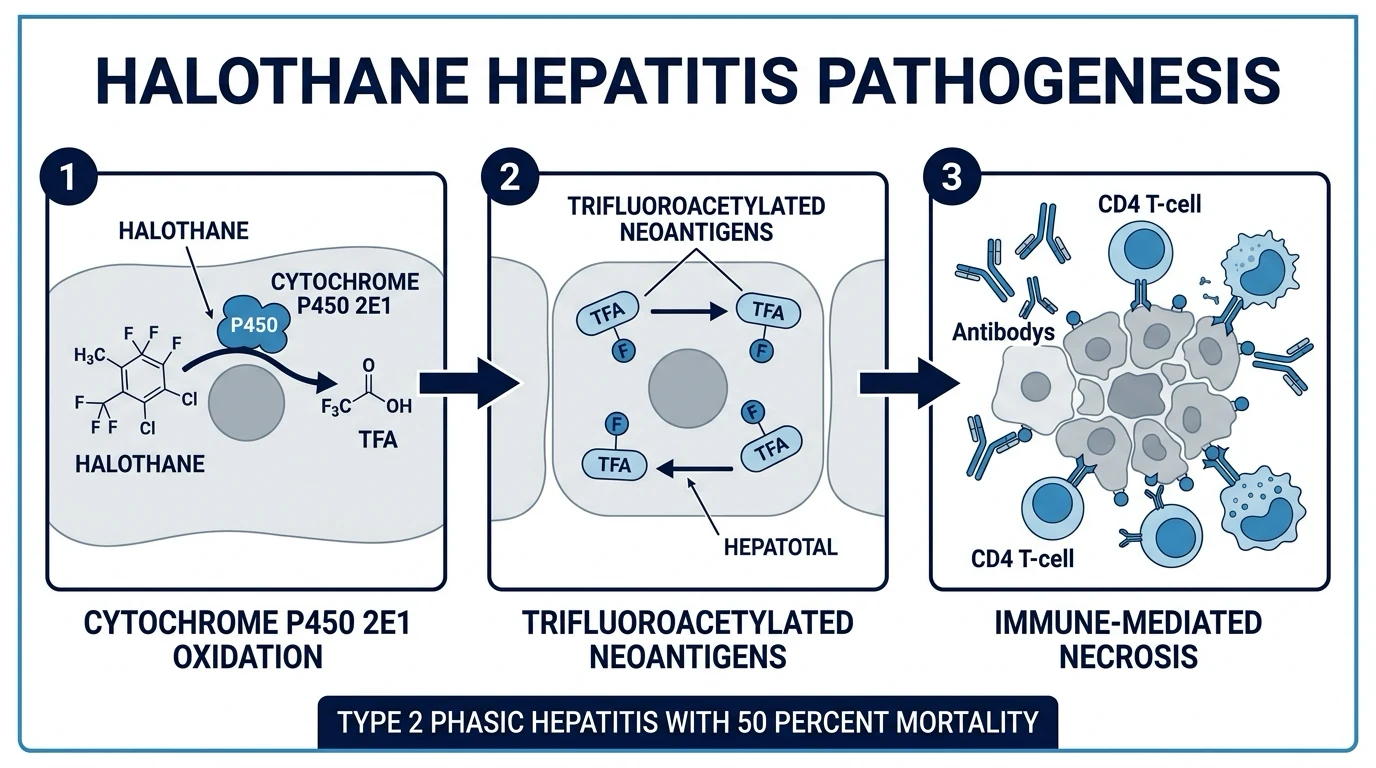
Type 2 (immune-mediated massive necrosis). The rare (approximately 1 in 35 000 exposures after a first exposure, rising steeply to around 1 in 3700 after a second) but catastrophic form, presenting one to two weeks after exposure with fever, rash, arthralgia, eosinophilia and then a rapid progression to severe jaundice, encephalopathy and fulminant hepatic failure with a mortality of approximately 50 percent. The pathogenesis is now well understood: oxidative metabolism of halothane by CYP2E1 generates trifluoroacetic acid (TFA), which covalently modifies hepatocyte proteins to form TFA-protein neoantigens; these neoantigens are presented to and activate anti-TFA antibodies and CD4 T-cells, which then mediate massive hepatocyte necrosis on re-exposure.[3] The rapid review of TFA effects in humans summarises the evidence that TFA-protein adducts are the immunological trigger and that the same chemistry underlies hepatitis from the related agents halothane, isoflurane (rarely) and desflurane (very rarely).[3]
Phasic / re-exposure pattern. The risk of type 2 hepatitis rises sharply after repeated exposures within a short interval — classically within 28 days — and is increased in women, in obesity, in middle age, and in those with a family history of halothane hepatitis. The clinical lesson, codified across regulators from the 1980s onward, was the rule of avoiding repeat halothane anaesthesia within three months and asking every patient about unexplained jaundice or fever after a previous anaesthetic. [1]
The National Halothane Study. The epidemiological case against halothane was framed by the National Halothane Study, the landmark multi-institutional retrospective review of postoperative hepatic outcomes that, together with subsequent case-control work, established the link between halothane and massive hepatic necrosis and quantified the rarity of the event.[2] The contemporary re-analysis by Forrest and colleagues reaffirms the methodological and clinical lessons of the original study for hospital outcomes and rare-drug toxicity.[2]
Malignant hyperthermia
Halothane is the classic historical trigger of malignant hyperthermia (MH), the pharmacogenetic crisis of uncontrolled skeletal-muscle calcium release produced by exposure to a volatile agent, alone or with suxamethonium. The mechanism is a defect of the skeletal-muscle sarcoplasmic-reticulum calcium-release channel, the ryanodine receptor type 1 (RYR1), and a smaller number of variants in the L-type voltage-gated calcium channel (CACNA1S); the triggering volatile opens the channel, calcium floods the myoplasm, and a hypermetabolic cascade ensues — rapid rise in end-tidal CO2, hyperthermia, muscle rigidity, rhabdomyolysis, hyperkalaemia and cardiac arrest if untreated.[4][5]
The European Malignant Hyperthermia Group 2025 guidelines continue to list all the potent volatile agents — halothane, isoflurane, sevoflurane and desflurane — as MH triggers, with halothane retaining its historical status as the agent most strongly associated with the original case series.[4] Tracy and colleagues' characterisation of a novel RYR1 variant (p.Gln474His) in MH is a recent molecular confirmation of the receptor's central role and of the genetic heterogeneity that underlies susceptibility.[5] The clinical implication is unchanged: a known or suspected MH-susceptible patient must never receive halothane (or any other volatile); the machine must be flushed and volatile excluded, and anaesthesia should be delivered as total intravenous anaesthesia (TIVA) in a volatile-free machine.
Other adverse effects
Halothane produces dose-dependent respiratory depression, atropine-responsive bradycardia, hypotension, postoperative shivering and a high incidence of postoperative nausea and vomiting (PONV). It raises intracranial pressure and is contraindicated in raised ICP unless hyperventilation is established first. As a uterine relaxant it can increase blood loss in the second stage of labour and at caesarean section, a property that has occasionally been exploited therapeutically for uterine relaxation but otherwise limits its obstetric use. Chronic occupational exposure in operating-theatre staff (before scavenging was universal) was associated with headache, fatigue and an excess of spontaneous abortion — part of the historical case that drove the introduction of gas-scavenging systems.[1]
Environmental impact
Halothane is a chlorofluorocarbon: its molecule contains both chlorine and fluorine bonded to carbon, and it therefore has the two environmental liabilities that distinguish it even from the modern ether volatiles. First, chlorine release in the stratosphere contributes to ozone depletion. Second, halothane is a greenhouse gas. The Talbot analysis of the greenhouse-gas impact of halogenated anaesthetic emissions demonstrates that every volatile in clinical use contributes to atmospheric warming, with halothane, isoflurane and sevoflurane having substantially lower global-warming potentials than desflurane (the worst offender), but halothane's additional ozone-depleting chemistry makes its environmental profile distinct and unfavourable.[7] The environmental cost, layered on top of the hepatitis and arrhythmia liabilities, made halothane impossible to justify in modern practice once safer agents became available.
Current place in practice
Halothane has been abandoned in most developed-world practice. It is no longer available in Australia, New Zealand, the United Kingdom, the United States and most of Western Europe, having been progressively withdrawn through the 1980s and 1990s as sevoflurane (which matched halothane for smooth gas induction without the hepatitis risk) replaced it for paediatric induction, and as isoflurane and then desflurane became the maintenance agents of choice.[1]
It persists in some low- and middle-income settings, where its low cost, long shelf-life, non-pungency and utility for inhalational induction in children with difficult intravenous access keep it in use, and where the alternatives are unaffordable. The exam point for the ANZCA candidate is that halothane is a historical agent in this region: it will not appear in your theatre, but it remains the pharmacological reference for potency, for catecholamine sensitisation, for type 2 hepatitis, and for the classic MH trigger, and it is still tested for exactly those reasons.[1]
Comparison with other volatile agents
| Agent | MAC in O2 (per cent) | Blood-gas coeff | Oil-gas coeff | Pungency | Metabolism | Notable toxicity |
|---|---|---|---|---|---|---|
| Halothane | 0.75 | 2.4 | 224 | Low (pleasant) | around 20 percent, CYP2E1 to TFA | Hepatitis (type 2), catecholamine arrhythmias, MH |
| Isoflurane | 1.2 | 1.4 | 98 | Moderate (pungent) | around 0.2 percent | Coronary steal (debated), MH |
| Sevoflurane | 2.0 | 0.65 | 50 | Low (sweet) | around 5 percent (compound A in desiccated absorbent) | Compound A (rat nephrotoxicity), MH |
| Desflurane | 6.0 | 0.42 | 19 | High (very pungent) | around 0.02 percent | Sympathetic activation, greenhouse, MH |
The summary the exam expects: halothane is the most potent (lowest MAC), the most soluble (slower onset/offset), the most pleasant (gas induction), the most arrhythmogenic with adrenaline, and the only one that causes type 2 immune hepatitis — and it has been replaced across the developed world by sevoflurane (for induction) and isoflurane and desflurane (for maintenance).[1]
Clinical
- Standard approach
- Evidence-based
Alternative
- Modified technique
- Risk-benefit
Red flags
[1]References
- [1]Gyorfi MJ, et al. Halothane Toxicity 2026.PMID 31424865
- [2]Forrest WH Jr, et al. The National Halothane Study and Hospital Outcomes Anesthesiology, 2025.PMID 41085307
- [3]Wipplinger J, et al. The Effects of Trifluoroacetic Acid (TFA) in Humans: A Rapid Review Life (Basel), 2025.PMID 41465764
- [4]Ruffert H, et al. European Malignant Hyperthermia Group 2025 guidelines for the investigation of malignant hyperthermia susceptibility Br J Anaesth, 2026.PMID 41478797
- [5]Tracy E, et al. Clinical and Genetic Characterization of a Novel RYR1 Variant (p.Gln474His) in Malignant Hyperthermia Susceptibility Genes (Basel), 2025.PMID 41595433
- [6]Cai Y, et al. Effects of Anesthetics on Cardiac Repolarization in Adults: A Network Meta-Analysis of Randomized Clinical Trials Heart Surg Forum, 2023.PMID 38178332
- [7]Talbot A, et al. Greenhouse gas impact from medical emissions of halogenated anaesthetic agents: a sales-based estimate Lancet Planet Health, 2025.PMID 40120629
- [8]Gill B, et al. Case report: Isoflurane therapy in a case of status asthmaticus requiring extracorporeal membrane oxygenation Front Med (Lausanne), 2022.PMID 36425104