Anaes · Volatile & inhalational agents
Isoflurane
Also known as 1-chloro-2,2,2-trifluoroethyl difluoromethyl ether · Fluorinated methyl ether · Forane · Maintenance volatile agent · The workhorse volatile · Pungent volatile
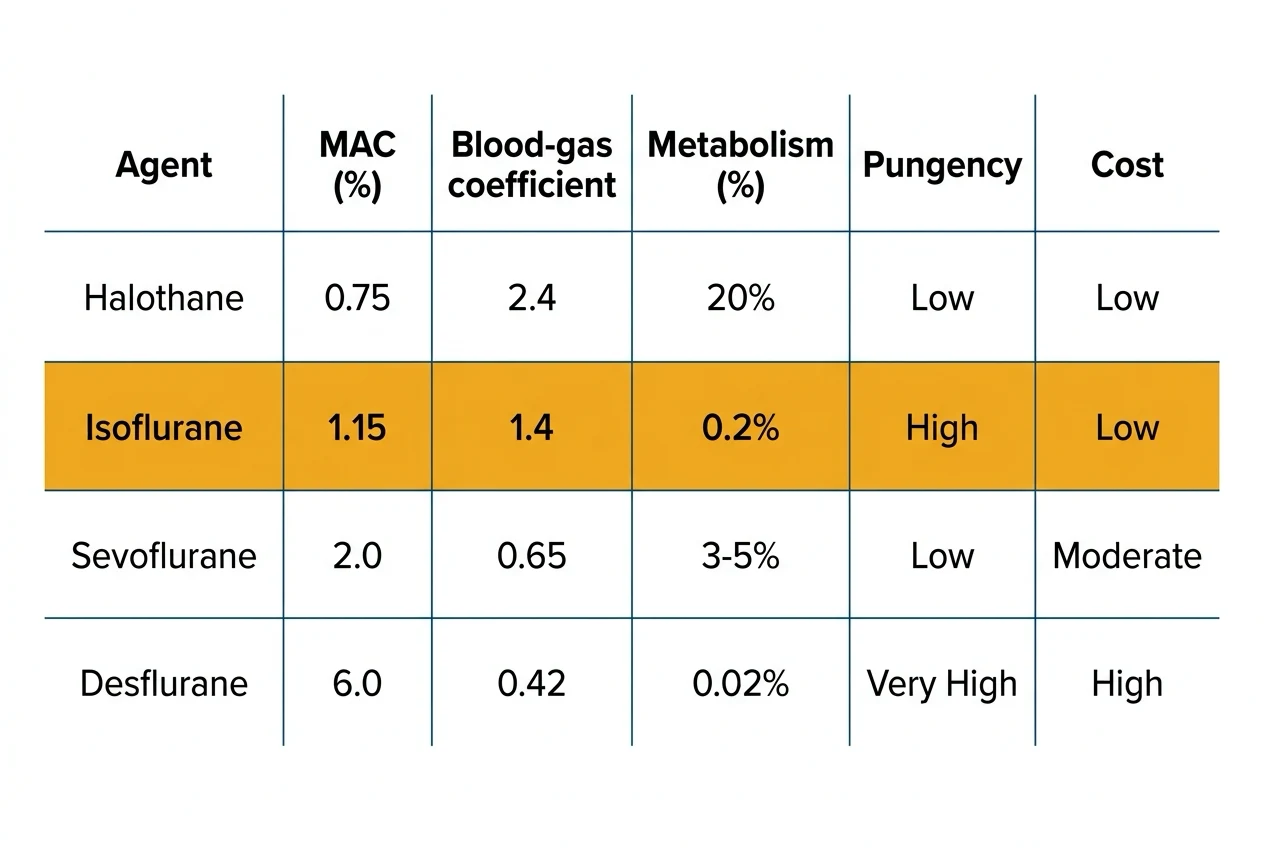
Isoflurane is a fluorinated methyl ether and one of the three modern volatile anaesthetic agents, the stable and cheap workhorse volatile used for maintenance where its pungency makes it unsuitable for inhalational induction. The framework rests on four exam-critical ideas: a blood-gas partition coefficient of 1.4 (higher than sevoflurane 0.65 and desflurane 0.42) means a slower induction and recovery than the insoluble agents; a minimum alveolar concentration of about 1.15 percent in adults measures a potency intermediate between halothane and sevoflurane; it is the least metabolised of the volatiles at about 0.2 percent, with no compound A and negligible fluoride release; and it is a potent vasodilator and the historical subject of the coronary-steal debate, now judged clinically insignificant in well-managed coronary disease. Built on the isoflurane-ICU-sedation-in-children work (Biedermann 2026), the inhaled-anaesthetics-and-Alzheimer's review (Yang 2026), the anaesthetics-and-glial-cells review (Wang 2026), the anaesthetic-gas-emissions analysis (Dogar 2026), the isoflurane-versus-desflurane optic-nerve study (Rajmohan 2026), the CPB-EEG-burst-suppression study (Bao 2026), the TAP-block-isoflurane study (Guadix-Urena 2026), and the desflurane-versus-propofol elderly neurocognitive trial (Somnuke 2026).
On this page & tools
Your progress
Saved locally on this device.
8 MCQs with explanations
Target exams
Red flags
Why this matters to the anaesthetist
Isoflurane is one of the three modern volatile anaesthetic agents, the stable and inexpensive workhorse of maintenance anaesthesia. Where sevoflurane dominates the inhalational induction and the paediatric airway, and desflurane the rapid wake-up in the long or obese case, isoflurane holds its place as the cheap, chemically stable, haemodynamically predictable agent for routine maintenance and for prolonged ICU sedation. It is the volatile that the trainee meets first in the pharmacology of the inhaled agents, because its properties sit midway between the older soluble agents (halothane, ether) and the newer insoluble ones (sevoflurane, desflurane), and so it frames every comparison the examiner draws. [1]
The drug concentrates the highest-yield pharmacology of the inhaled agents. Its blood-gas partition coefficient of 1.4 is the worked example of moderate solubility — soluble enough to slow induction and recovery relative to the insoluble agents, yet insoluble enough to have displaced halothane — and it teaches the candidate the principle that onset and offset track solubility across the class. Its pungency is the single property that excludes it from the inhalational induction, the negative mirror of sevoflurane's sweet odour. Its minimum alveolar concentration of about 1.15 percent measures a potency between halothane and sevoflurane, and its place in the Meyer-Overton correlation is the centrepiece of the volatile-pharmacology viva. And its vasodilation — and the historical coronary-steal debate that the vasodilation provoked — is a classic safety question that tests the candidate's grasp of the drug's cardiovascular pharmacology. Master isoflurane and the volatile agents fall into place around it. [1]
Physical chemistry
Isoflurane is 1-chloro-2,2,2-trifluoroethyl difluoromethyl ether — a fluorinated methyl ether, a close chemical relative of sevoflurane and desflurane and an isomer of enflurane. The carbon-fluorine and carbon-chlorine bonds give the molecule its chemical stability, its low arrhythmogenic potential relative to halothane, and its resistance to metabolic degradation. It is a clear, colourless, non-flammable liquid at room temperature with a boiling point of 48.5 degrees Celsius and a vapour pressure of about 238 mmHg at 20 degrees, delivered through a standard temperature-and-flow-compensated (variable bypass) vaporiser that does not need to be heated or pressurised — in contrast to desflurane, which boils near room temperature and demands a heated pressurised vaporiser. [1]
Three physical properties dominate its clinical behaviour. The first is its blood-gas partition coefficient of 1.4 — a moderate solubility, higher than sevoflurane (0.65) and desflurane (0.42) and lower than halothane (2.4), that means a meaningful fraction of the inspired agent is taken up into the blood on each breath, so the alveolar partial pressure (and therefore the brain partial pressure) rises and falls more slowly than with the insoluble agents, producing a slower induction and a slower recovery. The second is its oil-gas partition coefficient of about 91, which sets its potency through the Meyer-Overton correlation — a high lipid solubility that corresponds to a high potency and a minimum alveolar concentration of about 1.15 percent in adults. The third is its pungent, ether-like odour, the property that, more than any other, sets isoflurane apart from sevoflurane: the pungency irritates the airway of the awake patient, provoking coughing, breath-holding and laryngospasm, so isoflurane cannot be used for a mask induction and is reserved for maintenance after an intravenous induction. [1]
Mechanism of action
The defining pharmacological correlation of the inhaled agents is the Meyer-Overton relationship: the potency of an agent is directly proportional to its lipid solubility, measured by its oil-gas partition coefficient. The more lipid-soluble the agent, the more potent it is — so the minimum alveolar concentration, the measure of potency, is inversely related to lipid solubility, and the product of MAC and the oil-gas coefficient is roughly constant across agents. Isoflurane, with an oil-gas coefficient of about 91, sits on the same line as halothane (224), sevoflurane (47) and desflurane (19). For a century this correlation pointed to a unitary, non-specific target: the lipid bilayer of the neuronal membrane, with anaesthesia resulting from a disruption of membrane function. [1]
The modern view is more nuanced. Isoflurane, like the other volatile agents, acts at several specific protein targets rather than at a single one. It potentiates the GABA-A receptor, the principal inhibitory ligand-gated chloride channel of the central nervous system, increasing the opening of the chloride channel in response to GABA and so hyperpolarising and silencing the neuron — the chief mediator of the hypnotic and immobilising effects. It inhibits the NMDA receptor, the excitatory glutamate-gated cation channel. It activates the two-pore-domain potassium channels (the TREK and TASK families), which hyperpolarise the neuron by allowing potassium efflux. And it has downstream effects on glial cells and astrocytic signalling, the subject of the active investigation of how the general anaesthetics reshape neural-support cell function.[3]
No single receptor explains all of the effects of isoflurane. The immobility to surgical stimulus is mediated largely at the spinal cord (GABA-A and glycine), the hypnosis at the brain, and the analgesic component partly at the NMDA receptor. But the Meyer-Overton correlation remains the bedrock description of inhaled-agent potency, and it is the property the examiner reaches for first when asked to explain why a lipid-soluble agent is a potent one. [1]
Pharmacokinetics
The pharmacokinetics of isoflurane are governed by its moderate blood-gas solubility. Because the coefficient is 1.4, a meaningful fraction of the inspired agent is taken up into the blood on each breath, so the alveolar partial pressure rises more slowly towards the inspired partial pressure than it does with the insoluble agents. Since the brain partial pressure follows the alveolar partial pressure, the brain concentration — and the depth of anaesthesia — equilibrates more slowly, producing a slower induction and, when the dialled concentration is reduced or the agent is turned off, a slower recovery than sevoflurane or desflurane. This is the same solubility principle that governs every inhaled agent: the higher the blood-gas solubility, the slower the alveolar and brain partial pressures change, and the less controllable the anaesthetic. Isoflurane is fast enough for routine maintenance, but it is not the agent for the ultra-rapid wake-up, and the longer context-sensitive half-time is the property that makes it acceptable — even advantageous — for prolonged ICU sedation where a slow offset is tolerated.[1]
Isoflurane is excreted overwhelmingly unchanged through the lungs. Only about 0.2 percent is metabolised — by the cytochrome P450 enzyme CYP2E1 in the liver — which makes isoflurane the least metabolised of the modern volatile agents (sevoflurane is about 3 to 5 percent metabolised, halothane about 20 percent). The consequences are all favourable: there is no compound A formation (compound A is a sevoflurane-specific degradation product), no clinically significant carbon monoxide formation with desiccated absorbent (the CO concern is greatest with desflurane and enflurane, and far less with isoflurane), and negligible fluoride ion release, so there is no nephrotoxicity concern of the kind that has been raised — and largely dismissed — for sevoflurane. The negligible metabolism is the pharmacokinetic basis of isoflurane's safety profile and the reason it has been so widely used for long-duration anaesthesia and for prolonged ICU sedation. [1]
Pharmacodynamics
Isoflurane produces a dose-dependent depression of the central nervous system, progressing from sedation through to surgical anaesthesia as the alveolar (and hence brain) partial pressure rises. On the respiratory system it is a bronchodilator (a property shared with the other volatile agents and useful in the bronchospastic patient), and it produces a characteristic pattern of reduced tidal volume with an increased respiratory rate, while the minute volume is moderately reduced. It blunts the ventilatory response to hypoxia and to carbon dioxide, so the spontaneously breathing patient under deep volatile anaesthesia will hypoventilate. [1]
On the cardiovascular system isoflurane is, above all, a vasodilator. It produces a dose-dependent reduction in systemic vascular resistance and mean arterial pressure, and it produces more vasodilation than sevoflurane at equipotent doses. The fall in blood pressure is mediated mainly through vasodilation rather than through myocardial depression: isoflurane maintains or slightly increases the heart rate and produces no significant myocardial depression at clinical doses, so the cardiac output is relatively preserved — a clear advantage over halothane, which depresses contractility directly. A consequence of the vasodilation is a reflex tachycardia at higher concentrations, and a coronary vasodilation that is the basis of the historical steal debate (see below). [1]
On the central nervous system isoflurane reduces the cerebral metabolic rate for oxygen (CMRO2) and, at clinical doses, reduces the cerebral blood flow through cerebral vasoconstriction, so cerebral autoregulation is largely preserved — a property that makes isoflurane comparatively well suited to neuroanaesthesia. At high MAC the cerebral blood flow and intracranial pressure rise as flow and metabolism become uncoupled, a consideration in the patient with raised intracranial pressure, where isoflurane is used cautiously with hyperventilation; the CPB-EEG work on burst suppression illustrates how the volatile depth is titrated against the processed-EEG in cardiac and neurosurgical anaesthesia.[6] Isoflurane relaxes uterine smooth muscle, useful for uterine relaxation but a cause of postpartum bleeding at high doses, and it produces a degree of muscle relaxation that potentiates the non-depolarising muscle relaxants.
Minimum alveolar concentration (MAC)
The minimum alveolar concentration (MAC) is the alveolar concentration of an agent, at one atmosphere, that prevents movement in response to a surgical stimulus in 50 percent of subjects — the median effective dose, the standard measure of potency of an inhaled agent. The lower the MAC, the more potent the agent. For isoflurane the MAC is about 1.15 percent in adults (commonly quoted as 1.15 to 1.3 percent), intermediate between halothane (0.75 percent) and sevoflurane (about 2 percent), and it is higher in children and lower in the elderly, falling progressively with age. [1]
MAC is additive: a half-MAC dose of isoflurane combined with a half-MAC dose of nitrous oxide gives a one-MAC anaesthetic, which is the basis of combining the two. It is modified by patient factors. The factors that lower MAC (so that less agent is needed) are increasing age, hypothermia, pregnancy, and the co-administration of opioids, benzodiazepines, the alpha-2 agonists (clonidine, dexmedetomidine), nitrous oxide, and hypotension; the regional-anaesthesia adjunct work, such as the TAP-block-isoflurane study, is a concrete example of a regional block lowering the effective volatile requirement.[7] The factors that raise MAC (so that more agent is needed) are infancy and young childhood, hyperthermia, chronic alcohol intake, hypernatraemia, and the monoamine oxidase inhibitors. These modifiers are exam-critical because they explain why the dialled concentration is titrated to the individual patient rather than set to a single number.
Clinical uses
Isoflurane's roles are maintenance, ICU sedation, neuroanaesthesia, and cardiac anaesthesia. [1]
- Maintenance. A dialled concentration of 1 to 2.5 percent in oxygen or nitrous-oxide-and-oxygen (about 0.7 to 1.5 MAC, commonly supplemented by nitrous oxide or an opioid) sustains a surgical depth of anaesthesia. It is the cheap, stable maintenance agent where the rapid wake-up of desflurane or the inhalational-induction convenience of sevoflurane is not needed.
- NOT for inhalational induction. Isoflurane is pungent and airway-irritant and cannot be used for mask induction — it provokes coughing, breath-holding and laryngospasm in the awake patient. Induction must be intravenous; isoflurane is introduced only after the airway is controlled.
- ICU sedation. Isoflurane is an accepted agent for prolonged ICU sedation, where the slower context-sensitive half-time is acceptable — even advantageous — over days of sedation, and where the negligible metabolism, organ-sparing profile and stable haemodynamics are attractive; the isoflurane-ICU-sedation work in children is a recent examination of this role.[1]
- Neuroanaesthesia. Isoflurane reduces CMRO2 and maintains cerebral autoregulation better than sevoflurane at high MAC, which makes it comparatively well suited to neuroanaesthesia, used cautiously with hyperventilation in raised intracranial pressure.[6]
- Cardiac anaesthesia. Isoflurane produces less myocardial depression than halothane, is cheap and haemodynamically stable, and carries the added benefit of ischaemic preconditioning (see below); the coronary-steal concern (see below) is now judged clinically insignificant in well-managed disease.
- Bronchospastic disease. As a bronchodilator it is useful in the patient with asthma or obstructive airway disease where a volatile is preferred.
- Malignant-hyperthermia-susceptible patients. A common trap: isoflurane is NOT safe in MH susceptibility — it is a trigger (see Adverse effects). The MH-susceptible patient needs a total intravenous technique.
Ischaemic preconditioning
Isoflurane is the best-studied of the anaesthetic preconditioning agents. It mimics ischaemic preconditioning — the phenomenon whereby a brief ischaemic insult renders a tissue tolerant to a subsequent, longer ischaemia — through the activation of pro-survival signalling pathways. The best characterised are the reperfusion-injury-salvage kinase (RISK) pathway and the opening of the mitochondrial ATP-sensitive potassium (K-ATP) channels, which together reduce mitochondrial permeability-transition-pore opening, blunt reperfusion injury, and limit infarct size in the ischaemic-reperfused myocardium. The same pro-survival signalling is implicated in neuroprotection against ischaemic neuronal injury. [1]
The preclinical evidence for isoflurane preconditioning is strong — reduced infarct size, preserved contractile function, and protected neurons — and the principle underpins the preference for a volatile technique in cardiac anaesthesia. The clinical significance is debated: some trials show a reduction in cardiac biomarkers and improved outcomes with volatile-based anaesthesia in cardiac surgery, while others find no meaningful long-term benefit, and the effect must be weighed against a dual action. The same agent that preconditioning renders neuroprotective also produces neurotoxicity — apoptosis and dysregulated neurodevelopment in the immature brain, and postoperative cognitive dysfunction in the elderly — through mechanisms that include the very GABA-A and NMDA targets that mediate the anaesthesia. The inhaled-anaesthetics-and-Alzheimer's review and the glial-cells review frame this as the central unresolved tension of the modern volatile pharmacology: preconditioning versus neurotoxicity, protection versus harm, in the same molecule.[2][3]
The coronary steal debate
Isoflurane is a coronary vasodilator, and that vasodilation was the basis of one of the most enduring controversies in anaesthetic pharmacology. The argument was that by dilating normal coronary arterioles, isoflurane might divert (steal) blood away from an ischaemic, maximally dilated territory towards non-ischaemic myocardium — a coronary steal syndrome — and so worsen ischaemia in the patient with critical coronary disease. In the 1980s this concern led to real caution, and isoflurane was at times avoided in severe coronary artery disease, particularly in the patient with a subtotal LAD lesion or collateral-dependent myocardium. [1]
The modern consensus is that steal syndrome is clinically insignificant in well-managed patients with coronary disease. The theoretical risk has not translated into demonstrable harm in extensive clinical study, and isoflurane is now considered safe in coronary disease provided the haemodynamics are controlled — that is, provided the blood pressure is maintained (with a vasopressor or fluid where needed) so that the diastolic coronary perfusion pressure is preserved. The benefits — less myocardial depression than halothane, cheapness, stability, and the ischaemic preconditioning discussed above — outweigh the now-small steal concern. The examiner's expectation is that the candidate can state the mechanism, acknowledge the historical caution, and deliver the modern verdict: steal is a theoretical risk that is clinically insignificant in well-managed coronary disease, and isoflurane is a reasonable and safe agent for the cardiac patient. [1]
Adverse effects
- Pungency and airway irritation — the defining clinical drawback. If used for mask induction, isoflurane provokes coughing, breath-holding and laryngospasm; it is therefore NOT used for inhalational induction, only for maintenance after an intravenous induction.
- Malignant hyperthermia — isoflurane IS a trigger of malignant hyperthermia, like every volatile agent. This is the single most important safety constraint on the drug: in the known or suspected MH-susceptible patient, no isoflurane is given, and the anaesthetic is a strict total intravenous technique with a vapour-free machine.
- Hypotension — the vasodilation reduces systemic vascular resistance and mean arterial pressure, and the fall is exaggerated in hypovolaemia or shock; titrate down and correct volume.
- Hepatotoxicity — very rare, and far less than the immune-mediated hepatitis of halothane; a few case reports exist but it is not a clinical concern of the same order.
- Neurotoxicity in the developing brain — a preclinical concern with prolonged exposure in neonates, where apoptosis and dysregulated neurodevelopment are demonstrated in animal models; the clinical significance is debated, but prolonged high-dose exposure in the neonate is avoided where alternatives exist.[2]
- Postoperative cognitive dysfunction in the elderly — a preclinical signal with debated clinical significance; the desflurane-versus-propofol neurocognitive work in the elderly frames the wider question of whether the choice of anaesthetic affects postoperative cognition.[8]
- Environmental — isoflurane is a potent greenhouse gas with a measurable global-warming potential and atmospheric lifetime, though less than desflurane; theatre scavenging and low-flow techniques mitigate the cost (see below).[4]
Comparison with other volatile agents
- Versus sevoflurane. Isoflurane is more soluble (blood-gas 1.4 versus 0.65), so the induction and recovery are slower; it is pungent where sevoflurane is non-pungent and sweet-smelling (so isoflurane cannot be used for mask induction, sevoflurane can); it is less metabolised (about 0.2 percent versus 3 to 5 percent); and it forms no compound A. Sevoflurane is the default for induction and paediatric anaesthesia; isoflurane is the cheaper, more soluble maintenance agent.[5]
- Versus desflurane. Isoflurane is more soluble (blood-gas 1.4 versus 0.42), so the recovery is slower; it causes less airway irritation and less sympathetic surge than desflurane (desflurane is the most pungent and irritant of all, and raises the heart rate and blood pressure on up-titration); it is cheaper; and it is a less potent greenhouse gas than desflurane, which has the highest global-warming potential of the volatiles. Desflurane is favoured for the rapid wake-up in the long or obese case; isoflurane for routine maintenance. The isoflurane-versus-desflurane optic-nerve work is a recent comparison of the two in a specific surgical context.[5]
- Versus halothane. Isoflurane produces less myocardial depression (the cardiac output is preserved, the blood pressure falls through vasodilation rather than contractile depression); it causes less hepatitis (no immune-mediated halothane hepatitis); it does not sensitise the myocardium to adrenaline to the same degree, so exogenous adrenaline is tolerated in higher concentrations; it is less soluble (blood-gas 1.4 versus 2.4); and it is cheaper and more stable. Halothane is now largely retired; isoflurane was one of its successors.
Environmental impact
Isoflurane is a greenhouse gas. It has a measurable global-warming potential — less than desflurane's (which has the highest of the volatiles and is the chief environmental offender), but still many times that of carbon dioxide over its atmospheric lifetime — so the agent contributes to the climate footprint of anaesthesia. The practical response is to use theatre scavenging (mandatory, to protect staff and to limit atmospheric release), to favour low fresh-gas flows with circle systems (which reduce both the emissions and the cost of an already cheap agent), and to consider total intravenous anaesthesia or the lower-impact volatile where the clinical need allows. The anaesthetic-gas-emissions analysis is part of the active quantification of the operating-theatre climate footprint, and the choice of agent is now an environmental as well as a clinical decision: where the rapid wake-up of desflurane is not needed, isoflurane is the lower-impact volatile of the maintenance pair.[4]
Clinical
- Standard approach
- Evidence-based
Alternative
- Modified technique
- Risk-benefit
Red flags
[1] [1] [1] [1] [1] [1]References
- [1]Biedermann R, et al. Isoflurane for difficult sedation in critically ill children: a retrospective analysis in a mixed pediatric intensive care population Front Pediatr, 2026.PMID 42290746
- [2]Yang L, et al. Inhaled General Anesthetics in Alzheimer's Disease Progression: Divergent Effects, Underlying Mechanisms, and Future Perspectives Mol Neurobiol, 2026.PMID 41915331
- [3]Wang X, et al. The dual effects of anesthetics on glial cells: a review of neuroprotection and neurotoxicity Front Pharmacol, 2026.PMID 41669683
- [4]Dogar SA, et al. Anaesthetic gas emissions in a tertiary hospital in Pakistan: Behavioural drivers versus technological solutions J Clim Chang Health, 2026.PMID 42292653
- [5]Rajmohan N, et al. Comparison of the effects of isoflurane and desflurane on the optic nerve sheath diameter in elderly patients undergoing robotic-assisted laparoscopic radical prostatectomies in steep Trendelenburg position - A randomised controlled trial J Minim Access Surg, 2026.PMID 42085065
- [6]Bao H, et al. A Systematic Review of How Cardiopulmonary Bypass Parameters Influence Electroencephalogram Signals Brain Sci, 2026.PMID 42041820
- [7]Guadix-Urena Z, et al. Analgesic efficacy of an ultrasound-guided three-points transversus abdominis plane (TAP) block in bitches undergoing laparoscopic ovariectomy Vet J, 2026.PMID 42248237
- [8]Somnuke P, et al. Effect of desflurane versus propofol on perioperative neurocognitive disorders in older adults undergoing major urological surgery: a randomized trial BMC Geriatr, 2026.PMID 42321629