Anaes · Intravenous induction agents
Intravenous induction agents
Also known as IV induction · Propofol · Thiopental · Ketamine · Etomidate · Midazolam
The intravenous induction agents produce a rapid, smooth loss of consciousness whose recovery is governed by redistribution from the brain to the muscle and fat. The framework rests on four exam-critical ideas: the agents act principally at the GABA-A receptor (propofol, thiopental, etomidate and the benzodiazepines), with ketamine the exception at the NMDA receptor; their speed of onset and offset is the property of a lipid-soluble drug distributing into a large volume and then redistributing; propofol is the default, but its hypotension, its propofol-infusion syndrome, and its emulsion base each carry a caveat; and the choice of agent is governed above all by the patient's haemodynamic and disease state — the shocked patient needs ketamine or etomidate, not propofol; the asthmatic needs ketamine; and etomidate carries the adrenal-suppression controversy. Built on the etomidate-adrenal meta-analysis (Albert 2011), the propofol-infusion-syndrome papers (Kam & Cardone 2007, Bray 1999), the ketamine-in-traumatic-brain-injury trials (BIKe, KETA-BID), the esketamine review (Hu 2026), and the pharmacogenomics review (Kassab 2026).
On this page & tools
Your progress
Saved locally on this device.
Target exams
Red flags
Overview & definition
The intravenous induction agents produce a rapid, smooth loss of consciousness — within one arm-to-brain circulation, around thirty seconds — by a direct action on the central nervous system. The four used in modern practice are propofol, thiopental, ketamine and etomidate, joined by the benzodiazepines (principally midazolam) as sedative-anxiolytic adjuncts rather than true induction agents. They differ in their receptor target, their haemodynamic effect, their adverse-effect profile, and — critically — the patient in whom each is the right or the wrong choice. [1]
The unifying pharmacokinetic principle is that they are all highly lipid-soluble, so they cross the blood-brain barrier rapidly to produce unconsciousness, and they recover quickly — not because they are metabolised fast, but because they redistribute out of the brain into the larger muscle and fat compartments. The depth tracks the plasma (and hence brain) concentration, which is why propofol, with its rapid clearance, is uniquely suited to a total intravenous infusion technique. [1]
Mechanism: the GABA-A receptor and the NMDA receptor
With one exception, the intravenous induction agents act by enhancing the GABA-A receptor, the principal inhibitory ligand-gated chloride channel of the central nervous system. Binding enhances the channel's opening, hyperpolarising the neuron and producing the sedative, hypnotic and anaesthetic effect. Propofol, thiopental, etomidate and the benzodiazepines all act here, at overlapping but distinct binding sites, which is why their effects are additive and (for the benzodiazepines) reversible by flumazenil.[7]
The exception is ketamine, an antagonist of the NMDA receptor — the principal excitatory glutamate-gated cation channel. By blocking NMDA-mediated excitation, ketamine produces its characteristic dissociative anaesthesia — a state of catalepsy and analgesia with the eyes open, the airway reflexes preserved and the cardiovascular system stimulated — a pharmacology and a clinical profile wholly distinct from the GABA-ergic agents.[6]
Pharmacokinetics: redistribution and the three-compartment model
The induction agents are lipid-soluble weak acids with a large volume of distribution. After an intravenous bolus they reach the brain within one circulation and produce unconsciousness in seconds. Recovery, within minutes, occurs by redistribution from the well-perfused brain (and the vessel-rich group) into the larger muscle and fat compartments — the plasma and brain concentrations fall as the drug moves out, and the patient wakes. This redistribution, not metabolism, is the basis of the rapid recovery of a single induction dose. [1]
The pharmacokinetics are described by a three-compartment model: a central compartment (the plasma and the vessel-rich organs, including the brain), a fast peripheral compartment (muscle) and a slow peripheral compartment (fat). With repeated or continuous dosing (a maintenance infusion), the peripheral compartments saturate and the context-sensitive half-time lengthens — propofol, with its very high clearance, tolerates this far better than thiopental, which accumulates and produces a delayed recovery. This is why propofol is the agent of total intravenous anaesthesia and thiopental is not. [1]
Propofol: the default induction agent
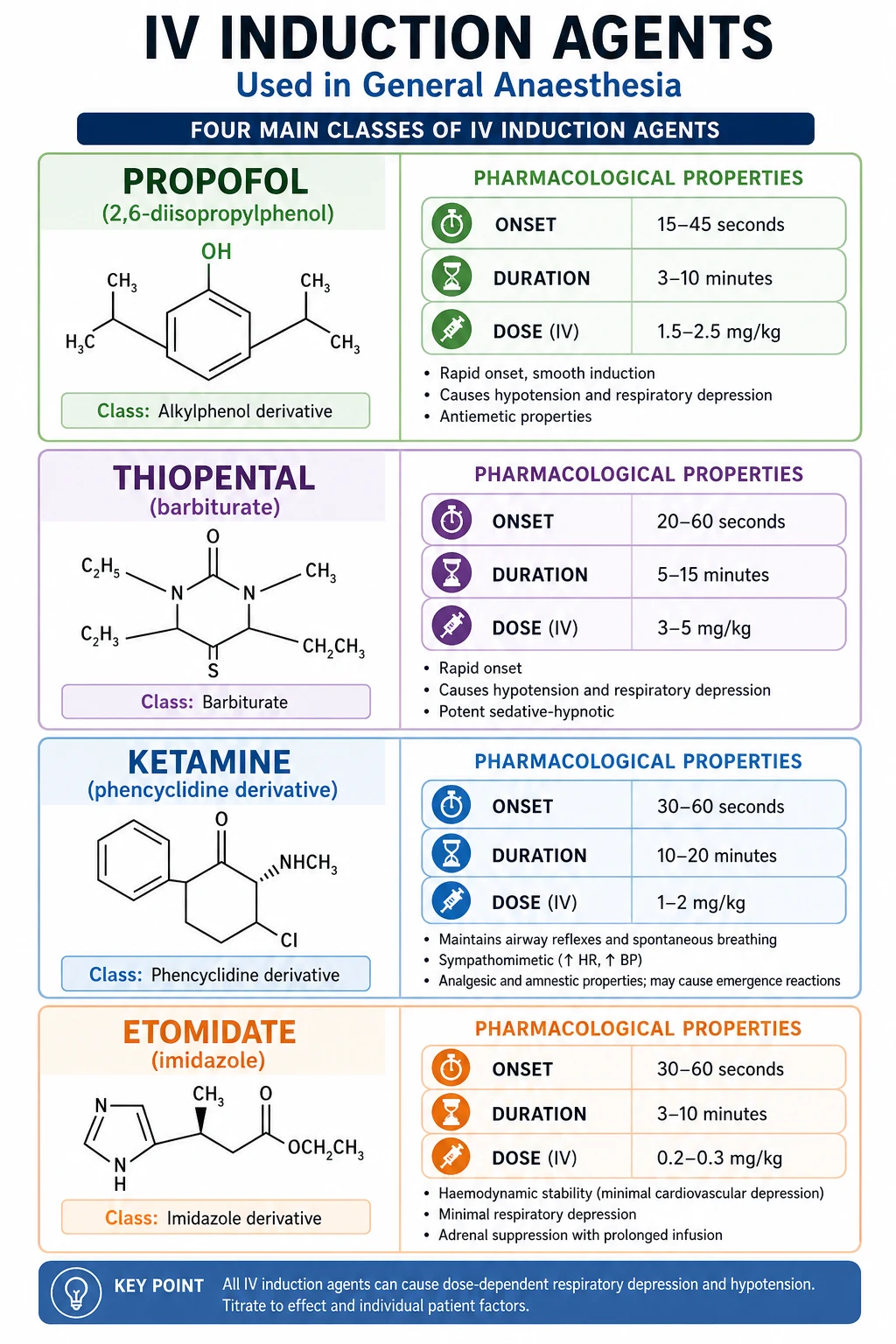
Propofol (2,6-diisopropylphenol) is the default induction agent for elective anaesthesia, the maintenance agent of total intravenous anaesthesia, and the sedative of procedural sedation. It is given at 2 to 2.5 mg/kg for induction. It is GABA-ergic, smooth and rapid, with an antiemetic effect and a clean, clear-headed recovery that made it the agent of day-case surgery. It is formulated as a lipid emulsion (soya oil, egg lecithin), giving it its white appearance and its propensity to cause pain on injection (mitigated by lidocaine pretreatment or a large antecubital vein).[7]
Its principal drawback is haemodynamic: it is a vasodilator and a negative inotrope, producing a dose-dependent hypotension and a degree of apnoea — tolerable in the well patient, undesirable in the shocked or the cardiac-compromised, in whom another agent is chosen. It lowers the blood pressure partly by the loss of sympathetic tone and partly by direct vasodilation. [1]
Propofol infusion syndrome
The propofol infusion syndrome (PRIS) is a rare but devastating complication of prolonged, high-dose propofol sedation — classically over 4 mg/kg/hr for more than 48 hours, and most feared in the critically ill child. The features are those of mitochondrial energy failure: a progressive metabolic acidosis, rhabdomyolysis, cardiac failure (a bradycardic, inotrope-resistant cardiomyopathy), hyperkalaemia, hepatomegaly and lipaemia. The mortality is high. The syndrome was first described in children receiving prolonged propofol sedation in intensive care, and the review by Kam and Cardone set out its mechanism and recognition.[2][3]
The prevention is a heightening of suspicion in any patient on a prolonged propofol infusion: monitor the acid-base, the lactate, the creatine kinase and the potassium, and stop the propofol the moment PRIS is suspected, substituting an alternative sedative. The syndrome is essentially unknown after a single induction dose or a short theatre infusion. [1]
Thiopental: the barbiturate
Thiopental is the ultrashort-acting barbiturate that was the standard induction agent for half a century and the agent of the classical rapid sequence induction. It is GABA-ergic, given at 3 to 5 mg/kg, and produces a rapid, smooth loss of consciousness in one arm-to-brain circulation. It is a potent cardiovascular depressant (vasodilation and negative inotropy, like propofol) and a cerebral vasoconstrictor that lowers the cerebral metabolic rate — useful in neuroprotection, but its hypotension is a disadvantage in the shocked patient. It is strongly alkaline, so extravasation causes tissue necrosis and intra-arterial injection is a disaster. [1]
Two properties ended its routine use. It accumulates with repeated dosing (a long context-sensitive half-time), so it cannot be used as a maintenance infusion and produces a hangover. And it is absolutely contraindicated in the porphyrias — it induces the enzyme ALA synthase and precipitates an acute porphyric crisis with neurovisceral attacks that can be fatal. [1]
Ketamine: the dissociative anaesthetic
Ketamine, the NMDA antagonist, is pharmacologically and clinically distinct. It produces a dissociative anaesthesia — profound analgesia and a cataleptic state with the eyes open, nystagmus and preserved airway reflexes and spontaneous ventilation. Its defining haemodynamic property is that it stimulates the sympathetic nervous system, raising the heart rate and the blood pressure — the induction agent of choice for the hypovolaemic, the shocked and the severely cardiac-compromised, where the GABA-ergic agents' hypotension would be dangerous. (The caveat is that ketamine is itself a direct negative inotrope, so in the patient who has exhausted the catecholamine response — the profoundly shocked, chronically ill patient — it can cause hypotension, a paradoxical but important effect.)[6]
It is a bronchodilator, making it the induction agent of choice for the severe asthmatic. It is an analgesic, useful for procedural sedation and field anaesthesia. It increases the salivary secretions (an antisialogogue is often given first). Its chief drawback is the emergence phenomenon — vivid, sometimes distressing hallucinations and agitation on recovery, attenuated by a benzodiazepine. The enantiomer esketamine is increasingly used for its cleaner profile and its emerging role in treatment-resistant depression.[6]
Ketamine and the injured brain
Ketamine was, for decades, contraindicated in raised intracranial pressure on the grounds that it increased the cerebral blood flow and the intracranial pressure in the head-injured patient. The modern evidence has overturned this. The BIKe trial and the KETA-BID trial have examined ketamine's effect on the intracranial pressure and the cortical spreading depolarisations in severe traumatic brain injury, and the contemporary position is that ketamine, at induction doses, does not increase the intracranial pressure in the head-injured patient, may be neuroprotective, and is safe and useful in the shocked, head-injured patient — overturning a long-held but inadequately evidence-based contraindication.[4][5]
Etomidate: the haemodynamically stable agent
Etomidate is the GABA-ergic induction agent whose defining property is its haemodynamic stability — it produces almost no change in the blood pressure, the heart rate or the cardiac output at induction, which makes it the agent of choice for the haemodynamically tenuous: the shocked, the severe aortic or valvular disease, and the frail elderly. It is given at 0.2 to 0.3 mg/kg. Its drawbacks are the pain on injection, the myoclonus (avoided by a small dose of an opioid or a benzodiazepine first), and a high rate of postoperative nausea and vomiting. [1]
The defining controversy, however, is its effect on the adrenal cortex. [1]
Etomidate and the adrenal cortex
Etomidate is a potent inhibitor of 11-beta-hydroxylase, the enzyme of cortisol synthesis. A single induction dose suppresses the adrenal cortisol response for several hours to days, a finding of particular concern in the critically ill patient with incipient adrenal insufficiency — above all the patient in septic shock, in whom the adrenal reserve is already depleted. The systematic review and meta-analysis of Albert and colleagues confirmed that etomidate increases the incidence of adrenal insufficiency in critical illness, and the question of whether this translates into increased mortality in sepsis remains the central, unresolved debate around the agent.[1]
The practical position is that etomidate remains a valid choice for the induction of the critically ill patient where haemodynamic stability is the priority, accepting the adrenal-suppression caveat; the alternative is ketamine, which does not suppress the adrenal and is also haemodynamically stable, and which has therefore gained ground in the critically ill. [1]
The benzodiazepines and flumazenil
The benzodiazepines — principally midazolam — act at a distinct site on the GABA-A receptor, producing sedation, anxiolysis, anterograde amnesia and, in high dose, anaesthesia. Midazolam is rapid, water-soluble (non-irritant) and short-acting, and is used for premedication, co-induction and procedural sedation rather than as a sole induction agent (the induction is slow and the dose unpredictable compared with propofol). Its effects — and those of overdose — are specifically and competitively reversed by flumazenil, a property unique to the benzodiazepine class. [1]
Adverse effects and special considerations
- Pain on injection — propofol and etomidate; mitigated by lidocaine pretreatment or a large-bore antecubital vein.
- Allergy — propofol is formulated in an egg-and-soya emulsion; modern evidence has shown it is safe even in patients with egg, soya or peanut allergy, but the historical caution lingers. True propofol anaphylaxis occurs.
- Porphyria — the barbiturates (thiopental) are absolutely contraindicated; propofol, ketamine and the benzodiazepines are safe.
- Hyperkalaemia — the barbiturates and propofol are safe in the upregulated-muscle patient (the succinylcholine contraindication does not extend to the induction agents).
- Extravasation — thiopental is strongly alkaline and causes tissue necrosis if it extravasates or is given intra-arterially. [1]
Agent selection by the patient
The choice of agent is governed by the interaction of the agent's profile with the patient's state.[7]
- The shocked, hypovolaemic or severely cardiac-compromised patient — ketamine (sympathetic stimulation, preserved blood pressure) or etomidate (haemodynamic neutrality). Avoid propofol and thiopental for their hypotension.
- The severe asthmatic — ketamine (bronchodilator).
- The raised-intracranial-pressure / traumatic brain injury patient — propofol (lowers the cerebral metabolic rate and the intracranial pressure) or thiopental (cerebral vasoconstriction, lowered metabolic rate); ketamine is no longer contraindicated.
- The obstetric patient — thiopental (rapid, crosses the placenta but is redistributed from the neonate quickly); propofol is increasingly used.
- The child — propofol or an inhalational induction with sevoflurane; thiopental is still used in neonates.
- The patient with porphyria — propofol, ketamine or a benzodiazepine; never thiopental. [1]
Target-controlled infusion and total intravenous anaesthesia
Propofol's very high clearance and its predictable pharmacokinetics make it the agent of the target-controlled infusion (TCI) — a pump that delivers the drug to achieve and hold a predicted plasma (or effect-site) concentration, computed from a population pharmacokinetic model (the Marsh model, and the newer Eleveld model that spans all patient groups). A propofol-and-remifentanil TIVA technique is the alternative to the volatile for maintenance, chosen for the malignant-hyperthermia-susceptible patient, for the patient with a shared airway (ENT, bronchoscopy), and for the smooth, emission-free emergence. The depth must be monitored (processed EEG, e.g. BIS) to avoid both awareness and overdose. [1]
Clinical
- Standard approach
- Evidence-based
Alternative
- Modified technique
- Risk-benefit
Red flags
[1] [1] [1] [1] [1]References
- [1]Albert SG, Ariyan S, Rather A. The effect of etomidate on adrenal function in critical illness: a systematic review Intensive Care Med, 2011.PMID 21373823
- [2]Kam PC, Cardone D. Propofol infusion syndrome Anaesthesia, 2007.PMID 17567345
- [3]Bray RJ. Propofol-infusion syndrome in children Lancet, 1999.PMID 10376650
- [4]De Sloovere V, Mebis L, Wouters P, Guiza F, et al. Brain Injury and Ketamine study (BIKe): a prospective, randomized controlled double blind clinical trial to study the effects of ketamine on therapy intensity level and intracranial pressure in severe traumatic brain injury patients Trials, 2025.PMID 40437634
- [5]Andreasen TH, Olsen MH, Gluud C, Lindschou J, et al. S-ketamine versus placebo for cortical spreading depolarisation in severe acute brain injury (KETA-BID): protocol for a pilot, randomised, blinded clinical trial BMJ Open, 2025.PMID 40721263
- [6]Hu HL, Huang QZ, Xie PX. A comprehensive review of the clinical progress of esketamine: From anesthesia to antidepressant therapy Medicine (Baltimore), 2026.PMID 42065202
- [7]Kassab N, Abourjeili J, Eid MJ, Raphael CK. Pharmacogenomics of commonly used intravenous anesthetics Pharmacogenet Genomics, 2026.PMID 41437621