Anaes · Anaesthetic adjuncts
Subanaesthetic ketamine as an analgesic adjunct
Also known as Low-dose ketamine · NMDA antagonist adjunct · Opioid-sparing ketamine · Anti-hyperalgesic ketamine · Esketamine analgesia
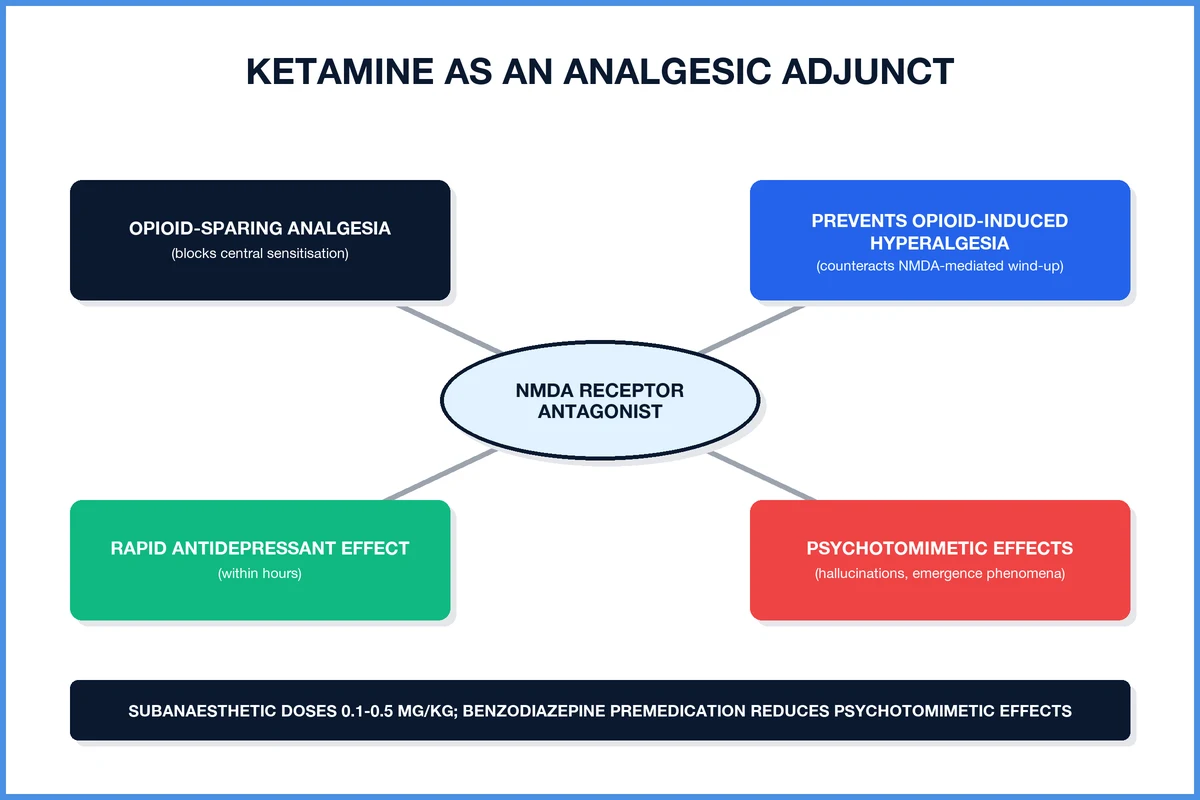
Subanaesthetic-dose ketamine is the prototypical NMDA-receptor antagonist used not to induce anaesthesia but to prevent the central sensitisation that drives postoperative pain, opioid tolerance and opioid-induced hyperalgesia. At a tenth to a half of the induction dose, given as a 0.1 to 0.5 mg per kg bolus or a 0.1 to 0.5 mg per kg per hour infusion, it is one of the most effective opioid-sparing adjuncts available, reducing opioid requirements by about 25 to 50 per cent across a wide range of surgery. The framework rests on five exam-critical ideas: the analgesia is mechanistically an ANTI-HYPERALGESIC action, not a simple analgesic one, because use-dependent NMDA blockade preferentially silences the wind-up and central sensitisation that amplify pain after tissue injury; the same mechanism directly counteracts the NMDA-driven pathway by which opioids themselves produce hyperalgesia and tolerance, so ketamine is uniquely valuable in the opioid-tolerant patient; it is effective for neuropathic pain by both the intravenous and the topical route; its S-enantiomer esketamine preserves the analgesic and anti-hyperalgesic effect with fewer psychotomimetic emergences and a rapid antidepressant action licensed for treatment-resistant depression; and even at these low doses the sympathomimetic cardiovascular stimulation and the psychotomimetic effects persist, so patient selection matters. Built on the topical ketamine neuropathic-pain study (Rav 2026), the perioperative ketamine and esketamine fatigue review (Al Subhi 2026), the opioid-sparing anaesthesia and PONV trial (Sung 2026), the neuro-glial marker work in sinus surgery (Rizopoulou 2026), the dexamethasone and rebound-pain study (Hong 2026), and the palliative opioid therapy review (Chen 2026).
On this page & tools
Your progress
Saved locally on this device.
Target exams
Red flags

Why this matters to the anaesthetist
Opioids have carried perioperative analgesia for a century, and they carry its three great problems with them: dose-dependent respiratory depression, postoperative nausea and vomiting, and the paradox of opioid-induced hyperalgesia (OIH), in which the very drugs given to treat pain lower the pain threshold and accelerate tolerance. Subanaesthetic-dose ketamine is the cleanest pharmacological answer to all three that the anaesthetist has, because it works by a mechanism the opioids do not touch. Where morphine, fentanyl and the related mu agonists produce analgesia through the inhibitory G-protein-coupled opioid receptor, ketamine blocks the NMDA receptor, the principal excitatory ligand-gated ion channel of the central nervous system, and in doing so it interrupts the central sensitisation (wind-up) that is the common final pathway of postoperative pain, opioid tolerance and opioid-induced hyperalgesia. [1]
The clinical dividend is large and well replicated. A low-dose perioperative ketamine infusion reduces opioid requirements by about 25 to 50 per cent across a wide range of major surgery, lowers the pain scores, prolongs the time to first analgesic request, and — because less opioid is given — reduces opioid-related nausea and vomiting.[4] In the opioid-tolerant patient (the chronic-pain patient on long-term opioids, the palliative patient, the patient on opioid substitution therapy) it is often the single most useful adjunct, restoring analgesia where escalating opioid doses have stopped working.[6] And because it does not cause respiratory depression or histamine release, it can be run where an opioid infusion cannot. This topic concerns the adjunct use of ketamine — the subanaesthetic bolus and infusion — as distinct from its use as an induction agent, which is covered in the parent ketamine topic.
Mechanism of action: anti-hyperalgesia rather than analgesia
The defining pharmacological fact about subanaesthetic ketamine is that its analgesic action is mechanistically an anti-hyperalgesic action. The NMDA receptor is a calcium- and sodium-permeable ligand-gated ion channel gated by glutamate, requiring glycine as a co-agonist and membrane depolarisation to displace the resting magnesium block. After tissue injury, repeated C-fibre and A-delta firing releases glutamate onto the dorsal-horn NMDA receptors; the channel opens, calcium floods in, and a cascade of second messengers (protein kinase C, calcium-calmodulin-dependent protein kinase II, nitric oxide synthase) produces wind-up and central sensitisation — the dorsal horn neurons fire more readily to a given stimulus, the receptive field expands, and the patient becomes hyperalgesic and allodynic. This is the neural substrate of postoperative pain that outlasts the surgical stimulus itself. [1]
Ketamine binds inside the open NMDA channel pore in a use-dependent (open-channel block) fashion. The channel must be opened by glutamate before ketamine can reach its binding site, so ketamine preferentially blocks the most-active, most-sensitised receptors — exactly the population that central sensitisation has recruited. By preventing the calcium influx it aborts the kinase cascade and stops wind-up. The result is not that the patient feels less of an unchanging pain; it is that the pain is prevented from amplifying. This is the single concept that organises the entire adjunct pharmacology of ketamine: it is an anti-hyperalgesic, and every clinical use — opioid-sparing, OIH prevention, neuropathic-pain efficacy, the opioid-tolerant rescue — follows from that mechanism.[1][2]
This is also the mechanism by which ketamine counters opioid tolerance and opioid-induced hyperalgesia. Chronic opioid exposure activates the same NMDA-protein-kinase-C pathway in the dorsal horn; the opioid becomes less effective (tolerance) and the patient becomes more sensitive to pain (hyperalgesia). NMDA antagonism directly counteracts this, which is why a ketamine infusion restores analgesia in the opioid-tolerant patient where further opioid simply does not.[4][6]
Pharmacokinetics of the subanaesthetic infusion
The pharmacokinetics that govern a 1 to 2 mg per kg induction bolus also govern the 0.1 to 0.5 mg per kg per hour analgesic infusion, but the clinical implications differ. Ketamine is highly lipid-soluble with a large volume of distribution of 3 to 5 L per kg and a high hepatic clearance (chiefly CYP2B6 and CYP3A4, by N-demethylation to the active metabolite norketamine, which has about one-third the NMDA potency of the parent and prolongs the analgesic effect beyond the distribution half-life). After a small subanaesthetic bolus the onset of analgesia is within one to two minutes; the context-sensitive half-time rises only moderately with the duration of infusion, far less steeply than a barbiturate, which is why a low-dose infusion can be run for hours to days without the unpredictable accumulation of thiopental. [1]
Two practical points follow. First, the active metabolite norketamine accumulates during a prolonged infusion and contributes a cumulative analgesic and psychotomimetic effect that a single bolus does not — a patient on a 24-hour infusion may emerge with more vivid dreams than the dose alone predicts. Second, the high lipid solubility means ketamine crosses the placenta and the blood-brain barrier readily; it is excreted in breast milk in small amounts, and although single perioperative doses are generally regarded as compatible with lactation, the chronic-pain and palliative populations on long-term infusion warrant individualised advice.[2]
The opioid-sparing effect
The opioid-sparing effect is the most robustly demonstrated and the most clinically useful property of subanaesthetic ketamine. Across major abdominal, thoracic, orthopaedic and breast surgery, a perioperative low-dose ketamine infusion reduces total opioid consumption by about 25 to 50 per cent, with a parallel reduction in pain scores and in opioid-related side effects.[4] The reduction is clinically important because it breaks the cycle in which more opioid produces more nausea, more sedation and more hyperalgesia, each of which then demands more opioid. By substituting an anti-hyperalgesic for part of the opioid dose, ketamine lowers the nausea burden and shortens the time to mobilisation; the opioid-sparing anaesthesia literature in breast surgery confirms a reduction in postoperative nausea and vomiting when opioid exposure is cut.[4]
The magnitude of the sparing depends on the type of surgery and the patient. It is largest where the nociceptive input is intense and prolonged (major abdominal, thoracotomy, major orthopaedic, extensive soft-tissue surgery) and where the patient is opioid-tolerant at baseline, in whom a fixed opioid dose produces inadequate analgesia. It is smaller, and often not worth the psychotomimetic cost, in minor or superficial surgery where the opioid requirement is modest anyway. Ketamine combines synergistically with the other opioid-sparing adjuncts — intravenous lidocaine, dexmedetomidine, paracetamol and the non-steroidal anti-inflammatories — and is a rational component of an enhanced-recovery-after-surgery (ERAS) multimodal regimen.[2][5]
Prevention of opioid-induced hyperalgesia and tolerance
Opioid-induced hyperalgesia is the paradox by which opioids, especially at high dose or with prolonged exposure, lower the pain threshold and produce a pain that is qualitatively different from — and broader than — the original surgical pain. It is mechanistically distinct from tolerance (loss of analgesic effect requiring dose escalation), although the two share the NMDA-protein-kinase-C pathway in the dorsal horn and frequently coexist. Both are increasingly recognised as drivers of poor long-term outcomes after surgery: the patient who leaves hospital on a high opioid dose and does not wean it is often the patient whose perioperative opioids induced a hyperalgesic state.[6]
Ketamine is the most direct pharmacological counter to OIH, because the NMDA receptor IS the mechanism by which opioids produce hyperalgesia. A subanaesthetic infusion given perioperatively and continued for 24 to 48 hours postoperatively attenuates the development of acute opioid tolerance and reduces the opioid escalation that would otherwise occur in the opioid-tolerant patient. In the palliative and chronic-cancer-pain population, where escalating opioid doses and OIH are a daily clinical problem, low-dose ketamine is an established second-line analgesic that can restore responsiveness to the opioid and reduce its dose, and the palliative opioid literature explicitly addresses this role.[6] Adjuncts that suppress the inflammatory and rebound components of post-block pain, such as intravenous dexamethasone, act on a complementary pathway and are increasingly used alongside ketamine in multimodal regimens.[5]
Neuropathic pain and the topical route
Neuropathic pain — pain arising from a lesion or disease of the somatosensory nervous system — is the pain class in which the NMDA-driven central sensitisation is most pronounced and in which conventional opioids and the non-steroidal drugs are least effective. Because NMDA antagonism targets the amplification mechanism rather than the nociceptive input, ketamine is effective for neuropathic pain by both the intravenous and the topical route, and this is one of its clearest niche indications.[1]
The intravenous route — a subanaesthetic infusion for a chronic-pain or complex-regional-pain-syndrome patient — is the most-studied and often produces dramatic relief where conventional drugs have failed. The topical route is a newer and increasingly used option: ketamine formulated in a compounded cream (commonly with amitriptyline and lidocaine) produces local analgesia by a peripheral NMDA and sodium-channel action with minimal systemic absorption, and the recent topical neuropathic-pain trial supports its use for localised neuropathic pain.[1] The topical route is particularly attractive for the patient in whom systemic psychotomimetic effects must be avoided — the elderly, the patient with a psychiatric history, the patient in whom an intravenous infusion is impractical.
The rapid antidepressant effect and esketamine
The analgesic and the anti-hyperalgesic actions of subanaesthetic ketamine are accompanied by a property no conventional analgesic shares: a rapid antidepressant effect within hours of administration, in contrast to the weeks taken by the monoamine reuptake-inhibiting antidepressants. The mechanism is glutamate-based — a rapid restoration of synaptic plasticity through the mTOR pathway and an increase in brain-derived neurotrophic factor — and it is the pharmacological basis of the esketamine intranasal spray licensed for treatment-resistant depression.[2]
This matters to the anaesthetist for two reasons. First, the S-enantiomer esketamine, which produces fewer psychotomimetic effects than the racemate at equipotent analgesic doses, is increasingly used as a perioperative opioid-sparing infusion on the rationale that the lower emergence burden makes the subanaesthetic dose more tolerable; the perioperative esketamine evidence, including its effect on postoperative fatigue, is accumulating.[2] Second, the patient presenting for surgery who is already on, or who has a history of treatment-resistant depression treated with, esketamine warrants a careful multimodal plan, since the drug interacts with the same NMDA target the anaesthetist may be planning to use.
Bronchodilation and severe asthma
Ketamine is the only intravenous anaesthetic agent that is a bronchodilator, and this property is retained at subanaesthetic doses. By a direct action on airway smooth muscle and by catecholamine release it relaxes bronchial tone, and a low-dose infusion can be used as an adjunct in the patient with severe bronchospasm or refractory status asthmaticus who is deteriorating despite maximal inhaled and intravenous bronchodilator therapy. In this context the sympathomimetic cardiovascular stimulation is an advantage rather than a side effect, and the absence of respiratory depression allows the infusion to be run without worsening the hypercapnia that is driving the respiratory failure. This indication, while less common than the perioperative analgesic one, is the indication in which subanaesthetic ketamine can be genuinely life-saving. [1]
Dosing, routes and practical regimens
The adjunct doses are an order of magnitude below the induction dose, and the regimens can be given by several routes: [1]
- Perioperative intravenous infusion. The standard regimen is a bolus of 0.1 to 0.5 mg per kg before surgical incision, followed by an infusion of 0.1 to 0.5 mg per kg per hour (about 5 to 20 micrograms per kg per minute) continued intra-operatively and into the postoperative period for 24 to 48 hours. The bolus is omitted if the patient is haemodynamically tenuous, and the infusion is the component that carries the opioid-sparing effect.[2]
- Opioid-tolerant and chronic-pain patient. A higher end of the range (0.3 to 0.5 mg per kg per hour) is often needed, reflecting the up-regulated NMDA tone; the infusion is the most reliable way to restore analgesia in this population.[6]
- Oral. Oral ketamine (typically 0.5 to 1 mg per kg) is used for chronic and palliative pain where the intravenous route is impractical, and for procedural analgesia such as burns dressing changes. Bioavailability is low (about 20 per cent) and first-pass metabolism produces significant norketamine.
- Intranasal. The esketamine nasal spray is the licensed formulation for treatment-resistant depression; the racemic intranasal route has been used for analgesia in paediatric and chronic-pain settings.[2]
- Topical. A compounded cream (commonly ketamine with amitriptyline and lidocaine) is applied to localised neuropathic-pain areas for a peripheral action with minimal systemic absorption.[1]
- Intramuscular. Rarely used for the adjunct indication, but available where intravenous access is impossible (typically the frightened child).
The total daily dose should be titrated to analgesic effect and to the emergence of psychotomimetic or cardiovascular side effects; the infusion is the dose form that allows this titration most precisely. [1]
Adverse effects at adjunct doses
The side-effect profile at subanaesthetic doses is the same in kind as at induction dose but smaller in magnitude; none of the effects is abolished, and the anaesthetist who believes low-dose ketamine is free of them will be caught out. [1]
- Psychotomimetic effects — the signature adverse effect. Vivid dreams, hallucinations, a sense of detachment from the body, and emergence phenomena occur in a minority of patients on a low-dose infusion; they are commoner in adults, in the opioid-tolerant and in those with a psychiatric history, and they are the commonest reason the infusion is stopped. They are reduced by benzodiazepine premedication (a small dose of midazolam), by using the low end of the dose range, and by using esketamine in place of the racemate.[2]
- Sympathomimetic cardiovascular stimulation — heart rate, blood pressure, cardiac output and systemic vascular resistance rise via central sympathetic stimulation and noradrenaline-reuptake inhibition. This is desirable in shock and a hazard in uncontrolled hypertension, ischaemic heart disease, recent myocardial infarction and aortic dissection, where the surge in afterload and myocardial work can precipitate ischaemia.
- Hypersalivation — increased salivary and bronchial secretions; an antisialagogue (glycopyrrolate) is often given, particularly in children.
- Nystagmus — a horizontal nystagmus and roving eye movement are common and harmless but can alarm the unwary.
- Nausea and vomiting — ketamine is more emetogenic than propofol, though the opioid-sparing effect offsets some of this; an antiemetic is usually co-administered.[4]
- Tolerance and dependence with prolonged use — relevant in the chronic-pain and palliative populations on long-term infusion, where escalating doses may be required and the drug is subject to misuse potential.[6]
What ketamine does NOT do at adjunct doses is equally important and frequently examined: it does not cause respiratory depression, it does not release histamine, and it preserves the airway reflexes better than other sedatives (though a rapid bolus can still transiently apnoeise the patient). [1]
Esketamine versus racemic ketamine
The two enantiomers differ in potency and in side-effect profile in a way that is directly relevant to the adjunct use. The S-plus-enantiomer (esketamine) binds the NMDA receptor with about four times the affinity of the R-minus-enantiomer, so esketamine is the more potent analgesic and anti-hyperalgesic at a given dose. It also produces fewer psychotomimetic effects — the principal drawback of the racemate — and less hypersalivation. These advantages are balanced by higher cost and, in many countries, more restricted availability. [1]
For the adjunct indication esketamine is increasingly preferred where the psychotomimetic burden must be minimised — the elderly, the patient with a psychiatric history, the ambulatory patient being discharged on the day of surgery — and the perioperative esketamine evidence supports an opioid-sparing and postoperative-fatigue-reducing effect comparable to or better than the racemate at lower psychotomimetic cost.[2] The racemic drug remains the cheaper and more widely available form for the great majority of the world's perioperative, chronic-pain and palliative use.
Clinical indications and patient selection
The indications for subanaesthetic ketamine group naturally into those in which it is a first-line adjunct and those in which it is a niche rescue. [1]
- Major surgery with high expected opioid requirement — major abdominal, thoracic, extensive orthopaedic and large soft-tissue surgery — where the opioid-sparing effect is largest and most cost-effective.[4]
- The opioid-tolerant patient — chronic-pain patient on long-term opioids, palliative patient, patient on opioid substitution therapy — in whom NMDA-mediated tolerance and hyperalgesia have made the opioid ineffective and ketamine can restore analgesia.[6]
- Neuropathic and complex regional pain — by the intravenous infusion for the acute crisis and by the topical cream for localised neuropathic pain, where conventional analgesics are least effective.[1]
- Perioperative esketamine in selected patients — where psychotomimetic minimisation is paramount, with accumulating evidence for an opioid-sparing and postoperative-fatigue-reducing benefit.[2]
- Severe asthma and refractory status asthmaticus — where the bronchodilator and sympathomimetic properties, combined with the absence of respiratory depression, make a low-dose infusion a rational adjunct to maximal bronchodilator therapy.
- Palliative and chronic-cancer pain — where escalating opioid doses and opioid-induced hyperalgesia are limiting, and low-dose ketamine can reduce the opioid requirement and restore responsiveness.[6]
- Surgery in which the neuro-glial response to surgical stress is a concern — subanaesthetic ketamine modulates the perioperative neuro-glial activation reflected in markers such as S-100B and neuron-specific enolase, an effect studied in the surgical-stress context.[3]
Patient selection is governed by the cardiovascular and the psychotomimetic profile. The infusion is relatively contraindicated in uncontrolled hypertension, ischaemic heart disease (where the sympathomimetic surge is hazardous), in the active psychosis, and in pregnancy (where high doses are to be avoided, though single perioperative doses are generally acceptable). It is particularly suitable for the opioid-tolerant, the shocked and the bronchospastic patient, in whom its mechanism and its side-effect profile both run in the anaesthetist's favour. [1]
Clinical
- Standard approach
- Evidence-based
Alternative
- Modified technique
- Risk-benefit
Red flags
[1] [1] [1] [1] [1] [1]References
- [1]Rav E, et al. Topical Amitriptyline, Ketamine, and Lidocaine Cream for Neuropathic Pain Control in Pediatric Oncology Patients J Pain Symptom Manage, 2026.PMID 42362167
- [2]Al Subhi M, et al. Effect of Perioperative Ketamine and Esketamine on Postoperative Fatigue: A Systematic Review and Meta-Analysis of Randomized Controlled Trials Medicina (Kaunas), 2026.PMID 42356168
- [3]Rizopoulou S, et al. Variations in S-100Β and Neuron-Specific Enolase Levels During Functional Endoscopic Sinus Surgery Under Moderately Controlled Hypotension Using Four Distinct Anesthetic Protocols: A Randomized Controlled Study Medicina (Kaunas), 2026.PMID 42356019
- [4]Sung TY, et al. Effect of Opioid-Sparing Anesthesia on Postoperative Nausea and Vomiting After Breast Surgery: A Single-Center Randomized Controlled Trial J Clin Med, 2026.PMID 42355627
- [5]Hong B, et al. Consistent analgesic effect of intravenous dexamethasone on rebound pain after brachial plexus block: a causal machine learning approach Korean J Pain, 2026.PMID 42357812
- [6]Chen J, et al. Top Ten Tips Palliative Care Clinicians Should Know About Navigating Outpatient Opioid Prescribing J Palliat Med, 2026.PMID 42363735