Anaes · Intravenous induction agents
Ketamine
Also known as NMDA receptor antagonist · Dissociative anaesthetic · Phencyclidine derivative · Aryl-cyclohexylamine · Racemic ketamine · S-ketamine (esketamine) · Ketalar
Ketamine is the only intravenous induction agent whose pharmacology is built on NMDA-receptor antagonism rather than GABA-A modulation, and that single mechanistic difference explains every property that makes it the induction agent of choice for the hypovolaemic, the bronchospastic and the patient in refractory status asthmaticus. The framework rests on four exam-critical ideas: it is a non-competitive, use-dependent NMDA-receptor antagonist that binds inside the open ion channel and blocks calcium and sodium influx, a mechanism fundamentally different from the GABA-A positive allosteric modulation of propofol and thiopental; its dissociative state, profound sub-anaesthetic analgesia, bronchodilation and sympathomimetic pressor response make it unique among induction agents; the critical caveat that in the catecholamine-depleted heart the direct negative inotropic effect is unmasked and the expected pressor response can become a severe hypotension; and esketamine, the S-enantiomer, is about four times more potent at the NMDA receptor with fewer psychotomimetic effects and is the basis of the licensed intranasal treatment for treatment-resistant depression. Built on the foundational CI-581 human pharmacology (Domino 1965), the Lancet ketamine review (Dundee 1970), the NMDA pharmacokinetic and pharmacodynamic analysis (Niesters 2012), the opioid-sparing systematic reviews (Subramaniam 2004, Laskowski 2011), the status-asthmaticus review (Goyal 2013), the chirality review (Andrade 2017), the ketamine-metabolite antidepressant programme (Zanos Nature 2016, Molecular Psychiatry 2018, Pharmacological Reviews 2018), and the contemporary perioperative, trauma, prehospital, RSI and psychiatric-emergencies literature (Al Subhi 2026, Tanaka 2026, Rav 2026, Ayazbekova 2026, Duclos 2026, Mills 2026, Sheridan 2026, Chilingarashvili 2026).
On this page & tools
Your progress
Saved locally on this device.
8 MCQs with explanations
Target exams
Red flags
Why this is examined
Ketamine is one of the four intravenous induction agents every anaesthetist must master — alongside propofol, thiopental and etomidate — and it is examined relentlessly because it is the mechanistic outlier of the four. Every other agent produces unconsciousness by modulating the GABA-A receptor (enhancing inhibition). Ketamine does not touch the GABA-A receptor at clinical doses; it blocks the NMDA receptor (blocking excitation). That single difference is the source of every property that distinguishes ketamine from its peers — a dissociative state rather than a smooth loss of consciousness, a profound analgesia at sub-anaesthetic doses, a bronchodilator action shared by no other induction agent, and a sympathomimetic pressor response that raises rather than lowers the blood pressure.[9][10]
Any viva, SAQ or hot case that begins with "a haemodynamically unstable patient needs a rapid-sequence induction — what agent?" is testing ketamine. The shocked trauma patient, the dehydrated child, the patient in haemorrhagic or early septic shock, the patient in refractory status asthmaticus deteriorating despite maximal bronchodilator therapy, and the frightened uncooperative child who needs a painful procedure but has no intravenous access — these are all ketamine stems, and the candidate who reaches for propofol or thiopental in any of them will fail the question.[5][7][14] The trap, and the part that separates a pass from a distinction, is the catecholamine-depleted heart: the agent chosen for its pressor effect can, in the late exhausted circulation, cause the opposite — a profound hypotension — because its pressor action is indirect and the direct myocardial depression is normally hidden. Master the indirect-versus-direct cardiovascular pharmacology and you hold the most examined and most misunderstood part of the topic.
Four ideas define the drug and drive every examination question. First, it is a phencyclidine derivative and an aryl-cyclohexylamine, a non-competitive, use-dependent antagonist at the NMDA receptor that binds inside the open channel pore. Second, it produces the dissociative state — a cataleptic, amnestic, analgesic dissociation of the thalamocortical and limbic systems from the higher association areas, distinct from the smooth GABA-ergic unconsciousness of the other agents. Third, it is sympathomimetic (an indirect pressor through central sympathetic stimulation and noradrenaline-reuptake inhibition) with a direct negative inotropic effect that is masked in the catecholamine-replete heart and unmasked in the depleted one. Fourth, the S(+)-enantiomer (esketamine) is about four times more potent at the NMDA receptor, has a cleaner emergence profile, and — through the rapid glutamate-mediated restoration of synaptic plasticity and the (2R,6R)-hydroxynorketamine metabolite — is the basis of the licensed intranasal treatment for treatment-resistant depression.[15][16][17] Hold these four in tension — the NMDA mechanism, the dissociation, the indirect-pressor with a direct-depressant catch, and the enantiomer pharmacology — and you hold the whole topic.
From angel dust to the induction agent of shock — the history
Ketamine did not begin as an intravenous induction agent. It began as a derivative of phencyclidine (PCP), the aryl-cyclohexylamine synthesised in 1926 and investigated by Parke-Davis in the late 1950s as a potential intravenous anaesthetic under the name Sernyl. PCP produced a powerful dissociative state and profound analgesia, but its emergence was dominated by an intense, prolonged and frequently terrifying psychotomimetic reaction — delirium, hallucinations and agitation that could last for many hours — and it was abandoned for human anaesthesia. PCP subsequently escaped into illicit use as "angel dust".[10]
The medicinal chemists at Parke-Davis then sought a safer congener that would retain the dissociative and analgesic properties of PCP but with a far more acceptable, much briefer emergence. Ketamine (CI-581) was synthesised by Calvin Stevens in 1962, and its first human pharmacology was characterised by Edward Domino, Paul Chodoff and Guenter Corssen in 1965, in the seminal paper that named the "dissociative anaesthetic" state and established the cardiovascular, respiratory and psychotomimetic profile that defines the drug to this day.[9] The drug was introduced into clinical anaesthetic practice in 1970 (Ketalar), and the early clinical experience was summarised in the same year by Dundee and colleagues in the Lancet, which established ketamine's niche as the induction agent for the patient in whom the cardiovascular depression of the barbiturates was dangerous — the shocked, the hypovolaemic and the high-risk paediatric patient.[10]
The history matters for the examination in two ways. First, it explains the structural class: ketamine is an aryl-cyclohexylamine, a structural relative of PCP, and the cyclohexanone ring is the pharmacophore that confers the high NMDA-receptor affinity. Second, it explains the central clinical liability: the emergence phenomena that caused PCP to be abandoned are present in ketamine too, merely attenuated and shortened by the structural modification — which is why benzodiazepine pretreatment, low-dose infusion strategies, and the esketamine enantiomer are all, in different ways, attempts to refine away the residual psychotomimetic burden that has been part of the molecule's identity since its discovery.[10]
Physical chemistry and formulation
Ketamine is an aryl-cyclohexylamine — a phencyclidine derivative — with a cyclohexanone ring bearing an aminomethyl substituent. It is supplied as the hydrochloride salt in a clear, colourless, aqueous solution, and it carries a single chiral centre at the carbon bearing the amine, which is the structural basis of the two enantiomers and of esketamine (developed in the section on enantiomers). [1]
Four physical-chemical properties define ketamine and set it apart from every other induction agent, and each is favourite MCQ fodder: [1]
- It is water-soluble. Unlike propofol (insoluble, supplied as a lipid emulsion) and etomidate (poorly soluble, supplied in propylene glycol), ketamine is supplied as a clear, colourless, aqueous solution at a pH of about 3.5 to 5.5. It is, in fact, the only routinely used intravenous induction agent that is water-soluble, and this is the basis of two of its clinical signatures: there is no pain on injection (no lipid or solvent irritant), and it can be mixed in the same syringe with other water-soluble drugs (such as the sympathomimetics and the neuromuscular blockers) without precipitation or inactivation — a useful property in the rapid-sequence setting.
- It is, paradoxically, also highly lipid-soluble. This apparent contradiction — a molecule that is both water-soluble in formulation and lipophilic in vivo — is resolved by the pKa and the salt formulation: as the hydrochloride salt it dissolves in water, but the free base (about 55 to 60 percent at physiological pH, given the pKa of 7.5) is highly lipophilic. This is what allows the rapid blood-brain barrier penetration that produces the onset within one arm-to-brain circulation.
- It is supplied as a racemic mixture or as the pure S(+)-enantiomer. The racemate (Ketalar) contains both the R(-) and the S(+) enantiomers; the S(+)-enantiomer (esketamine, marketed as Ketanest and, for depression, as Spravato) is the more potent and is increasingly used in Europe and in the psychiatric indication.[15]
- It crosses the placenta and the blood-brain barrier readily. The high lipid solubility means ketamine crosses the placenta — relevant to neonatal depression after maternal induction, though it remains a useful induction agent in obstetric haemorrhage for the cardiovascular stability — and into breast milk, though single clinical doses are generally considered compatible with lactation.[10]
Mechanism of action — non-competitive, use-dependent NMDA antagonism
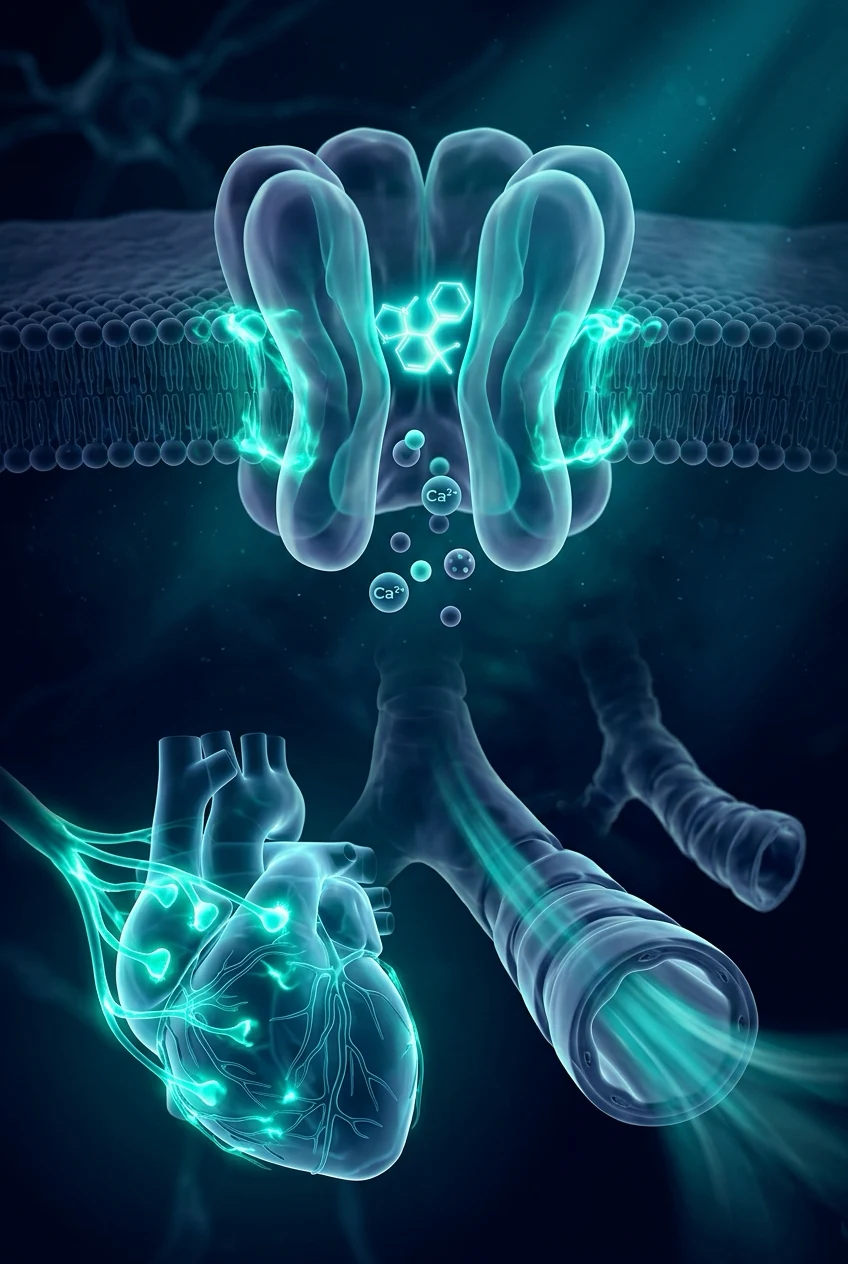
Ketamine is a non-competitive antagonist at the NMDA receptor, the principal fast excitatory ligand-gated ion channel of the central nervous system. Understanding the mechanism requires understanding the receptor itself, because the mechanism is inseparable from the receptor's gating logic.[11][18]
The NMDA receptor and its gating. The NMDA receptor is a calcium- and sodium-permeable cation channel assembled from four subunits (typically two GluN1 and two GluN2 subunits, encoded by the GRIN genes). It is gated by glutamate (at the GluN2 recognition site) but it requires, in addition, three conditions to open: [1]
- Glutamate must bind at the GluN2 (agonist) recognition site.
- Glycine (or D-serine) must bind as a co-agonist at the GluN1 site — a frequently-examined detail, because glycine is a positive modulator rather than a mere permissive factor, and the glycine site is the target of some experimental antagonists.
- Membrane depolarisation must displace the magnesium ion that constitutively blocks the pore at the resting membrane potential. The magnesium block is voltage-dependent: at rest the pore is plugged; when the membrane depolarises (typically because an adjacent AMPA receptor has fired), the magnesium is expelled, and only then can the channel open and admit calcium and sodium. [1]
This triple gating — glutamate, glycine and depolarisation — is the basis of the receptor's role in coincidence detection, synaptic plasticity, learning, memory and the central sensitisation of pain. Calcium entry through the open NMDA channel activates the calcium-dependent second messengers and kinases (protein kinase C, calcium-calmodulin-dependent protein kinase II) that drive long-term potentiation, wind-up, opioid tolerance and the hyperexcitability of chronic pain. [1]
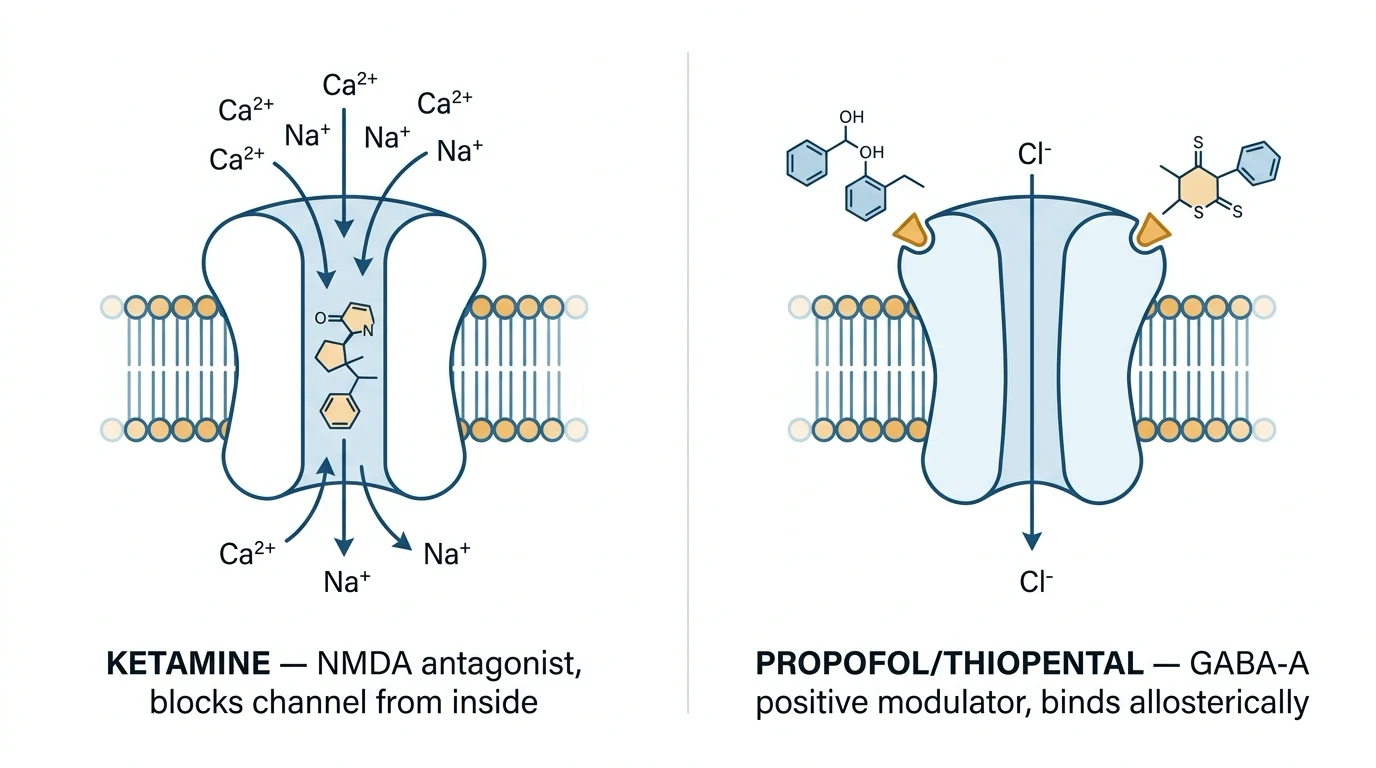
Ketamine binds inside the open pore. Ketamine does not act at the glutamate site, the glycine site, or a modulatory site on the outside of the channel. It binds within the ion channel pore itself, at a site in the transmembrane domain reached only when the channel is open, and it physically blocks the flow of ions. This is the defining pharmacological feature of the NMDA channel blockers (a class that includes the recreational dissociative agents, memantine and the experimental neuroprotectants): they are use-dependent (open-channel) blockers.[11][18]
The clinical consequence of use-dependence is profound: because the channel must first be opened by glutamate before ketamine can reach its binding site, ketamine preferentially blocks the most-active (most-firing) receptors and pathways. A quiet, low-firing synapse is largely spared; a hyperactive, wind-up-driven pain synapse is selectively silenced. This use-dependence is the mechanistic basis of two of ketamine's most distinctive clinical properties — its selectivity for the hyperactive pain pathways of central sensitisation (the anti-hyperalgesic rather than simply analgesic action), and its efficacy where the conventional opioids and GABA-ergic agents have failed. [1]
The second-messenger consequence. By blocking calcium influx through the open NMDA channel, ketamine prevents the activation of the calcium-dependent kinases that drive central sensitisation, wind-up and opioid tolerance. This is the mechanistic basis of the opioid-sparing and anti-hyperalgesic effect that is developed in the analgesia section, and of the prevention of opioid-induced hyperalgesia.[12][13]
The mechanistic divide from the GABA-ergic agents. This mechanism is fundamentally different from that of propofol, thiopental and etomidate, which are GABA-A positive allosteric modulators: they enhance an inhibitory channel (more chloride in, neuronal hyperpolarisation), whereas ketamine blocks an excitatory channel (less calcium in, reduced neuronal activation). The difference in mechanism is the source of the difference in the clinical state — a GABA-ergic agent produces a smooth, synchronised cortical depression and a natural-looking sleep; an NMDA antagonist produces the dissociation described below. Enhanced inhibition versus blocked excitation is the single phrase that explains why ketamine is not "another propofol".[10]
Ketamine is not a pure NMDA agent. Although NMDA antagonism is the dominant and defining action, ketamine interacts with several other receptors at clinical concentrations, and these off-target actions contribute to parts of its profile: [1]
- Opioid receptors (mu and, to a lesser extent, kappa), contributing to the analgesia. The opioid contribution is supported by the partial (not complete) naloxone reversibility of ketamine analgesia.
- The monoamine transporters — ketamine inhibits the reuptake of noradrenaline and dopamine, contributing to the sympathomimetic cardiovascular effect and to the antidepressant and psychotomimetic effects.[18]
- Voltage-gated sodium channels, a local-anaesthetic-like action that contributes to the analgesia (and to the topical-neuropathic-pain effect) and to a weak local-anaesthetic property.[3]
- N-type (voltage-gated) calcium channels and the hyperpolarisation-activated cyclic-nucleotide-gated (HCN) channels, at higher concentrations.
These off-target actions explain why ketamine's profile is richer than a pure NMDA antagonist would predict, and why it is sometimes described as a "dirty" drug — a term that, in pharmacology, is often a strength rather than a weakness. [1]
Pharmacokinetics
Ketamine's pharmacokinetics are those of a highly lipophilic drug with a large volume of distribution and a high clearance.[11]
Onset and the role of redistribution. After an intravenous induction dose the onset of anaesthesia is 30 to 60 seconds — one arm-to-brain circulation — driven by the high lipid solubility that carries the drug across the blood-brain barrier essentially instantly, with onset limited only by the circulation time. The intramuscular route produces surgical anaesthesia within 3 to 5 minutes. Recovery after a single intravenous bolus is rapid — about 10 to 20 minutes — and, as with the other induction agents, this early recovery is driven not by metabolism but by redistribution: ketamine leaves the vessel-rich central compartment (the brain and the well-perfused organs) and distributes into the larger muscle and fat compartments, the plasma and brain concentrations fall, and the patient emerges.[10]
The large volume of distribution. The volume of distribution at steady state is 3 to 5 L/kg, reflecting extensive uptake into the well-perfused and lipid-rich tissues (brain, heart, muscle and fat). This large distribution volume is the reason the elimination half-life (2 to 3 hours) is much longer than the clinical duration of a bolus (10 to 20 minutes): the clinical emergence tracks the distribution/redistribution phase, while the elimination half-life tracks the slow washout from the peripheral compartments. [1]
Metabolism — hepatic, CYP, and the active metabolite. Metabolism is chiefly hepatic, by the cytochrome P450 enzymes, predominantly CYP2B6 and CYP3A4. The principal pathway is N-demethylation to norketamine, which is an active metabolite with about one-third the analgesic and anaesthetic potency of the parent drug at the NMDA receptor. Norketamine is then hydroxylated (to hydroxynorketamines, including the (2R,6R)-hydroxynorketamine now implicated in the antidepressant effect) and conjugated to water-soluble glucuronide and sulfate metabolites that are excreted renally. About 80 percent of a dose is excreted as metabolites in the urine and only a small fraction is excreted unchanged.[18]
The activity of norketamine is pharmacologically important and clinically consequential: it prolongs the analgesic effect beyond the parent drug's distribution half-life (the analgesia outlasts the dissociative state) and it contributes to the cumulative effect of a prolonged infusion. It is also the reason that hepatic impairment prolongs the effect more than renal impairment does — the metabolite is active, so a failure of metabolism (hepatic) lengthens the effect, whereas the conjugated excretory products are inactive so renal impairment accumulates inactive species. [1]
The hydroxynorketamine metabolite and the antidepressant story. The N-demethylation pathway also generates the (2R,6R)-hydroxynorketamine (HNK) metabolite, which — in the landmark work of Zanos and Gould — reproduces the antidepressant effect without NMDA-receptor antagonism and without the psychotomimetic liability. This discovery reframed the antidepressant mechanism as, at least partly, an AMPA-receptor-mediated and mTOR-pathway-mediated restoration of synaptic plasticity rather than a pure NMDA block, and it is the basis of the ongoing HNK-analogue drug-development programme.[16][17][18]
The context-sensitive half-time and infusion suitability. The context-sensitive half-time — the time for the plasma concentration to halve once an infusion is stopped — rises only moderately with the duration of the infusion, far less steeply than thiopental and only somewhat more than propofol. This moderate rise, combined with the high clearance, is what makes ketamine usable as a maintenance and analgesic infusion without the unpredictable accumulation of the barbiturates — it is the pharmacokinetic basis of the opioid-sparing, the opioid-free and the intensive-care sedation infusions.[11]
The dissociative state
Ketamine produces a state unlike that of any other induction agent — the dissociative state that gave the class its name. The patient appears to be awake — the eyes remain open, a slow nystagmus is often present, the limbs may hold a cataleptic (waxy, held) posture, and the corneal and gag reflexes are preserved — yet the patient is unresponsive to the environment and amnestic for the period. It is, in Domino's original description, a functional and electrophysiological dissociation of the thalamocortical and limbic systems from the higher association areas, not a global depression of the cortex.[9]
The dissociation arises from ketamine's electrophysiological effect on the brain. Rather than globally depressing the cortex (the GABA-ergic pattern of a slow, synchronised, high-amplitude EEG), ketamine produces a distinctive EEG signature — theta activity with, paradoxically, a raised rather than lowered bispectral index (BIS). This is a well-known and frequently-examined confounder of depth-of-anaesthesia monitors under ketamine: the BIS (and other processed-EEG depth monitors) read high and may indicate "light" anaesthesia even in a patient who is dissociated and unresponsive. The monitor cannot be trusted as a depth indicator under ketamine, and this is a favourite MCQ distractor and a real clinical trap. [1]
The clinical correlates of the dissociative state are several: [1]
- Amnesia and analgesia coexist with apparent wakefulness. The patient may move and the eyes may be open, but the patient is amnestic and profoundly analgesic. This is the basis of ketamine's use in procedural sedation, where the preservation of the airway reflexes and the respiratory drive is an advantage over the deeper, more apnoea-producing alternatives.
- Muscle tone is preserved or increased, and random or purposeless movements, hypertonus and catalepsy occur. This is the reason a neuromuscular blocker is usually added for a surgical induction — ketamine alone does not provide the flaccid, still surgical field that a volatile agent or propofol provides.
- The airway reflexes and the respiratory drive are relatively preserved, the basis of ketamine's reputation as the agent that does not require controlled ventilation — but, as emphasised in the red flags, this preservation is relative and a large or rapid bolus still causes apnoea. [1]
Pharmacodynamics — analgesia, bronchodilation, and the central effects
Three pharmacodynamic properties make ketamine uniquely useful among the induction agents, and each is examined in its own right.[18]
Profound analgesia at sub-anaesthetic doses. Ketamine produces a profound analgesia at a tenth to a half of the induction dose — a property shared with no other induction agent and the basis of its role in opioid-sparing multimodal analgesia, opioid-free anaesthesia and chronic-pain management. The analgesia is mediated principally by the use-dependent NMDA blockade in the dorsal horn of the spinal cord, which prevents the central sensitisation and wind-up that amplify and sustain pain, with a contribution from the opioid-receptor and sodium-channel off-target actions. The systematic reviews establish that sub-anaesthetic ketamine reduces postoperative opioid consumption by about a quarter to a half across a wide range of surgery, and that it is effective against both somatic and neuropathic pain and against opioid-induced hyperalgesia.[12][13][4] The topical and regional formulations extend this to the periphery, by a local NMDA and sodium-channel action on the peripheral nociceptor.[3]
Bronchodilation — the only bronchodilator induction agent. Ketamine relaxes airway smooth muscle by a direct effect on the bronchial smooth muscle and indirectly by the release of catecholamines, and it is the only intravenous induction agent that is a bronchodilator. This makes it the induction agent of choice for the patient in severe bronchospasm or refractory status asthmaticus, where the volatile agents may be impossible to deliver (no intravenous access for the bronchodilator, no effective alveolar ventilation to carry the volatile), and where the bronchoconstrictor tendency of the barbiturates (histamine release) is undesirable.[14] A ketamine infusion can both anaesthetise the deteriorating asthmatic and actively break the bronchospasm, and the modern critical-care literature supports its use in refractory status asthmaticus as both an anaesthetic and a bronchodilator.[14]
Sympathomimetic cardiovascular stimulation. The cardiovascular pharmacology is developed in detail in the next section; here it is sufficient to note that the sympathomimetic effect — a rise in heart rate, blood pressure, cardiac output and systemic vascular resistance — is itself a pharmacodynamic property that distinguishes ketamine from every other induction agent and is the basis of its use in shock. [1]

Cerebral effects — the ICP question, reassessed. Ketamine increases the cerebral metabolic rate for oxygen (CMRO2), the cerebral blood flow (CBF) and the intracranial pressure (ICP) — the opposite of the GABA-ergic agents, which reduce all three. Historically this made ketamine a relative contraindication in raised intracranial pressure and traumatic brain injury, and that legacy position is still what most textbooks and many exam keys state. The modern reassessment is more nuanced: the rise in cerebral blood flow is largely mediated by a rise in the PaCO2 if ventilation is not controlled, so controlled normocapnic ventilation blunts most of the cerebral effect; and, critically, ketamine preserves or even increases the cerebral perfusion pressure through its sympathomimetic effect on the mean arterial pressure, which is the dominant determinant of cerebral perfusion (CPP = MAP - ICP). Contemporary neurocritical-care and neurotrauma series have not shown the feared ICP harm when ketamine is used for RSI with controlled ventilation and adequate sedation, and ketamine is increasingly used — and explicitly endorsed in recent reviews — for the RSI of the neurotrauma patient, where the alternative (propofol or thiopental in a shocked brain-injured patient) carries its own harm from hypotension-induced secondary brain injury.[8] The pass answer names both positions: the traditional contraindication and the modern, ventilation-controlled, perfusion-preserving reassessment.
Respiratory effects. Ketamine preserves the airway reflexes and the respiratory drive better than the other induction agents, and characteristically the patient continues to breathe after losing consciousness. This is the basis of its use in procedural sedation and in field anaesthesia. A large or rapid bolus, or the addition of an opioid, still produces transient apnoea, and the airway must always be managed. Ketamine also increases the bronchial secretions (the basis of the hypersalivation) and is a potent bronchodilator, as above.[14]
Malignant hyperthermia — safe. Ketamine does not trigger malignant hyperthermia, and is therefore safe in the known MH-susceptible patient. Like propofol and etomidate, it is one of the safe induction agents; the triggers are suxamethonium and the volatile agents. [1]
Cardiovascular effects — the indirect pressor and the direct depressant
The cardiovascular effect of ketamine is the property most often tested and most often misunderstood, and getting it right is the single biggest determinant of passing a ketamine viva.[5]
The pressor response. After an induction dose, ketamine characteristically increases the heart rate by 20 to 30 percent and the blood pressure by 20 to 40 percent — the "sympathomimetic" pressor response that is the basis of its use in the shocked patient. The cardiac output rises in parallel, and the systemic vascular resistance is maintained or slightly increased. This rise is indirect: ketamine stimulates the central sympathetic outflow in the vasomotor centre of the medulla and inhibits the neuronal reuptake of noradrenaline (a cocaine-like action at the noradrenaline transporter), so more noradrenaline is available at the sympathetic neuroeffector junctions, the heart rate and contractility rise, and the venous and arterial tone increase.[18]
The direct negative inotropic effect — the hidden catch. A second, less-discussed cardiovascular action is that ketamine has a direct negative inotropic effect on isolated cardiac muscle — it directly depresses myocardial contractility in vitro. In the intact, catecholamine-replete patient this direct depression is completely masked by the much larger indirect sympathomimetic stimulation, so the net effect is a rise in cardiac performance. In the catecholamine-depleted patient the masking fails, and the direct depression emerges — the subject of the next section.[10]
This indirect-versus-direct pharmacology is the heart of the topic. The agent chosen for its pressor effect works by releasing endogenous noradrenaline; it does not itself constrict vessels or strengthen the heart directly (indeed it weakens the heart directly). The pressor effect therefore depends on the presence of releasable endogenous catecholamine stores, and the whole edifice collapses when those stores are exhausted. For the great majority of hypovolaemic and hypotensive patients — the trauma patient, the dehydrated patient, the patient in early septic shock — the catecholamine stores are intact and ketamine behaves as expected, raising the blood pressure and making it the safest induction agent for the maintenance of the blood pressure. The contemporary trauma and prehospital literature confirms that weight-based ketamine is a safe and effective induction agent in the haemodynamically compromised patient, and the ketamine-versus-etomidate comparisons in the critically ill show comparable haemodynamic profiles.[5][7][8]

The catecholamine-depleted heart — the central caveat
The single most important — and most often misstated — caveat in ketamine pharmacology concerns the catecholamine-depleted heart. Ketamine's sympathomimetic pressor response is, as described, an indirect action: it works by stimulating the central sympathetic outflow and by inhibiting the neuronal reuptake of noradrenaline, so that more endogenous noradrenaline is delivered to the heart and the vasculature. The response therefore depends on the presence of endogenous catecholamine stores that can be released.[10]
In the patient whose catecholamine stores are depleted — the patient in prolonged severe shock, the patient with chronic severe heart failure who has been intensely sympathetically driven for days, the late septic patient, the patient on chronic beta-blocker therapy whose reflex sympathetic reserve is blunted — the indirect sympathomimetic response fails, and ketamine's direct negative inotropic effect is unmasked. The isolated-muscle depression that is normally hidden by the much larger pressor response now becomes the dominant effect, and ketamine can produce a severe hypotension — the opposite of the expected pressor response. This is the paradox that catches the unwary: the agent chosen for its pressor effect causes a collapse.[5]
The practical implication is that ketamine is not a vasopressor in its own right, and the profoundly shocked, catecholamine-depleted patient must not be induced on the assumption that ketamine will rescue the blood pressure. Such a patient needs concurrent vasopressor and inotrope support ready and running (noradrenaline, adrenaline or vasopressin), the ketamine dose titrated gently to effect (and often reduced, since the shocked patient is more sensitive to any induction agent), and full cardiovascular monitoring. For the great majority of shocked patients — early trauma, hypovolaemia, early sepsis — the catecholamine stores are intact and ketamine behaves as expected, raising the blood pressure. It is only the late, exhausted circulation that unmasks the direct depression, and the contemporary trauma literature continues to support ketamine as a safe agent across the spectrum of shock, provided the exhausted heart is supported.[5][8]
Clinical uses and dosing
Ketamine's clinical uses span induction, sedation, analgesia, bronchodilation and psychiatry, and the dosing is correspondingly route- and indication-specific.[10][7]
- Induction of anaesthesia (intravenous). The standard intravenous induction dose is 1 to 2 mg/kg, given over 30 to 60 seconds. In the haemodynamically tenuous patient the dose is titrated carefully to effect and reduced if the patient is critically ill, since the shocked patient is more sensitive to any induction agent.[7]
- Induction of anaesthesia (intramuscular — the paediatric route). Where intravenous access is impossible — typically the frightened, uncooperative child — the intramuscular dose is 4 to 5 mg/kg, which produces surgical anaesthesia within about 3 to 5 minutes. This is the standard prehospital and emergency-department paediatric rescue when an intravenous line cannot be secured, and it exploits the wide safety margin of ketamine for the airway and the cardiovascular system.[7]
- Sedation infusion. For procedural or intensive-care sedation the infusion is 0.1 to 0.3 mg/kg/hour, or equivalently 5 to 20 micrograms/kg/min. Analgesic-dose sedation preserves the respiratory drive and the airway reflexes better than a propofol or opioid infusion, which is the basis of its use in procedural sedation and in the ICU sedation of the bronchospastic patient.[14]
- Analgesic (opioid-sparing) infusion. A sub-anaesthetic infusion of 0.1 to 0.6 mg/kg/hour provides opioid-sparing analgesia, typically as part of a multimodal regimen in major surgery, in the opioid-tolerant patient, and in opioid-free anaesthesia. (The detailed pharmacology of the low-dose opioid-sparing use is developed in the companion topic on subanaesthetic ketamine as an analgesic adjunct.)[4][12][13]
- Oral, rectal and intranasal. Oral 5 to 10 mg/kg (for deeper paediatric sedation and premedication) is used for burns dressing changes, paediatric premedication and painful wound care, where the profound analgesia and the preserved airway reflexes are advantageous. The intranasal route is used for both analgesia (1 to 2 mg/kg) and, as esketamine, for treatment-resistant depression.[3]
- Antidepressant. 0.5 mg/kg over 40 minutes intravenously (racemic ketamine, off-label) is the standard antidepressant infusion for treatment-resistant depression, repeated as a course; esketamine is given as the licensed intranasal preparation (Spravato), and the (2R,6R)-hydroxynorketamine metabolite pathway underpins the mechanism.[2][16]
Special indications — the ketamine niches
The indications in which ketamine is the agent of choice, or uniquely useful, are the heart of its clinical identity and the heart of the examination: [1]
- Rapid-sequence induction in shock and trauma. In the hypovolaemic, the bleeding and the septic patient, the sympathomimetic pressor response preserves the blood pressure where propofol and thiopental cause a dangerous drop. Ketamine is the standard induction agent for trauma RSI in most prehospital and emergency-department systems, and the trauma and prehospital literature confirms its safety profile in the haemodynamically compromised patient, including the intermittent-bolus prehospital maintenance regime.[5][7][8]
- Severe bronchospasm and refractory status asthmaticus. Ketamine bronchodilates by a direct action on airway smooth muscle and by catecholamine release, and it is the only intravenous induction agent that is a bronchodilator. In the asthmatic patient who is deteriorating despite maximal bronchodilator therapy, a ketamine infusion can both anaesthetise and break the bronchospasm.[14]
- Paediatric sedation for painful procedures. The combination of profound analgesia, preserved airway reflexes, cardiovascular stability and the availability of an intramuscular route makes ketamine the standard agent for procedural sedation in children — fracture reduction, wound repair, burns dressing changes, and imaging in the uncooperative child.[3]
- The patient without intravenous access. The reliable intramuscular induction dose (4 to 5 mg/kg) makes ketamine the agent of choice when a frightened child or an intravenous-drug-user with no accessible veins needs anaesthesia and no line can be secured.
- Opioid-sparing multimodal analgesia and opioid-free anaesthesia. Sub-anaesthetic-dose ketamine prevents central sensitisation and opioid tolerance, and is a core component of the opioid-sparing and the fully opioid-free anaesthetic techniques, reducing opioid consumption by a quarter to a half across major surgery.[4][12][13]
- Treatment-resistant depression. The rapid glutamate-based antidepressant effect — a profound departure from the monoamine pharmacology of the conventional antidepressants — is the basis of the esketamine nasal spray licensed for treatment-resistant depression, and of off-label intravenous racemic ketamine. The mechanism involves the rapid restoration of synaptic plasticity through the mTOR and AMPA-receptor pathways, and — as the Zanos programme established — the (2R,6R)-hydroxynorketamine metabolite reproduces the effect without the NMDA block and without the psychotomimetic liability.[2][16][17][18]
- Refractory status epilepticus. Ketamine's anti-glutamatergic (NMDA/AMPA) action makes it a third- or fourth-line agent for status epilepticus that has failed the GABA-ergic first- and second-line agents (lorazepam, phenytoin, levetiracetam), on the rationale that the late phase of status becomes benzodiazepine-resistant and glutamate-mediated.
- Topical and regional analgesia. Topical and subcutaneous ketamine has been used for refractory neuropathic pain by a peripheral NMDA and sodium-channel action on the nociceptor.[3]
Adverse effects
- Emergence phenomena — the signature adverse effect. On emergence the patient may experience vivid hallucinations, vivid nightmares, delirium and a sense of detachment from the body or the environment (a "bad trip"), occurring in the first hours after recovery. They are more common after a large bolus, in adults, with high cumulative doses, and in the psychiatrically unwell or opioid-tolerant patient. They are reduced by benzodiazepine pretreatment (a small dose of midazolam), by avoiding stimulation during emergence, and by using a low-dose infusion rather than a bolus. They are the principal drawback of ketamine for routine elective anaesthesia in the adult, and the principal reason the racemate is being superseded by esketamine in the elective setting.
- Hypersalivation. Ketamine increases the bronchial and salivary secretions, especially in children. Combined with the preserved airway reflexes this can precipitate laryngospasm, so an antisialagogue (glycopyrrolate or atropine) is often added for paediatric and airway-procedure use.
- Nystagmus, diplopia and transient ocular movements are common and are a component of the dissociative state.
- The catecholamine-depleted-heart hypotension, as developed above — the paradoxical cardiovascular collapse.
- The intraocular-pressure rise, a hazard in the open-eye injury.
- Tolerance, dependence and chronic-use toxicity. Ketamine is a drug of misuse (the illicit "special K"), and repeated or prolonged administration produces tolerance, psychological dependence, and — uniquely among the induction agents — the chronic-use hepatobiliary and lower-urinary-tract toxicity. The characteristic lesion is an ulcerative, interstitial cystitis with a thickened bladder wall, urgency, frequency and haematuria, seen in chronic abusers and in some long-term palliative and chronic-pain patients; the mechanism is a toxic metabolite effect on the urothelium. Prescribing for chronic use must follow institutional and regulatory controls.
- Hyperglycaemia (a sympathomimetic effect on glucose handling) and a mild transient leukocytosis are minor metabolic effects of little clinical consequence. [1]
S(+)-ketamine (esketamine) and the enantiomer pharmacology
The two enantiomers of ketamine differ markedly in potency and in side-effect profile, and the enantiomer story is now a central examination theme because of the psychiatric indication.[15]
The structural basis. Ketamine has a single chiral centre at the carbon bearing the amine, so it exists as two enantiomers — the R(-)-arcketamine and the S(+)-esketamine. The clinical drug is supplied either as the racemic mixture (equal parts of both, Ketalar) or as the pure S(+)-enantiomer (esketamine, Ketanest for anaesthesia, Spravato for depression).[15]
The potency difference. The S(+)-enantiomer (esketamine) binds the NMDA receptor with an affinity about four times that of the R(-)-enantiomer, so esketamine is the more potent anaesthetic and analgesic at a given dose — the esketamine induction dose is correspondingly lower (about 0.5 to 1 mg/kg IV).[15]
The side-effect difference. Esketamine produces fewer psychotomimetic effects on emergence — the principal drawback of the racemate — and it causes less hypersalivation. These advantages are balanced by a higher cost and, in many countries, a more restricted availability, which is why the racemate remains the workhorse in the resource-limited and the trauma setting.[15]
The psychiatric indication — the glutamate revolution. The most important modern role of esketamine is as the intranasal spray (Spravato, esketamine nasal spray together with a new oral antidepressant) that has been licensed by the FDA and the EMA for treatment-resistant depression, on the basis of a rapid-onset antidepressant effect (within hours, versus the weeks of the monoamine antidepressants) that is mechanistically a profound departure from the monoamine hypothesis of depression.[2][15]
The mechanism of the antidepressant effect is one of the great recent stories in psychopharmacology and is now a legitimate anaesthesia-pharmacology examination topic because it touches the receptor and metabolite pharmacology. The effect is now understood to involve: [1]
- A rapid glutamate surge in the prefrontal cortex, driven partly by the NMDA antagonism on GABA-ergic interneurons (disinhibition of the glutamatergic pyramidal cells) and partly by the monoamine-transporter effects.[17]
- AMPA-receptor activation and the downstream mTOR (mammalian target of rapamycin) signalling pathway, which drives the rapid synthesis of synaptic proteins (brain-derived neurotrophic factor, BDNF) and the proliferation of dendritic spines — a structural restoration of the synapses that have atrophied in depression. This is the "synaptic plasticity" restoration that is now the dominant mechanistic account.[2][17]
- The (2R,6R)-hydroxynorketamine (HNK) metabolite, which — in the landmark Zanos and Gould work — reproduces the antidepressant effect without NMDA-receptor antagonism and without the psychotomimetic liability, through an AMPA-receptor-mediated mechanism. This reframed the antidepressant effect as, at least partly, an HNK-mediated action, and it is the basis of the ongoing HNK-analogue drug-development programme that aims to deliver the antidepressant benefit without the dissociation, the abuse potential or the cardiovascular stimulation of the parent drug.[16][18]
The perioperative esketamine evidence is accumulating — the systematic review by Al Subhi and colleagues examined the effect of perioperative ketamine and esketamine on postoperative fatigue, and esketamine is increasingly used perioperatively as an opioid-sparing analgesic on the rationale that the lower psychotomimetic burden makes the sub-anaesthetic infusion more tolerable than the racemate.[1]

Comparison with the other intravenous induction agents
The four-agent comparison is one of the most reliable SAQ and viva frameworks in anaesthetic pharmacology. The candidate who can name the class, the mechanism, the cardiovascular effect, the analgesic property and the principal liability of each agent — and then pivot to the clinical niche that the profile defines — has mastered the intravenous induction agents.[6][8]
SAQ answer scaffold
A second-part SAQ on ketamine ("describe the pharmacology of ketamine, with particular attention to its cardiovascular effects and its clinical uses") should be built in seven layers: [1]
- Identity and structure. An aryl-cyclohexylamine, a phencyclidine derivative, the only routinely used intravenous induction agent that is water-soluble (clear aqueous solution, pH 3.5 to 5.5, pKa 7.5), supplied as a racemate or as the more potent S(+)-enantiomer esketamine. No pain on injection; compatible with other water-soluble drugs.
- Mechanism. A non-competitive, use-dependent antagonist at the NMDA receptor that binds inside the open ion channel pore and blocks calcium and sodium influx — fundamentally different from the GABA-A positive allosteric modulation of the other agents. Off-target actions on the opioid receptors, the monoamine transporters and the voltage-gated sodium channels.
- Pharmacokinetics. Onset 30 to 60 seconds (one arm-brain circulation); duration 10 to 20 minutes (redistribution); large volume of distribution (3 to 5 L/kg); high clearance (12 to 17 mL/kg/min) by hepatic CYP2B6/3A4 N-demethylation to the active norketamine (about one-third potency); conjugated metabolites excreted renally; moderate context-sensitive half-time rise (infusion-suitable); the (2R,6R)-hydroxynorketamine metabolite underpins the antidepressant effect.
- Pharmacodynamics — the dissociative state and the unique properties. The dissociative state (cataleptic, amnestic, analgesic dissociation of the thalamocortical and limbic systems; raised BIS); profound sub-anaesthetic analgesia (use-dependent dorsal-horn NMDA block); bronchodilation (the only bronchodilator induction agent); relative preservation of the airway reflexes and respiratory drive.
- The cardiovascular effects — the indirect pressor and the direct depressant. The 20-to-40-percent sympathomimetic rise (central sympathetic stimulation plus noradrenaline-reuptake inhibition) that makes it the induction agent of shock; the masked direct negative inotropy; the catecholamine-depleted-heart paradox (pressor fails, depression unmasked, severe hypotension); the implication that ketamine is not a vasopressor in its own right and the profoundly shocked patient needs a pressor running.
- Clinical uses and dosing. Induction 1 to 2 mg/kg IV (4 to 5 mg/kg IM); sedation 0.1 to 0.3 mg/kg/h; analgesic infusion 0.1 to 0.6 mg/kg/h; oral 5 to 10 mg/kg; antidepressant 0.5 mg/kg over 40 min or intranasal esketamine. The niches: shock/trauma RSI, refractory status asthmaticus, paediatric procedural sedation, opioid-sparing/opioid-free anaesthesia, treatment-resistant depression, refractory status epilepticus.
- Adverse effects and the enantiomer. Emergence phenomena (reduced by benzodiazepine, low-dose infusion); hypersalivation; the catecholamine-depleted hypotension; the ICP question (reassessed); the intraocular-pressure rise; chronic-use cystitis. Esketamine is four times more potent with a cleaner emergence and is the basis of the licensed intranasal treatment of depression. [1]
Viva stem bank and model phrases
- "Compare and contrast the intravenous induction agents, with particular reference to the haemodynamically unstable patient." Open with the four-agent comparison table; deliver ketamine as the agent of shock (sympathomimetic); close with the catecholamine-depleted caveat and the etomidate-in-sepsis counterpoint.
- "A 24-year-old trauma patient is brought in hypovolaemic, in haemorrhagic shock, with a blood pressure of 70 systolic. He needs a rapid-sequence induction. Discuss your induction agent." Lead with ketamine 1 to 2 mg/kg for the sympathomimetic preservation of the pressure; have a vasopressor running for the depleted-heart caveat; co-induction with the neuromuscular blocker; controlled normocapnic ventilation.
- "What is the mechanism of ketamine's cardiovascular effect, and why can it sometimes cause hypotension in the very shocked patient?" The indirect sympathomimetic action (central sympathetic stimulation plus noradrenaline-reuptake inhibition); the masked direct negative inotropy; the catecholamine-depleted unmasking.
- "A patient in refractory status asthmaticus is deteriorating despite maximal bronchodilator therapy and needs intubation. What agent and why?" Ketamine — the only bronchodilator induction agent; an infusion both anaesthetises and breaks the bronchospasm.
- "Describe the molecular pharmacology that distinguishes ketamine from propofol." Non-competitive NMDA antagonism (use-dependent open-channel block) versus GABA-A positive allosteric modulation; blocked excitation versus enhanced inhibition; the dissociative state versus the smooth GABA-ergic unconsciousness.
- "What is esketamine, and why has it become important?" The S(+)-enantiomer, four times more potent with fewer emergence phenomena; the licensed intranasal treatment of treatment-resistant depression via the glutamate-AMPA-mTOR synaptic-plasticity mechanism and the HNK metabolite.
- "Should ketamine be used in raised intracranial pressure?" Name both positions: the traditional contraindication (it raises CMRO2, CBF and ICP) and the modern reassessment (controlled normocapnic ventilation blunts the CBF rise, the sympathomimetic effect preserves CPP, and contemporary neurotrauma series show no ICP harm). [1]
Common traps
- Treating ketamine as a vasopressor. It is not. The pressor effect is indirect and depends on releasable catecholamines; in the depleted heart it fails and the unmasked direct negative inotropy causes collapse. The profoundly shocked patient needs a vasopressor running, not the assumption that ketamine will rescue the pressure.
- Forgetting that the analgesia outlasts the dissociative state. The norketamine active metabolite prolongs the analgesia beyond the distribution-driven clinical emergence, which is why a single dose provides prolonged analgesia and why infusions accumulate effect.
- Trusting the BIS as a depth monitor under ketamine. The BIS reads high (the dissociative state raises the processed-EEG indices), so the monitor falsely indicates "light" anaesthesia in a patient who is dissociated and unresponsive. Do not titrate to the BIS under ketamine.
- Overstating the ICP contraindication. The legacy position (absolute contraindication in raised ICP) is not the modern position. With controlled normocapnic ventilation the CBF rise is blunted and the CPP is preserved; contemporary neurotrauma series do not show harm. The balanced answer names both positions.
- Confusing the intramuscular dose with the intravenous dose. The IM dose (4 to 5 mg/kg) is several times the IV dose (1 to 2 mg/kg) — giving the IV dose IM will underdose, and giving the IM dose IV will overdose. This is a classic numeric distractor.
- Forgetting the water-solubility signature. Ketamine is the only routinely used induction agent that is water-soluble, which is the basis of no injection pain and syringe compatibility. This is the structural fact that earns the easy mark.
- Omitting the enantiomer pharmacology. Esketamine is four times more potent, has a cleaner emergence, and is the basis of the licensed depression treatment — the candidate who omits the enantiomer story misses a distinction-level mark in the modern examination. [1]
References
- [1]Al Subhi M, et al. Effect of Perioperative Ketamine and Esketamine on Postoperative Fatigue: A Systematic Review and Meta-Analysis of Randomized Controlled Trials Medicina (Kaunas), 2026.PMID 42356168
- [2]Tanaka M, et al. Synaptic Plasticity-Intrinsic Excitability and Antidepressant Discovery Biomedicines, 2026.PMID 42351693
- [3]Rav E, et al. Topical Amitriptyline, Ketamine, and Lidocaine Cream for Neuropathic Pain Control in Pediatric Oncology Patients J Pain Symptom Manage, 2026.PMID 42362167
- [4]Ayazbekova A, et al. Role of Opioid-Free Anesthesia Versus Opioid-Based Anesthesia in Postoperative Pain and Opioid Consumption: A Systematic Review and Meta-Analysis J Clin Med, 2026.PMID 42355728
- [5]Duclos G, et al. Ketamine Low dOse Evaluation on morphine consumption in traumatic patients: study protocol for a randomized, double-blind, placebo-controlled trial (KLOE-Trial) Scand J Trauma Resusc Emerg Med, 2026.PMID 42310772
- [6]Mills J, et al. Ketamine Versus Propofol for Sedation in Acute Psychiatric Emergencies During Aeromedical Retrieval: A Randomized Clinical Trial Prehosp Emerg Care, 2026.PMID 42307216
- [7]Sheridan B, et al. Maintenance of prehospital anaesthesia using an intermittent bolus regime in blunt trauma patients with a high GCS and hemodynamic reserve: a retrospective cohort study Scand J Trauma Resusc Emerg Med, 2026.PMID 42351216
- [8]Chilingarashvili G, et al. Ketamine Versus Etomidate for Rapid Sequence Intubation in Critically Ill Adults: A Comprehensive Systematic Review and Meta-Analysis Cureus, 2026.PMID 42011475
- [9]Domino EF, Chodoff P, Corssen G. PHARMACOLOGIC EFFECTS OF CI-581, A NEW DISSOCIATIVE ANESTHETIC, IN MAN Clin Pharmacol Ther, 1965.PMID 14296024
- [10]Dundee JW, Knox JW, Black GW, et al. Ketamine Lancet, 1970.PMID 4194382
- [11]Niesters M, Martini C, Dahan A. Pharmacokinetic and pharmacodynamic considerations for NMDA receptor antagonists in the treatment of chronic neuropathic pain Expert Opin Drug Metab Toxicol, 2012.PMID 22871026
- [12]Subramaniam K, Subramaniam B, Steinbrook RA. Ketamine as adjuvant analgesic to opioids: a quantitative and qualitative systematic review Anesth Analg, 2004.PMID 15271729
- [13]Laskowski K, Stirling A, McKay WP, Lim HJ. A systematic review of intravenous ketamine for postoperative analgesia Can J Anaesth, 2011.PMID 21773855
- [14]Goyal S, Agrawal A. Ketamine in status asthmaticus: A review Indian J Crit Care Med, 2013.PMID 24082612
- [15]Andrade C. Ketamine for Depression, 3: Does Chirality Matter? J Clin Psychiatry, 2017.PMID 28682536
- [16]Zanos P, Moaddel R, Morris PJ, et al. NMDAR inhibition-independent antidepressant actions of ketamine metabolites Nature, 2016.PMID 27144355
- [17]Zanos P, Gould TD. Mechanisms of ketamine action as an antidepressant Mol Psychiatry, 2018.PMID 29532791
- [18]Zanos P, Thompson SM, Gould TD, et al. Ketamine and Ketamine Metabolite Pharmacology: Insights into Therapeutic Mechanisms Pharmacol Rev, 2018.PMID 29945898