Anaes · Local anaesthetic pharmacology
Local anaesthetic additives and adjuvants
Also known as Local anaesthetic adjuvants · Adrenaline as a vasoconstrictor additive · Clonidine and dexmedetomidine adjuvants · Perineural dexamethasone
Additives are combined with local anaesthetics to speed onset, prolong duration, improve block quality and spare opioid. Adrenaline (1:200,000) is the commonest additive, prolonging the block and lowering toxicity through vasoconstriction, but must never be used in end-arterial territories. Sodium bicarbonate alkalinises the solution for faster onset but precipitates bupivacaine. Alpha-2 agonists (clonidine, dexmedetomidine) prolong and improve blocks but cause hypotension, bradycardia and sedation. Dexamethasone (perineural or intravenous) prolongs the block and reduces rebound pain. Neuraxial opioids give synergistic analgesia but risk delayed respiratory depression. Hyaluronidase enhances spread in ophthalmic blocks, and preservatives (metabisulfite, methylparaben) cause many local-anaesthetic allergy reactions (Grelowska 2026, de Souza 2026, Hong 2026).
On this page & tools
Your progress
Saved locally on this device.
8 MCQs with explanations
Target exams
Red flags

Overview — why additives are used
Local anaesthetic additives, also called adjuvants, are drugs combined with a local anaesthetic solution to improve the performance and safety of a regional block. Four pharmacological goals drive their use: a faster onset of block, a longer duration of action, an improvement in block quality (denser sensory and motor block), and a reduction in the total dose of local anaesthetic and opioid required, which lowers the risk of local-anaesthetic systemic toxicity and opioid-related side effects [1] [5].
No single local anaesthetic is ideal. The long-acting amides such as bupivacaine and ropivacaine provide prolonged analgesia but have a relatively slow onset; the short-acting agents such as lidocaine have a rapid onset but wear off quickly. Additives allow the clinician to fine-tune this trade-off, tailoring the solution to the block, the patient and the surgical setting. Modern multimodal analgesia explicitly aims to be opioid-sparing, and perineural and neuraxial adjuvants are central to that strategy [2] [5].
Adrenaline and epinephrine — the vasoconstrictor additive
Adrenaline (epinephrine) is by far the commonest local anaesthetic additive. It is a direct-acting sympathomimetic that stimulates alpha-1 adrenergic receptors on vascular smooth muscle, producing vasoconstriction at the site of injection. This vasoconstriction has three desirable consequences: it slows systemic absorption of the local anaesthetic, which prolongs the duration of the block; it lowers the peak plasma concentration of the local anaesthetic, reducing the risk of local-anaesthetic systemic toxicity; and it intensifies the depth of the block by keeping the drug in the nerve vicinity for longer [5].
The standard concentration is 1:200,000, equivalent to 5 micrograms per mL, or 1:100,000 for shorter-acting agents. A useful clinical rule is that adrenaline roughly doubles the safe maximum dose of lidocaine, taking it from 3 mg per kg to about 7 mg per kg in a healthy adult. Adrenaline is most useful with the shorter-acting, more vasodilatory agents (lidocaine), and less useful with bupivacaine and ropivacaine, which are themselves long-acting because of their high protein binding. [1]
The cardinal contraindication is injection into an end-arterial circulation. Adrenaline-containing solutions must never be used for blocks of the fingers, toes, nose, penis or earlobe, because vasoconstriction of a single end-artery with no collateral supply can produce tissue ischaemia and necrosis. Adrenaline is also used cautiously in patients with severe hypertension, cardiac disease (especially ischaemic heart disease and tachyarrhythmias), in pregnancy, and in patients receiving volatile anaesthetic agents such as halothane, which sensitise the myocardium to catecholamines and predispose to ventricular arrhythmias [5].
Felypressin is a synthetic analogue of vasopressin (antidiuretic hormone) that produces vasoconstriction without direct cardiac effects. It is an alternative vasoconstrictor additive used with prilocaine, principally in dental practice, and is favoured in patients in whom adrenaline is contraindicated on cardiac grounds. [1]
Sodium bicarbonate — alkalinisation for faster onset
Local anaesthetics are weak bases that exist in equilibrium between an un-ionised, lipid-soluble form and an ionised, water-soluble form. Only the un-ionised form can cross the nerve membrane to reach the internal binding site on the sodium channel. Commercially prepared local anaesthetic solutions are formulated at an acidic pH (around 4) to maximise shelf-life and solubility, which means that most of the drug is in the ionised form at the time of injection. [1]
Adding sodium bicarbonate to the local anaesthetic solution raises its pH, shifting the equilibrium towards the un-ionised, lipid-soluble form. This produces a faster onset of block, reduces the pain experienced on injection (because the solution is no longer so acidic), and can improve block quality. Alkalinisation is used predominantly with lidocaine. [1]
The important caveat is that raising the pH too far can cause the less soluble long-acting amides to precipitate out of solution. Bupivacaine and ropivacaine are particularly prone to precipitation, so alkalinisation is mainly a technique used with lidocaine. If precipitation occurs the drug is no longer bioavailable and the block may fail [5].
Alpha-2 adrenergic agonists — clonidine and dexmedetomidine
The alpha-2 adrenergic agonists clonidine and dexmedetomidine are well-established additives for both neuraxial (spinal and epidural) and peripheral nerve blocks. They act on alpha-2 receptors both in the dorsal horn of the spinal cord, where they modulate nociceptive transmission, and peripherally at the nerve, where they enhance the conduction block produced by the local anaesthetic. The net effects are prolongation of the duration of block, improvement in block quality, and an opioid-sparing effect on postoperative pain [2] [1].
Clonidine is the older and more extensively studied agent. Dexmedetomidine, the pharmacologically active dextroenantiomer and a more selective alpha-2 agonist, is increasingly used and may be more potent milligram for milligram than clonidine, as demonstrated by recent head-to-head comparisons of adjuvants in fascial plane blocks [1].
The principal side effects of both agents follow directly from their sympathetic mechanisms: hypotension, bradycardia and sedation. These are dose-dependent and can be clinically significant, particularly in the elderly and in patients with limited cardiovascular reserve. Alpha-2 agonists should be avoided or used with great caution in patients with heart block, untreated severe cardiac disease, or hypovolaemia [2].
Dexamethasone — perineural and intravenous
Dexamethasone, a long-acting glucocorticoid, is used as a local anaesthetic adjuvant to prolong the duration of peripheral nerve blocks and fascial plane blocks. When administered perineurally it is thought to act by inhibiting inflammatory mediator release and by a direct action on glucocorticoid receptors in the nerve, reducing ectopic discharge. Perineural dexamethasone can extend a long-acting block by several hours [1].
Dexamethasone also has a valuable role in reducing rebound pain — the transient surge of pain that occurs when a block wears off — and in reducing postoperative nausea and vomiting (PONV), for which it is a well-established antiemetic. Intravenous dexamethasone given at the time of surgery appears to be nearly as effective as the perineural route for prolonging block duration and reducing rebound pain, which has led many practitioners to prefer the intravenous route on the grounds of safety, because perineural dexamethasone remains off-label in many regulatory jurisdictions [3]. Recent evidence confirms a consistent analgesic effect of intravenous dexamethasone on rebound pain after blocks across a range of procedures [3].
Neuraxial opioids — synergistic analgesia with a delayed hazard
Opioids are added to neuraxial (spinal and epidural) local anaesthetic solutions to exploit the synergy between opioid receptors in the dorsal horn and the sodium-channel block produced by the local anaesthetic. Lipophilic opioids such as fentanyl and sufentanil have a rapid onset and a relatively short duration; hydrophilic opioids such as morphine and diamorphine have a slower onset but a much longer duration of analgesia, and a single dose of intrathecal or epidural morphine can provide analgesia for 12 to 24 hours [2].
The defining risk of neuraxial opioids is delayed respiratory depression. Because hydrophilic opioids such as morphine spread rostrally in the cerebrospinal fluid to reach the medullary respiratory centres over several hours, respiratory depression can peak many hours after administration, well after the operating room phase has ended. Patients receiving neuraxial morphine or diamorphine must therefore have their respiratory rate and sedation score monitored for at least 12 to 24 hours. The other characteristic side effects of neuraxial opioids are pruritus (often dose-related and mediated by opioid receptors in the trigeminal area), nausea and vomiting, and urinary retention [2].
Peripheral (perineural) opioid administration, by contrast, is of little benefit; the opioid-sparing effect of opioids is principally a neuraxial phenomenon [2].
Hyaluronidase — enhancing spread in ophthalmic blocks
Hyaluronidase is an enzyme that depolymerises hyaluronic acid, a key component of the interstitial connective-tissue matrix. By breaking down this matrix it reduces the viscosity of the tissue and enhances the spread of the injected local anaesthetic solution through tissue planes. Its principal use is in ophthalmic regional anaesthesia — peribulbar and retrobulbar blocks — where thorough spread of the local anaesthetic is needed to achieve akinesia of the eye and adequate anaesthesia for intraocular surgery [5].
Hyaluronidase is less commonly used in other peripheral blocks because modern ultrasound-guided techniques allow precise deposition of local anaesthetic next to the target nerve, reducing the need for pharmacological spread. It carries a small but recognised risk of allergic reaction, and rare reports of orbital damage have been described with ophthalmic use. [1]
Other investigated adjuvants
A number of other drugs have been studied as perineural or neuraxial adjuvants, with varying evidence to support them. Preservative-free ketamine, an NMDA receptor antagonist, has been used neuraxially and perineurally to prolong analgesia by dampening central sensitisation; the preservative-free formulation is essential because benzethonium chloride or chlorbutanol preservatives are neurotoxic. Magnesium sulphate, also an NMDA antagonist, has been added to neuraxial solutions to prolong block duration. Tramadol, a weak opioid with monoaminergic activity, has been studied as a perineural adjuvant. Midazolam and neostigmine have been investigated neuraxially, but their use is limited by side effects (sedation with midazolam; nausea with neostigmine) and by safety concerns, and they are not in routine clinical use [5].
Preservatives and antioxidants — the real cause of many "LA allergies"
Many of the reactions attributed to "allergy" to an amide local anaesthetic are in fact reactions to the excipients in the preparation, not to the local anaesthetic itself. Two agents in particular account for most such reactions. [1]
Sodium metabisulphite is an antioxidant added to adrenaline-containing local anaesthetic solutions (for example, bupivacaine with adrenaline) to prevent degradation of the catecholamine. It can cause allergic-type reactions in susceptible individuals. Methylparaben is a preservative used in multidose vials of local anaesthetic to prevent microbial contamination after the vial is opened; it is a recognised cause of true allergic reactions and may also have weak preservative activity that patients react to. [1]
The practical implication is that a patient who reports "allergy to local anaesthetic" may actually be allergic to the preservative, and may tolerate a preservative-free single-dose ampoule of the same drug perfectly well. A careful history, and where appropriate allergy testing, is needed to distinguish true amide allergy (rare) from preservative or antioxidant reactions (more common). Ester local anaesthetics, in contrast, have a true allergenic potential because they are metabolised to para-aminobenzoic acid (PABA), a known allergen. [1]
Clinical rationale — multimodal, opioid-sparing analgesia
The contemporary rationale for using local anaesthetic adjuvants is to embed regional anaesthesia within a multimodal, opioid-sparing analgesic strategy. By prolonging the duration of a single-shot block and improving its quality, adjuvants reduce the patient's exposure to opioids and their side effects (respiratory depression, sedation, nausea, ileus, constipation), and they lower the total local anaesthetic dose required, which reduces the risk of local-anaesthetic systemic toxicity. This is important across the age spectrum: in children, effective regional analgesia with appropriate adjuvants supports earlier recovery and discharge and reduces the distress of uncontrolled pain [6]. In complex cases, integrated monitoring and titrated anaesthetic delivery help to optimise the balance between analgesia and safety [4].
The choice of adjuvant is matched to the block and the surgical context. For abdominal wall and fascial plane blocks, dexamethasone and alpha-2 agonists are the most studied prolongation agents [1] [5]. For neuraxial blocks, opioids and alpha-2 agonists are the mainstay. The goal is always to tailor the solution to the patient and the procedure rather than to apply a one-size-fits-all recipe [5].
Patient-specific cautions
Several patient factors dictate caution or modification of the adjuvant choice. End-arterial injection sites (fingers, toes, nose, penis, earlobe) absolutely contraindicate adrenaline. Severe cardiac disease, heart block, untreated hypovolaemia and significant bradycardia argue against the alpha-2 agonists. Neuraxial opioids require a setting in which respiratory monitoring for delayed depression is feasible, which may limit their use on a general ward. In children, the doses of all adjuvants must be weight-adjusted, and the risk-benefit balance differs from adults; paediatric regional analgesia demands specialist expertise [6]. Pregnancy, hepatic and renal impairment, and concurrent medications (for example, beta-blockers, digoxin, volatiles) must also be taken into account.
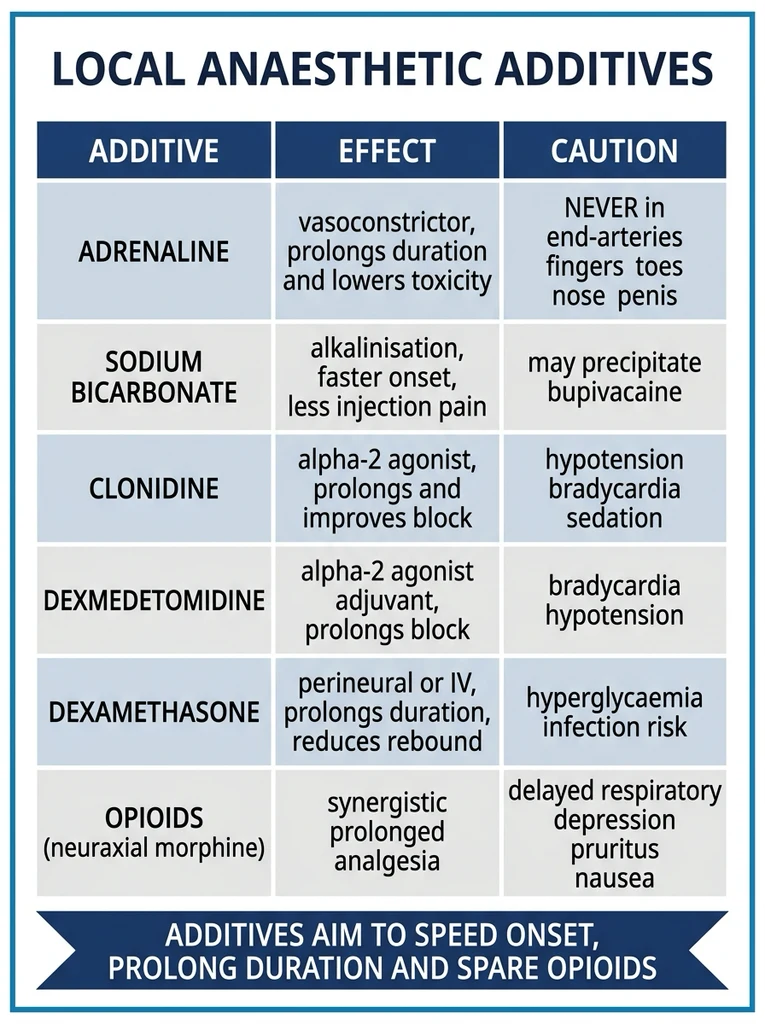
Summary comparison of additives
A working comparison of the principal additives, organised by mechanism, principal effect and key caution, helps to consolidate the exam answer: [1]
- Adrenaline (1:200,000) — vasoconstrictor; prolongs duration, lowers peak plasma level; never use in end-arteries.
- Sodium bicarbonate — alkalinisation; faster onset, less injection pain; precipitates bupivacaine.
- Clonidine — alpha-2 agonist; prolongs and improves block, opioid-sparing; hypotension, bradycardia, sedation.
- Dexmedetomidine — alpha-2 agonist; similar to clonidine, possibly more potent; same haemodynamic profile.
- Dexamethasone — glucocorticoid; prolongs block, reduces rebound and PONV; perineural off-label in some regions.
- Neuraxial opioids (morphine, diamorphine, fentanyl, sufentanil) — synergistic analgesia; delayed respiratory depression, pruritus, nausea, urinary retention.
- Hyaluronidase — enzyme; enhances tissue spread; mainly ophthalmic; small allergy risk.
- Felypressin — vasopressin analogue; vasoconstriction without cardiac stimulation; dental use with prilocaine. [1]
Current place in practice
Local anaesthetic additives are now an established and expected component of high-quality regional anaesthesia. The trend in contemporary practice is towards ultrasound-guided precision, multimodal opioid-sparing analgesia, and a preference for intravenous over perineural dexamethasone where the evidence shows equivalent benefit with lower risk. Alpha-2 agonists and dexamethasone are the dominant prolongation agents for single-shot peripheral and fascial plane blocks, while neuraxial analgesia combines local anaesthetic with opioid and, selectively, clonidine [1] [3] [5]. The clinician's task is to choose the adjuvant that best fits the block, the patient's comorbidities, and the postoperative monitoring environment.
Clinical
- Standard approach
- Evidence-based
Alternative
- Modified technique
- Risk-benefit
Red flags
[1]References
- [1]Grelowska E, et al. Dexamethasone vs. Dexmedetomidine as Adjuvants to Erector Spinae Plane Block in Total Knee Arthroplasty: A Randomized Double-Blind Controlled Trial J Clin Med, 2026.PMID 42355681
- [2]de Souza PMF, et al. Opioid-sparing analgesia with clonidine versus fentanyl in inguinal hernia repair: a randomized clinical trial Hernia, 2026.PMID 42364024
- [3]Hong B, et al. Consistent analgesic effect of intravenous dexamethasone on rebound pain after brachial plexus block: a causal machine learning approach Korean J Pain, 2026.PMID 42357812
- [4]Ramesh S, et al. Integrated Advanced Monitoring and Target-Controlled Infusion Anesthesia in a Child With Arthrogryposis Multiplex Congenita Cureus, 2026.PMID 42359210
- [5]Chooklin S, et al. In Search of Ideal Analgesia: Classical and Deep Rectus Sheath Block in Laparoscopic Cholecystectomy Local Reg Anesth, 2026.PMID 42358227
- [6]El-Tallawy SN, et al. Postoperative Pain Outcomes and Satisfaction in Preschool Versus School-Age Children: A Prospective Multicenter Observational Study Cureus, 2026.PMID 42338860