Anaes · Local anaesthetic pharmacology
Local anaesthetic agents compared
Also known as Lidocaine bupivacaine ropivacaine comparison · Amide local anaesthetic head-to-head · Levobupivacaine and ropivacaine (safer S-enantiomers) · Local anaesthetic cardiotoxicity ranking
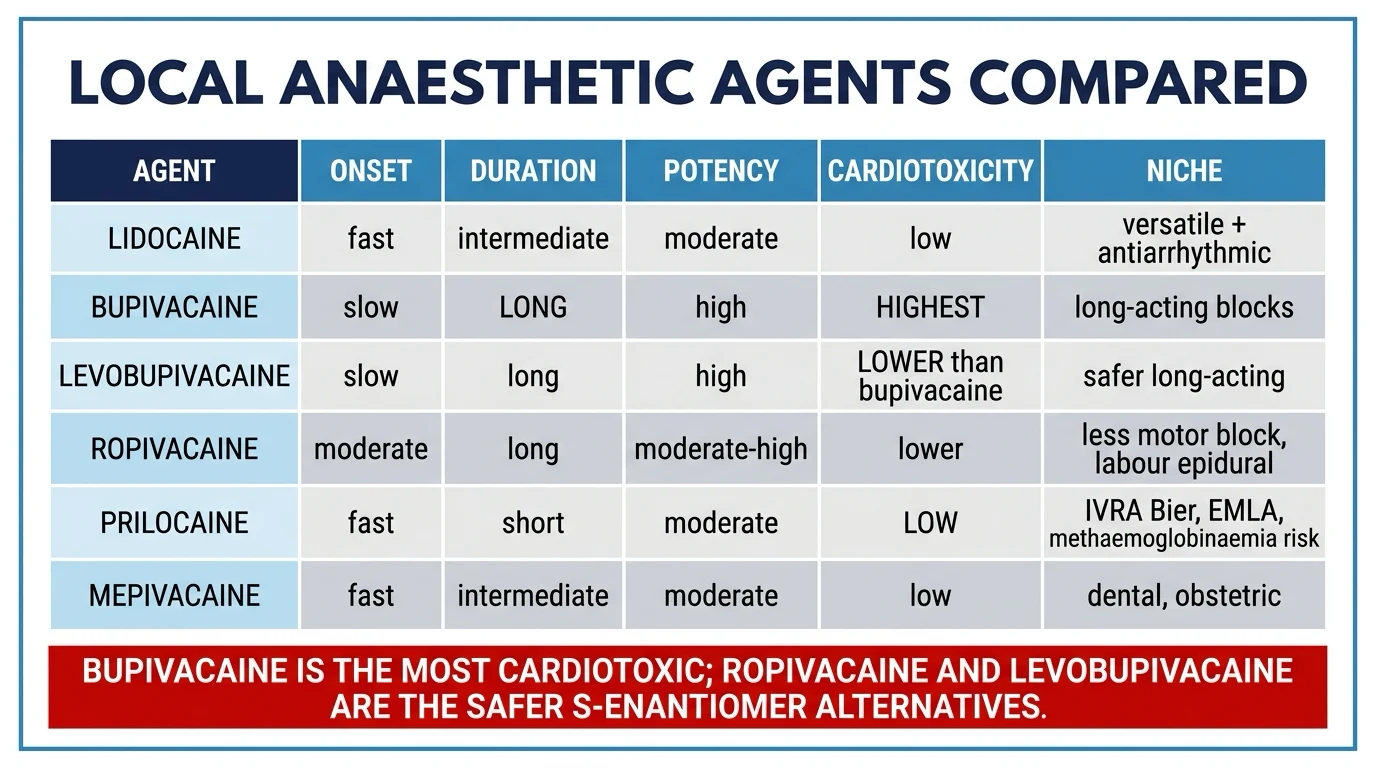
The amide local anaesthetics differ in onset, duration, potency and cardiotoxicity, and these four properties drive every exam answer on agent selection. Lidocaine (lignocaine) is the fast-onset, intermediate-duration versatile all-rounder and also a class Ib antiarrhythmic, validated as a benchmark topical and infiltration agent by Shao et al. (2026) and Majewska et al. (2026). Bupivacaine is long-acting and potent but is the MOST CARDIOTOXIC amide, with a racemic formulation whose R(+)-enantiomer drives refractory ventricular arrhythmia (Robinson et al., 2026). Levobupivacaine and ropivacaine are the pure S-enantiomer alternatives that retain long duration with less cardiotoxicity, and ropivacaine additionally produces less motor block at low concentration, valued in labour epidural analgesia (Stojanovic et al., 2026; Cao et al., 2026; Grelowska et al., 2026). Prilocaine is short-acting and the least toxic per unit potency but causes methaemoglobinaemia via its o-toluidine metabolite, treated with methylene blue (Shao, Majewska). The cardiotoxicity ranking is bupivacaine greater than levobupivacaine or ropivacaine greater than lidocaine or prilocaine.
On this page & tools
Your progress
Saved locally on this device.
8 MCQs with explanations
Target exams
Red flags
Overview
The clinically useful amide local anaesthetics — lidocaine, bupivacaine, levobupivacaine, ropivacaine, prilocaine and mepivacaine — share the same mechanism of action: reversible blockade of voltage-gated sodium channels on nerve axons, preventing the generation and conduction of the action potential. What distinguishes them at the exam bedside is a small set of structure-activity differences that translate, with high predictability, into four clinically observable properties: onset, duration, potency and systemic toxicity. Master these four axes and the choice of agent for any given block follows directly. Recent comparative pharmaceutical work on lidocaine and prilocaine creams by Shao et al. (2026) and the head-to-head topical comparison of lidocaine-tetracaine against lidocaine-prilocaine by Majewska et al. (2026) re-illustrate how even close pharmacological cousins differ in formulation behaviour and clinical effect [2][3].
Three ideas anchor the topic. First, lipid solubility (and thus potency) and protein binding rise together, and both track duration: the more lipid-soluble agents (bupivacaine, ropivacaine) bind more tightly to the channel and to plasma proteins, stay longer at the nerve and act longer. Second, the pKa governs onset: agents with a pKa closer to physiological pH exist more in the uncharged, membrane-permeant base form at tissue pH, so a pKa near 7.9 (lidocaine, mepivacaine, prilocaine) gives fast onset while a pKa near 8.1 (bupivacaine) slows onset. Third — and most heavily examined — cardiotoxicity tracks lipid solubility but is powerfully modulated by stereochemistry: the long-acting, highly lipid-soluble agents are the most dangerous to the heart, and the R(+) enantiomer of bupivacaine is disproportionately responsible [4].
Lidocaine (lignocaine)
Lidocaine is the benchmark amide against which the others are measured and the most versatile agent in the class. It is an amide with a pKa of about 7.9, so a large fraction is in the uncharged base form at tissue pH, giving a FAST onset of action. Its duration is intermediate, typically 1 to 2 hours for infiltration and peripheral nerve block, reflecting moderate lipid solubility and protein binding. Potency is moderate. The maximum recommended doses are 3 mg per kg plain and 7 mg per kg when combined with adrenaline, the adrenaline-induced vasoconstriction slowing systemic absorption and prolonging both duration and the safety margin. Lidocaine is genuinely a jack-of-all-trades: infiltration, topical anaesthesia (mucous membranes and, as EMLA, intact skin), intravenous regional anaesthesia (Bier's block), peripheral nerve block, and epidural anaesthesia all fall within its range [2][3].
Uniquely among the local anaesthetics, lidocaine is also a class Ib antiarrhythmic. The same sodium-channel blockade that interrupts nerve conduction shortens the action potential duration and suppresses ventricular ectopy in cardiac tissue, which is why intravenous lidocaine is used for ventricular arrhythmias. The dual role is a recurring exam point and carries a practical warning: systemic doses delivered for regional anaesthesia can affect cardiac conduction, and lidocaine should be used cautiously in patients with pre-existing conduction disease. Because it is fast, reliable, familiar and reversible, lidocaine remains the all-rounder against which Shao et al. (2026) standardised their lidocaine and prilocaine cream equivalence work and against which Majewska et al. (2026) compared lidocaine-prilocaine and lidocaine-tetracaine topical preparations [2][3].
Bupivacaine
Bupivacaine is the long-acting, high-potency, high-cardiotoxicity agent of the class. Its pKa of about 8.1 means less drug is in the base form at tissue pH, giving a comparatively SLOW onset. Its high lipid solubility and high (about 95 percent) plasma protein binding produce a LONG duration of action — typically 3 to 8 hours for a peripheral nerve block and even longer for some neuraxial applications. The maximum recommended dose is 2 mg per kg, with no meaningful increment from adrenaline because bupivacaine is already highly protein-bound and tissue-sequestered. It is the workhorse for long-acting neuraxial and major peripheral nerve block, and modern long-acting formulations such as the liposomal bupivacaine described by Robinson et al. (2026) for nail procedures extend its duration further by slow release from lipid vehicles [4].
The dominant exam fact about bupivacaine is its cardiotoxicity. It is the MOST cardiotoxic local anaesthetic in clinical use. Bupivacaine is formulated as a racemate — an equal mixture of R(+) and S(-) enantiomers — and the dangerous cardiotoxicity resides mainly in the R(+) enantiomer, which binds cardiac sodium channels with high affinity and dissociates slowly, producing prolonged conduction blockade. The clinical signature is local-anaesthetic systemic toxicity (LAST) that progresses to refractory ventricular arrhythmia and circulatory arrest, often resistant to standard resuscitation. The treatment is intravenous lipid emulsion (1.5 mL per kg bolus of 20 percent lipid, repeated or infused), which sequesters the drug in a lipid plasma compartment and draws it away from cardiac tissue, alongside standard ACLS modified to avoid high-dose vasopressin and to use small boluses of adrenaline. The toxicity problem, and the recognition that it is stereochemically driven, is the entire rationale for the S-enantiomer agents discussed next [4].
Levobupivacaine
Levobupivacaine is the pure S(-) enantiomer of bupivacaine. Because potency and duration are properties of the molecule as a whole and not of one enantiomer, levobupivacaine preserves bupivacaine's long duration and high potency: onset is slow, duration is 3 to 8 hours, and the maximum recommended dose is 2 mg per kg. The decisive difference is in the heart. Removing the R(+) enantiomer lowers the cardiotoxicity: levobupivacaine produces less depression of cardiac conduction and contractility than racemic bupivacaine, and the dose required to produce malignant arrhythmia is higher. In animal and isolated-tissue work the ratio of the dose causing cardiovascular collapse to the dose causing CNS toxicity (the CC/CNS ratio) is more favourable for levobupivacaine than for bupivacaine, giving a wider margin before the heart is affected [5].
Clinically, levobupivacaine is the safer long-acting substitute for racemic bupivacaine in neuraxial and major peripheral nerve block where prolonged analgesia is wanted and an accidental intravascular injection is possible. Its place in elderly and frail practice is illustrated by Cao et al. (2026), who studied continuous fascia iliaca compartment block with a long-acting amide in elderly hip-fracture patients and weighed the analgesic benefit against systemic and cognitive effects such as postoperative delirium [5]. The take-home message is simple: when a long block is needed, prefer the S-enantiomer.
Ropivacaine
Ropivacaine is the other pure S-enantiomer long-acting amide, a structural relative of bupivacaine in which the butyl group on the nitrogen is replaced by a propyl group (ropivacaine is the propyl analogue of bupivacaine). That single-carbon-shorter side chain slightly lowers lipid solubility compared with bupivacaine, which has two practical consequences. First, ropivacaine is marginally LESS POTENT than bupivacaine, so for an equivalent effect a modestly higher concentration or volume is sometimes used. Second, and more usefully, ropivacaine produces LESS MOTOR BLOCK at low concentration, giving a sensory-motor differential that is valued in labour epidural analgesia, where dilute ropivacaine (commonly about 2 mg per mL) provides analgesia while preserving maternal mobility and the ability to push. The duration is intermediate-to-long and the maximum recommended dose is 3 to 3.5 mg per kg [1][6].
Like levobupivacaine, ropivacaine was explicitly developed to reduce cardiotoxicity, and in head-to-head work it is less cardiotoxic than racemic bupivacaine, with less depression of cardiac conduction and a lower risk of refractory arrhythmia after accidental intravascular injection. It has therefore become the default long-acting amide in obstetric and many regional settings. Its behaviour as a block analgesic with adjuvants continues to be actively studied: Stojanovic et al. (2026) randomised patients to ropivacaine-dexamethasone and measured the salivary cortisol response as a stress marker, while Grelowska et al. (2026) compared dexamethasone with dexmedetomidine as adjuvants to an erector spinae plane block built on an amide local anaesthetic, both studies underscoring ropivacaine's central place in modern truncal and fascial-plane analgesia [1][6].
Prilocaine
Prilocaine is the short-acting amide with a favourable toxicity profile and one signature adverse effect. It has a fast onset and a SHORT duration, with maximum recommended doses of 6 mg per kg plain and 8 mg per kg with adrenaline — higher than lidocaine's because prilocaine is the LEAST TOXIC amide per unit potency. The reason is pharmacokinetic: prilocaine is rapidly metabolised, mainly in the liver but also in the lung, to o-toluidine, and this rapid clearance keeps plasma concentrations low after injection. That property makes prilocaine attractive for intravenous regional anaesthesia (Bier's block), where a large dose is deliberately placed in an isolated limb, and for topical use, where it is paired with lidocaine as EMLA (eutectic mixture of local anaesthetics) for anaesthesia of intact skin. Shao et al. (2026) evaluated the pharmaceutical equivalence of lidocaine and prilocaine creams, and Majewska et al. (2026) compared the pain scores of lidocaine-prilocaine against lidocaine-tetracaine topical preparations, both studies turning on prilocaine's role as a topical partner to lidocaine [2][3].
The signature problem is methaemoglobinaemia. The o-toluidine metabolite oxidises the iron in haemoglobin from the ferrous (Fe2+) to the ferric (Fe3+) state, forming methaemoglobin, which cannot bind oxygen. The patient looks cyanosed, pulse oximetry reads low, and the saturation does not improve with supplemental oxygen because the problem is not oxygen delivery but oxygen carrying-capacity. The classic clue is chocolate-brown blood and a pulse-oximetry reading that drifts toward about 85 percent and plateaus. The treatment is methylene blue, 1 to 2 mg per kg intravenously, which acts as an electron donor to reduce methaemoglobin back to haemoglobin via NADPH-methaemoglobin reductase. Because of this risk, prilocaine is avoided in infants and in patients with congenital methaemoglobinaemia or glucose-6-phosphate dehydrogenase deficiency (in whom methylene blue is itself haemolytic and contraindicated). Doses should be totalled across all routes [2][3].
Mepivacaine
Mepivacaine is pharmacologically a close cousin of lidocaine and is best remembered as lidocaine with one useful tweak. It is an amide with a fast onset and a slightly longer duration than lidocaine, and it produces LESS intrinsic vasodilatation, so it is effective as a plain solution without adrenaline — useful when adrenaline is undesirable (for example, in digits or in patients in whom vasoconstriction is hazardous). Maximum recommended doses are 5 mg per kg plain and 7 mg per kg with adrenaline. Mepivacaine's main clinical homes are dental practice and obstetric analgesia, although its ready placental transfer — it crosses to the fetus efficiently and, unlike bupivacaine, is not preferentially ion-trapped — makes it less ideal in obstetrics than the alternatives when a long block is wanted, and it has largely ceded obstetric use to ropivacaine and levobupivacaine. [1]
Other agents
Two further amides round out the list and are worth a sentence each. Etidocaine is a long-acting amide analogue of lidocaine that produces profound and prolonged motor block, an unfavourable profile that has largely removed it from practice — patients prefer an analgesic block that spares motor function, and ropivacaine and levobupivacaine do this better. Articaine is an unusual amide that carries both an amide linkage and an ester side-chain; it is metabolised by both plasma esterases and hepatic routes, has a fast onset, and is very widely used in dentistry, where its rapid hydrolysis contributes to a clean recovery. Articaine is generally treated alongside the amides in exam answers but its dual metabolism is the differentiator to mention. [1]
The cardiotoxicity ranking
The single most examined fact in this topic is the cardiotoxicity ranking of the amide local anaesthetics. From worst to best it runs: bupivacaine is greater than levobupivacaine and ropivacaine (comparable, both lower) which are greater than lidocaine and prilocaine (lowest). The mechanism is stereochemically driven: bupivacaine's R(+) enantiomer binds and dissociates slowly from cardiac sodium channels, producing persistent conduction blockade, QRS widening, refractory ventricular arrhythmia and circulatory collapse. Removing the R(+) enantiomer — the whole point of levobupivacaine and ropivacaine — attenuates this, and the lower lipid solubility of ropivacaine attenuates it further still [4].
The clinical correlate is twofold. First, when a long-acting block is required, prefer levobupivacaine or ropivacaine over racemic bupivacaine; the duration is essentially preserved while the margin of safety widens. Second, when LAST does occur — most often after an accidental intravascular injection of a large bupivacaine dose — the treatment is intravenous lipid emulsion. The 20 percent lipid emulsion is given as a 1.5 mL per kg bolus, repeated once if needed, followed by an infusion of 0.25 mL per kg per minute, and it works by partitioning the lipophilic drug out of the myocardium into an expanded lipid plasma compartment (the "lipid sink"). Standard ACLS is run in parallel, with care to avoid vasopressin and to use small boluses of adrenaline, which can worsen bupivacaine-induced arrhythmia in high doses [4][5].
Potency, onset and duration compared (structure-activity recap)
A compact structure-activity recap ties the agents together. POTENCY tracks lipid solubility: more lipid-soluble agents partition more readily into the nerve membrane and bind the sodium channel more tightly, so bupivacaine (and levobupivacaine) is the most potent, ropivacaine is slightly less potent, and lidocaine, mepivacaine and prilocaine are the least potent. ONSET tracks pKa: agents whose pKa is close to physiological pH have more drug in the uncharged base form that crosses the nerve membrane, so lidocaine, mepivacaine and prilocaine (pKa about 7.9) have fast onset while bupivacaine and ropivacaine (pKa about 8.1) are slower. DURATION tracks protein binding and tissue sequestration: highly protein-bound agents such as bupivacaine, levobupivacaine and ropivacaine persist at the nerve longest (3 to 8 hours), while lidocaine, mepivacaine and prilocaine are shorter (1 to 3 hours). Adrenaline prolongs duration and lowers peak plasma concentration for all agents by inducing vasoconstriction, but the effect is largest for the shorter-acting, more vasodilating agents (lidocaine, prilocaine) and smallest for the already highly protein-bound bupivacaine. [1]
Clinical selection by procedure
Agent selection follows directly from the four axes. For SHORT procedures needing reliable, fast anaesthesia — skin infiltration, short incision and drainage, brief peripheral nerve block — lidocaine (3 mg per kg plain, 7 mg per kg with adrenaline) or prilocaine are the natural choices, lidocaine for versatility and prilocaine when a larger mass of drug is needed with the lowest systemic toxicity. For TOPICAL anaesthesia of intact skin, the lidocaine-prilocaine eutectic mixture (EMLA) validated by Shao et al. (2026) and compared by Majewska et al. (2026) remains the standard, with lidocaine-tetracaine as an alternative [2][3]. For intravenous regional anaesthesia (Bier's block), prilocaine is traditional (low toxicity, short duration) and lidocaine is a common alternative.
For LONG-ACTING blocks — neuraxial, major peripheral nerve block, fascial-plane and truncal block — prefer levobupivacaine or ropivacaine over racemic bupivacaine for the safer cardiotoxicity profile, accepting bupivacaine (or its liposomal formulation, Robinson et al., 2026) only when the long duration is the dominant requirement and the risk of intravascular injection is controlled [4][5]. Cao et al. (2026) illustrate the elderly and frail context, where continuous fascia iliaca block with a long-acting amide must be balanced against systemic and cognitive effects [5]. For LABOUR EPIDURAL ANALGESIA, dilute ropivacaine is the modern default because its sensory-motor differential gives analgesia with preserved mobility, and Grelowska et al. (2026) and Stojanovic et al. (2026) show how adjuvants such as dexamethasone and dexmedetomidine are added to ropivacaine-based blocks to extend duration and lower the required local-anaesthetic mass [1][6].
Summary comparison table
A working summary of the six core agents, suitable for exam recall: [1]
- Lidocaine — onset FAST, duration 1 to 2 hours (intermediate), potency MODERATE, dose 3 mg per kg plain or 7 mg per kg with adrenaline, toxicity LOW, special feature class Ib antiarrhythmic; the versatile all-rounder.
- Bupivacaine — onset SLOW, duration 3 to 8 hours (long), potency HIGH, dose 2 mg per kg, toxicity HIGHEST (racemic, R(+) cardiotoxic), use long-acting neuraxial and major nerve block; treat LAST with lipid emulsion.
- Levobupivacaine — onset SLOW, duration 3 to 8 hours (long), potency HIGH, dose 2 mg per kg, toxicity LOWER than bupivacaine (pure S(-) enantiomer); the safer long-acting substitute.
- Ropivacaine — onset SLOW to intermediate, duration intermediate-to-long, potency slightly less than bupivacaine, dose 3 to 3.5 mg per kg, toxicity LOWER than bupivacaine (pure S-enantiomer), LESS MOTOR BLOCK at low concentration; default for labour epidural and modern fascial-plane blocks.
- Prilocaine — onset FAST, duration SHORT, potency MODERATE, dose 6 mg per kg plain or 8 mg per kg with adrenaline, toxicity LOWEST per potency but causes METHEMOGLOBINAEMIA (treat with methylene blue); used for Bier's block and as EMLA.
- Mepivacaine — onset FAST, duration slightly longer than lidocaine, potency MODERATE, dose 5 mg per kg plain or 7 mg per kg with adrenaline, toxicity LOW, effective plain (little intrinsic vasodilatation); dental and obstetric use, crosses placenta readily. [1]
Current place in practice
In contemporary practice the long-acting racemate bupivacaine is being steadily displaced by its safer S-enantiomer alternatives, levobupivacaine and ropivacaine, for any block in which an accidental intravascular injection is possible, while lidocaine and prilocaine retain the short-acting and topical niches. The driving force is the cardiotoxicity ranking — bupivacaine worst, then the S-enantiomers, then lidocaine and prilocaine — combined with the availability of intravenous lipid emulsion as rescue and the ongoing refinement of slow-release formulations such as liposomal bupivacaine [4]. Adjuvant strategies, exemplified by the dexamethasone and dexmedetomidine work of Stojanovic et al. (2026) and Grelowska et al. (2026), increasingly accompany the long-acting amides to extend analgesia and lower total local-anaesthetic dose, and the elderly-focused continuous fascia iliaca block study of Cao et al. (2026) shows the agents being deployed where systemic and cognitive effects must be weighed as carefully as analgesic duration [1][5][6]. For exam purposes the message is stable: know the four axes, know the cardiotoxicity ranking, know that the S-enantiomers are the safer long-acting substitutes, and never forget prilocaine's methaemoglobinaemia.
Clinical
- Standard approach
- Evidence-based
Alternative
- Modified technique
- Risk-benefit
Red flags
[1]References
- [1]Stojanovic SM, et al. Salivary Cortisol Response After Ropivacaine-Dexamethasone Administration: A Randomized Clinical Trial Pharmaceuticals (Basel), 2026.PMID 42356547
- [2]Shao P, et al. Evaluation of the Pharmaceutical Equivalence of Lidocaine and Prilocaine Creams Pharmaceutics, 2026.PMID 42357323
- [3]Majewska L, et al. Pain Scores Associated with Lidocaine-Tetracaine Versus Lidocaine-Prilocaine Topical Anesthesia During Facial and Cervical Microneedling: A Retrospective Single-Center Observational Analysis Medicina (Kaunas), 2026.PMID 42356039
- [4]Robinson C, et al. A novel utilization of liposomal bupivacaine in nail procedures J Am Acad Dermatol, 2026.PMID 42361907
- [5]Cao L, et al. Postoperative Delirium Following Continuous Fascia Iliaca Compartment Block in Elderly Patients with Hip Fracture: A Case Series and Literature Review Local Reg Anesth, 2026.PMID 42326841
- [6]Grelowska E, et al. Dexamethasone vs. Dexmedetomidine as Adjuvants to Erector Spinae Plane Block in Total Knee Arthroplasty: A Randomized Double-Blind Controlled Trial J Clin Med, 2026.PMID 42355681