Anaes · Local anaesthetic pharmacology
Local anaesthetic chemistry: amide and ester
Also known as Amide vs ester local anaesthetics · Local anaesthetic structure-activity · Voltage-gated sodium channel blockers
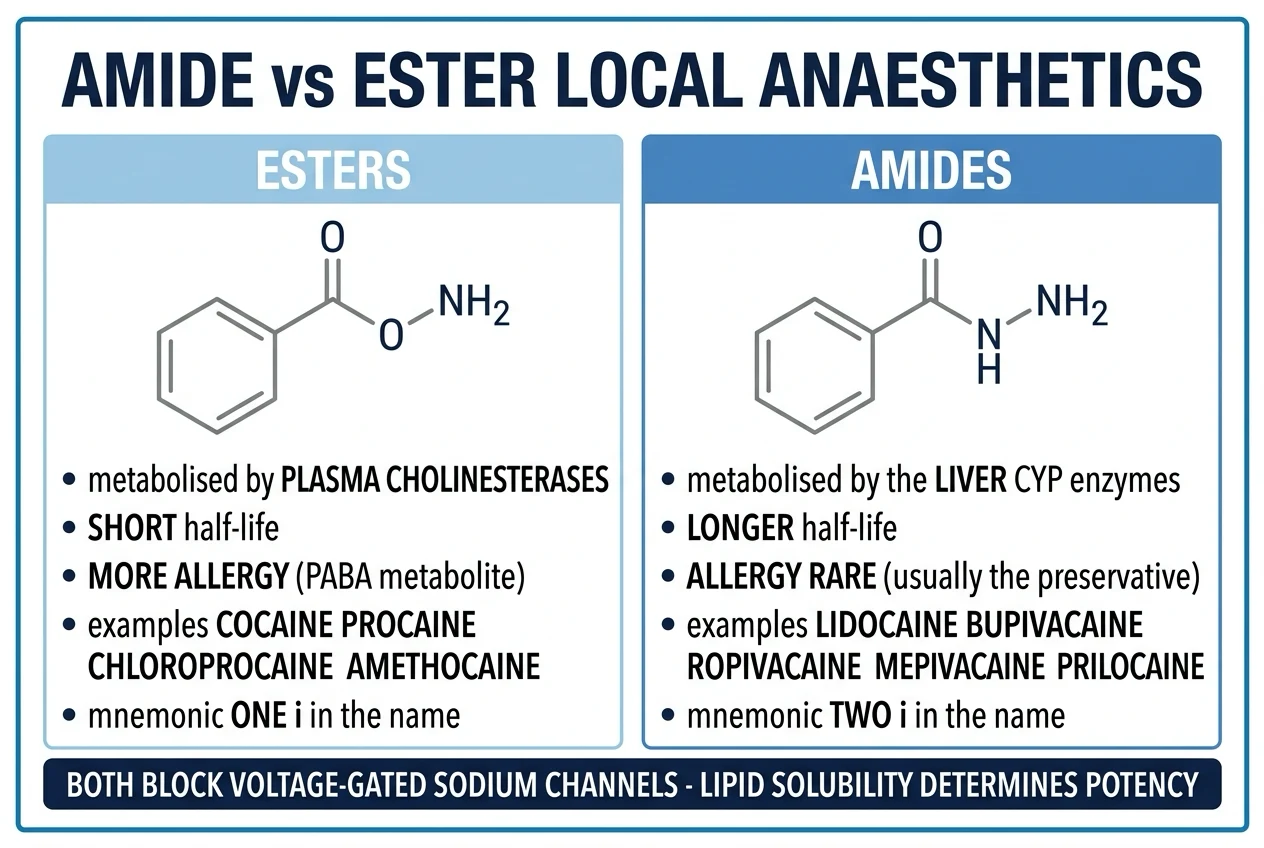
Local anaesthetics reversibly block nerve conduction by inhibiting voltage-gated sodium channels in a use-dependent fashion, and every agent shares a three-part structure (a lipophilic aromatic ring, an ester or amide linkage, and a hydrophilic tertiary amine) that classifies it as an ESTER (cocaine, procaine, chloroprocaine, amethocaine), metabolised by plasma cholinesterases to para-aminobenzoate (PABA) and so carrying a higher allergy risk, or an AMIDE (lidocaine, bupivacaine, ropivacaine, prilocaine), metabolised by hepatic CYP450 enzymes with rare true allergy. They are weak bases (pKa about 7.6 to 8.9): the un-ionised lipid-soluble form crosses the nerve membrane and the ionised form binds the channel from inside, so onset depends on pKa and tissue pH and is reduced in inflamed or acidotic tissue (ion trapping). Potency tracks lipid solubility and duration tracks protein binding, so bupivacaine is potent and long-acting while lidocaine has a faster onset. Small myelinated and unmyelinated sensory fibres block before large motor fibres, and adrenaline prolongs duration (but must be avoided in end-arterial territories). These fundamentals are reinforced by the recent reviews of Galata (2026) on LA hypersensitivity, Little (2026) on local-only anaesthesia, Copur (2026) on LA dosing, Ogu (2026) on bupivacaine formulation, Chooklin (2026) on LA clinical use and de Souza (2026) on regional analgesia adjuvants.
On this page & tools
Your progress
Saved locally on this device.
8 MCQs with explanations
Target exams
Red flags

Overview
Local anaesthetics are drugs that produce reversible loss of sensation in a restricted region of the body by blocking nerve conduction. They are among the most frequently administered drugs in anaesthetic practice, used for topical, infiltration, field block, peripheral nerve block, neuraxial (spinal and epidural) and intravenous regional anaesthesia [4]. Their clinical role in providing opioid-sparing analgesia continues to grow: Chooklin and colleagues (2026) illustrate their place in abdominal-wall blocks for laparoscopic surgery, and de Souza and colleagues (2026) place regional local-anaesthetic techniques within multimodal, opioid-sparing pathways [2][6].
Although the clinical agents are numerous, all share a single mechanism and a single basic chemistry. Understanding that chemistry explains why some agents are short-acting and others long-acting, why some are more prone to allergy, why onset differs between drugs, and why local anaesthetics fail in inflamed tissue [4].
Mechanism of action: voltage-gated sodium channel block
Local anaesthetics reversibly block nerve conduction by inhibiting voltage-gated sodium channels (VGSC, NaV channels). They bind to a specific receptor site on the inner (intracellular) face of the channel's alpha subunit, preventing the sodium influx that underlies the upstroke of the action potential [2][4]. With sodium entry blocked, the nerve can no longer depolarise and conduction fails.
Binding is state-dependent. Local anaesthetics bind preferentially to the open and inactivated states of the channel rather than the resting state, which produces use-dependent (frequency-dependent) block: the more rapidly a nerve fires, the more channels pass through the open and inactivated states and the more drug binds [2]. This is why local anaesthetics preferentially block rapidly firing nociceptive fibres and why the block deepens over the first few minutes after injection. Recovery occurs as the drug dissociates and the concentration at the channel falls.
The three-part chemical structure
Every local anaesthetic molecule has the same three components [4]:
- A lipophilic aromatic ring, usually a substituted benzene ring, which confers lipid solubility and allows the drug to partition into nerve membranes.
- An intermediate linkage, which is either an ester bond or an amide bond. This single bond is the basis of the ester versus amide classification of local anaesthetics.
- A hydrophilic tertiary (usually) amine, which can accept a proton to become a positively charged quaternary ammonium ion and which is responsible for binding the sodium channel from inside the nerve. [1]
The lipophilic-hydrophilic balance is essential: a molecule must be lipid-soluble enough to reach the nerve membrane and cross it, but must then form the water-soluble ionised species that actually blocks the channel. Substituents on the aromatic ring and amine tune this balance and give each agent its distinct pharmacology. [1]
Weak-base ionisation and onset
Local anaesthetics are weak bases with a pKa in the range of about 7.6 to 8.9. In solution they exist in equilibrium between an un-ionised free base (conventionally written B), which is lipid-soluble, and an ionised conjugate acid (BH+), which is water-soluble [5][4]. Only the un-ionised form can cross the lipid nerve membrane. Once inside the axon, the drug re-equilibrates and the ionised form binds the sodium channel from the intracellular side.
The proportion of drug in the un-ionised form at physiological pH is governed by the Henderson-Hasselbalch relationship, so onset of action depends on both the drug's pKa and the tissue pH [5]. A drug whose pKa is close to body pH (about 7.4) will have a larger fraction un-ionised at the injection site and so will penetrate nerve membrane more rapidly. Because only the un-ionised form diffuses in, a high pKa slows onset even though the total dose is the same.
Ester local anaesthetics
Ester local anaesthetics have an ester linkage between the aromatic ring and the amine. They are hydrolysed in plasma by plasma cholinesterases (pseudocholinesterase, butyrylcholinesterase), giving rapid breakdown, a short plasma half-life and water-soluble metabolites [1][4]. The rate of hydrolysis is fast, which limits systemic toxicity but also shortens duration.
A key metabolite of ester hydrolysis is para-aminobenzoate (PABA), which is highly antigenic and accounts for the higher allergy risk of ester local anaesthetics [1]. Galata and colleagues (2026), in a retrospective review of suspected local-anaesthetic hypersensitivity, emphasise that ester agents and their PABA metabolites are disproportionately represented among true (immunologically mediated) local-anaesthetic reactions, whereas suspected reactions to amides are frequently not allergic at all [1].
Representative ester agents include cocaine, procaine, chloroprocaine, amethocaine (tetracaine) and benzocaine. A useful mnemonic is that the generic name of an ester contains only one letter "i" (for example, procaine, amethocaine), whereas amide names contain two [4]. Patients with a genuine ester allergy can usually receive an amide safely.
Amide local anaesthetics
Amide local anaesthetics have an amide linkage and are metabolised in the liver by cytochrome P450 microsomal enzymes, principally by N-dealkylation of the amine and aromatic hydroxylation followed by conjugation [1][4]. Hepatic metabolism is slower than plasma esterase hydrolysis, so amides have a longer plasma half-life and a correspondingly higher risk of accumulation and systemic toxicity with repeated dosing or infusion. Liver disease, low cardiac output state, and reduced hepatic blood flow all prolong amide clearance.
True allergy to amide local anaesthetics is rare. Most reactions attributed to "lidocaine allergy" are either vasovagal, toxic, or reactions to an added preservative (methylparaben) or antioxidant (sodium metabisulphite, found in preparations that contain adrenaline) rather than to the amide itself [1]. When a genuine amide allergy is confirmed, switching to an agent without the implicated excipient, or to a different amide, is usually possible; cross-reactivity between amides is low.
Representative amide agents include lidocaine (lignocaine), bupivacaine, levobupivacaine, ropivacaine, mepivacaine, prilocaine, etidocaine and articaine. The mnemonic is that the generic name of an amide contains two letter "i"s (for example, l-i-doca-i-ne, bup-i-va-i-caine) [4]. Articaine is unusual in carrying both a thiophene ring and an ester group that allows partial plasma hydrolysis, giving it a rapid offset despite its amide classification.
Structure-activity relationships
Three physicochemical properties map onto three clinically important outcomes [3][5][4]:
- Lipid solubility determines potency. A more lipid-soluble agent partitions more readily into nerve membrane, reaches the channel receptor at a lower external concentration, and is therefore more potent. Lipid solubility correlates strongly with protein binding, so the most lipid-soluble agents are also the most highly protein-bound.
- Protein binding determines duration. Agents that bind plasma and tissue proteins (chiefly alpha-1-acid glycoprotein and albumin) are retained at the site of injection for longer, prolonging the block.
- The pKa determines onset. As discussed above, an agent with a pKa close to physiological pH has more un-ionised drug available to cross the membrane and so has a faster onset. [1]
These principles explain the clinically important contrasts. Bupivacaine is highly lipid-soluble and highly protein-bound, so it is potent and long-acting; its slow onset reflects a relatively high pKa and tight tissue binding [3]. The liposomal bupivacaine formulations examined by Ogu and colleagues (2026) exploit this prolonged binding to extend analgesia further [3]. Lidocaine has lower lipid solubility and a pKa about 7.9, giving it a faster onset but a shorter duration. Ropivacaine and levobupivacaine are S-enantiomer preparations developed to retain bupivacaine-like duration while reducing cardiac and CNS toxicity.
Inflammation and acidosis reduce efficacy
Local anaesthetics are less effective in inflamed or infected (acidotic) tissue, a phenomenon known as ion trapping [5][4]. Inflamed tissue has a low pH, which shifts the weak-base equilibrium toward the ionised (BH+) form. Because only the un-ionised form crosses the nerve membrane, less active drug reaches the intracellular channel receptor and the block is poor or fails. This is why injecting into a frankly infected area (for example, a dental abscess) often produces inadequate anaesthesia, and why increasing the dose or volume does not reliably overcome the problem. Copur and colleagues (2026), examining the relationship between local-anaesthetic dose and optic nerve sheath diameter as a marker of systemic effect, underline how dose and tissue conditions jointly determine both efficacy and systemic absorption [5].
Differential nerve-fibre block
Local anaesthetics block small nerve fibres before large ones, producing a differential block [2]. Small myelinated B fibres (preganglionic autonomic) and small myelinated A-delta and small unmyelinated C fibres (pain and temperature) are blocked before the large myelinated A-alpha motor fibres. At low concentrations, therefore, sensory and autonomic block exceed motor block, which is the basis for using low-concentration infusions (for example ropivacaine 0.2 per cent) to provide analgesia while preserving motor function [2]. The order of block is typically autonomic, then pain and temperature, then touch and pressure, then motor; recovery occurs in the reverse order.
The use-dependent mechanism contributes to this differential effect, because nociceptive C fibres fire at high frequencies and so present more open and inactivated channels for the drug to bind. Myelination also matters: the drug must reach the nodes of Ranvier in myelinated fibres, so small fibres with closely spaced nodes are blocked at lower concentrations than large fibres with widely spaced nodes. [1]
Additives: adrenaline and bicarbonate
Two additives are in routine use [6][2]. Adrenaline (epinephrine), usually in a concentration of 1 in 200,000 (5 micrograms per millilitre), is a vasoconstrictor that reduces systemic absorption of the local anaesthetic, lowers peak plasma concentration and so reduces systemic toxicity, and prolongs duration by retaining the drug at the injection site. De Souza and colleagues (2026) place vasoconstrictor-containing local anaesthesia within the broader context of adjuvant strategies for opioid-sparing regional analgesia [6].
Adrenaline must never be used in end-arterial territories (fingers, toes, nose, penis, earlobe), because vasoconstriction of an end artery with no collateral supply can cause irreversible tissue ischaemia and necrosis. Concerns about adrenaline in these territories have softened in recent years with the use of very dilute concentrations, but the traditional contraindication remains an exam-critical safety point. [1]
Sodium bicarbonate is added to alkalinise the solution. Raising the pH toward the drug's pKa increases the fraction in the un-ionised form, which speeds onset and reduces the pain of injection (commercial preparations are acidic to improve shelf-stability). Over-alkalinisation risks precipitation, so only small volumes of bicarbonate are added. [1]
Systemic toxicity (LAST)
Local-anaesthetic systemic toxicity (LAST) is covered in detail in its own topic but is summarised here because it follows directly from the chemistry. Systemic toxicity occurs when peak plasma concentration rises high enough for the drug to block sodium (and other) channels in the brain and heart [3][4]. Early features are CNS toxicity: circumoral tingling, tinnitus, agitation, progressing to loss of consciousness and tonic-clonic seizures. With higher concentrations, cardiovascular toxicity follows: hypotension, conduction block, and cardiac arrest.
Bupivacaine is the most cardiotoxic amide because it binds cardiac sodium channels tightly and dissociates slowly (fast-in, slow-out), producing refractory arrhythmias [3]. Ropivacaine and levobupivacaine were developed to reduce this risk. The specific antidote for established LAST is a 20 per cent intravenous lipid emulsion, which sequesters the lipophilic local anaesthetic from cardiac and CNS tissue (the "lipid sink"). Preventing LAST depends on careful dose calculation, aspiration before injection, fractional injection, ultrasound guidance, and vigilance for early signs [5].
Clinical application and agent choice
The choice of agent balances onset, duration, potency and toxicity profile against the intended block [2][4]. Lidocaine is chosen where a rapid onset and moderate duration are needed (infiltration, short peripheral nerve block); prilocaine is used for intravenous regional anaesthesia (Bier's block) because of its rapid metabolism and lower systemic toxicity, though it can cause methaemoglobinaemia. Bupivacaine, levobupivacaine and ropivacaine are preferred for long-acting analgesia (epidural, paravertebral, abdominal-wall blocks such as the rectus sheath block described by Chooklin, 2026) [2]. Chloroprocaine, an ester with extremely rapid plasma hydrolysis, is increasingly used for short-duration spinal and epidural anaesthesia where a quick offset is desirable [4]. Liposomal bupivacaine extends the duration of infiltration analgesia, as studied by Ogu and colleagues (2026) [3].
Comparison summary: amide versus ester
| Feature | Ester local anaesthetics | Amide local anaesthetics |
|---|---|---|
| Linkage | Ester bond | Amide bond |
| Metabolism | Plasma cholinesterase (pseudocholinesterase) | Hepatic CYP450 (N-dealkylation, hydroxylation) |
| Half-life | Short (rapid hydrolysis) | Longer |
| Allergy risk | Higher (PABA metabolite) | Rare (reactions usually to preservative or antioxidant) |
| Examples | Cocaine, procaine, chloroprocaine, amethocaine, benzocaine | Lidocaine, bupivacaine, levobupivacaine, ropivacaine, mepivacaine, prilocaine, etidocaine, articaine |
| Mnemonic | One "i" in the name | Two "i"s in the name |
| Stability | Less stable in solution; heat-sensitive | More stable; can be autoclaved |
Clinical
- Standard approach
- Evidence-based
Alternative
- Modified technique
- Risk-benefit
Red flags
[1]References
- [1]Galata Z, et al. Local anesthetic hypersensitivity: Frequently suspected, rarely proven: A retrospective study of 101 patients Allergy Asthma Proc, 2026.PMID 42343493
- [2]Chooklin S, et al. In Search of Ideal Analgesia: Classical and Deep Rectus Sheath Block in Laparoscopic Cholecystectomy Local Reg Anesth, 2026.PMID 42358227
- [3]Ogu E, et al. The Effect of Liposomal Bupivacaine and Obesity on Postoperative Opioid Consumption in Children With Scoliosis J Pediatr Orthop, 2026.PMID 42351400
- [4]Little K, et al. Guidelines in Practice: Local-Only Anesthesia AORN J, 2026.PMID 42360750
- [5]Copur I, et al. Association Between Local Anesthetic Volume-Dose Combinations and Optic Nerve Sheath Diameter as an Indirect Marker of Intracranial Pressure During Ultrasound-Guided Supraclavicular Brachial Plexus Block: A Randomized Trial Medicina (Kaunas), 2026.PMID 42356116
- [6]de Souza PMF, et al. Opioid-sparing analgesia with clonidine versus fentanyl in inguinal hernia repair: a randomized clinical trial Hernia, 2026.PMID 42364024