Anaes · Local anaesthetic pharmacology
Local anaesthetic pharmacology
Also known as Local anaesthetics · Lidocaine · Bupivacaine · Ropivacaine · LAST · Lipid rescue
Local anaesthetics produce reversible blockade of nerve conduction by binding the voltage-gated sodium channel from inside the axon, preventing the action potential. The framework rests on four exam-critical ideas: the agents are classified as amides or esters by their linking bond (which determines their metabolism — hepatic for amides, plasma-cholinesterase for esters); their onset, potency and duration are governed by their pKa, lipid solubility and protein binding respectively; their systemic toxicity (LAST) progresses from CNS excitation to seizures to cardiovascular collapse, with bupivacaine uniquely cardiotoxic; and the specific antidote for severe LAST is intravenous lipid emulsion, which acts as a lipid sink absorbing the drug. Built on the ASRA LAST checklist (Neal 2021), the lipid-resuscitation mechanism review (Fettiplace & Weinberg 2018), the bupivacaine reference (McAllister 2026), the LAST emergency protocols (Meral 2026), and the geriatric LA toxicity review (Waldinger 2020).
On this page & tools
Your progress
Saved locally on this device.
Target exams
Red flags
Overview & definition
A local anaesthetic is a drug that produces a reversible blockade of nerve conduction by preventing the generation and propagation of the action potential. Applied topically, by infiltration, around a nerve (a peripheral nerve block), or around the spinal cord (neuraxial), they abolish sensation — and, at sufficient concentration, motor power — in a defined region, without the loss of consciousness that general anaesthesia produces. [1]
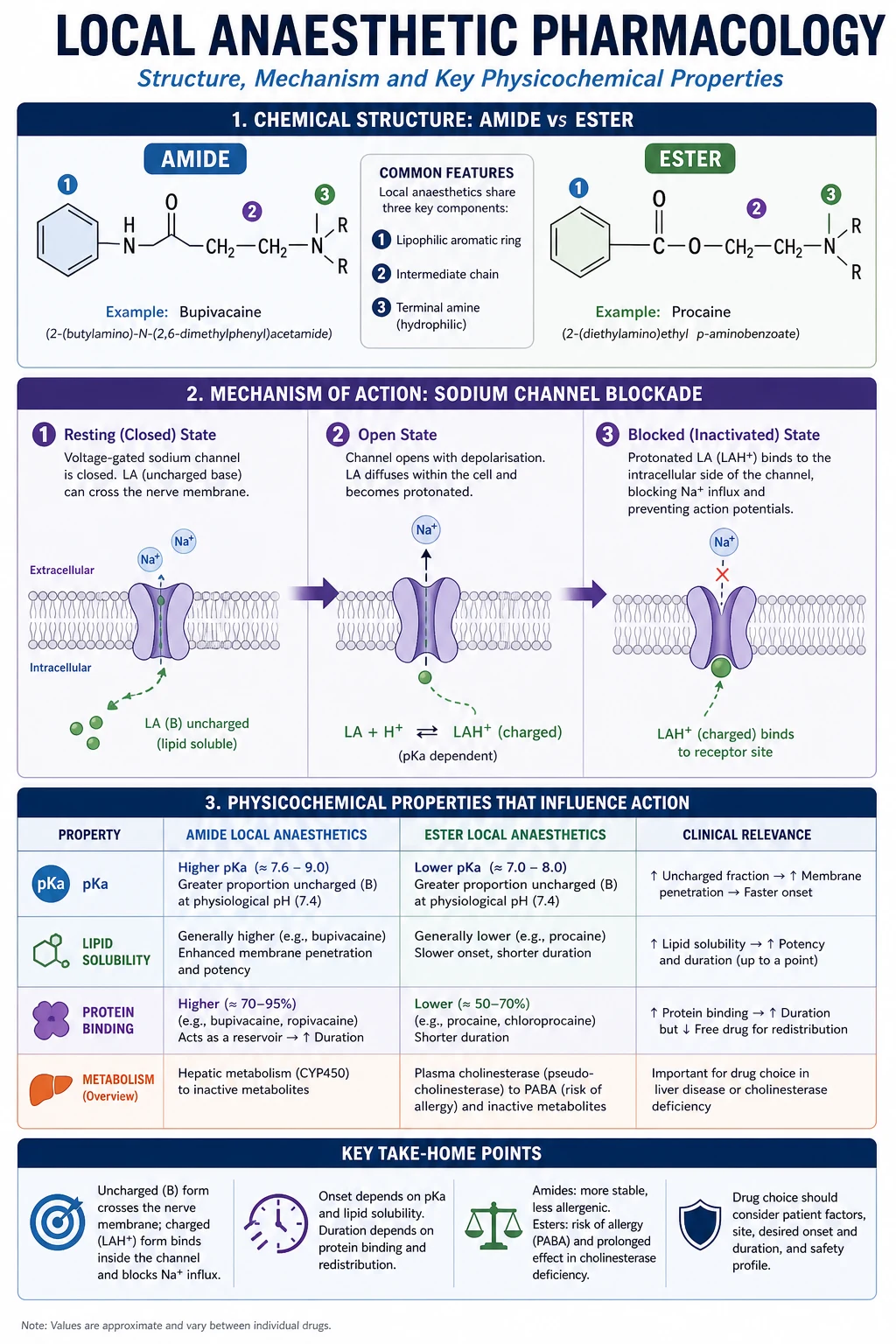
The local anaesthetics are classified by their chemical linkage — amides (lidocaine, bupivacaine, ropivacaine, prilocaine) and esters (procaine, chloroprocaine, tetracaine, cocaine, benzocaine) — a distinction that governs their metabolism, their allergy profile and their stability. They all share the same three-part structure (a lipophilic aromatic ring, an intermediate chain, and a hydrophilic amine), and they all act at the voltage-gated sodium channel, but their onset, potency and duration differ markedly, and their toxicity is the principal safety concern. [1]
Structure: amides and esters — the defining classification
The local anaesthetic molecule has three parts: a lipophilic aromatic ring (which allows it to cross the nerve membrane), an intermediate linking chain (which is either an amide bond or an ester bond — the basis of the classification), and a hydrophilic amine (which is protonated at physiological pH to the active charged form that blocks the channel). [1]
The amides — lidocaine, bupivacaine, ropivacaine, prilocaine, mepivacaine — are metabolised by hepatic microsomal enzymes (cytochrome P450), are stable in solution, and rarely cause true allergy (the allergy is usually to the preservative, not the drug). They are the agents of modern clinical practice. [1]
The esters — procaine, chloroprocaine, tetracaine, cocaine, benzocaine — are metabolised by plasma cholinesterase (rapidly, so a shorter plasma half-life), are unstable in solution, and are more allergenic (they are broken down to para-aminobenzoic acid (PABA), a known allergen). Cocaine is unique among them for its vasoconstrictor and euphoriant properties. [1]
The mnemonic: the amides all have two i's in their name (lidocaine, bupivaccaine, etc.), the esters do not (procaine, chloroprocaine, tetracaine). [1]
Mechanism of action: voltage-gated sodium-channel blockade
A nerve action potential is generated when a stimulus raises the membrane potential to threshold, opening voltage-gated sodium channels in the axonal membrane. Sodium influx depolarises the membrane, the action potential propagates, and the signal travels. The local anaesthetics block this by binding to the inner pore of the voltage-gated sodium channel, physically plugging it, so sodium cannot enter and the action potential cannot rise.[3]
The binding is state-dependent: the local anaesthetic binds more tightly to the open (activated) and inactivated states of the channel than to the resting state. This means that rapidly firing nerves (pain fibres, which fire at high frequency) are blocked preferentially — a property called use-dependent block, which explains why pain is abolished before motor or touch in a differential block. [1]
The drug reaches its binding site from inside the axon — it must cross the lipid membrane first. Only the unionised (base) form can cross the membrane; once inside, it re-equilibrates and the ionised (cation) form binds the channel. This is the basis of the pKa effect on onset (below). [1]
Pharmacokinetics: pKa, onset, lipid solubility and potency
Three physicochemical properties govern the clinical behaviour: [1]
-
pKa (the dissociation constant) determines the speed of onset. At physiological pH (7.4), a drug with a pKa close to 7.4 has more of its molecules in the unionised base form, which crosses the membrane rapidly — so the onset is fast. Lidocaine (pKa 7.9) has a faster onset than bupivacaine (pKa 8.1). The corollary: in acidotic or infected tissue (low pH), more of the drug is ionised, less crosses the membrane, and the block is slow or ineffective — the principle behind "you cannot anaesthetise pus." [1]
-
Lipid solubility (the oil:water partition coefficient) determines potency: the more lipid-soluble the agent, the more readily it crosses the membrane and the more potent it is. Bupivacaine is more lipid-soluble (and potent) than lidocaine. [1]
-
Protein binding determines duration: the more tightly the drug binds to tissue proteins, the longer it stays at the nerve. Bupivacaine (high protein binding) lasts longer than lidocaine (moderate). [1]
The clinical agents
Lidocaine — the prototype amide. Rapid onset (2 to 5 minutes), moderate duration (1 to 2 hours), moderate potency. Used for infiltration, field blocks, intravenous regional anaesthesia (Bier's block), topical (the spray, the gel), and as an antiarrhythmic. Maximum dose: 3 mg/kg plain, 7 mg/kg with adrenaline. [1]
Bupivacaine — the long-acting amide. Slow onset (10 to 15 minutes), long duration (4 to 8 hours), high potency. Used for neuraxial and peripheral nerve blocks where a prolonged block is wanted. Maximum dose: 2 mg/kg. Its tight binding to the cardiac sodium channel makes it uniquely cardiotoxic (below).[3]
Ropivacaine — an S-enantiomer developed as a less cardiotoxic alternative to bupivacaine. Comparable onset and duration but with a higher threshold for cardiac toxicity and a shorter duration at the cardiotoxic dose. Maximum dose: 3 mg/kg. [1]
Prilocaine — an amide with a relatively rapid onset and short duration, less toxic than lidocaine (higher volume of distribution, faster metabolism) — the agent of choice for intravenous regional anaesthesia. Its principal adverse effect is methaemoglobinaemia (below), from its metabolite o-toluidine. [1]
Maximum doses and the weight-based calculation
Every dose of a local anaesthetic must be calculated in milligrams per kilogram before drawing up the syringe — the commonest cause of LAST is a miscalculation or an inadvertent intravascular injection. The standard maximum doses are: [1]
- Lidocaine — 3 mg/kg plain, 7 mg/kg with adrenaline.
- Bupivacaine — 2 mg/kg (with or without adrenaline — the addition of adrenaline does not significantly raise the maximum for bupivacaine).
- Ropivacaine — 3 mg/kg.
- Prilocaine — 6 mg/kg plain. [1]
The dose in milligrams is the concentration (per cent) times the volume (millilitres) times ten — so 20 mL of 0.5 per cent bupivacaine is 100 mg (0.5 x 20 x 10). The dose must be calculated, confirmed and respected for every block. [1]
Local anaesthetic additives: adrenaline, bicarbonate, clonidine
- Adrenaline (1:200,000 or 5 microgram per mL) — added to cause local vasoconstriction, which slows the systemic absorption of the drug, prolongs the block, lowers the peak plasma concentration (reducing toxicity), and allows a higher maximum dose (for lidocaine, from 3 to 7 mg/kg). It must never be used in end-arterial territories (fingers, toes, nose, penis) for fear of ischaemic necrosis.
- Sodium bicarbonate — alkalinises the solution (raises the pH toward the pKa), increasing the unionised fraction and speeding the onset. Useful for infiltration and for reducing the pain of injection.
- Clonidine, dexmedetomidine, opioids — alpha-2 agonists and opioids enhance the quality and the duration of the block when added to neuraxial and peripheral injections, by actions at their own receptors. [1]
Local anaesthetic systemic toxicity: the CNS and cardiac features
LAST is the systemic toxicity of a rising plasma local-anaesthetic concentration, usually from an inadvertent intravascular injection or a true overdose. It progresses through a characteristic sequence.[1]
The CNS features appear first, in a predictable order: a prodrome of perioral tingling, a metallic taste, tinnitus, and agitation — the early warning signs of rising CNS concentration; then twitching and seizures; and ultimately unconsciousness and respiratory arrest. The CNS is first excited, then depressed — the same sequence as other local-anaesthetic effects, reflecting the blockade of inhibitory before excitatory pathways. [1]
The cardiovascular features follow, at higher plasma concentrations: hypertension and tachycardia initially (the sympathetic excitation), then hypotension, conduction block, bradycardia and asystole. Bupivacaine is uniquely dangerous here: its tight binding to the cardiac sodium channel produces a profound, refractory depression of myocardial function — ventricular arrhythmias and an arrest that resists standard ACLS, the clinical syndrome that drove the development of the lipid-rescue antidote and of the less cardiotoxic enantiomers.[3]
Lipid emulsion rescue: the antidote
Intravenous lipid emulsion 20 per cent is the specific antidote for severe LAST — for any LAST-induced seizure that does not rapidly stop, or for any arrhythmia or cardiac arrest. The ASRA 2020 checklist gives the protocol: a 1.5 mL/kg bolus of 20 per cent lipid emulsion, followed by an infusion of 0.25 mL/kg/min for at least 10 minutes, with repeat boluses and an increased infusion rate for refractory cases, to a ceiling of about 10 mL/kg in the first 30 minutes.[1][4]
The mechanism is a combination of a lipid sink (the large lipid load creates an expanded plasma lipid phase that absorbs the lipophilic local anaesthetic, lowering its free concentration at the tissues) and a direct metabolic/cardiac energy-substrate effect (the fatty acids provide fuel for the failing myocardium). The review by Fettiplace and Weinberg set out the dual mechanism.[2]
The modified ACLS for LAST: stop the injection, call for help, secure the airway with 100 per cent oxygen; control the seizures with a benzodiazepine; for the arrhythmia or arrest, use lipid early, use small doses of adrenaline (large doses worsen the bupivacaine myocardial depression), avoid vasopressin and calcium-channel blockers, and treat the ventricular arrhythmias with amiodarone (not lidocaine, which adds to the local-anaesthetic load).[1][4]
The ASRA checklist and the emergency response
The ASRA LAST checklist (2020 version) is the definitive reference for the recognition and the management of LAST. It emphasises: the early recognition of the prodrome; the immediate cessation of the injection; the calling for help; the airway management with oxygen (hypoxia and acidosis worsen LAST); the lipid emulsion given early rather than late; and the modified ACLS. The checklist should be immediately available wherever local anaesthetics are used in potentially toxic doses.[1][4]
Bupivacaine cardiotoxicity and the development of the enantiomers
The recognition of bupivacaine's unique cardiotoxicity — from the reports of refractory cardiac arrest in the 1970s and 1980s, particularly in obstetric epidural anaesthesia — drove the development of two less-cardiotoxic alternatives: ropivacaine (the pure S-enantiomer of the related compound) and levobupivacaine (the S-enantiomer of bupivacaine itself). Both have a higher threshold for cardiac toxicity than the racemic bupivacaine, because the R-enantiomer (which is more cardiotoxic) is excluded. They are preferred where a large-volume, long-acting block is intended (e.g. an epidural).[3][5]
Methaemoglobinaemia: prilocaine and benzocaine
Prilocaine (and, topically, benzocaine) is metabolised to o-toluidine, which oxidises the iron of haemoglobin from the ferrous to the ferric state, producing methaemoglobin — which cannot carry oxygen. A clinical methaemoglobinaemia (a chocolate-brown blood, a falling saturation that does not respond to oxygen, a cyanosis) follows high doses. The treatment is methylene blue (1 to 2 mg/kg intravenously), which reduces the methaemoglobin back. This limits prilocaine's total dose and explains the preference for other agents where large doses are needed. [1]
The effect of tissue pH: why infected tissue resists blockade
In infected, inflamed or ischaemic tissue, the pH is low (the tissue is acidotic). The low pH shifts the local anaesthetic toward the ionised (charged) form, which cannot cross the nerve membrane — so the drug stays outside the nerve, the onset is delayed or absent, and the block fails. This is the pharmacological basis of the clinical dictum "you cannot anaesthetise pus" — the infected tissue resists the block, and the surgery must either be delayed until the infection resolves or performed under general anaesthesia. [1]
Clinical application: infiltration, field blocks, neuraxial
The local anaesthetics are used across the full range of regional techniques: topical (the spray, the gel, the cream — EMLA for venepuncture, lidocaine for the mucosa), infiltration (the subcutaneous ring for a wound or a laceration), field blocks (the infiltration around a surgical field), peripheral nerve blocks (the ultrasound-guided injection around a specific nerve or plexus), and neuraxial (the spinal, the epidural, the combined spinal-epidural). Each technique has its appropriate agent, concentration, volume and maximum dose, and each demands the weight-based calculation and the awareness of LAST.[5]
Clinical
- Standard approach
- Evidence-based
Alternative
- Modified technique
- Risk-benefit
Red flags
[1] [1] [1] [1] [1]References
- [1]Neal JM, Neal EJ, Weinberg GL. American Society of Regional Anesthesia and Pain Medicine Local Anesthetic Systemic Toxicity checklist: 2020 version Reg Anesth Pain Med, 2021.PMID 33148630
- [2]Fettiplace MR, Weinberg G. The Mechanisms Underlying Lipid Resuscitation Therapy Reg Anesth Pain Med, 2018.PMID 29356774
- [3]McAllister RK, Patel P. Bupivacaine 2026.PMID 30422478
- [4]Meral RM, Nagpal AS, Wasserman R. International Pain and Spine Intervention Society Emergency Protocols: Local Anesthetic Systemic Toxicity (LAST) Interv Pain Med, 2026.PMID 42325878
- [5]Waldinger R, Weinberg GL, Gitman M, Fettiplace MR. Local Anesthetic Toxicity in the Geriatric Population Drugs Aging, 2020.PMID 31598909