Anaes · Local anaesthetic pharmacology
Local anaesthetic pharmacokinetics, dosing and maximum doses
Also known as Local anaesthetic maximum doses · Local anaesthetic systemic toxicity (LAST) · Lipid emulsion rescue · Mg per kg dose calculation
Local anaesthetic pharmacokinetics and safe dosing rest on a small set of exam-critical ideas. Onset is governed by pKa (a pKa closer to 7.4 means more un-ionised drug at physiological pH and faster onset), the total dose (mass of drug) and tissue perfusion, while duration is governed by protein binding (more bound means longer), lipid solubility, intrinsic vasoactivity and the addition of a vasoconstrictor (adrenaline) (Little, 2026; Christensen, 2026; Copur, 2026). The maximum recommended adult doses are: lidocaine 3 mg per kg plain and 7 mg per kg with adrenaline; bupivacaine 2 mg per kg plain and 2 mg per kg with adrenaline; levobupivacaine 2 mg per kg; ropivacaine about 3 to 3.5 mg per kg; prilocaine 6 mg per kg plain and 8 mg per kg with adrenaline; and mepivacaine 5 mg per kg plain and 7 mg per kg with adrenaline (Christensen, 2026; Little, 2026). Toxicity depends on the peak plasma concentration, which is determined by the total dose and the rate of absorption from the site, highest at intercostal sites and lowest subcutaneously, so the same mg per kg dose is more dangerous intercostally (Christensen, 2026; Merchant, 2026). Always calculate the dose in mg per kg, aspirate before injecting and inject slowly (Christensen, 2026; Little, 2026). Local-anaesthetic systemic toxicity (LAST) presents with CNS signs (perioral tingling, tinnitus, agitation progressing to tonic-clonic seizures and coma) and then cardiovascular collapse, worst with bupivacaine; the specific antidote is intravenous lipid emulsion 1.5 mL per kg bolus then infusion, with small adrenaline boluses and prolonged resuscitation (Meral, 2026).
On this page & tools
Your progress
Saved locally on this device.
8 MCQs with explanations
Target exams
Red flags
Overview — pharmacokinetics and safe dosing
Local anaesthetics are weak bases that reversibly block voltage-gated sodium channels in peripheral nerves, preventing the generation and propagation of the action potential and producing a reversible loss of sensation. Their clinical behaviour — how quickly they work (onset), how long they last (duration), how much can be given safely (maximum dose), and how they cause harm when overdosed (systemic toxicity) — is governed by a small number of pharmacokinetic and physicochemical principles that anaesthetists must be able to recite and apply at the bedside [5]. Safe practice has three pillars: calculate the dose in mg per kg for the individual patient, aspirate before injecting and inject slowly, and titrate the dose to the injection site because absorption varies enormously between sites [1][5]. The MaxSafe calculator of Christensen and colleagues operationalises these principles as a fractional-toxicity tool that sums the contribution of each agent against its maximum dose and is a useful point-of-care check [1]. The remainder of this topic works through onset, duration, the maximum-dose table, the absorption gradient that makes site as important as agent, and local-anaesthetic systemic toxicity (LAST) and its specific antidote, intravenous lipid emulsion [2].
Determinants of onset
The onset of a local anaesthetic block is the time from injection to satisfactory surgical anaesthesia, and it is governed principally by three factors [5][6].
The first is the pKa. Local anaesthetics are weak bases that exist in equilibrium between an un-ionised lipid-soluble form (which crosses the nerve membrane) and an ionised water-soluble form (which is the active species that binds the sodium channel from inside the cell). The pKa is the pH at which the two forms are present in equal amounts. A drug with a pKa closer to physiological pH (7.4) has a greater fraction in the un-ionised, membrane-permeant form at the tissue pH, so more drug crosses the membrane per unit time and the onset is faster. Lidocaine (pKa about 7.9) and mepivacaine have a faster onset than bupivacaine and ropivacaine (pKa about 8.1), precisely because more of the drug is un-ionised at pH 7.4 [5]. This is also why local anaesthetics are slow to work in infected, inflamed tissue (low pH): the acidic environment pushes the equilibrium toward the ionised form, trapping drug outside the nerve [5].
The second determinant is the concentration of the solution and the total dose (mass of drug) deposited. A 2 per cent solution delivers more drug per millilitre than a 1 per cent solution, accelerating diffusion to the nerve; but a larger total dose also brings the patient closer to the toxic threshold, so concentration and volume are traded off against safety [5][6]. Copur and colleagues demonstrated this volume-dose relationship directly, showing that higher local-anaesthetic volume-dose combinations increase a surrogate of intracranial pressure (optic nerve sheath diameter), a reminder that dose has systemic as well as local consequences [6].
The third determinant is tissue perfusion. Highly vascular tissues deliver drug away from the nerve more quickly (shortening duration) but also bring more drug to the nerve more quickly in the first moments, and the counter-current spread of drug within the tissue is faster where blood flow is high. In practice, onset is fast at intercostal and epidural sites and slower at less vascular subcutaneous sites [5].
Determinants of duration
The duration of a block is how long surgical anaesthesia or analgesia is maintained, and it is governed principally by protein binding, lipid solubility, intrinsic vasoactivity and the addition of a vasoconstrictor [5][4].
Protein binding is the single most important determinant. Local anaesthetics bind plasma and tissue proteins (chiefly alpha-1-acid glycoprotein and albumin), and drugs that bind more tightly remain in the nerve-sodium-channel environment for longer, prolonging the block. Bupivacaine is highly protein-bound (about 95 per cent) and is long-acting; lidocaine is less protein-bound (about 65 per cent) and is shorter-acting [5]. Lipid solubility contributes in the same direction: more lipid-soluble drugs partition into the nerve membrane and stay longer [5].
Intrinsic vasoactivity matters because all amide local anaesthetics (except cocaine, which is a vasoconstrictor) cause some vasodilatation, which increases blood flow to the injection site and washes drug away. The net duration is therefore a balance between protein binding and intrinsic vasodilatation [5].
The fourth and most clinically modifiable determinant is the addition of a vasoconstrictor, almost always adrenaline. By constricting local vessels, adrenaline slows the removal of local anaesthetic from the injection site, keeping it near the nerve for longer and prolonging duration; it also lowers the peak plasma concentration and so reduces systemic toxicity, allowing a larger maximum dose for lidocaine [5][4]. Ogu and colleagues illustrate the formulation-dependent side of duration, showing that liposomal bupivacaine — a sustained-release preparation — extends bupivacaine duration further still and that this must be weighed against dose and patient factors such as obesity [4].
Maximum recommended doses — the mg per kg table
The maximum recommended adult doses, in mg per kg, are the single most frequently examined set of numbers in local-anaesthetic pharmacology and must be memorised [1][5]. The MaxSafe tool of Christensen and colleagues encodes exactly these thresholds as the denominator of its fractional-toxicity calculation [1].
| Agent | Plain (mg per kg) | With adrenaline (mg per kg) |
|---|---|---|
| Lidocaine (lignocaine) | 3 | 7 |
| Bupivacaine | 2 | 2 |
| Levobupivacaine | 2 | 2 |
| Ropivacaine | about 3 to 3.5 | about 3 to 3.5 |
| Prilocaine | 6 | 8 |
| Mepivacaine | 5 | 7 |
Two patterns deserve emphasis. First, adrenaline roughly doubles the safe maximum for lidocaine (from 3 to 7 mg per kg) because it slows absorption and lowers the peak plasma concentration [5]. Second, adrenaline adds little or nothing to the maximum for bupivacaine (2 mg per kg plain and with adrenaline), because bupivacaine is already highly protein-bound and the addition of a vasoconstrictor does not meaningfully lower its peak plasma level [1][5]. Prilocaine has the highest plain maximum (6 mg per kg, 8 with adrenaline) but carries a methaemoglobinaemia risk at high dose, which is a separate constraint on its use [5]. These maxima are for an adult of average body mass; they must be adjusted down in the elderly, in hepatic and cardiac disease, in pregnancy, and in children, and in obesity the dose should be based on ideal or lean body weight rather than total body weight to avoid overdose [4][5].
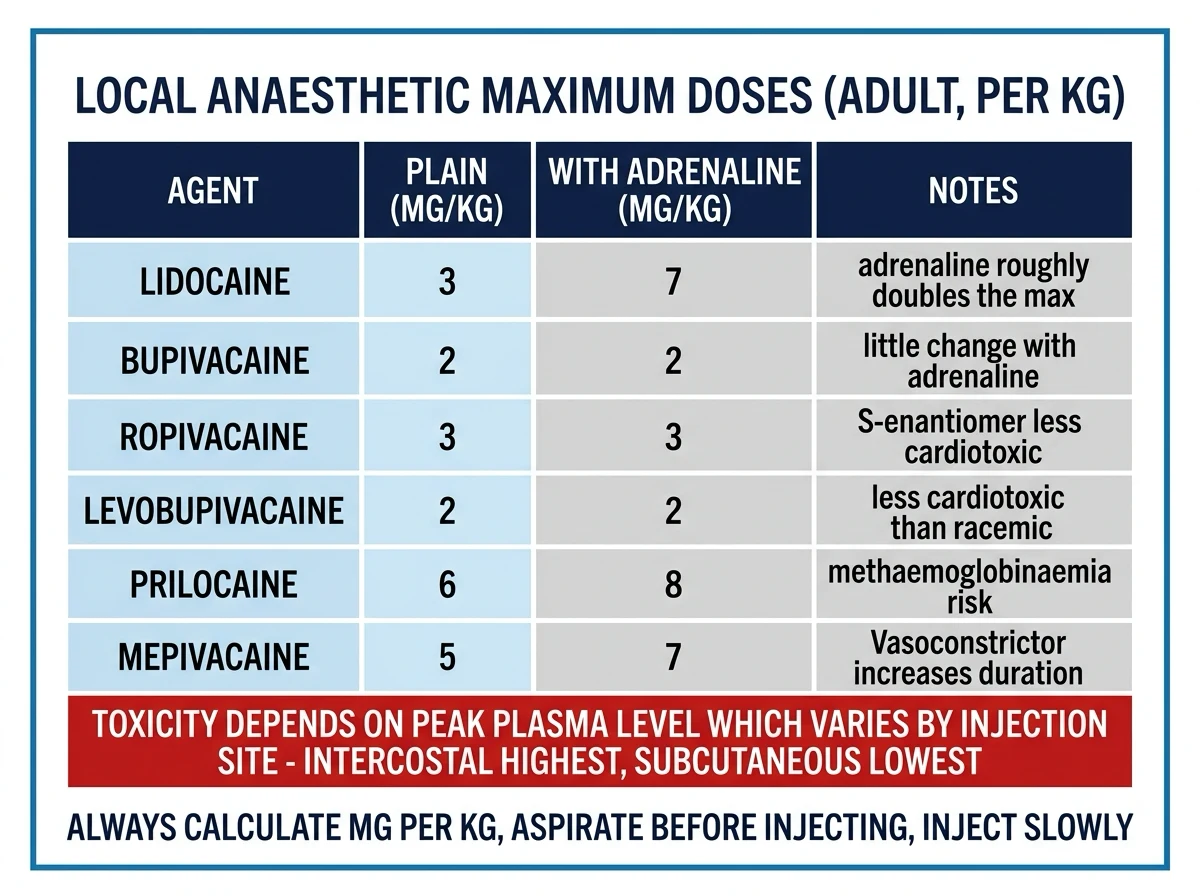
Why adrenaline changes the max dose for lidocaine but not bupivacaine
The differential effect of adrenaline on the maximum dose is one of the most common viva questions in local-anaesthetic pharmacology, and the answer hinges on the determinants of duration described above [5].
Lidocaine is moderately protein-bound and produces intrinsic vasodilatation, so a substantial fraction of an injected dose is washed away from the nerve and absorbed into the systemic circulation, producing a relatively high peak plasma concentration for a given dose. Adding adrenaline constricts the local vessels, slows this washout, keeps more drug at the nerve (prolonging the block) and lowers the peak plasma concentration (reducing toxicity). Because the peak plasma concentration is lower, a larger total dose can be given safely, and the maximum rises from 3 to 7 mg per kg [5].
Bupivacaine, in contrast, is already highly protein-bound (about 95 per cent) and has a more favourable tissue residence, so adrenaline does not meaningfully lower its peak plasma concentration and does not buy additional safe dose [1][5]. The maximum therefore stays at 2 mg per kg whether or not adrenaline is added. The same is broadly true of ropivacaine and levobupivacaine, both of which are long-acting amides with high protein binding [5]. Ogu and colleagues reinforce that for bupivacaine the formulation (plain versus liposomal) is a more important determinant of duration and safety profile than the addition of adrenaline [4].
Toxicity depends on peak plasma concentration — the injection-site absorption gradient
Systemic toxicity is determined not by the total dose alone but by the peak plasma concentration that the dose produces, and that peak depends on how quickly and how completely the drug is absorbed from the injection site [1][3]. Absorption varies enormously between sites, in the order: intercostal is greater than intratracheal is greater than caudal or epidural is greater than brachial plexus is greater than subcutaneous [5]. A common simplification for viva purposes is that intercostal absorption is highest and subcutaneous absorption is lowest.
The practical consequence is that the same mg per kg dose produces a higher and more dangerous plasma level at an intercostal site than at a subcutaneous site. Intercostal blocks therefore require a smaller per-kilogram dose than subcutaneous infiltration, even though the textbook maximum is the same. Merchant and colleagues make this concrete in the context of truncal fascial-plane blocks (erector spinae plane versus transversus abdominis), where the safety and dosing of the local anaesthetic are inseparable from the site and the spread of the injectate [3]. Christensen and colleagues encode this site-dependence in the MaxSafe fractional-toxicity calculation, which forces the clinician to consider the site as well as the agent when computing a safe dose [1]. The clinical rule is to dose for the site as well as the agent: reduce the per-kilogram dose at highly vascular sites and titrate carefully [1][3].
Dose calculation and safe-injection practice
Safe local-anaesthetic practice rests on a routine that should be applied on every injection [1][5].
First, calculate the dose in mg per kg for the individual patient before drawing up any drug. Determine the patient weight, identify the agent and whether it contains adrenaline, look up the maximum from the table above, and compute the maximum allowable dose in milligrams (weight in kg times mg per kg). Convert that to a volume by dividing by the concentration (a 1 per cent solution contains 10 mg per mL; a 0.5 per cent solution contains 5 mg per mL). Always use the lowest effective concentration and volume that will produce the desired block [5].
Second, aspirate before injecting. Intravascular injection — whether into a vein during an intravenous regional anaesthesia Bier's block, into a vessel during a plexus block, or accidentally during subcutaneous infiltration — delivers the entire dose directly to the heart and brain and causes immediate, severe toxicity at doses that would be harmless if correctly placed [2][5]. Aspiration is therefore mandatory before every bolus, and a negative aspiration is not a guarantee (the needle tip can move), so injection must also be in small incremental boluses with intermittent re-aspiration [5].
Third, inject slowly. Slow injection limits the rate of rise of the plasma concentration if some of the dose is inadvertently intravascular, and it allows the patient to report early symptoms of CNS toxicity (perioral tingling, tinnitus) before progression to seizures [2][5]. Christensen and colleagues argue that the MaxSafe fractional-toxicity check should be performed as part of this routine, so that the cumulative dose is always known and compared with the maximum [1].
Local-anaesthetic systemic toxicity — CNS then cardiovascular
Local-anaesthetic systemic toxicity (LAST) is the syndrome caused by an excessive plasma concentration of local anaesthetic, producing progressive dysfunction of the central nervous system and then the cardiovascular system [2]. The International Pain and Spine Intervention Society emergency protocol of Meral and colleagues is the contemporary reference for recognition and management [2].
The central nervous system is affected first because the neurons of the cortex are more susceptible than myocardium at any given plasma level. Early features are excitatory and reflect blockade of inhibitory interneurons: circumoral or perioral tingling, tongue paraesthesia, a metallic taste, tinnitus, light-headedness, visual disturbance and agitation [2]. As the plasma concentration rises, generalized tonic-clonic seizures occur, followed by unconsciousness, respiratory depression and coma [2].
The cardiovascular system is affected at higher plasma concentrations. Local anaesthetics block cardiac sodium channels, producing negative inotropy, conduction slowing (prolonged PR and QRS), hypotension and arrhythmia [2]. The risk of progression to cardiovascular collapse is increased by hypoxia, acidosis, hypercarbia, low protein binding (as in neonates) and hepatic impairment, all of which either raise the free plasma concentration or sensitize the myocardium [2]. These precipitants are important because they are correctable, and their prevention (maintaining oxygenation and ventilation) is part of LAST prevention as much as treatment.
Bupivacaine cardiotoxicity — the worst offender
Bupivacaine is the most cardiotoxic of the commonly used local anaesthetics and the agent most associated with catastrophic LAST [2]. The reason lies in its sodium-channel kinetics. Bupivacaine binds cardiac sodium channels during the depolarised (inactivated) state and dissociates from them very slowly during diastole — a property described as fast-in, slow-out — so at physiological heart rates a substantial fraction of channels remain blocked from beat to beat, producing severe conduction slowing, negative inotropy and a characteristic re-entrant ventricular arrhythmia that is highly refractory to standard resuscitation [2].
Bupivacaine-induced cardiac arrest is therefore notoriously difficult to reverse. Standard advanced life support doses of adrenaline can be harmful in this setting because high-dose adrenaline increases myocardial oxygen demand and can worsen the arrhythmia; the protocol of Meral and colleagues therefore specifies small adrenaline boluses and early lipid emulsion [2]. Resuscitation may need to be prolonged (over an hour) and should not be abandoned, because the lipid emulsion scavenges bupivacaine from the myocardium and the outcome can be excellent if the team persists [2].
This is also the rationale for the S-enantiomer agents. Levobupivacaine (the S-enantiomer of bupivacaine) and ropivacaine (an S-enantiomer propyl analogue) were developed specifically to reduce cardiotoxicity: the R-enantiomer of bupivacaine has slower dissociation kinetics and greater cardiotoxicity than the S-form, so the pure S-preparations dissociate faster from cardiac sodium channels and produce a less refractory arrhythmia in overdose [5]. They do not abolish the risk; they shift the dose-response curve to the right, but a large overdose of ropivacaine or levobupivacaine can still cause LAST [2].
LAST treatment — the emergency protocol
The management of LAST is an emergency and follows a defined sequence, summarised in the International Pain and Spine Intervention Society protocol of Meral and colleagues [2].
The immediate steps are to STOP the injection and call for help, then secure the AIRWAY and give 100 per cent oxygen. Hypoxia and acidosis worsen LAST and must be corrected aggressively; ventilation should be assisted or controlled as needed [2].
Seizures are controlled with a benzodiazepine (midazolam or diazepam). Propofol in small doses can terminate seizures but should be used with great caution because it adds cardiovascular depression in a patient already at risk of collapse; avoid large doses [2].
Hypotension and arrhythmia are treated with adrenaline, but in SMALL boluses. Large, standard-ACLS doses of adrenaline are harmful in bupivacaine toxicity because they increase myocardial oxygen demand and worsen ventricular arrhythmia; the protocol recommends reduced adrenaline doses (small 10 to 20 microgram boluses titrated to effect) and avoids vasopressin [2].
The specific antidote is INTRAVENOUS LIPID EMULSION, given early rather than as a last resort. The standard regimen is a 20 per cent lipid emulsion at 1.5 mL per kg as an intravenous bolus, followed by an infusion of 0.25 mL per kg per minute, repeated or up-titrated if recovery is incomplete [2]. Lipid emulsion works by creating an intravenous lipid phase that extracts (acts as a sink for) the lipophilic local anaesthetic from the myocardium and plasma, lowering the free drug concentration at the sodium channel. It is most dramatically effective for bupivacaine but should be given for any LAST that does not resolve immediately with airway and circulatory support [2].
Finally, resuscitation should be PROLONGED. Because lipid emulsion can recover a myocardium that has been arrested for a long time, resuscitation in LAST should be continued for at least an hour and should not be abandoned early [2].
Special situations — elderly, hepatic impairment, pregnancy, obesity, neonate
Several patient groups require dose reduction or heightened vigilance [4][5].
In the elderly, cardiac output and hepatic blood flow fall, protein binding may be reduced, and comorbidity is common; the maximum dose should be reduced and titrated cautiously [5].
In hepatic impairment, the amide local anaesthetics (lidocaine, bupivacaine, ropivacaine, levobupivacaine, mepivacaine, prilocaine) are metabolised by the liver, so reduced hepatic function prolongs their half-life and raises the risk of accumulation and toxicity; doses should be reduced and dosing intervals extended. Ester local anaesthetics (procaine, chloroprocaine, cocaine, tetracaine, amethocaine) are metabolised by plasma pseudocholinesterases and are relatively spared in hepatic disease (though synthesis of the enzyme itself can be impaired in severe disease) [5].
In pregnancy, epidural venous engorgement (from uterine compression of the vena cava) reduces the epidural volume and so reduces the dose needed for a given block height; the aortocaval compression and reduced functional residual capacity also worsen any LAST-induced hypoxia, so careful dosing and left lateral tilt are essential [5].
In obesity, dosing on total body weight risks overdose because the lipophilic local anaesthetics partition into fat, raising the effective dose per kilogram of lean mass; Ogu and colleagues emphasise that dose should be based on ideal or lean body weight rather than total body weight, and that the choice of formulation (for example liposomal bupivacaine) interacts with body habitus in determining opioid-sparing and safety [4].
In neonates and infants, reduced alpha-1-acid glycoprotein means a higher free (unbound) fraction of amide local anaesthetic for a given total plasma concentration, so the effective toxic threshold is lower and doses must be reduced; this is the basis for the well-known contraindication to bupivacaine with adrenaline in particular paediatric contexts and the careful dosing of ropivacaine in caudal blocks [2][5].
Adrenaline as an additive — benefits and the end-artery contraindication
Adrenaline (usually 1 in 200,000, that is 5 micrograms per mL) is added to local anaesthetic for three reasons: to prolong duration, to reduce systemic toxicity by slowing absorption (mainly for lidocaine), and to act as a marker of intravascular injection (a rise in heart rate gives early warning) [5]. The duration and toxicity benefits are greatest for lidocaine and mepivacaine and negligible for bupivacaine and ropivacaine, as described above [5].
The absolute contraindication is injection into end-arterial territories that have no collateral blood supply: the fingers, toes, nose, penis and earlobe. Adrenaline-induced vasoconstriction in these territories can cause ischaemia and tissue necrosis, and adrenaline-containing solutions must never be used for ring blocks of digits or the penis [5]. This rule has been partially relaxed in modern practice for lidocaine with adrenaline in digital blocks (where large case series have not shown harm), but for examination purposes the contraindication to adrenaline in end-arterial territories should be stated as absolute [5]. Merchant and colleagues reinforce that the safety of any local-anaesthetic adjunct depends on the site, the concentration and the total dose, and that the additive is part of a system rather than a free good [3].
Clinical summary
In practice, every local-anaesthetic injection should follow the same routine: identify the agent and whether it contains adrenaline; look up the maximum dose from the mg per kg table (lidocaine 3 plain, 7 with adrenaline; bupivacaine and levobupivacaine 2 plain and with adrenaline; ropivacaine about 3 to 3.5; prilocaine 6 plain, 8 with adrenaline; mepivacaine 5 plain, 7 with adrenaline); calculate the maximum milligrams and convert to a volume for the patient; reduce the dose for the site (intercostal highest, subcutaneous lowest) and for the patient (elderly, hepatic, pregnant, obese, neonate); use the lowest effective concentration and volume; aspirate before and during injection; and inject slowly [1][5]. If toxicity occurs, stop the injection, secure the airway and give 100 per cent oxygen, control seizures with a benzodiazepine, treat hypotension and arrhythmia with small adrenaline boluses, give intravenous lipid emulsion (1.5 mL per kg bolus then infusion) early, and resuscitate for at least an hour [2]. Bupivacaine is the worst offender and the strongest indication for lipid emulsion [2].
Clinical
- Standard approach
- Evidence-based
Alternative
- Modified technique
- Risk-benefit
Red flags
[1]References
- [1]Christensen SA, et al. MaxSafe: a mobile-friendly calculator for fractional local anesthetic toxicity and epinephrine dose tracking in dental practice J Dent Anesth Pain Med, 2026.PMID 42266421
- [2]Meral RM, et al. International Pain and Spine Intervention Society Emergency Protocols: Local Anesthetic Systemic Toxicity (LAST) Interv Pain Med, 2026.PMID 42325878
- [3]Merchant N, et al. Comparing the analgesic utility & safety of erector spinae plane block versus thoracic epidural for multiple rib fracture trauma: a retrospective cohort analysis Injury, 2026.PMID 42361789
- [4]Ogu E, et al. The Effect of Liposomal Bupivacaine and Obesity on Postoperative Opioid Consumption in Children With Scoliosis J Pediatr Orthop, 2026.PMID 42351400
- [5]Little K, et al. Guidelines in Practice: Local-Only Anesthesia AORN J, 2026.PMID 42360750
- [6]Copur I, et al. Association Between Local Anesthetic Volume-Dose Combinations and Optic Nerve Sheath Diameter as an Indirect Marker of Intracranial Pressure During Ultrasound-Guided Supraclavicular Brachial Plexus Block: A Randomized Trial Medicina (Kaunas), 2026.PMID 42356116