Anaes · Volatile & inhalational agents
MAC and solubility: principles of volatile anaesthetic action
Also known as Minimum alveolar concentration · MAC principles · Oil-gas and blood-gas partition coefficients · Meyer-Overton correlation · Mechanisms of general anaesthesia
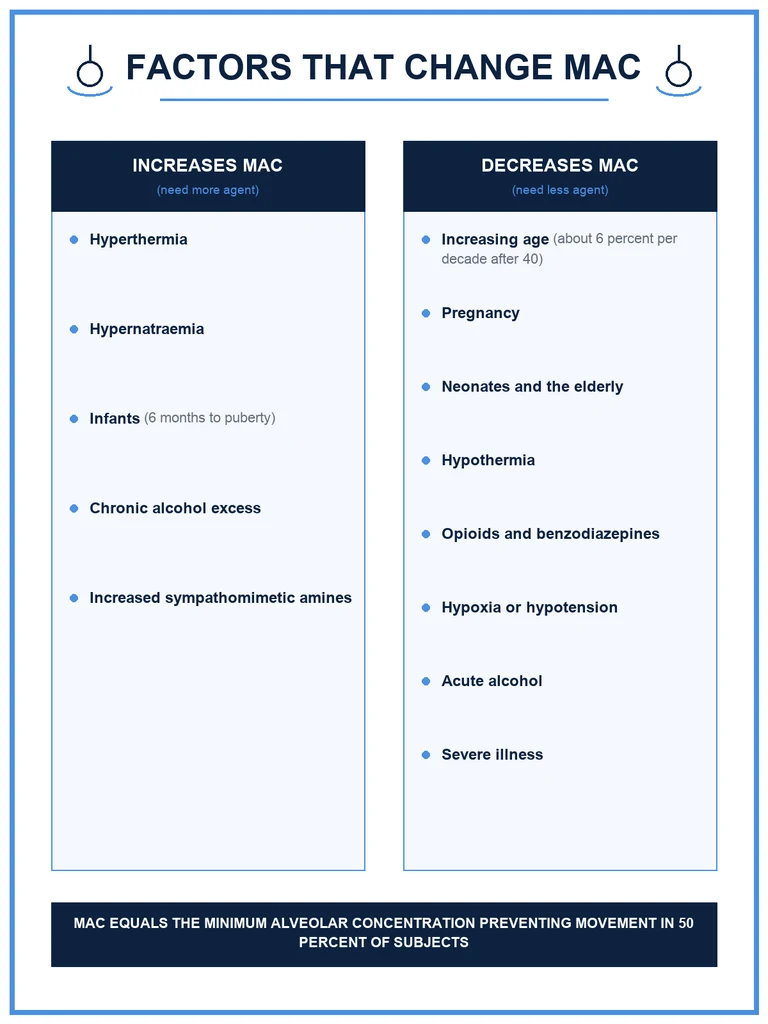
Minimum alveolar concentration (MAC) is the ED50 of an inhalational agent, defined as the minimum alveolar concentration (in volume percent at 1 atmosphere, standardised to age 40, 37 degrees Celsius and no other agents) that prevents movement in response to a surgical stimulus in 50 percent of subjects; it is a measure of POTENCY and is inversely related to it, so halothane at a MAC of 0.75 percent is the most potent and nitrous oxide at a MAC of 105 percent the least. It is the PARTIAL PRESSURE of agent in the brain that anaesthetises, and alveolar partial pressure equilibrates with arterial and then brain partial pressure (Dalton's law). MAC is RAISED by hyperthermia, hypernatraemia, infancy, chronic alcohol and sympathomimetics, and LOWERED by increasing age (around 6 percent per decade after 40), pregnancy, opioids, benzodiazepines, hypothermia and severe illness; MAC is ADDITIVE across agents (0.5 MAC sevoflurane plus 0.5 MAC nitrous oxide equals 1 MAC). The oil-gas partition coefficient (lipid solubility) determines POTENCY through the Meyer-Overton correlation, while the blood-gas partition coefficient determines the SPEED of onset and offset (lower means faster), and modern work shows anaesthesia is a multi-target protein phenomenon, not a single lipid site, with action at GABA-A, NMDA, two-pore-domain potassium (TREK) and voltage-gated sodium and calcium channels (Hollingworth 2026, Dong 2026, Watanabe 2026, Wu 2026, Gan 2026, Bajwa 2026).
On this page & tools
Your progress
Saved locally on this device.
Target exams
Red flags

Overview
The inhalational anaesthetics are unusual in pharmacology because they are administered as a gas, titrated against an alveolar concentration, and excreted largely unchanged through the lungs. Three ideas organise their whole pharmacology and dominate the Primary exam. The first is minimum alveolar concentration (MAC), the dose unit of an inhalational agent, which is an ED50 — a measure of potency, not of speed. The second is solubility, expressed as two partition coefficients: the oil-gas coefficient, which determines potency through the Meyer-Overton correlation, and the blood-gas coefficient, which determines the speed of onset and offset. The third is the mechanism of anaesthesia, which the modern view holds to be a multi-target protein phenomenon, acting at GABA-A receptors, NMDA receptors, two-pore-domain potassium channels and voltage-gated sodium and calcium channels, rather than a single lipid site.[3][2]
These three ideas answer the three practical questions the anaesthetist asks of every volatile: how much do I need (potency, MAC), how fast does it go in and come out (blood-gas), and what is it actually doing to the brain (mechanism). The clinical determination of MAC for a defined endpoint, as illustrated by Gan and colleagues' measurement of the median effective concentration of sevoflurane for i-gel insertion in children, shows that MAC is a living, measurable quantity, not a fixed constant, and is the framework for every dosing decision.[1]
Definition of MAC
Minimum alveolar concentration (MAC) is defined as the minimum concentration of an anaesthetic in the alveoli, at 1 atmosphere of pressure and expressed in volume percent, that prevents movement in response to a standard surgical stimulus in 50 percent of subjects. It is therefore an ED50 — the dose at which half of subjects do not move — and it is a measure of POTENCY.[1]
The definition is tightly standardised so that agents can be compared: the reference subject is around 40 years old, at 37 degrees Celsius, at 1 atmosphere ambient pressure, breathing the agent in oxygen with no other sedative or analgesic on board. End-tidal (alveolar) concentration is the measured variable because it is the lung concentration that, after equilibration, sets the arterial and then the brain partial pressure. By Dalton's law the partial pressure of the agent is what exerts the pharmacological effect, and the alveolar partial pressure equilibrates across the alveolar-capillary membrane with the arterial blood and then, across the blood-brain barrier, with the brain. This is the reason alveolar (end-tidal) concentration is used as the surrogate for brain concentration in clinical practice and in research.[1]
Gan and colleagues' determination of the median effective concentration of sevofolurane for i-gel laryngeal mask airway insertion in children is a worked example of the principle: a quantal ED50 is measured for a defined clinical endpoint (successful i-gel insertion without movement), and that concentration is reported as a MAC-equivalent for that endpoint. The same method defines MAC for the classical endpoint of movement to skin incision.[1]
MAC and potency
MAC is inversely related to potency. The lower the MAC, the more potent the agent, because less of it is needed to abolish the response to a standard stimulus. The classical MAC values in oxygen for the common agents at standard conditions are approximately: halothane 0.75 percent (most potent), isoflurane 1.2 percent, sevoflurane 2.0 percent, desflurane 6.0 percent, and nitrous oxide 105 percent (least potent, and essentially impossible to use as a sole agent at 1 atmosphere because its MAC exceeds 100 percent of the inspired mixture).[1]
| Agent | MAC in O2 (per cent) | Relative potency |
|---|---|---|
| Halothane | 0.75 | Highest (most potent) |
| Isoflurane | 1.2 | High |
| Sevoflurane | 2.0 | Moderate |
| Desflurane | 6.0 | Low |
| Nitrous oxide | 105 | Lowest (weakest) |
The inverse relationship is the single most testable point: a low MAC means a potent agent, not a weak one. The reason halothane is so potent is its very high lipid solubility, expressed as the highest oil-gas partition coefficient of the common agents, which places it at the top of the Meyer-Overton axis (see below).[1]
Factors that INCREASE MAC
Several factors raise MAC, meaning that more agent is required to achieve the same depth of anaesthesia. These should be remembered as a group because the exam question usually asks for a list.[1][3]
- Hyperthermia — MAC rises with body temperature.
- Hypernatraemia — chronic hypernatraemia raises MAC.
- Age — MAC is highest in infancy and early childhood (peak around six months of age) and falls through childhood; infants and young children therefore need more agent per kilogram than adults.
- Chronic alcohol excess — the chronic, tolerant heavy drinker has an elevated MAC.
- Increased central sympathomimetic activity — exogenous catecholamines, ephedrine, monoamine oxidase inhibitors and amphetamine raise MAC.
- Genetic factors — some species and individual variation in MAC is heritable. [1]
The clinical consequence is that in a pyrexial, hypernatraemic, chronically alcohol-tolerant young child the anaesthetist must expect to deliver a higher end-tidal concentration to achieve surgical anaesthesia.[1]
Factors that DECREASE MAC
A larger group of factors lower MAC, meaning that less agent is needed. These are clinically the more important, because they include the common comorbidities and co-administered drugs of everyday practice.[1][3]
- Increasing age — MAC falls progressively with age, by about 6 percent per decade after the age of 40; an 80-year-old needs roughly 30 percent less volatile than a 40-year-old.
- Pregnancy — MAC is reduced by up to 30 percent, especially in the third trimester, and reverts after delivery.
- Neonates and the elderly — at the extremes of age MAC is lower than the 40-year-old reference.
- Hypothermia — MAC falls as body temperature falls.
- Co-administered depressants — opioids, benzodiazepines, barbiturates, propofol, ketamine and the alpha-2 agonists (clonidine, dexmedetomidine) all lower MAC in a dose-related fashion.
- Lithium and acute alcohol intoxication — both lower MAC.
- Severe systemic illness — critical illness reduces MAC.
- Hypoxia, severe hypotension, anaemia, metabolic acidosis and hypercarbia — all lower MAC, and the last three are terminal-event phenomena in which anaesthetic requirement falls. [1]
The practical point is that in the elderly, the pregnant, the hypothermic, the opiate-pretreated or the critically ill patient the volatile should be titrated down, and end-tidal concentration guided by the patient's comorbidity, not by a fixed target.[1]
MAC-AWAKE and MAC-BAR
MAC as defined above is the MAC for movement to a surgical stimulus, sometimes written MAC-INC (incision). Two related quantities matter clinically and appear in exam questions.[6]
MAC-AWAKE is the alveolar concentration at which 50 percent of subjects lose consciousness (or, conversely, open their eyes and respond to command on emergence). It is approximately 0.3 to 0.5 of the standard MAC across agents. MAC-AWAKE is the dose that prevents explicit awareness and underpins the amnestic component of anaesthesia; it is the relevant threshold when awareness is the concern. Processed electroencephalographic depth-of-anaesthesia monitors (BIS, entropy and similar processed-EEG devices) are used to titrate anaesthetic delivery to keep the patient below MAC-AWAKE and to reduce the risk of awareness, as set out in the Indian expert consensus on intra-operative consciousness monitoring with processed EEG.[6]
MAC-BAR is the alveolar concentration that blocks the adrenergic and autonomic (catecholamine and cardiovascular) response to incision. It is higher than MAC-INC, at approximately 1.5 to 1.7 MAC, and represents the dose needed to obtund the sympathetic surge to a noxious stimulus. The clinical implication is that at a typical maintenance depth of around 1 MAC the patient will not move, but may still mount a pressor and catecholamine response to the stimulus, which is why anaesthetists supplement volatiles with opioids to blunt the autonomic response. [1]
MAC additivity
MAC values are additive across inhalational agents. When two agents are given together, their fractional MACs sum to a total MAC: 0.5 MAC of sevoflurane plus 0.5 MAC of nitrous oxide gives a total of 1.0 MAC of anaesthetic effect. The interaction is additive, not synergistic, which is convenient for dosing and for exam arithmetic.[1]
This principle underpins the common technique of combining a sub-MAC concentration of a potent volatile with 50 to 70 percent nitrous oxide in oxygen: the nitrous oxide contributes around 0.5 to 0.7 MAC, allowing a smaller delivered concentration of the potent volatile, with a reduction in volatile-related side effects (hypotension, respiratory depression, cost, pollution). The second gas effect (see below) accelerates the uptake of the companion volatile when nitrous oxide is the carrier, which is a kinetic bonus on top of the additive potency benefit. MAC is also additive (in effect, if not in formal units) with intravenous hypnotics and opioids, which is why co-induction lowers the volatile requirement — quantified above as a factor that decreases MAC.[1]
Partition coefficients: oil-gas and blood-gas
A partition coefficient is the ratio of the concentration of an agent in two phases at equilibrium. For inhalational anaesthetics two coefficients dominate the pharmacology, and the exam asks the candidate to keep them strictly separate because they govern different properties.[1][3]
The oil-gas partition coefficient is the ratio of the concentration of agent dissolved in lipid (oil) to that in gas at equilibrium. It is a measure of LIPID SOLUBILITY, and it correlates with POTENCY (the Meyer-Overton correlation, below): the higher the oil-gas coefficient, the more potent the agent and the lower its MAC. Halothane, with an oil-gas coefficient of around 224, is the most potent of the common agents; desflurane, at around 19, the least potent among the volatiles. [1]
The blood-gas partition coefficient is the ratio of the concentration of agent dissolved in blood to that in gas at equilibrium. It governs the SPEED of uptake and elimination, and therefore the rate of rise of alveolar partial pressure and the speed of induction and emergence: the lower the blood-gas coefficient, the faster the onset and offset. It does NOT determine potency. The blood-gas coefficients rank, from lowest (fastest) to highest (slowest): desflurane 0.42, nitrous oxide 0.47, sevoflurane 0.65, isoflurane 1.4, halothane 2.4. Xenon, with a blood-gas coefficient of around 0.12, is the fastest of all. This is why desflurane and sevoflurane have a rapid in-and-out profile and halothane a slow one, despite halothane being the more potent agent. [1]
| Agent | Oil-gas coeff (potency) | Blood-gas coeff (speed) | MAC in O2 (per cent) |
|---|---|---|---|
| Halothane | around 224 | 2.4 | 0.75 |
| Isoflurane | around 98 | 1.4 | 1.2 |
| Sevoflurane | around 50 | 0.65 | 2.0 |
| Desflurane | around 19 | 0.42 | 6.0 |
| Nitrous oxide | around 1.4 | 0.47 | 105 |
| Xenon | around 20 | around 0.12 | around 71 |
The exam-critical separation: oil-gas sets potency (the column that aligns with MAC), blood-gas sets speed (the column that does not). Confusing the two is one of the most common and most penalised errors in the Primary.[1]
The Meyer-Overton correlation
The Meyer-Overton rule, published independently by Meyer (1899) and Overton (1901), states that the POTENCY of a general anaesthetic correlates linearly with its LIPID SOLUBILITY (its oil-gas partition coefficient). Plot the logarithm of MAC (or of the anaesthetising partial pressure) against the oil-gas partition coefficient for a wide range of agents — from nitrous oxide and xenon through the halogenated volatiles to ether and chloroform — and they fall on a single straight line: the more lipid-soluble, the more potent.[1][3]
The implication the early workers drew was that anaesthetics act at a hydrophobic (lipid) site, and that anaesthesia is produced when a critical molar concentration of agent dissolves in the lipid of the nerve membrane. This was the unitary (lipid) theory of anaesthesia, sometimes called the fluid-membrane theory: it proposed that anaesthetics dissolve in the lipid bilayer, disorder or fluidise it, and thereby disrupt nerve impulse transmission. The appeal of the theory was that it explained, in a single physical principle, the otherwise startling fact that chemically inert and structurally unrelated compounds (inert gases, alcohols, halogenated hydrocarbons) all produce anaesthesia.[3]
Exceptions to Meyer-Overton
The unitary lipid theory could not survive the accumulating exceptions, which collectively argue that anaesthetics act at protein sites rather than (or in addition to) a bulk lipid site.[3]
- Stereoselectivity. The enantiomers of chiral anaesthetics (for example the isomers of isoflurane, or of etomidate and barbiturates) differ in anaesthetic potency. Bulk lipid would not distinguish between enantiomers of identical physicochemical properties, but a chiral protein binding site would. The existence of stereoselectivity is strong evidence for a protein target.
- Non-immobilisers. Certain lipid-soluble compounds predicted by Meyer-Overton to be anaesthetic (for example some perfluorinated alkanes) fail to produce anaesthesia, despite partitioning into lipid as expected. They break the correlation and cannot be explained by a pure lipid theory.
- Pressure reversal. At very high ambient pressures (for example in deep-sea diving chambers), the anaesthetic effect can be partially reversed. This "pressure reversal" was originally interpreted as compaction of the lipid bilayer against the fluidising effect of anaesthetic, but the precise mechanism remains debated; it does, however, demonstrate that potency is not a simple function of lipid concentration.
- Cut-off effect. Within a homologous series, anaesthetic potency rises with chain length up to a point and then disappears, again inconsistent with a purely lipophilic mechanism. [1]
These exceptions drove the modern protein-target view: anaesthetics act at multiple, distinct protein binding sites on receptors and ion channels.[3][2]
Modern mechanisms — multi-target protein action
The contemporary view is that general anaesthesia is a multi-target phenomenon: different agents, and different components of the anaesthetic state (amnesia, immobility, hypnosis, analgesia), are produced at distinct molecular targets, and the old search for a single "unitary" mechanism is obsolete.[3]
The principal targets are: [1]
- The inhibitory GABA-A receptor. Most intravenous hypnotics (propofol, thiopental, etomidate) and the halogenated volatiles potentiate GABA-A, the ligand-gated chloride channel that mediates fast inhibition in the brain, increasing chloride influx and hyperpolarising the neuron. The aminosteroids and many volatiles act here.
- The excitatory NMDA receptor. Ketamine, nitrous oxide and xenon block the NMDA subtype of glutamate receptor, reducing excitatory neurotransmission; this is pharmacologically distinct from the GABA-ergic agents.
- The two-pore-domain potassium channels (K2P, including TREK-1). Volatile anaesthetics activate these background potassium channels, hyperpolarising and silencing neurons; TREK-1 knockout mice show reduced sensitivity to volatile anaesthesia, evidence that this channel is a genuine molecular target.
- Voltage-gated sodium channels. Hollingworth and colleagues demonstrate that volatile anaesthetics modulate voltage-gated sodium channel function at a site distinct from the local anaesthetic binding site, providing a molecular explanation for the suppression of presynaptic action-potential propagation and neurotransmitter release by volatiles, relevant to both immobilisation (spinal cord) and hypnosis.[2]
- Voltage-gated calcium channels and calcium signalling. Dong and colleagues identify calcium signalling dysregulation as a convergent mechanism in anaesthetic-induced neurotoxicity, implicating calcium-channel and calcium-handling protein targets in both the anaesthetic effect and the downstream neurotoxic injury that underlies postoperative cognitive dysfunction and delirium.[5]
The recovery of neurocognitive function after anaesthesia reflects the reversal of these multi-target effects as the agent is eliminated; Watanabe and colleagues describe a potential mechanism and a strategy for accelerating that recovery, grounded in the same receptor and channel targets that produce the anaesthetic state.[4] Wu and colleagues' narrative review of general anaesthetics and postoperative delirium summarises the clinical and mechanistic evidence that these multi-target actions, particularly in the ageing brain, contribute to postoperative cerebral dysfunction.[3]
The summary the exam expects: anaesthesia is NOT a single lipid-site (unitary) phenomenon but a multi-target protein phenomenon, with the inhalational agents acting at GABA-A, NMDA, K2P/TREK, voltage-gated sodium and voltage-gated calcium channels, each contributing to a component of the anaesthetic state.[3][2][5]
Kinetic consequences — concentration effect, second gas effect, overpressurisation
The blood-gas partition coefficient governs the rate of rise of alveolar partial pressure (and hence brain partial pressure) for a given delivered concentration. Three related kinetic phenomena accelerate that rise and are covered in detail in the volatile-agent topics but mentioned here because they are direct kinetic consequences of uptake.[1]
The concentration effect is the observation that the higher the inspired concentration of an agent, the faster the rise of its alveolar partial pressure. It is most pronounced for nitrous oxide, which can be delivered at high inspired concentrations (50 to 70 percent). The second gas effect is the related acceleration of the uptake of a companion ("second") agent delivered alongside nitrous oxide: the rapid uptake of nitrous oxide from the alveolus into blood concentrates the second agent in the alveolus and draws in more fresh gas, speeding its alveolar rise. Overpressurisation is the deliberate use of an inspired concentration higher than the target alveolar concentration (for example 8 percent sevoflurane to achieve an end-tidal of 2 percent) to shorten the time to equilibration. All three are strategies to overcome the slowing effect of blood solubility on the rise of alveolar partial pressure; all three are more effective the lower the blood-gas coefficient of the agent. [1]
Clinical application — agent choice and dosing
The framework above directly guides agent selection and dosing. The choice of agent is driven by the desired speed of onset and offset (blood-gas coefficient), by potency and stability (MAC and oil-gas), by airway tolerability (pungency), by metabolic and toxicity profile, and by cost and environmental impact. Sevoflurane, with a low blood-gas coefficient (0.65), a non-pungent pleasant smell and a moderate MAC (2.0), is the agent of choice for inhalational induction in children; desflurane, with the lowest blood-gas coefficient among the potent agents (0.42), gives the fastest emergence but is too pungent for inhalational induction and produces sympathetic activation at high concentrations.[1]
Dosing in MAC terms lets the anaesthetist standardise depth across agents and across the factors that change MAC. In an elderly, opiate-pretreated, hypothermic patient, MAC is lower and the target end-tidal should be reduced; in a pyrexial child it should be increased. Combining a potent volatile with nitrous oxide exploits MAC additivity (0.5 plus 0.5 equals 1) and the second gas effect, and depth is monitored against MAC-AWAKE using processed EEG to reduce the risk of awareness, as recommended by the Indian expert consensus on intra-operative consciousness monitoring.[6]
The cross-cutting principle is that the anaesthetist titrates to the PARTIAL PRESSURE of agent in the brain, using the alveolar (end-tidal) concentration as its surrogate, accounting for the factors that change MAC, the solubility that changes speed, and the multi-target mechanism that defines the effect.[1][3]
Clinical
- Standard approach
- Evidence-based
Alternative
- Modified technique
- Risk-benefit
Red flags
[1]References
- [1]Gan Z, et al. The Median Effective Concentration of Sevoflurane for I-Gel Laryngeal Mask Insertion in Unpremedicated Children Aged 1-10 Years: A Prospective Concentration-Finding Study Pediatr Discov, 2026.PMID 42021953
- [2]Hollingworth D, et al. Volatile anaesthetics modulate voltage-gated sodium channel function at a site directly linked to channel gating Nat Commun, 2026.PMID 42321197
- [3]Wu JN, et al. The Impact of General Anesthetics on Postoperative Delirium: A Narrative Review Based on Clinical Randomized Controlled Trials from the Last Five Years Geriatrics (Basel), 2026.PMID 42345745
- [4]Watanabe R, et al. A potential mechanism and strategy for accelerating recovery of neurocognitive function after general anaesthesia through store-operated Orai1 channels Br J Pharmacol, 2026.PMID 41918371
- [5]Dong C, et al. Calcium Signaling Dysregulation as a Convergent Mechanism in Anesthetic-Induced Developmental Neurotoxicity Drug Des Devel Ther, 2026.PMID 42232094
- [6]Bajwa SJS, et al. Indian expert consensus on intra-operative consciousness monitoring using processed electroencephalogram-based indices: A Delphi-based approach Indian J Anaesth, 2026.PMID 42145302