Anaes · Anaesthetic adjuncts
Metaraminol — the mixed-acting vasopressor (alpha-1 plus indirect noradrenaline release)
Also known as Metaraminol · Aramine · Mixed-acting vasopressor · Alpha-1 agonist with indirect noradrenaline release · Perioperative bolus vasopressor
Metaraminol is a SYNTHETIC SYMPATHOMIMETIC AMINE with a DUAL mechanism that sets it apart from every other vasopressor on the anaesthetic tray. It acts DIRECTLY as an alpha-1 agonist, producing arteriolar and venous vasoconstriction and a rise in systemic vascular resistance and blood pressure; AND it acts INDIRECTLY by releasing noradrenaline from sympathetic nerve terminals, the released noradrenaline in turn stimulating cardiac beta-1 receptors and supporting the heart rate and the cardiac output. This mixed-acting profile is the single most important fact about the drug. The haemodynamic signature is a rise in systemic vascular resistance and blood pressure from the alpha-1 vasoconstriction, with a MAINTAINED or slightly INCREASED cardiac output and heart rate from the noradrenaline-release beta effect, which is the critical difference from phenylephrine, a pure alpha-1 agonist whose blood-pressure rise triggers a baroreceptor-mediated reflex bradycardia and may lower the cardiac output. The clinical roles flow from this pharmacology: metaraminol is a popular first-line bolus vasopressor for anaesthesia-induced and perioperative hypotension wherever maintaining the cardiac output is desirable, a push-dose emergency treatment for post-intubation hypotension (demonstrated by da Silveira and colleagues), and an established option for obstetric spinal hypotension where the effective dose depends on the maternal body mass index (shown by Gao and colleagues). The intravenous bolus dose is 0.5 to 2 mg and the duration of a bolus is about 20 to 30 minutes (longer than phenylephrine, whose bolus lasts about 5 minutes); it is metabolised by monoamine oxidase. Adverse effects include tachycardia and arrhythmias from the beta effect of the released noradrenaline, tissue necrosis on extravasation, reduced splanchnic and renal perfusion at high doses, and TACHYPHYLAXIS as noradrenaline stores are depleted with prolonged use. Metaraminol is less expensive than several alternatives and carries a lower environmental cost (Parkinson and colleagues). Built on the da Silveira push-dose metaraminol study for post-intubation arterial hypotension, the Gao maternal body mass index and metaraminol dosing study, the Parkinson financial and environmental cost comparison of adrenaline, ephedrine, metaraminol and phenylephrine, the Dong vasopressor selection and postoperative delirium in older adults study, the Liu machine learning intraoperative hypotension prediction model, and the Turhan erector spinae plane block versus thoracic paravertebral block study.
On this page & tools
Your progress
Saved locally on this device.
8 MCQs with explanations
Target exams
Red flags

Why this matters to the anaesthetist
Intraoperative hypotension is the commonest haemodynamic disturbance of anaesthesia, and the vasopressor the anaesthetist chooses shapes not only the blood pressure but also the heart rate, the cardiac output, the afterload and — in the obstetric patient — the fetal wellbeing. Metaraminol occupies a distinctive place in the vasopressor formulary because it is the prototypical MIXED-ACTING agent: it works BOTH directly, as an alpha-1 agonist producing vasoconstriction, AND indirectly, by releasing noradrenaline from sympathetic nerve terminals. The released noradrenaline stimulates cardiac beta-1 receptors, so metaraminol supports the heart rate and the cardiac output at the same time as it raises the systemic vascular resistance. This dual fingerprint makes it behave quite differently from phenylephrine, the pure alpha-1 agonist, and the exam candidate who grasps this single distinction can predict almost everything the drug does.[4][5]
The contexts in which metaraminol is first-line or strongly preferred are the high-yield exam territory. It is a popular first-line bolus vasopressor for anaesthesia-induced and perioperative vasodilatory hypotension wherever maintaining the cardiac output is desirable — which is most routine perioperative hypotension, and especially the hypotension that follows induction and intubation, where push-dose metaraminol has been shown to reduce post-intubation arterial hypotension (the da Silveira study). It is an established option for obstetric spinal-induced hypotension, where the dose required to prevent hypotension depends on the maternal body mass index (the Gao study). And it is the workhorse bolus vasopressor in much of Australian and New Zealand practice, valued for its slightly longer duration and its smoother, more sustained effect than phenylephrine. The broader effort to predict intraoperative hypotension with machine learning (the Liu model) reflects the move toward anticipating the episodes metaraminol is used to treat, so that a vasopressor can be deployed early and titrated smoothly rather than reactively.[1][2][5]
Mechanism of action and receptor pharmacology
Metaraminol is a synthetic sympathomimetic amine with a DUAL mechanism, and the exam candidate must be able to state both components clearly. The DIRECT component is alpha-1 agonism: metaraminol binds the alpha-1 receptor (a Gq-coupled G-protein-coupled receptor on vascular smooth muscle), activates phospholipase C, generates inositol triphosphate and diacylglycerol from membrane phosphatidylinositol bisphosphate, and raises intracellular calcium, which binds calmodulin, activates myosin light-chain kinase and produces arteriolar and venous smooth-muscle contraction. The result is vasoconstriction of both the arterioles (raising the systemic vascular resistance) and the veins (increasing venous return and preload). This direct alpha-1 component is similar in kind to phenylephrine's, though metaraminol is somewhat less alpha-1 selective.[4]
The INDIRECT component is the release of noradrenaline from sympathetic nerve terminals. Metaraminol is taken up into the sympathetic nerve terminal by the noradrenaline transporter (uptake-1) and displaces noradrenaline from its storage vesicles, so that the stored noradrenaline is released into the synaptic cleft and acts on the postsynaptic receptors. The released noradrenaline stimulates alpha-1 receptors (adding to the direct vasoconstriction) and, critically, beta-1 receptors on the heart, producing a degree of positive inotropy and chronotropy. This indirect, noradrenaline-release component is what makes metaraminol a MIXED-acting drug rather than a pure alpha-1 agonist, and it is the reason metaraminol supports the cardiac output while phenylephrine does not.[4]
Because metaraminol is partly dependent on intact noradrenaline stores for its indirect effect, two pharmacological consequences follow that are exam-worthy. First, drugs that deplete noradrenaline stores (reserpine, some antidepressants) or that block uptake-1 (cocaine, tricyclic antidepressants) modify the indirect component of the response. Second, with prolonged or repeated dosing the noradrenaline stores can become depleted and the indirect component weakens, producing TACHYPHYLAXIS — a progressive loss of effect that is the hallmark of indirectly-acting sympathomimetics and that has no parallel with the pure direct alpha-1 agonist phenylephrine. The dependence on monoamine oxidase for metabolism also means that monoamine oxidase inhibitors potentiate and prolong metaraminol's effect, a classic interaction to flag.[4]
Haemodynamic effects
The haemodynamic signature of metaraminol follows directly from its dual mechanism, and the exam candidate must be able to draw it on a graph and contrast it with phenylephrine. The systemic vascular resistance rises (alpha-1 vasoconstriction, direct plus the noradrenaline-released alpha-1 component) and the blood pressure rises. The venoconstriction increases venous return and preload, which supports the stroke volume. The heart rate is maintained or may rise slightly, because the released noradrenaline provides beta-1 stimulation that offsets any tendency toward a baroreceptor-mediated reflex bradycardia. The cardiac output is therefore MAINTAINED or slightly INCREASED — which is the mirror image of phenylephrine, whose pure alpha-1 vasoconstriction triggers an unopposed reflex bradycardia and may lower the cardiac output.[4]
This absence of a reflex bradycardia is the single most important haemodynamic distinction between metaraminol and phenylephrine, and it is the key to several exam questions. With phenylephrine, the sudden rise in blood pressure is sensed by the carotid sinus and aortic arch baroreceptors and met by a vagal reflex bradycardia, because there is no beta-1 effect to offset it; the heart rate falls and the cardiac output may fall with it. With metaraminol, the same baroreceptor reflex is set in motion, but the noradrenaline released by the indirect component stimulates the beta-1 receptors and holds the heart rate up, so the reflex bradycardia is attenuated or abolished and the cardiac output is preserved. In practical terms, metaraminol raises the blood pressure WITHOUT trading away the heart rate or the cardiac output, which is exactly what is wanted in most routine perioperative hypotension.[4]
A practical contrast cements the point. Phenylephrine is the right drug when the problem is pure vasoplegia and the heart rate should not rise — but it is the wrong drug when the heart rate is already low or when the cardiac output needs supporting, because its reflex bradycardia worsens both. Metaraminol is the right drug when the problem is vasodilatory hypotension and the cardiac output should be maintained or supported — but it is the wrong drug when the heart rate is already high or when tachycardia is dangerous, because its indirect noradrenaline release can drive the heart rate higher. Noradrenaline itself, with direct alpha-1 and direct beta-1 activity, sits between the two: it raises the systemic vascular resistance and supports the cardiac output without relying on a pool of releasable noradrenaline that can be depleted. The vasopressor selection and postoperative delirium work by Dong and colleagues, focused on the older adult, is part of a broader literature showing that these haemodynamic fingerprints shape outcomes beyond the blood pressure number — the heart-rate and cardiac-output consequences of the chosen vasopressor matter to the brain and the kidney as well as to the circulation.[4]
Pharmacokinetics and dosing
Metaraminol has a pharmacokinetic profile that suits the titrated bolus and the infusion use that dominate its clinical role. The onset of action after an intravenous bolus is 1 to 2 minutes, somewhat slower than phenylephrine because part of the effect depends on uptake into the nerve terminal and the release of noradrenaline. The duration of a bolus is about 20 to 30 minutes, which is considerably longer than phenylephrine (whose bolus lasts about 5 minutes) and is one of the reasons metaraminol is valued as a bolus vasopressor: a single dose gives a smoother, more sustained correction of the blood pressure, with less of the sawtooth pattern that repeated phenylephrine boluses can produce. Metaraminol is metabolised by monoamine oxidase, and the monoamine oxidase inhibitor interaction is the classic pharmacokinetic flag — the effect is potentiated and prolonged, so the dose must be reduced and the dosing interval extended.[1]
The practical dosing ranges the exam candidate must know are the intravenous bolus and the infusion. The intravenous bolus dose is 0.5 to 2 mg, titrated to effect. For the minor anaesthesia-induced dip a bolus of 0.5 to 1 mg is usual; for the more pronounced vasoplegia the dose is titrated upward toward 2 mg. The longer duration means that the interval between boluses is longer than with phenylephrine — typically 10 to 15 minutes — which is a practical advantage for the anaesthetist managing a long case. For sustained hypotension, metaraminol can be given as a continuous infusion, prepared at a concentration such as 40 mg in 500 mL and titrated to the mean arterial pressure target. The infusion is less common than the bolus in routine practice (where phenylephrine or noradrenaline are the usual infusions) but retains a role where a sustained mixed alpha and beta effect is wanted.[1]
The push-dose (or "bolus-dose") technique, formalised for emergency and perioperative use by the da Silveira study and others, deserves specific attention. Push-dose metaraminol refers to the preparation of a dilute bolus — commonly 0.5 to 1 mg drawn up in a syringe, often diluted to 10 micrograms per mL or similar — for rapid correction of an acute blood-pressure drop, particularly around induction and intubation where post-intubation arterial hypotension is common and a fast, reliable, moderately sustained vasopressor is wanted. The da Silveira trial demonstrated that push-dose metaraminol reduces the incidence of post-intubation arterial hypotension, establishing the technique on an evidence base rather than on custom alone. The slightly slower onset and longer duration of metaraminol, relative to phenylephrine, are features that suit the push-dose context, where the goal is a smooth correction rather than a rapid spike.[1]
Clinical indications
The clinical indications for metaraminol group neatly into categories, all flowing from its mixed-acting pharmacology. The first and commonest is perioperative vasodilatory hypotension of any cause — the vasoplegia of spinal and epidural anaesthesia, the vasodilation produced by the intravenous and volatile induction agents, and the vasodilatory component of early septic shock. In each of these the problem is a low systemic vascular resistance, and metaraminol directly corrects the mechanism by raising the resistance through alpha-1 vasoconstriction while the indirect noradrenaline release supports the cardiac output. This makes metaraminol a sensible first-line bolus vasopressor for the haemodynamically routine patient, and it is widely used as such across anaesthetic practice, particularly in Australia and New Zealand. The intraoperative hypotension prediction work of Liu and colleagues reflects the move toward anticipating these episodes so that a vasopressor like metaraminol can be deployed pre-emptively.[5][4]
The second category is the push-dose, emergency and peri-induction context, where metaraminol is used to prevent or treat the post-intubation arterial hypotension that follows the induction-intubation sequence. The combination of the induction agent's vasodilation and myocardial depression, the positive-pressure ventilation's reduction of venous return, and the resolution of the intubation stimulus can produce a sharp drop in blood pressure in the minutes after intubation, particularly in the cardiovascularly compromised or volume-depleted patient. Push-dose metaraminol, given around the time of induction, reduces this drop, and the da Silveira study provides the evidence. The regional anaesthesia context — for example, the erector spinae plane block versus the thoracic paravertebral block studied by Turhan and colleagues — is another setting in which metaraminol may be the vasopressor of choice, because the sympathetic block produced by these truncal blocks produces a vasodilatory hypotension for which a mixed-acting agent that maintains the cardiac output is well suited.[1][6]
The third category is obstetric spinal-induced hypotension in caesarean section, where metaraminol has an established (if second-line, behind phenylephrine on fetal-pH grounds) role. The dose of metaraminol required to prevent spinal hypotension is influenced by the maternal body mass index, as Gao and colleagues demonstrated — higher body mass index patients require a larger dose, reflecting the larger blood volume and the greater degree of aortocaval compression and the altered pharmacokinetics in obesity. The fourth category is the patient in whom the cardiac output should be explicitly supported — the mildly beta-blocked patient, the patient with a borderline cardiac output, and the vasoplectic patient in whom a pure alpha-1 reflex bradycardia would be poorly tolerated. In these patients metaraminol's beta-component (via noradrenaline release) is a feature rather than a bug.[2][4]
Push-dose metaraminol and post-intubation hypotension
Post-intubation arterial hypotension is a well-recognised complication of the rapid-sequence induction and intubation sequence, and it is clinically important because it can produce a period of cerebral and coronary hypoperfusion at exactly the moment the patient is most vulnerable. The mechanism is a convergence of factors: the induction agent (propofol, thiopentone) produces vasodilation and myocardial depression; the positive-pressure ventilation that follows reduces the venous return; and the resolution of the laryngoscopy-driven sympathetic surge leaves a transient vasoplegia. The net effect is a drop in blood pressure that is common, often under-recognised, and clinically meaningful in the cardiovascularly compromised patient.[1]
The da Silveira study addressed this directly by testing whether push-dose metaraminol, given around the time of induction, reduces the incidence of post-intubation arterial hypotension. The findings supported the technique: prophylactic or early push-dose metaraminol reduced the frequency and the severity of the post-intubation blood-pressure drop. The pharmacology of metaraminol suits the push-dose context well — the alpha-1 vasoconstriction corrects the vasoplegia, the indirect noradrenaline release supports the cardiac output at a moment when the induction agent has depressed the myocardium, and the moderate duration (about 20 to 30 minutes) bridges the period of haemodynamic instability without the sawtooth of a very short-acting agent. This is one of the clearest modern evidence-based applications of metaraminol and the exam candidate should know the study and its conclusion.[1]
The practical technique is straightforward. A dilute metaraminol solution is prepared (for example, 1 mg in 10 mL, giving 100 micrograms per mL, or a similar concentration), and a bolus of 0.5 to 1 mg is given around the time of induction, with further increments titrated to the haemodynamic response. A secure, free-flowing intravenous line is essential (the extravasation-necrosis risk applies), and the heart rate and blood pressure are monitored continuously through the induction-intubation sequence. The push-dose technique is complementary to, not a replacement for, addressing the underlying contributors to the hypotension — ensuring adequate volume status, titrating the induction agent, and avoiding excessive positive-pressure ventilation. The broader intraoperative hypotension prediction work of Liu and colleagues extends the same principle — anticipate the drop and act pre-emptively — to the intraoperative phase beyond intubation.[1][5]
Obstetric spinal hypotension and the influence of maternal BMI
Obstetric spinal-induced hypotension is one of the best-studied vasopressor contexts in anaesthesia, and metaraminol has an established place in its management. Neuraxial blockade in the parturient produces a sudden sympathetic block with profound vasodilation and a fall in systemic vascular resistance; the hypotension that results is nearly universal without vasopressor support and threatens the uteroplacental perfusion. Phenylephrine is the preferred first-line vasopressor on the basis of fetal acid-base status — it produces a higher umbilical artery pH than ephedrine, because ephedrine crosses the placenta and its beta stimulation drives a fetal metabolic acidosis. Metaraminol sits alongside phenylephrine as an effective alternative, with a similar alpha-1-driven correction of the vasoplegia and a modest beta-component from noradrenaline release that supports the maternal cardiac output.[2]
The Gao study added an important practical dimension: the dose of metaraminol required to prevent spinal hypotension depends on the maternal body mass index. Higher body mass index parturients require a larger metaraminol dose, reflecting the larger blood volume, the greater degree of aortocaval compression by the gravid uterus, and the altered pharmacokinetics (including a larger volume of distribution) that accompany obesity. The implication for practice is that a fixed, one-size-fits-all metaraminol dose is inadequate for the obstetric population, and the dose should be titrated to the haemodynamic target with the body mass index in mind — a higher baseline and infusion rate for the higher body mass index parturient, and a lower dose for the lower body mass index parturient, with vigilant haemodynamic monitoring throughout. This dose-individualisation principle is the exam-worthy contribution of the Gao study.[2]
It is worth restating the phenylephrine-versus-metaraminol distinction in the obstetric context, because the fetal-pH evidence favours phenylephrine and the exam may probe it. Phenylephrine, acting purely on alpha-1, improves the maternal blood pressure and the uteroplacental perfusion without producing the fetal beta stimulation that drives acidosis, and it produces a higher umbilical artery pH than ephedrine. Metaraminol's indirect noradrenaline release is largely a maternal effect (the noradrenaline is released at maternal sympathetic nerve terminals and does not cross the placenta in the way ephedrine does), so metaraminol does not share ephedrine's fetal-acidosis liability — but the fetal-pH evidence base is larger and stronger for phenylephrine than for metaraminol, which is why phenylephrine remains first-line. Metaraminol is a reasonable alternative where phenylephrine is unavailable or where its reflex bradycardia is problematic (for example, the parturient who develops a symptomatic bradycardia on phenylephrine).[2]
Comparison with other vasopressors
Metaraminol is best understood by comparison, because the vasopressors form a spectrum defined by their receptor activity and the direct-versus-indirect distinction, and the comparison is a frequent examination structure.[4]
- Versus phenylephrine. Phenylephrine is a PURE alpha-1 agonist with no beta activity, so its blood-pressure rise triggers an unopposed baroreceptor-mediated reflex bradycardia and the cardiac output may fall. Metaraminol, with its alpha-1 plus indirect noradrenaline-release (beta-1) action, raises the blood pressure while MAINTAINING the cardiac output and the heart rate, because the released noradrenaline offsets the reflex bradycardia. This is the pivotal distinction. Phenylephrine is the right drug where tachycardia is undesirable (aortic stenosis, hypertrophic obstructive cardiomyopathy, ischaemic heart disease) and where the fetal pH is the priority (obstetric spinal hypotension); metaraminol is the right drug where the cardiac output should be maintained or where a slightly longer duration is wanted. Phenylephrine's bolus lasts about 5 minutes; metaraminol's lasts about 20 to 30 minutes. Phenylephrine does not show tachyphylaxis; metaraminol does, as noradrenaline stores are depleted.[4]
- Versus ephedrine. Ephedrine is also a mixed-acting agent — it acts directly on alpha and beta receptors AND indirectly by releasing noradrenaline. The comparison with metaraminol is subtle but important. Ephedrine has a relatively greater beta component, so it produces more tachycardia and more cardiac stimulation, while metaraminol has a relatively greater alpha component, so it produces more vasoconstriction. Ephedrine crosses the placenta and causes fetal beta stimulation and metabolic acidosis (the reason phenylephrine is preferred in obstetrics); metaraminol's noradrenaline release is a maternal effect and does not carry the same fetal-acidosis liability. Both show tachyphylaxis with repeated dosing as noradrenaline stores are depleted. The clinical flashpoint for the comparison is the patient who is both hypotensive and mildly bradycardic, where ephedrine's beta component is useful — but metaraminol's longer duration and greater alpha effect make it the more sustained vasopressor.[4]
- Versus noradrenaline. Noradrenaline is a DIRECT alpha-1, alpha-2 and beta-1 agonist. It raises the systemic vascular resistance (alpha-1) and supports the cardiac output (beta-1) by a direct receptor action, whereas metaraminol achieves a similar mixed effect partly indirectly through the release of noradrenaline. The practical difference is that noradrenaline's effect is consistent and not subject to tachyphylaxis from noradrenaline-store depletion, because it does not rely on a releasable pool. Noradrenaline is the preferred first-line vasopressor for sustained vasodilatory shock (septic, post-cardiopulmonary-bypass) where reliable, titratable, direct alpha and beta activity is required; metaraminol is better suited to the intermittent bolus correction of perioperative hypotension where its longer duration is an advantage and its tachyphylaxis is not a limiting problem.[4]
- Versus vasopressin. Vasopressin acts on the V1 receptor, a completely different pathway from the adrenergic receptors. It produces vasoconstriction independent of the adrenergic system, which makes it useful in refractory vasoplegia where adrenergic receptors are down-regulated and catecholamines (including metaraminol) become less effective. Vasopressin does not produce tachycardia or a reflex bradycardia and does not rely on noradrenaline stores. Metaraminol and vasopressin are complementary drugs for different layers of the vasoplegic problem rather than direct substitutes.[4]
Adverse effects and safety
The adverse-effect profile of metaraminol is the predictable consequence of its mixed-acting pharmacology, and the exam candidate should be able to derive each effect from the mechanism rather than memorise it.[4]
The principal haemodynamic adverse effect is tachycardia and arrhythmias, arising from the beta-1 stimulation of the noradrenaline released by the indirect component. At higher doses, and in the patient sensitised to catecholamines — the thyrotoxic patient, the patient on a monoamine oxidase inhibitor, and the patient whose myocardium is sensitised by a volatile anaesthetic — the released noradrenaline can produce a significant tachycardia and a predisposition to ventricular arrhythmias. This is the reason metaraminol is a poorer choice than phenylephrine where tachycardia is undesirable (aortic stenosis, hypertrophic obstructive cardiomyopathy, ischaemic heart disease), and it is the basis for the caution against pushing the dose to very high levels. The vasopressor selection and postoperative delirium work by Dong and colleagues, in older adults, is a reminder that the haemodynamic fingerprint of the vasopressor — the heart rate and the cardiac-output trajectory, not just the blood-pressure number — shapes downstream organ outcomes, and a vasopressor that drives a tachycardia may carry its own cerebral and cardiac risks.[4]
The principal local adverse effect is tissue necrosis on extravasation, shared with all the concentrated alpha-agonists. Metaraminol is a potent vasoconstrictor and extravasation into the perivascular tissue produces intense local ischaemia and necrosis. A secure, free-flowing intravenous line is essential, and central venous access is preferred for a sustained high-dose infusion. The antidote for extravasation is phentolamine (an alpha-blocker, 5 to 10 mg in 10 mL saline, infiltrated subcutaneously around the extravasation site), which competitively blocks the alpha-1 receptor and reverses the vasoconstriction; early recognition and treatment are critical.[4]
At high doses, metaraminol reduces perfusion of the renal, splanchnic and peripheral vascular beds, because the alpha-1 vasoconstriction is non-selective across the regional circulations. This is the basis of the caution against pushing alpha-agonists to very high doses in shock, where the price of the blood pressure may be a covert splanchnic and renal ischaemia. Metaraminol also produces a degree of pulmonary vasoconstriction, raising the pulmonary vascular resistance, which is a caution in pulmonary hypertension and right-ventricular failure where an increase in the afterload on the right ventricle is poorly tolerated. The fifth exam-worthy adverse effect is tachyphylaxis — the progressive loss of the indirect (noradrenaline-release) component of the effect as the noradrenaline stores in the sympathetic nerve terminals become depleted with prolonged or repeated dosing. A patient who responded well to the first few metaraminol boluses may respond less well to the tenth, and the practical response is to convert a sustained metaraminol requirement to a direct-acting agent (noradrenaline) rather than escalating the dose indefinitely. Monoamine oxidase inhibitors potentiate and prolong the effect through reduced metabolism, requiring a reduced dose and an extended interval.[4]
Special populations
- The obstetric patient. Metaraminol has an established role in obstetric spinal-induced hypotension, as an alternative to phenylephrine. The Gao study demonstrated that the metaraminol dose required to prevent hypotension depends on the maternal body mass index, with higher body mass index parturients requiring a larger dose. Phenylephrine remains first-line on fetal-pH grounds, but metaraminol is a reasonable alternative where phenylephrine is unavailable or where its reflex bradycardia is problematic.[2]
- The elderly patient. The haemodynamic profile of metaraminol — maintained cardiac output, no reflex bradycardia — is often favourable in the older adult, in whom a pure alpha-1 reflex bradycardia (as from phenylephrine) may be poorly tolerated because of conduction disease, baseline bradycardia or beta-blockade. The vasopressor selection and postoperative delirium work by Dong and colleagues supports the principle that vasopressor choice in the older adult must respect the heart-rate and cerebral-perfusion consequences of the drug. The counterweight is that the tachycardia and arrhythmia risk of metaraminol's beta component is also more clinically significant in the older adult with ischaemic heart disease, so the choice between phenylephrine and metaraminol in the elderly must be individualised to the heart-rate tolerance and the cardiac lesion.[4]
- The cardiac patient. Metaraminol is the wrong vasopressor where tachycardia is undesirable — severe aortic stenosis, hypertrophic obstructive cardiomyopathy, and ischaemic heart disease — because the indirect noradrenaline release can drive the heart rate up and worsen the lesion (phenylephrine is preferred in these patients). It is a reasonable choice where the cardiac output should be supported — the mildly beta-blocked patient with vasoplegia, or the patient with a borderline cardiac output in whom a pure alpha-1 agent would risk a reflex bradycardia. In low-output cardiogenic shock, metaraminol (like all pure vasopressors) is not the primary agent; the emphasis should be on inotropy and the underlying cause.[4]
- The patient on monoamine oxidase inhibitors. Because metaraminol is metabolised by monoamine oxidase, the concurrent use of a monoamine oxidase inhibitor reduces its breakdown and potentiates and prolongs its effect, producing an exaggerated and sustained hypertensive response. This is the classic pharmacokinetic interaction to flag. The dose should be markedly reduced (some sources suggest as little as one-tenth of the usual dose) and the dosing interval extended, and the patient should be monitored closely for a hypertensive crisis. The interaction applies to both the direct and the indirect component of the effect, because the indirect noradrenaline release is itself normally terminated by monoamine oxidase within the nerve terminal.[4]
- The patient on tricyclic antidepressants or with noradrenaline-store depletion. Tricyclic antidepressants block the uptake-1 transporter by which metaraminol enters the nerve terminal to release noradrenaline, attenuating the indirect component. Drugs that deplete noradrenaline stores (reserpine) have a similar effect over time, producing tachyphylaxis. These interactions are less dramatic than the monoamine oxidase inhibitor interaction but are exam-worthy as modifiers of the indirect component of the response.[4]
Practical administration, cost and environmental footprint
In practice metaraminol is most often given as a titrated intravenous bolus, with the infusion reserved for sustained hypotension. For the acute anaesthesia-induced or post-intubation dip a bolus of 0.5 to 2 mg is drawn up and given in increments, with the effect assessed over 1 to 2 minutes and the longer duration (about 20 to 30 minutes) allowing a comfortable interval before the next dose. The push-dose technique — a dilute metaraminol solution prepared for rapid peri-induction use, validated for the prevention of post-intubation hypotension by da Silveira and colleagues — is a formalisation of this bolus practice. For sustained hypotension, a continuous infusion (for example, 40 mg in 500 mL, titrated to the mean arterial pressure target) retains a role. A secure, free-flowing intravenous line is essential throughout because of the extravasation-necrosis risk, and central venous access is preferred for a sustained high-dose infusion.[1]
The cost and environmental profile of metaraminol deserves specific attention because the Parkinson study placed it in a comparative context alongside adrenaline, ephedrine and phenylephrine. The findings are relevant to the modern anaesthetic practice in which both the financial cost and the environmental footprint of drug choices are increasingly scrutinised. Metaraminol is less expensive than some of its vasopressor comparators and carries a competitive environmental cost, which — alongside its favourable pharmacokinetic duration and its mixed-acting haemodynamic profile — contributes to its popularity as a first-line bolus vasopressor, particularly in Australia and New Zealand. The cost consideration does not override the clinical pharmacology (the right vasopressor for the haemodynamic picture always takes precedence over the price), but where two agents are clinically equivalent the cheaper and greener option is the better choice, and metaraminol often fills that niche.[3]
The broader context of haemodynamic management ties these threads together. The intraoperative hypotension prediction model of Liu and colleagues represents the move toward anticipating the episodes metaraminol is used to treat, so that the vasopressor can be deployed pre-emptively and titrated smoothly. The regional-anaesthesia context — for example, the truncal blocks studied by Turhan and colleagues, which produce a sympathetic block and a vasodilatory hypotension — is a setting in which metaraminol's mixed-acting profile (vasoconstriction plus cardiac-output support) is well matched to the mechanism. And the vasopressor-selection-and-delirium work of Dong and colleagues is a reminder that the choice of vasopressor shapes outcomes beyond the blood pressure, through the heart-rate, cardiac-output and cerebral-perfusion trajectories that each agent produces. The skilled anaesthetist chooses metaraminol not because it is the default but because its pharmacology — mixed alpha-1 and indirect noradrenaline release, maintained cardiac output, moderate duration — fits the haemodynamic problem at hand.[5][6][4]
Clinical
- Standard approach
- Evidence-based
Alternative
- Modified technique
- Risk-benefit
Red flags
[1] [1] [1] [1] [1]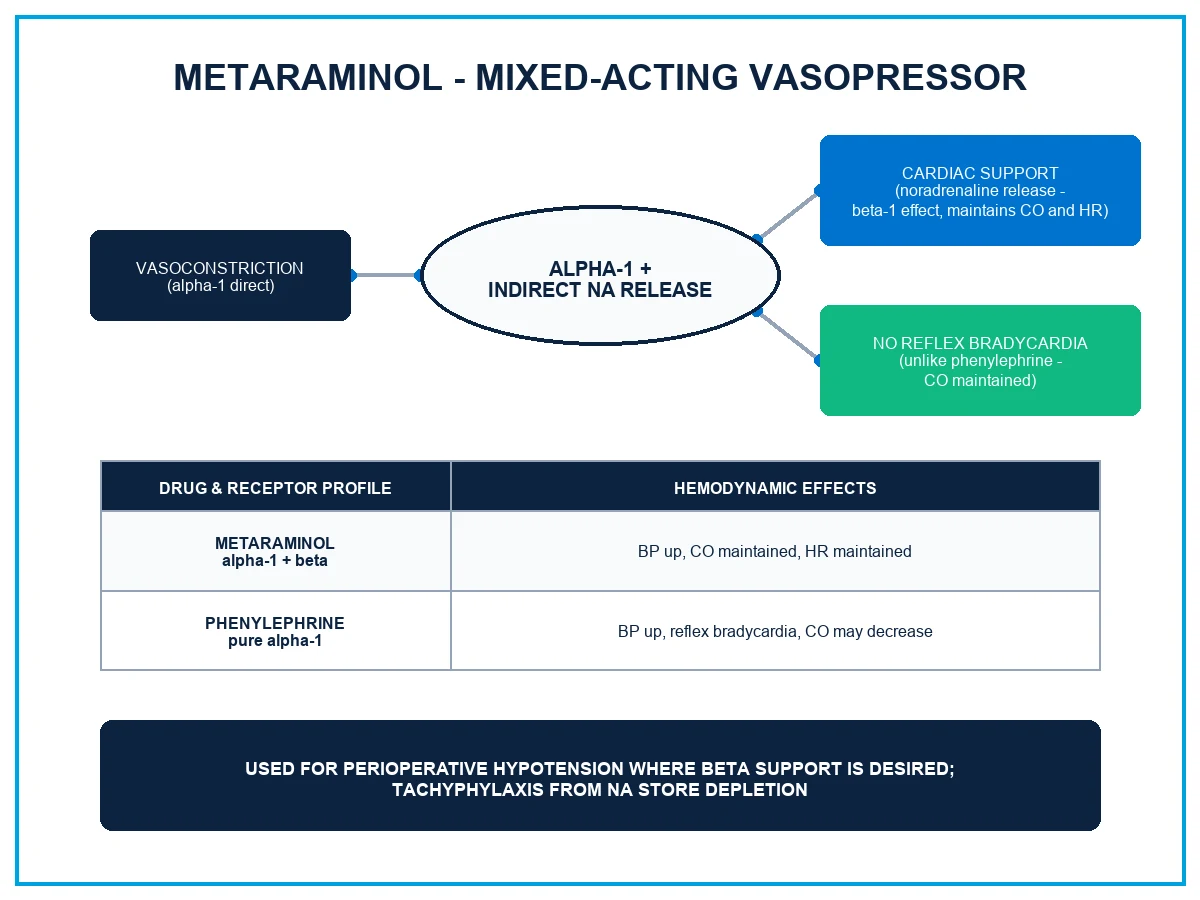
References
- [1]da Silveira F, et al. Avoidance of post-intubation arterial hypotension with push-dose metaraminol: a multicentre retrospective cohort study (ARAMAN study) Heart Lung, 2026.PMID 42173042
- [2]Gao X, et al. Effect of maternal body mass index on the dosage of metaraminol for preventing hypotension after spinal anesthesia BMC Anesthesiol, 2026.PMID 42121030
- [3]Parkinson EA, et al. The Financial and Environmental Cost of Anaesthetic Emergency Drugs: Comparing Ampoules With Prefilled Syringes Cureus, 2026.PMID 42005180
- [4]Dong T, et al. Vasopressor Selection and Postoperative Delirium in Older Adults: A Propensity-Matched Database Analysis Semin Cardiothorac Vasc Anesth, 2026.PMID 42359892
- [5]Liu D, et al. Development and external validation of an interpretable machine learning model for predicting prolonged postoperative ICU length of stay in coronary artery bypass grafting patients using MIMIC-IV 3.1 and eICU-CRD 2.0 BMC Med Inform Decis Mak, 2026.PMID 42365267
- [6]Turhan O, et al. Erector Spinae Plane Block Versus Thoracic Paravertebral Block in Laparoscopic Cholecystectomy: A Randomized Controlled Study J Clin Med, 2026.PMID 42355760