Anaes · Anaesthetic adjuncts
Morphine
Also known as Prototype mu-opioid agonist · Phenanthrene opioid analgesic · Natural opium alkaloid analgesic
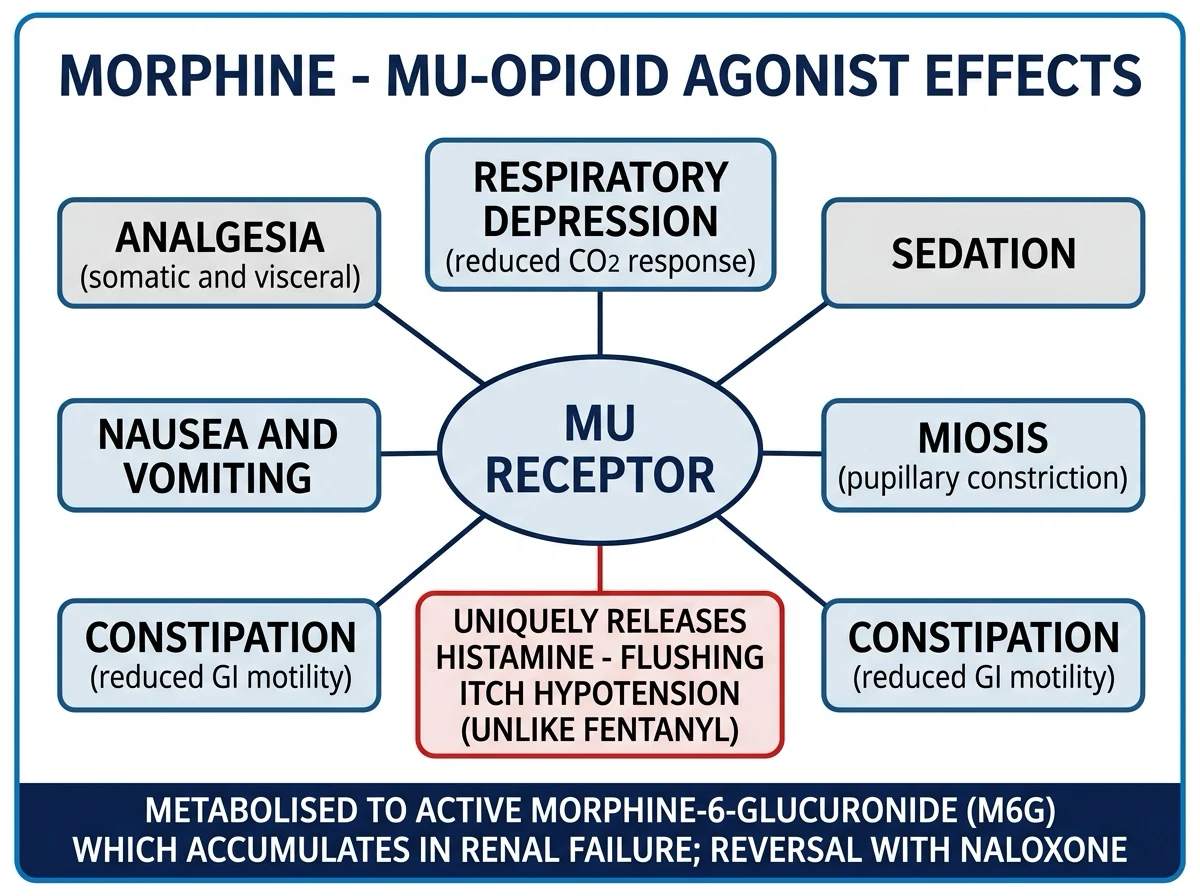
Morphine is the prototype phenanthrene opioid, a full agonist at the mu-opioid receptor and the natural alkaloid of opium against which every other opioid is compared. It produces the canonical mu-opioid constellation: analgesia, sedation, miosis, euphoria, constipation and nausea, and its principal hazard is respiratory depression from a reduced medullary response to carbon dioxide, reversed by the competitive antagonist naloxone. Two features make morphine pharmacologically distinctive and exam-critical. First, it UNIQUELY releases histamine from mast cells, producing flushing, urticaria, pruritus and vasodilation with hypotension, a feature it does not share with fentanyl and a caution in asthma. Second, it is metabolised by hepatic glucuronidation to the active metabolite morphine-6-glucuronide (M6G), which is a more potent analgesic than the parent and ACCUMULATES in renal failure, producing prolonged respiratory depression, so fentanyl (no active metabolites) is preferred in renal impairment. Tolerance, dependence and opioid-induced hyperalgesia develop with repeated use, and opioid misuse is a major public-health concern. Built on the cancer-pain measurement-based-care work (Yi 2026), the revised arthroplasty analgesia protocol (Di Lucia 2026), the kappa-agonism overdose-reversal rodent study (Voronkov 2026), the palliative opioid-therapy top-tips review (Chen 2026), the opioid-sparing clonidine-versus-fentanyl hernia trial (de Souza 2026), and the postmortem oxycodone toxicology meta-analysis (Fede 2026).
On this page & tools
Your progress
Saved locally on this device.
Target exams
Red flags

Overview — the prototype mu agonist
Morphine is the prototype phenanthrene opioid, a full agonist at the mu-opioid receptor, and the natural alkaloid of opium against which every other opioid is compared.[1] It remains the reference standard for severe acute and cancer pain: measurement-based cancer-pain analgesia still anchors its use in palliative practice, and it is central to perioperative and palliative opioid stewardship.[1][4] It has weak additional activity at the kappa and delta opioid receptors, but its clinical profile is essentially the mu-opioid profile — analgesia, sedation, miosis, respiratory depression, constipation and euphoria — and it is the drug against which fentanyl, remifentanil, oxycodone and the synthetics are all described.[6]
Mechanism — mu-receptor agonism and descending inhibition
Morphine is a full agonist at the mu-opioid G-protein-coupled receptor. Binding couples to the inhibitory Gi protein, which inhibits adenylate cyclase (reducing intracellular cAMP), closes voltage-gated presynaptic calcium channels and opens potassium channels. The net effect is neuronal hyperpolarisation and a reduction in the release of excitatory neurotransmitters — substance P, glutamate and CGRP — from the primary afferent terminal in the dorsal horn.[4] Simultaneously morphine enhances descending inhibitory pathways from the periaqueductal grey and the rostral ventromedial medulla. The result is impairment of nociceptive transmission: analgesia that is more effective for slow, deep, somatic and visceral pain than for rapid, sharp or neuropathic pain, and that raises the pain threshold and modifies the affective response to pain rather than abolishing sensation.[1]
Pharmacodynamic effects — the mu-opioid constellation
The pharmacodynamic effects of morphine are the canonical mu-opioid effects and all share the same receptor:[4]
- Analgesia — both somatic and visceral, nociceptive more than neuropathic; the affective component of pain is blunted.
- Sedation and drowsiness — dose-dependent clouding of consciousness; the patient is calm and often sleeps but is arousable.
- Euphoria — and sometimes dysphoria, mediated by the limbic reward pathways; this underlies the misuse potential.
- Respiratory depression — by a direct effect on the medullary respiratory centres, reducing the response to carbon dioxide (see below); this is the principal hazard.
- Miosis — pupillary constriction via stimulation of the Edinger-Westphal nucleus; pinpoint pupils are the classical sign of opioid overdose.
- Cough suppression — via the medullary cough centre, the basis of the historical antitussive use.
- Constipation — reduced gastrointestinal motility and increased sphincter tone, essentially universal and showing little tolerance.
- Nausea and vomiting — direct stimulation of the chemoreceptor trigger zone.
- Biliary effects — spasm of the sphincter of Oddi, raising biliary pressure (see red flags).
- Urinary retention — increased detrusor and sphincter tone.
- Cardiovascular effects — mild bradycardia and, through histamine-mediated vasodilation, hypotension. [1]
Respiratory depression — the principal hazard
The principal danger of morphine is respiratory depression. Morphine acts directly on the ventral medullary respiratory centres to reduce their sensitivity to carbon dioxide: the carbon dioxide response curve shifts rightward and its slope flattens, so the patient tolerates a higher arterial partial pressure of carbon dioxide before increasing ventilation. The clinical signs are a slow, shallow, regular breathing pattern and falling respiratory rate; death from opioid overdose is characteristically apnoea with a circulation that is initially preserved.[3] The specific antidote is naloxone, a competitive mu-opioid antagonist. Naloxone must be titrated to the respiratory rate (and oxygenation), not to full alertness: the goal is restoration of adequate ventilation, because pushing to full wakefulness precipitates severe pain, acute withdrawal and catecholamine surge in the opioid-tolerant patient.[3] Naloxone has a short half-life (about 30 to 80 minutes), shorter than morphine, so resedation is a real risk and the patient must be monitored after reversal.
Histamine release — morphine's distinguishing feature
A pharmacological feature that distinguishes morphine from fentanyl is the release of histamine from mast cells. This is not an IgE-mediated allergy but a direct mast-cell degranulation that is dose- and route-dependent (most marked with rapid intravenous administration).[3] The clinical consequences are flushing of the face, neck and upper trunk, urticaria over the injection site, pruritus (often intense, and a common reason patients dislike morphine and neuraxial morphine) and vasodilation with hypotension.[6] Because of the histamine release, morphine is used with caution in asthma (risk of bronchospasm) and in the haemodynamically unstable patient, where fentanyl — which does not release histamine — is preferred.[5]
Pharmacokinetics and metabolism
Morphine has a low oral bioavailability of about 30 per cent because of extensive first-pass metabolism, but the oral route is still used, particularly in palliative and cancer-pain maintenance.[1][4] After intravenous administration the onset of action is about 5 to 10 minutes, the peak effect occurs at around 20 minutes, and the duration of action is about 3 to 5 hours — longer than fentanyl's analgesic duration after a single bolus but much shorter than its clearance, an important distinction (see comparison below).[2]
Morphine is metabolised in the liver by glucuronidation (UGT2B7) to two main metabolites. Morphine-3-glucuronide (M3G) is inactive as an analgesic but is neuro-excitatory in excess and may contribute to myoclonus, agitation and allodynia in accumulation. Morphine-6-glucuronide (M6G) is an ACTIVE analgesic — indeed a more potent analgesic than the parent morphine — and also produces respiratory depression. Both glucuronides are excreted renally.[6]
Active metabolite M6G and renal failure — prefer fentanyl
The active metabolite morphine-6-glucuronide accumulates in renal failure because it is renally excreted, and a more potent and longer-lasting opioid effect results — classically a prolonged respiratory depression that can persist for many hours after the last morphine dose.[6] For this reason morphine is relatively contraindicated or used with great caution in renal impairment, and fentanyl — which has no active metabolites and is cleared by redistribution and hepatic metabolism to inactive species — is the preferred opioid in renal disease.[3][5] M3G also accumulates in renal failure and may cause neuro-excitability. The toxicology of opioids and their metabolites in overdose is well illustrated by the postmortem concentration literature.[6]
Hepatic and elderly considerations
In hepatic impairment, glucuronidation is relatively preserved compared with oxidation (glucuronidation is a high-capacity, less liver-dependent pathway), but in advanced liver disease clearance is reduced and the duration of action is prolonged, so the dose interval should be lengthened.[4] In the elderly, two factors combine: increased pharmacodynamic sensitivity to opioids (a given plasma concentration produces a greater effect) and reduced clearance, so the same dose produces higher and more prolonged levels. The practical rule is to reduce the dose, lengthen the interval, and titrate slowly in the elderly, in whom a standard dose can produce unexpected respiratory depression.[4]
Neuraxial morphine and delayed respiratory depression
Preservative-free morphine is used for neuraxial analgesia — epidural and intrathecal (intrathecal is the more potent and longer-lasting route). Morphine is the most hydrophilic of the common opioids, and this physicochemical property is the key to its neuraxial behaviour: unlike lipophilic fentanyl, morphine remains in the cerebrospinal fluid rather than partitioning rapidly into the spinal lipid, and so it spreads rostrally in the CSF to reach the medullary respiratory centres over many hours.[2] The clinical consequence is delayed respiratory depression with a peak at 6 to 24 hours after neuraxial administration, long after the patient has left the operating room or recovery. Patients receiving neuraxial morphine must therefore have respiratory rate and sedation score monitored overnight, and naloxone must be available.[3]
Clinical uses — acute pain, cancer, pulmonary oedema
The clinical uses of morphine follow directly from its reliable analgesia and its haemodynamic profile:[2]
- Severe acute pain — postoperative analgesia (now usually within a multimodal, opioid-sparing protocol), traumatic pain, and the analgesia of acute myocardial infarction, where the venodilation reduces preload and the analgesia blunts the sympathetic surge.[2]
- Cancer and palliative pain — morphine remains the reference opioid for moderate-to-severe cancer pain, titrated within a measurement-based-care framework against documented pain scores, and used orally for maintenance where possible.[1][4]
- Acute left-ventricular-failure pulmonary oedema — the venodilation reduces preload, the anxiolysis relieves the distressing dyspnoea, and the mild afterload reduction helps; this is a classical emergency-medicine indication.
- Neuraxial analgesia — preservative-free epidural or intrathecal morphine for major surgery (see above).
- Symptom control at the end of life — breathlessness and pain in palliative care.[4]
Tolerance, dependence, hyperalgesia and misuse
Repeated administration of morphine produces tolerance (a diminishing effect at a given dose, due to receptor downregulation and adaptive changes) and physical dependence (a withdrawal syndrome on abrupt cessation — lacrimation, rhinorrhoea, sweating, piloerection, abdominal cramps, diarrhoea, anxiety). A separate phenomenon is opioid-induced hyperalgesia, in which the patient becomes more sensitive to pain rather than less, an effect mediated by glial activation and the excitatory M3G metabolite.[4] Opioid misuse and addiction are a major public-health concern, and the pharmacology of toxicity and lethal concentrations is the subject of detailed toxicological review.[6] These properties underpin modern opioid-stewardship and the conservative, multimodal approach to perioperative and outpatient opioid therapy.[4]
Opioid-sparing multimodal analgesia
Because the adverse effects of morphine are dose-dependent, the modern approach is opioid-sparing multimodal analgesia: combining paracetamol, non-steroidal anti-inflammatory drugs, regional and neuraxial techniques, alpha-2 agonists such as clonidine or dexmedetomidine, low-dose ketamine and lidocaine infusions to minimise the total opioid dose and therefore the respiratory depression, sedation, nausea, constipation and misuse risk.[5] The clonidine-versus-fentanyl opioid-sparing trial in inguinal hernia repair is an example of the evidence base supporting this approach, in which the opioid is one component of a protocol rather than its backbone.[5]
Comparison with fentanyl
The morphine-versus-fentanyl comparison is a viva staple. The key distinctions are: [1]
- Receptor mechanism — both are full mu agonists; no difference at the receptor.
- Potency — fentanyl is roughly 100 times more potent than morphine by weight.
- Onset — fentanyl is faster (1 to 2 minutes intravenously) because its high lipid solubility speeds blood-brain barrier crossing; morphine's onset is 5 to 10 minutes because it is less lipid-soluble.
- Duration — after a single bolus fentanyl is shorter-acting (redistribution), but fentanyl is highly context-sensitive and accumulates with infusion; morphine's duration is about 3 to 5 hours.
- Histamine — morphine releases histamine (flushing, itch, hypotension, caution in asthma); fentanyl does not.[5]
- Active metabolites — morphine forms the active M6G that accumulates in renal failure; fentanyl has no active metabolites and is preferred in renal impairment.[5]
- Neuraxial behaviour — morphine is hydrophilic with rostral CSF spread and delayed respiratory depression; fentanyl is lipophilic, stays near the injection site, and has a faster onset but shorter segmental duration.
Clinical
- Standard approach
- Evidence-based
Alternative
- Modified technique
- Risk-benefit
Red flags
[1]References
- [1]Yi M, et al. Implementing measurement-based care in the analgesic management of cancer pain patients receiving intrathecal drug infusion Sci Rep, 2026.PMID 42362599
- [2]Di Lucia L, et al. An evaluation of a revised analgesia protocol for elective joint arthroplasty Ir Med J, 2026.PMID 42348181
- [3]Voronkov M, et al. Does Kappa Agonism Improve Reversal of 'Tranq-Dope' Overdose? Evidence from a Rodent Model Pharmaceuticals (Basel), 2026.PMID 42356464
- [4]Chen J, et al. Top Ten Tips Palliative Care Clinicians Should Know About Navigating Outpatient Opioid Prescribing J Palliat Med, 2026.PMID 42363735
- [5]de Souza PMF, et al. Opioid-sparing analgesia with clonidine versus fentanyl in inguinal hernia repair: a randomized clinical trial Hernia, 2026.PMID 42364024
- [6]Fede MS, et al. Postmortem Oxycodone Toxicology: A Systematic Review and Meta-Analysis of Concentrations and Interpretative Markers Molecules, 2026.PMID 42357450