Anaes · Neuromuscular blockade & reversal
Neostigmine reversal of neuromuscular blockade
Also known as Anticholinesterase reversal · Acetylcholinesterase inhibition · Neostigmine plus glycopyrrolate · Competitive-block reversal
Neostigmine is a reversible acetylcholinesterase inhibitor that raises the concentration of acetylcholine at the neuromuscular junction so that it outcompetes a non-depolarising blocker at the postsynaptic nicotinic receptor, restoring neuromuscular transmission (Kronauer 2026; Tao 2026). It reverses ONLY non-depolarising (competitive) blocks; it does not reverse and in fact augments a depolarising (suxamethonium phase I) block, so it must never be used to reverse sux. It must be given only once spontaneous recovery has begun — ideally at a train-of-four count of 4 with fade — because there is a ceiling effect beyond a maximum dose and a risk of neostigmine-induced weakness (a cholinergic-excess depolarising-type block) if it is overdosed. It MUST be co-administered with an anticholinergic, glycopyrrolate preferred (or atropine), to block the muscarinic effects of bradycardia, bronchospasm, salivation and gut cramps, in a ratio of roughly 5 parts neostigmine to 2 parts glycopyrrolate. Compared with sugammadex (Tsai 2026; Leslie 2026; Martins de Brito 2026; Chen 2026), neostigmine is cheap and applicable to all non-depolarisers but slower, needs evidence of recovery, has a ceiling effect, and is associated with residual blockade and postoperative pulmonary complications. It is a quaternary ammonium compound that does not cross the blood-brain barrier, and it is also used for acute colonic pseudo-obstruction (Ogilvie syndrome) and, off-label, as a regional-anaesthesia adjuvant (Zamani Kiasari 2026).
On this page & tools
Your progress
Saved locally on this device.
8 MCQs with explanations
Target exams
Red flags

Overview — anticholinesterase reversal
Neostigmine is the classical acetylcholinesterase inhibitor used to reverse a non-depolarising neuromuscular block. It belongs to the anticholinesterase class, and its place in modern anaesthesia is as the cheap, broadly applicable reversal agent — the comparator against which the newer encapsulation agent sugammadex is measured.[6][5]
The contemporary reviews of muscle relaxation and neuromuscular monitoring (Kronauer and colleagues, 2026) and of reversal practice across centres (Tao and colleagues, 2026) both frame neostigmine the same way: an effective reversal of a competitive block provided the block has already begun to recover, with a ceiling on its effect and a burden of muscarinic side effects that must be co-managed.[6][5]
Mechanism — acetylcholinesterase inhibition
At the neuromuscular junction, acetylcholine released by the motor nerve terminal acts at the postsynaptic nicotinic receptor to depolarise the muscle fibre, and is then hydrolysed within milliseconds by acetylcholinesterase in the synaptic cleft. A non-depolarising muscle relaxant produces its block by competitive antagonism at that same nicotinic receptor: it occupies the receptor without activating it, so acetylcholine cannot act.[6]
Neostigmine is a reversible inhibitor of acetylcholinesterase. It carbamylates the esteratic site of the enzyme, forming a carbamoyl-enzyme complex that hydrolyses slowly, so the enzyme is functionally inhibited for a useful clinical period. With breakdown blocked, acetylcholine accumulates at the junction. The rising acetylcholine concentration displaces the non-depolarising blocker from the receptor by mass action — it outcompetes the blocker — and neuromuscular transmission is restored.[6]
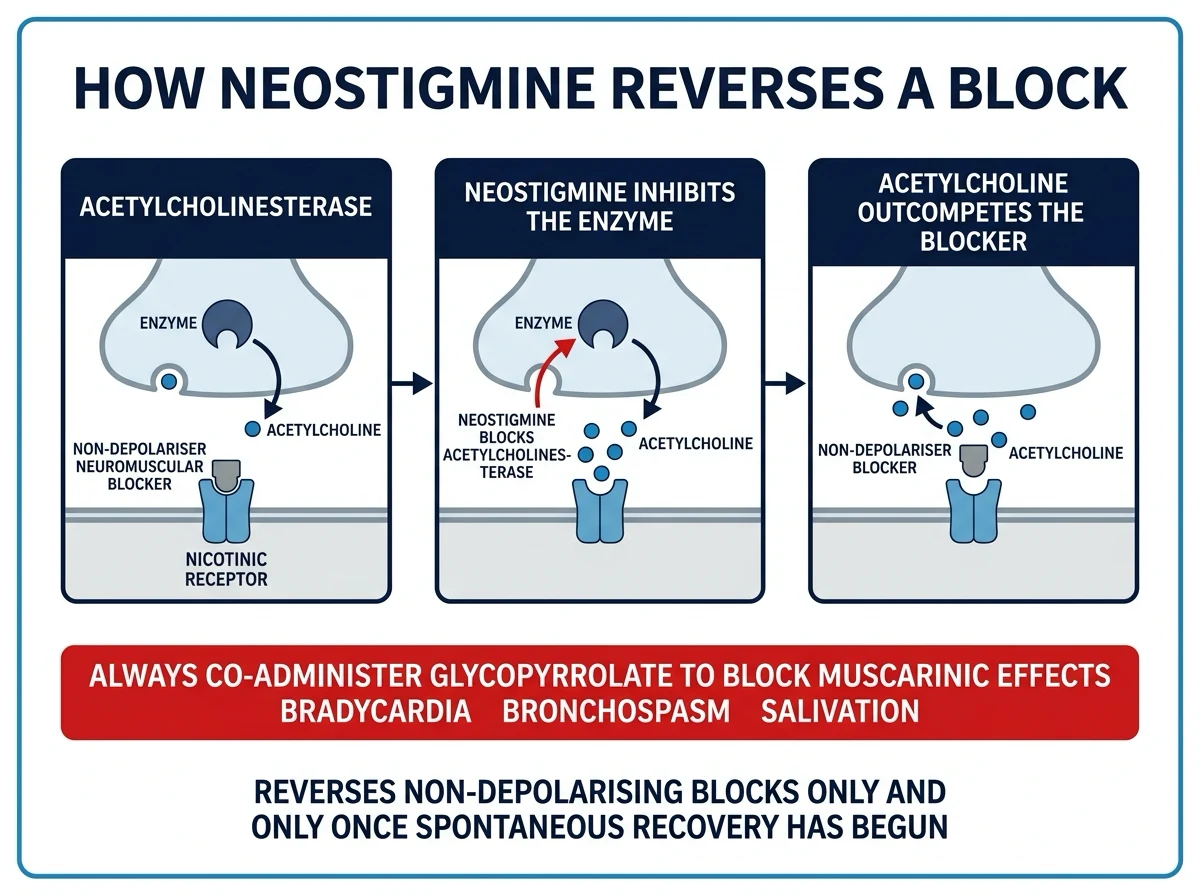
Two consequences follow directly from this mechanism and dominate the exam answer. First, because the strategy depends on raising acetylcholine to overcome a competitor, neostigmine can only reverse a competitive (non-depolarising) block — it cannot reverse a block that is not competitive in the first place. Second, because it raises acetylcholine everywhere cholinesterase acts, it produces muscarinic as well as nicotinic effects, which is why an anticholinergic is mandatory.[6]
What it reverses — and what it does not
Neostigmine reverses non-depolarising (competitive) blocks — those produced by rocuronium, vecuronium, atracurium, cisatracurium, mivacurium, pancuronium and the rest. These are the blocks it is designed for, and for the benzylisoquinolines (atracurium, cisatracurium, mivacurium) it remains the principal reversal agent, since sugammadex cannot encapsulate them.[6]
Neostigmine does not reverse a depolarising block, and this is a frequent exam point and a clinical trap. Suxamethonium (succinylcholine) produces a phase I depolarising block by persistently depolarising the end-plate; raising acetylcholine further does not overcome it and augments the depolarisation, deepening the block. Neostigmine must therefore never be used to reverse a suxamethonium block. In a suxamethonium phase II (desensitising) block, which can appear after prolonged or repeated dosing, anticholinesterase reversal is unreliable and risky, and the diagnosis must be secure before any reversal is attempted.[6]
Timing — only after spontaneous recovery has begun
Because neostigmine works by raising acetylcholine to outcompete the blocker, it can only restore transmission once there is a receptor population beginning to recover for the acetylcholine to act on. It is therefore given only once spontaneous recovery is under way, ideally at a train-of-four count of 4 with fade (or, at a minimum, a confirmed return of twitches on quantitative monitoring).[6][5]
Given during a deep block — when there is no twitch on the train-of-four, or only one — neostigmine is ineffective: there is nothing for the accumulated acetylcholine to recover. The surveys and reviews of current practice make this the central teaching of neostigmine reversal: confirm recovery objectively before reversing, and if the block is deep and the agent is an aminosteroid, use sugammadex instead.[6][5]
Dose, onset, duration and the ceiling effect
The dose of neostigmine for reversal is about 0.04 to 0.07 mg per kg, to a maximum of around 5 mg in the adult. The onset is roughly 5 to 10 minutes and the duration of effect is 30 to 60 minutes.[6]
A defining pharmacological property is the ceiling effect. Neostigmine inhibits acetylcholinesterase; once essentially all the available enzyme is inhibited, the acetylcholine concentration cannot be driven any higher by giving more neostigmine. Beyond the maximum dose, additional neostigmine produces no further reversal — all the enzyme is already inhibited — and, as the next section explains, it begins to do harm. This ceiling is the fundamental reason neostigmine cannot reverse a deep block and the basis for sugammadex's advantage in that setting, since sugammadex removes the blocker rather than opposing it and has no such ceiling.[6]
Neostigmine-induced weakness — why overdose is harmful
The same rising acetylcholine that restores transmission at the right dose becomes the problem at excessive dose. A cholinergic excess at the neuromuscular junction can itself produce a depolarising-type block at the nicotinic receptor — the receptor is persistently activated and depolarised, the membrane does not repolarise, and the result is weakness rather than recovery. This is neostigmine-induced weakness, and it is the direct reason not to push the dose beyond the maximum chasing a fuller reversal.[6]
The clinical implication is that more is not better. Once the ceiling is reached the only way to recover the block further is to remove the blocker (sugammadex for rocuronium or vecuronium) or to wait for spontaneous recovery and elimination of the relaxant.[6]
Muscarinic side effects and the mandatory anticholinergic
Neostigmine raises acetylcholine at all cholinergic synapses, not only at the neuromuscular junction. At muscarinic receptors this produces the predictable cholinergic syndrome: bradycardia and even asystole, bronchospasm and increased bronchial secretions, salivation, miosis, increased gut motility and cramps, and urinary urgency. Left unopposed these effects are dangerous — the bradycardia can be profound — so neostigmine must always be co-administered with an anticholinergic (antimuscarinic) that blocks the muscarinic but not the nicotinic effects.[6]
Glycopyrrolate (glycopyrronium) is the preferred anticholinergic because its onset and duration closely match those of neostigmine, so the two agents cover each other in time. Atropine is an alternative; it has a faster onset but a shorter duration, which can leave a late muscarinic window. The two are dosed together in a ratio of roughly 5 parts neostigmine to 2 parts glycopyrrolate by dose (for example, neostigmine 2.5 mg with glycopyrrolate 0.5 mg, or neostigmine 0.05 mg/kg with glycopyrrolate 0.01 mg/kg). The rule is absolute: never give neostigmine without an anticholinergic.[6]
Pharmacology — quaternary ammonium, no blood-brain barrier crossing
Neostigmine is a quaternary ammonium compound — it carries a permanent positive charge — and is therefore ionised and lipid-insoluble at physiological pH. It does not cross the blood-brain barrier, so it produces no central cholinergic effects; its action is confined to the periphery. This is the important contrast with physostigmine, a tertiary amine that is lipid-soluble and does cross the blood-brain barrier, and which can therefore be used for central anticholinergic toxicity (and correspondingly can produce central cholinergic effects).[6]
Neostigmine is poorly absorbed from the gut, so it is given intravenously for reversal. It is partly metabolised by plasma esterases and partly excreted unchanged by the kidney, which is relevant in renal failure, where its duration may be prolonged.[6]
Other anticholinesterases
The anticholinesterase class contains several agents whose contrasting kinetics the exam expects you to place alongside neostigmine.[6]
Edrophonium has a faster onset and shorter duration than neostigmine; it is rarely used in modern anaesthetic practice (historically it was used in the diagnosis of myasthenia gravis, a role now largely supplanted). Pyridostigmine is slower in onset and longer in duration than neostigmine; its oral form is a mainstay of the chronic treatment of myasthenia gravis. Physostigmine, as noted, is the tertiary-amine anticholinesterase that crosses the blood-brain barrier and is used for central anticholinergic syndrome. Neostigmine sits in the middle of this range for reversal use.[6]
Neostigmine versus sugammadex
The comparison with sugammadex is the heart of the modern reversal question, and it is now firmly evidence-based. Sugammadex is a modified gamma-cyclodextrin that encapsulates rocuronium and vecuronium in the plasma, lowering their free concentration so the blocker diffuses away from the junction — a mechanism independent of acetylcholine or of spontaneous recovery.[1][3]
The differences fall into clear axes. Applicability: neostigmine reverses all non-depolarisers; sugammadex reverses only rocuronium and vecuronium (the aminosteroids) and is useless for the benzylisoquinolines. Speed and depth: sugammadex reverses even a profound, deep block rapidly and completely, whereas neostigmine is effective only once recovery has begun and cannot reverse a deep block. Ceiling: neostigmine has a ceiling, sugammadex does not. Anticholinergic: neostigmine requires a co-administered antimuscarinic; sugammadex does not. Cost: neostigmine is cheap, sugammadex is expensive. The randomised and pharmacoeconomic literature has now tested whether sugammadex's pharmacological advantages translate into better outcomes.[1][2][3]
The combined strategy has also been examined: Chen and colleagues (2026) tested half-dose neostigmine with low-dose sugammadex for vecuronium reversal, seeking to preserve sugammadex's effectiveness while limiting its cost — an active area of practice where the two agents are used together rather than as alternatives.[4]
Residual blockade and postoperative pulmonary complications
The safety question for neostigmine is whether reversal with it leaves patients with residual neuromuscular blockade — a train-of-four ratio below 0.9 in recovery — and whether that translates into harm. Residual blockade produces a weak, poorly coordinated upper airway, an impaired ventilatory response to hypoxia, and a weak cough, so that the clinical consequences are upper-airway obstruction, hypoxaemia and aspiration in the recovery room.[1][3]
The 2026 outcome studies are the evidence an examiner now expects. Tsai and colleagues (2026) compared sugammadex with neostigmine and the risk of postoperative pulmonary complications, finding an advantage to sugammadex — consistent with the pharmacology, since sugammadex produces more complete reversal.[1] Leslie and colleagues (2026), publishing in the Lancet Respiratory Medicine, reported the definitive comparison of sugammadex versus neostigmine for reversal and postoperative pulmonary complications, establishing the outcomes advantage that the earlier pharmacological studies had only inferred.[3] Martins de Brito and colleagues (2026) extended the comparison to postoperative cognitive recovery, an emerging endpoint in the field.[2]
The synthesis is that neostigmine, used correctly (only after recovery has begun, with an anticholinergic, with quantitative monitoring), remains effective, but it is associated with a higher residual-blockade and pulmonary-complication burden than sugammadex for the aminosteroids — and that is the modern argument for sugammadex where the agent and the resources allow.[1][3]
Other uses — Ogilvie syndrome, myasthenia and regional adjuvant
Beyond reversal, neostigmine has two further uses worth knowing. First, it is a treatment for acute colonic pseudo-obstruction (Ogilvie syndrome), in which a massively dilated atonic colon fails to propel its contents; intravenous neostigmine, given in a monitored setting because of its muscarinic effects, can decompress the colon and avert ischaemia and perforation.[6] Second, in the chronic management of myasthenia gravis, the oral anticholinesterase pyridostigmine is the mainstay, but intravenous neostigmine has a role in myasthenic crisis.[6]
A third, off-label use is as a regional-anaesthesia adjuvant: neostigmine has been added to local-anaesthetic blocks for its analgesic effect at spinal and peripheral sites. Zamani Kiasari and colleagues (2026), for example, compared the additive effect of dexmedetomidine and neostigmine with bupivacaine on peripheral nerve block, illustrating this continuing line of investigation — though this remains an off-label application and not a routine use.[7]
Clinical workflow and current place in practice
The integrated contemporary workflow for neostigmine reversal is: monitor the block quantitatively with acceleromyography at the adductor pollicis; confirm that spontaneous recovery has begun — ideally a train-of-four count of 4 with fade; then administer neostigmine 0.04 to 0.07 mg/kg to a maximum of about 5 mg together with glycopyrrolate in the 5 to 2 ratio; and confirm a train-of-four ratio of 0.9 or above before extubation. Do not exceed the maximum dose; if the block is still deep after a reasonable interval and the agent is rocuronium or vecuronium, use sugammadex rather than pushing neostigmine.[6][5]
The place of neostigmine in modern practice is therefore as the cheap, universal reversal for non-depolarising blocks that have begun to recover, indispensable for the benzylisoquinolines and for settings where sugammadex is unavailable, but increasingly displaced by sugammadex for the aminosteroids — particularly after a deep block — wherever the outcomes evidence and the resources support it. The survey of Tao and colleagues (2026) documents that this transition is uneven across centres, with neostigmine still heavily used and quantitative monitoring still under-deployed, which is itself a marker of residual-blockade risk.[5][6]
Clinical
- Standard approach
- Evidence-based
Alternative
- Modified technique
- Risk-benefit
Red flags
[1]References
- [1]Tsai YF, et al. Sugammadex vs. neostigmine and the risk of postoperative pulmonary complications after upper gastrointestinal endoscopic procedures: a propensity score matched analysis of 15,730 patients Anaesthesia, 2026.PMID 42317106
- [2]Martins de Brito H, et al. The Effect of Sugammadex Versus Neostigmine on Postoperative Cognitive Recovery: A Systematic Review and Meta-Analysis Cureus, 2026.PMID 42317954
- [3]Leslie K, et al. Sugammadex versus neostigmine for reversal of neuromuscular blockade and postoperative pulmonary complications (SNaPP): an international, randomised, controlled, phase 4 trial Lancet Respir Med, 2026.PMID 42263720
- [4]Chen Z, et al. Half-dose neostigmine and low dose sugammadex as a reversal agent for vecuronium: a pilot randomized trial Anaesth Crit Care Pain Med, 2026.PMID 42217574
- [5]Tao JC, et al. Current status of neuromuscular reversal and neuromuscular monitoring in China: a cross-sectional survey BMC Anesthesiol, 2026.PMID 42185770
- [6]Kronauer T, et al. [Muscle relaxation and neuromuscular monitoring : Current findings and recommendations for the clinical practice] Anaesthesiologie, 2026.PMID 42334564
- [7]Zamani Kiasari A, et al. Comparing additive effect of dexmedetomidine and neostigmine to bupivacaine on postspinal anesthesia cesarean section induced pain intensity: A health promotion Approach J Educ Health Promot, 2026.PMID 42328403