Anaes · Neuromuscular blockade & reversal
Neuromuscular blockade & reversal
Also known as Muscle relaxants · Neuromuscular blocking agents · Sugammadex · Train-of-four · Residual curarisation
Neuromuscular blockade is the reversible abolition of skeletal-muscle tone that makes surgery and intubation possible. The framework rests on four exam-critical ideas: the block is produced at the nicotinic receptor of the neuromuscular junction, either by depolarisation (succinylcholine) or by competitive antagonism (rocuronium, vecuronium, the benzylisoquinolines); its depth must be measured objectively with a train-of-four monitor, because the eye and the hand cannot; reversal is by two entirely different mechanisms — the acetylcholinesterase inhibitor neostigmine, which raises acetylcholine to outcompete a non-depolariser, and sugammadex, which encapsulates rocuronium and vecuronium and removes them from the junction; and the clinical goal is a train-of-four ratio of 0.9 or above at extubation, because residual blockade below that threshold causes hypoxaemia, weakness and aspiration in the recovery room. Built on the first-in-human sugammadex study (Gijsenbergh 2005), the Cochrane reviews of sugammadex and of rocuronium-versus-succinylcholine, the perioperative monitoring consensus (Naguib 2018), the SNaPP outcomes trial (Leslie 2026), and the perioperative hypersensitivity epidemiology (Mertes 2019).
On this page & tools
Your progress
Saved locally on this device.
8 MCQs with explanations
Target exams
Red flags
Overview & definition
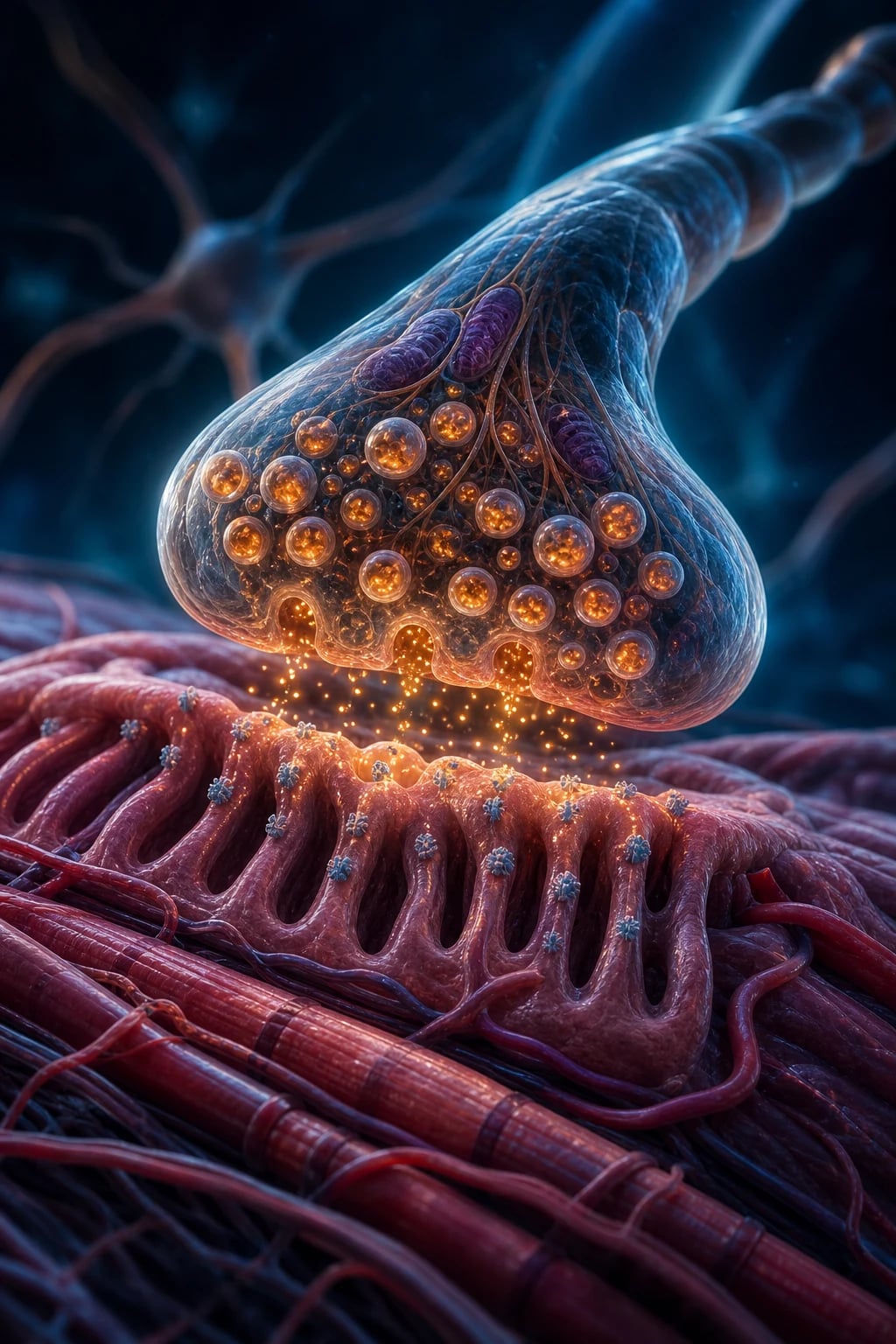
Neuromuscular blockade is the reversible abolition of skeletal-muscle contraction, produced by drugs that act at the nicotinic receptor of the neuromuscular junction. It is the cornerstone of anaesthesia for the surgeon — it abolishes reflex movement and tone, relaxes the vocal cords for intubation, and permits controlled ventilation — and it is the one anaesthetic intervention whose depth must be measured, not guessed, because an unrecognised residual block in recovery is a silent cause of hypoxaemia and airway obstruction.[5]
The neuromuscular blocking agents fall into two classes by mechanism. The depolarising agent succinylcholine acts like acetylcholine, depolarising the end-plate but resisting breakdown, producing an initial contraction (fasciculation) followed by flaccid paralysis. The non-depolarising agents (rocuronium, vecuronium, atracurium, cisatracurium and the rest) are competitive antagonists — they occupy the receptor without activating it, so that acetylcholine cannot act.[5]
The reversal of a non-depolarising block is achieved by two wholly distinct mechanisms. Neostigmine inhibits acetylcholinesterase, raising acetylcholine at the junction to outcompete the blocker — effective only once spontaneous recovery has begun. Sugammadex is a modified gamma-cyclodextrin that encapsulates rocuronium and vecuronium in the plasma and removes them from the junction entirely — a mechanism with no receptor action, which is why it can reverse even a profound block.[1][2]
The neuromuscular junction and the mechanism of block
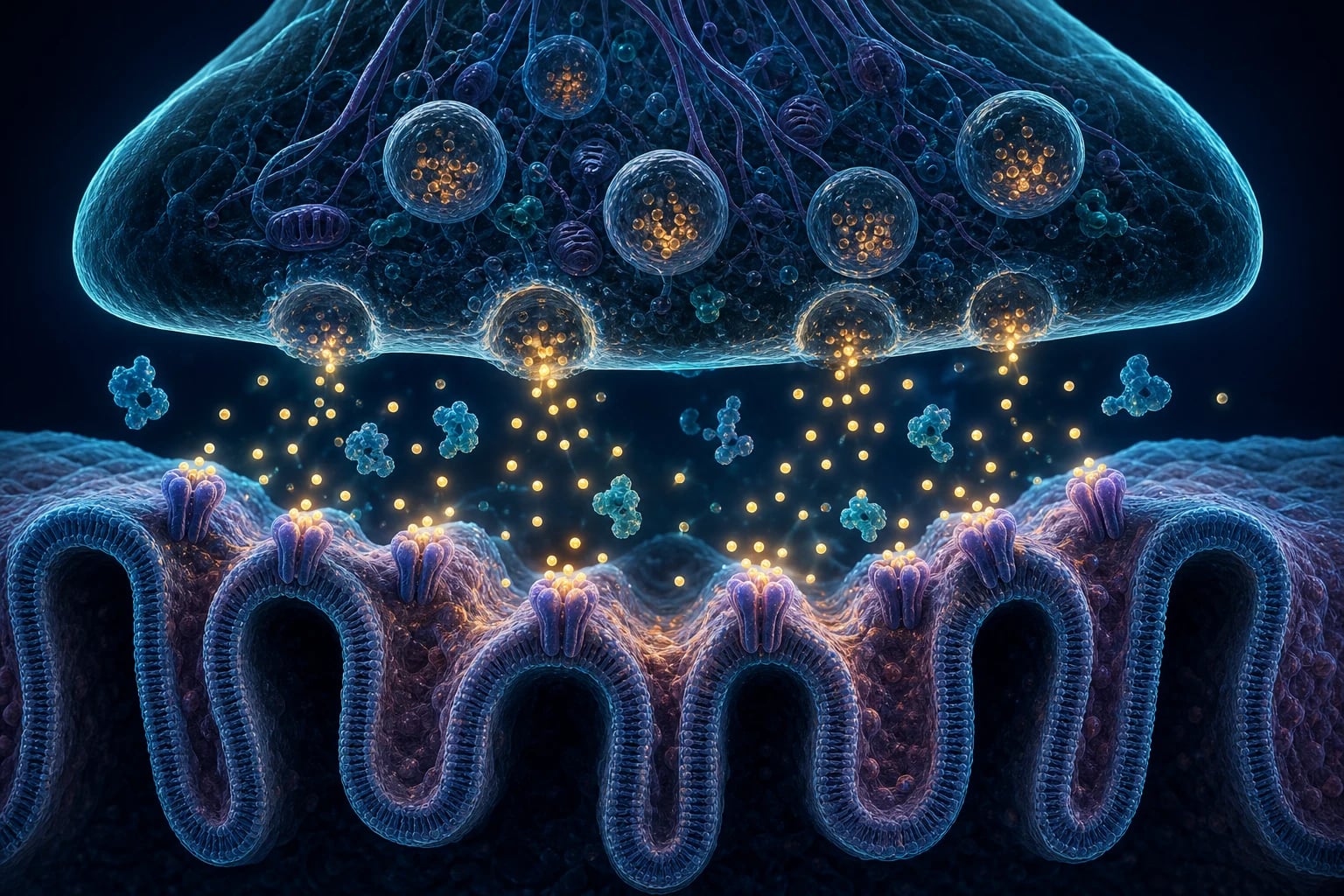
The arrival of an action potential at the motor nerve terminal releases acetylcholine into the synaptic cleft. Acetylcholine binds the nicotinic receptors on the highly folded motor end-plate; the receptor's ion channel opens, sodium influx depolarises the membrane, and the muscle contracts. Acetylcholinesterase, anchored in the cleft, hydrolyses the transmitter within milliseconds, ending the signal and resetting the receptor.[5]
Both classes of neuromuscular blocker act at the post-junctional nicotinic receptor, but in opposite ways. Succinylcholine is a depolarising agonist — it binds and opens the channel, producing a sustained depolarisation that first excites (the visible fasciculations) and then renders the end-plate refractory, so no further impulse can pass. The non-depolarisers are competitive antagonists — they occupy the receptor without opening the channel, so acetylcholine is outnumbered and transmission fails. The practical consequence is that the two classes behave differently, are monitored differently, and are reversed differently. [1]
Depolarising block: succinylcholine
Succinylcholine (suxamethonium) remains unmatched for the speed of its onset — it produces intubating conditions within 30 to 60 seconds — because its depolarising action is rapid and complete. It is hydrolysed by plasma (butyryl)cholinesterase, so its clinical effect is short, around 5 to 10 minutes, which is its great advantage for a rapid sequence induction where the airway must be secured swiftly and recovered quickly if it fails.[8]
Its disadvantages, however, are numerous and examined relentlessly: [1]
- Hyperkalaemia — the depolarisation releases potassium from muscle; this is small in the healthy patient but dangerously large in the patient with upregulated, denervated or injured muscle — burns (beyond about 24 hours), crush injury, denervation, prolonged immobility, upper motor neuron lesions and severe abdominal sepsis — in whom succinylcholine can cause a hyperkalaemic cardiac arrest.
- Malignant hyperthermia — succinylcholine is a recognised trigger, and is contraindicated in the known susceptible patient.
- Bradycardia, especially with repeated doses, from its muscarinic effects.
- Postoperative myalgia, from the initial fasciculations.
- Raised intraocular and intragastric pressure — a concern in the open-eye and the full-stomach patient.
- Prolonged block in the patient with inherited or acquired plasma cholinesterase deficiency.
- Anaphylaxis — it is among the commonest culprits of perioperative anaphylaxis.[7]
Non-depolarising agents: rocuronium, vecuronium and the benzylisoquinolines
The non-depolarising agents are competitive antagonists at the nicotinic receptor. They differ in onset, duration, route of elimination, and — critically — whether they can be encapsulated by sugammadex.[5]
- Rocuronium (an aminosteroid) is the workhorse of modern practice. It has an onset approaching that of succinylcholine at high dose (1.2 mg/kg produces intubating conditions in about 60 seconds, the basis of its use in rapid sequence induction), an intermediate duration, and — uniquely among the common agents — it is rapidly reversible by sugammadex.
- Vecuronium (also an aminosteroid) is slower in onset, intermediate in duration, and likewise reversible by sugammadex.
- Atracurium and cisatracurium (benzylisoquinolines) undergo Hofmann elimination (a spontaneous, pH- and temperature-dependent breakdown) and non-specific ester hydrolysis, so they are independent of renal and hepatic function — the choice in renal or hepatic failure. They are not reversed by sugammadex. [1]
The key practical point is that the choice of agent is governed by the intended reversal: rocuronium (or vecuronium) if sugammadex reversal is planned, atracurium or cisatracurium if organ failure makes that the safer maintenance drug. [1]
Monitoring the block: train-of-four and quantitative monitoring
A neuromuscular block is only safe to reverse and to extubate once it has recovered to a train-of-four ratio of 0.9 or above. The train-of-four (TOF) delivers four supramaximal stimuli at 0.5-second intervals and compares the height of the fourth twitch to the first (the T4/T1 ratio). At full recovery the ratio is 1.0; as the non-depolarising block deepens, the later twitches disappear first, so the ratio falls and then the twitches vanish in reverse order.[5]
The deep block is graded by counting the post-tetanic count (PTC) — the number of twitches after a tetanic stimulus — when there is no response to the train-of-four at all. This matters because the dose of sugammadex is chosen by the depth of the block (below). [1]
The central teaching of the perioperative monitoring consensus is that only quantitative (objective) monitoring is reliable. The qualitative assessment — feeling the twitch, asking the patient to lift their head, or judging by eye — cannot reliably detect a TOF ratio below 0.9, and therefore cannot reliably exclude residual blockade. Every patient receiving a neuromuscular blocker should have quantitative acceleromyographic monitoring at the adductor pollicis from induction to a confirmed TOF ratio of 0.9 or above in recovery.[5]
Reversal of non-depolarising block: the acetylcholinesterase inhibitors
Neostigmine is the classical reversal agent. It inhibits acetylcholinesterase, so acetylcholine accumulates at the junction and outcompetes the non-depolarising blocker at the receptor — a strategy that works only when there is something to compete with, that is, when spontaneous recovery is already under way (at least one twitch on the train-of-four). Given at a deep block it is ineffective and, by raising acetylcholine to no useful end, may itself contribute to weakness.[2]
Neostigmine is given with an antimuscarinic — glycopyrrolate — to limit its muscarinic side effects (bradycardia, salivation, bronchoconstriction). The dose is around 0.04 to 0.07 mg/kg to a maximum of about 5 mg. Its limitations are the mirror of sugammadex's strengths: it is slower, it cannot reverse a deep block, and it relies on the block having receded — which is precisely why residual blockade after neostigmine has been, historically, so common.[2][3]
Sugammadex: the encapsulating reversal agent
Sugammadex is a modified gamma-cyclodextrin — a hollow, lipophilic torus of glucose molecules that binds rocuronium (and, less avidly, vecuronium) in a tight 1:1 encapsulation complex in the plasma. By binding the drug, it lowers its free plasma concentration, and the blocker diffuses away from the junction down the concentration gradient. The complex is then excreted unchanged by the kidney. Sugammadex has no action at any receptor — it does not inhibit acetylcholinesterase, it does not act at the nicotinic receptor — which is why it reverses even a profound block and has few of the autonomic effects of neostigmine.[1]
The agent was introduced by the first-in-human study of Gijsenbergh and colleagues in 2005, which demonstrated the dose-dependent encapsulation and reversal of rocuronium — a genuinely novel mechanism, the first reversal of a drug by selective encapsulation rather than by opposing its pharmacology.[1]
Two constraints define its use. First, it reverses only rocuronium and vecuronium — it has no affinity for succinylcholine or the benzylisoquinolines, and reaching for it after atracurium is an error. Second, it is excreted unchanged by the kidney, so it is used with caution (or avoided) in severe renal impairment. [1]
Sugammadex dosing: 2, 4 and 16 mg/kg by depth of block [1]
The dose of sugammadex is chosen by the depth of the block, measured on the monitor: [1]
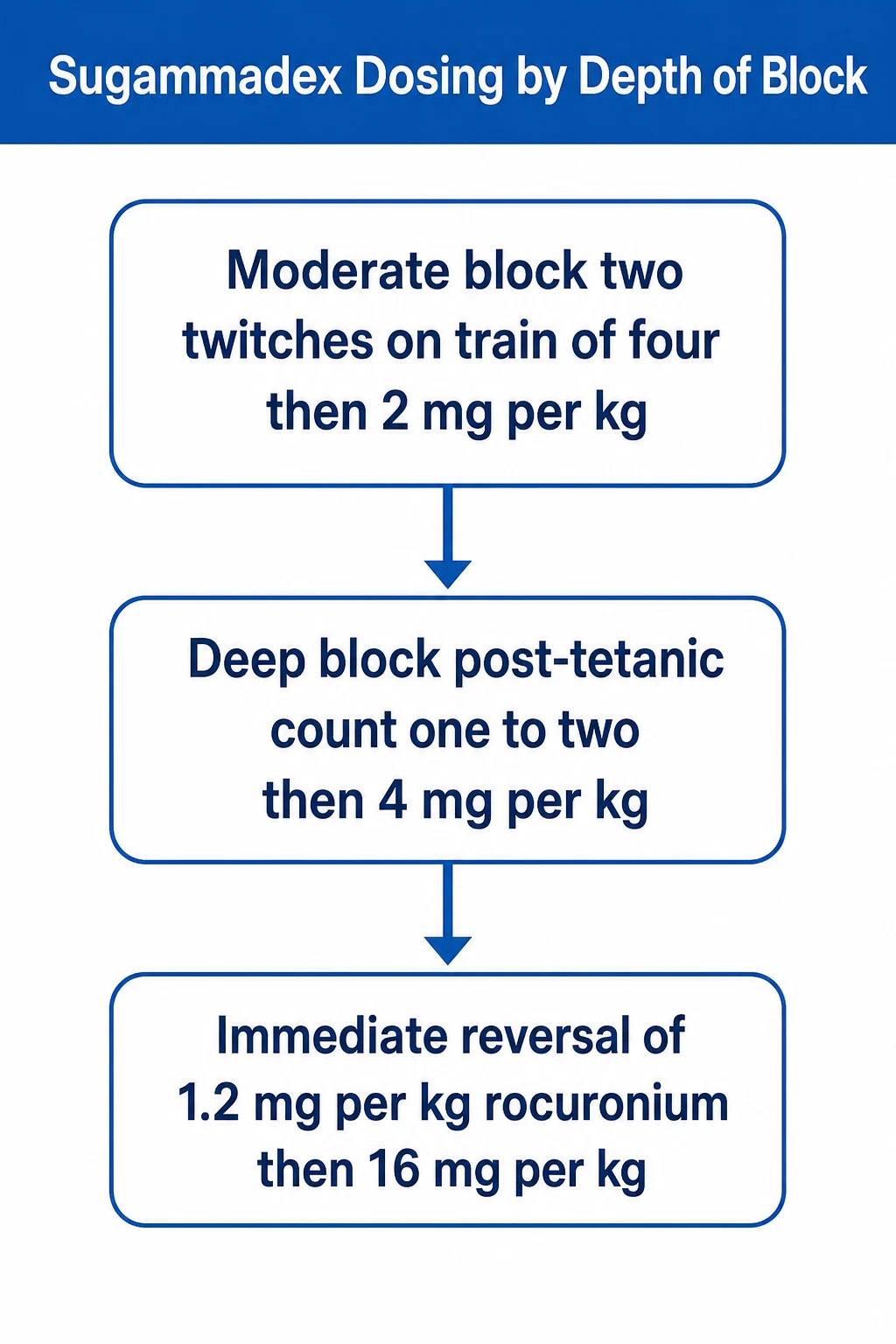
- 2 mg/kg for the recovery of a moderate block — when at least two twitches have returned spontaneously on the train-of-four (TOF2).
- 4 mg/kg for the recovery of a deep block — when there is a post-tetanic count of one or two but no train-of-four response.
- 16 mg/kg for the immediate, routine reversal of a profound block shortly after a 1.2 mg/kg intubating dose of rocuronium — reversing the patient to a safe state in around three minutes, the role that made sugammadex the answer to the failed rapid sequence induction. [1]
Because the dose tracks the depth, quantitative monitoring is inseparable from safe sugammadex use: without knowing how deep the block is, the dose is a guess.[2][5]
Sugammadex versus neostigmine: the evidence
The Cochrane review of sugammadex versus neostigmine for the reversal of neuromuscular blockade in adults found that sugammadex reverses the block faster and more completely than neostigmine, with a markedly lower rate of residual neuromuscular blockade — across moderate and deep blocks. The earlier Cochrane review had established that sugammadex prevents postoperative residual blockade relative to neostigmine (or placebo).[2][3]
The clinical question that followed was whether that pharmacological superiority translates into better patient outcomes — fewer pulmonary complications. The SNaPP trial (Leslie and colleagues, 2026), an international randomised phase 4 trial, compared sugammadex with neostigmine for reversal and its effect on postoperative pulmonary complications — the definitive outcomes test of the two agents, and the study an examiner now expects cited when the comparison is asked.[6]
Rocuronium versus succinylcholine for rapid sequence induction
The Cochrane review of rocuronium versus succinylcholine for rapid sequence induction intubation concluded that succinylcholine provides slightly superior intubating conditions, but rocuronium at 1.2 mg/kg is an acceptable alternative — and, critically, one whose block can be immediately reversed by sugammadex if the airway fails. This single property — the ability to undo a near-succinylcholine-speed intubating dose within minutes — is the principal reason rocuronium has displaced succinylcholine in many centres for the rapid sequence induction, especially where succinylcholine is contraindicated.[8][9]
Residual neuromuscular blockade and its consequences
Residual neuromuscular blockade — a train-of-four ratio below 0.9 in the recovery room — is the central safety problem of the field, and the reason quantitative monitoring is mandated. An incompletely recovered patient has a weak, poorly coordinated upper airway, an impaired ventilatory response to hypoxia, and a weakened cough — the combination that produces upper-airway obstruction, hypoxaemia, aspiration, and the occasional need for reintubation in recovery.[3][5]
The condition is silent: the patient looks awake, may obey commands and lift their head briefly, yet still have a TOF ratio in the dangerous range — which is why the clinical tests (head lift, hand grip, eye opening) are unreliable and the monitor is not. The prevention is twofold: monitor quantitatively to a confirmed TOF ratio of 0.9, and reverse with an agent and a dose matched to the depth of the block.[5]
Adverse effects and safety: anaphylaxis, bradycardia, recurarisation
- Anaphylaxis. The neuromuscular blocking agents are the leading cause of perioperative anaphylaxis, and among them rocuronium and succinylcholine are among the commonest culprits. The comparative epidemiology of perioperative hypersensitivity places the muscle relaxants at the top of the list of incriminated agents. Sugammadex is a rare cause. A sudden cardiovascular collapse on induction, with or without bronchospasm or cutaneous signs, is anaphylaxis until proven otherwise and is treated immediately with intravenous adrenaline.[7]
- Bradycardia and asystole can occur with both neostigmine (if the antimuscarinic is inadequate) and, rarely, sugammadex, and with repeated succinylcholine.
- Recurarisation — the reappearance of the block after apparent recovery — was a recognised hazard of neostigmine reversal at depth, when the inhibitor wore off before the blocker did. It is far less likely with sugammadex, which removes the blocker rather than opposing it, though recurarisation has nonetheless been reported in particular circumstances.[2]
Special populations: paediatrics, renal impairment, the elderly
- Paediatrics. The Cochrane review of sugammadex for the reversal of neuromuscular blockade in infants and children confirms its efficacy and safety in this population, extending the adult evidence to paediatric practice.[4]
- Renal impairment. Because sugammadex and its rocuronium complex are excreted unchanged by the kidney, sugammadex is used with caution or avoided in severe renal impairment, where a benzylisoquinoline (atracurium, cisatracurium) — cleared by Hofmann elimination — is the preferred maintenance blocker, reversed conventionally with neostigmine.
- The elderly clear the blockers more slowly and are more sensitive to the respiratory consequences of residual block, so monitoring and reversal are if anything more important, not less.
The clinical approach: monitoring-guided, sugammadex-first deep block
The integrated modern practice is: choose rocuronium as the maintenance (and intubating) blocker so that sugammadex reversal is available; monitor quantitatively with an acceleromyograph at the adductor pollicis throughout; and reverse with a dose matched to the depth — 16 mg/kg for immediate reversal, 4 mg/kg for a deep block, 2 mg/kg for a moderate block — confirming a train-of-four ratio of 0.9 or above before extubation. Where sugammadex is unavailable or the blocker is atracurium or cisatracurium, neostigmine with glycopyrrolate remains effective provided it is given only once spontaneous recovery is under way and the depth is shallow.[2][5][6]
Clinical
- Standard approach
- Evidence-based
Alternative
- Modified technique
- Risk-benefit
Red flags
[1] [1] [1] [1] [1]References
- [1]Gijsenbergh F, Ramael S, Houwing N, van Iersel T. First human exposure of Org 25969, a novel agent to reverse the action of rocuronium bromide Anesthesiology, 2005.PMID 16192761
- [2]Hristovska AM, Duch P, Allingstrup M, Afshari A. Efficacy and safety of sugammadex versus neostigmine in reversing neuromuscular blockade in adults Cochrane Database Syst Rev, 2017.PMID 28806470
- [3]Abrishami A, Ho J, Wong J, Yin L, Chung F. Sugammadex, a selective reversal medication for preventing postoperative residual neuromuscular blockade Cochrane Database Syst Rev, 2009.PMID 19821409
- [4]Raphael CK, El Bcherawi N, Atallah F, Moukarzel M. Sugammadex for reversing neuromuscular blockade in infants and children Cochrane Database Syst Rev, 2025.PMID 41257414
- [5]Naguib M, Brull SJ, Kopman AF, Hunter JM, et al. Consensus Statement on Perioperative Use of Neuromuscular Monitoring Anesth Analg, 2018.PMID 29200077
- [6]Leslie K, Darvall JN, Chan MTV, Peyton PJ, et al. Sugammadex versus neostigmine for reversal of neuromuscular blockade and postoperative pulmonary complications (SNaPP): an international, randomised, controlled, phase 4 trial Lancet Respir Med, 2026.PMID 42263720
- [7]Mertes PM, Ebo DG, Garcez T, Rose M, et al. Comparative epidemiology of suspected perioperative hypersensitivity reactions Br J Anaesth, 2019.PMID 30916015
- [8]Tran DT, Newton EK, Mount VA, Lee JS, et al. Rocuronium versus succinylcholine for rapid sequence induction intubation Cochrane Database Syst Rev, 2015.PMID 26512948
- [9]Tran DTT, Newton EK, Mount VAH, Lee JS, et al. Rocuronium vs. succinylcholine for rapid sequence intubation: a Cochrane systematic review Anaesthesia, 2017.PMID 28654173