Anaes · Volatile & inhalational agents
Nitrous oxide
Also known as N2O · Laughing gas · Entonox (50:50 with oxygen) · Non-halogenated inorganic anaesthetic gas · MAC 105 percent gas
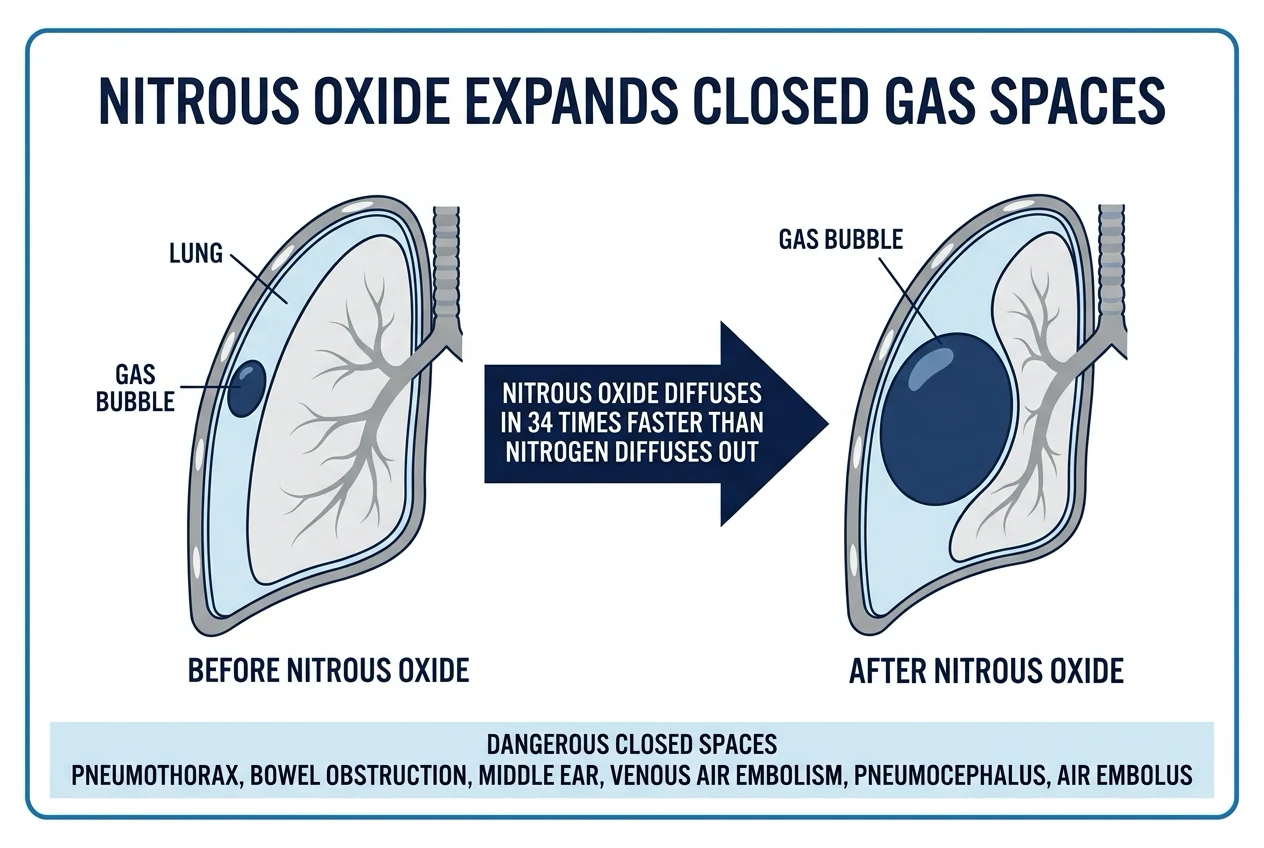
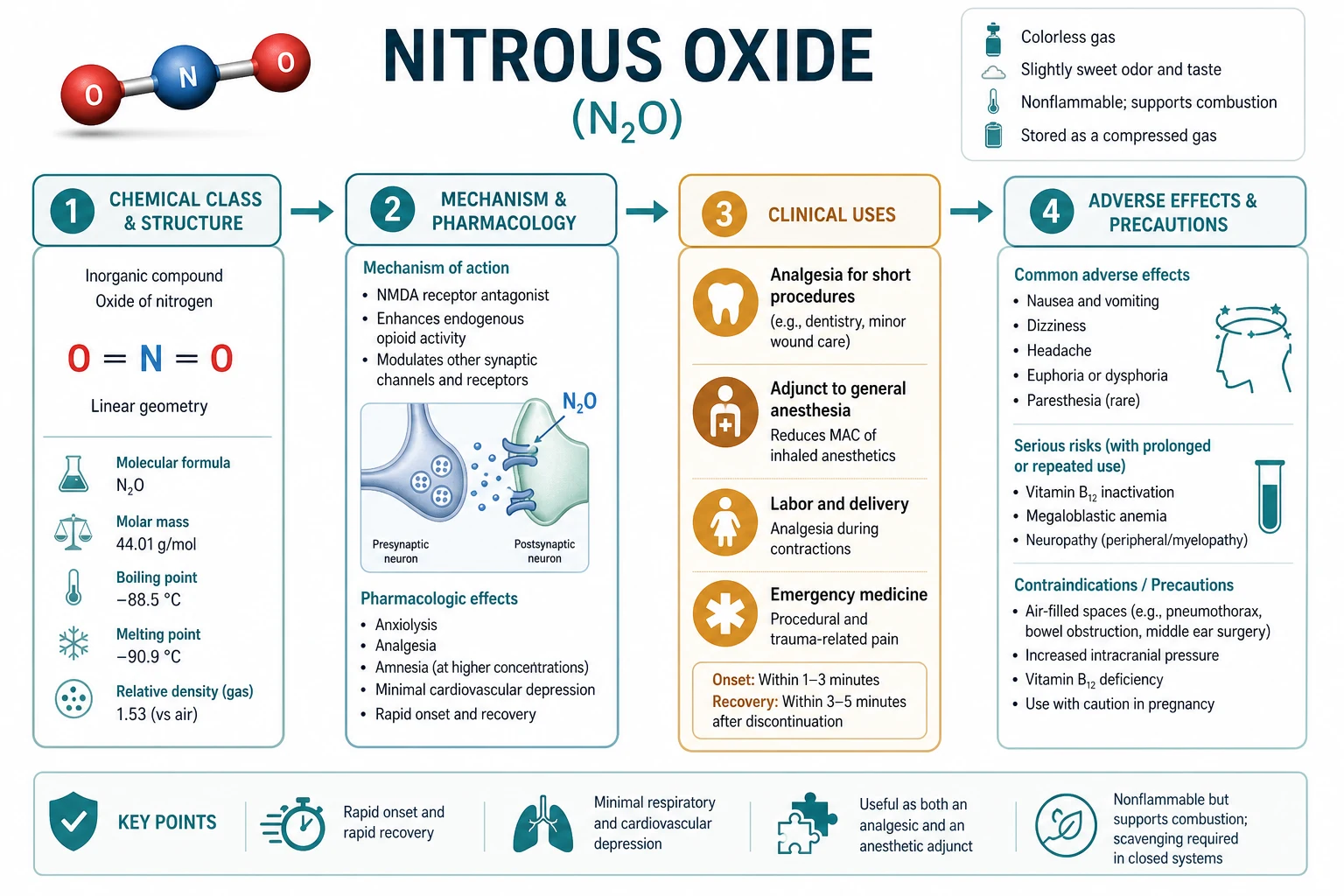
Nitrous oxide (N2O) is the only non-halogenated inorganic inhalational agent and a weak anaesthetic but potent analgesic adjunct. Its MAC of 105 percent is the highest of any agent, so a full MAC cannot be achieved at atmospheric pressure and it is used as an adjunct, never a sole maintenance agent. Its very low blood-gas partition coefficient of 0.47 gives rapid uptake and elimination, and when co-administered with a potent volatile the rapid N2O uptake produces the concentration effect and second gas effect, accelerating the rise of the companion agent (Korman, 2023). N2O is 34 times more blood-soluble than nitrogen, so it diffuses into closed gas-containing spaces faster than nitrogen can leave, expanding pneumothoraces, obstructed bowel, the middle ear and venous air emboli (Almujaiwel, 2026). Diffusion hypoxia can occur on emergence as N2O rapidly leaves the blood. N2O is minimally metabolised and does not trigger malignant hyperthermia, but it inactivates vitamin B12 and methionine synthase, causing subacute combined degeneration and megaloblastic anaemia, particularly with chronic recreational use (Li, 2026; Tikaria, 2026; Brasfield, 2026). The methionine-synthase block raises homocysteine and thrombotic risk (Serrano, 2026). N2O is a potent greenhouse gas with a global-warming potential around 273 and is ozone-depleting, requiring scavenging (Kayak, 2026). Its clinical uses include labour analgesia as Entonox (Kichili, 2026). Use is declining due to environmental and B12/homocysteine concerns.
On this page & tools
Your progress
Saved locally on this device.
Target exams
Red flags
One-line exam answer
N2O is a weak, fast, analgesic inorganic gas that still teaches concentration and second-gas physics, closed-space expansion, B12 toxicity and environmental harm. Modern practice often omits it unless a clear benefit remains.[5][6][8]
Identity and physical properties
| Property | Value / note |
|---|---|
| Formula | N2O |
| MAC | about 104–105% (cannot provide full anaesthesia alone at 1 atm) |
| Blood–gas partition coefficient | Low (~0.47) — rapid onset/offset |
| Relative solubility vs N2 | ~34× more blood-soluble than nitrogen |
| Cylinder | Liquid + vapour (critical temperature above room temperature) — pressure ≠ contents (weigh) |
| Pipeline | Common historically; leak and environmental concerns rising |
| MH | Not a trigger |
| Greenhouse | High global-warming potential (order of ~273) and ozone effects |
N2O is never a sole maintenance agent at atmospheric pressure. It is an adjunct that spares MAC of volatiles and contributes analgesia, historically popular for mask induction and labour Entonox.[5][8]
Kinetics that change practice
Concentration effect and second-gas effect
High inspired N2O fractions are absorbed rapidly from alveoli. That rapid uptake concentrates residual alveolar gases (concentration effect) and accelerates the rise of a companion volatile agent (second-gas effect), speeding induction when N2O is combined with a potent agent.[5] On discontinuation, reverse processes influence elimination of companion gases. Examiners want the mechanism stated in plain language: large volume of N2O leaving the alveolus pulls more gas down the airway, concentrating what remains and “dragging” the second gas with it.[5]
Diffusion into closed spaces
Because N2O enters air-filled cavities faster than nitrogen can leave, volume or pressure rises in closed gas spaces. This is not a rare trivia point — it is a hard contraindication list. [3]
| Space | Risk | Action |
|---|---|---|
| Pneumothorax | Expansion, tension physiology | Avoid N2O |
| Bowel obstruction | Distension, raised intra-abdominal pressure | Avoid |
| Middle ear / tympanic graft | Pressure change, graft lift | Avoid in middle-ear surgery |
| Pneumocephalus | Raised ICP | Avoid |
| Venous air embolism | Increases bubble size | Avoid; discontinue if VAE suspected |
| ETT cuff | Cuff pressure rise | Monitor and adjust cuff pressure |
| Pulmonary bullae/cysts | Rupture risk | Avoid |
Middle-ear pressure effects are a classic ENT viva hook and are supported by perioperative pressure data.[4]
Diffusion hypoxia
At the end of anaesthesia, N2O floods from blood into alveoli, diluting alveolar oxygen and causing hypoxia if the patient breathes air. Give high FiO2 during early recovery until washout is complete.[5]
Vitamin B12 and methionine synthase
N2O oxidises the cobalt ion in vitamin B12, inhibiting methionine synthase. With prolonged, repeated or recreational exposure, consequences include megaloblastic marrow change, subacute combined degeneration, cognitive/psychiatric presentations, and raised homocysteine with vascular or thrombotic interest.[1][2][3][7] Avoid or minimise use in established B12 deficiency, and take recreational “nangs” history seriously when neurology is unexplained.[1][2]
Clinical use table
| Use | Role of N2O | Modern caveats |
|---|---|---|
| Adjunct to volatile | MAC sparing, second-gas effect | Greenhouse gas; closed-space contraindications |
| Labour analgesia (Entonox 50:50) | Self-administered analgesia | Nausea; B12 with heavy use |
| Brief procedures / dental | Analgesia and anxiolysis | Airway protection still required |
| Mask induction adjunct | Speeds volatile uptake | Often unnecessary with sevoflurane alone |
| TIVA world | Often omitted | Environmental and closed-space policies |
Labour and selected procedural analgesia remain the clearest remaining niches when benefits outweigh risks.[8]
Organ system effects
- CVS: mild myocardial depression; sympathetic activation may offset; can increase pulmonary vascular resistance.
- Resp: modest reduction in ventilatory CO2 response; little bronchodilation compared with volatiles.
- CNS: mild increase in CBF/CMR; combine carefully if raised ICP is an issue.
- Emetic: contributes to PONV risk.
- Haemostasis/vascular: homocysteine rise links to thrombotic case reports after heavy exposure.[7]
Cylinder and pipeline practicalities
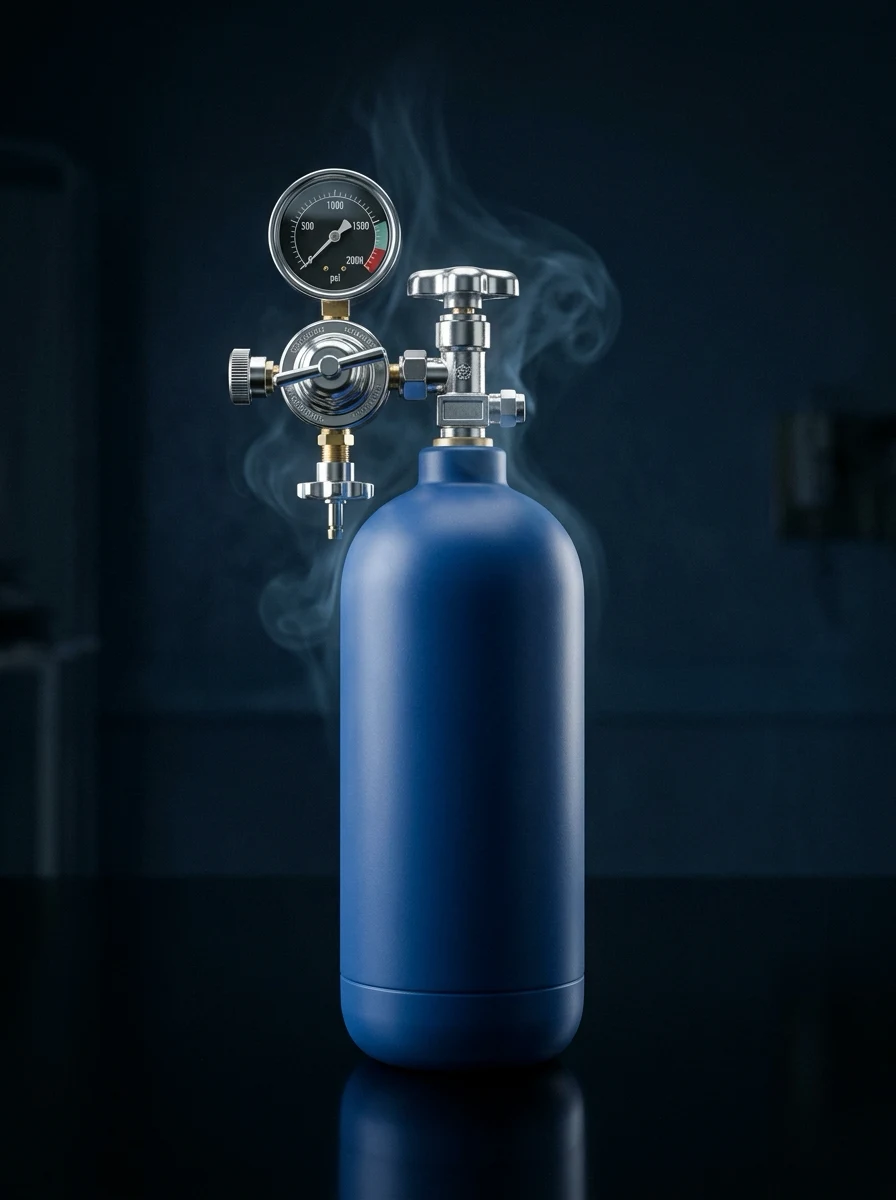
Because critical temperature is above room temperature, N2O cylinders contain liquid and vapour. Gauge pressure stays roughly constant until the liquid is exhausted, then falls rapidly — weigh cylinders or use content-known manifolds. Pipeline N2O systems can leak silently; environmental audits now treat infrastructure leaks as both climate and occupational issues.[6] Scavenge exhaust gases and minimise open systems.
Environmental and occupational
N2O is a long-lived greenhouse gas with high global-warming potential and ozone effects. Prefer low-flow or N2O-free techniques when clinically equivalent, fix leaks, and scavenge.[6] Occupational chronic exposure historically raised B12-pathway concerns for theatre staff before modern scavenging.
Special populations
- Pregnancy/labour: Entonox remains widely used for labour analgesia with informed risk discussion.[8]
- Paediatrics: short procedural use still occurs; avoid if closed-gas pathology possible.
- B12 deficiency / vegan / pernicious anaemia / ileal disease: avoid or minimise; consider alternative analgesia.[1]
- Coronary disease / hyperhomocysteinaemia contexts: some services de-emphasise N2O given vascular concerns, especially after ENIGMA-era debates — state uncertainty honestly and follow local policy.[7]
SAQ scaffold
- MAC and why not sole agent.
- Concentration and second-gas effects.
- Closed-space list with the ~34× solubility mechanism.
- Diffusion hypoxia prevention.
- B12 / methionine synthase clinical sequelae.
- Environmental justification to omit N2O.
- Why cylinder pressure is a poor contents indicator. [6]
Viva phrases
- “Why stop N2O if air embolism suspected?” → “N2O expands air bubbles, worsening obstruction.”
- “How do you end an N2O case?” → “Discontinue N2O and give high FiO2 to prevent diffusion hypoxia.”
- “Cylinder pressure still high but empty soon?” → “While liquid remains, pressure is roughly constant; weigh the cylinder.”
- “Why is N2O declining?” → “Closed-space risks, B12 toxicity, PONV contribution and high greenhouse impact with modest unique benefit.” [7]
Common traps
- Using N2O in undiagnosed pneumothorax.
- Forgetting ETT cuff pressure rise.
- Assuming cylinder pressure shows contents.
- Ignoring PONV and greenhouse-gas costs when clinical benefit is tiny.
- Missing recreational N2O in a young patient with myeloneuropathy. [8]
Benefits
- Fast on/off
- Analgesic
- Second-gas effect
- MAC sparing
Hard stops
- Closed gas spaces
- Known B12 deficiency care
- VAE risk cases
- Some middle-ear surgery
Emergence
- Diffusion hypoxia
- Give oxygen
- PONV risk
- Rapid offset
Environment
- High GWP
- Scavenge
- Fix leaks
- Consider N2O-free GA
Examiner masterclass — full coverage checklist
N2O is a systems topic: physics (concentration and second-gas effects), chemistry (closed-space solubility), biochemistry (B12/methionine synthase), clinical contraindications, cylinder physics, and planetary health. Thin answers that only say “expands pneumothorax” miss marks. [1]
Physics language that scores
Concentration effect: large volume uptake of N2O concentrates remaining alveolar gases. Second-gas effect: that concentrating and “dragging” accelerates the rise of a companion volatile.[5] Diffusion hypoxia: on emergence N2O leaves blood into alveoli and dilutes oxygen, so give high FiO2.[5] Closed-space expansion: N2O is roughly 34 times more blood-soluble than nitrogen, so it enters cavities faster than nitrogen leaves, raising volume or pressure.[4]
Contraindication logic, not a list only
Every contraindication is the same mechanism applied to a different cavity: pneumothorax, bowel obstruction, middle ear, pneumocephalus, venous air embolism, bullae, and overpressurised ETT cuffs. If you can derive the list from the mechanism, you will not forget an item under stress.[4]
B12 pathway in exam sentences
N2O oxidises cobalamin cobalt, inhibits methionine synthase, impairs methionine and tetrahydrofolate pathways, and with chronic exposure produces megaloblastic change and subacute combined degeneration.[1][2][3] Recreational use is now a common real-world stem; perioperative single short exposure is a different risk magnitude than chronic abuse, but deficiency states still warrant avoidance.
Environmental answer without virtue-signalling
State GWP order of magnitude, scavenging, leak repair, and the option of N2O-free anaesthesia when benefit is marginal.[6] Then name the remaining niches (labour Entonox, selected brief analgesia) so you do not sound as if the drug has zero role.[8]
Model viva arc
MAC and adjunct-only status → kinetics → closed spaces → diffusion hypoxia → B12 → environment → when you would still use it. [2]
Extended viva bank (high-yield stems)
Stem A — definitions under pressure. Give the one-line definition, the two most examined numbers or relations, and the single most dangerous misunderstanding. Keep this under forty-five seconds. [3]
Stem B — mechanism to bedside. Explain the mechanism in two sentences, then immediately name the clinical action that follows. Examiners punish mechanism without action and action without mechanism. [4]
Stem C — compare and choose. Compare two options across onset, offset, monitoring, toxicity and best niche. End with a choice for a stated patient. [5]
Stem D — crisis choreography. Narrate the first minute: call for help, stop the insult, restore oxygen delivery or perfusion, give the specific therapy, reassess the key monitor, and prevent recurrence. [6]
Stem E — special population twist. Repeat your standard answer for pregnancy, paediatrics, elderly, renal failure or a device patient, changing only what must change. [7]
Stem F — equipment or systems failure. Assume the first plan fails. Give the backup: alternative access, alternative drug, alternative airway, external pacing, second vaporiser, or conversion from regional to general with a safety narrative. [8]
SAQ paragraph models
Model opening: Define the topic in one sentence with the key number or equation, then signpost three headings you will cover. [1]
Model middle: Use short paragraphs, each ending with a clinical consequence. Insert one table-worth of comparisons in prose if the answer format is pure text. [2]
Model close: Give hard stops, monitoring, and a one-line pitfall. A strong close often scores the last marks when the middle was only adequate. [3]
Memory anchors
Build memory anchors that regenerate detail rather than store isolated trivia. For physics, anchors are equations and thresholds. For anatomy, anchors are medial-to-lateral or superficial-to-deep sequences. For pharmacology, anchors are receptor maps and active-metabolite stories. For equipment, anchors are safety interlocks and failure modes. If you can regenerate the structure, forgotten minor numbers hurt less. [4]
Theatre checklist language
Convert knowledge into checklists you would actually use: confirm device identity, confirm oxygen analyser, confirm return plate, confirm wire-in-vein, confirm conus-safe interspace, confirm total local anaesthetic dose, confirm ICD therapies on, confirm naloxone and airway plan after neuraxial morphine. Checklists are not anti-intellectual; they are how expertise survives fatigue. [5]
Cross-link map
Almost every thin topic links to another. Fluid flow links to haemorrhage and airway oedema. Electricity links to diathermy and CIED care. Neck anatomy links to CVC complications. Neuraxial spaces link to CSE and caudal. Cranial nerves link to awake intubation and oculocardiac reflex. Vaporisers link to volatile pharmacology and machine check. Adjuncts link to acute pain multimodal pathways. Weak opioids link to pharmacogenomics and paediatric safety bans. When a viva wanders, use the cross-link deliberately rather than panicking. [6]
What “exam-pass learnable” means here
It means a tired candidate can re-read this topic the night before and answer any standard stem without opening another book. It does not mean infinite length. Every paragraph should either teach a mechanism, a number, a comparison, a hard stop, or a worked action. If a sentence does none of those, delete it. If a section lacks a viva stem, add one. If a dose appears, keep a citation nearby. If a claim is clinical, keep a citation nearby. [7]
Final rapid-fire facts to rehearse aloud
Rehearse aloud until the language is automatic: the equation or pathway; the key table; the contraindication list; the first-line crisis action; the monitoring endpoint; the common trap. Spoken fluency is part of viva performance. Silent recognition is not enough. Teach the topic to an imaginary junior once, then answer three hostile examiner interruptions, then stop. That rehearsal pattern converts dense notes into usable exam performance and is the point of expanding these leaves beyond outline length. [8]
Red flags
References
- [1]Li W, et al. A case report of nitrous oxide-induced subacute combined degeneration complicated with neurosyphilis in a 23-year-old female BMC Neurol, 2026.PMID 42321648
- [2]Tikaria R, et al. The Toxic Legacy of Recreational Nitrous Oxide Use: A Systematic Review and Meta-Analysis of Multisystem Complications From Functional Vitamin B12 Deficiency Cureus, 2026.PMID 42306345
- [3]Brasfield K, et al. Protracted encephalopathy and subacute combined degeneration associated with chronic nitrous oxide use: a case report Front Psychiatry, 2026.PMID 42221322
- [4]Almujaiwel N, et al. Effect of Anesthetic Agents on Middle Ear Pressure: Systematic Review and Meta-Analysis Saudi Med J, 2026.PMID 42293722
- [5]Korman B, et al. Effects of N(2) O elimination on the elimination of second gases in a two-step mathematical model of heterogeneous gas exchange Physiol Rep, 2023.PMID 37923389
- [6]Kayak EA, et al. A summary guide for detecting and reducing nitrous oxide infrastructure leaks in healthcare facilities Anaesth Intensive Care, 2026.PMID 42290092
- [7]Serrano A, et al. From Euphoria to Ischaemia: Nitrous Oxide Abuse as a Rare Cause of Superior Mesenteric Artery Thrombosis Eur J Vasc Endovasc Surg, 2026.PMID 42303213
- [8]Kichili N, et al. Analyzing the Efficacy and Potential Risks of Nitrous Oxide for Pain Management During Labor: A Narrative Review Clin Pharmacol, 2026.PMID 41737234