Anaes · Anaesthetic adjuncts
Noradrenaline
Also known as Norepinephrine · Direct-acting catecholamine vasopressor · Alpha-1 greater than beta-1 agonist · First-line septic shock vasopressor
Noradrenaline (norepinephrine) is the physiological NEUROTRANSMITTER of the sympathetic nervous system and a DIRECT-ACTING CATECHOLAMINE synthesised from dopamine by dopamine-beta-hydroxylase. Its receptor profile is potent ALPHA-1 vasoconstriction plus moderate BETA-1 inotropy and chronotropy plus presynaptic ALPHA-2 autoreceptor activity, with a NET ALPHA-DOMINANT effect (alpha greater than beta) and crucially NO beta-2 activity. The alpha-1 vasoconstriction raises systemic vascular resistance and blood pressure; the baroreceptor response to that pressure rise produces the characteristic REFLEX BRADYCARDIA. Cardiac output is MAINTAINED or slightly decreased because the beta-1 inotropy offsets the increased afterload, and cardiac output is better preserved than with a pure alpha-1 agent such as phenylephrine precisely because of this beta-1 component (Yahya 2026; Dong 2026). Noradrenaline is the FIRST-LINE vasopressor for SEPTIC SHOCK and the Surviving Sepsis Campaign recommended first-line agent for vasodilatory shock, and it is also used for neurogenic shock and perioperative vasoplegia (Yahya 2026; Liu 2026). Its very short half-life of about 2 to 3 minutes mandates a CONTINUOUS IV INFUSION at 0.05 to 1.0 micrograms per kg per min, it is metabolised by COMT and MAO, and its principal adverse effects are peripheral and digital ischaemia from excessive alpha-1 vasoconstriction, arrhythmias (less than adrenaline because of the absent beta-2 effect), hypertension, reflex bradycardia, and reduced splanchnic and renal perfusion at high doses, plus EXTRAVASATION tissue necrosis that is treated with phentolamine infiltration (Parkinson 2026). The absence of beta-2 activity distinguishes it from adrenaline: noradrenaline produces less tachycardia, no bronchodilation, and no metabolic hyperglycaemia, hypokalaemia or lactate rise. Built on the first-line vasopressor therapy in septic shock study (Yahya 2026), the vasopressor selection and postoperative delirium study in older adults (Dong 2026), the machine-learning intraoperative hypotension prediction model (Liu 2026), the cost and environmental comparison of anaesthetic emergency drugs (Parkinson 2026), the physiological difficult airway management study (Ghaffar 2026), and the erector spinae plane block versus thoracic paravertebral block trial (Turhan 2026).
On this page & tools
Your progress
Saved locally on this device.
8 MCQs with explanations
Target exams
Red flags

Overview and definition
Noradrenaline (norepinephrine) is the physiological NEUROTRANSMITTER of the sympathetic nervous system and a direct-acting catecholamine. It is synthesised in the adrenal medulla and in sympathetic postganglionic nerve terminals from dopamine by the enzyme dopamine-beta-hydroxylase, and it is in turn the immediate biochemical precursor of adrenaline (which is made by phenylethanolamine-N-methyltransferase adding a methyl group). In the USA the drug is called norepinephrine; in Australasia, the United Kingdom and much of the world it is called noradrenaline. Both names refer to the same molecule and the same drug.[1]
Pharmacologically, noradrenaline is a DIRECT-ACTING catecholamine, meaning it binds and activates adrenergic receptors itself rather than requiring the release of stored transmitter (the distinction from the indirect-acting or mixed-acting sympathomimetics such as ephedrine). Its receptor profile is ALPHA-DOMINANT — potent alpha-1 activity with moderate beta-1 activity, and no clinically important beta-2 activity — and this profile is the key to every exam answer about the drug.[2]
Clinically, noradrenaline is the FIRST-LINE vasopressor for septic shock and vasodilatory shock, the Surviving Sepsis Campaign recommended first-line agent, and a standard infusion in intensive care and theatre for any state of pathological vasoplegia. The increasing ability to predict intraoperative hypotension in advance (Liu 2026) is changing when and how vasopressor plans including noradrenaline are prepared.[3]
Mechanism: a direct-acting catecholamine
Noradrenaline is a catecholamine, meaning it has the characteristic catechol (3,4-dihydroxybenzene) ring structure. The catechol ring is the target of the enzyme catechol-O-methyltransferase (COMT) and is the reason catecholamines have a very short duration of action when given systemically.[1]
It is DIRECT-ACTING, binding to adrenergic receptors on the target cell surface and activating them itself. This is the key contrast with ephedrine, whose dominant effect is indirect (it displaces noradrenaline from nerve-terminal stores), and it is the reason noradrenaline does not exhibit the tachyphylaxis that ephedrine does — there is no finite transmitter pool to deplete.[4]
Because it is the endogenous neurotransmitter, noradrenaline is also the ligand that is released at postganglionic sympathetic nerve terminals (except at sweat glands, which use acetylcholine) and acts as a co-transmitter with adrenaline from the adrenal medulla. When given as a drug, it reproduces the effects of sympathetic nervous system activation with the alpha-dominant bias described below. [1]
Receptor pharmacology
The adrenergic receptor profile of noradrenaline is the most examined feature of the drug and must be known precisely.[1][2]
- Alpha-1 receptor (potent, post-synaptic). Gq-coupled, acting through phospholipase C and intracellular calcium to produce arteriolar and venous vasoconstriction. This is the dominant clinical effect and produces the rise in systemic vascular resistance, venous return and blood pressure.
- Beta-1 receptor (moderate). Gs-coupled, acting through cyclic AMP to increase heart rate (positive chronotropy), contractility (positive inotropy) and atrioventricular nodal conduction. The beta-1 effect is real but is outweighed in the intact patient by the reflex response to the alpha-1-mediated pressure rise.
- Alpha-2 receptor (presynaptic autoreceptor). When noradrenaline binds presynaptic alpha-2 receptors on the sympathetic nerve terminal, it inhibits further noradrenaline release — a negative-feedback loop that limits sympathetic overactivity. Alpha-2 agonists such as dexmedetomidine exploit this mechanism centrally.
- Beta-2 receptor (negligible). Noradrenaline has essentially no beta-2 agonist activity at clinical doses. This is the crucial difference from adrenaline and explains why noradrenaline does not produce bronchodilation or the metabolic effects of beta-2 stimulation. [1]
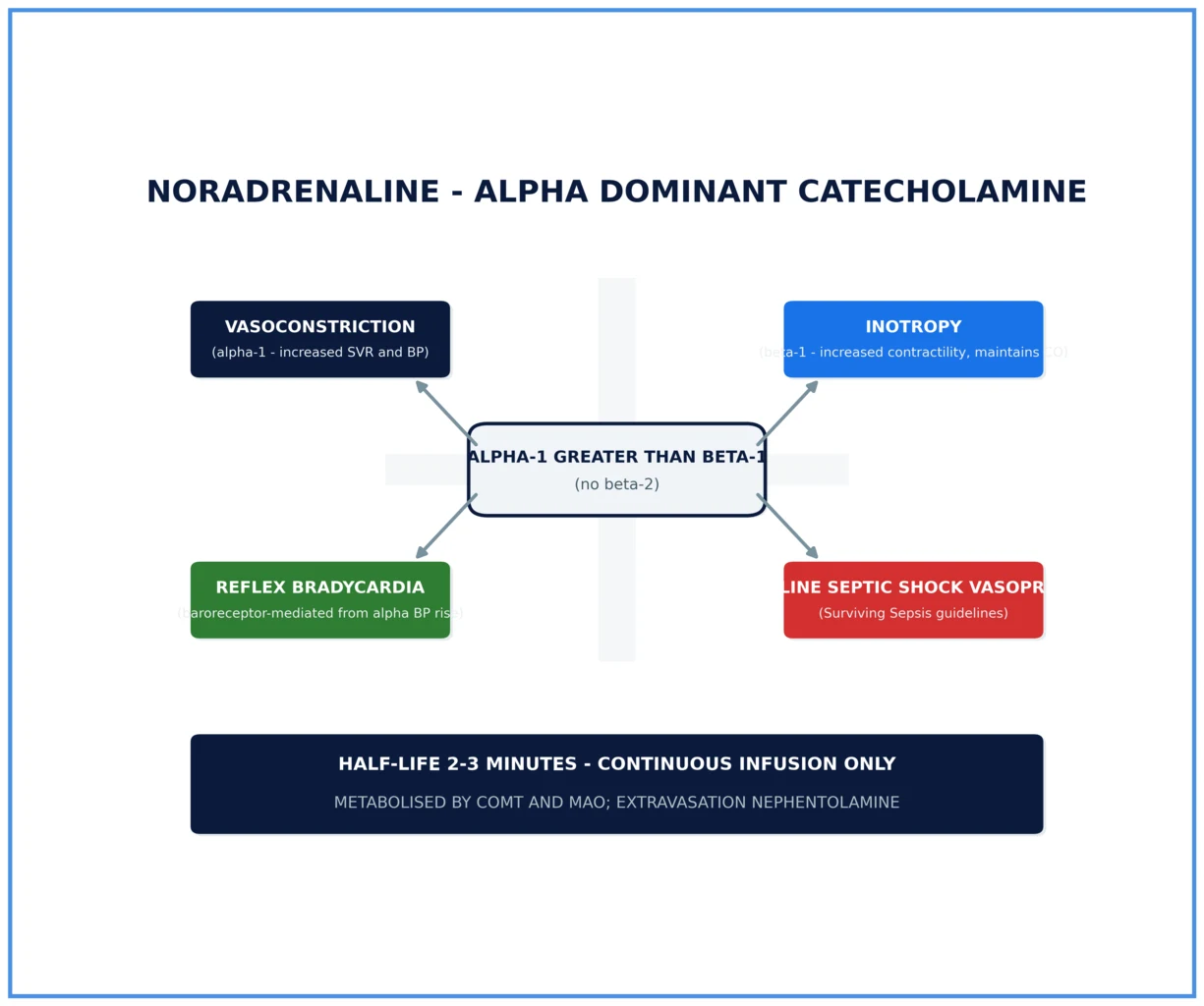
The NET EFFECT is therefore ALPHA-DOMINANT (alpha greater than beta): intense vasoconstriction raising blood pressure, with the cardiac beta-1 effect present but largely masked by the baroreceptor-mediated reflex slowing of the heart.[2]
Haemodynamic effects
The haemodynamic signature of noradrenaline is a rise in blood pressure driven by increased systemic vascular resistance, with a reflex fall in heart rate and a cardiac output that is maintained or slightly decreased.[1][2]
- Blood pressure rises, primarily through alpha-1-mediated arteriolar vasoconstriction increasing systemic vascular resistance. Venous constriction also increases venous return and preload. The rise is dose-dependent and can be rapid.
- Systemic vascular resistance rises substantially — this is the dominant haemodynamic change and the reason noradrenaline is the agent of choice for vasodilatory shock where SVR is pathologically low.
- Heart rate typically FALLS. The alpha-1-mediated rise in blood pressure activates the arterial baroreceptors, which increase vagal outflow to the sinus node, producing REFLEX BRADYCARDIA. This is the expected response and is the opposite of the tachycardia seen with adrenaline or ephedrine.
- Cardiac output is MAINTAINED or slightly decreased. The increased afterload from intense vasoconstriction would tend to reduce stroke volume, but the beta-1 inotropic effect offsets this, so the net effect on cardiac output is small. Crucially, cardiac output is better preserved with noradrenaline than with a pure alpha-1 agent such as phenylephrine, precisely because noradrenaline retains the beta-1 component that phenylephrine lacks (Yahya 2026; Dong 2026).[1][2]
- Myocardial oxygen demand rises with the increased afterload and contractility, but less than with adrenaline because there is no beta-2-driven tachycardia.
Pharmacokinetics and dosage
Noradrenaline has the defining pharmacokinetic feature of all catecholamines: a very short elimination half-life of about 2 to 3 minutes, owing to rapid metabolism by COMT and monoamine oxidase (MAO).[4]
This short half-life has one dominant clinical consequence: noradrenaline can only be given as a CONTINUOUS INTRAVENOUS INFUSION. A bolus would produce a fleeting effect that is gone within minutes, and the drug cannot be given as intermittent boluses for sustained blood pressure support in the way that phenylephrine, ephedrine or metaraminol can. The infusion is titrated to a mean arterial pressure (or other perfusion) target.[1]
The usual adult infusion rate is 0.05 to 1.0 micrograms per kg per min, started low and titrated upward. In refractory septic shock doses higher than 1.0 microgram per kg per min are sometimes required, and there is no absolute upper limit — the dose is whatever is needed to restore perfusion, with escalating doses simply signalling increasingly severe vasoplegia rather than a pharmacological ceiling. [1]
Noradrenaline should ideally be delivered through a CENTRAL venous line, because the intense alpha-1 vasoconstriction means that extravasation from a peripheral cannula causes severe tissue ischaemia and necrosis. In an emergency a large peripheral cannula with close monitoring may be used as a bridge until central access is established. It is metabolised by COMT and MAO to inactive vanillylmandelic acid and normetanephrine, which are excreted in the urine.[4]
First-line use in septic shock
Noradrenaline is the FIRST-LINE vasopressor for septic shock and is the Surviving Sepsis Campaign recommended first-line agent for adults with vasodilatory shock. This is the central clinical fact about the drug and the most likely single point to be examined.[1]
The rationale follows directly from the receptor profile. Septic shock is a state of pathological vasoplegia — nitric-oxide-mediated and cytokine-driven loss of vascular tone produces a low systemic vascular resistance, hypotension, and a hyperdynamic but ineffective circulation. Noradrenaline directly restores the lost vascular tone through alpha-1 agonism, raising systemic vascular resistance and blood pressure, while its beta-1 component supports stroke volume so that cardiac output is maintained as the afterload rises. First-line vasopressor therapy for fluid-refractory septic shock has been examined even in neonatal practice, where the same alpha-plus-beta logic supports the choice of a direct-acting catecholamine to restore perfusion (Yahya 2026).[1]
Noradrenaline is preferred over adrenaline in septic shock because it produces less tachycardia and less lactate rise (adrenaline's beta-2 effect drives glycolysis and lactate production, which can confound lactate-based resuscitation targets). It is preferred over dopamine because dopamine causes more tachyarrhythmias. It is preferred over phenylephrine because pure alpha-1 vasoconstriction without beta-1 support can reduce cardiac output, and septic patients often have myocardial depression that benefits from the beta-1 component. Vasopressin is used as a SECOND-LINE adjunct to noradrenaline (it acts on a different receptor — the V1 vasopressin receptor — and allows the noradrenaline dose to be reduced), not as a replacement.[1]
Other shock states and perioperative use
Beyond septic shock, noradrenaline is used across the spectrum of vasodilatory and low-SVR states, and increasingly in the perioperative setting.[1][3]
- Vasodilatory shock of any cause. This includes anaphylactic shock (after adrenaline and fluid resuscitation), post-cardiopulmonary-bypass vasoplegia, and drug-induced vasoplegia (e.g. from vasodilators or phosphodiesterase inhibitors). The common thread is a low systemic vascular resistance that noradrenaline's alpha-1 effect directly corrects.
- Neurogenic shock. Acute spinal cord injury interrupts the sympathetic outflow, producing loss of vasomotor tone with hypotension and bradycardia. Noradrenaline is used to restore vascular tone and mean arterial pressure (with the target often being a mean arterial pressure of 85 to 90 mmHg in acute spinal cord injury to protect cord perfusion).
- Perioperative hypotension and vasoplegia. Noradrenaline infusions are increasingly used in the operating theatre to treat anaesthesia-induced vasoplegia, particularly in the patient with pre-existing low vascular tone. The ability to predict intraoperative hypotension before it happens, using machine-learning models trained on the arterial pressure waveform (Liu 2026), is shifting practice toward early, proactive vasopressor use rather than reactive boluses.[3]
- Emergency airway management in the shocked patient. The haemodynamically unstable patient who requires emergency intubation (for example, the septic patient needing mechanical ventilation) is at high risk of cardiovascular collapse during induction. Maintaining perfusion with a noradrenaline infusion before and during airway management is a central part of the physiological approach to the difficult airway in the emergency department (Ghaffar 2026).[5]
- Hypotension from regional anaesthesia. Neuraxial and major regional blocks interrupt the sympathetic chain and produce vasodilation and hypotension. While bolus phenylephrine or ephedrine is usual for spinal hypotension, the more prolonged hypotension associated with thoracic paravertebral and continuous regional techniques may require infusion vasopressor support, a consideration in trials comparing regional anaesthesia techniques such as erector spinae plane block versus thoracic paravertebral block (Turhan 2026).[6]
Adverse effects and extravasation
The adverse-effect profile of noradrenaline is the necessary consequence of intense alpha-1 vasoconstriction plus beta-1 cardiac stimulation.[4]
- Peripheral, digital and tissue ischaemia. Intense alpha-1 vasoconstriction can compromise perfusion to the extremities, fingers, toes, skin and nose, particularly at high doses or in the patient with peripheral vascular disease. This is the most important practical adverse effect and may progress to necrosis.
- Extravasation necrosis. If a noradrenaline infusion extravasates into subcutaneous tissue, the local alpha-1 vasoconstriction produces severe ischaemia and tissue necrosis. This is the reason a central line is preferred. If extravasation occurs, the treatment is prompt local infiltration of PHENTOLAMINE, a non-selective alpha-blocker that reverses the vasoconstriction, injected into the extravasation area (Parkinson 2026).[4]
- Arrhythmias. Beta-1 stimulation can precipitate atrial and ventricular arrhythmias, though LESS frequently than adrenaline because noradrenaline lacks the beta-2 effect and tends to slow the heart rate through the baroreceptor reflex.
- Hypertension. Excessive alpha-1 vasoconstriction can overshoot, producing hypertension that risks intracranial haemorrhage or vascular injury in the susceptible patient.
- Reflex bradycardia. The expected heart-rate response to the pressure rise; usually well tolerated but may be symptomatic in the patient with conduction disease.
- Reduced splanchnic and renal perfusion. At high doses, alpha-1 vasoconstriction can reduce blood flow to the splanchnic bed and the kidneys. However, by maintaining cardiac output (through the beta-1 component) noradrenaline generally preserves renal perfusion better than a pure alpha-1 agent, and in septic shock restoring mean arterial pressure with noradrenaline often IMPROVES urine output compared with the untreated hypotensive state.[1]
The cost and environmental comparison of anaesthetic emergency drugs by Parkinson quantified the relative expense and waste burden of the routine emergency vasopressors, a useful stewardship reference when rationalising theatre and ICU drug selection.[4]
Comparison with adrenaline
The noradrenaline-versus-adrenaline comparison turns on a single receptor difference — beta-2 — and is a frequent viva question.[1]
- Receptor profile. Adrenaline is a potent agonist at alpha-1, beta-1 AND beta-2. Noradrenaline is a potent alpha-1 and moderate beta-1 agonist with NO beta-2 activity. This single difference drives every clinical contrast.
- Heart rate. Adrenaline raises heart rate (beta-1 and beta-2). Noradrenaline typically produces reflex bradycardia because the alpha-1-driven pressure rise activates the baroreceptors. This is the clearest haemodynamic distinction.
- Bronchodilation. Adrenaline produces bronchodilation through beta-2. Noradrenaline does not, and is not a bronchodilator.
- Metabolic effects. Adrenaline, through beta-2, produces glycogenolysis and hyperglycaemia, an intracellular potassium shift causing hypokalaemia, and increased glycolysis causing a lactate rise. Noradrenaline lacks these effects because it has no beta-2 activity. This is why noradrenaline is preferred over adrenaline in septic shock: the adrenaline-driven lactate rise confounds lactate-based resuscitation monitoring.
- Cardiac output. Adrenaline raises cardiac output substantially (beta-1 inotropy plus beta-2-driven tachycardia). Noradrenaline maintains cardiac output (beta-1 inotropy offsetting the increased afterload) but does not raise it to the same degree.
- Clinical roles. Adrenaline is first-line for anaphylaxis and cardiac arrest and is a potent inotrope and bronchodilator. Noradrenaline is first-line for septic and vasodilatory shock where the priority is restoring vascular tone without tachycardia or lactate rise.[1]
Comparison with phenylephrine and vasopressin
Noradrenaline must also be distinguished from the pure alpha agent phenylephrine and the non-adrenergic vasopressin.[2][4]
Against phenylephrine, both raise blood pressure through alpha-1 vasoconstriction, but phenylephrine is a PURE alpha-1 agonist with no beta activity, whereas noradrenaline has alpha-1 plus beta-1. The consequence is in cardiac output: phenylephrine tends to REDUCE cardiac output because the reflex bradycardia and increased afterload are unopposed by any inotropic support, whereas noradrenaline MAINTAINS cardiac output because the beta-1 inotropy offsets the increased afterload. This is why noradrenaline, not phenylephrine, is first-line in septic shock: the septic patient often has myocardial depression that a pure alpha-1 agent would worsen. Phenylephrine is reserved for situations where an increase in heart rate is specifically undesirable (e.g. tachycardia, aortic stenosis, obstetric spinal hypotension).[1]
Against vasopressin, the two drugs act on completely different receptor systems. Noradrenaline acts on adrenergic receptors (alpha-1, beta-1); vasopressin acts on the V1 vascular vasopressin receptor, producing vasoconstriction through a non-adrenergic, Gq-coupled pathway that is preserved even in sepsis (where adrenergic receptor responsiveness may be downregulated). Vasopressin is used as a SECOND-LINE adjunct to noradrenaline in septic shock — adding it typically allows the noradrenaline dose to be reduced ("catecholamine-sparing") — and as a first-line agent in vasoplegia associated with cardiac surgery and in some centres for the catecholamine-resistant anaphylaxis scenario. The two are complementary, not interchangeable.[1]
Clinical selection and current place in practice
Noradrenaline is the cornerstone vasopressor of modern critical care and holds a defined and central place in anaesthetic practice.[1][2]
In septic and vasodilatory shock it is unambiguously first-line: it directly restores the lost vascular tone, maintains cardiac output through its beta-1 component, avoids the tachycardia and lactate rise of adrenaline, and is supported by the Surviving Sepsis Campaign guidelines. When septic shock is refractory to noradrenaline alone, vasopressin is added as a catecholamine-sparing adjunct, and adrenaline is occasionally added as a second-line inotrope-vasopressor. [1]
In neurogenic shock it is the standard agent for restoring spinal-cord perfusion pressure. In perioperative vasoplegia it is increasingly used by infusion, particularly as the ability to predict intraoperative hypotension (Liu 2026) allows a vasopressor plan to be prepared before induction rather than assembled reactively.[3]
In older adults, vasopressor choice has acquired a second dimension beyond blood pressure: the contribution of vasopressor selection to postoperative delirium. Noradrenaline, unlike ephedrine, does not cross the blood-brain barrier to any important extent and does not produce the central stimulation that contributes to delirium, so it is a reasonable choice in the delirium-prone older patient who needs sustained vasopressor support (Dong 2026).[2]
The practical summary: reach for noradrenaline by infusion when the problem is vasodilatory shock or sustained perioperative vasoplegia, titrate to a perfusion target, give it through a central line, remember that extravasation needs phentolamine, and remember that it has no beta-2 effect and so avoids the tachycardia, bronchodilation and metabolic noise of adrenaline.[4]
Clinical
- Standard approach
- Evidence-based
Alternative
- Modified technique
- Risk-benefit
Red flags
[1] [1] [1] [1] [1]References
- [1]Yahya R, et al. First-line vasopressor therapy in neonates with fluid-refractory septic shock: A systematic review and meta-analysis of randomized controlled trials Am J Emerg Med, 2026.PMID 42361705
- [2]Dong T, et al. Vasopressor Selection and Postoperative Delirium in Older Adults: A Propensity-Matched Database Analysis Semin Cardiothorac Vasc Anesth, 2026.PMID 42359892
- [3]Liu D, et al. Development and external validation of an interpretable machine learning model for predicting prolonged postoperative ICU length of stay in coronary artery bypass grafting patients using MIMIC-IV 3.1 and eICU-CRD 2.0 BMC Med Inform Decis Mak, 2026.PMID 42365267
- [4]Parkinson EA, et al. The Financial and Environmental Cost of Anaesthetic Emergency Drugs: Comparing Ampoules With Prefilled Syringes Cureus, 2026.PMID 42005180
- [5]Ghaffar S, et al. Physiological difficult airway management in the emergency department J Pak Med Assoc, 2026.PMID 42363338
- [6]Turhan O, et al. Erector Spinae Plane Block Versus Thoracic Paravertebral Block in Laparoscopic Cholecystectomy: A Randomized Controlled Study J Clin Med, 2026.PMID 42355760