Anaes · Anaesthetic adjuncts
Opioid receptors, biased agonism, tolerance and opioid-induced hyperalgesia
Also known as Mu, kappa and delta opioid receptors · G-protein-biased opioid agonism and oliceridine · Opioid-induced hyperalgesia (OIH)
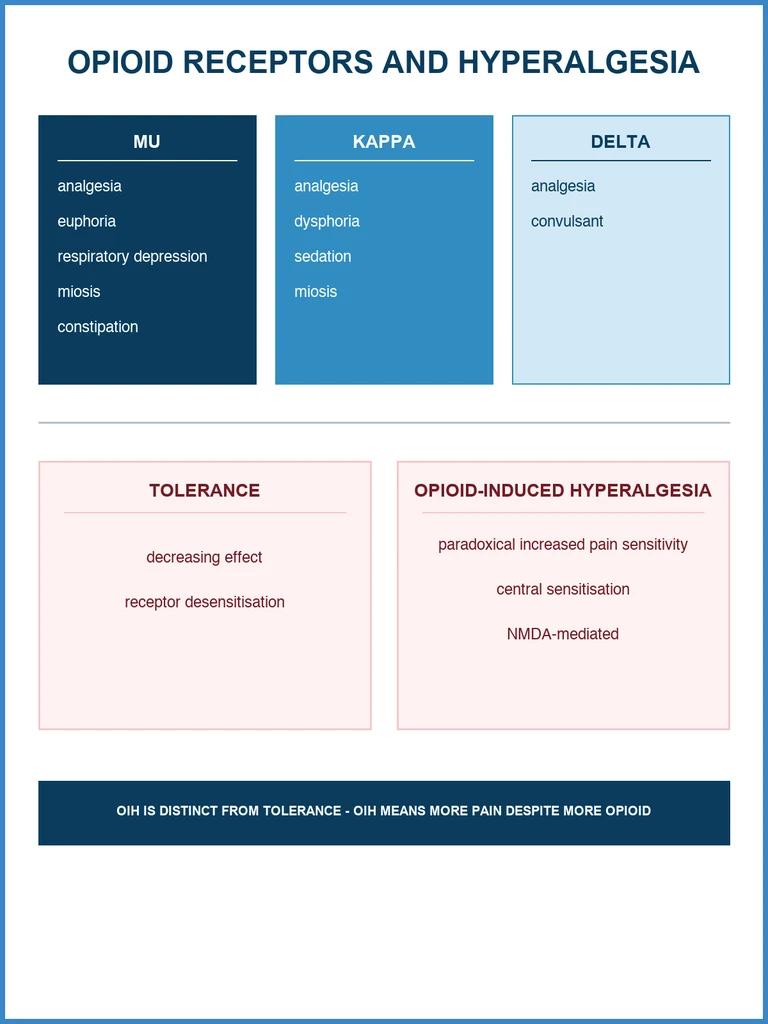
Opioid receptors are a family of G-protein-coupled receptors — the mu (MOR), kappa (KOR) and delta (DOR) — that mediate the analgesic and adverse effects of all clinically used opioids, together with a naloxone-insensitive fourth member, the NOP (nociceptin or orphanin FQ) receptor. All three classical receptors couple to inhibitory Gi/Go proteins, inhibiting adenylate cyclase, closing voltage-gated calcium channels and opening potassium channels, which hyperpolarises the nociceptive neurone and reduces release of substance P and glutamate. The mu receptor is the principal target of most clinical opioids (morphine, fentanyl) and mediates supraspinal and spinal analgesia, euphoria, respiratory depression, miosis and constipation; the kappa receptor mediates spinal analgesia with dysphoria and psychotomimetic effects but less respiratory depression; the delta receptor contributes to analgesia and is convulsant at high doses. Biased agonism — the concept that different ligands stabilise different receptor conformations to preferentially drive G-protein (analgesic) over beta-arrestin (adverse-effect) signalling — underpins drugs such as oliceridine. Repeated opioid exposure produces tolerance, a pharmacodynamic loss of effect through receptor desensitisation, downregulation and internalisation, and, distinct from tolerance, opioid-induced hyperalgesia (OIH), a paradoxical increase in pain sensitivity driven by central sensitisation, NMDA receptor activation, descending facilitation, glial activation and dynorphin. OIH is managed by opioid reduction or rotation and by NMDA antagonists (ketamine, methadone), alpha-2 agonists and multimodal non-opioid analgesia.
On this page & tools
Your progress
Saved locally on this device.
8 MCQs with explanations
Target exams
Red flags
Overview
Opioids produce their effects by binding to a family of G-protein-coupled receptors (GPCRs). There are three classical opioid receptors — the mu (MOR), kappa (KOR) and delta (DOR) — and a fourth, pharmacologically related but naloxone-insensitive member, the NOP receptor (the nociceptin or orphanin FQ receptor). All three classical receptors are coupled to inhibitory Gi/Go proteins and share the same intracellular signalling logic, but they differ in their distribution, their endogenous ligands and, crucially for the exam candidate, in the clinical effects they produce when activated [1][2].
Understanding which receptor drives which effect is not an academic exercise. The mu receptor explains why most clinical opioids cause respiratory depression, miosis and constipation; the kappa receptor explains why drugs like pentazocine and nalbuphine can produce dysphoria and hallucinations; and the delta receptor explains why some analgesic strategies remain experimental. At a higher level, two concepts dominate modern opioid pharmacology and now appear routinely in fellowship examinations: biased agonism, the basis for drugs like oliceridine that try to separate analgesia from adverse effects; and opioid-induced hyperalgesia (OIH), a paradoxical worsening of pain that is mechanistically distinct from tolerance and demands different management [1][5].
The three classical opioid receptors
The three classical opioid receptors are products of distinct genes but share approximately sixty per cent sequence homology, and all are seven-transmembrane G-protein-coupled receptors. They are the mu-opioid receptor (MOR, encoded by OPRM1), the kappa-opioid receptor (KOR, encoded by OPRK1) and the delta-opioid receptor (DOR, encoded by OPRD1) [1].
A fourth receptor, the NOP receptor (also called the nociceptin/orphanin FQ receptor, encoded by OPRL1), is structurally homologous to the classical opioid receptors but is not sensitive to naloxone. Its endogenous ligand is nociceptin (orphanin FQ), and it modulates pain, anxiety and reward through pathways that overlap with but are distinct from the classical receptors. NOP is an active drug-discovery target but has limited bearing on the everyday clinical use of opioids [1][2].
The endogenous opioid peptides — the endorphins, enkephalins and dynorphins — show receptor preference: beta-endorphin acts at mu and delta, the enkephalins at delta, and dynorphin at kappa. These peptide-receptor pairings map onto the pharmacology below and help explain why dynorphin is implicated in kappa-mediated dysphoria and in the pathology of opioid-induced hyperalgesia [1].
The mu-opioid receptor (MOR)
The mu receptor is the most important receptor for clinical anaesthesia and analgesia because almost every opioid in routine use — morphine, fentanyl, sufentanil, remifentanil, alfentanil, methadone, pethidine, codeine, tramadol and oxycodone — is a mu agonist. The analgesic and adverse effects a clinician associates with an opioid are, in the main, the effects of mu receptor activation [1][4].
Mu receptor activation produces the following effects: [1]
- Supraspinal and spinal analgesia — the desired effect, through modulation of descending inhibitory pathways and suppression of dorsal horn neurotransmitter release.
- Euphoria and a sense of well-being, central to the reward and misuse liability of mu agonists.
- Respiratory depression — a direct, dose-dependent effect on medullary respiratory centres, reducing the response to carbon dioxide. This is the principal cause of fatal opioid overdose.
- Miosis — stimulation of the Edinger-Westphal nucleus produces pinpoint pupils.
- Constipation — increased smooth muscle tone and reduced gut motility.
- Sedation, nausea and vomiting (through the chemoreceptor trigger zone), and cough suppression.
- Physical dependence with continued use [1][4].
Because respiratory depression and euphoria both flow from mu activation, a central goal of modern opioid drug design is to retain mu-mediated analgesia while shedding mu-mediated harm — the rationale for biased agonism, discussed below. Genetic variation in OPRM1 also contributes to inter-individual differences in opioid sensitivity, which is part of the rationale for dual-target and polypharmacology approaches to analgesia [4].
The kappa-opioid receptor (KOR)
The kappa receptor produces a profile that overlaps with mu in some respects but diverges sharply in others, and recognising the divergence is a frequent discriminator in viva and written questions [1][6].
Kappa receptor activation produces: [1]
- Spinal analgesia — kappa agonists are analgesic, but largely through spinal rather than supraspinal mechanisms.
- Sedation and miosis, shared with mu.
- DYSPHORIA, not euphoria, and psychotomimetic effects — hallucinations, dissociation and depersonalisation. This is the single most tested kappa-specific fact.
- Less respiratory depression and less constipation than mu agonists, which makes kappa-preferring drugs attractive in principle [1][6].
The dysphoric and psychotomimetic liability of kappa activation is precisely why mixed agonist-antagonists such as pentazocine and nalbuphine (partial kappa agonists) can produce unsettling subjective effects and why they fell out of widespread favour. There is renewed interest in kappa pharmacology: kappa agonism has been explored as a way to improve reversal of opioid overdose and to limit the post-reversal respiratory depression and dysphoria that pure naloxone reversal can cause, although the psychotomimetic ceiling remains the limiting problem [6].
The delta-opioid receptor (DOR)
The delta receptor is the least clinically characterised of the three classical receptors. It produces analgesia at both spinal and supraspinal sites, and it modulates mood and reward. Its defining clinical pharmacology is that high-dose delta activation is convulsant, which has historically limited the development of selective delta agonists as analgesics [1][2].
Despite this, the delta receptor remains an active drug-discovery target. Selective delta agonists are being investigated for chronic pain, migraine and mood disorders, with the aim of producing analgesia free of the respiratory depression that constrains mu agonists. The convulsant liability is the principal obstacle, and no selective delta agonist is yet in routine anaesthetic practice [1].
The G-protein signalling mechanism (Gi/Go coupling)
All three classical opioid receptors share the same intracellular signalling mechanism: they are coupled to inhibitory Gi/Go proteins. When an agonist binds the receptor, the alpha subunit of the Gi/Go protein exchanges GDP for GTP, dissociates, and produces three convergent effects that together hyperpolarise the neurone and reduce neurotransmitter release [1][2]:
- Inhibition of adenylate cyclase — reducing intracellular cyclic AMP.
- Closure of voltage-gated N-type calcium channels — reducing calcium influx at the presynaptic terminal and so reducing exocytosis of neurotransmitter.
- Opening of inward-rectifying potassium channels — increasing K+ efflux and hyperpolarising the postsynaptic membrane. [1]
The net effect is neuronal hyperpolarisation and a fall in the release of the excitatory neurotransmitters that carry nociceptive signals — principally substance P and glutamate from the primary afferent into the dorsal horn, with reinforcement of descending inhibitory pathways from the periaqueductal grey and nucleus raphe magnus. This is why an opioid, at a cellular level, dampens the transmission of pain [1].
This shared mechanism means that a mu agonist, a kappa agonist and a delta agonist all use the same intracellular toolkit; their different clinical profiles arise from where the receptors are expressed and which neuronal circuits they sit in, not from fundamentally different second messengers [1][2].
Biased agonism: G-protein versus beta-arrestin
Biased agonism (also called functional selectivity) is the concept that different ligands binding the same receptor can stabilise different active conformations of that receptor, preferentially activating one downstream signalling pathway over another. For the mu-opioid receptor, the two principal pathways are the G-protein pathway (linked to analgesia) and the beta-arrestin pathway (linked to several adverse effects, including respiratory depression and constipation) [1][5].
The therapeutic promise is obvious: a ligand that drives G-protein signalling strongly but recruits beta-arrestin only weakly should, in theory, deliver analgesia with less respiratory depression and less gastrointestinal toxicity than a conventional full agonist like morphine or fentanyl. This is the rationale for oliceridine (TRV130), a G-protein-biased mu agonist that reached clinical use. Clinical study of oliceridine against sufentanil has examined whether biased agonism translates into a measurable reduction in opioid-related adverse effects such as postoperative nausea and vomiting, with the general finding that the benefit, while real, is more modest than the original mechanistic promise suggested [5].
Two caveats matter for the exam. First, biased agonism is a spectrum, not an all-or-nothing property — even a biased ligand still has some beta-arrestin activity at sufficient dose, so respiratory depression is reduced, not abolished. Second, the precise contribution of beta-arrestin to each opioid adverse effect remains an active area of research, and recent kinetic work on ligand-receptor binding reinforces that dwell time and binding kinetics at the receptor, not bias alone, shape the observed drug effect [1][2][5].
Receptor internalisation, desensitisation and tolerance
Tolerance is the progressive decrease in the effect of a given opioid dose with repeated administration, so that increasing doses are required to maintain the same analgesic or adverse effect. It is a pharmacodynamic phenomenon that develops at the receptor level [1][2].
The cellular basis of tolerance involves several linked processes: [1]
- Receptor desensitisation — the receptor becomes less responsive to the agonist, partly through phosphorylation and uncoupling from the G-protein.
- Receptor downregulation — the total number of receptors on the cell surface falls with sustained agonist exposure.
- Receptor internalisation — receptors are removed from the membrane into endosomes; some are recycled, others degraded.
- Adaptive changes downstream — including upregulation of adenylate cyclase signalling (a compensatory response to chronic inhibition), which contributes to the withdrawal state when the agonist is removed [1].
An important nuance is that cross-tolerance between opioids is incomplete. A patient tolerant to morphine will not be fully tolerant to fentanyl or methadone at equianalgesic doses, which is why opioid rotation can restore analgesia even when the original opioid has lost effect. This incomplete cross-tolerance is also the reason that equianalgesic conversion calculations must be reduced — typically by twenty-five to fifty per cent — when switching between opioids, to avoid overdose [2][3].
Not all opioid effects tolerate at the same rate. Miosis and constipation show remarkably little tolerance even after years of opioid use, whereas analgesia, sedation and respiratory depression tolerate substantially. This is why a chronic opioid patient still gets constipated on a dose that no longer makes them drowsy, and why the respiratory-depressant ceiling on chronic high-dose therapy is not as high as the analgesic tolerance might suggest. [1]
Opioid-induced hyperalgesia (OIH)
Opioid-induced hyperalgesia (OIH) is a paradoxical increase in pain sensitivity caused by opioid exposure. The patient becomes more, not less, sensitive to pain. It is one of the most important and most frequently examined concepts in modern opioid pharmacology, and the key to it is that it is distinct from tolerance [1][5].
The distinction is worth stating precisely. In tolerance, a given dose produces less effect over time — the patient needs more drug to get the same analgesia. In OIH, the pain actually worsens despite maintained or even increasing opioid doses, and the quality of the pain changes: it often becomes more diffuse, more severe and spreads beyond the original painful area. Put another way, tolerance is a rightward shift of the dose-response curve; OIH is a lowering of the pain threshold itself — the opioid is, paradoxically, generating pain [1].
Clinically, OIH should be suspected when a patient's pain is escalating on stable or increasing opioid doses, when the pain distribution widens beyond the surgical or traumatic site, when increasing opioid doses make the pain worse rather than better, and when allodynia (pain from a normally non-painful stimulus) emerges during opioid therapy. The phenomenon is best described after high-dose or long-duration opioid exposure, particularly with potent, short-acting opioids such as remifentanil used intraoperatively, but it can occur with any opioid [1][5].
Mechanism. OIH is a form of central sensitisation — a maladaptive increase in the gain of nociceptive processing in the central nervous system. Several mechanisms converge to produce it [1]:
- NMDA receptor activation — the dominant mechanism. Opioid exposure disinhibits and upregulates NMDA-mediated glutamatergic signalling in the dorsal horn, producing wind-up and a sustained increase in excitability. This is the same pathway that underlies neuropathic pain, and it explains why NMDA antagonists are effective for both.
- Descending facilitation — opioid exposure shifts the balance of descending control from inhibition toward facilitation, so that signals from the rostral ventromedial medulla actively amplify incoming pain rather than suppressing it.
- Glial activation — microglia and astrocytes are activated by opioid exposure and release pro-inflammatory cytokines that sensitise nociceptive neurones.
- Dynorphin — upregulation of the endogenous kappa peptide dynorphin in the spinal cord has a pronociceptive role in OIH, linking the kappa system to hyperalgesia [1][6].
- Changes in ascending and descending monoamine pathways that tilt the system toward facilitation.
The NMDA centrality of the mechanism explains the therapeutic logic of OIH management: NMDA antagonists break the sensitisation, opioid rotation changes the receptor pharmacology, and alpha-2 agonists and multimodal analgesia reduce the opioid load that is driving the problem [1][5].
Management of OIH and tolerance
Because OIH and tolerance have different mechanisms, their management overlaps but is not identical. The principles are [1][3][5]:
- Reduce the opioid dose where possible, or rotate to a different opioid — opioid rotation exploits incomplete cross-tolerance and, for methadone specifically, adds NMDA antagonism.
- Add an NMDA antagonist — ketamine is the prototype and the best evidence-based option; methadone brings NMDA antagonism built in. This is the single most mechanistically targeted intervention for OIH.
- Add an alpha-2 agonist — clonidine or dexmedetomidine, which provide analgesia through a non-opioid pathway and reduce opioid requirements.
- Use multimodal non-opioid analgesia — paracetamol, NSAIDs, regional and neuraxial techniques, lignocaine infusions and gabapentinoids, all aimed at minimising the opioid load.
- Recognise and treat tolerance separately, by dose adjustment or rotation, while addressing OIH through the mechanistic measures above [1][3].
The underlying principle is that simply escalating the opioid dose worsens OIH — more opioid drives more central sensitisation. The correct response to suspected OIH is to reduce or change the opioid and add NMDA-targeted and multimodal therapy, not to push the existing opioid higher [1][5].
Tolerance, dependence and addiction distinguished
These three terms are often used loosely but refer to distinct phenomena, and fellowship candidates are expected to separate them precisely [1][4].
- Tolerance is a pharmacodynamic phenomenon — a decrease in the effect of a given dose due to receptor desensitisation, downregulation and internalisation. It is expected, predictable and reversible.
- Physical dependence is the emergence of a withdrawal syndrome when the opioid is stopped or an antagonist is given. It reflects adaptive downregulation that has occurred to counter chronic agonist exposure, and it too is a pharmacodynamic expectation of chronic use, not a moral failing.
- Addiction is a behavioural and neurobiological syndrome characterised by compulsive drug-seeking and drug-use despite harm, loss of control and continued use. It is distinct from tolerance and physical dependence — a patient can be tolerant and physically dependent (as most chronic opioid users are) without being addicted, and addiction can occur in the relative absence of marked tolerance [1][4].
This distinction matters clinically because it separates dose escalation driven by tolerance (manage by rotation and multimodal analgesia) from compulsive use driven by addiction (manage with structured substance-use treatment), and it guards against the undertreatment of pain in patients who are physically dependent but not addicted [4].
Comparison of the opioid receptors
The receptors can be compared across the axes that anaesthetic examinations most often probe [1][6]:
| Feature | Mu (MOR) | Kappa (KOR) | Delta (DOR) |
|---|---|---|---|
| Endogenous peptide | beta-endorphin | dynorphin | enkephalin |
| Analgesia | supraspinal and spinal | mainly spinal | spinal and supraspinal |
| Mood effect | euphoria | dysphoria, psychotomimetic | mood modulation |
| Respiratory depression | marked | less than mu | minimal (clinical doses) |
| Miosis | yes | yes | minimal |
| Constipation | marked | less than mu | minimal |
| Clinical agonists | morphine, fentanyl | pentazocine, nalbuphine | experimental |
| High-dose concern | respiratory depression | psychotomimetic | convulsant |
The pattern to take away is that mu accounts for most of the wanted and unwanted effects of routine opioids; kappa offers analgesia with dysphoria and less respiratory depression; and delta remains largely experimental because of its convulsant ceiling [1][6].
Clinical implications and emerging directions
Several recent developments flow directly from the receptor pharmacology above and are worth knowing for the viva [1][2][3][4]:
- Biased mu agonists such as oliceridine aim to retain analgesia while reducing respiratory depression and nausea, with the evidence suggesting a real but modest benefit over conventional mu agonists [5].
- Dual-target ligands that engage the mu receptor and a second target — for example dopamine D3 receptors — are being designed to separate analgesia from the reward and misuse liability that drives the opioid epidemic [4].
- Allosteric modulators of the opioid receptors offer a way to fine-tune endogenous opioid signalling without the full agonist effects of a conventional opioid, and kinetic profiling of ligand-receptor binding is increasingly used to predict which compounds will show useful bias and which will not [1][2].
- Long-acting buprenorphine formulations exploit the partial agonist and kappa-antagonist pharmacology of buprenorphine to deliver stable maintenance therapy for opioid use disorder with less misuse liability, and their pharmacokinetic and pharmacodynamic profile is now well characterised [3].
- Kappa agonism and antagonism remain a double-edged frontier: kappa agonists are analgesic but dysphoric, while kappa antagonists are being explored to improve reversal of opioid overdose and to limit the dysphoria and respiratory depression that complicate naloxone-only reversal [6].
Rapid self-test — cover and answer
Q1. Which opioid receptor causes dysphoria and psychotomimetic effects? The kappa receptor (KOR). Mu causes euphoria, kappa causes dysphoria. [1]
Q2. OIH versus tolerance — state the distinction in one sentence each. Tolerance is a decreasing effect at a given opioid dose (rightward dose-response shift). OIH is a paradoxical increase in pain sensitivity — worsening pain despite maintained or increasing opioid doses (lowered pain threshold). [1]
Q3. Name the three intracellular effects of Gi/Go-coupled opioid receptor activation. Inhibition of adenylate cyclase (reduced cAMP), closure of voltage-gated calcium channels, and opening of potassium channels — together hyperpolarising the neurone and reducing substance P and glutamate release. [1]
Q4. What is biased agonism, and which drug is the prototype? Different ligands stabilise different receptor conformations, preferentially driving the G-protein pathway (analgesia) over the beta-arrestin pathway (adverse effects). Oliceridine is the G-protein-biased mu agonist prototype. [1]
Q5. First-line pharmacological treatment for opioid-induced hyperalgesia? An NMDA antagonist — ketamine (or methadone, which carries NMDA antagonism), combined with opioid reduction or rotation and multimodal non-opioid analgesia. [1]
Clinical
- Standard approach
- Evidence-based
Alternative
- Modified technique
- Risk-benefit
Red flags
[1]References
- [1]Wang H, et al. Molecular mechanism of allosteric modulation of opioid receptors Signal Transduct Target Ther, 2026.PMID 42362532
- [2]Kurowska K, et al. Hold on tight: the kinetic profiling of opioid receptor ligands using the CORAL-MD J Cheminform, 2026.PMID 42363184
- [3]Wang T, et al. Buprenorphine long acting injectables: clinical needs, pharmacodynamic and pharmacokinetic basis, and design challenges for solid preformed implants Eur J Pharm Biopharm, 2026.PMID 42364665
- [4]Jahan K, et al. Dual-target mu opioid-dopamine D(3) receptor (MOR-D(3)R) ligands based on etonitazene: New leads for transforming nitazenes into novel analgesics Eur J Med Chem, 2026.PMID 42361479
- [5]Liu F, et al. Impact of oliceridine versus sufentanil on postoperative nausea and vomiting in patients undergoing thyroid surgery: a prospective, double-blind, randomized controlled trial Ann Med, 2026.PMID 42339818
- [6]Voronkov M, et al. Does Kappa Agonism Improve Reversal of 'Tranq-Dope' Overdose? Evidence from a Rodent Model Pharmaceuticals (Basel), 2026.PMID 42356464