Anaes · Opioids & analgesics
Opioids & analgesics
Also known as Opioids · Fentanyl · Remifentanil · Morphine · Opioid-free anaesthesia · Patient-controlled analgesia · Opioid-induced respiratory depression · Opioid-sparing
The opioids and the analgesics in the perioperative care. The framework rests on the receptor pharmacology (the mu, the kappa, the delta), the agents (the fentanyl, the remifentanil, the morphine, the alfentanil, the sufentanil, the oxycodone, the tramadol, the methadone), the pharmacokinetics (the onset, the duration, the context-sensitive half-time), the adverse effects (the respiratory depression, the PONV, the constipation, the ileus, the tolerance, the dependence), the opioid-sparing multimodal strategy, and the opioid-free anaesthesia.
On this page & tools
Your progress
Saved locally on this device.
Target exams
Red flags
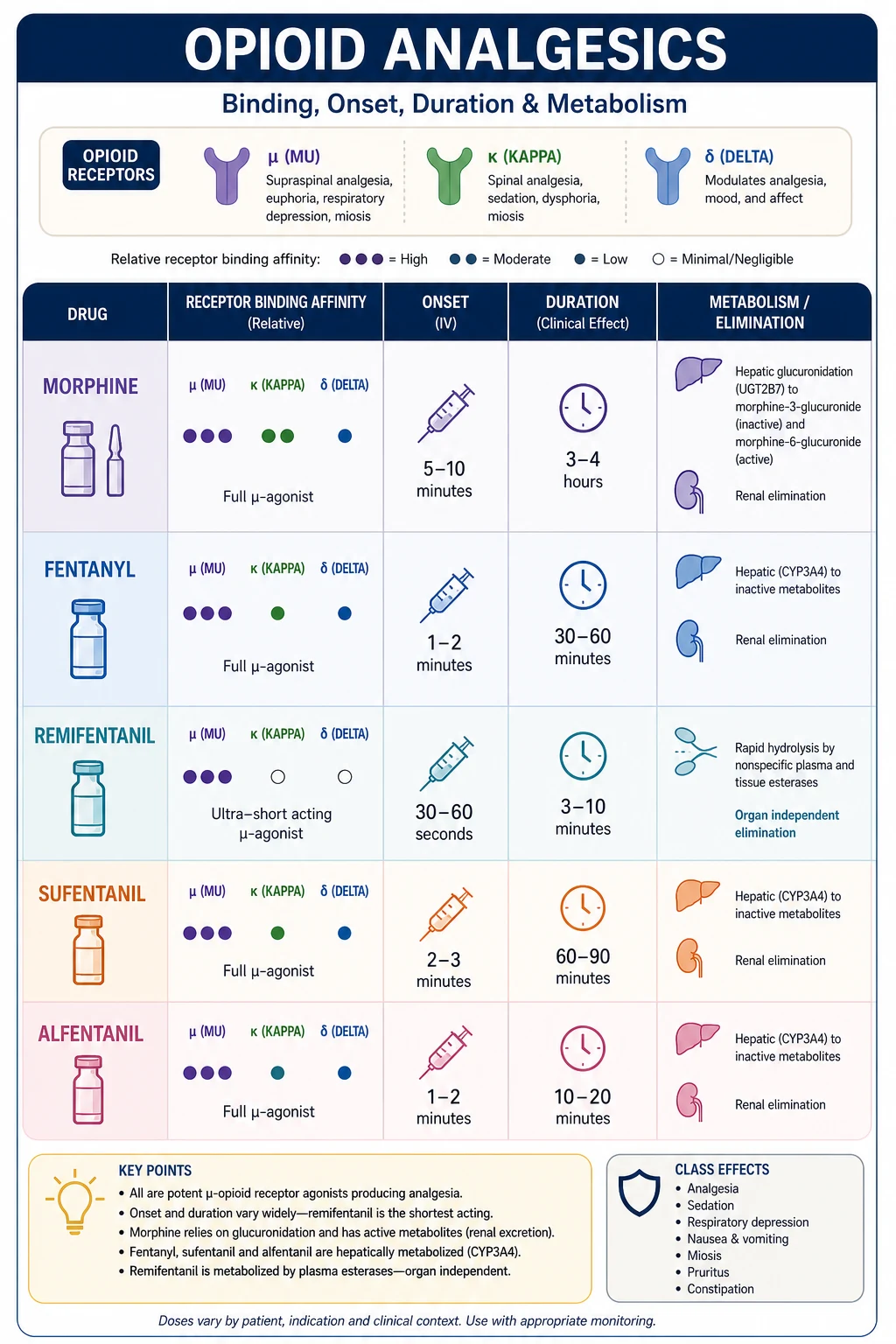
Receptor pharmacology
| Receptor | Endogenous theme | Agonist effects examiners want |
|---|---|---|
| Mu (MOP) | Endorphins/endomorphins | Analgesia, respiratory depression, euphoria, miosis, reduced GI motility, urinary retention, dependence, pruritus |
| Kappa (KOP) | Dynorphins | Analgesia, dysphoria, diuresis, less respiratory depression than mu |
| Delta (DOP) | Enkephalins | Analgesia, some affective/seizure modulation |
Most clinical anaesthetic opioids are mu agonists. Partial agonists/antagonists (buprenorphine, naloxone) appear in chronic pain and rescue contexts. [1]
Cellular mechanism (short)
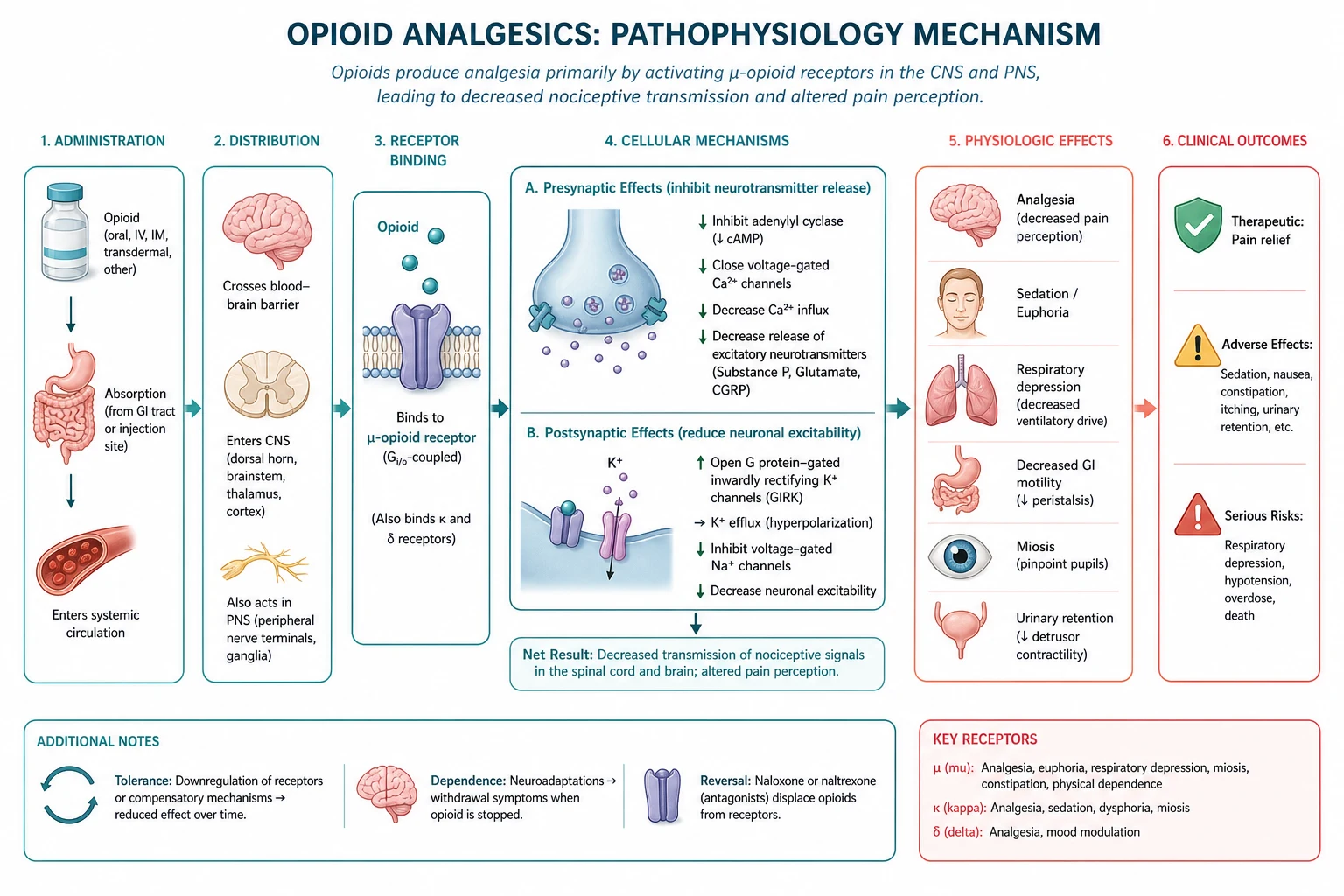
Gi/o coupled receptor → ↓cAMP, ↑K efflux, ↓Ca influx → reduced neuronal excitability and neurotransmitter release in ascending pain pathways, plus descending modulation. Tolerance and hyperalgesia involve receptor level changes and NMDA among other mechanisms — hence ketamine as anti-hyperalgesic partner. [1]
Agent clinical use table
| Agent | Onset / duration snapshot | Metabolism / active metabolite | Best perioperative use | Critical caution |
|---|---|---|---|---|
| Morphine | Slow IV peak 15–30 min; long | Hepatic glucuronidation; M6G active, renal clearance | Post-op PCA/infusion, longer analgesia | Renal failure → prolonged sedation/resp depression |
| Fentanyl | Fast; redistribution after bolus | Hepatic; high lipid solubility | Intra-op boluses, patches (chronic) | Infusion accumulation (rising CSHT) |
| Alfentanil | Fastest classic bolus peak | Hepatic | Laryngoscopy, short stimuli | Early apnoea; rigidity |
| Remifentanil | Ultra-short; flat CSHT | Esterases; inactive metabolite | TIVA, neuro, organ failure | No residual analgesia; OIH |
| Sufentanil | Highly potent | Hepatic | Cardiac/long cases (some practice) | Accumulation, potency errors |
| Oxycodone | Oral reliable; IV where available | CYP3A4/2D6 | Step-down oral analgesia | Abuse; interactions |
| Hydromorphone | Potent | Hepatic | Alternative to morphine | Decimal dose errors |
| Tramadol | Dual mechanism | CYP2D6 → M1 | Moderate pain | Seizures; serotonin |
| Codeine | Prodrug | CYP2D6 → morphine | Largely restricted | Breastfeeding; kids tonsillectomy |
| Methadone | Long; NMDA activity | Complex | Chronic/cancer; sometimes peri-op | QT prolongation; accumulation |
| Pethidine | Historical | Norpethidine pro-convulsant | Rarely first-line now | Seizures in renal impairment; serotonergic MAOI risk |
Context-sensitive half-time
After stopping a continuous infusion, time for concentration to fall 50% depends on how long you infused for most lipophilic opioids (peripheral compartments fill). Remifentanil is the flat exception. Draw this graph in vivas. [1]
Adverse effect grid and management
| Effect | Mechanism theme | Prevention / treatment |
|---|---|---|
| Respiratory depression | Mu brainstem | Monitoring; titrate; naloxone |
| Sedation / delirium | CNS mu | Opioid spare; treat causes |
| Nausea/vomiting | CTZ / vestibular | Multimodal antiemetics |
| Constipation / ileus | Enteric mu | Laxatives; regional; alvimopan specialised |
| Pruritus | Central mu (esp neuraxial) | Antihistamine partial; opioid antagonist microdose strategies |
| Sphincter of Oddi spasm | Smooth muscle | Alternative opioid; nitrates/glucagon historically |
| Immunomodulation / endocrine | Chronic use | Stewardship |
| OIH / tolerance | Complex incl NMDA | Ketamine; dose discipline; regional |
Multimodal opioid-sparing protocol (exam scaffold)
- Regional or local wherever incision allows.
- Paracetamol regular unless contraindicated.
- NSAID/COX-2 if renal, bleeding, anastomosis policies allow.
- Ketamine low-dose if chronic pain, high expected need, remifentanil case.
- Alpha-2 agonist if haemodynamics allow.
- Lidocaine infusion for selected abdominal cases.
- Opioid for rescue and intra-op titration — not the only pillar.
- PONV risk-adapted prophylaxis. [1]
Opioid-free anaesthesia is a deliberate regional-plus-adjunct strategy, not merely "no fentanyl drawn up." [1]
PCA essentials
| Parameter | Purpose | Pitfall |
|---|---|---|
| Demand dose | Patient control | Too small → frustration; too large → apnoea |
| Lockout interval | Safety | Too short stacking |
| Background infusion | Rarely needed acute naïve | Increases respiratory events |
| Monitoring | RR, sedation, SpO2 | Oxygen can mask hypoventilation |
Naloxone
Competitive mu antagonist. Give small titrated IV boluses to restore ventilation while trying not to precipitate full-blown pain and catecholamine surge. Infusion if long-acting agonist on board. Half-life may be shorter than agonist → renarcotisation — observe in monitored area. [1]
Special populations
| Population | Opioid pearl |
|---|---|
| Renal failure | Avoid morphine/codeine; careful tramadol; remifentanil/fentanyl (titrated) preferred patterns |
| Hepatic failure | Reduce dose/frequency; prefer drugs with predictable titration |
| Elderly | Start low; multimodal; delirium risk |
| OSA | Extreme caution; regional; monitored bed |
| Chronic opioid use | Expect higher needs; continue baseline where appropriate; regional gold |
| Paediatrics | Weight-based; avoid codeine post-tonsillectomy |
SAQ scaffold
- Mu receptor effects.
- Choose opioid for ESRD laparotomy with reasons.
- Explain CSHT and name the flat agent.
- Write a multimodal recipe for open colectomy.
- PCA parameters and monitoring.
- Naloxone titration and renarcotisation. [1]
Viva phrases
- "Why not morphine PCA in dialysis patient?" → "Morphine-6-glucuronide accumulates and causes prolonged respiratory depression."
- "Patient apnoeic after fentanyl" → "Airway and ventilation first; titrated naloxone if needed; then review dosing and residual drugs." [1]
Common traps
- Equianalgesic arithmetic errors (hydromorphone).
- Background PCA in opioid-naïve elderly.
- Stopping remifentanil without landing analgesia.
- Full naloxone bolus turning recovery into a hypertension/pain crisis unnecessarily. [1]
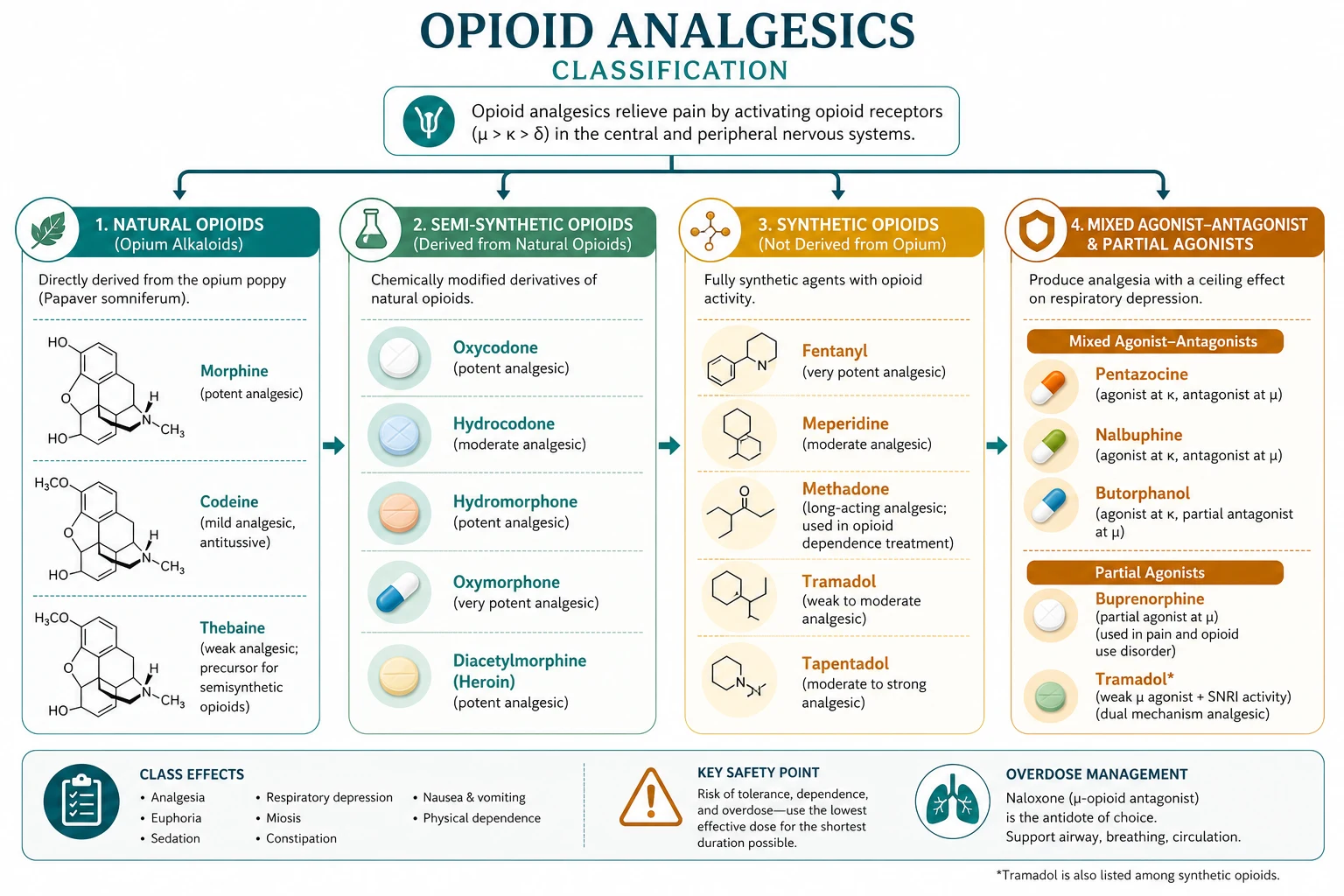
Intra-operative
- Fentanyl boluses
- Remi infusion
- Alfentanil for spikes
- Watch rigidity
Post-operative
- Morphine/oxycodone
- PCA
- Multimodal base
- Sedation scores
Organ failure
- Avoid M6G in ESRD
- Remi esterases
- Reduce doses
- Monitor longer
Rescue
- Airway first
- Naloxone titrate
- Renarcotisation watch
- Review cause
Red flags
[1]Primary exam expansion — dense examiner pack
Receptor subtypes and effects
| Receptor | Classic effects | Endogenous ligands teaching |
|---|---|---|
| Mu (MOP) | Analgesia, respiratory depression, miosis, euphoria, reduced GI motility, dependence | β-endorphin, endomorphins |
| Kappa (KOP) | Analgesia (spinal), sedation, dysphoria, diuresis | Dynorphins |
| Delta (DOP) | Analgesia, some mood/modulation | Enkephalins |
Clinical opioids are primarily mu agonists; mixed agonist–antagonists (nalbuphine, buprenorphine partial) have ceiling and withdrawal-precipitating properties. [1]
Cellular mechanism
GPCR Gi/o → ↓cAMP, ↑K efflux (hyperpolarise), ↓Ca influx (↓transmitter release) at nociceptive pathways (peripheral, dorsal horn, descending brainstem). Tolerance: receptor desensitisation/internalisation and system adaptations. Opioid-induced hyperalgesia: paradoxical sensitisation with high-dose/remifentanil debates. [1]
Comparative clinical pharmacology table
| Drug | Onset IV | Duration / kinetics | Special |
|---|---|---|---|
| Fentanyl | Fast | Redistribution; CSHT rises with infusion | Chest wall rigidity; patch chronic |
| Alfentanil | Very fast (low pKa) | Shorter | Intubation spikes |
| Sufentanil | Fast potent | Long case infusion some centres | Very potent |
| Remifentanil | Fast | CSHT 3–5 min flat; esterases | Transition plan mandatory |
| Morphine | Slower | Active M6G; histamine | Renal failure danger |
| Oxycodone | — | Oral/IV | CYP2D6 less critical than codeine |
| Codeine | Prodrug | CYP2D6 → morphine | Children/breastfeeding restrictions |
| Tramadol | Weak mu + monoamine | Seizure/serotonin risk | Interactions |
| Pethidine | — | Norpethidine seizures | Avoid chronic/renal |
| Methadone | Slow | Long QT, long t½ | Complex acute pain |
| Buprenorphine | Partial mu | High affinity; ceiling | Naloxone resistance relative |
| Naloxone | Fast antagonist | Short t½ → renarcotisation | Titrate |
Respiratory depression physiology
↓ respiratory rate and blunted CO2 response curve; tidal volume may fall; upper airway obstruction risk in OSA. Shift of apnoeic threshold. Synergy with volatiles, benzos, residual NMB. Management: airway, O2, stimulation, naloxone titrated, infusion if long agonist, ICU if needed. [1]
Organ failure rules
Renal: avoid morphine (M6G), pethidine (norpethidine); careful oxycodone; remifentanil/fentanyl often preferred with monitoring. Hepatic: reduced clearance many; titrate. Elderly: start low. Obesity: dosing weight choices; OSA risk. [1]
Multimodal analgesia skeleton
Paracetamol + NSAID (if not contraindicated) + regional/local + sparse opioid. Sparing reduces Type A respiratory and ileus ADRs. PCA principles: lockout, bolus, background only selected cases (background raises risk). [1]
Intraoperative use patterns
Induction co-administration reduces induction agent dose but risks rigidity/apnoea. MAC-sparing. Remifentanil TCI/infusion for stimulating surgery with beta-block caution (bradycardia). Toward end: longer opioid or regional before remi off. [1]
Antagonists and partial agonists pitfalls
Naloxone: reverse resp depression; may precipitate acute pain/sympathetic surge/pulmonary oedema rare; wears off — observe. Naltrexone oral chronic. Partial agonists in opioid-tolerant patients can precipitate withdrawal. [1]
SAQ: compare morphine and remifentanil (8 marks)
Receptor same mu (1). Kinetics CSHT/metabolites (3). Clinical uses (2). Cautions each (2). [1]
Viva
Q: Why avoid codeine in some children? A: CYP2D6 UM → morphine toxicity risk post-tonsillectomy/breastfeeding contexts. Q: First action opioid apnoea? A: Open airway and ventilate — then naloxone. Q: Why is M6G important? A: Potent active metabolite renally cleared — accumulates in ESRD. [1]
High-yield viva battery and numbers lock-in
Mu effects list (must not miss any major)
Analgesia; respiratory depression; miosis; cough suppression; nausea/vomiting (CTZ); reduced GI motility/constipation; urinary retention; euphoria/dependence; pruritus; bradycardia; chest wall rigidity (esp fentanyl/remi rapid); immunosuppression nuances advanced. [1]
PCA safety rules
Patient-only button; appropriate lockout; no unauthorised background in opioid-naive usually; monitoring sedation and RR; oxygen and naloxone available; educate family not to press. Background infusions increase risk more than benefit in many ward settings. [1]
Opioid-tolerant patient strategy
Continue baseline equivalent perioperatively when possible; expect higher acute opioid need; maximise regional/multimodal; consider ketamine adjunct; avoid pure antagonist/partial agonist precipitating withdrawal; discharge safety planning. [1]
Full viva dialogue (additional)
Examiner: Compare fentanyl and morphine for intraoperative use. [1]
Candidate: Both are mu agonists. Fentanyl is more lipid soluble, faster onset, redistributes quickly after bolus, and lacks active renally cleared metabolites like morphine-6-glucuronide, but infusion CSHT rises with duration and it can cause rigidity. Morphine is slower, longer, releases some histamine, and is problematic in renal failure because of M6G, making it better as a postoperative drug than as a sole long intraoperative infusion in many contexts. [1]
Examiner: How does naloxone work and what are its pitfalls? [1]
Candidate: It is a competitive mu antagonist that reverses opioid effects including analgesia and respiratory depression. Its duration may be shorter than the agonist, so renarcotisation occurs; large boluses cause acute pain and sympathetic surge; titrate to ventilation and observe in a monitored environment, using an infusion if necessary. [1]
Exam traps
- Codeine "weak safe" in children/breastfeeding UM risk.
- Morphine PCA in ESRD without thought.
- Remifentanil stop without transition.
- Single naloxone dose then unmonitored ward discharge. [1]
Examiner synthesis paragraph
Opioid answers need receptor, kinetics and safety in that order. Mu agonism gives analgesia with respiratory depression, miosis and gut stasis; mixed agents and antagonists modify that profile. Match drug to context: fentanyl boluses and remifentanil infusions intraoperatively, morphine carefully postoperatively, avoid morphine-6-glucuronide accumulation in renal failure, never treat codeine as universally weak, and plan transition analgesia before remifentanil stops. Multimodal sparing reduces Type A harm. Naloxone titrated to ventilation with observation for renarcotisation closes every toxicity stem. [1]
Worked SAQ mark plan — remifentanil versus morphine (8)
Shared mu receptor analgesia and respiratory depression (1). Remifentanil esterase clearance flat CSHT 3–5 minutes and transition need (3). Morphine slower kinetics active M6G renal accumulation (2). One intraoperative and one postoperative preferred context each (2). [1]
References
- [1]Ayazbekova A, et al. Role of Opioid-Free Anesthesia Versus Opioid-Based Anesthesia in Postoperative Pain and Opioid Consumption: A Systematic Review and Meta-Analysis J Clin Med, 2026.PMID 42355728
- [2]Hughes DA, et al. Remifentanil patient-controlled analgesia for labour analgesia: guidance from the obstetric anaesthetists' association: Recommendations for well tolerated provision of remifentanil PCA for labour analgesia Eur J Anaesthesiol, 2026.PMID 42080744
- [3]Lewis T, et al. Acute Fentanyl Toxicity:From Opioid-Induced to Hypoxia-Mediated Pathophysiology J Neurophysiol, 2026.PMID 42333655
- [4]Peng YJ, et al. Opioid-induced respiratory depression: an underappreciated role of the peripheral nervous system J Neurophysiol, 2026.PMID 42166777