Anaes · Intravenous induction agents
Propofol
Also known as 2,6-diisopropylphenol · Diprivan · Propofol lipid emulsion · TIVA agent · Propofol infusion syndrome
Propofol (2,6-diisopropylphenol) is the most widely used intravenous induction agent in the world, the backbone of total intravenous anaesthesia, and the standard sedative for procedural sedation and intensive-care sedation. The framework rests on four exam-critical ideas: it is a positive allosteric modulator at the GABA-A receptor that potentiates chloride channel opening and hyperpolarises the neuron, with additional actions at glycine and sodium channels and, at high doses, on mitochondrial and calcium signalling; its speed of onset and offset is the property of a highly lipophilic drug distributing into a large volume and then redistributing out of the brain, described by a three-compartment model whose very high clearance (about 1.5 to 2 L/min) is what makes sustained infusion feasible; it is the default induction agent in the well patient but causes a dose-dependent hypotension from vasodilation and myocardial depression that makes it the wrong choice for the shocked or severely cardiac-compromised; and the propofol infusion syndrome is a rare but often-fatal complication of prolonged high-dose sedation (over 4 mg/kg/hour for more than 48 hours) caused by blockade of mitochondrial fatty-acid oxidation. Built on the calcium-signalling anaesthetic-neurotoxicity review (Dong 2026), the dose-dependent biomarker study (Pathak 2026), the EEG-entropy sedation-monitoring work (Popovici 2026), the remimazolam-propofol-remifentanil adjunct trial (Kazokas 2026), the TCI challenging-case report (Ramesh 2026), the TIVA-versus-sevoflurane cardiac-surgery trial (Fazekas 2026), the desflurane-versus-propofol neurocognitive study (Somnuke 2026), and the sine-wave ECG cardiac-arrest case (El-Medany 2026).
On this page & tools
Your progress
Saved locally on this device.
8 MCQs with explanations
Target exams
Red flags
Why this matters to the anaesthetist
Propofol is the most widely used intravenous induction agent in the world, and the agent that defines modern anaesthesia. It is the default induction agent for elective anaesthesia, the maintenance agent of total intravenous anaesthesia (TIVA), and the sedative of choice for procedural sedation and intensive-care sedation. No other agent matches its combination of a rapid, smooth onset, a clear-headed recovery, an antiemetic effect, and the predictable pharmacokinetics that allow it to be given by continuous infusion. An understanding of propofol is therefore an understanding of the everyday conduct of anaesthesia. [1]
The drug also concentrates the highest-yield pharmacology in the exam. Its mechanism is the GABA-A positive allosteric modulation that unifies most of the induction agents; its pharmacokinetics is the three-compartment redistribution model and the context-sensitive half-time; its cardiovascular effect is the dose-dependent hypotension that tests agent selection in the shocked patient; and its distinctive adverse effect, the propofol infusion syndrome, is a classic mechanism question on mitochondrial energy failure. Master propofol and the rest of the intravenous induction agents fall into place around it. [1]
Physical chemistry
Propofol is 2,6-diisopropylphenol — a simple phenol with two isopropyl groups that give it its name. It is highly lipid-soluble and insoluble in water, which is the defining problem of its formulation. It is supplied as a 1 percent lipid emulsion (10 mg/mL) in which the propofol is dissolved in soybean oil, emulsified with egg lecithin and made isotonic with glycerol. This white, milky emulsion is the source of its familiar appearance and of several of its clinically important properties.[1]
Three properties follow directly from the emulsion. First, the emulsion supports bacterial growth — the lipid is a culture medium — so strict asepsis is mandatory and the drug is formulated with a preservative (EDTA or sodium metabisulfite); even so, the propofol syringe must be discarded after 6 hours. Second, the emulsion irritates the vein wall, producing the pain on injection that is one of the drug's signature adverse effects. Third, the lipid contributes a caloric load (about 1.1 kcal per mL) that matters in the critically ill patient on a prolonged infusion. Propofol is also supplied as a newer microemulsion or with added metabisulfite, but the lipid-emulsion presentation remains the standard. [1]
Mechanism of action
Propofol is a positive allosteric modulator at the GABA-A receptor, the principal inhibitory ligand-gated chloride channel of the central nervous system. It binds at a site distinct from the benzodiazepine and the barbiturate sites, and potentiates the action of GABA: the chloride channel opens more readily and for longer, chloride enters the neuron, the membrane is hyperpolarised, and the neuron is rendered less excitable. At high concentrations propofol can directly open the chloride channel in the absence of GABA, a direct agonist action that explains its potency.[5]
The GABA-A receptor is the principal, but not the sole, mediator of propofol's effect. It also acts at the glycine receptor (the inhibitory channel of the spinal cord and brainstem) and at voltage-gated sodium channels, and it interacts with the endocannabinoid system. At high doses and over prolonged exposure, propofol disturbs mitochondrial function and calcium signalling — the dysregulation of intracellular calcium handling is increasingly implicated in both its anaesthetic-neurotoxicity profile and, in its most extreme form, the propofol infusion syndrome.[5]
Pharmacokinetics
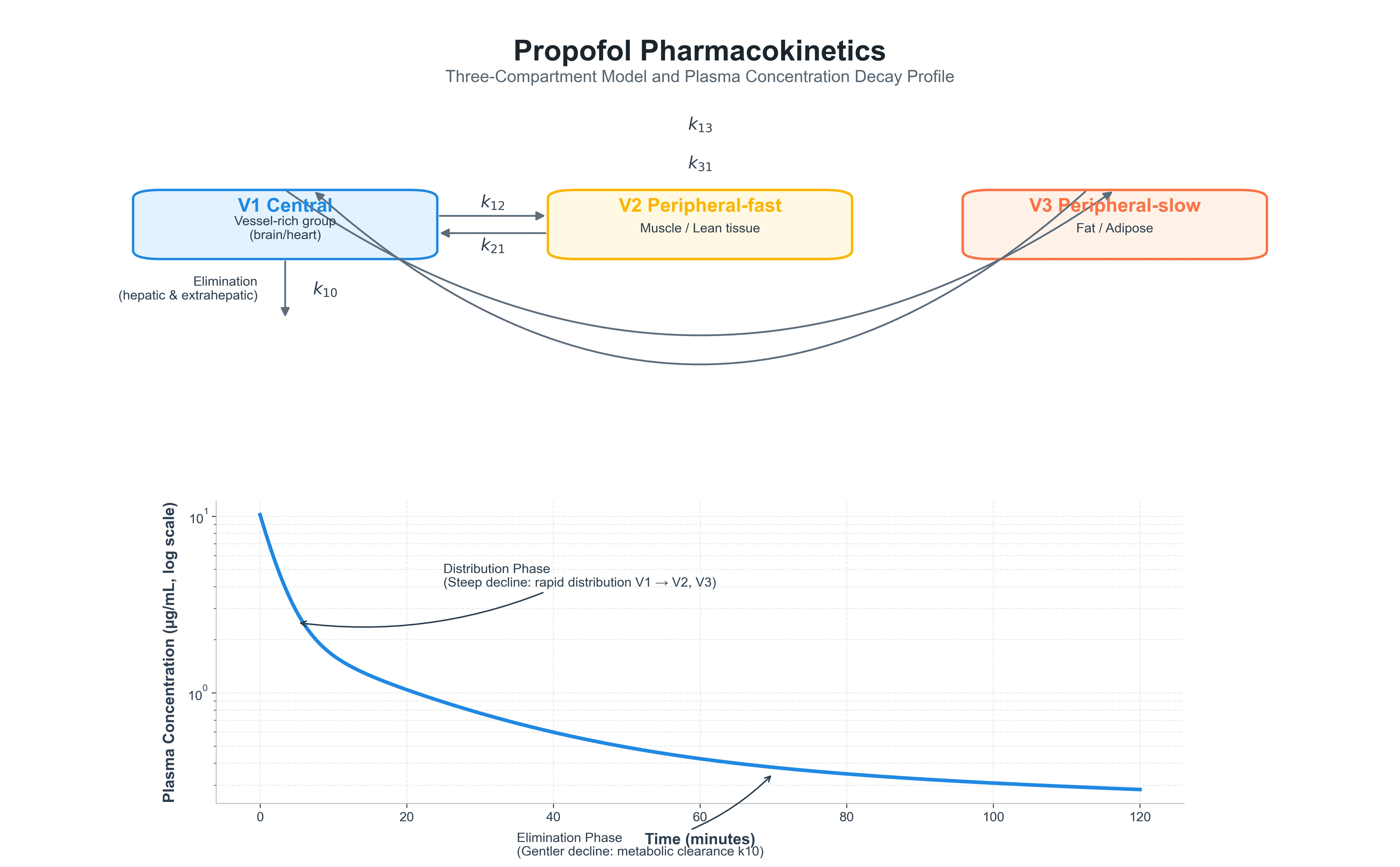
Propofol's pharmacokinetics are the basis of its clinical dominance, and they are described by a three-compartment model. After an intravenous bolus it reaches the brain within one arm-to-brain circulation, producing loss of consciousness in 15 to 45 seconds. Recovery after a single bolus is rapid — about 10 minutes — and this recovery is due not to metabolism but to redistribution: propofol leaves the vessel-rich central compartment (the brain and the well-perfused organs) and distributes into the larger muscle and fat compartments, the plasma and brain concentrations fall, and the patient wakes. [1]
Metabolism is chiefly hepatic, by glucuronidation and hydroxylation (the latter largely by CYP2B6 and CYP2C9), to inactive water-soluble conjugates excreted by the kidney. There is significant extrahepatic metabolism, demonstrated in the lung and the kidney, which contributes to the drug's exceptionally high clearance of about 1.5 to 2 L/min — a clearance that exceeds hepatic blood flow and is the key property that allows a sustained maintenance infusion without accumulation. Because clearance is so high and so little is excreted unchanged, propofol is safe in renal and hepatic impairment. [1]
The context-sensitive half-time is the half-time for the plasma concentration to fall once an infusion is stopped, and it is the practical measure of recovery from a maintenance technique. For propofol it rises only modestly with the duration of infusion — about 10 minutes at 1 hour, rising to about 40 minutes at 8 hours — far better than thiopental, which accumulates and produces a prolonged hangover. This is why propofol is the agent of total intravenous anaesthesia and thiopental is not. [1]
Pharmacodynamics
Propofol produces a dose-dependent depression of the central nervous system, progressing from sedation through to general anaesthesia as the plasma (and effect-site) concentration rises. At sub-hypnotic concentrations it is an antiemetic — used in small bolus doses (10 to 20 mg) for the treatment of postoperative nausea and vomiting — and this antiemetic property is one of the reasons TIVA is associated with less PONV than a volatile technique.[4]
Propofol is an anticonvulsant, raising the seizure threshold, and it has been used to terminate status epilepticus. It is a bronchodilator. On the cerebral circulation it reduces the cerebral metabolic rate for oxygen and the cerebral blood flow, and it lowers the intracranial pressure — properties that make it a neuroanaesthetic agent — but it also lowers the mean arterial pressure to a similar or greater extent, so the cerebral perfusion pressure (MAP minus ICP) must be actively maintained.[4]
On the respiratory system propofol causes dose-dependent respiratory depression: tidal volume and respiratory rate fall, and apnoea is common after an induction dose, especially after an opioid pre-treatment. It also depresses the laryngeal and pharyngeal reflexes and the hypoxic ventilatory response. The dose-dependent biomarker work confirms a smooth, monotonic relationship between the propofol effect-site concentration and the depth of central nervous system depression.[4]
Cardiovascular effects
Propofol's principal drawback is its haemodynamic effect. It reduces the systemic vascular resistance, by a combination of loss of sympathetic vasomotor tone and direct smooth-muscle relaxation, and it reduces myocardial contractility (a direct negative inotropic effect). The net result is a 15 to 40 percent drop in blood pressure after an induction dose, a fall that is larger than that produced by thiopental and far larger than that of etomidate or ketamine. [1]
Characteristically the hypotension is accompanied by less tachycardia than thiopental — propofol attenuates the baroreceptor reflex and blunts the sympathetic response — so the blood pressure falls without the compensatory rise in heart rate. It also attenuates the pressor response to laryngoscopy and intubation, a property exploited in the balanced induction. Propofol is safe in coronary disease when dosed carefully, because the reduction in blood pressure is accompanied by a reduction in myocardial work and the myocardial oxygen balance is preserved, but it is contraindicated in hypovolaemia and severe cardiac failure, where the loss of afterload and contractility cannot be tolerated and another agent (ketamine or etomidate) must be chosen. [1]
Clinical uses and dosing
Propofol's three roles are induction, maintenance (TIVA), and sedation. [1]
- Induction. The standard induction dose is 1.5 to 2.5 mg/kg in the healthy adult. In the elderly the dose is reduced to 1 to 1.5 mg/kg (a 30 to 50 percent reduction), reflecting a smaller central compartment, reduced clearance and increased sensitivity, and the dose is always titrated slowly to effect. In children the dose is higher per kilogram, at 2.5 to 3.5 mg/kg, reflecting a larger central volume and faster clearance.
- Maintenance infusion. A maintenance infusion of 4 to 12 mg/kg/hour sustains a surgical depth of anaesthesia, more commonly delivered as a target-controlled infusion (TCI).
- Target-controlled infusion. The TCI pump delivers propofol to hold a predicted plasma or effect-site concentration computed from a population pharmacokinetic model — the Marsh model (weight-based, for adults) and the Schnider model (incorporating age, height and lean body mass, targeting the effect site) — typically targeting an effect-site concentration of 3 to 6 micrograms/mL for surgical anaesthesia.[2][6]
- Sedation. For procedural or intensive-care sedation the infusion rate is 25 to 100 micrograms/kg/min (1.5 to 6 mg/kg/hour).
Because the pharmacodynamic effect tracks the effect-site concentration, the depth of anaesthesia should be monitored with a processed EEG (spectral entropy or bispectral index), titrating to a target range to avoid both awareness and overdose; the entropy-monitoring work demonstrates that this closes the loop between dose and effect.[2]
TIVA and target-controlled infusion
Propofol is the agent of total intravenous anaesthesia (TIVA). The standard technique combines a propofol infusion for hypnosis with a remifentanil infusion (a rapid, ultra-short-acting opioid) for analgesia — the propofol-remifentanil TIVA that is the modern alternative to a volatile-based technique, and to which adjuncts such as remimazolam are now being added.[1]
The advantages of TIVA over a volatile technique are several: no theatre pollution (no scavenging of greenhouse-gas vapour, an environmental and occupational benefit); rapid, clear-headed recovery; less postoperative nausea and vomiting; no airway irritation (useful in the reactive airway and in bronchoscopy); and it is not a malignant-hyperthermia trigger, making it the technique for the MH-susceptible patient. The TIVA-versus-sevoflurane comparison in cardiac surgery and the desflurane-versus-propofol neurocognitive comparison illustrate the modern evidence base for these choices.[7][3]
The Eleveld model is the latest universal pharmacokinetic model for propofol, built to span adults, children and the elderly with a single parameter set, and is increasingly the default in modern TCI pumps.[6] The most advanced systems pair the TCI pump with EEG depth-of-anaesthesia monitoring in a closed loop, automatically titrating the propofol effect-site target to a measured depth — a technique shown to reduce both under- and over-dosing and increasingly used in challenging pharmacokinetic situations.[2][6]
Adverse effects
- Pain on injection — the most common complaint. It is caused by the lipid emulsion irritating the vein wall. It is reduced by lidocaine 20 to 40 mg pretreatment with a tourniquet applied (venous occlusion for 30 to 60 seconds), by the use of a large antecubital vein, and by slow injection. Injecting into a small dorsal hand vein is the worst case.
- Hypotension — the dose-dependent fall in blood pressure described above; the most important clinical adverse effect.
- Apnoea — common after an induction dose, especially after an opioid.
- Myoclonus — involuntary movements on induction, less pronounced than with etomidate.
- Contamination and infection — the lipid emulsion supports bacterial growth; strict asepsis and discard after 6 hours are mandatory.
- Green urine — a harmless discoloration from a phenol metabolite; of no consequence.
- Allergy — true propofol anaphylaxis occurs; the emulsion is egg- and soya-based, though modern evidence shows it is safe even in patients with egg, soya or peanut allergy.
- Propofol infusion syndrome — the most serious adverse effect, discussed separately below. [1]
Propofol infusion syndrome
The propofol infusion syndrome (PRIS) is a rare but frequently fatal complication of prolonged, high-dose propofol sedation. The classical trigger is an infusion of over 4 mg/kg/hour for more than 48 hours, and it is most feared in the critically ill child in the paediatric intensive care unit, though it occurs in adults too. The features are those of mitochondrial energy failure: a progressive metabolic acidosis, rhabdomyolysis, cardiac failure (a bradycardic, inotrope-resistant cardiomyopathy that can progress to a sine-wave ECG and cardiac arrest), hepatomegaly, lipaemia, renal failure and hyperkalaemia.[8]
The mechanism is blockade of mitochondrial fatty-acid oxidation — propofol impairs the transport of long-chain fatty acids into the mitochondria and the activity of the respiratory chain, so the cell cannot generate ATP from fat and accumulates toxic intermediates. The tissues most dependent on fatty-acid oxidation — skeletal and cardiac muscle, the liver — are those that fail. The case reports of a sine-wave ECG progressing to cardiac arrest illustrate the terminal cardiac phenotype.[8]
The treatment is to stop the propofol immediately and provide supportive care — haemofiltration for the acidosis and renal failure, inotropic and mechanical circulatory support, and carbohydrate loading to provide an alternative substrate. The prevention is to keep prolonged infusions under 4 mg/kg/hour, to monitor the acid-base, the lactate, the creatine kinase and the potassium in any patient on a sustained propofol infusion, and to switch to a volatile agent or a barbiturate for prolonged ICU sedation. The syndrome is essentially unknown after a single induction dose or a short theatre infusion.[8]
Special populations
- Pregnancy. Propofol crosses the placenta. A high dose immediately before caesarean section — before the cord is clamped — causes neonatal depression, so the induction dose is kept modest and timed after cord clamping for any supplementation. It is safe in lactation.
- The elderly. The induction dose is reduced by 30 to 50 percent (to 1 to 1.5 mg/kg), reflecting a smaller central compartment, reduced clearance and increased receptor sensitivity, and it is titrated slowly.[3]
- Paediatrics. Children require a higher dose per kilogram for induction (2.5 to 3.5 mg/kg). The paediatric intensive-care population is the highest-risk group for PRIS, and prolonged high-dose propofol sedation is avoided in this group.
- Renal and hepatic impairment. Propofol is generally safe — its clearance is high, its metabolism produces inactive water-soluble conjugates, and little is excreted unchanged — though the dose should be titrated in advanced disease.
- The haemodynamically unstable patient. Propofol's vasodilation and negative inotropy are poorly tolerated; consider ketamine or etomidate instead, both of which preserve the blood pressure.
Comparison with other induction agents
- Versus thiopental. Propofol gives a faster, clearer recovery (redistribution plus high clearance versus thiopental's accumulation), causes more hypotension, produces less bronchospasm and is antiemetic rather than nauseating. Thiopental is contraindicated in porphyria; propofol is not.
- Versus ketamine. Propofol produces no sympathomimetic stimulation (so more hypotension), no bronchodilation, no analgesia, and no emergence phenomenon. Ketamine is the agent of the shocked and the asthmatic; propofol is the agent of the well, elective patient.
- Versus etomidate. Propofol causes more hypotension, has no adrenal suppression (etomidate inhibits 11-beta-hydroxylase), and produces less myoclonus and less PONV. Etomidate is the agent of the haemodynamically tenuous.
- Versus sevoflurane (inhalational). A TIVA technique gives no theatre pollution, a faster, clearer recovery and less PONV, at the cost of needing an intravenous line and a pump; sevoflurane gives less airway irritation for maintenance and is the practical choice for the inhalational induction (the needle-phobic child, the difficult intravenous access). The desflurane-versus-propofol neurocognitive work and the TIVA-versus-sevoflurane cardiac-surgery trial frame this modern choice.[3][7]
Clinical
- Standard approach
- Evidence-based
Alternative
- Modified technique
- Risk-benefit
Red flags
[1] [1] [1] [1] [1] [1]References
- [1]Kazokas D, et al. The Effects of Low-Dose Remimazolam Adjunct on Propofol-Remifentanil Anaesthesia in Day Case Gynaecological Surgery: A Retrospective Cohort Study Medicina (Kaunas), 2026.PMID 42356189
- [2]Popovici SE, et al. EEG-Derived Entropy Monitoring During Propofol Sedation for ERCP: Sedation Profiles, Age-Related Effects, and Implications for Procedure-Specific Target Ranges Medicina (Kaunas), 2026.PMID 42356061
- [3]Somnuke P, et al. Effect of desflurane versus propofol on perioperative neurocognitive disorders in older adults undergoing major urological surgery: a randomized trial BMC Geriatr, 2026.PMID 42321629
- [4]Pathak A, et al. Mechanistic simulation identifies predictive dose-dependent biomarkers of propofol anesthesia bioRxiv, 2026.PMID 42327056
- [5]Dong C, et al. Calcium Signaling Dysregulation as a Convergent Mechanism in Anesthetic-Induced Developmental Neurotoxicity Drug Des Devel Ther, 2026.PMID 42232094
- [6]Ramesh S, et al. Integrated Advanced Monitoring and Target-Controlled Infusion Anesthesia in a Child With Arthrogryposis Multiplex Congenita Cureus, 2026.PMID 42359210
- [7]Fazekas A, et al. Total Intravenous Anesthesia Versus Sevoflurane-Based Inhalation Anesthesia Within an Enhanced Recovery After Cardiac Surgery (ERACS) Protocol J Cardiothorac Vasc Anesth, 2026.PMID 42350176
- [8]El-Medany AYM, et al. Rapid Evolution of Sine-Wave Electrocardiographic Morphology Preceding Cardiac Arrest JACC Case Rep, 2026.PMID 42165462