Anaes · Anaesthetic adjuncts
Remifentanil
Also known as Ultra-short-acting ester opioid · Flat context-sensitive half-time opioid · Organ-independent opioid analgesic · TIVA opioid (with propofol)
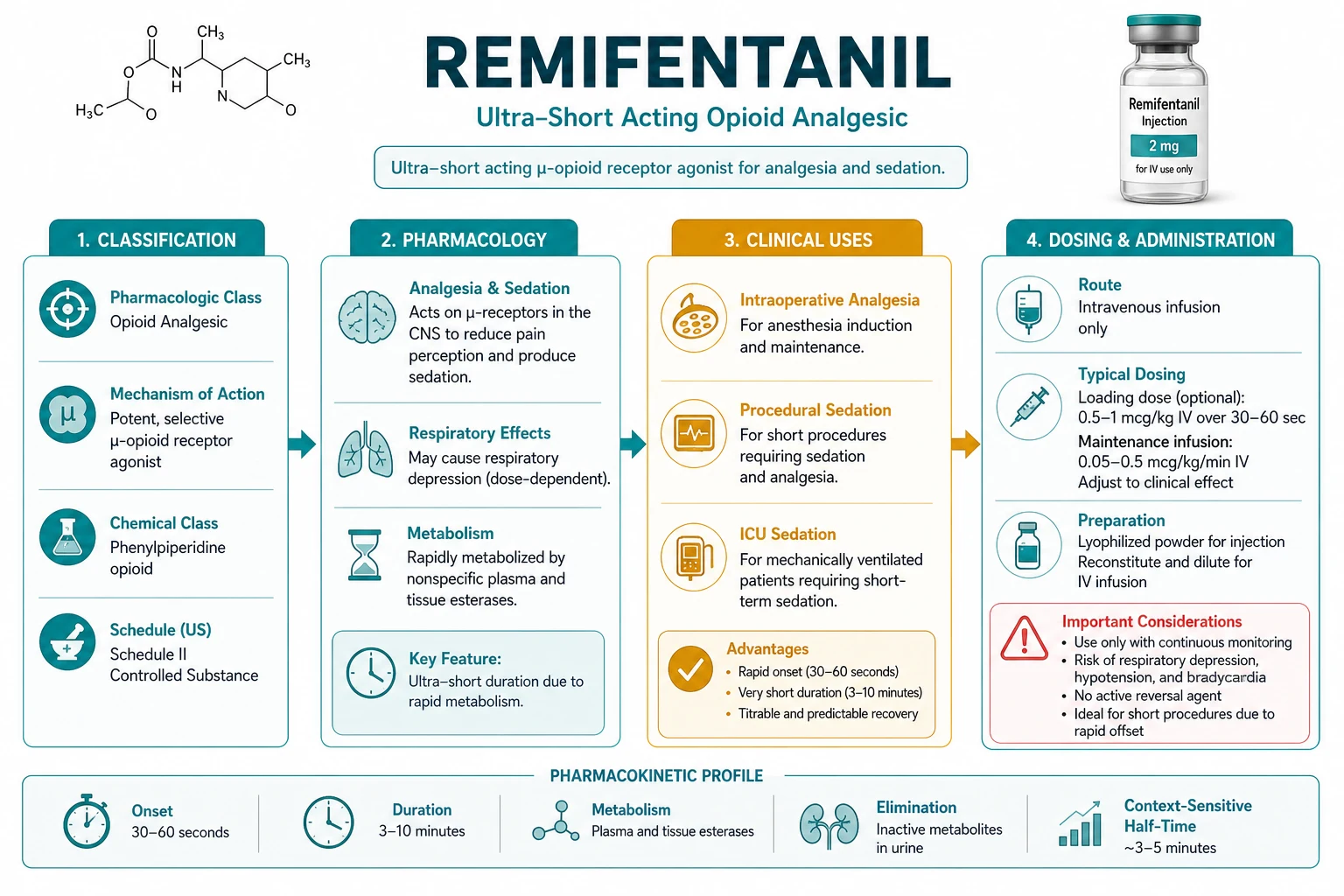
Remifentanil is a synthetic phenylpiperidine full mu-opioid agonist of similar potency to fentanyl whose defining feature is metabolism by non-specific plasma and tissue esterases to an essentially inactive metabolite, giving a flat context-sensitive half-time of about 3 to 4 minutes that does not rise with infusion duration — it is the only opioid that does not accumulate, no matter how long the infusion. It has a rapid onset (peak about 1 to 2 minutes) and offset within 3 to 5 minutes of stopping regardless of infusion length, is safe in hepatic and renal failure, is given by IV infusion only, and is the opioid component of the classic propofol-remifentanil TIVA. It causes rapid acute tolerance and opioid-induced hyperalgesia, so alternative analgesia must be established before stopping. Built on the propofol-remifentanil TIVA study (Kazokas 2026), the analgesia-first strategy study (Wang 2026), the remifentanil anaesthesia study (Rizopoulou 2026), the target-controlled-infusion study (Ramesh 2026), the outpatient anaesthesia study (Alnemri 2026), and the paediatric epilepsy anaesthesia study (Sun 2026).
On this page & tools
Your progress
Saved locally on this device.
8 MCQs with explanations
Target exams
Red flags
Why this is examined
Remifentanil is the only opioid whose offset is essentially independent of infusion duration. That single property underpins propofol–remifentanil TIVA, neuroanaesthesia with immediate wake-up testing, titratable analgesia in organ failure, and the classic exam trap of catastrophic rebound pain when the infusion stops without a transition plan [1][2][4].
Chemistry, receptor and potency
Remifentanil is a synthetic anilidopiperidine (phenylpiperidine) opioid with a methyl-ester side chain. It is a selective full agonist at the mu-opioid receptor, producing analgesia, respiratory depression, miosis, bradycardia and muscle rigidity like other pure mu agonists. Potency is similar to fentanyl (order of magnitude ~100 times morphine). It does not release histamine. [1]
The ester bond is the whole story: non-specific esterases in blood and tissues hydrolyse remifentanil to remifentanil acid, which has negligible clinical activity. Clearance is therefore: [1]
- independent of hepatic blood flow and CYP pathways for practical purposes
- independent of renal function for the parent drug
- not dependent on butyrylcholinesterase (pseudocholinesterase) — patients with suxamethonium apnoea still metabolise remifentanil [3]
Pharmacokinetics in numbers
| Parameter | Value / behaviour | Exam meaning |
|---|---|---|
| Time to peak effect | about 1 to 2 minutes | Align rate changes with surgical stimulus |
| Offset after stopping | about 3 to 5 minutes | Predictable emergence |
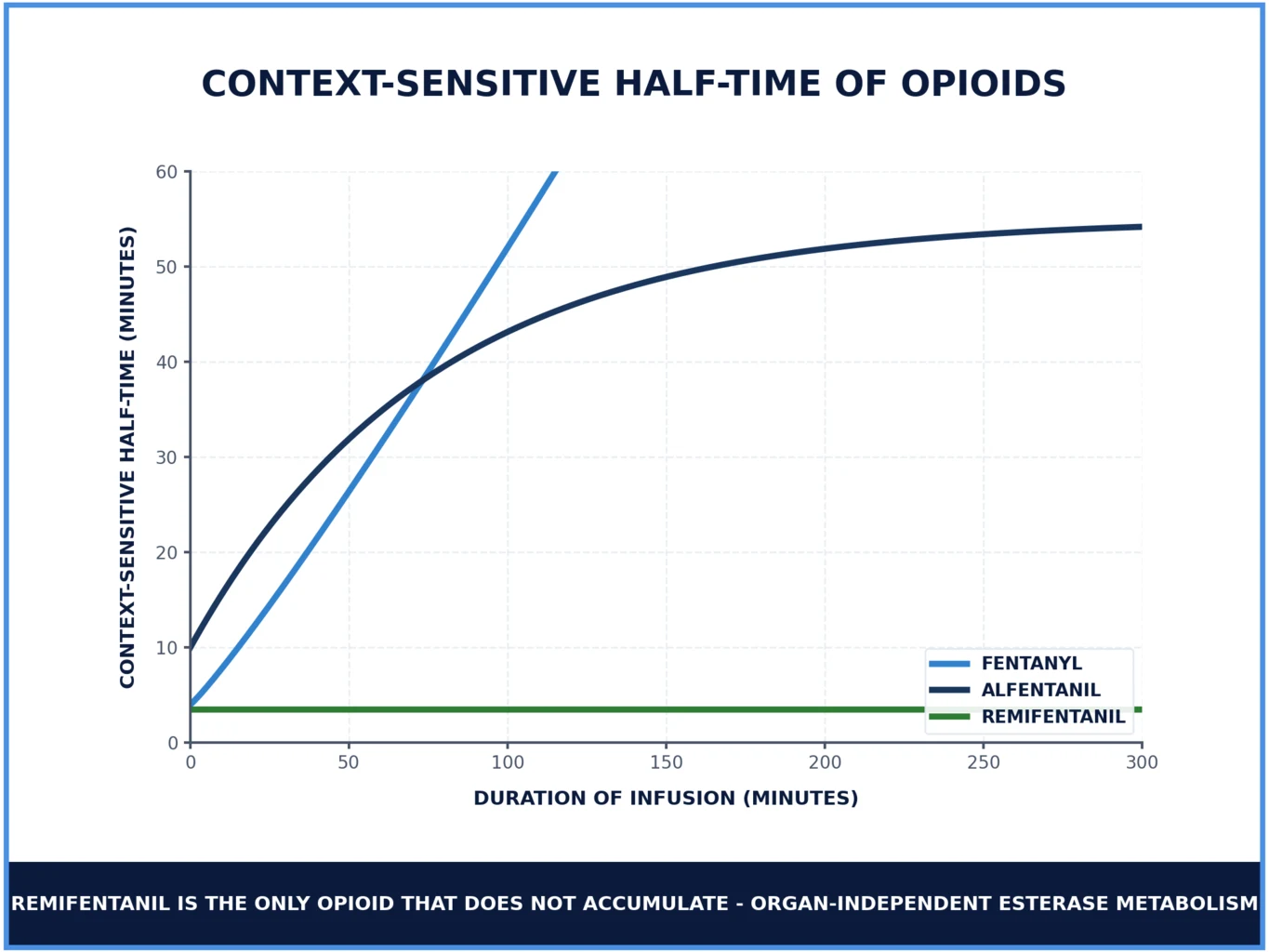
| Context-sensitive half-time | about 3 to 4 minutes, flat | Does not rise with 1 hour or 10 hours of infusion [4] |
| Volume of distribution | Relatively small vs fentanyl | Less tissue store |
| Metabolism | Non-specific esterases | Organ-independent |
| Metabolite | Remifentanil acid (weak) | No late analgesia from metabolite |
| Route | Continuous IV infusion or TCI | Unsuitable as sole intermittent ward bolus opioid |
Flat context-sensitive half-time — the graph to draw
Context-sensitive half-time (CSHT) is the time for plasma concentration to fall by 50% after stopping an infusion of a given duration. For fentanyl, alfentanil and sufentanil the curve climbs as peripheral compartments fill. For remifentanil the curve is a horizontal line near 3 to 4 minutes. That is why examiners ask you to sketch CSHT curves and point to remifentanil as the exception [1][4].
Offset is metabolic, not redistribution. After a single fentanyl bolus you wake partly because drug redistributes; after remifentanil you wake because the molecules are destroyed. [1]
Clinical use table (learnable)
| Clinical situation | Why remifentanil fits | Practical pattern | Mandatory companion plan |
|---|---|---|---|
| Propofol–remifentanil TIVA | Synergistic hypnosis–analgesia; rapid recovery | TCI effect-site or manual microg/kg/min infusion titrated to stimulus and processed EEG if used [1][4] | Morphine or fentanyl or regional 20–30 min before end |
| Craniotomy / spine with wake test | Clear-headed fast offset | Stable infusion; avoid late long-acting sedatives | Multimodal non-sedating analgesics |
| Carotid / short stimulating phases | Intense blunt of transient peaks | Temporary rate increase | Return to baseline rate after stimulus |
| Hepatic or renal failure | Esterase clearance | Prefer over morphine (M6G) or long fentanyl infusions [3][6] | Non-opioid multimodal backbone |
| Analgesia-first ICU strategies | Titratable without stacking hypnotics | Protocolised infusions [2] | Sedation targets and weaning plan |
| Day-case / fast-track | Minimal hangover | Short case infusions [5] | Prevent rebound with regional + paracetamol/NSAID/ketamine |
| Paediatric epilepsy / complex cases | Rapid titration around neuromonitoring | Specialist dosing weight-based [6] | PICU handover of transition plan |
Typical adult maintenance rates often sit in a broad band such as 0.05 to 0.5 microg/kg/min (or TCI target ranges per model library). State that you titrate to effect, reduce with hypnotic synergy, and know age adjustments — do not recite a single magic number as if universal. [1]
Acute tolerance and opioid-induced hyperalgesia
Within hours, remifentanil can produce acute tolerance and OIH so that the same surgical stimulus needs higher rates, and cessation unmasks a hyperalgesic patient [2]. Exam answer structure:
- Anticipate it whenever infusion is more than brief.
- Before stopping: long-acting opioid (e.g. morphine IV titrated) and/or regional block and/or ketamine anti-hyperalgesic dose and simple analgesics.
- Time the long-acting drug so its peak covers remifentanil disappearance (often 20–30 minutes pre-end).
- Do not "just give naloxone" for pain — that is wrong physiology. [1]
Adverse effects and immediate management
| Problem | Recognition | First actions |
|---|---|---|
| Apnoea / hypoventilation | Low RR, rising ETCO2 | Airway, reduce/stop infusion; rarely need naloxone if timed stop |
| Bradycardia | HR fall, especially with high rate + propofol | Reduce rate; anticholinergic |
| Hypotension | Vasodilation + rate | Fluids, vasopressor, reduce rate |
| Chest-wall rigidity | Hard bag, high airway pressure after bolus | Stop bolus, 100% O2, urgent neuromuscular blockade if cannot ventilate |
| Severe emergence pain | Immediate on stop | Rescue opioid + ketamine; fix process next time |
Comparison tables
Versus other phenylpiperidines
| Feature | Remifentanil | Fentanyl | Alfentanil | Sufentanil |
|---|---|---|---|---|
| Bolus practicality | Poor for ward | Excellent | Excellent short peak | Potent |
| Long infusion accumulation | None (flat CSHT) | Marked | Moderate rise | Rises |
| Organ failure | Excellent | Hepatic | Hepatic | Hepatic |
| Residual post-op analgesia | None | Yes | Some | Yes |
| OIH/tolerance prominence | High if unmanaged | Lower | Lower | Lower |
Versus morphine
Morphine is slow, long, hepatic with active morphine-6-glucuronide that accumulates in renal failure, and provides lasting post-op analgesia. Remifentanil is the opposite kinetic tool. They are partners (transition), not substitutes. [1]
Cost and stewardship
Remifentanil is expensive and needs a pump, training and a transition culture. Use it where its kinetics buy safety or surgical conditions; do not use it as default for every case if a simple fentanyl–volatile technique with regional would serve [5].
SAQ answer scaffold
- Classify remifentanil and state receptor.
- Describe esterase metabolism and metabolite activity.
- Define CSHT and contrast remifentanil with fentanyl.
- Give two clinical indications with dosing philosophy.
- Detail transition analgesia and OIH.
- List CVS and rigidity risks with management. [1]
Viva stem bank and model phrases
- "What is unique about remifentanil kinetics?" → "Non-specific esterase hydrolysis produces a context-sensitive half-time that remains about 3 to 4 minutes regardless of infusion duration."
- "How do you stop a remifentanil TIVA?" → "I do not simply switch it off. I ensure multimodal and a longer-acting opioid or regional analgesia is established about 20 to 30 minutes before the planned end, then taper the remifentanil as surgery finishes."
- "Is remifentanil safe in cholinesterase deficiency?" → "Yes for metabolism — it is not a butyrylcholinesterase substrate." [1]
Common traps
- Treating remifentanil like fentanyl boluses on the ward.
- No transition plan.
- Large rapid boluses causing rigidity and bradycardia.
- Confusing remifentanil with remimazolam.
- Claiming hepatic metabolism as primary clearance. [1]
Remifentanil
- Esterase metabolism
- Flat CSHT
- Infusion/TCI only
- Transition analgesia mandatory
Fentanyl
- Hepatic clearance
- CSHT rises
- Bolus workhorse
- Residual analgesia
Alfentanil
- Fast bolus onset
- pKa ~6.5
- CSHT rises
- Short stimulus tool
Morphine
- Active M6G
- Slow peak
- Post-op mainstay
- Renal caution
Red flags
[1]References
- [1]Kazokas D, et al. The Effects of Low-Dose Remimazolam Adjunct on Propofol-Remifentanil Anaesthesia in Day Case Gynaecological Surgery: A Retrospective Cohort Study Medicina (Kaunas), 2026.PMID 42356189
- [2]Wang YM, et al. Feasibility and safety of an analgesia-first strategy without hypnotic sedatives in adult patients admitted to the intensive care unit after neurosurgical craniotomy: a protocol for a single-arm, single-center exploratory prospective study Front Med (Lausanne), 2026.PMID 42359072
- [3]Rizopoulou S, et al. Variations in S-100Β and Neuron-Specific Enolase Levels During Functional Endoscopic Sinus Surgery Under Moderately Controlled Hypotension Using Four Distinct Anesthetic Protocols: A Randomized Controlled Study Medicina (Kaunas), 2026.PMID 42356019
- [4]Ramesh S, et al. Integrated Advanced Monitoring and Target-Controlled Infusion Anesthesia in a Child With Arthrogryposis Multiplex Congenita Cureus, 2026.PMID 42359210
- [5]Alnemri A, et al. Predictors of Unplanned Admission After Outpatient Rhytidectomy Aesthet Surg J, 2026.PMID 42322187
- [6]Sun L, et al. Perioperative anesthetic management in pediatric patients with medically refractory pulmonary arterial hypertension undergoing surgical or transcatheter potts shunt: a retrospective case series BMC Anesthesiol, 2026.PMID 42304217