Anaes · Neuromuscular blockade & reversal
Rocuronium
Also known as Aminosteroid non-depolarising neuromuscular blocker · Suxamethonium alternative for RSI · Sugammadex-reversible muscle relaxant
Rocuronium is an aminosteroid non-depolarising neuromuscular blocker that acts as a COMPETITIVE antagonist at the postsynaptic nicotinic (muscle-type) acetylcholine receptor — it displaces acetylcholine without activating the receptor, producing flaccid paralysis without fasciculation (Kronauer, 2026). It has the FASTEST onset of any non-depolariser — about 60 to 90 seconds at a standard 0.6 mg per kg intubating dose and approaching 60 seconds at a 1.0 to 1.2 mg per kg rapid-sequence-induction dose — making it the standard suxamethonium alternative for RSI when sux is contraindicated (O'Connell, Ipsen, Freund, 2026). Its duration is intermediate and dose-dependent, its elimination is predominantly hepatobiliary (so it is safe in butyrylcholinesterase deficiency, unlike sux), and its cardiovascular profile is stable with no histamine release. Two reversal pathways exist — neostigmine (acetylcholinesterase inhibition, which raises synaptic acetylcholine) and sugammadex, a modified gamma-cyclodextrin that selectively encapsulates rocuronium and can reverse even a profound block (Lawson, 2026). The principal risk is anaphylaxis: rocuronium has historically been one of the leading single causes of perioperative anaphylaxis, as highlighted by NAP6 (Zofia Lisiecka, 2026).
On this page & tools
Your progress
Saved locally on this device.
Target exams
Red flags
Overview
Rocuronium bromide is a non-depolarising neuromuscular blocker of the aminosteroid group, structurally related to vecuronium and pancuronium and distinct from the benzylisoquinolines (atracurium, mivacurium, cisatracurium). It was designed to provide a non-depolariser with an onset fast enough to be a practical alternative to suxamethonium for rapid sequence induction, and that combination of rapid onset, intermediate duration, cardiovascular stability and selective reversibility by sugammadex has made it the most widely used intubating relaxant in modern anaesthetic and emergency practice.[1][8]
The drug occupies a central place in the modern neuromuscular-blockade story: it is the standard sux-sparing agent for rapid sequence intubation, and it is the agent whose reversal was transformed by sugammadex. The two ideas examiners return to again and again are its competitive-antagonist mechanism and the depth-based dosing of sugammadex reversal.[7][2]
Structure and mechanism
Rocuronium is a competitive antagonist at the postsynaptic nicotinic (muscle-type, N_M) acetylcholine receptor at the neuromuscular junction. It binds the receptor without activating it and so blocks acetylcholine from gaining access; crucially, there is no receptor activation, no depolarisation and no fasciculation, and the resulting paralysis is flaccid. This is the defining pharmacological distinction from suxamethonium, which is a depolarising agent that first activates the receptor (producing fasciculation) and then keeps it depolarised.[1]
Because the block is competitive, it can be overcome in two ways: by raising the concentration of acetylcholine at the junction (the basis of reversal with an anticholinesterase such as neostigmine) or by removing the rocuronium from the receptor compartment (the basis of reversal by sugammadex encapsulation).[1] Structurally, the aminosteroid backbone confers the molecule's cardiovascular stability and its lack of histamine release, distinguishing it from the benzylisoquinolines.[8]
Onset and intubation
Rocuronium has the fastest onset of any non-depolarising neuromuscular blocker. At the standard intubating dose of 0.6 mg per kg, good intubating conditions are achieved in about 60 to 90 seconds; at the higher rapid-sequence-induction dose of 1.0 to 1.2 mg per kg, onset approaches about 60 seconds, bringing it within range of suxamethonium.[3][6]
This is the basis of rocuronium's role as the suxamethonium alternative of choice for rapid sequence induction: when suxamethonium is contraindicated (hyperkalaemia, burns, denervation, malignant hyperthermia susceptibility, raised intracranial or intraocular pressure), a 1.0 to 1.2 mg per kg dose of rocuronium provides intubating conditions that randomised and observational data show are non-inferior to suxamethonium for first-pass success.[7] The trade-off is duration — a high RSI dose produces a longer block than sux — and historically that was the main objection to rocuronium for RSI; sugammadex has largely removed that objection (see Reversal with sugammadex).[2]
Duration and maintenance
Rocuronium is classified as an intermediate-duration agent, and its duration is dose-dependent. At 0.6 mg per kg the clinical duration is roughly 30 to 60 minutes; at a 1.2 mg per kg RSI dose the block is markedly prolonged. This dose-dependence is the property examiners probe, because it explains both the drug's RSI utility (a high dose buys reliable intubating conditions) and its RSI hazard (the same high dose commits the operator to a longer block).[4]
For maintenance of relaxation, rocuronium is given by intermittent bolus or by infusion. A typical maintenance bolus is 0.1 to 0.15 mg per kg, titrated to a quantitative train-of-four target; an infusion is usually run at around 0.3 to 0.6 mg per kg per hour and adjusted to depth. Prehospital and retrieval practice has validated an intermittent-bolus maintenance regime for ongoing relaxation after RSI.[4]
Pharmacokinetics and elimination
Rocuronium is cleared predominantly by the hepatobiliary route: roughly 70 percent is excreted in bile and about 25 percent renally, with a small fraction metabolised. The elimination is largely independent of plasma (butyryl) cholinesterase, which is the key pharmacokinetic distinction from suxamethonium and mivacurium — rocuronium is therefore safe and behaves predictably in patients with inherited butyrylcholinesterase deficiency, in whom sux causes a prolonged block.[1]
Because both biliary and renal pathways contribute, duration is prolonged in significant renal or hepatic impairment, and some accumulation occurs with repeated dosing or prolonged infusion in organ failure. Plasma clearance is also reduced at the extremes of age and in critical illness, so depth monitoring is essential whenever elimination may be impaired.[8]
Cardiovascular and systemic effects
Rocuronium is cardiovascularly very stable. It does not cause histamine release even at high doses, so it does not produce the hypotension or bronchospasm seen with some benzylisoquinolines. A mild vagolytic effect can produce a slight tachycardia or rise in blood pressure at high (RSI) doses, but clinically significant haemodynamic change is unusual.[1]
It does not affect the seizure threshold (so it is acceptable in electroconvulsive therapy and in epilepsy), it does not raise intracranial or intraocular pressure, and it has no meaningful effect on consciousness or pain — it must always be given with an adequate hypnotic and analgesic.[8]
Reversal with neostigmine
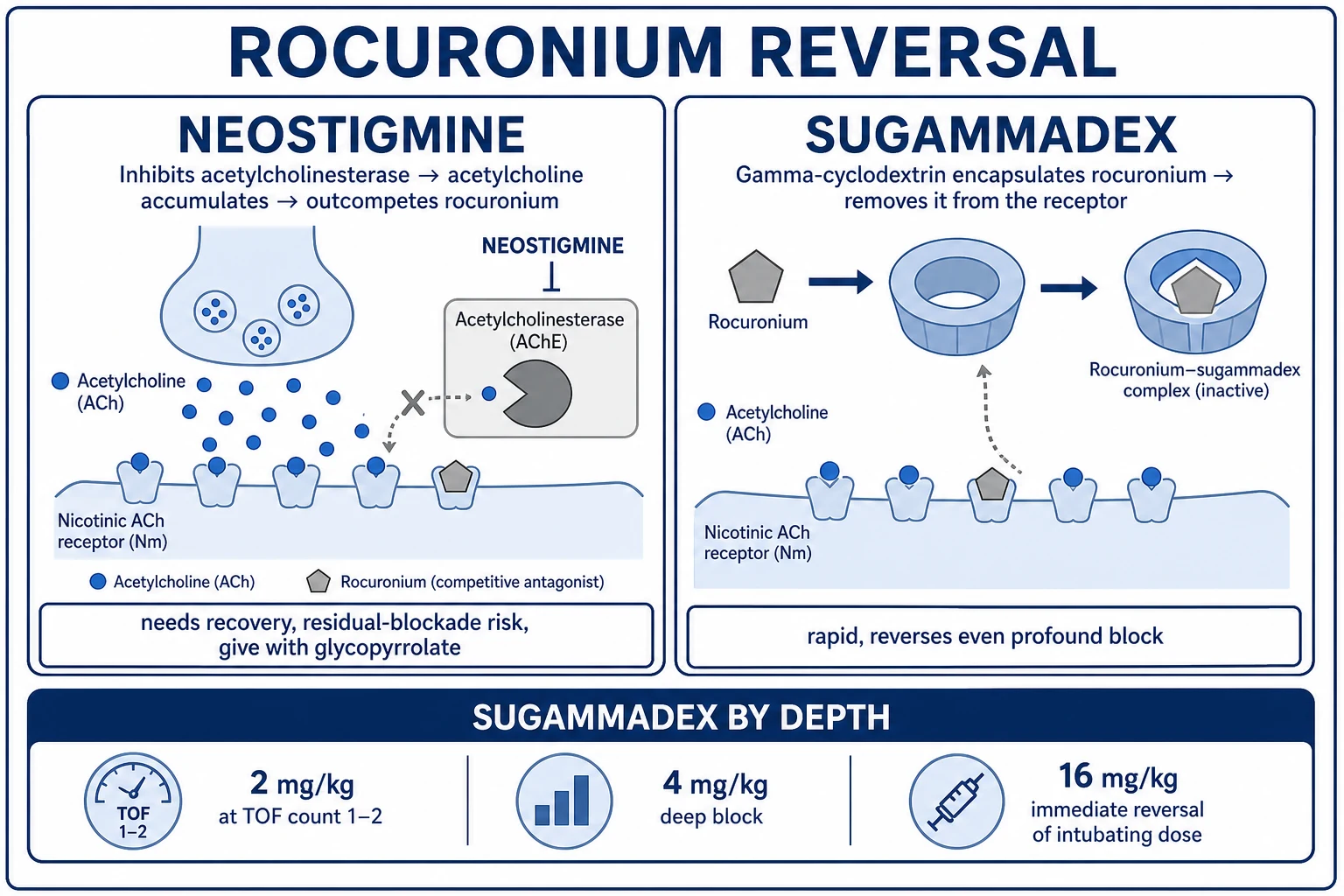
The first reversal mechanism is acetylcholinesterase inhibition with neostigmine. By inhibiting the enzyme that breaks down acetylcholine at the junction, neostigmine raises synaptic acetylcholine concentration until it outcompetes the blocker at the receptor. A muscarinic anticholinergic — glycopyrrolate (or atropine) — is given with it to offset the muscarinic side-effects of cholinesterase inhibition (bradycardia, salivation, bronchoconstriction).[1]
Neostigmine is effective for any non-depolariser, but it has two fundamental limits. First, it requires evidence of spontaneous recovery: it should only be given once a quantitative train-of-four ratio is approaching normal, because giving neostigmine against a profound block cannot produce full reversal and may paradoxically worsen it. Second, even when it appears to reverse the block clinically, residual neuromuscular blockade remains a real risk, which is why quantitative train-of-four monitoring is mandatory before extubation.[1][8]
Reversal with sugammadex
The second reversal mechanism is selective encapsulation by sugammadex, a modified gamma-cyclodextrin with a hydrophobic cavity that binds rocuronium (and, less avidly, vecuronium) with very high affinity. By drawing rocuronium out of the plasma and trapping it in the cavity, sugammadex creates a concentration gradient that pulls the drug off the receptor, restoring neuromuscular function rapidly and reliably — and, uniquely, it can reverse a deep or profound block that neostigmine cannot.[2]
Sugammadex dosing is depth-based, and this is the point examiners expect candidates to state precisely.[2]
- 2 mg per kg — for reversal at a train-of-four count of 1 to 2 (a moderate to shallow block), typically giving recovery to a normal train-of-four ratio within a few minutes.
- 4 mg per kg — for a deep block (a post-tetanic count of 1 to 2, with no twitches on train-of-four).
- 16 mg per kg — for immediate reversal of a large 1.2 mg per kg intubating dose, restoring neuromuscular function within about 3 minutes; this is the dose for the cannot-intubate-cannot-oxygenate scenario in which the operator needs the block gone now. [1]
This depth-based dosing is why quantitative neuromuscular monitoring is inseparable from safe sugammadex use: the dose is chosen from the measured depth of block.[1][2]
Neuromuscular monitoring
Quantitative train-of-four monitoring is now the standard of care for any non-depolarising block, rocuronium included. Four supramaximal stimuli are delivered at 0.5-second intervals and the ratio of the fourth to the first twitch (the TOF ratio) is measured; a ratio of 0.9 or above is the target for safe extubation. Fade — the fourth twitch being smaller than the first — is the hallmark of a non-depolarising (competitive) block, in contrast to the sustained but reduced-amplitude pattern of a depolarising block.[1]
Monitoring guides the intubating dose (depth confirms readiness to intubate), the maintenance dose or infusion rate (titration to a target depth), and the reversal (the choice between neostigmine and sugammadex, and the sugammadex dose). It is the only reliable way to detect residual blockade, which remains a contributor to postoperative respiratory complications.[1][6]
Adverse effect: anaphylaxis
The principal risk of rocuronium is perioperative anaphylaxis. Rocuronium, like the other aminosteroid relaxants, has historically been one of the leading single causes of perioperative anaphylaxis, a finding reinforced by NAP6 in the United Kingdom where neuromuscular blockers accounted for the majority of confirmed anaphylaxis cases. The reaction is IgE-mediated, occurs within minutes of administration, and presents with hypotension, bronchospasm, erythema and cardiovascular collapse; immediate recognition and treatment with intravenous adrenaline, fluid and airway support is essential.[5]
There has been interest in whether sugammadex might help in rocuronium anaphylaxis by encapsulating free drug, but this is debated and is not a substitute for standard anaphylaxis management with adrenaline. The safe position is that any patient given rocuronium must be managed where anaphylaxis can be recognised and treated immediately.[5]
Rocuronium versus suxamethonium
The rocuronium-versus-sux comparison is one of the most frequently examined pharmacology questions.[7]
Advantages of rocuronium over suxamethonium. No hyperkalaemia (so safe in burns, denervation, trauma, renal failure); no malignant hyperthermia trigger (non-depolarisers do not trigger MH); no rise in intracranial or intraocular pressure; no fasciculation or myalgia; safe and predictable in butyrylcholinesterase deficiency; and reversible with sugammadex.[7][2]
Disadvantages of rocuronium against sux. Slower onset (even at 1.2 mg per kg, about 60 seconds versus the 30 to 60 seconds of sux) and a longer duration, so that historically a cannot-intubate-cannot-oxygenate event left the operator without spontaneous ventilation for longer. The availability of sugammadex 16 mg per kg for immediate reversal has largely closed this gap, which is why rocuronium has displaced sux as the default RSI agent in many centres.[7][2]
Rocuronium in special situations
Renal impairment prolongs duration because around a quarter of the drug is renally cleared and accumulation is possible; sugammadex is itself renally cleared, so in severe renal failure the reversibility advantage may be reduced. Hepatic impairment and biliary obstruction prolong the block because biliary excretion is the dominant elimination route. Pregnancy does not contraindicate rocuronium — it is acceptable for caesarean section RSI; onset may be slightly faster and duration slightly shorter owing to the increased volume of distribution. Critical illness and the elderly show reduced clearance and increased sensitivity, so titration with quantitative monitoring is essential.[8][4]
In paediatric practice rocuronium is effective at standard weight-based dosing, with a relatively faster onset in infants. In malignant hyperthermia-susceptible patients rocuronium is the relaxant of choice because, like all non-depolarisers, it does not trigger MH.[8]
Clinical use and current place in practice
Rocuronium is now the default intubating relaxant in much of anaesthetic and emergency practice: it is the agent of choice for rapid sequence induction when suxamethonium is contraindicated, and increasingly the default first-line RSI agent regardless, given that sugammadex has removed the chief historical objection to its longer duration.[7][2] It is used for routine intubation, for maintenance of relaxation by bolus or infusion, and in prehospital and retrieval anaesthesia.[4]
Its place in practice rests on five properties that examiners expect candidates to articulate: competitive-antagonist mechanism with no depolarisation; the fastest onset of any non-depolariser; intermediate dose-dependent duration; cardiovascular stability with no histamine release; and selective, depth-titrated reversibility by sugammadex. Its single dominant risk — anaphylaxis — is the reason it can never be given casually.[5][1]
Clinical
- Standard approach
- Evidence-based
Alternative
- Modified technique
- Risk-benefit
Red flags
[1]References
- [1]Kronauer T, et al. [Muscle relaxation and neuromuscular monitoring : Current findings and recommendations for the clinical practice] Anaesthesiologie, 2026.PMID 42334564
- [2]Lawson C, et al. A multi-center retrospective cohort study of SUGAmmadex for neuromuscular blockade reversal in the emergency department: SUGARED study - on behalf of EMPHARM-NET Investigators Am J Emerg Med, 2026.PMID 42349235
- [3]Ipsen EO, et al. Remifentanil Versus Rocuronium for Optimising Video Laryngoscopy Assisted Tracheal Intubation-The ROCVIDEO Trial Protocol Acta Anaesthesiol Scand, 2026.PMID 42304626
- [4]Sheridan B, et al. Maintenance of prehospital anaesthesia using an intermittent bolus regime in blunt trauma patients with a high GCS and hemodynamic reserve: a retrospective cohort study Scand J Trauma Resusc Emerg Med, 2026.PMID 42351216
- [5]Zofia Lisiecka M, et al. Allergic reactions to anaesthetics in surgery: current challenges and perspectives Drug Metab Pers Ther, 2026.PMID 42229044
- [6]Freund Y, et al. Improving the safety of emergency tracheal intubation Curr Opin Crit Care, 2026.PMID 42170830
- [7]O'Connell DH, et al. Outcomes of Succinylcholine and Rocuronium for Rapid Sequence Intubation in the Emergency Department West J Emerg Med, 2026.PMID 42258841
- [8]Kronauer T, et al. [Muscle relaxation 2026-50 years of searching for the ideal relaxant] Anaesthesiologie, 2026.PMID 42319466