Anaes · Volatile & inhalational agents
Sevoflurane
Also known as Fluoromethyl 2,2,2-trifluoro-1-(trifluoromethyl)ethyl ether · Fluorinated methyl isopropyl ether · Sevorane · Inhalational induction agent · Default volatile agent · Compound A formation
Sevoflurane is a fluorinated methyl isopropyl ether and the most widely used volatile anaesthetic agent in the world, the default maintenance agent in much of adult practice and the agent of choice for paediatric anaesthesia. The framework rests on four exam-critical ideas: its non-pungent, sweet odour makes it the only modern volatile agent suitable for inhalational induction, especially in the needle-phobic child and the difficult intravenous access; its low blood-gas partition coefficient of 0.65 (second only to desflurane among the volatile liquids) means a rapid equilibration between alveoli, blood and brain and so a rapid induction and recovery; its potency is measured by a minimum alveolar concentration of about 2 percent in adults, and like every volatile it is a trigger of malignant hyperthermia; and its distinctive chemical hazard is the degradation to compound A in desiccated soda lime and the formation of carbon monoxide in desiccated baralyme, balanced against an environmental cost as a greenhouse gas. Built on the explainable machine-learning work on perioperative cognition (Lim 2026), the review of general anaesthetics and postoperative delirium (Wu 2026), the sevoflurane-neurocognition FTO m6A mechanism study (Li 2026), the total intravenous versus sevoflurane cardiac-surgery trial (Fazekas 2026), the sevoflurane-versus-propofol calmodulin study (Wang 2026), the desflurane-versus-propofol neurocognitive trial in the elderly (Somnuke 2026), the midazolam-premedication-sevoflurane study (Nacar 2026), and the haemorrhage-altered sevoflurane pharmacokinetics study (Gruell 2026).
On this page & tools
Your progress
Saved locally on this device.
8 MCQs with explanations
Target exams
Red flags
Why this matters to the anaesthetist
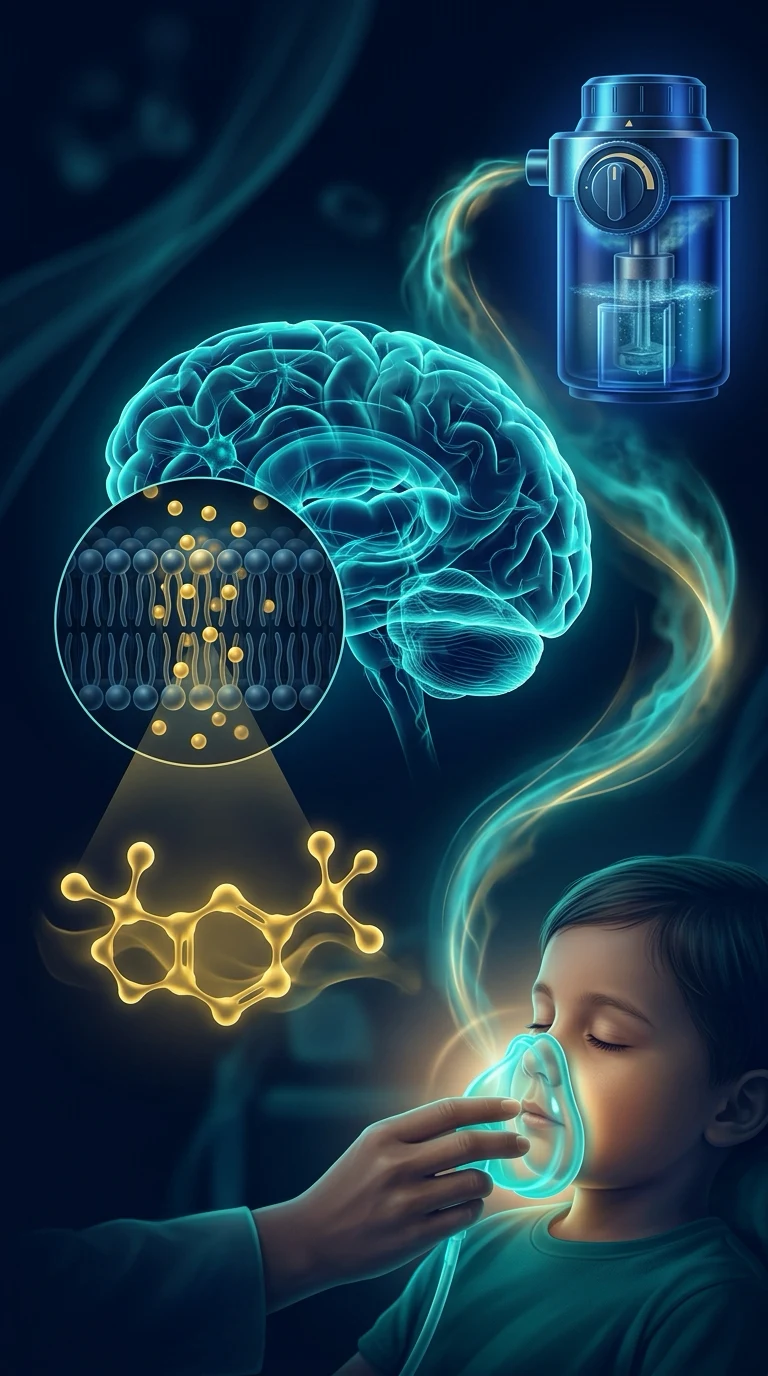
Sevoflurane is the default volatile anaesthetic agent in modern practice. It is the most widely used volatile in the world, the routine maintenance agent in a large share of adult anaesthetics, and the undisputed agent of choice for paediatric anaesthesia and for the inhalational induction. Where propofol defines the intravenous side of the speciality, sevoflurane defines the volatile side, and an understanding of its pharmacology is an understanding of the everyday conduct of inhalational anaesthesia. [1]
The drug concentrates the highest-yield pharmacology of the inhaled agents. Its sweet, non-pungent odour is the single property that makes it, alone among the modern volatiles, suitable for a mask induction — the technique that secures the airway of the needle-phobic child and the adult with impossible intravenous access. Its low blood-gas solubility is the principle that explains why onset and recovery are rapid, and it is the worked example of the alveolar-to-brain equilibration that governs every inhaled agent. Its minimum alveolar concentration of about 2 percent is the standard measure of potency against which desflurane, isoflurane and halothane are compared. And its chemical interaction with carbon-dioxide absorbents — the formation of compound A and of carbon monoxide in desiccated soda lime — is a classic safety question that tests the candidate's grasp of the breathing circuit. Master sevoflurane and the rest of the volatile agents fall into place around it. [1]
Physical chemistry
Sevoflurane is fluoromethyl 2,2,2-trifluoro-1-(trifluoromethyl)ethyl ether — a fully fluorinated methyl isopropyl ether. The complete fluorination is the key to its properties: the carbon-fluorine bond is strong and stable, which gives the molecule its low blood-gas solubility, its chemical stability in the vaporiser, and its low arrhythmogenic potential relative to halothane. It is a clear, colourless, non-flammable liquid at room temperature with a boiling point of 58 degrees Celsius and a vapour pressure of about 157 mmHg at 20 degrees, delivered through a standard temperature-and-flow-compensated (variable bypass) vaporiser that does not need to be heated or pressurised — in contrast to desflurane, which boils near room temperature and demands a heated pressurised vaporiser. [1]
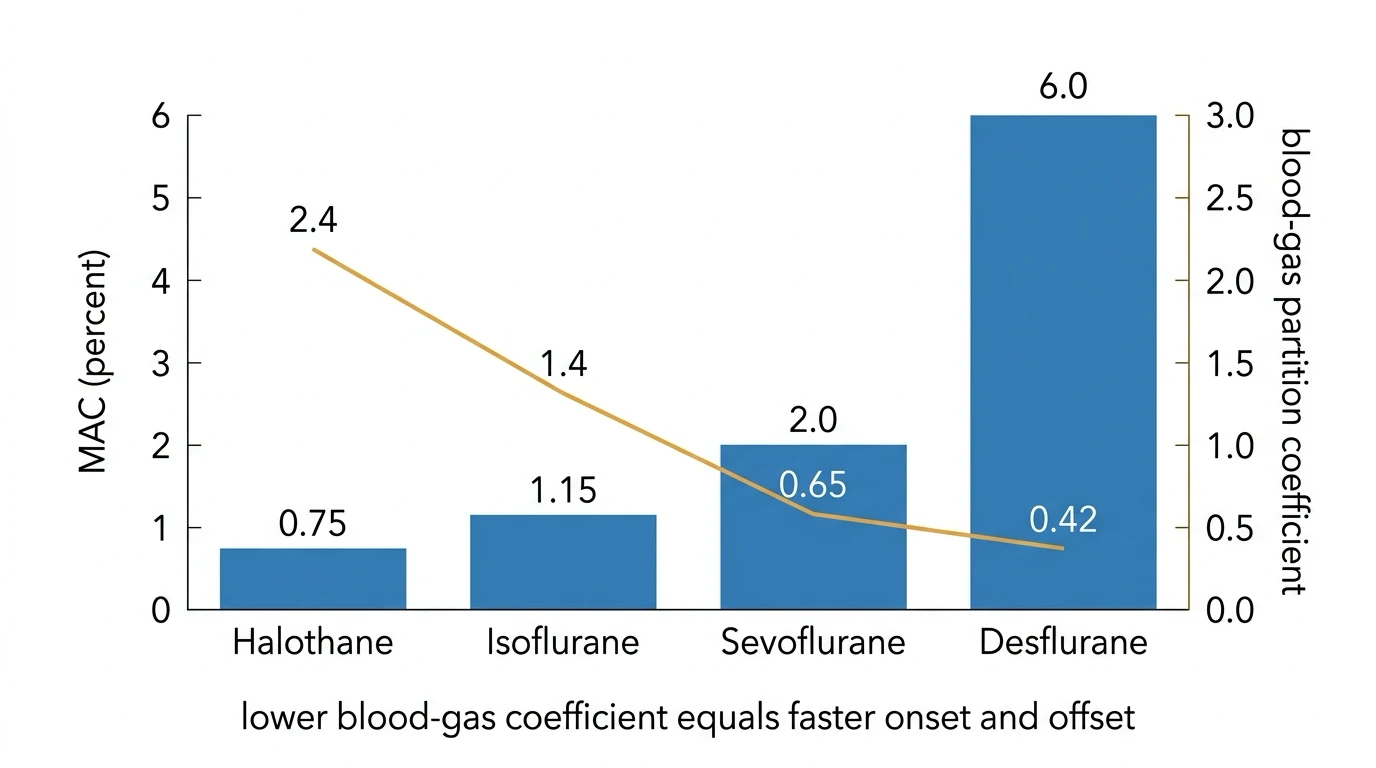
Two physical properties dominate its clinical behaviour. The first is its blood-gas partition coefficient of 0.65 — a low solubility, second only to desflurane (0.42) among the volatile liquids, that means little of the agent is taken up into the blood per breath, so the alveolar partial pressure (and therefore the brain partial pressure) rises and falls rapidly, producing a fast induction and a fast, clear recovery. The second is its oil-gas partition coefficient of about 47, which sets its potency through the Meyer-Overton correlation — a moderate lipid solubility that corresponds to a moderate potency and a minimum alveolar concentration of about 2 percent in adults. The non-pungent, sweet, ether-like odour is the third defining property and the one that, more than any other, sets sevoflurane apart: desflurane and isoflurane are pungent and irritant, provoking coughing, breath-holding and laryngospasm in the awake patient, so they cannot be used for an inhalational induction; sevoflurane is tolerated, and so it can. [1]
Mechanism of action
The defining pharmacological correlation of the inhaled agents is the Meyer-Overton relationship: the potency of an agent is directly proportional to its lipid solubility, measured by its oil-gas partition coefficient. The more lipid-soluble the agent, the more potent it is — so the minimum alveolar concentration, the measure of potency, is inversely related to lipid solubility, and the product of MAC and the oil-gas coefficient is roughly constant across agents. For a century this correlation pointed to a unitary, non-specific target: the lipid bilayer of the neuronal membrane, with anaesthesia resulting from a disruption of membrane function.[5]
The modern view is more nuanced. Sevoflurane, like the other volatile agents, acts at several specific protein targets rather than at a single one. It potentiates the GABA-A receptor, the principal inhibitory ligand-gated chloride channel of the central nervous system, increasing the opening of the chloride channel in response to GABA and so hyperpolarising and silencing the neuron — the chief mediator of the hypnotic and immobilising effects. It inhibits the NMDA receptor, the excitatory glutamate-gated cation channel (the principal target of xenon and nitrous oxide, but a contributor to volatile anaesthesia too). It activates the two-pore-domain potassium channels (the TREK and TASK families), which hyperpolarise the neuron by allowing potassium efflux. And it potentiates the glycine receptor, the inhibitory channel of the spinal cord and brainstem.[5]
No single receptor explains all of the effects of sevoflurane. The immobility to surgical stimulus is mediated largely at the spinal cord (GABA-A and glycine), the hypnosis at the brain, and the analgesic component partly at the NMDA receptor. But the Meyer-Overton correlation remains the bedrock description of inhaled-agent potency, and the calmodulin work comparing sevoflurane with propofol illustrates that the two agents share intracellular calcium-signalling targets even though they differ in their principal receptor — a convergence that helps explain why both produce general anaesthesia through fundamentally different entry routes.[5]
Pharmacokinetics
The pharmacokinetics of sevoflurane are governed by its low blood-gas solubility. Because the coefficient is 0.65, only a modest fraction of the inspired agent is taken up into the blood on each breath, so the alveolar partial pressure rises quickly towards the inspired partial pressure. Since the brain partial pressure follows the alveolar partial pressure, the brain concentration — and the depth of anaesthesia — equilibrates rapidly, producing a rapid induction and, when the dialled concentration is reduced or the agent is turned off, a rapid recovery. This is the same principle that governs desflurane and that made the modern insoluble agents displace the older, more soluble agents (ether, halothane, isoflurane): the lower the blood-gas solubility, the faster the alveolar and brain partial pressures change, and the more controllable the anaesthetic. [1]
Sevoflurane is excreted overwhelmingly unchanged through the lungs. Only about 3 to 5 percent is metabolised, by the cytochrome P450 enzyme CYP2E1 in the liver, to hexafluoroisopropanol and inorganic fluoride ions. Hexafluoroisopropanol is conjugated with glucuronic acid and excreted by the kidney; the fluoride release produces a transient, modest rise in serum fluoride that has been the basis of the longstanding (and ultimately unproven-in-humans) concern about nephrotoxicity. The serum fluoride can reach levels that, in the rat, correlate with renal injury, but extensive human study has failed to demonstrate a clinically significant renal harm at modern doses and flows. [1]
The clinically important chemical-pharmacokinetic interaction is with the carbon-dioxide absorbent in the circle system. Sevoflurane is degraded by strong bases in the absorbent, and the degradation is greatly accelerated when the absorbent is desiccated (dried out). Two products matter. The first is compound A, a vinyl ether formed when sevoflurane interacts with the strong base (particularly potassium hydroxide) in soda lime; its formation is increased by low fresh-gas flows, by high inspired concentrations, and by desiccated or warm absorbent. Compound A is nephrotoxic in rats, producing a proximal tubular injury, but it has never been shown to harm humans despite intensive study, and modern practice and modern absorbents (which lack the strong bases potassium and sodium hydroxide) have made clinical nephrotoxicity exceedingly rare. The second product is carbon monoxide, formed when sevoflurane (and more so desflurane) interacts with desiccated baralyme or strongly desiccated soda lime; this can deliver dangerous amounts of CO to the patient and is prevented by regular absorbent changes and by turning the vapouriser off when the machine is left standing so the absorbent is not dried by a continuous gas flow. [1]
A special pharmacokinetic circumstance is the haemodynamically unstable patient. In haemorrhage or shock the reduced cardiac output and the increased sympathetic tone redistribute blood flow towards the brain and the heart, so the alveolar-to-brain delivery of the agent is accelerated and the agent becomes effectively more potent — a smaller dose produces a deeper anaesthetic and a larger fall in blood pressure. The haemorrhage-altered-pharmacokinetics work is a recent reminder that in the shocked patient the volatile must be titrated down, often to a fraction of the usual dialled concentration, or an intravenous technique chosen.[8]
Pharmacodynamics
Sevoflurane produces a dose-dependent depression of the central nervous system, progressing from sedation through to surgical anaesthesia as the alveolar (and hence brain) partial pressure rises. On the respiratory system it is a bronchodilator (a property shared with the other volatile agents and useful in the bronchospastic patient), and it produces a characteristic pattern of reduced tidal volume with an increased respiratory rate, while the minute volume is moderately reduced. It blunts the ventilatory response to hypoxia and to carbon dioxide, so the spontaneously breathing patient under deep volatile anaesthesia will hypoventilate — a reason to provide supplemental oxygen and to monitor ventilation. [1]
On the cardiovascular system sevoflurane produces a dose-dependent reduction in systemic vascular resistance and mean arterial pressure, but it causes less direct myocardial depression than halothane and the cardiac output is relatively preserved. The blood pressure falls mainly through vasodilation rather than through a fall in contractility, and the heart rate is little changed. Like the other modern volatile agents, sevoflurane sensitises the myocardium to adrenaline far less than halothane — exogenous adrenaline (for instance in surgical infiltration) is tolerated in higher concentrations than would be safe with halothane. The TIVA-versus-sevoflurane comparison in cardiac surgery confirms a haemodynamically stable profile in the cardiac patient, with the volatile providing the additional benefit of anaesthetic preconditioning, balanced against any haemodynamic cost.[4]
On the central nervous system sevoflurane reduces the cerebral metabolic rate for oxygen and, at low concentrations, reduces the cerebral blood flow through cerebral vasoconstriction. At high MAC this vasoconstriction reverses and the cerebral blood flow and intracranial pressure rise — a consideration in the patient with raised intracranial pressure, where sevoflurane is used cautiously with hyperventilation. Sevoflurane relaxes uterine smooth muscle, useful for uterine relaxation but a cause of postpartum bleeding at high doses, and it produces a degree of muscle relaxation that potentiates the non-depolarising muscle relaxants. [1]
Minimum alveolar concentration (MAC)
The minimum alveolar concentration (MAC) is the alveolar concentration of an agent, at one atmosphere, that prevents movement in response to a surgical stimulus in 50 percent of subjects — the median effective dose, the standard measure of potency of an inhaled agent. The lower the MAC, the more potent the agent. For sevoflurane the MAC is about 2 percent in adults (commonly quoted as 1.8 to 2.2 percent), and it is higher in children — about 2.5 percent — and lower in the elderly — about 1.8 percent and falling progressively with age. [1]
MAC is additive: a half-MAC dose of sevoflurane combined with a half-MAC dose of nitrous oxide gives a one-MAC anaesthetic, which is the basis of combining the two. It is modified by patient factors. The factors that lower MAC (so that less agent is needed) are increasing age, hypothermia, pregnancy, and the co-administration of opioids, benzodiazepines, the alpha-2 agonists (clonidine, dexmedetomidine), nitrous oxide, and hypotension; the midazolam-premedication work is a concrete example of a benzodiazepine lowering the effective requirement.[7] The factors that raise MAC (so that more agent is needed) are infancy and young childhood, hyperthermia, chronic alcohol intake, hypernatraemia, and the monoamine oxidase inhibitors. These modifiers are exam-critical because they explain why the dialled concentration is titrated to the individual patient rather than set to a single number.
Clinical uses
Sevoflurane's three roles are inhalational induction, maintenance, and the agent of choice for paediatric anaesthesia. [1]
- Inhalational induction. For mask induction sevoflurane is given at up to 8 percent in oxygen (with or without nitrous oxide). It is the only modern volatile suitable for this technique, because it is non-pungent and sweet-smelling and so is tolerated by the awake patient taking breaths. This is the technique of choice for the needle-phobic child, the child with difficult intravenous access, and the adult with an anticipated difficult airway where a gas induction is elected.
- Maintenance. A dialled concentration of 1 to 3 percent (about 0.7 to 1.3 MAC, commonly supplemented by nitrous oxide or an opioid) sustains a surgical depth of anaesthesia. It is the routine maintenance agent in a large share of adult practice worldwide.
- Paediatric anaesthesia. Sevoflurane is the agent of choice for paediatric anaesthesia — the sweet smell tolerable to children, the smooth rapid induction, the haemodynamic stability, and the bronchodilation make it near-ideal in the child.
- Bronchospastic disease. As a bronchodilator it is the agent of choice in the patient with asthma or obstructive airway disease where a volatile is preferred.
- Malignant-hyperthermia-susceptible patients. A common trap: sevoflurane is NOT safe in MH susceptibility — it is a trigger (see Adverse effects). The MH-susceptible patient needs a total intravenous technique.
- Day-case surgery. The rapid recovery makes sevoflurane a good choice for day-case surgery, though propofol TIVA gives a clearer early recovery and less PONV.
- Difficult airway. A gas induction with sevoflurane preserves spontaneous ventilation in the anticipated difficult airway, a technique that has a defined place in the difficult-airway algorithms. [1]
Inhalational induction technique
The inhalational induction is the technique that exploits sevoflurane's defining property, and it has a standard conduct. The patient is pre-oxygenated with 100 percent oxygen. Sevoflurane is then delivered at up to 8 percent with a high fresh-gas flow of 6 to 8 L/min of oxygen (with nitrous oxide added where appropriate). [1]
Two techniques are used. In the cooperative adult, the single-breath vital-capacity technique: the patient exhales fully, takes a single vital-capacity breath of 8 percent sevoflurane in oxygen from a pre-filled breathing circuit, and holds it; loss of consciousness follows in 1 to 2 minutes. In the child (and the less cooperative adult), the incremental technique: the dialled concentration is started low (about 0.5 percent) and increased every few breaths up to 8 percent, so the child is gradually anaesthetised without the abrupt breath of high concentration. [1]
Once consciousness is lost, intravenous access is established (now that the patient is anaesthetised and immobile), the airway is assessed, and the airway is secured by an LMA or by tracheal intubation. The depth is then dialled back to a maintenance concentration. The midazolam-premedication study illustrates how a benzodiazepine premedication smooths the induction and lowers the effective sevoflurane requirement, a common adjunct in anxious children.[7]
Adverse effects
- Emergence agitation and delirium — the most clinically important adverse effect of sevoflurane, occurring especially in children aged 1 to 5 years after sevoflurane anaesthesia. The child emerges restless, inconsolable, disoriented, and at risk of self-injury. It is reduced by an alpha-2 agonist (dexmedetomidine), by a small dose of propofol at the end of the case, by ketamine, or by switching to desflurane or propofol for maintenance after a sevoflurane induction. The postoperative-delirium review frames this as part of the broader neurocognitive profile of the general anaesthetics.[2]
- Postoperative nausea and vomiting (PONV) — the volatile agents are emetogenic, and sevoflurane is a risk factor for PONV; propofol TIVA produces less PONV.
- Compound A nephrotoxicity — a rat finding, never proven to harm humans; prevented by avoiding desiccated soda lime, using fresh absorbent, and (by older guidance) not running prolonged flows below 1 to 2 L/min.
- Carbon monoxide formation — from desiccated baralyme or strongly desiccated soda lime; prevented by regular absorbent changes and by turning the vapouriser off when the machine stands.
- Seizures and epileptiform EEG activity — reported at high concentrations, especially in patients with epilepsy; sevoflurane is not contraindicated in epilepsy but high inspired concentrations for prolonged periods should be used with caution. The FTO m6A work is part of the active investigation of sevoflurane's neurocognitive and neurotoxic effects.[3]
- Hepatotoxicity — very rare, and far less than the immune-mediated hepatitis of halothane; a few case reports exist but it is not a clinical concern of the same order.
- Malignant hyperthermia — sevoflurane IS a trigger of malignant hyperthermia, like every volatile agent. This is the single most important safety constraint on the drug: in the known or suspected MH-susceptible patient, no sevoflurane is given, and the anaesthetic is a strict total intravenous technique with a vapour-free machine.
Sevoflurane and the paediatric airway
Sevoflurane is the default agent for paediatric inhalational induction, and its place in paediatric anaesthesia deserves separate emphasis. The sweet smell is tolerable to children, the induction is smooth and rapid, the haemodynamics are stable, and the agent bronchodilates — properties that together make it near-ideal in the child, whose airway is reactive, whose veins are difficult, and whose cooperation is limited. A gas induction with sevoflurane, with the child sitting on a parent's lap and breathing through a fruit-scented mask, is the iconic technique of paediatric anaesthesia. [1]
The main drawback is emergence agitation, which is more frequent after sevoflurane than after other techniques and which peaks in the 1 to 5 year age group. The reduction strategies are several: an alpha-2 agonist such as dexmedetomidine given intra-nasally or intravenously; a small bolus of propofol at the end of the case; ketamine; or, after a sevoflurane induction, switching to desflurane or to a propofol infusion for maintenance, which lowers the emergence-agitation rate while preserving the benefit of the gas induction. The postoperative-delirium review situates this within the wider question of how the general anaesthetics affect the developing and the ageing brain.[2][3]
Comparison with other agents
- Versus desflurane. Sevoflurane is less pungent (so an inhalational induction is possible with sevoflurane and not with desflurane), causes less airway irritation and less sympathetic surge, but is slightly more soluble (blood-gas 0.65 versus 0.42), so desflurane gives a marginally faster emergence. The two give a broadly similar recovery; desflurane is favoured for the rapid wake-up in the long or obese case, sevoflurane for the induction and for routine maintenance. The desflurane-versus-propofol neurocognitive work in the elderly frames the choice in terms of postoperative cognition, an active field.[6]
- Versus isoflurane. Sevoflurane is much less pungent (isoflurane cannot be used for an inhalational induction), is less soluble (blood-gas 0.65 versus 1.4), and so gives a faster induction and recovery. Isoflurane is cheaper and is a potent vasodilator, and is chosen where cost is decisive; sevoflurane is the routine choice otherwise.
- Versus halothane. Sevoflurane causes less myocardial depression, sensitises the myocardium to adrenaline far less, is not hepatotoxic in the same way, and is less soluble (blood-gas 0.65 versus 2.4), so the induction and recovery are far faster. Halothane is now largely retired; sevoflurane is its successor in paediatric practice.
- Versus propofol TIVA. Sevoflurane is cheaper and simpler (a vaporiser versus an infusion pump and a target-controlled model), but produces theatre pollution (a greenhouse-gas vapour that must be scavenged), more PONV, and emergence agitation in children. Propofol TIVA gives a clearer, calmer recovery, less PONV, no theatre pollution, and is not an MH trigger. The TIVA-versus-sevoflurane trial in cardiac surgery, the calmodulin study, and the desflurane-versus-propofol neurocognitive comparison illustrate the modern evidence base for this choice, with the perioperative-cognition work increasingly part of the decision.[4][5][1]
Environmental and safety considerations
Sevoflurane is a greenhouse gas. It has a measurable global-warming potential (much lower than desflurane's, but still many times that of carbon dioxide) and an atmospheric lifetime of a few years, so the agent contributes to the climate footprint of anaesthesia. The practical response is to use theatre scavenging (mandatory, to protect staff and to limit atmospheric release), to favour low fresh-gas flows with circle systems (within the limits set by compound A formation, using modern non-strong-base absorbents), and to consider total intravenous anaesthesia as the lower-impact alternative where the clinical need allows. The choice of agent is now an environmental as well as a clinical decision, and sevoflurane is the lower-impact volatile where desflurane's extra speed is not needed. [1]
The two chemical-safety hazards — compound A formation in desiccated soda lime (a rat nephrotoxin, not proven in humans) and carbon monoxide formation in desiccated baralyme or strongly desiccated soda lime (a real human hazard) — are both prevented by the same measures: regular absorbent changes, the use of modern absorbents without the strong bases (calcium hydroxide lime, Amsorb), and turning the vapouriser off when the machine is left standing so a continuous gas flow does not desiccate the absorbent. The cardiovascular pharmacology — the dose-dependent fall in blood pressure and the increased effective potency in the shocked patient — is a final safety consideration: in haemorrhage or shock the volatile must be titrated down or an intravenous technique chosen, as the haemorrhage-pharmacokinetics work reminds us.[8]
Clinical
- Standard approach
- Evidence-based
Alternative
- Modified technique
- Risk-benefit
Red flags
[1] [1] [1] [1] [1] [1]References
- [1]Lim JA, et al. Explainable Machine Learning Analysis of Perioperative Factors Associated with Clinically Significant Emergence Agitation After Pediatric Ophthalmic Surgery Medicina (Kaunas), 2026.PMID 42356201
- [2]Wu JN, et al. The Impact of General Anesthetics on Postoperative Delirium: A Narrative Review Based on Clinical Randomized Controlled Trials from the Last Five Years Geriatrics (Basel), 2026.PMID 42345745
- [3]Li J, et al. Astrocytic FTO-dependent m6A demethylation drives sevoflurane-induced perioperative neurocognitive disorders in mice J Neurosci, 2026.PMID 42309814
- [4]Fazekas A, et al. Total Intravenous Anesthesia Versus Sevoflurane-Based Inhalation Anesthesia Within an Enhanced Recovery After Cardiac Surgery (ERACS) Protocol J Cardiothorac Vasc Anesth, 2026.PMID 42350176
- [5]Wang J, et al. Differential effects of sevoflurane versus propofol on calmodulin expression in breast cancer patients Pak J Pharm Sci, 2026.PMID 42262213
- [6]Somnuke P, et al. Effect of desflurane versus propofol on perioperative neurocognitive disorders in older adults undergoing major urological surgery: a randomized trial BMC Geriatr, 2026.PMID 42321629
- [7]Nacar C, et al. Effect of Intranasal Midazolam-Butorphanol Premedication on Sevoflurane Anaesthesia in Traumatised Buzzards (Buteo spp.) Vet Med Sci, 2026.PMID 42319166
- [8]Gruell CA, et al. The influence of haemorrhage and fluid resuscitation with either Plasma-Lyte A or Ringer's Lactate in Beagle dogs under sevoflurane anaesthesia-part 2: Buccal mucosal microcirculation Vet Anaesth Analg, 2026.PMID 42308856