Anaes · Neuromuscular blockade & reversal
Sugammadex reversal and residual neuromuscular blockade
Also known as Modified gamma-cyclodextrin · Selective relaxant binding agent · Encapsulation reversal of rocuronium/vecuronium · Sugammadex depth-based dosing
Sugammadex is a modified gamma-cyclodextrin — a selective relaxant binding agent — that reverses the aminosteroid neuromuscular blockers by ENCAPSULATION: it forms a tight 1 to 1 host-guest inclusion complex with rocuronium (highest affinity) and vecuronium in plasma, lowering their free plasma concentration so the blocker diffuses off the nicotinic receptor and transmission is restored, acting in plasma rather than at the receptor or at acetylcholinesterase (Lawson 2026; Kronauer 2026). It is transformative because it reverses even a profound, deep block, with depth-based dosing — 2 mg per kg at a train-of-four count of 1 to 2, 4 mg per kg for a deep block (post-tetanic count 1 to 2), and 16 mg per kg for immediate reversal of a 1.2 mg per kg rocuronium intubating dose within about 3 minutes (Lawson 2026; Kronauer 2026). It needs no anticholinergic — it does not raise acetylcholine — and it is excreted unchanged in the urine, so it is contraindicated in severe renal impairment (Kronauer 2026). It markedly reduces residual neuromuscular blockade and postoperative pulmonary complications versus neostigmine (Leslie 2026; Tsai 2026). The principal hazards are anaphylaxis, sometimes severe (Lee 2026), recurarisation if the dose is inadequate (Felix 2026), delayed airway oedema (Habib 2026), and a reduction in hormonal-contraceptive efficacy through progesterone binding so that women of childbearing potential need additional contraception for 7 days (Akca 2025).
On this page & tools
Your progress
Saved locally on this device.
8 MCQs with explanations
Target exams
Red flags
Overview — the selective relaxant binding agent
Sugammadex is a modified gamma-cyclodextrin — the first of a class of drugs called selective relaxant binding agents. It reverses an aminosteroid neuromuscular block not by opposing the blocker at the receptor and not by inhibiting acetylcholinesterase, but by removing the blocker from the equation entirely: it encapsulates the aminosteroid molecule in plasma so that the blocker diffuses off the nicotinic receptor and neuromuscular transmission is restored.[1][8]
The contemporary review by Kronauer and colleagues (2026) frames sugammadex as the agent that transformed the reversal of neuromuscular blockade, because — unlike neostigmine — it reverses even a profound, deep block rapidly and completely, and it does so without raising acetylcholine and therefore without muscarinic side effects.[8] The multi-centre retrospective cohort reported by Lawson and colleagues (2026) confirms its established place in clinical practice for aminosteroid reversal.[1]
Mechanism — gamma-cyclodextrin encapsulation of the aminosteroid in plasma
Sugammadex is a modified gamma-cyclodextrin. A cyclodextrin is a ring of sugar molecules (a cyclic oligosaccharide) with a hydrophilic exterior and a hydrophobic cavity. The gamma-cyclodextrin ring is widened and its cavity deepened by chemical modification so that it snugly accommodates the steroid skeleton of rocuronium and vecuronium. The four negatively charged carboxyl groups added to the ring extend the cavity and provide an electrostatic attraction to the positively charged quaternary ammonium of the aminosteroid.[8]
The mechanism is encapsulation — a 1 to 1 host-guest inclusion complex. Sugammadex in plasma wraps itself around a molecule of rocuronium or vecuronium, forming a very tight, essentially irreversible water-soluble complex. Because the complex is tight and the binding avid, the free plasma concentration of the relaxant falls sharply. The bound relaxant can no longer reach the nicotinic receptor, and — crucially — the concentration gradient now drives the blocker to diffuse off the receptor and back into plasma, where more sugammadex complexes it. Neuromuscular transmission is restored.[1][8]
Two features of this mechanism dominate the exam answer. First, sugammadex does not act at the nicotinic receptor and does not inhibit acetylcholinesterase — it has no cholinergic mechanism at all, which is why it needs no anticholinergic. Second, because it removes the blocker rather than opposing it, there is no ceiling effect analogous to neostigmine's: it can reverse a block of any depth that the agent produced, including a profound block with no twitches on the train-of-four.[8]
Selectivity — rocuronium greater than vecuronium greater than pancuronium; not the benzylisoquinolines or sux
Sugammadex is selective for the aminosteroid (steroid-based) non-depolarisers. It binds rocuronium with the highest affinity, vecuronium somewhat less avidly, and pancuronium weakly. The encapsulation is a stereochemical fit between the hydrophobic cavity and the steroid skeleton, which is why only the aminosteroids fit well.[8]
Sugammadex does NOT bind the benzylisoquinolines — atracurium, cisatracurium and mivacurium — which have a different (benzylisoquinoline, not steroid) structure, nor does it bind suxamethonium, a depolariser. The practical consequence is fundamental and a favourite exam point: sugammadex reverses ONLY the aminosteroids, chiefly rocuronium and vecuronium. A block produced by atracurium or cisatracurium cannot be reversed by sugammadex and must be left to spontaneous recovery (Hofmann elimination and ester hydrolysis) or reversed with neostigmine. Giving sugammadex after a benzylisoquinoline is useless.[8]
This selectivity is the inverse of neostigmine, which reverses all non-depolarisers but is useless for suxamethonium. The two reversal agents are thus complementary: neostigmine for the benzylisoquinolines (and the aminosteroids once recovery has begun), sugammadex for the aminosteroids at any depth.[8]
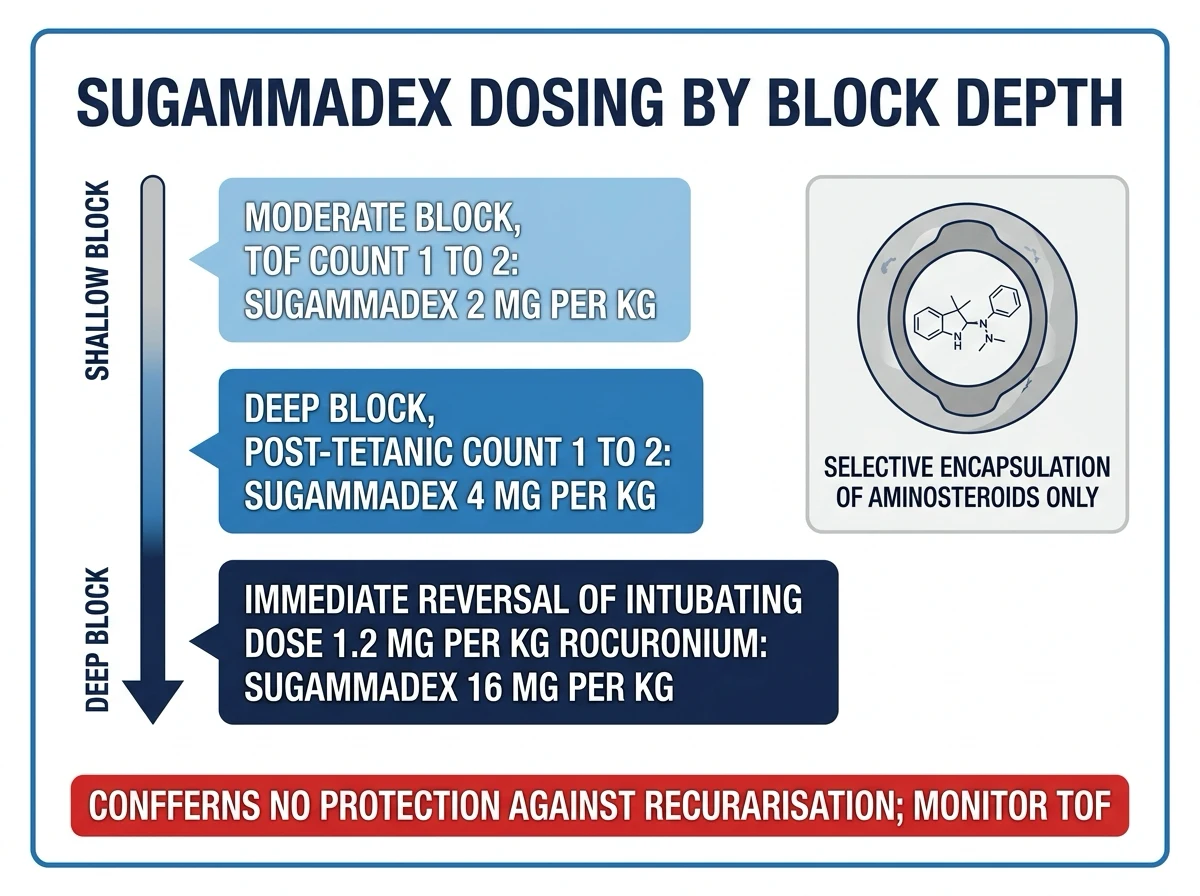
Depth-based dosing — 2, 4 and 16 mg per kg [1]
The defining clinical feature of sugammadex, and the single most testable point, is that the dose is determined by the depth of the block, assessed by quantitative neuromuscular monitoring. There are three depths and three corresponding doses.[8][1]
For a shallow to moderate block — a train-of-four (TOF) count of 1 to 2 (at least one twitch present on TOF stimulation) — the dose is 2 mg per kg. This is the everyday reversal scenario at the end of a case where the block is wearing off but recovery is incomplete.[8]
For a deep block — a post-tetanic count (PTC) of 1 to 2 and NO twitches on the train-of-four — the dose is 4 mg per kg. This reverses a block that neostigmine cannot touch, because neostigmine requires spontaneous recovery to have begun.[8]
For immediate reversal of a large intubating dose — 1.2 mg per kg of rocuronium given for rapid-sequence induction, where reversal is needed within minutes — the dose is 16 mg per kg, which reverses the block within about 3 minutes. This is the "sugammadex rescue" scenario, discussed next.[1][8]
The principle is that there must be enough sugammadex molecules to bind and encapsulate every molecule of relaxant that needs to be removed. A deeper block means more relaxant to be mopped up at the junction and in plasma, so a higher dose is required. Inadequate dosing relative to the depth is a direct cause of recurarisation, because the bound and unbound relaxant can re-equilibrate.[7][8]
Immediate reversal of an intubating dose — the CICO rescue scenario
The 16 mg per kg dose is the headline application of sugammadex. Rocuronium at 1.2 mg per kg is a rapid-onset intubating dose used for rapid sequence induction (RSI), an alternative to suxamethonium. If, after such a dose, the anaesthetist finds themselves in a cannot-intubate-cannot-oxygenate (CICO) situation — the most feared emergency in anaesthesia — then 16 mg per kg of sugammadex will reverse the rocuronium block within about 3 minutes, restoring spontaneous breathing and upper-airway tone and providing a pharmacological exit from a crisis that would otherwise require an emergency surgical airway.[1][8]
This "sugammadex rescue" has changed the calculus of RSI. The availability of sugammadex is one of the arguments for preferring high-dose rocuronium (1.2 mg per kg) over suxamethonium for RSI: rocuronium has a similar intubating time to suxamethonium, has none of sux's bradycardia, hyperkalaemia, malignant hyperthermia or phase II block risks, and — uniquely among neuromuscular blockers — it can now be reversed. Suxamethonium has no reversal. The caveats are that the 16 mg per kg dose must be immediately available on the difficult-airway trolley, that it is expensive, and that the team must have given rocuronium (it will not work for any other agent). Lawson and colleagues (2026) document the real-world use of sugammadex in this and the standard reversal settings.[1][8]
Elimination — excreted unchanged in urine; contraindicated in severe renal failure
Sugammadex is not metabolised. It is excreted unchanged in the urine by glomerular filtration, together with the encapsulated relaxant. The elimination half-life is roughly 2 to 3 hours in adults with normal renal function. Because clearance depends entirely on the kidney, sugammadex is contraindicated in severe renal impairment (typically a glomerular filtration rate below 30 mL per min) and in patients on dialysis.[8]
The reason for the contraindication is that in severe renal failure neither the free sugammadex nor the sugammadex-relaxant complex can be cleared. They accumulate, and because the binding — though very tight — is a reversible equilibrium, the complex can slowly dissociate, releasing free relaxant that re-distributes to the junction and reproduces the block (recurarisation) days later. This is the basis of the renal-impairment contraindication, emphasised in the Kronauer review.[8]
The dose is not modified for age or for mild to moderate hepatic impairment (the drug is not hepatically cleared). Pregnancy and lactation are addressed under the hormonal-interaction section below. [1]
No anticholinergic needed — the contrast with neostigmine
A direct and clinically welcome consequence of sugammadex's mechanism is that it does not require a co-administered anticholinergic. Because sugammadex does not raise acetylcholine — it does not touch acetylcholinesterase — there are no muscarinic side effects to block. There is no bradycardia from cholinergic excess, no bronchospasm, no salivation, and no need for glycopyrrolate or atropine.[8]
This is the sharpest practical contrast with neostigmine, which MUST be given with an antimuscarinic (glycopyrrolate preferred, in a 5 to 2 ratio) precisely because its acetylcholinesterase inhibition raises acetylcholine at muscarinic as well as nicotinic synapses. The neostigmine-glycopyrrolate co-administration is an absolute rule; the sugammadex-no-anticholinergic situation is one of its principal advantages.[8]
(Note that sugammadex has its own, separate adverse-effect profile — including rare anaphylaxis and isolated bradycardia reports — addressed below, but these are not muscarinic in origin and do not call for an anticholinergic.) [1]
Residual blockade — sugammadex reduces it versus neostigmine
Residual neuromuscular blockade — a train-of-four ratio below 0.9 in the recovery room — produces a weak, poorly coordinated upper airway, an impaired ventilatory response to hypoxia, and a weak cough, so that the clinical consequences are upper-airway obstruction, hypoxaemia, aspiration and postoperative pulmonary complications. Residual blockade has been the central safety problem of neostigmine reversal, because neostigmine is incomplete, especially when given too early or to a deep block.[5][6]
Sugammadex, by removing the relaxant rather than opposing it, produces a more complete and more rapid reversal, and the 2026 outcome literature now establishes that this translates into fewer residual blocks and fewer pulmonary complications. Tsai and colleagues (2026) compared sugammadex with neostigmine and the risk of postoperative pulmonary complications and found an advantage to sugammadex.[6] Leslie and colleagues (2026), publishing in the Lancet Respiratory Medicine, reported the definitive comparison of sugammadex versus neostigmine for reversal and postoperative pulmonary complications, establishing the outcomes advantage that the earlier pharmacological studies had only inferred.[5]
The synthesis is that sugammadex markedly REDUCES residual neuromuscular blockade and postoperative pulmonary complications compared with neostigmine for the aminosteroids — a finding that is now the evidence base for preferring sugammadex, particularly after a deep block or in patients at high risk of pulmonary complications (obesity, obstructive sleep apnoea, the elderly).[5][6]
Recurarisation — mechanism and prevention
Recurarisation is the return of neuromuscular block after an apparently adequate initial reversal. It is a recognised hazard of sugammadex, and Felix and colleagues (2026) reported it occurring in the post-anaesthesia care unit an hour after administration — a reminder that recovery must always be confirmed, not assumed.[7]
The mechanism is one of re-equililibrium and inadequate mopping-up. Sugammadex binds the relaxant in plasma; the relaxant then diffuses off the receptor down its concentration gradient. If the sugammadex dose is too small for the amount of relaxant present — i.e. the dose was not matched to the depth of the block — then once the initial redistribution is complete there is still free relaxant in peripheral compartments that diffuses back into plasma and back to the junction, faster than the remaining sugammadex can bind it. The block returns. The same mechanism underlies the recurarisation risk in renal failure, where the complex cannot be cleared and slowly dissociates.[7][8]
The prevention of recurarisation rests on three rules. First, dose to the depth: use quantitative monitoring (TOF, post-tetanic count) to judge the block depth and give 2, 4 or 16 mg per kg accordingly — never guess. Second, confirm recovery: a TOF ratio of 0.9 or above must be demonstrated at the adductor pollicis before extubation. Third, avoid sugammadex in severe renal failure, where accumulation and dissociation of the complex is the mechanism of recurarisation. Felix and colleagues (2026) make the case that monitoring does not stop at the moment of reversal but must continue into recovery.[7][8]
Adverse effects — anaphylaxis, bradycardia, airway oedema, anticoagulant effect
Sugammadex has no muscarinic effects and no acetylcholine-related toxicity, but it has its own distinct adverse-effect profile that the exam expects you to know.[8]
Anaphylaxis is the most important. It is rare but well documented, and several regulatory agencies have added warnings to the product information. The reaction can be severe and refractory, and Lee and colleagues (2026) reported the successful rescue of sugammadex-induced anaphylactic shock using extracorporeal membrane oxygenation (ECMO) when conventional resuscitation failed — an illustration of how catastrophic the reaction can be. The preparation must include the standard anaphylaxis kit (adrenaline, fluids, oxygen), and the diagnosis should be confirmed with serum tryptase and follow-up allergy testing.[2]
Bradycardia and asystole. Isolated reports describe severe bradycardia, a few progressing to cardiac arrest, within minutes of sugammadex administration. The mechanism is not cholinergic (sugammadex does not raise acetylcholine) and is incompletely understood; atropine and external cardiac massage have been used. The event is rare but warrants monitoring at the time of administration.[8]
Delayed laryngeal and upper-airway oedema. Habib and colleagues (2026) described a novel adverse effect — delayed laryngeal and upper-airway oedema appearing after sugammadex administration, which can compromise the airway in recovery. The anaesthetist should be aware that airway compromise after sugammadex is not always residual blockade; oedema is in the differential.[3]
Weak anticoagulant effect. Sugammadex has a theoretical and weak anticoagulant action (an effect on the clotting system documented in laboratory studies), which is a consideration in patients already on anticoagulants or with a coagulopathy, although clinically significant bleeding attributable to sugammadex alone is uncommon.[8]
Hormonal interaction — progesterone binding and contraception
Because the hydrophobic cavity of sugammadex is not perfectly specific to aminosteroids, it can also bind other hydrophobic steroidal molecules to a lesser degree. The clinically relevant one is progesterone (and other hormonal contraceptives). Sugammadex can bind progesterone and reduce the free concentration of hormonal contraceptives, lowering their efficacy.[4]
The work of Akca and colleagues (2025) on the effects of sugammadex and neostigmine on maternal steroid and lactation-related hormones documents the endocrine dimension of this interaction — sugammadex influences steroid hormone profiles, which is the pharmacological basis of the contraceptive warning.[4]
The clinical rule, which is an exam favourite, is that women of childbearing potential receiving sugammadex need additional (non-hormonal) contraception for 7 days after the dose, because hormonal contraception cannot be relied upon for that week. This is the single most easily tested sugammadex safety point and should always be mentioned in any answer on its adverse effects or drug interactions.[4]
Sugammadex versus neostigmine — a structured comparison
The comparison with neostigmine is the heart of the modern reversal question, and it is now firmly evidence-based. The differences fall into clear axes.[5][6]
Mechanism. Neostigmine inhibits acetylcholinesterase so acetylcholine accumulates and outcompetes a non-depolariser at the receptor. Sugammadex encapsulates the aminosteroid in plasma, removing it from the receptor. The two strategies are fundamentally different: one opposes the blocker, the other removes it.[8]
Applicability. Neostigmine reverses all non-depolarisers (aminosteroids and benzylisoquinolines). Sugammadex reverses ONLY rocuronium and vecuronium (the aminosteroids) and is useless for atracurium, cisatracurium, mivacurium and suxamethonium.[8]
Speed and depth. Sugammadex reverses even a profound, deep block rapidly and completely, with no need for spontaneous recovery; neostigmine is effective only once recovery has begun and cannot reverse a deep block, and it has a ceiling effect beyond a maximum dose of about 5 mg.[8]
Anticholinergic. Neostigmine MUST be given with an antimuscarinic (glycopyrrolate, 5 to 2 ratio); sugammadex needs none.[8]
Residual blockade and pulmonary complications. Sugammadex is associated with less residual blockade and fewer postoperative pulmonary complications than neostigmine for the aminosteroids — the findings of Leslie (2026, Lancet Respiratory Medicine) and Tsai (2026).[5][6]
Cost. Neostigmine is cheap; sugammadex is expensive — the principal practical barrier to routine use of sugammadex for every reversal.[5][6]
Safety profile. Neostigmine carries muscarinic effects and a risk of neostigmine-induced weakness; sugammadex carries rare anaphylaxis, recurarisation, the contraceptive interaction, and the renal-impairment contraindication.[2][7][4][8]
Cost, availability and current place in practice
The integrated contemporary workflow for aminosteroid reversal is: monitor the block quantitatively with acceleromyography at the adductor pollicis; judge the depth of the block (TOF count, post-tetanic count); then give sugammadex 2 mg per kg for a shallow/moderate block (TOF count 1 to 2), 4 mg per kg for a deep block (PTC 1 to 2), or 16 mg per kg for immediate reversal of a 1.2 mg per kg intubating dose; and confirm a train-of-four ratio of 0.9 or above before extubation. Continue to monitor into the recovery room to detect recurarisation.[1][8]
The principal barrier to routine use is cost. Sugammadex is far more expensive than neostigmine, and many institutions restrict or have restricted its use to defined indications — typically immediate reversal of an intubating dose (the CICO rescue), reversal of a deep block where neostigmine cannot work, and high-risk patients in whom residual blockade is particularly dangerous. The 2026 outcomes evidence (Leslie, Tsai) has strengthened the argument for broader use, because the pharmacological advantage translates into fewer pulmonary complications, but the cost-effectiveness debate continues.[5][6]
The current place of sugammadex in practice is therefore as the agent of choice for reversal of rocuronium and vecuronium at any depth, with neostigmine retained for the benzylisoquinolines and for resource-limited settings. The Lawson cohort (2026) documents its real-world uptake, and the Kronauer review (2026) sets the standard that quantitative monitoring should accompany every reversal, whichever agent is chosen.[1][8]
Clinical
- Standard approach
- Evidence-based
Alternative
- Modified technique
- Risk-benefit
Red flags
[1]References
- [1]Lawson C, et al. A multi-center retrospective cohort study of SUGAmmadex for neuromuscular blockade reversal in the emergency department: SUGARED study - on behalf of EMPHARM-NET Investigators Am J Emerg Med, 2026.PMID 42349235
- [2]Lee S, et al. Successful rescue for anaphylactic shock due to sugammadex using extracorporeal cardiopulmonary resuscitation Perfusion, 2026.PMID 42087621
- [3]Habib R, et al. Sugammadex-Associated Delayed Laryngeal and Upper Airway Edema: A Novel Adverse Effect J Investig Med High Impact Case Rep, 2026.PMID 42113672
- [4]Akca S, et al. Effects of Sugammadex and Neostigmine on Maternal Steroid and Lactation-Related Hormone Levels During Cesarean Section: A Randomized Clinical Trial J Clin Pract Res, 2025.PMID 42305259
- [5]Leslie K, et al. Sugammadex versus neostigmine for reversal of neuromuscular blockade and postoperative pulmonary complications (SNaPP): an international, randomised, controlled, phase 4 trial Lancet Respir Med, 2026.PMID 42263720
- [6]Tsai YF, et al. Sugammadex vs. neostigmine and the risk of postoperative pulmonary complications after upper gastrointestinal endoscopic procedures: a propensity score matched analysis of 15,730 patients Anaesthesia, 2026.PMID 42317106
- [7]Felix F, et al. Recurarization in the Post-anesthesia Care Unit One Hour After Sugammadex Administration: A Case Report Cureus, 2026.PMID 42306367
- [8]Kronauer T, et al. [Muscle relaxation and neuromuscular monitoring : Current findings and recommendations for the clinical practice] Anaesthesiologie, 2026.PMID 42334564