Anaes · Airway management
Supraglottic airway devices (LMA and SGAD): generations, applications and the difficult-airway rescue
Also known as Laryngeal mask airway · LMA · Classic LMA · ProSeal LMA · LMA Supreme · i-gel · Intubating LMA · Fastrach · Second-generation supraglottic airway device · SGAD
Supraglottic airway devices (SGADs) sit above the glottis and provide a hands-free airway without tracheal intubation, and they are the most frequently examined single piece of airway equipment because they straddle routine practice and the rescue algorithm. The framework rests on four ideas: the device forms a seal around the laryngeal inlet and leaves the hands free, but it is not a definitive airway; the first generation (the classic LMA of Brain, 1988) has an inflatable cuff, a low seal pressure around 20 cm H2O, and no gastric drainage channel; the second generation (ProSeal LMA, LMA Supreme, i-gel) raises the seal pressure to 30 to 40 cm H2O and adds a gastric drainage channel that materially improves aspiration protection; and the devices are the DAS 2015 Plan B rescue after failed intubation, a bridge to intubation through the Fastrach, and a first-line option in CPR, prehospital and paediatric anaesthesia. Anchored to contemporary evidence on gastric-tube placement through the second-generation drainage channel, the non-inflatable visual laryngeal mask, the sevoflurane concentration for i-gel insertion in children, and the difficult airway of spinal muscular atrophy and the physiological emergency airway.
On this page & tools
Your progress
Saved locally on this device.
8 MCQs with explanations
Target exams
Red flags
Overview & definition
A supraglottic airway device (SGAD) is any airway that sits above the glottis and forms a seal around the laryngeal inlet, providing a hands-free airway without the passage of a tube through the vocal cords. The family is best known by its founding member — the laryngeal mask airway (LMA) — but it now spans first-generation devices, second-generation devices with a gastric drainage channel, and the intubating variants designed as conduits for tracheal intubation. The device is the single piece of airway equipment most frequently examined, because it straddles the routine and the rescue: it is the everyday substitute for the mask and the endotracheal tube in elective anaesthesia, and it is the Difficult Airway Society (DAS) 2015 Plan B when intubation has failed[4][5].
The idea is anatomically simple. The device is introduced blind through the mouth, advanced until resistance is felt against the upper oesophageal sphincter, and its cuff (inflatable in most designs) forms a seal around the laryngeal inlet. Ventilation is then delivered without laryngoscopy, without tracheal intubation, and with the operator's hands free. What the device gains in speed and simplicity, it concedes in security: it is not a definitive airway, it does not isolate the trachea from the oesophagus, and — in the first generation — it does not protect against aspiration. The whole evolution of the device, from the classic LMA of 1988 to the second-generation devices of today, is the attempt to narrow that concession[1][2].
The examined candidate is expected to hold three distinctions clearly: first versus second generation (the gastric channel and the seal pressure); the role in routine anaesthesia versus the role in the failed-airway algorithm (elective substitute versus Plan B rescue); and the honest limitation — a supraglottic airway is a bridge and a rescue, not a substitute for a definitive airway in the patient who is at high aspiration risk or who needs high airway pressures[4][5].
First-generation devices: the classic LMA
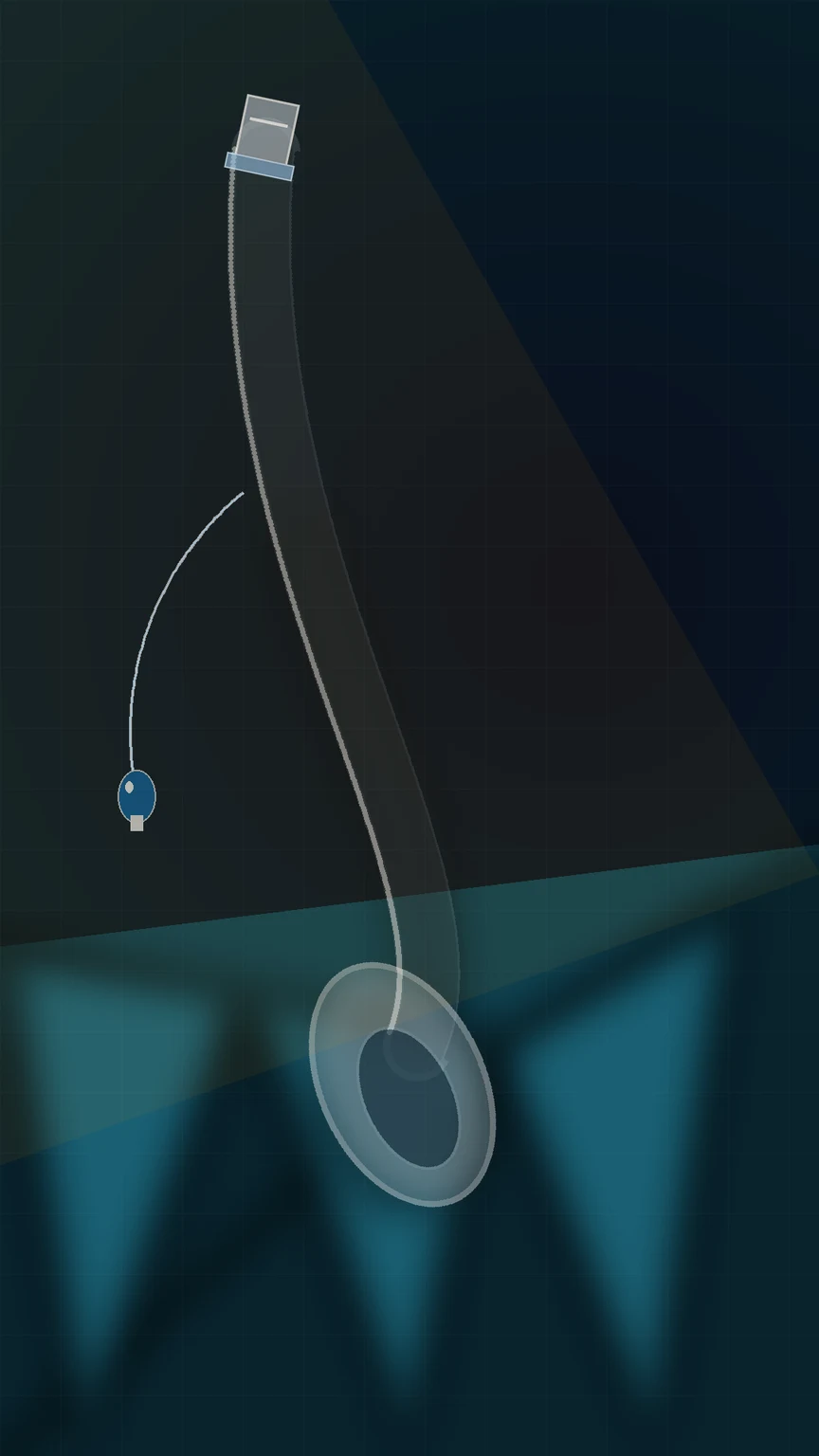
The first generation is the classic LMA (cLMA), the device designed by Archie Brain in 1988 and the original supraglottic airway. It consists of a silicone mask with an inflatable cuff, a ventilation tube, and a pilot balloon through which the cuff is inflated. Introduced blind through the mouth and advanced along the palate until the cuff lies against the upper oesophageal sphincter, it is inflated to form a seal around the laryngeal inlet, and the hands are then free[2].
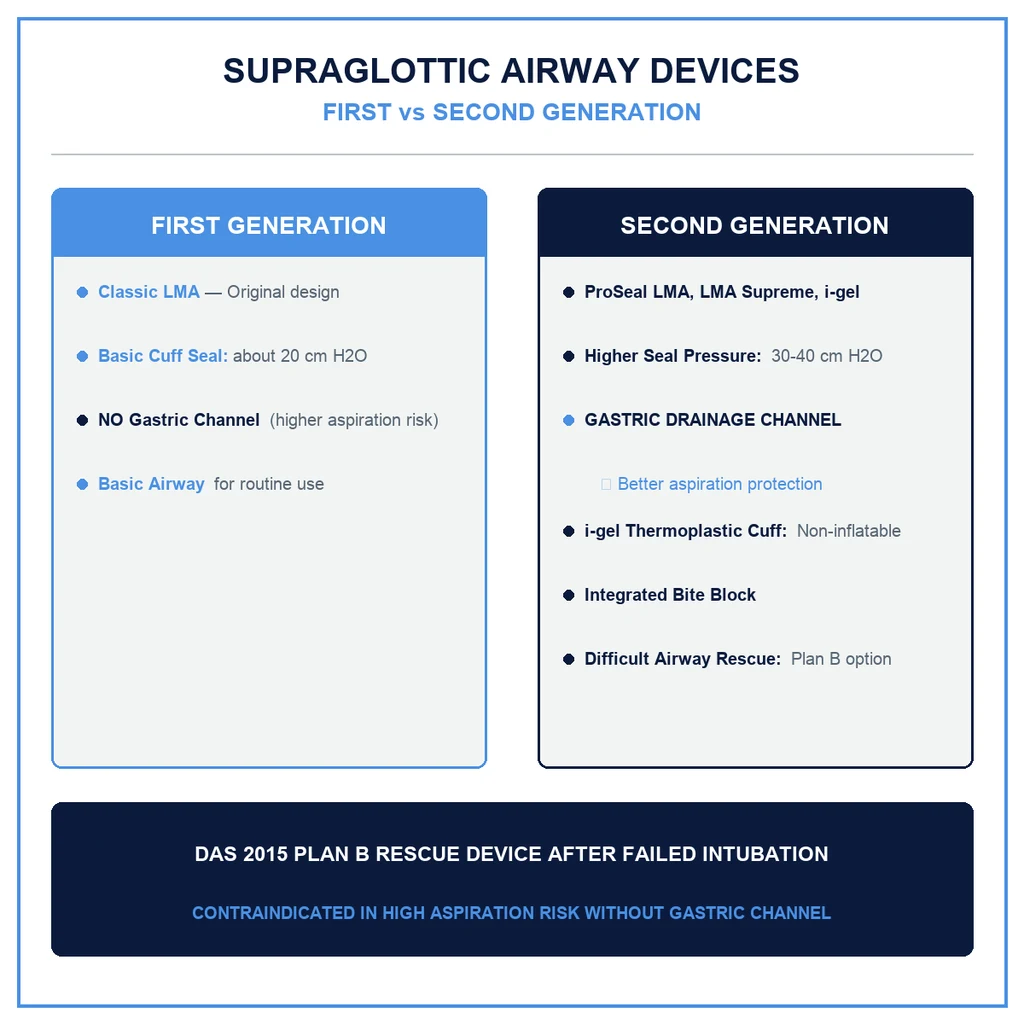
The defining limitation of the first generation is its low cuff seal pressure of about 20 cm H2O. The cuff forms its seal against the compliant pharyngeal mucosa, and the pressure it can sustain before leaking is modest; when the peak airway pressure of ventilation exceeds the seal, the device vents gas into the pharynx and the oesophagus, and ventilation fails. This sets the practical ceiling on the patients in whom the device can be used: any condition that raises the peak airway pressure — obesity, bronchospasm, reduced pulmonary compliance, the head-down laparoscopic position — risks exceeding the seal and is a relative contraindication[2].
The second, and more consequential, limitation is the absence of a gastric drainage channel. The cuff of the classic LMA does not isolate the glottis from the oesophagus; the seal is against the pharyngeal mucosa, and regurgitated gastric content that passes the cuff reaches the glottis and is aspirated. The classic LMA therefore offers no active protection against aspiration, and its elective use is reserved for the fasted patient at low aspiration risk. The whole rationale for the second generation flows from this single gap[1][2].
The classic LMA is sized by patient weight, with sizes running from 1 (the neonate under 5 kg) through 6 (the large adult), each with a recommended cuff volume. The sizing is the examined detail a candidate is expected to give: size 3 for the small adult, size 4 for the standard adult, size 5 for the large adult, with the paediatric sizes scaled down by weight[3].
Second-generation devices: seal pressure and the gastric channel
The second-generation devices — the ProSeal LMA, the LMA Supreme, and the i-gel — were designed to close the two gaps of the first generation, and they do so by raising the seal pressure and adding a gastric drainage channel. The gastric channel is the defining feature: a separate tube running parallel to the airway tube that opens at the tip of the device behind the cuff and allows a gastric tube to be passed, drained, and vented, so that regurgitated content is routed away from the glottis even if it passes the cuff[1].
The gastric drainage channel of the second-generation device is not a token addition. Contemporary evaluation confirms that a gastric tube can be reliably placed through the drainage channel of the second-generation devices, and that the channel both vents regurgitated content and provides a route for gastric decompression in the longer case. The protection it affords is the principal reason the second-generation device has displaced the classic LMA in routine elective practice and in the rescue algorithm[1].
The second advance is the higher seal pressure, of 30 to 40 cm H2O. The ProSeal LMA achieves this with a deeper, posterior cuff that seals the oesophageal inlet as well as the laryngeal, and a posterior cuff that splints the device and raises the oropharyngeal leak pressure. The LMA Supreme adds a rigid, single-use, anatomically curved airway tube and a gastric channel, designed for rapid placement and a stable seal. The clinical effect is that the second-generation device tolerates the higher peak airway pressures of the obese patient, the laparoscopic position, and the patient with reduced compliance, in whom the first generation would vent and fail[2].
The examined distinction is therefore crisp. The first generation has an inflatable cuff, a seal pressure of about 20 cm H2O, and no gastric channel; the second generation has a seal pressure of 30 to 40 cm H2O and a gastric drainage channel that vents regurgitated content and accepts a gastric tube. The first is the historical device; the second is the contemporary standard, and it is the device the DAS 2015 algorithm assumes when it deploys a supraglottic airway as the Plan B rescue[1][5].
The i-gel: a non-inflatable cuff
The i-gel is the notable exception within the second generation, and it is the device most often examined for its design rather than its use. Where the ProSeal and the Supreme seal with an inflatable cuff, the i-gel has a non-inflatable thermoplastic elastomer cuff that is moulded to mirror the laryngeal inlet and that softens and conforms to the patient's anatomy as it warms to body temperature. There is no cuff to inflate, no pilot balloon, and no uncertainty about cuff volume or pressure[2].
The advantages of the non-inflatable design flow from the absence of a cuff. Placement is faster, because there is no inflation step and no risk of over-inflation distorting the seal; the seal pressure is determined by the anatomical fit and is less variable than an inflatable cuff; and there is no cuff pressure to monitor during nitrous oxide diffusion or prolonged use. The device carries an integral gastric channel, so it offers the second-generation aspiration protection, and a broad, stable bowl that resists rotation[1][2].
The i-gel is widely used in paediatric anaesthesia, and the depth of anaesthesia required for its insertion has been quantified. The median effective concentration of sevoflurane for i-gel insertion in children has been characterised, and the device is a common first-line supraglottic airway in paediatric practice, where the speed of placement and the absence of a cuff are particular advantages[3].
The candidate is expected to know the i-gel by name, to identify the non-inflatable thermoplastic elastomer cuff as its distinguishing feature, to know that it carries a gastric channel and so qualifies as second generation, and to know that it conforms to the laryngeal inlet as it warms to body temperature. The device is also a favoured rescue and prehospital airway for the same reasons of speed and simplicity[2][5].
The intubating LMA (Fastrach)
The intubating LMA, the Fastrach (sometimes called the ILMA), is the variant designed not as a terminal airway but as a conduit for blind tracheal intubation. It differs from the classic LMA in three respects: the airway tube is wider, shorter, and gently curved, so that a cuffed endotracheal tube of moderate size can be passed through it; the mask incorporates a rigid, anatomically curved handle that positions the aperture over the glottis; and an epiglottic-elevating bar replaces the bars of the classic LMA, lifting the epiglottis as the tracheal tube is advanced[4].
The Fastrach is placed in the same blind fashion as the classic LMA, and a lubricated, cuffed endotracheal tube is then advanced through the device and, in the majority of cases, passes into the trachea without laryngoscopy. Where the blind pass fails, a fibreoptic bronchoscope can be passed through the tracheal tube to confirm the glottis and guide the intubation, converting a blind technique to a visualised one. The device is therefore a bridge to intubation — a way to secure the airway with a supraglottic device and then to intubate through it, in the patient in whom direct laryngoscopy has failed or is not possible[4].
The examined role of the Fastrach is in the difficult airway and the failed intubation. In the patient who cannot be intubated by direct laryngoscopy — the syndromic, the cervical-spine-injured, the distorted airway — the Fastrach offers a route to a definitive airway that does not depend on a line of sight. It is one of the techniques the difficult-airway algorithm keeps in reserve, and it is the device that most clearly embodies the principle that a supraglottic airway can be a bridge as well as a rescue[4][5].
Uses of the supraglottic airway
The supraglottic airway has five principal uses, and the candidate is expected to enumerate them with the rationale for each. [1]
- Routine anaesthesia. The everyday substitute for the face mask and the endotracheal tube, in the fasted patient undergoing a procedure of moderate duration that does not require muscle paralysis or high airway pressures. The device provides a hands-free airway without laryngoscopy, and it is the default airway for a large share of elective peripheral and day-surgery anaesthesia[2].
- Difficult-airway rescue (DAS 2015 Plan B). When intubation has failed and mask ventilation is difficult or impossible, a supraglottic airway is the rescue that re-establishes oxygenation. It is the explicit Plan B of the DAS 2015 algorithm, and the second-generation device is preferred for its gastric channel and higher seal pressure[4][5].
- A bridge to intubation. The intubating LMA (Fastrach) allows a tracheal tube to be passed through the device, either blindly or with fibreoptic guidance, converting a supraglottic rescue into a definitive airway[4].
- CPR and prehospital airway management. The supraglottic airway is widely used in cardiopulmonary resuscitation and by prehospital services, because it is placed rapidly, without laryngoscopy, and with minimal interruption to chest compressions. The second-generation device is preferred for its aspiration protection in the unfasted arrest patient[5].
- Paediatric anaesthesia. The supraglottic airway, and the i-gel in particular, is a first-line airway in paediatric anaesthesia, where the speed of placement, the absence of a cuff (in the i-gel), and the range of paediatric sizes make it suited to the wide span of paediatric anatomy[3][6].
Advantages over the endotracheal tube
The supraglottic airway is compared against the endotracheal tube, and its advantages are the reasons it is chosen for the routine case and held in reserve for the rescue. [1]
- Less invasive and no laryngoscopy. The device sits above the glottis and does not enter the trachea; it is placed blind, without the laryngoscope blade and the manipulation of the pharynx and the vocal cords that intubation requires.
- Less sympathetic stimulation. The avoidance of laryngoscopy and the absence of a tube through the cords mean less catecholamine surge, less hypertension and tachycardia, and a smoother cardiovascular course — relevant in the patient with ischaemic heart disease or raised intracranial pressure.
- Smoother emergence and less sore throat. The device is better tolerated at light planes of anaesthesia, the patient can often maintain their own airway around it as it is removed, and the incidence of post-operative sore throat is lower than with the endotracheal tube.
- Faster placement and a shallow learning curve. The blind insertion is rapid, the technique is acquired quickly by the novice, and the device is therefore well suited to the emergency, the prehospital, and the less-experienced operator[2][5].
These advantages must be weighed against the single, decisive advantage of the endotracheal tube — it is a definitive airway that isolates the trachea, tolerates high airway pressures, and protects against aspiration — and the supraglottic device is chosen only where that isolation is not required[1].
Disadvantages and limitations
The disadvantages of the supraglottic airway are the mirror of its advantages, and they define the patients in whom it must not be used. [1]
- It is not a definitive airway. The device does not enter the trachea, and it does not provide the secure, isolated airway of a cuffed endotracheal tube.
- It does not fully protect against aspiration. The first generation offers no aspiration protection; the second generation materially improves it through the gastric channel, but the protection is partial and does not equal a cuffed tracheal tube[1].
- Limited seal pressure. The cuff seal, of about 20 cm H2O in the first generation and 30 to 40 cm H2O in the second, sets a ceiling on the airway pressure the device can sustain, and ventilation fails when the peak pressure exceeds the seal[2].
- It can displace. The device is held in place by the cuff and the pharyngeal mucosa, not by a tape-and-tie around a tube through the cords, and it can rotate, migrate, or be knocked out during positioning, surgery, or transfer. Continuous capnography is mandatory to detect the displacement that would otherwise be silent[2].
Contraindications and aspiration risk
The contraindications follow directly from the limitations, and they are examined as a list with the rationale. [1]
- High aspiration risk. The full stomach, obesity, pregnancy (especially the third trimester), gastro-oesophageal reflux disease, ileus, and bowel or upper-airway obstruction are relative contraindications to a first-generation device and an indication for a rapid sequence induction with a cuffed endotracheal tube. The second-generation device with a gastric channel partially mitigates the risk but does not abolish it, and it is not a substitute for intubation in the patient at high aspiration risk[1][5].
- Pharyngeal pathology. Pharyngeal abscess, haematoma, tumour, or recent pharyngeal surgery distort the anatomy the cuff seals against, prevent a seal, and risk worsening the pathology.
- Low pulmonary compliance or high airway resistance. Obesity, bronchospasm, pulmonary oedema, and the head-down laparoscopic position raise the peak airway pressure above the cuff seal; the device vents and ventilation fails, and an endotracheal tube is required[2].
- Procedure requiring high airway pressure or muscle paralysis. Procedures that demand paralysis, that risk airway soiling, or that require peak pressures the device cannot sustain are not suited to a supraglottic airway[2].
The practical position is that the supraglottic airway is an elective device for the fasted, low-risk patient, and that the moment aspiration risk, airway pressure, or the need for a definitive airway intrudes, the device is exchanged for an endotracheal tube[1].
The DAS 2015 algorithm: the SGAD as Plan B
The defining role of the supraglottic airway in the difficult-airway algorithm is as the Plan B rescue of the Difficult Airway Society 2015 guideline. The algorithm is taught as a ladder of plans, and the supraglottic airway is the device that interrupts the spiral from a failed intubation to a can't-intubate-can't-oxygenate (CICO) event[4][5].
The algorithm runs as follows. Plan A is the primary intubation, optimised with preparation, position, preoxygenation, and the best-available laryngoscope. When Plan A fails — the intubation cannot be achieved — the operator declares failure early, limits attempts to avoid trauma, and moves to Plan B, the supraglottic airway. A second-generation device is placed as the best single attempt, and the outcome is judged on oxygenation[5].
The decision after Plan B is the examined point. If oxygenation is adequate after the supraglottic airway is placed, the operator stops. The airway is secured, the patient is ventilated, and the team waits for the patient to wake and recover spontaneous ventilation; the operator does not persist with repeated attempts at intubation, which is the error that converts a rescued airway into a lost one. If oxygenation is inadequate after the best-attempt supraglottic airway, the operator proceeds immediately to Plan C — front-of-neck access, the cannula or surgical cricothyroidotomy that is the CICO rescue[5].
The teaching is that the supraglottic airway is the device that buys time and oxygenation, and that its correct use is to stop when it works and to escalate when it does not. The second-generation device is preferred in the algorithm because the gastric channel affords some aspiration protection in the unfasted or refluxing patient, and the higher seal pressure tolerates the airway pressures of the deteriorating lung[1][5].
Special contexts: paediatric, CPR and prehospital use
Three contexts reshape the use of the supraglottic airway and are examined in their own right. [1]
In paediatric anaesthesia, the supraglottic airway is a first-line device. The i-gel, with its non-inflatable cuff and its range of paediatric sizes, is widely used, and the depth of anaesthesia required for its insertion has been quantified in children — the median effective concentration of sevoflurane for i-gel insertion provides an evidence-based guide to the plane of anaesthesia that prevents coughing, laryngospasm, and movement on placement. The device is used for routine paediatric anaesthesia, for bronchoscopic examination of the dynamic paediatric airway, and as a bridge in the difficult paediatric intubation[3][6].
In cardiopulmonary resuscitation, the supraglottic airway is an alternative to the endotracheal tube and the face mask, and it is placed rapidly and with minimal interruption to chest compressions. The second-generation device is preferred for its aspiration protection in the unfasted arrest patient, and the speed and simplicity of placement suit the resuscitation context where the most experienced operator may not be available. The device is a recognised airway for the advanced life-support algorithm[5].
In the prehospital and emergency setting, the supraglottic airway is used by services that may not have the laryngoscopic expertise or the time for a tracheal intubation, and in the physiological difficult airway of the emergency department, where the patient is hypoxaemic, shocked, and time-critical. The device is a rescue that re-establishes oxygenation while the definitive plan is made, and it is one of the tools the emergency airway algorithm keeps immediately available[5].
Device selection and sizing
The selection of the device follows the patient and the context, and the candidate is expected to give a structured answer rather than a recitation of brand names[2].
- For the routine, fasted, low-risk elective case, a second-generation device is now the default — the i-gel for its speed and non-inflatable cuff, the LMA Supreme for its rigidity and ease of placement, or the ProSeal for its high seal pressure. The classic LMA is the historical device and is rarely the first choice where a second-generation device is available[2].
- For the case at borderline aspiration risk or requiring higher airway pressure, a second-generation device with a gastric channel is chosen over the first generation, and a gastric tube is passed to vent and decompress the stomach[1].
- For the failed-intubation rescue, a second-generation device is the Plan B of the DAS 2015 algorithm, placed as a single best attempt[5].
- For the difficult airway where a definitive airway is needed, the intubating LMA (Fastrach) offers a bridge to a tracheal tube, placed blindly or with fibreoptic guidance[4].
- For paediatric anaesthesia, the i-gel is a first-line device, sized to the weight, with sevoflurane titrated to the depth that allows smooth insertion[3].
Sizing is by patient weight, with the cuff volume recommended for each size; the principle is to choose the size that fits the anatomy and to avoid over-inflation, which distorts the seal and risks pharyngeal trauma[2].
Clinical
- Standard approach
- Evidence-based
Alternative
- Modified technique
- Risk-benefit
Red flags
[1] [1] [1] [1] [1]References
- [1]Yin X, et al. Gastric tube placement through the drainage channel of second-generation supraglottic airway devices: a systematic review with evidence mapping Front Surg, 2026.PMID 42344572
- [2]Migliorelli S, et al. Clinical Evaluation of a Non-inflatable Visual Laryngeal Mask Airway: A Prospective Service Assessment in Elective and Difficult Airway Management Cureus, 2026.PMID 42291977
- [3]Gan Z, et al. The Median Effective Concentration of Sevoflurane for I-Gel Laryngeal Mask Insertion in Unpremedicated Children Aged 1-10 Years: A Prospective Concentration-Finding Study Pediatr Discov, 2026.PMID 42021953
- [4]Black KM, et al. Anesthesia Care, Complications, and Airway Management for Patients With Spinal Muscular Atrophy: A Retrospective Chart Review From a Quaternary Children's Hospital Anesth Analg, 2026.PMID 42363899
- [5]Ghaffar S, et al. Physiological difficult airway management in the emergency department J Pak Med Assoc, 2026.PMID 42363338
- [6]Schramm D, et al. Bronchoscopic and interventional management of tracheobronchomalacia in children with bronchopulmonary dysplasia: a review of evidence Paediatr Respir Rev, 2026.PMID 42364941