Anaes · Neuromuscular blockade & reversal
Suxamethonium
Also known as Succinylcholine · Sux · Depolarising neuromuscular blocker · RSI muscle relaxant · Diacetylcholine
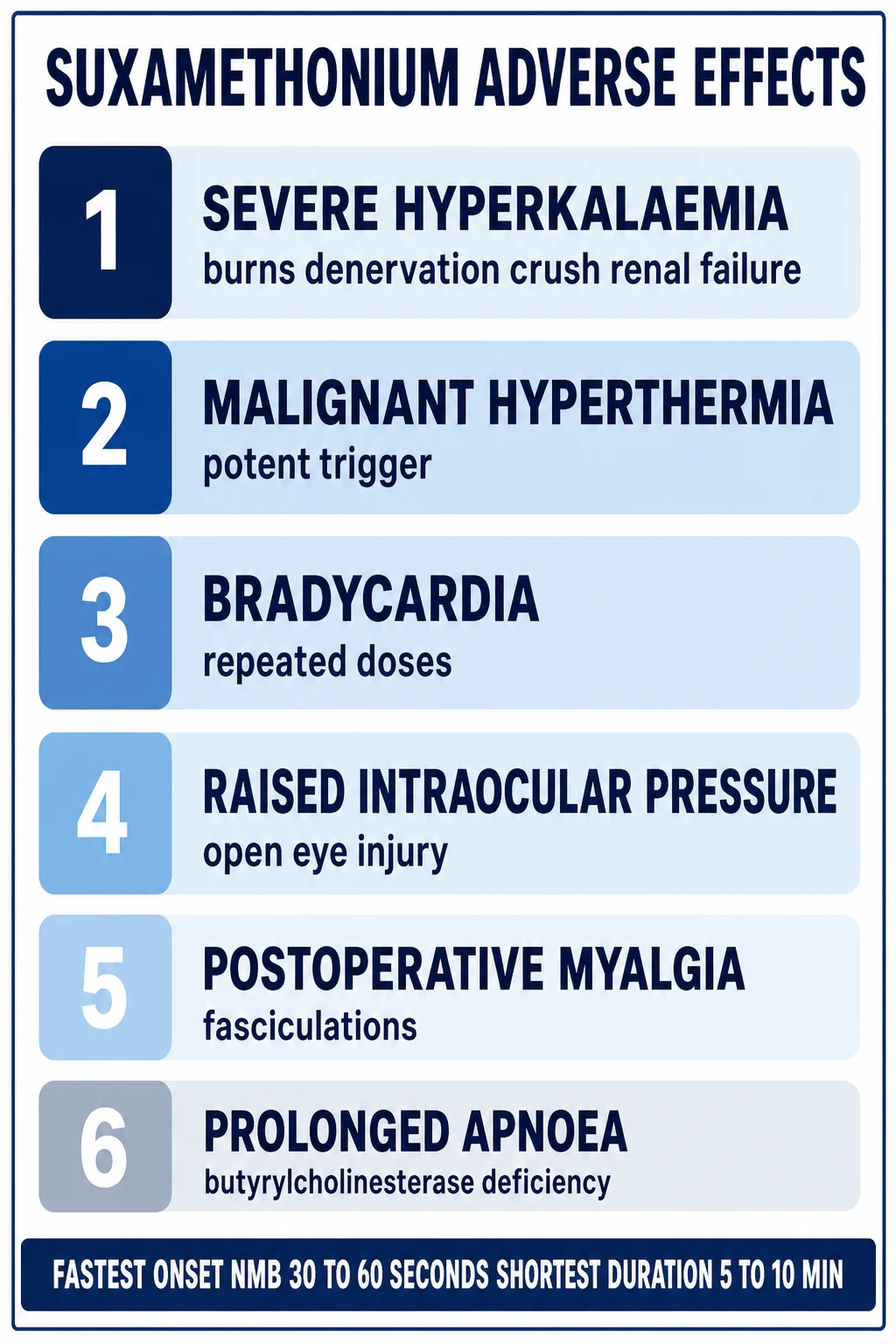
Suxamethonium (succinylcholine, sux) is the ONLY depolarising neuromuscular blocker in clinical use — structurally it is two acetylcholine molecules joined back-to-back as a di-acetylcholine ester, and it activates the postsynaptic nicotinic (muscle) receptor to produce an initial depolarisation (the visible fasciculation) followed by a sustained depolarisation that inactivates the surrounding sodium channels and produces a phase I block and flaccid paralysis. It has the FASTEST onset of any neuromuscular blocker at 30 to 60 seconds and the SHORTEST duration at 5 to 10 minutes, which makes it the rapid-sequence induction agent of choice for the full-stomach or aspiration-risk patient and for the difficult airway (O'Connell 2026; Marcus 2026). It is not hydrolysed by synaptic acetylcholinesterase but by plasma butyrylcholinesterase synthesised in the liver, so butyrylcholinesterase deficiency — genetic (dibucaine-resistant, autosomal recessive) or acquired (liver disease, pregnancy, organophosphates) — produces prolonged apnoea lasting hours (Snak de Souza 2026; Abbasi 2026). Repeated boluses or large total doses convert the block into a phase II (desensitisation) block that resembles a non-depolariser. The exam-critical adverse-effect and contraindication list is long and high-yield: severe hyperkalaemia in burns (beyond 24 hours and up to about 2 years), denervation, spinal-cord injury, prolonged immobility and critical illness from upregulated extrajunctional acetylcholine receptors (Puxty 2026); malignant hyperthermia — sux is a potent RYR1-mediated trigger (Fang 2026); bradycardia; raised intraocular pressure (contraindicated in the open-eye injury); raised intracranial and intragastric pressure; fasciculation and postoperative myalgia; masseter spasm; anaphylaxis. Rocuronium 1.2 mg/kg reversed by sugammadex is the standard sux-sparing alternative (Kronauer 2026; Zhang 2026).
On this page & tools
Your progress
Saved locally on this device.
Target exams
Red flags

Overview — the only depolarising neuromuscular blocker
Suxamethonium (succinylcholine, "sux") is the only depolarising neuromuscular blocker in clinical use, and it has held that position alone since its introduction in 1951. The half-century search for the ideal relaxant, reviewed by Kronauer and colleagues, has produced a long line of non-depolarising competitors — the aminosteroid rocuronium and the benzylisoquinolinium mivacurium among them — yet suxamethonium remains unsurpassed on the single property that defines its clinical niche: it has the fastest onset and the shortest duration of any neuromuscular blocker.[1][8]
That combination — fast in, fast out — is the reason sux is still the rapid-sequence induction (RSI) agent of choice for the full-stomach or aspiration-risk patient and for the difficult airway where a rapid return of spontaneous ventilation is desirable. It is also the reason it is so heavily examined: every anaesthetist must know not only its strengths but its long and high-yield list of dangers, the foremost of which — life-threatening hyperkalaemia and malignant hyperthermia — have no parallel among the non-depolarisers.[2][6]
Master sux by holding four ideas in tension: it is the only depolariser; it has unique pharmacokinetics (hydrolysed in plasma by butyrylcholinesterase, not at the synapse); its block evolves from a phase I to a phase II pattern with repeated dosing; and its adverse-effect profile is the single highest-yield list in neuromuscular pharmacology. [1]
Structure and mechanism of action
Suxamethonium is, in structural terms, two acetylcholine molecules joined back-to-back — a di-acetylcholine ester, a bis-quaternary ammonium compound. That molecular architecture is the whole key to its pharmacology. Because it carries the same quaternary ammonium head-group as acetylcholine, it binds and activates the postsynaptic nicotinic (muscle-type, N_M) receptor at the neuromuscular junction, exactly as acetylcholine does.[1]
The sequence at the end-plate is the heart of the mechanism and must be understood step by step. Suxamethonium binds the nicotinic receptor and opens the channel, sodium enters, and the motor end-plate depolarises — this initial depolarisation propagates outward across the muscle fibre and is seen clinically as fasciculation, the brief, visible, uncoordinated muscle twitches that precede the paralysis. Acetylcholine is then normally destroyed within milliseconds by synaptic acetylcholinesterase, terminating the signal; suxamethonium, however, is not a substrate for synaptic acetylcholinesterase, so it persists at the receptor. The result is a sustained depolarisation: the end-plate remains depolarised, the surrounding sodium channels enter their inactivated state and cannot reset, and the membrane in the perijunctional region becomes unresponsive to any further stimulation. The muscle is therefore unable to fire again — a state of flaccid paralysis. This is the phase I (depolarising) block.[1]
Two consequences follow directly from this mechanism and are examined repeatedly. First, because sux mimics acetylcholine at the receptor rather than blocking it, the block is augmented, not antagonised, by an anticholinesterase such as neostigmine — giving neostigmine to "reverse" a phase I block only increases the acetylcholine (and any lingering sux) at the junction and deepens the paralysis. Second, the initial fasciculation is the clinical signature of the depolarising mechanism and is the precursor of the postoperative myalgia discussed below. [1]
Pharmacokinetics — metabolism by plasma butyrylcholinesterase
The defining pharmacokinetic feature of suxamethonium is that it is hydrolysed in the plasma by butyrylcholinesterase (also called pseudocholinesterase or plasma cholinesterase), an enzyme synthesised in the liver — and not by the synaptic acetylcholinesterase at the neuromuscular junction. Butyrylcholinesterase hydrolyses sux rapidly to succinylmonocholine and then to succinic acid and choline, both inactive. This plasma hydrolysis, not receptor-level events, sets the duration of the block.[3][4]
The clinical numbers are exam-critical and must be quoted exactly. After an intravenous intubating dose the onset is the fastest of any neuromuscular blocker at 30 to 60 seconds, and the duration is the shortest at 5 to 10 minutes. The onset is fast precisely because sux is a small, highly potent, receptor-activating molecule that reaches the junction in one arm-to-brain circulation; the duration is short because butyrylcholinesterase clears the drug from the plasma within minutes. Recovery is by metabolism, not by redistribution — a key contrast with the induction agents — and this is why an absence of butyrylcholinesterase (whether genetic or acquired) prolongs the block so dramatically.[2][3]
The liver synthesis of butyrylcholinesterase is the link to the acquired causes of prolonged apnoea: any severe impairment of hepatic protein synthesis (advanced liver disease, severe illness, malnutrition), the altered physiology of pregnancy, and organophosphate exposure (which inhibits the enzyme) all reduce enzyme activity and lengthen the block. The genetic causes — the dibucaine-resistant variants — are taken up below in the section on prolonged apnoea.[3]
Phase I (depolarising) block
A phase I block is the clinical and neurophysiological pattern produced by an intubating dose of suxamethonium, and it must be distinguished from a phase II block both at the monitor and in the viva. The clinical sequence is fasciculation then flaccid paralysis, beginning about 30 seconds after the dose and recovering within 5 to 10 minutes.[1]
On train-of-four (TOF) stimulation, a phase I block shows four equal but reduced twitches with NO fade — all four responses are depressed to the same degree, so the T4 to T1 ratio is close to 1. There is no post-tetanic facilitation (PTF), and the response to tetanic stimulation is sustained (the contraction holds rather than fading). These three features — no fade, no post-tetanic facilitation, sustained tetanus — are the electrophysiological fingerprint of the depolarising mechanism: the end-plate is uniformly depolarised and responds uniformly to each stimulus.[1]
The single most important practical rule of the phase I block follows from the mechanism: an anticholinesterase (neostigmine) AUGMENTS and PROLONGS the block, it does not reverse it. Because neostigmine raises acetylcholine at the junction, and sux is acting as an acetylcholine-mimetic at the receptor, giving neostigmine simply deepens and lengthens the depolarising block. Never give neostigmine to reverse a phase I block. Reversal is unnecessary in any case — the block recovers spontaneously within minutes as butyrylcholinesterase clears the drug.[3]
Phase II (desensitisation) block
A phase II block (also called a desensitisation block) develops when suxamethonium is given in repeated boluses or as a large total dose, typically above about 4 to 6 mg per kg. The end-plate, after prolonged or repeated exposure to a depolarising agonist, becomes desensitised: some receptors become unresponsive while others are still being activated, and the neurophysiology converts from a depolarising to a non-depolarising pattern.[1][4]
On the monitor, a phase II block resembles a non-depolarising block: there is fade on the train-of-four (T4 smaller than T1), post-tetanic facilitation appears, the response to tetanus is not sustained, and recovery is slow. Once a phase II pattern is established, an anticholinesterase reversal becomes (cautiously) possible, because the block now behaves like a non-depolariser — but the far safer rule is to avoid repeated suxamethonium in the first place and to switch to a non-depolarising agent if a longer block is needed. The lesson: suxamethonium is a single-shot drug for rapid intubation, not an agent for repeated boluses or for maintenance by infusion.[1][4]
Clinical use — the rapid-sequence induction agent of choice
The clinical identity of suxamethonium rests on its unmatched onset and duration, which make it the agent of choice for the rapid sequence induction (RSI) — the technique used for the patient at risk of aspiration of gastric contents, in whom the goal is to secure the airway with the shortest possible interval between loss of consciousness and tracheal intubation. The standard RSI dose is 1 to 1.5 mg/kg intravenously, producing intubating conditions within 30 to 60 seconds and recovery within 5 to 10 minutes.[2][6]
The RSI indication spans the full stomach, the bowel obstruction, the late pregnancy, the emergency with an unknown fasting history, and the trauma patient — anywhere the aspiration risk is high and the anaesthetist needs to be intubating within a minute of induction. Sux is equally valuable in the difficult airway, where the ability to recover spontaneous ventilation within minutes is a safety net that no intermediate-acting non-depolariser can match.[6]
The other established use is electroconvulsive therapy (ECT), where a very short-acting muscle relaxant is required to prevent the injurious convulsion while allowing rapid recovery of ventilation between treatments. O'Connell and colleagues' comparison of suxamethonium and rocuronium for rapid sequence intubation in the emergency department, and Marcus and colleagues' study of rapid sequence induction practices and outcomes in abdominal surgery patients, together confirm that sux remains central to RSI practice, though rocuronium-sugammadex is an increasingly used sux-sparing alternative where sux is contraindicated.[2][6][8]
Adverse effect — severe hyperkalaemia
The most dangerous adverse effect of suxamethonium, and the one most heavily examined, is severe, potentially lethal hyperkalaemia. Suxamethonium, by activating the nicotinic receptor across the muscle membrane, releases potassium from muscle — in the healthy patient this rise is small (about 0.5 mmol per litre) and well tolerated. The danger arises in patients whose muscles have upregulated extrajunctional acetylcholine receptors: in these states the receptor mass is vastly expanded across the muscle membrane (not just at the end-plate), and sux activates them all at once, releasing a flood of potassium sufficient to produce ventricular fibrillation and cardiac arrest.[7]
The clinical states that cause receptor upregulation, and in which sux is therefore contraindicated, form the exam list and must be quoted in full: burns (the risk begins beyond 24 hours after the burn and persists for up to about 2 years), denervation injury, spinal cord injury, prolonged immobility or paralysis, crush injury, severe intra-abdominal infection or sepsis, critical-illness myopathy and neuropathy, and pre-existing hyperkalaemia with renal failure. Puxty and colleagues' scoping review of cardiac arrest after burn injury sets the hyperkalaemic arrest in the burn patient in its clinical context and underpins the burn contraindication.[7]
The exam-critical teaching point is operational: a sudden perioperative cardiac arrest in any patient with one of these conditions, occurring within minutes of a sux dose, is hyperkalaemia until proven otherwise. The immediate management is cardiopulmonary resuscitation, calcium chloride or calcium gluconate to stabilise the myocardial membrane, insulin and dextrose to drive potassium back into the cells, and hyperventilation — and the prevention is never to give sux to these patients in the first place.[7]
Adverse effect — malignant hyperthermia and masseter spasm
Suxamethonium is a potent trigger of malignant hyperthermia (MH), the RYR1-mediated pharmacogenetic crisis of uncontrolled skeletal-muscle calcium release, hypermetabolism, hypercapnia, hyperthermia, rhabdomyolysis and death. Fang and colleagues' review of the diverse RYR1 variants in malignant-hyperthermia-susceptible patients is the modern molecular background: susceptibility is inherited in an autosomal dominant pattern and is concentrated in variants of the ryanodine receptor type 1 (RYR1) and, less commonly, the dihydropyridine receptor (CACNA1S). Sux is one of the two classical triggers (the other being the volatile anaesthetic agents), and it must never be given to a patient with known or suspected MH susceptibility.[5]
The first clinical sign of MH after a sux dose may be masseter spasm — a rigidity of the jaw muscles that makes the mouth difficult to open and complicates laryngoscopy and intubation. Masseter spasm is not always MH, but it must be treated as MH until proven otherwise: stop the triggers, call for help, give dantrolene, and manage the hypermetabolic crisis. The other early signs — a rapidly rising end-tidal carbon dioxide despite increased ventilation, tachycardia, and a rising temperature — follow. The exam point: sux is a potent MH trigger, masseter spasm may be the first sign, and dantrolene is the specific treatment.[5]
Adverse effects — bradycardia, raised pressures, myalgia and anaphylaxis
The remaining adverse effects are individually less dramatic than hyperkalaemia and MH but together make up a long and frequently examined list. [1]
- Bradycardia. Because suxamethonium mimics acetylcholine, it has muscarinic as well as nicotinic effects, and the muscarinic action on the heart produces bradycardia, especially after a repeated dose (when the initial sympathetic counter-regulation has waned). The bradycardia can be sinus arrest. It is prevented and treated with atropine, which should be drawn up whenever a second dose of sux is contemplated.[1]
- Increased intraocular pressure (IOP). Sux raises the intraocular pressure, principally through the contraction of the extraocular muscles. This makes it contraindicated in the open-eye or penetrating globe injury, where the rise in pressure can expel the globe contents and blind the patient — one of the absolute contraindications to sux.[1]
- Increased intracranial pressure and increased intragastric pressure. Sux raises both. The rise in intragastric pressure is offset by a parallel rise in lower-oesophageal-sphincter pressure, so the net effect on aspiration risk is debated and probably small in the healthy patient, but it remains a concern in the RSI context that sux is otherwise used to address.[1]
- Fasciculation and postoperative myalgia. The visible fasciculation at onset is followed in many patients (especially young, muscular adults) by muscle pain, typically around the shoulders and back, in the postoperative period. A small defasciculating dose of a non-depolariser (a tenth of an intubating dose of rocuronium or vecuronium, given three minutes before the sux) reduces the fasciculation and the myalgia, though the practice is controversial and does not abolish the myalgia entirely.[1]
- Masseter spasm — discussed above as a potential first sign of MH.[5]
- Anaphylaxis. Suxamethonium is one of the more commonly implicated agents in perioperative anaphylaxis, and it features high on any list of neuromuscular-blocker allergens.[1]
Prolonged apnoea — butyrylcholinesterase deficiency
Because suxamethonium is cleared by plasma butyrylcholinesterase, any deficiency of that enzyme — genetic or acquired — produces prolonged apnoea: the block, instead of recovering in 5 to 10 minutes, lasts for hours, and the patient must be kept anaesthetised and mechanically ventilated until the drug is eventually cleared, however long that takes.[3][4]
The genetic causes are the inherited variants of the butyrylcholinesterase gene, inherited in an autosomal recessive pattern. The classical variant is the atypical (dibucaine-resistant) enzyme, but several other variants exist, and the systematic review by Snak de Souza and colleagues lays out the genotype-to-phenotype relationships that determine how long the apnoea lasts in each case. The dibucaine number quantifies the enzyme variant and is the single most examined number in this area: the dibucaine number is the percentage inhibition of the enzyme by the local anaesthetic dibucaine, and it is about 80 in the normal homozygote, about 50 to 60 in the heterozygote, and about 20 in the homozygous atypical. A low dibucaine number therefore identifies the patient at risk and explains the prolonged block.[3]
The acquired causes — severe liver disease, the late stages of pregnancy, organophosphate exposure (which inhibits butyrylcholinesterase), and severe systemic illness — reduce the enzyme concentration or activity and lengthen the block in the same way. Abbasi and colleagues' case report of prolonged neuromuscular paralysis after a sux induction is the clinical illustration of the problem at the bedside.[4]
The management is conservative and the exam answer: sedate, ventilate, and wait. Keep the patient anaesthetised and on the ventilator until the block recovers spontaneously — there is no specific reversal. A fresh frozen plasma transfusion (to supply functional butyrylcholinesterase) has been used in extreme cases but is not routine. Do not give neostigmine — it does not help a phase I block and may worsen it. The prevention is a careful history for a personal or family history of sux apnoea, and the choice of a non-depolariser where the history is positive or the risk is high.[3][4]
Contraindications
The contraindications to suxamethonium form one of the most frequently examined lists in anaesthetic pharmacology, and the safe answer is to reproduce them in full. They are the absolute contraindications that follow directly from the adverse effects above. [1]
- Burns — beyond 24 hours and for up to about 2 years after the burn.[7]
- Denervation injury and spinal cord injury — and any cause of upregulated extrajunctional receptors.[7]
- Prolonged immobility or paralysis — including critical-illness myopathy and neuropathy.[7]
- Crush injury and severe intra-abdominal infection or sepsis.[7]
- Pre-existing hyperkalaemia and renal failure with hyperkalaemia.[7]
- Open-eye or penetrating globe injury — the rise in intraocular pressure can extrude the globe contents.[1]
- Known or suspected malignant hyperthermia susceptibility — and any personal or family history of an MH reaction.[5]
- A personal or family history of suxamethonium-induced prolonged apnoea, or a known butyrylcholinesterase deficiency.[3]
- Young children with a suspected but undiagnosed myopathy — sux can precipitate catastrophic rhabdomyolysis and cardiac arrest in undiagnosed muscular dystrophy, which is why it is avoided as a routine agent in paediatric anaesthesia.[1]
Alternatives — rocuronium and sugammadex for the sux-sparing RSI
Where suxamethonium is contraindicated, the standard sux-sparing alternative for RSI is rocuronium at the higher intubating dose of 1.2 mg/kg, which produces intubating conditions in about 60 to 90 seconds — approaching but not quite matching the onset of sux. The decisive advantage of rocuronium over the older non-depolarisers is that it can be rapidly and completely reversed by sugammadex, the modified gamma-cyclodextrin that encapsulates and removes rocuronium (and vecuronium) from the circulation. Sugammadex at 16 mg/kg can reverse a profound rocuronium block within minutes, and this reversibility has transformed the RSI calculus: a rocuronium-sugammadex strategy gives the anaesthetist a non-depolarising RSI that is, for practical purposes, almost as rapidly reversible as sux — without any of the hyperkalaemia, MH-triggering or prolonged-apnoea risks.[2][1]
O'Connell and colleagues' comparison of suxamethonium and rocuronium for rapid sequence intubation in the emergency department is the contemporary evidence that the two agents are broadly comparable for first-pass intubation success, with rocuronium favoured where sux is contraindicated; Kronauer's review of the half-century search for the ideal relaxant places the rocuronium-sugammadex pairing in the historical arc of that search. Zhang and colleagues' trial of mivacurium against suxamethonium for bronchoscopy is a reminder that mivacurium — another short-acting agent, itself hydrolysed by butyrylcholinesterase — is an alternative short option in selected settings, though it carries the same prolonged-apnoea liability and is not an RSI drug.[2][1][8]
Comparison with the non-depolarising neuromuscular blockers
The contrast between suxamethonium and the non-depolarising blockers (rocuronium, vecuronium, atracurium, cisatracurium, mivacurium, pancuronium) is a guaranteed exam question and is best held as a table of opposing properties. [1]
Suxamethonium is the only depolariser; the others are competitive antagonists at the nicotinic receptor. Sux activates the receptor and produces an initial depolarisation (fasciculation); the non-depolarisers block the receptor without activating it, so there is no fasciculation. A sux block shows no fade on TOF, no post-tetanic facilitation, and sustained tetanus (phase I); a non-depolarising block shows fade, post-tetanic facilitation, and unsustained tetanus. Sux is augmented by neostigmine (never reversed); non-depolarisers are reversed by neostigmine (and rocuronium and vecuronium by sugammadex). Sux has the fastest onset and shortest duration; the non-depolarisers have a slower onset and a longer duration, with rocuronium the fastest onset of the group and mivacurium and succinylmonocholine among the shortest-acting.[1]
The adverse-effect profiles diverge completely. Sux carries the unique liabilities of hyperkalaemia in upregulated-receptor states, malignant hyperthermia triggering, raised intraocular pressure, and prolonged apnoea in butyrylcholinesterase deficiency — none of which the non-depolarisers share. The non-depolarisers share among themselves the liabilities of histamine release (especially mivacurium and atracurium), vagolysis and tachycardia (pancuronium, rocuronium), the Hofmann elimination and laudanosine considerations of atracurium and cisatracurium, and the organ-independent clearance that makes cisatracurium the choice in renal and hepatic failure. The practical synthesis: sux for the fast in/fast out RSI where it is not contraindicated; rocuronium-sugammadex for everything else and for the sux-contraindicated patient.[1][2][8]
Clinical
- Standard approach
- Evidence-based
Alternative
- Modified technique
- Risk-benefit
Red flags
[1]References
- [1]Martyn JAJ, Richtsfeld M Succinylcholine-induced hyperkalemia in acquired pathologic states: etiologic factors and molecular mechanisms Anesthesiology, 2006.PMID 16394702
- [2]O'Connell DH, et al. Outcomes of Succinylcholine and Rocuronium for Rapid Sequence Intubation in the Emergency Department West J Emerg Med, 2026.PMID 42258841
- [3]Snak de Souza CD, et al. Genotype-phenotype relationships in butyrylcholinesterase deficiency: a systematic review Br J Anaesth, 2026.PMID 42120224
- [4]Abbasi H, et al. Prolonged Neuromuscular Paralysis Following Succinylcholine Induction Leading to a Trans-Kambin Oblique Lateral Lumbar Interbody Fusion (OLLIF) Procedure Performed Without Neuromonitoring Cureus, 2026.PMID 42037893
- [5]Fang Y, et al. Considerations for diverse RYR1 variants in malignant hyperthermia susceptible patients: a report of two cases BMC Anesthesiol, 2026.PMID 42271251
- [6]Marcus SG, et al. Rapid Sequence Induction Practices and Outcomes in Abdominal Surgery Patients: A Multicenter Observational Cohort Study Anesthesiology, 2026.PMID 42257652
- [7]Puxty KA, et al. Cardiac arrest in adult patients following burn injury: a scoping review with expert recommendations on management Scand J Trauma Resusc Emerg Med, 2026.PMID 41507944
- [8]Zhang X, et al. Effect and safety of mivacurium chloride and succinylcholine for bronchoscopy: study protocol for a single-center, randomized, non-inferiority, and positive-controlled clinical trial Trials, 2026.PMID 41566470