Anaes · Intravenous induction agents
Thiopental
Also known as Sodium thiopentone · Thiopentone · Thiobarbiturate · Barbiturate induction agent · Pentothal
Thiopental (sodium thiopentone) is the classic barbiturate induction agent — the first true intravenous induction drug, introduced in 1934, and still the agent of choice for rapid-sequence induction in obstetric general anaesthesia, for status epilepticus, and for barbiturate-coma neuroprotection. The framework rests on four exam-critical ideas: it is a thiobarbiturate whose sulfur atom at position 2 confers ultra-high lipophilicity, and it acts at the GABA-A receptor by INCREASING the DURATION of chloride channel opening (distinct from the benzodiazepines, which increase the FREQUENCY), with direct channel opening at high doses; its signature speed — onset in 10 to 30 seconds and recovery in 5 to 10 minutes — is the property of instant blood-brain-barrier penetration followed by rapid redistribution from the vessel-rich to the muscle compartment, while its hepatic metabolism has a low extraction ratio so the context-sensitive half-time rises steeply and the drug accumulates with repeated boluses or infusion, making it unsuitable for maintenance; it causes a 10 to 25 percent drop in blood pressure from myocardial depression and venodilation with reflex tachycardia (less hypotension than propofol but more tachycardia) yet is remarkably safe in pregnancy, sparing the uteroplacental circulation; and acute intermittent porphyria is the absolute contraindication because barbiturates induce ALA synthase and precipitate a porphyric crisis, while intra-arterial injection is catastrophic from crystallisation in arterioles. Built on the caesarean-section general-anaesthesia practice review (Helmer 2026), the obstetric GA pharmacology best-practice paper (Craig 2026), the vagus-nerve-stimulation refractory status epilepticus study (Parak 2026), the neuro-sedation for intracranial hypertension work (Ravaux 2026), the anaesthetic allergy review (Lisiecka 2026), the barbiturate reference (Lewis 2026), the GABA-A receptor gallic-acid/diazepam work (Yana 2026), and the ketamine-versus-etomidate RSI comparison (Chilingarashvili 2026).
On this page & tools
Your progress
Saved locally on this device.
8 MCQs with explanations
Target exams
Red flags

Why this matters to the anaesthetist
Thiopental (sodium thiopentone) holds a singular place in anaesthetic history. Introduced into clinical practice by Waters and Lundy at the Mayo Clinic in 1934, it was the first drug to allow rapid, smooth intravenous induction of general anaesthesia, and it transformed the speciality. For more than half a century it was the world's standard induction agent, and the pharmacology it established — ultra-rapid onset from high lipid solubility, rapid recovery from redistribution, and a barbiturate action at the GABA-A receptor — became the template against which every subsequent induction agent, including propofol, is still judged. [1]
Although thiopental has been largely replaced by propofol for routine elective induction, it retains four irreplaceable niches in modern practice. It remains a first-choice induction agent for rapid-sequence induction in obstetric general anaesthesia for caesarean section, where its reassuring safety profile for the fetus and the mother is unmatched.[1][2] It is a first-line agent for status epilepticus, given as small intravenous boluses.[3] It is the classical drug of barbiturate-coma neuroprotection for refractory intracranial hypertension and for cerebral protection during aneurysm clipping, through its reduction of the cerebral metabolic rate for oxygen.[4] And it is not a trigger for malignant hyperthermia, so it remains available for the MH-susceptible patient. An understanding of thiopental is therefore an understanding of the history of the speciality and of the four situations in which no other agent will do.
Physical chemistry
Thiopental is sodium 5-ethyl-5-(1-methylbutyl)-2-thiobarbiturate — a thiobarbiturate, distinguished from its oxygen analogue pentobarbital by a sulfur atom at position 2 of the barbiturate ring. That single sulfur substitution is the whole secret of its pharmacology: sulfur is larger and more lipophilic than oxygen, and it increases the molecule's lipid solubility dramatically, which is why thiopental crosses the blood-brain barrier almost instantly and produces unconsciousness within one arm-to-brain circulation. This is the structure-property relationship that examiners expect you to articulate.[6]
It is supplied as a pale-yellow sodium salt powder in a vial, reconstituted with sterile water to make a 2.5 percent solution (25 mg per mL). The reconstituted solution is strongly alkaline, with a pH of 10 to 11, because the sodium salt of a weak acid is a base. This alkalinity has three consequences: there is no pain on injection (unlike the acidic or emulsion-irritation pain of propofol); it is chemically incompatible with acidic drugs and with suxamethonium in the same intravenous line or syringe — they precipitate — so they must never be mixed and the line should be flushed between them; and it is highly irritant if extravasated or injected intra-arterially. The reconstituted solution is stable for up to 7 days if kept refrigerated, though most departments use it fresh.[6]
Mechanism of action
Thiopental, like all barbiturates, produces its central nervous system depression by acting at the GABA-A receptor — the principal inhibitory ligand-gated chloride channel of the brain. The barbiturates bind at a site distinct from both the GABA site and the benzodiazepine site, and they increase the DURATION of chloride channel opening. When GABA binds and opens the channel, a barbiturate keeps that channel open for longer, so more chloride enters the neuron, the membrane is hyperpolarised, and the neuron is rendered less excitable. This is the key distinction the exam rewards: barbiturates increase the DURATION (mean open time) of each chloride channel opening, whereas benzodiazepines increase the FREQUENCY (the number of openings per unit time) — both increase total chloride conductance, but by different kinetics.[7][6]
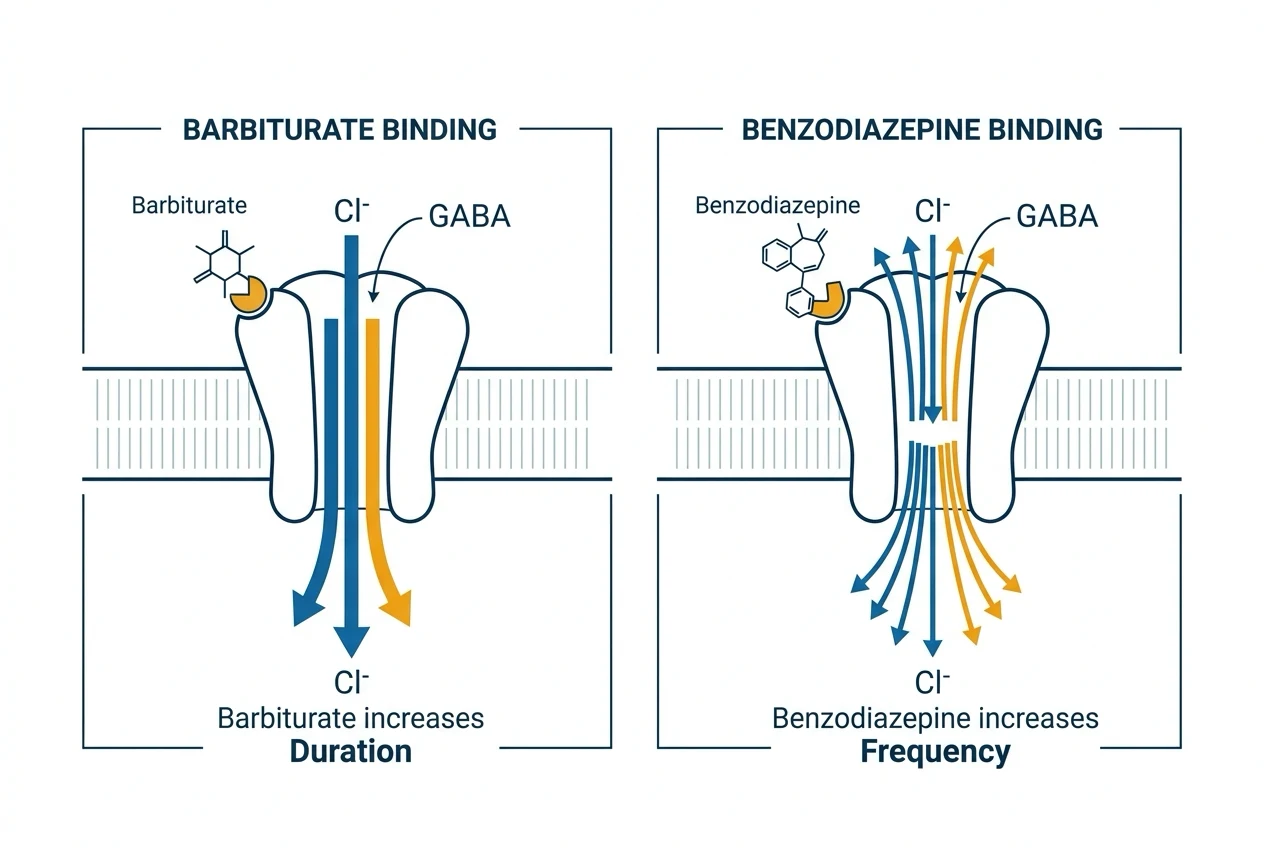
At high, anaesthetic concentrations the barbiturates have a second action that the benzodiazepines do not share: they can open the chloride channel directly, in the absence of GABA — a direct agonist effect that explains their greater potency and their lethality in overdose (the benzodiazepines, dependent on endogenous GABA, have a ceiling effect and are far safer alone). Thiopental also inhibits excitatory glutamate receptors of the AMPA and kainate subtypes at anaesthetic doses, reducing excitatory neurotransmission and contributing to its anticonvulsant and anaesthetic effect. This combination of enhanced inhibition and reduced excitation is the pharmacological basis of the barbiturate coma.[6]
Pharmacokinetics
Thiopental's pharmacokinetics are defined by ultra-high lipid solubility and rapid redistribution, and they explain both its great speed and its one great limitation — accumulation. [1]
After an intravenous bolus, thiopental reaches the brain in 10 to 30 seconds — one arm-to-brain circulation — because its very high lipid solubility lets it cross the blood-brain barrier instantly, and onset is limited only by the circulation time. Recovery after a single bolus is rapid — 5 to 10 minutes — and, as with propofol, this recovery is driven not by metabolism but by redistribution: thiopental leaves the vessel-rich central compartment (the brain and the well-perfused organs) and distributes into the larger muscle compartment, the plasma and brain concentrations fall, and the patient wakes.[6]
Metabolism is entirely hepatic, by oxidation of the side chain (and to a lesser extent desulfurisation), to inactive water-soluble metabolites excreted by the kidney. Critically, thiopental has a low hepatic extraction ratio — its clearance is limited by the liver's metabolic capacity rather than by hepatic blood flow, and it is much lower than that of propofol. This matters for the context-sensitive half-time. [1]
The context-sensitive half-time (CSHT) — the time for the plasma concentration to halve once an infusion is stopped — rises steeply with the duration of infusion. After a short infusion of about 1 hour it is around 20 minutes; after a prolonged infusion of about 8 hours it rises to about 3 hours. This steep rise occurs because, as the large muscle and fat compartments saturate over a sustained infusion, thiopental flows back from them into the plasma when the infusion stops, and the low hepatic clearance cannot clear it quickly. The practical consequence is decisive: thiopental accumulates with repeated boluses or with an infusion, producing a delayed and unpredictable recovery, and it is NOT suitable for maintenance infusion. This is the single pharmacokinetic fact that explains why propofol — whose high clearance keeps its CSHT flat — displaced thiopental from routine anaesthesia and from total intravenous anaesthesia.[6]
Thiopental is about 80 percent protein-bound (largely to albumin), so only the free fraction is active and crosses membranes; hypoalbuminaemia increases the free fraction and the effect. Its pKa is 7.6, so at physiological pH 7.4 about 60 percent is unionised — the lipid-soluble form that crosses the blood-brain barrier. The acidotic patient (pH falls, more ionised, less crosses) and the hypoalbuminaemic patient (more free fraction) both represent classic pharmacokinetic exam scenarios. [1]
Pharmacodynamics
Thiopental produces a dose-dependent depression of the central nervous system, progressing from sedation through to general anaesthesia as the effect-site concentration rises. It is a potent anticonvulsant — raising the seizure threshold and terminating seizures — which is the basis of its use in status epilepticus.[3]
On the cerebral circulation thiopental is a neuroprotective agent. It reduces the cerebral metabolic rate for oxygen (CMRO2) — dose-dependently, down to the point of an isoelectric EEG at burst suppression — and as metabolism falls, cerebral blood flow and cerebral blood volume fall in step, producing cerebral vasoconstriction and a reduction in intracranial pressure (ICP). Because mean arterial pressure is relatively preserved at induction doses, the cerebral perfusion pressure (MAP minus ICP) is maintained or improved. Thiopental also preserves cerebral autoregulation. These properties make it a neuroanaesthetic and neuroprotective agent. It also reduces intraocular pressure, useful for eye surgery and for the full stomach at risk of aspiration.[4]
On the respiratory system thiopental causes dose-dependent respiratory depression: tidal volume and respiratory rate fall, and apnoea is common after an induction dose, especially after an opioid. It depresses the ventilatory response to carbon dioxide and to hypoxia. A curious and classical property is that thiopental is antanalgesic — at sub-anaesthetic doses it enhances the perception of pain rather than relieving it — so a sedated but conscious patient may become more uncomfortable, and an analgesic must always be provided for painful procedures. [1]
Cardiovascular effects
Thiopental's principal cardiovascular action is a dose-dependent drop in blood pressure of 10 to 25 percent after an induction dose. The mechanism is twofold: a direct negative inotropic effect (myocardial depression) and venodilation that reduces venous return and preload; there is a modest reduction in systemic vascular resistance as well. The fall in blood pressure is generally less than that produced by propofol, but it is accompanied by more reflex tachycardia, because thiopental preserves the baroreceptor reflex more than propofol does, so the heart rate rises to compensate. This reflex tachycardia can be a disadvantage in coronary disease (rate-related ischaemia) and an advantage in the young vasodilated patient.[2]
An important and reassuring property is that thiopental is safe in pregnancy — it does not reduce uteroplacental blood flow at standard induction doses, which is one of the foundations of its continued use in obstetric general anaesthesia. It is not a trigger for malignant hyperthermia. As with all induction agents, the hypotension is exaggerated by hypovolaemia, and thiopental should be used cautiously — or replaced by ketamine or etomidate — in the shocked or severely cardiac-compromised patient.[8]
Clinical uses and dosing
- Induction of anaesthesia. The standard induction dose is 3 to 5 mg/kg for a healthy adult. In the elderly the dose is reduced to 3 to 4 mg/kg, reflecting a smaller central compartment and increased sensitivity, and it is always titrated slowly to effect. In children the dose is higher per kilogram, at 5 to 7 mg/kg, reflecting a larger central volume and faster clearance.[6]
- Rapid-sequence induction. Thiopental remains a first choice for obstetric RSI for caesarean section general anaesthesia — at 4 to 5 mg/kg — because it is rapid, spares the uteroplacental circulation, does not trigger malignant hyperthermia, and produces less neonatal depression than propofol at equipotent doses.[1][2]
- Status epilepticus. Intravenous boluses of 50 to 100 mg, repeated as needed, terminate seizures through the GABA-A and AMPA/kainate actions. It is a first-line agent where intravenous access is established.[3]
- Refractory intracranial hypertension and cerebral protection. A thiopental infusion titrated to burst suppression on EEG reduces CMRO2 by about 50 percent and controls intracranial pressure that has failed first-line measures; it is also used for intraoperative cerebral protection during aneurysm clipping and deep hypothermic circulatory arrest. The cost is accumulation, delayed recovery and immunosuppression.[4]
- Historical. Thiopental was the original "truth serum" of mid-twentieth-century psychiatry and military interrogation — a historical curiosity that rests on its disinhibiting, antanalgesic effect at low doses.
Obstetric anaesthesia and rapid-sequence induction
Thiopental retains its strongest modern foothold in obstetric general anaesthesia for caesarean section, where it remains the gold-standard induction agent in many countries.[1] The dose is 4 to 5 mg/kg. Three properties underpin this position. First, it is rapid in onset, suitable for a rapid-sequence induction in a patient at risk of aspiration. Second, it does not reduce uteroplacental blood flow and produces less neonatal depression than propofol at equipotent doses — a higher fraction of propofol crosses to the fetus and the neonate, so thiopental is the safer choice for the baby. Third, it does not trigger malignant hyperthermia, relevant to the obstetric patient of unknown MH status.
The modern evidence base — including reviews of caesarean-section general-anaesthesia practice and best-practice obstetric pharmacology — confirms that thiopental remains a recommended agent where it is available, though propofol is increasingly used where thiopental supply has been interrupted.[1][2] In a true rapid-sequence induction, thiopental is followed immediately by suxamethonium and cricoid pressure; remember that thiopental and suxamethonium are chemically incompatible in the same line (the alkaline thiopental precipitates the suxamethonium) and the line must be flushed between them.
Barbiturate coma and neuroprotection
The barbiturate coma is the extreme application of thiopental's neuroprotective pharmacology. A thiopental or pentobarbital infusion is titrated to achieve burst suppression on the electroencephalogram — the electrophysiological signature of maximal cerebral metabolic suppression, at which point the CMRO2 is reduced by about 50 percent and the cerebral blood flow, blood volume and intracranial pressure fall in parallel.[4]
The indications are three. Refractory status epilepticus that has failed first- and second-line agents can be controlled by a thiopental infusion to burst suppression, alongside emerging neuromodulatory adjuncts such as vagus-nerve stimulation.[3] Refractory intracranial hypertension — raised intracranial pressure that has not responded to sedation, head-up positioning, osmotic agents and normocapnia — can be controlled by barbiturate-induced metabolic suppression, the neuro-sedation evidence guiding its use.[4] Intraoperative cerebral protection during aneurysm clipping, carotid surgery or deep hypothermic circulatory arrest exploits the same CMRO2 reduction to increase the brain's tolerance of ischaemia.
The price is the pharmacokinetic accumulation described above: a sustained thiopental infusion produces a steeply rising context-sensitive half-time, a delayed and unpredictable recovery (hours to days), immunosuppression with increased nosocomial infection, hypothermia from lost thermoregulation, hypotension from myocardial depression and vasodilation requiring vasopressor support, and often a prolonged need for mechanical ventilation. Barbiturate coma is therefore a last-resort therapy, monitored by continuous EEG and withdrawn by careful taper once the brain has recovered. [1]
Adverse effects
- Tissue necrosis on extravasation. The alkaline pH of 10 to 11 is caustic to tissue; extravasation causes local pain, inflammation and necrosis. Secure intravenous access and avoidance of small veins are the prevention.[6]
- Intra-arterial injection — a catastrophe. If thiopental is inadvertently injected into an artery (typically the brachial, via a misplaced cannula) the alkaline solution causes crystallisation in the arterioles, intense vasoconstriction, thrombosis and gross tissue necrosis that can require amputation. The management is to leave the cannula in place, inject a vasodilator (papaverine or procaine), administer local or regional anaesthesia/nerve block for sympathectomy, anticoagulate with heparin, and refer urgently to a vascular surgeon. Meticulous confirmation of intravenous placement is the only true prevention.
- Allergic reactions. True thiopental anaphylaxis is rare but has been reported, including in the modern anaesthetic-allergy reviews; a barbiturate allergy is a contraindication to all barbiturates.[5]
- Antanalgesia. At sub-anaesthetic doses thiopental enhances pain perception — an analgesic must always be provided for painful procedures.
- Prolonged recovery. After repeated boluses or an infusion, the steeply rising context-sensitive half-time produces delayed and unpredictable recovery — the principal reason thiopental is not used for maintenance.
- Immunosuppression. Prolonged barbiturate infusion impairs immune function, increasing nosocomial infection in the ICU — relevant to prolonged barbiturate coma.
- Hypothermia. Barbiturates depress thermoregulation, and a burst-suppression infusion predictably produces hypothermia.
Contraindications
- Absolute — acute intermittent porphyria (and the other acute porphyrias). Barbiturates induce the enzyme ALA synthase, the rate-limiting enzyme of haem biosynthesis, and in a patient with an underlying porphyria this precipitates an acute porphyric crisis: severe abdominal pain, neuropsychiatric disturbance, motor neuropathy and paralysis, autonomic instability, and potentially death. This is the single most important contraindication to know, and it is absolute.[6]
- Absolute — known barbiturate allergy.
- Relative — hypovolaemia and severe cardiac failure. The myocardial depression and venodilation cause a drop in blood pressure that the compromised circulation cannot tolerate; titrate carefully to effect or choose ketamine or etomidate instead.
- Not a contraindication — asthma. Thiopental does not release histamine and is safe in asthma (unlike some older agents); this is a common exam trap.
- Not a contraindication — malignant hyperthermia susceptibility. Thiopental is not a trigger for malignant hyperthermia and is safe in the MH-susceptible patient.
Comparison with other induction agents
- Versus propofol. Thiopental has a slower hepatic metabolism and a much steeper context-sensitive half-time, so it accumulates where propofol does not — thiopental is unsuitable for maintenance infusion, propofol is the agent of TIVA. Thiopental causes less hypotension but more reflex tachycardia than propofol. It produces no pain on injection (versus the near-universal pain of propofol in a small vein), and there is no propofol infusion syndrome — barbiturates do not block mitochondrial fatty-acid oxidation. Thiopental is contraindicated in porphyria; propofol is not.
- Versus ketamine. Thiopental produces no sympathomimetic stimulation (so more hypotension, no preservation of the blood pressure in the shocked patient), no bronchodilation (ketamine is the agent of choice for the severely asthmatic), no analgesia (it is antanalgesic), and no emergence phenomenon. Ketamine preserves blood pressure and bronchial tone where thiopental does not.[8]
- Versus etomidate. Thiopental causes more hypotension (etomidate is the most haemodynamically stable induction agent and the agent of the shocked patient), has no adrenal suppression (etomidate inhibits 11-beta-hydroxylase), and produces no myoclonus and less PONV than etomidate. Thiopental is much cheaper and more widely available.[8]
The ketamine-versus-etomidate RSI comparison and the modern induction-agent literature frame the agent-selection question: thiopental for the obstetric patient and the neuroprotective case, propofol for the elective well patient and TIVA, ketamine for the shocked and the asthmatic, etomidate for the haemodynamically tenuous.[8]
Clinical
- Standard approach
- Evidence-based
Alternative
- Modified technique
- Risk-benefit
Red flags
[1] [1] [1] [1] [1] [1]References
- [1]Helmer P, et al. Clinical practices in general anaesthesia for caesarean section: A nationwide cross-sectional survey Eur J Anaesthesiol Intensive Care, 2026.PMID 42244826
- [2]Craig R, et al. Best practice in obstetric general anaesthesia: an umbrella review of pharmacological strategies for induction of general anaesthesia Anaesthesia, 2026.PMID 41987713
- [3]Parak A, et al. Case Report: Vagus nerve stimulation in super-refractory status epilepticus: Delayed seizure control and focal cortical knife-blade atrophy Epilepsy Behav Rep, 2026.PMID 42290904
- [4]Ravaux H, et al. Evaluation of disparities in neuro-sedation treatment for intracranial hypertension in traumatic brain injury in France: A national survey Anaesth Crit Care Pain Med, 2026.PMID 41349841
- [5]Zofia Lisiecka M, et al. Allergic reactions to anaesthetics in surgery: current challenges and perspectives Drug Metab Pers Ther, 2026.PMID 42229044
- [6]Lewis CB, et al. Phenobarbital 2026.PMID 30335310
- [7]Yana NT, et al. Gallic Acid-Mediated Enhancement of Diazepam-Induced Sedation via GABA(A) Receptor Modulation: In Vivo and In Silico Evaluation Food Sci Nutr, 2026.PMID 42255701
- [8]Chilingarashvili G, et al. Ketamine Versus Etomidate for Rapid Sequence Intubation in Critically Ill Adults: A Comprehensive Systematic Review and Meta-Analysis Cureus, 2026.PMID 42011475