Anaes · Anaesthetic adjuncts
Tramadol and codeine
Also known as Weak WHO step-2 opioids · CYP2D6-dependent opioids · Tramadol — dual-action analgesic · Codeine — prodrug of morphine
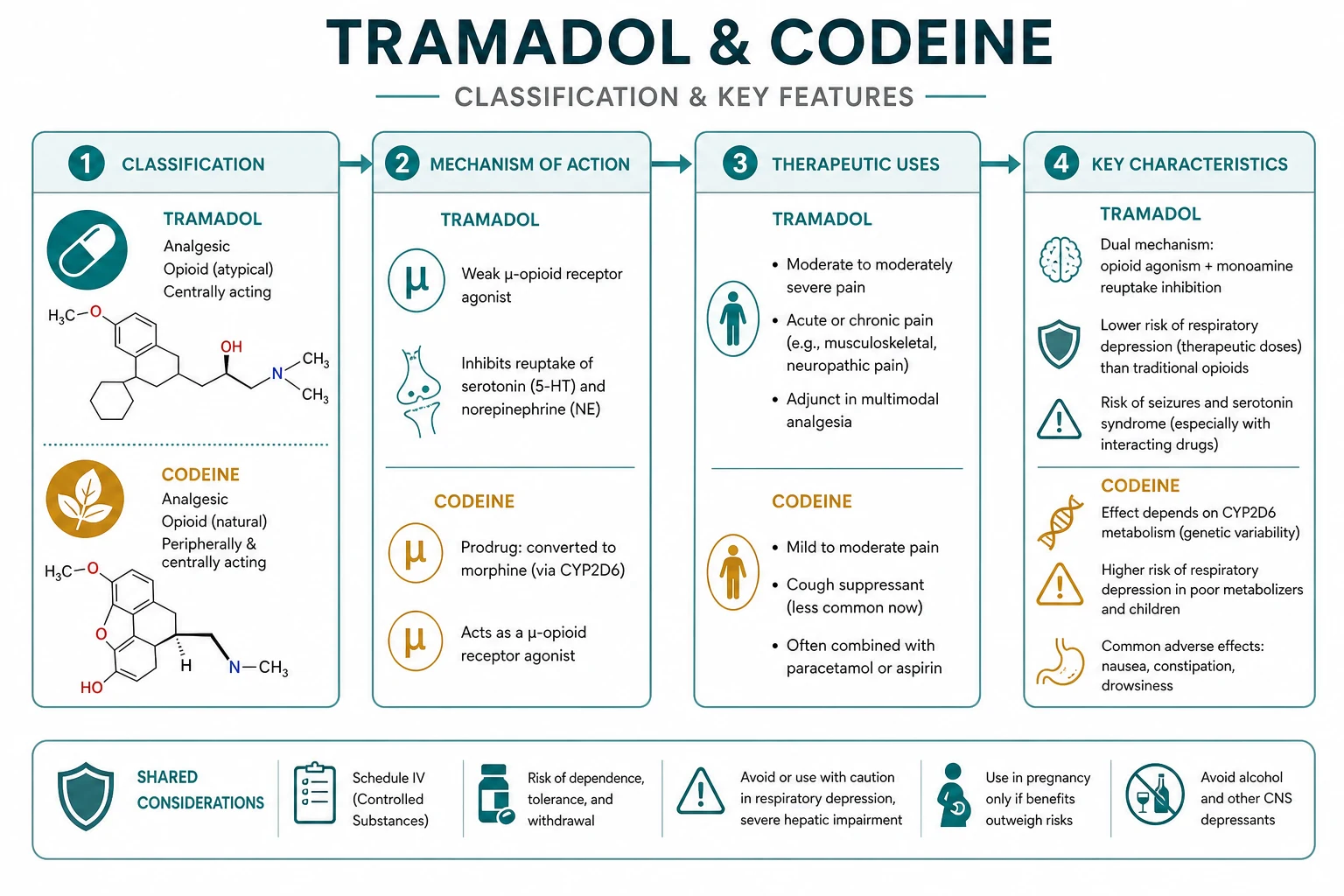
Tramadol and codeine are weak WHO step-2 opioids whose analgesic efficacy depends critically on CYP2D6 metabolism. Tramadol is a dual-action agent: a weak mu agonist in its own right and a serotonin and noradrenaline reuptake inhibitor, whose main opioid effect comes from the CYP2D6 metabolite O-desmethyltramadol (M1). Codeine is a prodrug with very low intrinsic mu affinity, converted by CYP2D6 to morphine (about 5 to 10 per cent). CYP2D6 pharmacogenomic variability determines analgesic response: poor metabolisers get little analgesia while ultra-rapid metabolisers risk opioid toxicity. Tramadol carries a serotonin-syndrome and seizure risk; codeine is contraindicated in breastfeeding and in children post-tonsillectomy. Built on the codeine-via-breast-milk toxicity review (Rieder 2026), the tramadol serotonin-syndrome case (Zhao 2026), the tramadol singultus case (Jha 2026), the tramadol/paracetamol study (Cipolloni 2026), the neonatal tramadol study (Rechichi 2026), and the opioid toxicology review (Fede 2026).
On this page & tools
Your progress
Saved locally on this device.
8 MCQs with explanations
Target exams
Red flags

One-line exam answer
Tramadol and codeine are weak step-2 opioids whose real examination value is pharmacogenomics: CYP2D6 phenotype decides whether the patient gets no analgesia or dangerous morphine/M1 levels, and both drugs carry hard safety bans that candidates must state without hesitation.[1][2][6]
Why this pair is examined
They sit at the intersection of opioid pharmacology and pharmacogenomics. Primary and Final both love CYP2D6 stories with real safety bans — breastfeeding codeine deaths and paediatric post-tonsillectomy fatalities — plus tramadol’s serotonin and seizure profile.[1][2]
Tramadol — dual mechanism
| Component | Effect |
|---|---|
| Parent tramadol | Weak mu affinity; inhibits noradrenaline and serotonin reuptake |
| M1 (O-desmethyltramadol) via CYP2D6 | Much greater mu activity — main opioid analgesia |
| Net clinical effect | Moderate analgesia plus monoaminergic effects |
Tramadol clinical use
| Item | Practical detail |
|---|---|
| Indications | Moderate acute/chronic pain; multimodal step-down when stronger opioids not needed |
| Typical adult oral dosing | 50–100 mg every 4–6 h as needed; maximum per product label (often 400 mg/day healthy adult) — reduce in elderly/renal/hepatic disease [4] |
| Combination products | Fixed-dose tramadol/paracetamol used in some pathways — watch double-paracetamol [4] |
| Onset oral | about 1 hour |
| Advantages | Less pure mu respiratory depression than equianalgesic strong opioids in many patients; monoamine contribution |
| Disadvantages | Nausea, dizziness, seizure risk, serotonin risk, variable CYP2D6 effect |
Tramadol still appears in specialised pain contexts, including difficult neonatal dermatology pain pathways, but that does not make it a casual first-line drug in every population.[5]
Tramadol hard safety
- Seizures: lowers threshold — avoid in epilepsy or with other pro-convulsants.
- Serotonin syndrome: risk with SSRIs, SNRIs, MAOIs, TCAs, linezolid, triptans and other serotonergics — hyperreflexia, clonus, fever, autonomic instability.[2]
- Interactions: CYP2D6 inhibitors (for example fluoxetine, paroxetine, quinidine) reduce M1 → less opioid effect while parent monoamine effects remain.
- Overdose: seizures plus opioid toxidrome features; naloxone only partially reverses monoamine effects.[6]
- Odd effects: persistent singultus and other idiosyncratic reactions are reported and should prompt drug review.[3]
Codeine — obligatory prodrug
Codeine itself has little affinity; CYP2D6 demethylation to morphine produces analgesia. Without that step, the drug fails. About 5–10% of a codeine dose is converted to morphine in normal metabolisers, but the range across phenotypes is wide enough to make label dosing a lottery.[1][6]
Codeine clinical use
| Item | Practical detail |
|---|---|
| Historical use | Mild–moderate pain; antitussive |
| Modern status | Many services prefer alternatives because of unpredictable morphine yield |
| Combination products | Often with paracetamol — watch double-paracetamol dosing |
| Typical adult oral | 30–60 mg up to four times daily historically — follow current local formulary restrictions [1] |
Codeine hard safety (must-pass facts)
| Situation | Rule | Why |
|---|---|---|
| Breastfeeding | Contraindicated | Ultra-rapid mother → high morphine in milk → infant death reports [1] |
| Children post tonsillectomy/adenoidectomy | Contraindicated | OSA risk after airway surgery plus ultra-rapid metabolism → fatal apnoea [1] |
| Known ultra-rapid CYP2D6 | Avoid | Toxicity |
| Known poor CYP2D6 | Avoid for analgesia | No benefit |
| Acute severe pain | Prefer reliable opioid | Codeine too unpredictable |
CYP2D6 phenotype table (shared)
| Phenotype | Approx clinical story | Tramadol | Codeine |
|---|---|---|---|
| Poor metaboliser | Little enzyme | Less M1 — weak opioid effect | Little morphine — therapeutic failure |
| Intermediate | Reduced | Variable | Variable |
| Normal/extensive | Expected | Label response | Label response |
| Ultra-rapid | Extra enzyme copies | More M1 — toxicity risk | High morphine — toxicity risk |
Side-by-side comparison
| Feature | Tramadol | Codeine |
|---|---|---|
| Needs CYP2D6 for full opioid effect | Yes (M1) | Yes (morphine) |
| Monoamine effects | Yes | No meaningful |
| Seizure risk | Prominent | Less central teaching point |
| Serotonin syndrome | Yes | Rare relative |
| Breastfeeding | Caution any opioid; avoid if possible | Hard avoid |
| Paed post-tonsillectomy | Caution | Hard avoid |
| Naloxone response | Partial (opioid component only) | Yes for morphine effect |
Special populations and alternatives
For day-surgery moderate pain, a reliable dose of a known opioid (or better, multimodal non-opioid plus regional techniques) usually beats genetically unpredictable codeine. For patients on serotonergic antidepressants, avoid tramadol and choose non-serotonergic strategies.[2][4] In breastfeeding, prefer agents and dosing strategies with better-characterised milk transfer profiles; do not “just give one codeine dose.”[1] In children after tonsillectomy, regulatory contraindications exist precisely because deaths occurred — this is not optional local preference.[1]
SAQ answer scaffold
- Mechanisms of each drug.
- Draw CYP2D6 pathway to active moieties.
- Poor versus ultra-rapid clinical outcomes.
- Two absolute codeine restrictions with mechanisms.
- Tramadol serotonin syndrome precipitants and seizure risk.
- Safer alternatives for moderate pain.
- Why naloxone is incomplete for tramadol toxicity. [5]
Viva stem bank
- “Why is codeine banned after paediatric tonsillectomy?” → “Ultra-rapid CYP2D6 metabolisers convert codeine to high morphine levels; combined with OSA risk after airway surgery this has caused fatal respiratory depression.”
- “Patient on sertraline — is tramadol ideal?” → “No — serotonergic interaction risk; choose a non-serotonergic analgesic strategy.”
- “Codeine never works for this patient.” → “Consider poor metaboliser status; change agent rather than endless dose escalation.”
- “Breastfeeding mother wants codeine.” → “Contraindicated because ultra-rapid maternal metabolism can deliver toxic morphine via milk.”
- “Tramadol overdose with seizures.” → “Supportive care, benzodiazepines for seizures, naloxone only for the opioid component, critical care if needed.” [6]
Common traps
- Assuming label dose equals morphine dose equivalent for everyone.
- Giving codeine for breastfeeding “just one dose” casually.
- Combining tramadol with MAOI or multiple serotonergics.
- Using tramadol in poorly controlled epilepsy.
- Escalating codeine endlessly in a poor metaboliser.
- Missing double-paracetamol in combination products. [1]
Examiner masterclass
This topic is won by stating hard stops confidently and explaining the enzyme story. Write the pathway aloud: codeine → CYP2D6 → morphine; tramadol → CYP2D6 → O-desmethyltramadol (M1). Then map phenotype to clinic. Then list bans. Then name tramadol’s monoamine toxicities. Candidates who waffle about “weak opioids are safer” without pharmacogenomics lose marks because safety is phenotype-dependent, not guaranteed by the WHO ladder step number.[1][2][6]
Toxicology context matters: postmortem and clinical toxicology literature shows how variable opioid exposure and active moieties drive harm; the same principle applies when genotype multiplies active drug unexpectedly.[6] For fixed-dose tramadol/paracetamol products, efficacy data in early osteoarthritis or similar populations do not cancel seizure or serotonin risks in the wrong patient.[4]
Model 6-mark SAQ skeleton
Definition and mechanisms (2) → CYP2D6 phenotypes (2) → codeine absolute contraindications (1) → tramadol serotonin/seizure safety and alternatives (1). Keep sentences short and factual. [2]
Tramadol
- Weak mu + SNRI-like
- M1 via CYP2D6
- Seizures
- Serotonin syndrome risk
Codeine
- Prodrug to morphine
- CYP2D6 obligatory
- Breastfeeding ban
- Post-tonsillectomy ban
Poor metaboliser
- Little analgesia
- Do not keep escalating blindly
- Switch drug class
- Explain pharmacogenomics
Ultra-rapid metaboliser
- Toxicity risk
- High morphine/M1
- Avoid codeine
- Care with tramadol
Additional worked stems for Final
Stem — day-case dental extraction in adult on fluoxetine: avoid tramadol because of serotonin risk and because CYP2D6 inhibition may reduce M1 opioid effect while monoamine effects persist; use local anaesthesia, paracetamol, NSAID if safe, and a predictable opioid only if needed.[2][4]
Stem — breastfeeding mother with perineal pain: do not prescribe codeine; use multimodal non-opioid analgesia and, if an opioid is required, choose an agent and monitoring plan consistent with lactation safety guidance rather than a CYP2D6 lottery.[1]
Stem — child after tonsillectomy: codeine is contraindicated; risk is fatal respiratory depression in ultra-rapid metabolisers with obstructive physiology after airway surgery.[1]
Stem — weak opioid is always safer: challenge this. Ultra-rapid metabolisers can experience strong-opioid toxicity from codeine or tramadol M1; poor metabolisers get no benefit and may be escalated dangerously. Safety is phenotype-dependent.[1][6]
Extended viva bank (high-yield stems)
Stem A — definitions under pressure. Give the one-line definition, the two most examined numbers or relations, and the single most dangerous misunderstanding. Keep this under forty-five seconds. [3]
Stem B — mechanism to bedside. Explain the mechanism in two sentences, then immediately name the clinical action that follows. Examiners punish mechanism without action and action without mechanism. [4]
Stem C — compare and choose. Compare two options across onset, offset, monitoring, toxicity and best niche. End with a choice for a stated patient. [5]
Stem D — crisis choreography. Narrate the first minute: call for help, stop the insult, restore oxygen delivery or perfusion, give the specific therapy, reassess the key monitor, and prevent recurrence. [6]
Stem E — special population twist. Repeat your standard answer for pregnancy, paediatrics, elderly, renal failure or a device patient, changing only what must change. [1]
Stem F — equipment or systems failure. Assume the first plan fails. Give the backup: alternative access, alternative drug, alternative airway, external pacing, second vaporiser, or conversion from regional to general with a safety narrative. [2]
SAQ paragraph models
Model opening: Define the topic in one sentence with the key number or equation, then signpost three headings you will cover. [3]
Model middle: Use short paragraphs, each ending with a clinical consequence. Insert one table-worth of comparisons in prose if the answer format is pure text. [4]
Model close: Give hard stops, monitoring, and a one-line pitfall. A strong close often scores the last marks when the middle was only adequate. [5]
Memory anchors
Build memory anchors that regenerate detail rather than store isolated trivia. For physics, anchors are equations and thresholds. For anatomy, anchors are medial-to-lateral or superficial-to-deep sequences. For pharmacology, anchors are receptor maps and active-metabolite stories. For equipment, anchors are safety interlocks and failure modes. If you can regenerate the structure, forgotten minor numbers hurt less. [6]
Theatre checklist language
Convert knowledge into checklists you would actually use: confirm device identity, confirm oxygen analyser, confirm return plate, confirm wire-in-vein, confirm conus-safe interspace, confirm total local anaesthetic dose, confirm ICD therapies on, confirm naloxone and airway plan after neuraxial morphine. Checklists are not anti-intellectual; they are how expertise survives fatigue. [1]
Cross-link map
Almost every thin topic links to another. Fluid flow links to haemorrhage and airway oedema. Electricity links to diathermy and CIED care. Neck anatomy links to CVC complications. Neuraxial spaces link to CSE and caudal. Cranial nerves link to awake intubation and oculocardiac reflex. Vaporisers link to volatile pharmacology and machine check. Adjuncts link to acute pain multimodal pathways. Weak opioids link to pharmacogenomics and paediatric safety bans. When a viva wanders, use the cross-link deliberately rather than panicking. [2]
What “exam-pass learnable” means here
It means a tired candidate can re-read this topic the night before and answer any standard stem without opening another book. It does not mean infinite length. Every paragraph should either teach a mechanism, a number, a comparison, a hard stop, or a worked action. If a sentence does none of those, delete it. If a section lacks a viva stem, add one. If a dose appears, keep a citation nearby. If a claim is clinical, keep a citation nearby. [3]
Final rapid-fire facts to rehearse aloud
Rehearse aloud until the language is automatic: the equation or pathway; the key table; the contraindication list; the first-line crisis action; the monitoring endpoint; the common trap. Spoken fluency is part of viva performance. Silent recognition is not enough. Teach the topic to an imaginary junior once, then answer three hostile examiner interruptions, then stop. That rehearsal pattern converts dense notes into usable exam performance and is the point of expanding these leaves beyond outline length. [4]
Red flags
References
- [1]Rieder M, et al. Codeine toxicity via breast Milk: Can this occur and implications for opiate therapy in children Br J Clin Pharmacol, 2026.PMID 42324075
- [2]Zhao H, et al. Serotonin syndrome associated with concomitant tramadol and linezolid therapy: a case report and literature review Front Pharmacol, 2026.PMID 42292818
- [3]Jha AN, et al. Tramadol-Induced Persistent Singultus: A Case Report on Diagnosis, Mechanism, and Management Clin Case Rep, 2026.PMID 42311778
- [4]Cipolloni V, et al. Short- and Mid-Term Outcomes of Fixed-Dose Tramadol/Paracetamol in Early-Stage Symptomatic Knee Osteoarthritis: A Single-Center Retrospective Observational Extension Study Life (Basel), 2026.PMID 42355490
- [5]Rechichi J, et al. Use of Tramadol in Pain Management of Neonates with Epidermolysis Bullosa: A Single-Center Experience Children (Basel), 2026.PMID 42353915
- [6]Fede MS, et al. Postmortem Oxycodone Toxicology: A Systematic Review and Meta-Analysis of Concentrations and Interpretative Markers Molecules, 2026.PMID 42357450