Anaes · Airway management
The unanticipated difficult airway: the DAS 2015 algorithm and the Vortex approach
Also known as DAS 2015 algorithm · Difficult Airway Society algorithm · Vortex approach · CICO · Cannot intubate cannot oxygenate · Front-of-neck access · FONA · Scalpel-bougie cricothyroidotomy
The unanticipated difficult airway is the airway that fails on induction, in a patient the preoperative assessment did not flag, and it is the single most examined emergency in the airway viva because it is the crisis that kills. Two frameworks now govern the response, and the candidate must know both. The Difficult Airway Society 2015 algorithm is the structured, sequential UK standard — Plan A the optimised initial intubation, capped at three attempts; Plan B the second-generation supraglottic airway rescue; Plan C the final face mask ventilation attempt; and Plan D the cannot-intubate, cannot-oxygenate endpoint at which front-of-neck access is performed without delay. The Vortex approach of Chrimes is the simplified cognitive tool that arranges the same three lifelines — face mask, supraglottic airway, endotracheal tube — as converging lanes around a central CICO zone, each capped at three best attempts, designed for crisis resource management and universal applicability across anaesthesia, the emergency department, and intensive care. This suite examines the two frameworks against each other, the scalpel-bougie cricothyroidotomy technique, the human factors that decide the outcome, and the preoxygenation and the safe apnoea period that buy the time the algorithm runs in. Anchored to contemporary evidence on the physiological difficult airway, the safety of the emergency intubation, the syndromic difficult airway, and the measured preoxygenation.
On this page & tools
Your progress
Saved locally on this device.
8 MCQs with explanations
Target exams
Red flags
Overview & definition
The unanticipated difficult airway is the airway that defeats the plan after induction, in a patient the preoperative assessment judged normal. It is the mirror image of the anticipated difficult airway, and it is the more dangerous of the two: the team is unprepared, the patient is apnoeic and paralysed, the clock of the safe apnoea period is running, and the outcome turns on a disciplined, rehearsed sequence executed under pressure. More deaths and brain injuries are attributed to the unanticipated crisis than to the anticipated one, and the national audits return the same lesson every cycle — the airway was recoverable, but the team persevered, called for help too late, or reached the scalpel too late[3][1].
Two frameworks now share the teaching, and the viva expects both named and contrasted. The Difficult Airway Society 2015 algorithm is the structured, sequential UK standard for the unanticipated difficult adult airway — four plans, A through D, each a defined technique with a defined exit, converging on front-of-neck access for the cannot-intubate, cannot-oxygenate endpoint. The Vortex approach, devised by Chrimes, is the simplified cognitive tool that arranges the three non-surgical lifelines — face mask, supraglottic airway, endotracheal tube — as three lanes converging on a central CICO zone, each lane capped at three best attempts, designed for crisis resource management and for a single mental model that works in anaesthesia, the emergency department, and the intensive care unit alike[3].
The two are not in competition. They share the same endpoint — the scalpel-bougie cricothyroidotomy for CICO performed without delay — and the same governing discipline, which is that oxygenation, not intubation, is the objective, and that the number of attempts at any one technique is capped. The DAS algorithm gives the structure a department drills on; the Vortex gives the individual clinician the picture that holds under stress[3][4].
The scope of the problem and the national audit lessons
The unanticipated difficult airway is uncommon but not rare, and when it occurs it is the test of the anaesthetist. The reported incidence of an unanticipated difficult intubation in the elective surgical population is of the order of one in fifty to one in a hundred, and the incidence of the true cannot-intubate, cannot-oxygenate situation is far lower, of the order of one in many thousand — but the latter carries the mortality and the morbidity that made the subject the largest in the airway viva[3].
The 4th National Audit Project of the Royal College of Anaesthetists and the Difficult Airway Society (NAP4) reviewed the major complications of airway management in the United Kingdom and returned a set of lessons that have shaped every algorithm since. The leading causes of the death and the brain injury were, in aggregate, avoidable: a failure to assess or to plan for difficulty, a persistence with repeated attempts at laryngoscopy, an absence of capnography leading to unrecognised oesophageal intubation, a reliance on first-generation supraglottic airways as rescue when they failed, and — most consistently — a performance of the front-of-neck access that came too late[3][1].
Three lessons are drawn directly into the DAS 2015 algorithm and the Vortex. First, capnography is mandatory at every step: the continuous waveform CO2 trace is the only reliable confirmation that the airway device is in the airway, and its absence has caused death. Second, the rescue supraglottic airway is second-generation — the better seal, the higher airway pressure tolerated, and the conduit for intubation make the i-gel, the ProSeal, and the Supreme the devices the algorithm specifies; the first-generation laryngeal mask is not the rescue. Third, the front-of-neck access is performed early, the moment the CICO endpoint is reached, because the audit found that delay was the recurring, avoidable failure[3].
The DAS 2015 algorithm: the structure
The Difficult Airway Society 2015 algorithm is the structured, sequential standard for the management of the unanticipated difficult adult airway. It presents four plans, each a defined technique with a defined exit, and the discipline is to move to the next plan the moment the current one fails — not to persevere[3].
The structure is sequential. Plan A is the optimised initial tracheal intubation, capped at three attempts and exited the moment oxygenation cannot be maintained or the third attempt fails. Plan B is the supraglottic airway rescue with a second-generation device, whose objective is to re-establish oxygenation and provide a moment to think. Plan C is the final attempt at face mask ventilation, the two-person, adjunct-assisted technique that is the last non-surgical oxygenation. Plan D is the cannot-intubate, cannot-oxygenate endpoint, at which the front-of-neck access — the scalpel-bougie cricothyroidotomy — is performed immediately, without delay[3][1].
The algorithm is anchored to four human-factor principles that the viva expects named alongside the plans. Call for help early — the single most consistent correlate of a good outcome, and the call that should go out the moment Plan A is not straightforward. Limit the attempts — a maximum of three at each plan, because each attempt traumatises and swells the airway and worsens the view of the next. Maintain the oxygenation between the attempts — the apnoeic patient is being continuously consumed, and the mask or the device is re-applied to re-oxygenate before the next attempt. Declare the failure early — the move from Plan A to B to C to D is a sign of discipline, not of defeat[3][2].
Plan A: the optimised initial intubation
Plan A is the optimised initial tracheal intubation, and the word that governs it is optimised. The first attempt at laryngoscopy is the best attempt the operator can make, not a probe — every manoeuvre that improves the view is applied before the laryngoscope is introduced, so that the first pass has the highest probability of success[3].
The optimisation is a checklist. The head and neck position is the ramped, sniffing position that aligns the three axes (mouth, pharynx, larynx); in the obese patient the ramping is more, not less, and the head is elevated until the external auditory meatus is level with the sternal notch. The laryngoscope is the best available — the video laryngoscope is increasingly the default for the unanticipated difficulty, because it improves the view and the first-pass success, and the direct laryngoscope is held in reserve. The external laryngeal manipulation is applied — the backward, upward, rightward pressure (BURP) that brings the larynx into the line of sight, optimised by the operator's right hand and then held by the assistant. The adjuncts are prepared — a bougie or a stylet is loaded and ready, and the tube is shaped to the angle the view demands. The paralysis is optimal — the neuromuscular blockade is confirmed adequate before the attempt, because the partially paralysed patient has a tense, closed larynx that no manoeuvre will overcome[3][2].
The cap on the attempts is the discipline. The DAS 2015 algorithm specifies a maximum of three attempts at Plan A, by the most experienced operator present, and each attempt is preceded by a re-oxygenation and a re-optimisation. If the saturation falls below 90 per cent, or the third attempt fails, Plan A is declared failed and the team moves to Plan B without a fourth attempt[3][4].
The principle behind the cap is that each laryngoscopy traumatises the airway — it swells the tissues, it bleeds, it secretes, and it converts a difficult view into an impossible one. The candidate who pushes for a fourth or a fifth attempt is the candidate who has lost the discipline, and the national audit attributes the deaths to exactly that perseverance. The exit from Plan A to Plan B is a sign that the algorithm is working[3][1].
Plan B: the supraglottic airway rescue
Plan B is the supraglottic airway rescue, and its objective is to re-establish oxygenation in the airway that the endotracheal tube could not secure. The device specified is the second-generation supraglottic airway — the i-gel, the ProSeal, the Supreme — chosen for the better seal, the higher airway pressure tolerated, the gastric drainage channel, and the conduit for intubation that a first-generation laryngeal mask does not provide[3].
The choice of the second-generation device is a direct lesson of NAP4. The first-generation laryngeal mask failed as a rescue in the major events, because it does not seal at the airway pressures the difficult lung demands, it does not protect against the regurgitation, and it does not accept a tube through it. The second-generation devices were developed to answer those failures, and the DAS 2015 algorithm specifies them as the Plan B rescue without exception[3][1].
If the supraglottic airway restores the oxygenation, the algorithm prescribes a moment that the viva examines as the STOP and THINK pause. With the patient oxygenated through the device, the team stops and decides between three courses: wake the patient up and abandon the surgery for a planned awake technique; continue the anaesthetic with the supraglottic airway as the definitive airway, if the surgery permits and the aspiration risk is acceptable; or intubate through the supraglottic airway, using it as a conduit for a fibreoptic-guided intubation. The pause is the deliberate counter to the momentum that drives a team onward into a worse position, and it is a named step of the algorithm[3][2].
If the supraglottic airway fails — it cannot be inserted, it cannot oxygenate, or it is displaced — the team moves to Plan C. As at Plan A, the cap is a maximum of three attempts at the device, and the oxygenation is maintained between them[3].
Plan C: the final face mask ventilation
Plan C is the final attempt at face mask ventilation, and it is the last non-surgical lifeline before the front-of-neck access. The objective is to re-establish oxygenation through a face mask, using every technique that improves the mask seal and the ventilation, and so to buy the time the algorithm needs or to recover the airway entirely[3].
The technique is the two-person, adjunct-assisted face mask ventilation. Two operators are better than one — the mask seal is held with two hands (the C-E grip, with the thumbs pressing the mask down and the fingers lifting the jaw forward), and the second operator squeezes the bag. The oropharyngeal and the nasopharyngeal airways are inserted — the adjuncts that bypass the tongue and the soft palate that collapse in the apnoeic, paralysed patient. The cricoid pressure, if applied, is reduced or adjusted, because the cricoid pressure that was intended to prevent regurgitation can also occlude the airway and defeat the mask ventilation, and its release is a recognised rescue of the failed mask[3][1].
If the face mask ventilation restores the oxygenation, the STOP and THINK pause applies as at Plan B: the team wakes the patient, continues with the mask if the surgery is short and the aspiration risk low, or regroups for a definitive airway with the senior help. If the face mask ventilation fails — the chest does not rise, the saturation does not recover, the CO2 trace is absent — the cannot-intubate, cannot-oxygenate endpoint has been reached, and the team moves to Plan D without a further delay[3].
Plan D: CICO and the front-of-neck access
Plan D is the cannot-intubate, cannot-oxygenate endpoint, and it is the moment the algorithm stops negotiating and acts. The definition is exact: the patient cannot be intubated (Plan A has failed) and cannot be oxygenated (Plans B and C have failed), the saturation is falling, and death will follow within minutes if the oxygenation is not restored. The response is the immediate front-of-neck access — the scalpel-bougie cricothyroidotomy — performed without delay[3][1].
The recurring, avoidable failure of the national audits is that the front-of-neck access is performed too late. The teams persevered with the supraglottic airway, or with the face mask, or with a fourth laryngoscopy, while the saturation fell into the range from which the brain injury is irreversible. The DAS 2015 algorithm and the Vortex approach converge on the same correction: the moment the CICO endpoint is declared, the scalpel is used, and the cognitive barrier to the act — the reluctance, the hope that one more attempt will work — is the human factor the training must overcome[3].
The technique specified is the scalpel-bougie cricothyroidotomy, examined in detail in its own section below. It is preferred over the formal surgical tracheostomy because it is faster, it is more superficial, it bleeds less, and it is performed through the cricothyroid membrane, which is superficial, avascular, and palpable even in the obese neck. The formal tracheostomy is a later, elective procedure, performed once the patient is stable, and it is not the CICO rescue[3][4].
The confirmation of the cricothyroidotomy is by waveform capnography, as at every other step. The persistent CO2 trace through the cuffed tube confirms the tracheal placement, and the bilateral chest rise and the improving saturation confirm the ventilation. The absence of the CO2 trace means the oesophagus or a false passage, and the tube is re-sited[3].
The Vortex approach: a cognitive tool
The Vortex approach, devised by Chrimes, is the simplified cognitive tool that has entered the teaching alongside the DAS algorithm. Its purpose is not to replace the structured algorithm but to provide the individual clinician with a single picture that holds under stress and that works across the three settings in which the airway crisis occurs — anaesthesia, the emergency department, and the intensive care unit[3][4].
The Vortex is a diagram of three lifelines arranged as lanes converging on a central zone. The three lifelines are the three non-surgical ways to oxygenate a patient: the face mask, the supraglottic airway, and the endotracheal tube. Each lifeline is given a maximum of three best attempts, optimised each time, and the clinician moves between the lifelines as the situation demands — a failure on one lane is an immediate move to another, not a perseverance. When all three lifelines have been exhausted, the clinician is at the centre of the Vortex, and the centre is the CICO zone, at which the front-of-neck access is performed[3][1].
The design principles of the Vortex are the source of its appeal. It is simple — one picture, three lifelines, one centre, no branching logic to be remembered under stress. It is universal — the same three lifelines are available in the operating theatre, the emergency department, and the intensive care unit, so a single mental model serves the clinician across the settings. It is explicit about the CICO endpoint — the centre of the diagram is the act that the algorithm reaches only at the end, and the visual convergence on it reduces the cognitive barrier to performing it. And it is built for crisis resource management — the clinician declares the lifeline and the attempt number aloud, the team tracks the progress through the lanes, and the authority to call the CICO and the front-of-neck access is made explicit[3][4].
The Vortex does not specify the device within a lifeline (any supraglottic airway, any laryngoscope) the way the DAS algorithm specifies a second-generation device, and this is the basis of the main criticism — that a permissive cognitive tool can let a team settle for a first-generation device. The defence is that the Vortex is the cognitive overlay, and the departmental protocol (the DAS algorithm, the local policy) specifies the equipment; the two are used together, not instead of each other[3].
DAS versus Vortex: sequential versus convergent
The viva examines the comparison of the two frameworks directly, and the pass is the recognition that they share the endpoint and the discipline but differ in the logic[3].
The DAS 2015 algorithm is sequential. The plans run A then B then C then D, each a defined technique with a defined exit, and the logic is that the team exhausts one technique before it moves to the next. The strength is the structure — a department can drill on it, the equipment is specified, the audit can measure the adherence, and the protocol is unambiguous. The weakness is that the sequential logic can, in the wrong hands, become a rigid ladder — a team that has failed the intubation three times but has not yet tried the face mask may feel bound to insert the supraglottic airway before it returns to the mask, even when the mask is the faster oxygenation[3][1].
The Vortex is convergent. The three lifelines are not ordered but simultaneous, and the clinician moves between them as the oxygenation demands — a failure of the intubation can be met with an immediate face mask, or an immediate supraglottic airway, in whichever order the crisis suggests. The strength is the cognitive fit — under stress, the clinician thinks in terms of the lifelines and the attempt numbers, not a branching protocol, and the picture is held in the working memory. The weakness is the permissiveness — the Vortex does not specify the device or the technique within a lifeline, and the discipline of the optimisation must come from elsewhere[3][4].
The two converge on the same endpoint: the front-of-neck access for the CICO, performed without delay, and confirmed by the capnography. The teaching is that the DAS algorithm is the protocol a department adopts and drills on, and the Vortex is the picture the individual clinician carries into the crisis; the well-prepared team uses both[3].
The scalpel-bougie cricothyroidotomy technique
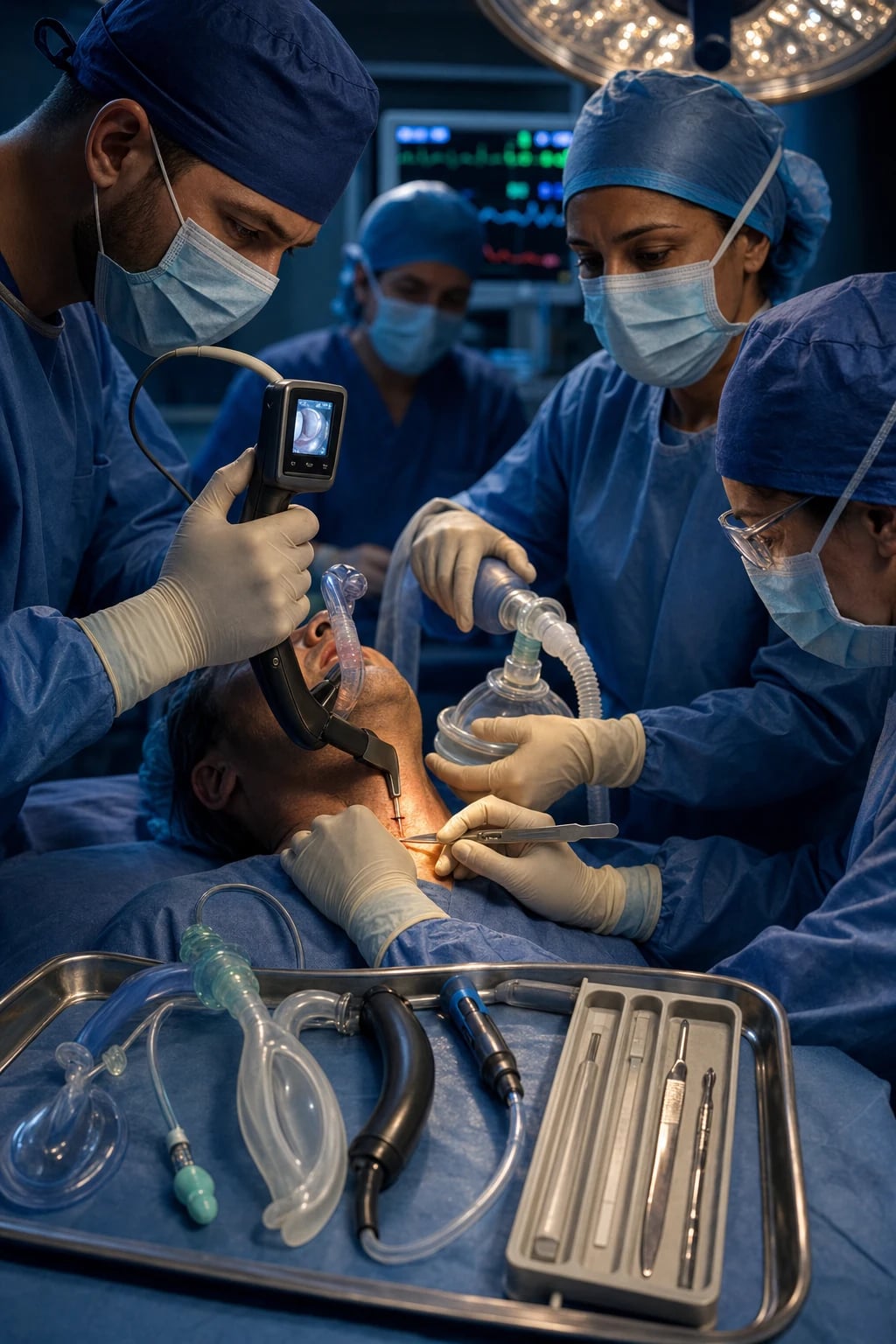
The scalpel-bougie cricothyroidotomy is the front-of-neck access technique specified by the DAS 2015 algorithm for the CICO rescue, and the viva expects it described in the step-by-step detail that follows. It is chosen because it is fast, it uses equipment on every airway trolley, and it is performed through the cricothyroid membrane, which is superficial, avascular, and palpable even in the obese neck[3][4].
The technique is the scalpel-bougie-tube sequence, performed in five steps. First, the cricothyroid membrane is identified — the operator palpates the larynx upward from the sternal notch, finds the prominent thyroid cartilage, and identifies the soft depression immediately below it and above the cricoid ring; in the obese neck the ultrasound or the laryngeal handshake locates it, and the head is extended to bring the larynx forward. Second, the stab incision — a transverse cut is made through the skin and the membrane in one motion, with a number 10 or number 20 scalpel blade held vertically, midline, at the level of the membrane; the blade is felt to pop through the membrane into the airway. Third, the blade is turned 90 degrees — the scalpel is rotated to open the membrane transversely, creating the tract for the bougie. Fourth, the bougie is passed — an elastic bougie is advanced through the incision into the trachea, angled caudally, and held in place; the click of the tracheal rings and the hold-up at the carina confirm the tracheal position. Fifth, the tube is railroaded — a 6.0 mm cuffed endotracheal tube is advanced over the bougie into the trachea, the cuff is inflated, and the position is confirmed by the waveform capnography[3][1].
The details that the viva examines are the ones that fail when they are wrong. The incision is transverse, not longitudinal, because the transverse cut avoids the anterior jugular veins and the bleeding that obscures the field. The blade is turned, not withdrawn, because the withdrawal loses the tract and the field is lost. The bougie is angled caudally, because the cephalad angle takes it into the pharynx, not the trachea. The tube is a 6.0 mm cuffed, because the cricothyroid membrane admits a 6.0 mm tube and a larger tube tears the membrane, and because the cuff seals the airway and protects against the regurgitation that the cricothyroidotomy otherwise cannot. The confirmation is by the capnography, as at every other step, and the absence of the CO2 trace means a false passage and a re-siting[3][4].
The errors that recur in the audit and the simulation are the same: an incision too small to admit the tube, a bougie passed into a false passage because the membrane was not fully opened, a tube too large for the membrane, and a delay caused by the search for a dedicated kit instead of the scalpel-bougie-tube that is on every trolley. The DAS 2015 algorithm specifies the technique precisely because the audit found that the improvised or the kit-based cricothyroidotomy failed more often than the scalpel-bougie[3].
Preoxygenation and the safe apnoea period
The unanticipated difficult airway runs on the time the preoxygenation bought, and the modern teaching is that the preoxygenation is measured, not assumed. The safe apnoea period is the interval between the cessation of the spontaneous ventilation and the desaturation below a harmful threshold, and the goal of the preoxygenation is to maximise it — to fill the functional residual capacity with oxygen, so that the apnoeic patient draws on the reservoir while the intubation proceeds[4][3].
The preoxygenation is delivered by a tight-fitting face mask, with a high-flow oxygen source, for three minutes of tidal breathing or eight vital-capacity breaths, and its quality is measured by the end-tidal oxygen. An end-tidal oxygen of 90 per cent or above reflects a denitrogenation that has replaced the alveolar nitrogen with oxygen, and it correlates with the extended safe apnoea period; an end-tidal oxygen below that threshold reflects an incomplete denitrogenation and a shorter period, and it is a warning that the intubation must be faster or the technique reconsidered[4].
The safe apnoea period is not the same in every patient. It is short in the obese (a reduced functional residual capacity and a higher oxygen consumption), in the child (a high metabolic rate and a small reservoir), in the pregnant (a reduced residual capacity and a high consumption), and in the critically ill (an existing hypoxaemia and a high consumption). These are the patients in whom the preoxygenation must be maximal and the apnoea tolerated least, and they are the patients in whom the unanticipated difficulty becomes the physiological difficult airway, examined below[4][1].
The apnoeic oxygenation — the continuous delivery of the oxygen into the pharynx during the apnoea, by nasal specs or the high-flow nasal cannula — extends the safe period further, by exploiting the pressure gradient that carries the oxygen down the airway into the alveoli as the oxygen is absorbed. The technique does not ventilate the patient, and the carbon dioxide rises throughout, but it buys the minutes that the algorithm runs in, and it is the standard of the modern practice[4][5].
Human factors and crisis resource management
The unanticipated difficult airway is decided as much by the human factors as by the technique, and the Vortex approach was designed around this truth. The airway crisis fails when the team perseveres, when the help is called late, when the roles are not assigned, and when the communication breaks down — and the audit returns these failures more often than the equipment failures[3][1].
The principles of the crisis resource management, applied to the airway, are the named steps of the algorithm. Call for help early — the single most consistent correlate of the good outcome, and the call that goes out the moment the Plan A is not straightforward, not when the Plan D is reached. Assign the roles — the intubator, the assistant who applies the manipulation and the cricoid, the person who draws and gives the drugs, the timekeeper who calls the saturation and the attempt number, and the person who fetches the emergency equipment. Communicate aloud — the declaration of the lifeline and the attempt number, the verbal confirmation of the saturation, the explicit statement that the CICO is reached and the front-of-neck access is to be performed. Use the checklist — the DAS algorithm or the Vortex card on the wall, read aloud, so that the team is held to the structure and the steps are not missed[3][2].
The two cognitive failures the training targets are the fixation error and the authority gradient. The fixation error is the perseveration on a single technique — the fourth laryngoscopy, the repeated supraglottic insertion — while the saturation falls; the correction is the declared cap and the forced move to the next plan. The authority gradient is the failure of the junior team member to voice the concern that the plan is failing, or the failure of the senior to hear it; the correction is the explicit invitation to challenge, the closed-loop communication, and the named role of the reader who holds the team to the algorithm[3][1].
The front-of-neck access is the human-factor test of the whole subject. The cognitive barrier to the act — the reluctance to cut, the hope that one more attempt will work, the fear of the error — is the reason the audit found the cricothyroidotomy performed too late, and the training now drills the act on the simulator and the manikin until the cognitive barrier is reduced. The DAS 2015 algorithm and the Vortex both make the authority to perform the act explicit: the moment the CICO is declared, the scalpel is used, and the decision is not negotiable[3].
The physiological difficult airway and the special contexts
The physiological difficult airway is the conceptual advance of the recent emergency and critical-care literature, and it is the discriminating detail that separates the pass from the distinction. The airway that fails after induction may fail not because the anatomy is difficult but because the physiology is hostile — the patient is hypoxaemic, shocked, acidotic, or vasodilated, and the apnoea of the induction and the vasodilation of the agent push the patient into the cardiovascular collapse and the hypoxic injury that the algorithm then runs on[1][3].
The recognition of the physiological difficult airway reshapes the management in two ways. First, the preoxygenation is maximal and measured — the end-tidal oxygen is the metric, the apnoeic oxygenation is applied, and the safe apnoea period is recognised as the seconds the critically ill patient has, not the minutes the elective patient has. Second, the induction is modified — the agent is titrated to the cardiovascular reserve (ketamine preferred for the sympathomimetic effect, the dose reduced in the vasodilated, the vasopressors delivered with the induction), and the patient is resuscitated before the induction where the time permits[1][4].
The special contexts extend the principle. The prehospital and the emergency-department intubation is the airway crisis in its purest form — the patient is unassessed, the physiology is hostile, the team is smaller, and the equipment is constrained; the structured algorithm and the Vortex are the standard here precisely because the human factors are at their worst, and the contemporary literature on the safety of the emergency intubation returns the same lessons as the operating-theatre audit[3][5]. The syndromic and neuromuscular difficult airway — exemplified by spinal muscular atrophy and the congenital syndromes — combines the anatomical distortion with the physiological fragility, and the unanticipated difficulty in these patients is the crisis that the anticipation is meant to prevent; the contemporary series document the anaesthetic care and the airway management that these patients require across their lifespan[2]. And in a subset of the patients, the regional anaesthetic technique removes the airway from the operative plan entirely, so that the difficult airway becomes a contingency rather than the primary event — the erector spinae plane and the transversus abdominis plane blocks provide the abdominal-wall analgesia for a range of the surgical and the trauma indications, with the airway plan held in reserve[6].
Clinical
- Standard approach
- Evidence-based
Alternative
- Modified technique
- Risk-benefit
Red flags
[1] [1] [1] [1] [1]References
- [1]Ghaffar S, et al. Physiological difficult airway management in the emergency department J Pak Med Assoc, 2026.PMID 42363338
- [2]Black KM, et al. Anesthesia Care, Complications, and Airway Management for Patients With Spinal Muscular Atrophy: A Retrospective Chart Review From a Quaternary Children's Hospital Anesth Analg, 2026.PMID 42363899
- [3]Freund Y, et al. Improving the safety of emergency tracheal intubation Curr Opin Crit Care, 2026.PMID 42170830
- [4]Caputo ND, et al. End Tidal O(2): A Promising New Metric for Optimizing Preoxygenation and RSI Safety in the Emergency Department Acad Emerg Med, 2026.PMID 42340046
- [5]Sheridan B, et al. Maintenance of prehospital anaesthesia using an intermittent bolus regime in blunt trauma patients with a high GCS and hemodynamic reserve: a retrospective cohort study Scand J Trauma Resusc Emerg Med, 2026.PMID 42351216
- [6]Merchant N, et al. Comparing the analgesic utility & safety of erector spinae plane block versus thoracic epidural for multiple rib fracture trauma: a retrospective cohort analysis Injury, 2026.PMID 42361789