Anaes · Anaesthetic adjuncts
Vasopressin
Also known as Antidiuretic hormone (ADH) · Arginine vasopressin (AVP) · Non-adrenergic V1 peptide vasopressor · Catecholamine-sparing vasopressor
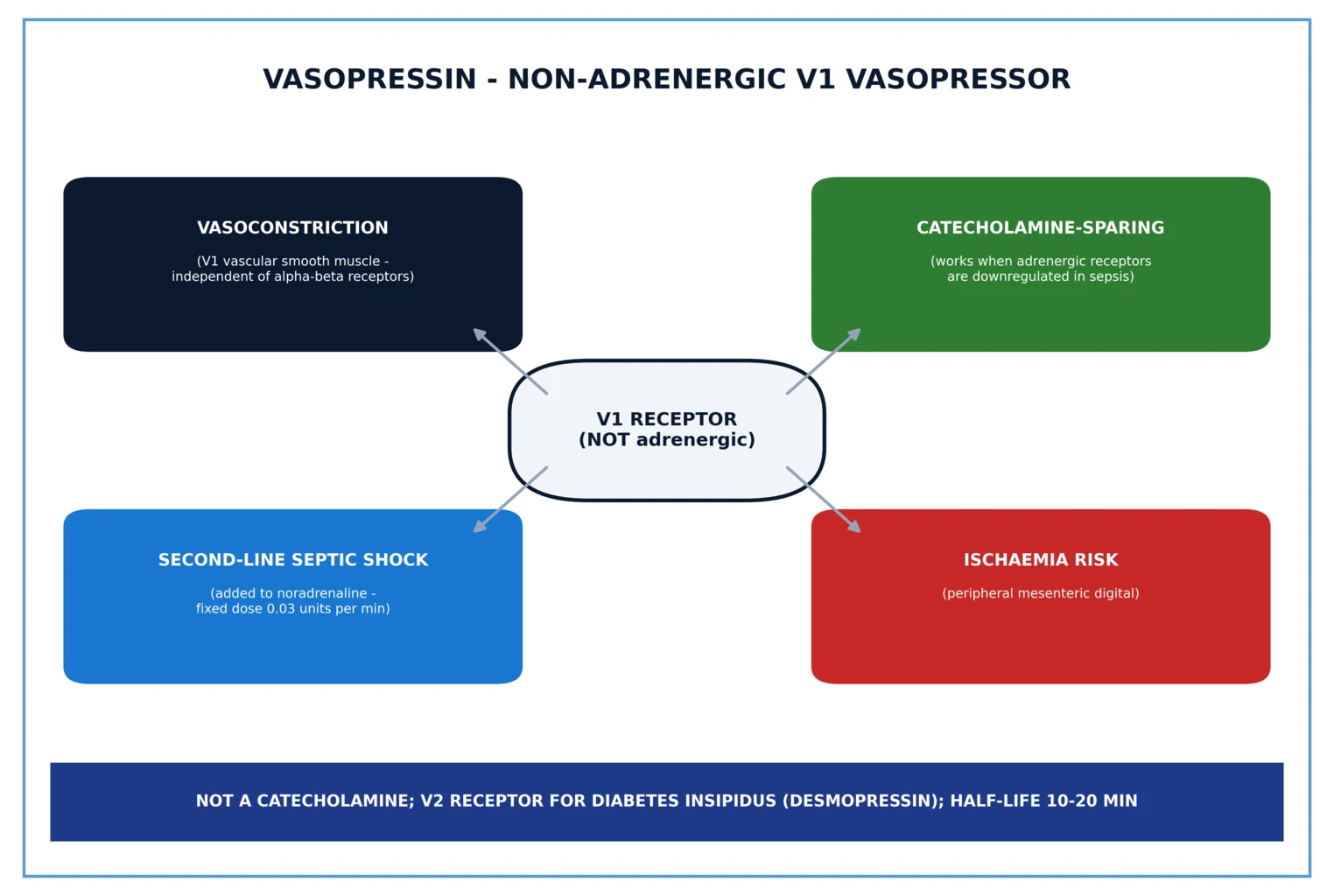
Vasopressin (antidiuretic hormone, ADH) is an endogenous PEPTIDE hormone released from the posterior pituitary that is fundamentally NOT a catecholamine — it acts through a completely separate, non-adrenergic receptor family. Its three receptors define its three actions: V1 (V1a) on vascular smooth muscle produces Gq-coupled vasoconstriction, V2 on the renal collecting duct produces Gs-coupled water reabsorption through aquaporin-2, and V3 (V1b) on the anterior pituitary drives ACTH release. As a vasopressor it works through V1 INDEPENDENT of adrenergic receptors, which is its defining advantage: it remains effective when adrenergic receptors are downregulated in septic shock and vasoplegia, the basis of its role as the catecholamine-sparing, catecholamine-resistant agent (Hiroto 2026, Dong 2026). The principal use is as a SECOND-LINE vasopressor in septic shock, added to noradrenaline when noradrenaline alone is insufficient — given at a FIXED dose of 0.03 to 0.04 units per min (NOT titrated to effect) and catecholamine-sparing, reducing the noradrenaline requirement (Hiroto 2026). Other uses are vasoplegia after cardiopulmonary bypass, variceal bleeding (splanchnic vasoconstriction), and — via its V2-selective synthetic analogue desmopressin (DDAVP) — central diabetes insipidus, haemophilia and von Willebrand disease (factor VIII and vWF release), and nocturnal enuresis (Yahya 2026, Parkinson 2026). It has a half-life of about 10 to 20 minutes, is metabolised by tissue peptidases in the liver and kidney, and is given by IV infusion. The adverse-effect profile is the direct consequence of V1 vasoconstriction (peripheral, digital and MESENTERIC ISCHAEMIA) plus V2 water retention (HYPONATRAEMIA at high or prolonged doses), with decreased cardiac output from increased afterload and reflex bradycardia. Against noradrenaline, vasopressin is non-adrenergic (no tachyarrhythmia, effective when adrenergic receptors are downregulated) where noradrenaline is alpha-plus-beta-1 adrenergic — the two are used TOGETHER in septic shock. Against adrenaline the mechanism differs entirely (peptide versus catecholamine). Built on the septic-shock noradrenaline-and-vasopressin timing and dose study (Hiroto 2026), the neonatal fluid-refractory septic shock first-line vasopressor study (Yahya 2026), the vasopressor selection and postoperative delirium in older adults study (Dong 2026), the cost and environmental comparison of anaesthetic emergency drugs (Parkinson 2026), the machine-learning intraoperative hypotension prediction model (Liu 2026), and the carbon-monoxide-as-stress-axis-regulator study (Mancuso 2026).
On this page & tools
Your progress
Saved locally on this device.
8 MCQs with explanations
Target exams
Red flags

Overview and definition
Vasopressin, also called antidiuretic hormone (ADH) or arginine vasopressin (AVP), is an endogenous PEPTIDE hormone of nine amino acids synthesised in the supraoptic and paraventricular nuclei of the hypothalamus and transported down axons to the posterior pituitary, from where it is released into the circulation. It is fundamentally NOT a catecholamine: it is a peptide, and it acts through a completely separate family of G-protein-coupled receptors — the vasopressin (V) receptors — that are independent of the alpha and beta adrenergic receptors on which noradrenaline, adrenaline and phenylephrine depend.[3][6]
For the anaesthetist and intensivist, vasopressin matters in two distinct ways. As a VASOPRESSOR it is the principal non-adrenergic agent available, added to noradrenaline in septic shock and used for vasoplegia after cardiopulmonary bypass; its value is that it constricts vascular smooth muscle through V1 receptors that are functionally preserved even when adrenergic receptors are downregulated, as happens in prolonged septic shock. As a RENAL HORMONE it acts through V2 receptors to concentrate the urine, and its synthetic analogue desmopressin treats central diabetes insipidus and the bleeding disorders that respond to endothelial factor-VIII and von-Willebrand-factor release. Understanding that one molecule does all of these things through three different receptors is the key to the topic.[1][4]
Receptor pharmacology
Vasopressin acts at three G-protein-coupled receptors, each coupled to a different second messenger and each responsible for a different clinical action. This three-receptor framework is the organising principle for the whole topic and examiners expect it stated precisely.[6]
- V1 receptor (V1a). Located on vascular smooth muscle (and also on platelets, liver and brain). It is Gq-coupled, acting through phospholipase C and inositol trisphosphate to raise intracellular calcium and produce smooth-muscle contraction — that is, VASOCONSTRICTION. This is the receptor through which vasopressin acts as a vasopressor. Critically, the V1 receptor is a vasopressin receptor and NOT an adrenergic receptor, so vasoconstriction produced through V1 is independent of alpha-1 adrenergic signalling and is preserved when adrenergic receptors are downregulated or desensitised.
- V2 receptor. Located on the basolateral membrane of the principal cells of the renal collecting duct. It is Gs-coupled, acting through cyclic AMP to insert aquaporin-2 water channels into the luminal (apical) membrane, increasing water reabsorption and concentrating the urine — the antidiuretic effect. This is the receptor responsible for the hyponatraemia of vasopressin excess and the target of desmopressin in diabetes insipidus.
- V3 receptor (V1b). Located mainly in the anterior pituitary. It is Gq-coupled and stimulates the release of adrenocorticotrophic hormone (ACTH), integrating vasopressin into the hypothalamic-pituitary-adrenal stress axis alongside corticotropin-releasing hormone. This stress-axis role places vasopressin among the context-dependent regulators of the HPA axis, a regulatory network in which gaseous signalling molecules such as carbon monoxide also act as context-dependent modulators (Mancuso 2026).[6]
A non-adrenergic vasopressor — mechanism and rationale
The pharmacological feature that defines vasopressin as a vasopressor is that it produces vasoconstriction through V1 receptors INDEPENDENTLY of the adrenergic system. Every other vasopressor in routine use — noradrenaline, adrenaline, phenylephrine, metaraminol, ephedrine — ultimately raises blood pressure by stimulating alpha-1 adrenergic receptors on vascular smooth muscle. In prolonged septic shock and other vasoplegic states, adrenergic receptors become downregulated and desensitised by sustained endogenous and exogenous catecholamine exposure, so escalating noradrenaline produces diminishing returns: the receptor population is exhausted.[1][3]
Vasopressin bypasses this problem. Because it constricts vascular smooth muscle through V1 rather than alpha-1, it remains effective when adrenergic receptors are downregulated. This is the basis of the two phrases that dominate the exam handling of vasopressin: it is a CATECHOLAMINE-RESISTANT agent (it works when catecholamines are failing) and a CATECHOLAMINE-SPARING agent (adding it allows the noradrenaline dose to be reduced for the same blood pressure). The vasopressor selection literature increasingly frames this as the central reason vasopressin is added to, rather than substituted for, noradrenaline in septic shock (Dong 2026).[3]
A second advantage follows from the non-adrenergic mechanism. Because vasopressin does not stimulate beta-1 adrenergic receptors, it does not produce the tachyarrhythmias that complicate high-dose catecholamine therapy. It does not cause the hyperglycaemia, hypokalaemia and lactate rise of adrenaline, and it does not rely on noradrenaline release from nerve terminals the way ephedrine does. The price is that V1 vasoconstriction is non-selective across vascular beds, which is the origin of its ischaemic adverse-effect profile.[4]
Septic shock — second-line, catecholamine-sparing
The principal vasopressor use of vasopressin is as a SECOND-LINE agent in septic shock, added to noradrenaline when noradrenaline alone is insufficient to restore mean arterial pressure. Surviving Sepsis guidelines recommend adding vasopressin (rather than escalating noradrenaline to very high doses) when the noradrenaline requirement is rising, typically in the range of 0.25 to 0.5 mcg per kg per min. The dose of vasopressin used is a FIXED infusion of 0.03 to 0.04 units per min; unlike noradrenaline, it is NOT titrated to a blood-pressure target, because outcome data show no benefit from dose escalation beyond the fixed range and a clear increase in ischaemic complications (Hiroto 2026).[1]
The rationale for the fixed, non-titrated dose rests on the VANDAD and VANISH trial programmes and the optimisation work that continues to examine the timing and dose of starting noradrenaline and vasopressin in septic shock (Hiroto 2026). Adding vasopressin at the fixed dose is CATECHOLAMINE-SPARING: it reduces the noradrenaline requirement, which in turn reduces the catecholamine load and its associated arrhythmogenic, metabolic and ischaemic liabilities. The timing question — whether to add vasopressin early (at a lower noradrenaline threshold) or only once noradrenaline requirements are high — is the active area of investigation, with the optimal window still being refined.[1]
In paediatric and neonatal fluid-refractory septic shock, the vasopressor strategy is an active evidence area; adrenaline and noradrenaline are established first-line options, and vasopressin is used as an adjunct in refractory disease, reflecting the same catecholamine-sparing logic applied to the developing circulation (Yahya 2026).[2]
Other clinical uses
Beyond septic shock, vasopressin has three further vasopressor and haemostatic roles that derive from its V1 splanchnic and systemic vasoconstriction, plus its V2-mediated renal actions.[4][6]
- Vasoplegia after cardiopulmonary bypass. Post-bypass vasoplegia, characterised by low systemic vascular resistance despite adequate cardiac output, is frequently relatively catecholamine-resistant and responds to vasopressin infusion through the same V1 mechanism that makes it useful in septic shock. It is used as an adjunct when noradrenaline and metaraminol are insufficient.
- Variceal and upper gastrointestinal bleeding. Vasopressin produces splanchnic vasoconstriction through V1 receptors in the mesenteric circulation, reducing portal inflow and pressure. It has been used in bleeding oesophageal varices (though terlipressin, a longer-acting analogue, is now preferred in many centres) and historically in other uncontrolled upper gastrointestinal bleeding as a temporising measure while definitive endoscopic therapy is arranged.
- Diabetes insipidus and water-homeostasis disorders. Central (cranial) diabetes insipidus is vasopressin-deficient and is treated with the V2-selective synthetic analogue desmopressin (see below). Nephrogenic diabetes insipidus is V2-receptor-resistant and does not respond to vasopressin or desmopressin. [1]
The cost-and-environment stewardship analysis of anaesthetic emergency drugs places vasopressin alongside the catecholamine vasopressors and is a relevant reference when rationalising the emergency tray (Parkinson 2026).[4]
Desmopressin (DDAVP)
Desmopressin (1-deamino-8-D-arginine vasopressin, DDAVP) is the synthetic V2-SELECTIVE analogue of vasopressin. By chemical modification it has greatly enhanced antidiuretic (V2) activity and minimal V1 activity, so at clinical doses it produces essentially NO vasoconstriction. This receptor selectivity is the key fact: desmopressin is a renal and haemostatic drug, not a vasopressor, and confusing it with vasopressin is a dangerous error.[6]
Desmopressin has three principal uses. First, CENTRAL (cranial) diabetes insipidus, where it replaces the missing endogenous vasopressin and restores concentrating ability through V2-mediated aquaporin-2 insertion. Second, the BLEEDING DISORDERS — mild haemophilia A and von Willebrand disease — where it releases stored factor VIII and von Willebrand factor from the endothelium (a V2-mediated effect on extrarenal vasopressin receptors), raising plasma levels and improving haemostasis for a finite period; it is used perioperatively to cover minor procedures and dental work. Third, PRIMARY NOCTURNAL ENSURESIS, where it reduces overnight urine output. It is given orally, intranasally, intravenously or subcutaneously, and its principal adverse effect is dilutional hyponatraemia from V2 water retention.[6]
Pharmacokinetics
Vasopressin is a peptide and so is destroyed in the gut; it is ineffective orally and is given by continuous intravenous infusion (or intramuscularly/subcutaneously for non-vasopressor indications). It is metabolised predominantly by tissue peptidases in the liver and kidney, with a smaller renal clearance contribution; it is not significantly dependent on plasma cholinesterase or on the cytochrome P450 system. The elimination half-life is about 10 to 20 minutes, which is short enough to allow titration of an infusion up and down with a near-immediate haemodynamic response, but long enough relative to adrenaline and noradrenaline that there is a modest weaning tail — the infusion should be weaned rather than stopped abruptly in the shocked patient.[4]
The short half-life underpins the continuous-infusion requirement: a single bolus produces only a transient effect, and sustained vasoconstriction requires a running infusion. It crosses the placenta and appears in breast milk, which is relevant in obstetric practice (see Dosage and administration). Endogenous vasopressin is released in response to two main stimuli — raised plasma osmolality (the osmotic pathway, very sensitive) and a fall in blood pressure or blood volume (the baroreceptor or non-osmotic pathway, which recruits vasopressin as a stress hormone alongside the sympathetic and renin-angiotensin systems). The non-osmotic release explains why vasopressin (and its analogue desmopressin action on V2) features in the stress-axis and sodium-homeostasis physiology that the context-dependent regulators of the HPA axis, including gaseous modulators such as carbon monoxide, interact with (Mancuso 2026).[6]
Adverse effects
The adverse-effect profile of vasopressin is the direct consequence of its receptor actions — intense V1 vasoconstriction and, at higher or prolonged exposure, V2 water retention.[3][4]
- Ischaemia — peripheral, digital and MESENTERIC. V1 vasoconstriction is non-selective across vascular beds, so the skin, digits and splanchnic circulation are all at risk. Peripheral and digital ischaemia can progress to gangrene, and mesenteric ischaemia is the most feared splanchnic complication. Vasopressin is used with caution, or avoided, in patients with peripheral vascular disease, a history of mesenteric ischaemia, or vasospastic disorders such as Raynaud phenomenon, and a running infusion is best delivered through a central line to limit extravasation injury.
- Hyponatraemia. V2-mediated water retention produces dilutional hyponatraemia, particularly with high or prolonged infusion and compounded by the non-osmotic vasopressin release of critical illness. Serum sodium must be monitored during sustained infusion.
- Decreased cardiac output. The rise in afterload from V1 vasoconstriction increases left ventricular afterload, which can reduce stroke volume and cardiac output in the failing or borderline heart. This is why vasopressin is used cautiously as a sole agent in cardiogenic shock and is usually combined with an inotrope.
- Reflex bradycardia. The rise in blood pressure produces a baroreceptor-mediated reflex bradycardia. Because vasopressin has no beta-1 activity, there is no direct chronotropic counterbalance, and the net heart-rate effect is often a slowing.
- Extravasation and tissue injury. As with any potent vasoconstrictor, extravasation causes local ischaemia; central administration is preferred for sustained infusion.
- Venous thromboembolism and rare effects. A small increase in thromboembolic events has been described with high-dose vasopressin analogues, reflecting V1 platelet aggregation; this is a lesser concern at the fixed septic-shock dose but relevant with terlipressin. [1]
In older adults the cumulative vasopressor load (vasopressin included) contributes to the broader vasopressor-and-delirium picture, in which agent selection is increasingly considered part of the delirium-risk profile (Dong 2026).[3]
Comparison with noradrenaline and adrenaline
The vasopressin-versus-noradrenaline contrast is the most important comparison and a standard viva subject. The essential point is that the two act through completely different receptor families and are used TOGETHER rather than as substitutes.[1][4]
Against noradrenaline, the defining difference is mechanism. Noradrenaline is a direct-acting catecholamine that raises blood pressure through alpha-1 (and to a lesser extent beta-1) adrenergic receptors, and is the first-line vasopressor for sustained vasoplegic shock. Vasopressin is a peptide that raises blood pressure through V1 receptors that are independent of adrenergic signalling. The consequences ramify across the whole profile: vasopressin is effective when adrenergic receptors are downregulated (noradrenaline is not, at saturating doses); vasopressin does not produce the beta-1-mediated tachyarrhythmias, hyperglycaemia, hypokalaemia and lactate rise of noradrenaline and adrenaline; and vasopressin is given at a fixed dose that is not titrated (noradrenaline is titrated to a mean arterial pressure target). In septic shock the two are synergistic — vasopressin is ADDED to noradrenaline, reducing the noradrenaline requirement while maintaining or improving blood pressure — and this combination is the standard modern approach.[1]
Against adrenaline, the contrast is even more fundamental in mechanism if less so in clinical use. Adrenaline is a broad alpha-plus-beta catecholamine with significant beta-2 activity; vasopressin is a non-adrenergic peptide. Adrenaline bronchodilates, raises cardiac output, and produces the metabolic and arrhythmogenic liability of beta-2 and beta-1 stimulation; vasopressin does none of these. The two are not interchangeable: adrenaline is the first-line drug for anaphylaxis and cardiac arrest where its beta-2 and combined alpha-plus-beta profile is essential, while vasopressin is the catecholamine-sparing adjunct for sustained vasoplegia. The cost-and-environment comparison of emergency vasopressors provides a stewardship dimension when their clinical profiles are otherwise comparable (Parkinson 2026).[4]
Dosage and administration
The vasopressor dose of vasopressin in adult septic shock is a FIXED continuous intravenous infusion of 0.03 to 0.04 units per min, started when the noradrenaline requirement is rising and continued until the shock resolves and the catecholamine can be weaned. The dose is NOT titrated upward to a blood-pressure target; if blood pressure remains inadequate on noradrenaline plus fixed-dose vasopressin, the next step is a third agent (typically adrenaline or, in some algorithms, further assessment of cardiac output and volume status) rather than escalating vasopressin.[1]
For infusion preparation, vasopressin is commonly diluted to a concentration such as 20 units in 100 mL or 40 units in 250 mL of normal saline or 5 percent dextrose, and delivered through a central line where practical because of extravasation risk. It is compatible with noradrenaline in the same line in most standard dilutions, which simplifies the dual-agent setup that is its main use.[4]
For the non-vasopressor indications, desmopressin replaces vasopressin and is given orally (100 to 200 micrograms), intranasally (10 to 40 micrograms), or by intravenous or subcutaneous injection (1 to 4 micrograms), titrated to the clinical response (urine output and osmolality in diabetes insipidus; factor-VIII and von-Willebrand-factor levels in the bleeding disorders). In obstetrics, vasopressin itself is used cautiously; the analogue oxytocin, structurally related, is the principal uterotonic, and ergometrine — not vasopressin — is the agent of concern in vasospastic disease.[6]
Clinical selection and current place in practice
Vasopressin is not a first-line agent for routine anaesthesia-induced hypotension; that role belongs to phenylephrine, metaraminol or ephedrine, and to noradrenaline for sustained shock. Its place is in the settings where its non-adrenergic V1 mechanism is specifically required.[3][5]
In septic shock it is the standard second-line vasopressor, added to noradrenaline at the fixed dose and used for its catecholamine-sparing effect. In post-bypass vasoplegia it is the catecholamine-resistant adjunct when noradrenaline is insufficient. In selected bleeding scenarios its splanchnic V1 vasoconstriction is exploited (more often via the longer-acting analogue terlipressin), and through its V2-selective analogue desmopressin it treats central diabetes insipidus and the factor-VIII- and vWF-responsive bleeding disorders. For the routine correction of anaesthesia-induced hypotension, vasopressin has no role; machine-learning prediction of intraoperative hypotension increasingly allows a vasopressor plan to be prepared before induction, and in most routine cases that plan features the narrower-spectrum catecholamine or pure alpha-1 agents rather than vasopressin (Liu 2026).[5]
The practical summary: reach for vasopressin when noradrenaline alone is failing in septic shock or post-bypass vasoplegia; give it at the fixed dose of 0.03 to 0.04 units per min and do not titrate; expect it to spare catecholamine and to avoid beta-1-mediated arrhythmia; and respect its V1-driven ischaemic liability (peripheral, digital and mesenteric) and its V2-driven hyponatraemia. Remember that desmopressin is its V2-selective, non-vasoconstricting cousin, used for the renal and haemostatic indications and never as a vasopressor.[1][3]
Clinical
- Standard approach
- Evidence-based
Alternative
- Modified technique
- Risk-benefit
Red flags
[1] [1] [1] [1] [1]References
- [1]Hiroto G, et al. Optimizing Timing and Dose of Starting Norepinephrine and Vasopressin in Septic Shock Life (Basel), 2026.PMID 42355442
- [2]Yahya R, et al. First-line vasopressor therapy in neonates with fluid-refractory septic shock: A systematic review and meta-analysis of randomized controlled trials Am J Emerg Med, 2026.PMID 42361705
- [3]Dong T, et al. Vasopressor Selection and Postoperative Delirium in Older Adults: A Propensity-Matched Database Analysis Semin Cardiothorac Vasc Anesth, 2026.PMID 42359892
- [4]Parkinson EA, et al. The Financial and Environmental Cost of Anaesthetic Emergency Drugs: Comparing Ampoules With Prefilled Syringes Cureus, 2026.PMID 42005180
- [5]Liu D, et al. Development and external validation of an interpretable machine learning model for predicting prolonged postoperative ICU length of stay in coronary artery bypass grafting patients using MIMIC-IV 3.1 and eICU-CRD 2.0 BMC Med Inform Decis Mak, 2026.PMID 42365267
- [6]Mancuso C, et al. Carbon Monoxide: A Context-Dependent Regulator of the Stress Axis Biomolecules, 2026.PMID 42352364