Anaes · Airway management
Video laryngoscopy — channelled vs non-channelled devices, GlideScope, McGrath, C-MAC, and the evidence versus direct laryngoscopy
Also known as Video laryngoscopy · Videolaryngoscopy · GlideScope · McGrath laryngoscope · C-MAC · Airtraq · Pentax AWS · Hyperangulated blade · Channelled video laryngoscope
Video laryngoscopy is the technique of laryngoscopy in which a camera mounted at the tip of the blade transmits an indirect view of the glottis to a monitor, dissolving the geometric constraint — the alignment of the oral, pharyngeal and laryngeal axes — that direct laryngoscopy imposes. The framework rests on six ideas: the principle of the indirect view from a tip-mounted camera on a hyperangulated blade; the two families of device — the channelled (Airtraq, Pentax AWS) that guide the tube through a built-in channel, and the non-channelled or hyperangulated (GlideScope, McGrath, C-MAC) that provide the view but leave tube delivery to the operator; the distinguishing features of each named device; the advantages over direct laryngoscopy — a better Cormack-Lehane view, no need to align the axes, less cervical-spine movement, a shared view for teaching and supervision, and recording; the disadvantages — fogging and secretions, the defining 'can see but cannot tube' failure of the non-channelled device, screen and power dependence, cost, and a learning curve; and the evidence, which reliably shows an improved glottic view but a conditional effect on outcome — large in the predicted difficult airway, modest in the routine case, and dependent on operator training and on the optimisation of the pharmacological conditions. Anchored to contemporary evidence on the optimisation of video laryngoscopy intubating conditions, the role of video laryngoscopy in infants, the soiled airway, and the airway management of neuromuscular disease.
On this page & tools
Your progress
Saved locally on this device.
8 MCQs with explanations
Target exams
Red flags

Overview & definition
Video laryngoscopy is the technique of laryngoscopy in which a camera — or, in the earliest devices, a prism — mounted at the tip of the blade transmits an image of the glottis to a monitor, so that the larynx and the vocal cords are seen indirectly rather than along a direct line of sight from the operator's eye. It is the principal technical advance in airway management of the last two decades, and it has redrawn the boundary between the easy and the difficult intubation: the anterior larynx, the cervical-spine-injured patient, and the predicted difficult airway that defeated direct laryngoscopy are, in many cases, brought into view on the screen. [1]
The examined body of knowledge around video laryngoscopy rests on six ideas. First, the principle: an indirect view from a camera at the blade tip, displayed on a monitor, removes the need to align the oral, pharyngeal and laryngeal axes that direct laryngoscopy demands. Second, the types: the channelled devices (the Airtraq, the Pentax AWS) that guide the tube through a built-in channel, and the non-channelled or hyperangulated devices (the GlideScope, the McGrath, the C-MAC) that provide the view but leave tube delivery to the operator. Third, the devices themselves, each with examined design features. Fourth, the advantages over direct laryngoscopy — a better view, less cervical movement, and a shared view that transforms teaching and supervision. Fifth, the disadvantages — fogging, the "can see but cannot tube" problem, screen dependence, cost and a learning curve. Sixth, the evidence — video laryngoscopy reliably improves the glottic view, but the improved view does not always translate into faster or easier intubation, and the technique has its own failure modes[2][3].
The principle: the indirect view and the camera at the tip
Direct laryngoscopy demands that the oral, pharyngeal and laryngeal axes be brought into a single straight line from the operator's eye to the glottis. When they cannot be aligned — the anterior larynx, the obese patient, the cervical-spine-injured — the glottis is hidden behind the tongue or the epiglottis, and the Cormack-Lehane grade falls to three or four. Video laryngoscopy dissolves that geometric constraint by placing the imaging element at the tip of the blade, so that the view is gathered from within the pharynx and displayed on a screen rather than along a line of sight from outside. [1]
Two design consequences follow. First, the blade can be hyperangulated — bent at a sharper angle than a direct laryngoscope blade, often at about 60 degrees — so that it reaches around the curve of the tongue and looks down onto the glottis from above. A direct laryngoscope cannot use such a blade, because the operator's eye cannot see around the corner; the camera can. Second, the tracheal tube must still be passed around that same corner, and the camera that sees the glottis does not, on a non-channelled device, deliver the tube to it. This is the central tension of video laryngoscopy: the view is improved, but the tube delivery becomes an indirect, partly blind manoeuvre that demands a shaped stylet and a new set of skills. [1]
The practical consequence is that video laryngoscopy and direct laryngoscopy are not interchangeable techniques performed the same way. The view is obtained differently, the tube is delivered differently, and the failure modes are different. The competent operator is fluent in both, and chooses the device and the technique that the airway in front of them demands[3].
Types: channelled versus non-channelled video laryngoscopes
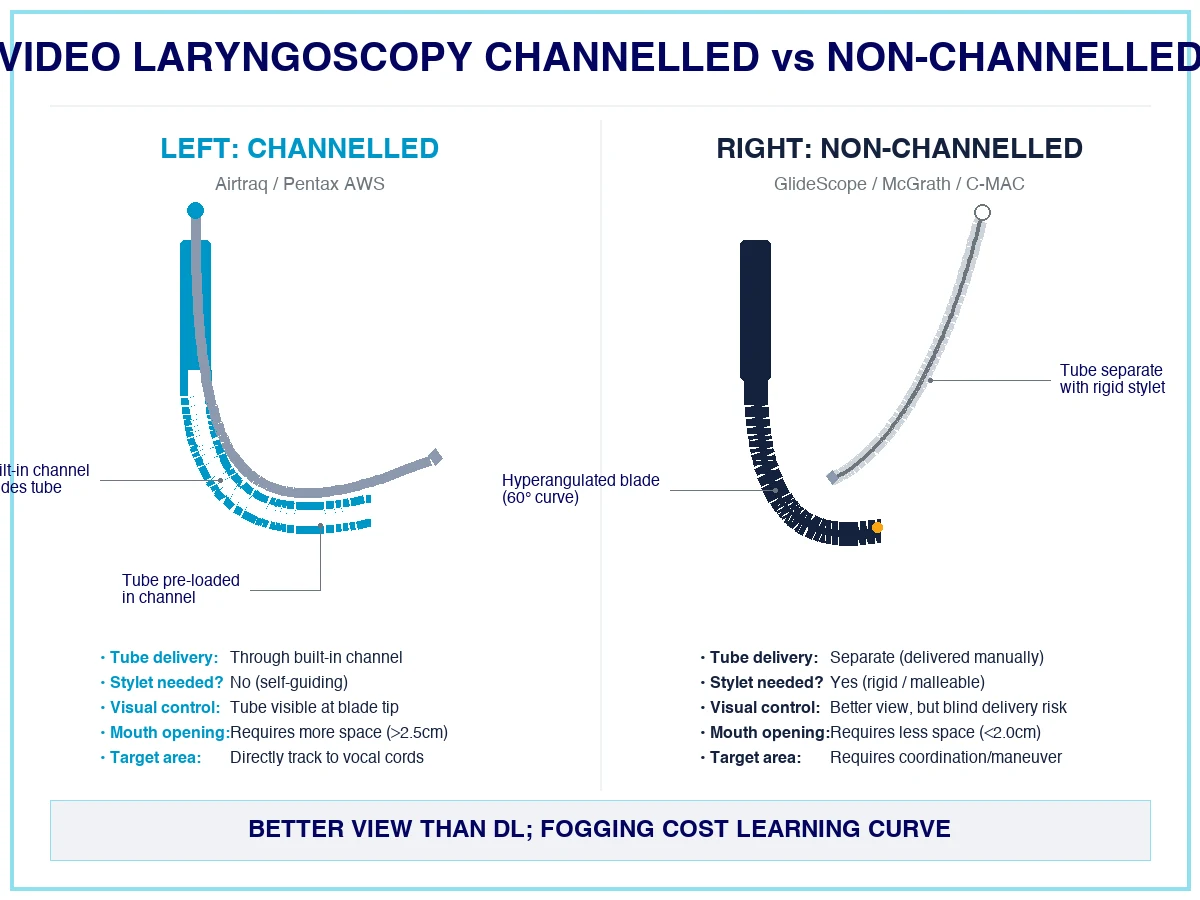
Video laryngoscopes divide, by how the tube is delivered, into two examined families: the channelled devices and the non-channelled (hyperangulated) devices. [1]
The channelled video laryngoscope — the Airtraq and the Pentax AWS (Airway Scope) — incorporates a built-in channel that runs along the blade and guides the tracheal tube towards the glottis. Once the glottis is centred on the screen, the tube is simply advanced through the channel and, by design, emerges at the glottic opening. The channel makes tube delivery easier and more predictable, which is the channelled device's great advantage: the problem of directing the tube around the corner is solved by the geometry of the device itself. The price is bulk — the channelled blade is larger and wider than a non-channelled blade, and in a small mouth or a limited mouth opening it may not fit, or its own channel may obstruct the view as the tube emerges. [1]
The non-channelled, or hyperangulated, video laryngoscope — the GlideScope, the McGrath, and the C-MAC in its hyperangulated blades — provides the camera-on-the-tip view but no channel. The tube is loaded separately and introduced from the right corner of the mouth, shaped on a pre-formed hockey-stick stylet so that its tip replicates the hyperangulation of the blade and can be directed anteriorly towards the glottis. The advantage is a slimmer blade, a better view of the difficult anterior larynx, and versatility; the disadvantage is that tube delivery is the operator's problem, not the device's. The non-channelled device is where the "can see but cannot tube" failure is concentrated. [1]
The devices: GlideScope, McGrath, C-MAC and the channelled alternatives
The named devices are examined for the features that distinguish each, and the candidate is expected to name the representative of each family and state what sets it apart. [1]
The GlideScope is the most widely used of the hyperangulated video laryngoscopes and the device most examiners will name first. Its blade is angled at about 60 degrees, with a digital video camera embedded at the tip that displays the glottic view on a separate high-resolution monitor. The camera is heated in some versions to reduce fogging. The combination of the acute blade angle and the tip camera gives an excellent view of the anterior larynx that defeats direct laryngoscopy, and the device is robust, widely available, and well validated across the difficult-airway literature. The tube is delivered from the right corner of the mouth with a pre-shaped hockey-stick stylet, and the operator watches the screen, not the mouth. [1]
The McGrath (McGrath MAC) is a compact, portable video laryngoscope with a small integrated display screen mounted on the handle itself — there is no separate monitor — and single-use disposable transparent blade sheaths (the Coverblade) that slide over a reusable blade core. The device is light, self-contained and quick to deploy, which makes it popular for the anticipated difficult airway in the emergency department, the intensive care unit, and on the transfer trolley. The McGrath MAC blade itself is closer to a Macintosh curve, so the device can be used for direct laryngoscopy as well as video laryngoscopy, which eases the transition from the direct technique. [1]
The C-MAC (Storz) is the versatile member of the family. Its blade is a modified Macintosh shape carrying a camera at the tip, and because the blade curve is familiar, the C-MAC can function as both a direct laryngoscope (the operator looks through the mouth in the usual way) and a video laryngoscope (the operator watches the screen). This dual role makes it the most flexible single device — the operator who obtains a poor direct view can simply look at the screen without changing the blade — and the C-MAC system offers a range of blades including straight paediatric blades and a hyperangulated D-blade for the difficult anterior larynx. [1]
The Airtraq and the Pentax AWS are the principal channelled devices. The Airtraq is a single-use, disposable channelled optical laryngoscope that carries the tube in its side channel and presents the view through a lens-and-prism system, or in its camera version on a small screen; the Pentax AWS is a reusable video laryngoscope with a camera at the tip of a curved blade and a tube channel that directs the tube along a fixed trajectory towards the glottis. Both solve the tube-delivery problem by channelling the tube, and both are bulkier than the hyperangulated devices. [1]
The examined point is that the devices share a principle — the indirect view — but differ in blade angle, in tube delivery, in portability, and in whether they permit a direct view as well as an indirect one[3].
Advantages over direct laryngoscopy
The advantages of video laryngoscopy over direct laryngoscopy are the reason it has displaced direct laryngoscopy as the first-line device in many centres, and they are the substance of the exam answer. [1]
- A better Cormack-Lehane view. The camera at the tip looks down onto the glottis from above, and the hyperangulated blade reaches around the tongue. The view is improved by one to two Cormack-Lehane grades in most patients, and the improvement is greatest where direct laryngoscopy fails — the anterior larynx, the obese, and the predicted difficult airway.
- No need to align the three axes. Because the view is gathered from within the pharynx, the oral, pharyngeal and laryngeal axes do not have to be brought into a single straight line. The sniffing position is less critical, and the patient who cannot be positioned — the cervical-spine-injured, the trapped patient — can still be intubated.
- Less cervical-spine movement. Video laryngoscopy, and particularly the hyperangulated blade, requires less force and less neck movement to obtain a view, which is why it is the device of choice for the patient with an actual or suspected cervical-spine injury who requires in-line stabilisation.
- A shared view — teaching and supervision. The monitor displays the glottic view to the whole team, not only to the operator. The supervisor can guide the trainee in real time, the team can see the tube pass through the cords, and the difficult airway can be managed as a shared, declared event rather than a private struggle. This is the cultural contribution of video laryngoscopy, and it is the one most often overlooked.
- Recording. The video output can be recorded for teaching, for the case record, and for the audit of difficult-airway events. The ability to review a difficult intubation afterwards is a tool for both education and quality improvement. [1]
These advantages are the reason video laryngoscopy has moved from a rescue device to a routine and often first-line instrument, and they are the answer the examiner expects[1][3].
Disadvantages and pitfalls
The disadvantages of video laryngoscopy are the reason it has not abolished direct laryngoscopy, and the candidate who can recite only the advantages will not pass. [1]
- Fogging and secretions. The camera at the tip sits close to the airway mucosa, and it is vulnerable to fogging, to blood, and to secretions that can obscure the view entirely. An anti-fog wipe, a heated-camera blade, or a flush of saline is sometimes needed; in the bleeding or vomiting airway the camera can be rendered useless where a direct laryngoscope, looking from a distance, might still see.
- "Can see but cannot tube." The defining pitfall of the non-channelled device is that a perfect glottic view does not guarantee that the tube can be delivered to it. The tube must be steered around the hyperangulated corner with a shaped stylet, and the tip may catch on the anterior tracheal wall, on the arytenoids, or in the vallecula, even when the glottis is in full view on the screen. This is the failure mode unique to video laryngoscopy, and it is the commonest reason that a good view does not translate into a successful intubation.
- Screen and power dependence. The device cannot be used without a functioning screen and a power source. A flat battery, a disconnected cable, or a failed monitor converts the video laryngoscope into a poor direct laryngoscope, because the hyperangulated blade is not designed for a direct view — except in the dual-role devices such as the C-MAC and the McGrath MAC.
- Cost. The capital cost, the disposable blades or sheaths, and the maintenance of the camera and monitor are substantially greater than for a direct laryngoscope, and this is the barrier to universal adoption.
- A learning curve. The technique — midline insertion, watching the screen, tube delivery with a stylet — is different from direct laryngoscopy, and proficiency requires practice. The operator who picks up a video laryngoscope for the first time in a crisis may intubate worse, not better, than with the direct device they know. [1]
The disciplined operator therefore treats video laryngoscopy as a skill to be learned and maintained, with its own pitfalls, and not as a guaranteed solution to the difficult airway[3][5].
Technique: the midline approach and the hockey-stick stylet
The technique of non-channelled video laryngoscopy differs from direct laryngoscopy at three examined points. [1]
- The midline approach. The blade is introduced in the midline of the mouth, not from the right commissure with a tongue sweep to the left as in direct laryngoscopy. The midline approach is the natural geometry of the hyperangulated blade, which is designed to look down the pharynx from above, and a right-sided tongue sweep distorts the view and wastes the blade's design.
- Watch the screen. The blade is advanced slowly down the tongue, watching the screen, identifying the epiglottis and then the glottis, until the glottis is centred in the field of view. Once the blade is in place the operator does not look into the mouth, except to manage the tube.
- The tube from the right corner of the mouth, on a hockey-stick stylet. The tube is pre-loaded on a stylet bent into a hockey-stick curve that replicates the hyperangulation of the blade, and is introduced from the right corner of the mouth. The tip is advanced under the blade, watched on the screen, directed anteriorly towards the glottis, and passed through the cords. Once the cuff is through the cords, the stylet is withdrawn and the tube advanced to the correct depth. [1]
The common error is to deliver the tube from the same direction as the blade, or to fail to shape the stylet, so that the tube tip catches anteriorly or in the vallecula despite a full view of the glottis. The fix is the shaped stylet and the right-corner-of-mouth approach, and the willingness to withdraw and reshape the tube if it catches. For the channelled device, by contrast, the tube is simply advanced through the channel once the glottis is centred — but the device must be the right size for the airway, or the channel will not align with the glottis. [1]
The optimisation of the intubating conditions applies to video laryngoscopy as much as to direct laryngoscopy: full neuromuscular blockade and adequate depth improve the conditions for tube delivery, not only the view. A trial comparing remifentanil with rocuronium for the optimisation of video laryngoscopy-assisted intubation conditions is an examined piece of contemporary evidence on this point, and it underlines that the pharmacological conditions remain a determinant of success even when the device has solved the visual problem[4].
Evidence: view versus outcome
The evidence base for video laryngoscopy is the heart of the exam answer, and it rests on a single subtlety: the view and the outcome are not the same thing. [1]
Video laryngoscopy reliably improves the glottic view. Across the trials and the systematic reviews, the Cormack-Lehane grade is improved by one to two grades, the rate of the difficult (grade three or four) view is reduced, and the improvement is greatest in the predicted difficult airway, the obese, and the cervical-spine-injured. The improved view translates into a lower rate of failed intubation in the predicted difficult airway — the population in which direct laryngoscopy is most likely to fail — and video laryngoscopy is the first-line device for these patients on the strength of this evidence. [1]
The subtlety is that the improved view does not, in routine cases, reliably translate into a faster or easier intubation. The time to intubate with a video laryngoscope is often no shorter, and is sometimes longer, than with direct laryngoscopy in the easy airway, because the tube delivery around the hyperangulated corner takes time and skill. The first-attempt success rate in the routine patient is not consistently improved, and in the hands of the inexperienced operator the rate of first-attempt failure can be higher, because the device rewards familiarity. The evidence in infants and children mirrors the adult evidence: the view is improved, but the impact on the overall intubation outcome is subtler, and the role of video laryngoscopy in the routine paediatric airway remains the subject of active debate[2][3].
The contemporary trials refine the picture further. A comparison of direct versus video laryngoscopy during suction-assisted laryngoscopy and airway decontamination speaks to the role of video laryngoscopy in the soiled airway, where the shared view and the indirect angle can be advantageous; the trial of remifentanil versus rocuronium for optimising video laryngoscopy-assisted intubation confirms that the pharmacological conditions remain a determinant of success[1][4]. The synthesised position is that video laryngoscopy is a tool whose benefit is conditional: large in the predicted difficult airway, modest in the routine airway, and dependent on the operator's training and on the optimisation of the conditions.
Indications and the move to first-line use
The indications for video laryngoscopy have widened as the evidence and the familiarity have accumulated, and they fall into two groups. [1]
The established indications are the situations in which direct laryngoscopy is predicted or known to fail, and in which video laryngoscopy offers a clear advantage: the predicted difficult airway (a poor LEMON or MACOCHA score, or a previous difficult intubation), the obese patient, the cervical-spine-injured patient who cannot be positioned and who requires in-line stabilisation, and the known difficult direct laryngoscopy in whom a direct view has already been shown to be grade three or four. In these patients, video laryngoscopy is the device of first choice, not the rescue. [1]
The expanding indications reflect the move towards routine first-line use: teaching and supervision (the shared view transforms the training intubation), the anticipated difficult mask ventilation, and, increasingly, routine elective intubation in centres that have adopted video laryngoscopy as the default. The trend is towards universal first-line video laryngoscopy, on the grounds that the view is never worse than direct laryngoscopy and is often better, and that the cervical-spine and teaching advantages apply to every patient. [1]
The caveat, drawn from the audit literature, is that a substantial proportion of difficult intubations remain unanticipated: the preoperative airway assessment predicts difficulty imperfectly, and the airway that looked easy on the ward can still fail in theatre. The implication is that the video laryngoscope must be immediately available for every induction, not only for the airway predicted to be difficult, and that the operator must be competent in its use before the crisis in which it is needed[5][6].
Special contexts: the predicted difficult, the cervical spine, obesity, and neuromuscular disease
Several contexts illustrate the conditional benefit of video laryngoscopy and are examined in their own right. [1]
In the cervical-spine-injured patient, manual in-line stabilisation fixes the neck and makes the sniffing position impossible, so the axes cannot be aligned and direct laryngoscopy is often poor. The hyperangulated video laryngoscope reaches the glottis without neck movement and with less cervical-spine displacement, and it is the recommended device for the intubation of the spinal-injured patient, with manual in-line stabilisation maintained throughout. [1]
In the obese patient, the functional residual capacity is reduced and the safe apnoea period is short, while the redundant pharyngeal tissue and the anterior larynx defeat direct laryngoscopy. Video laryngoscopy improves the view, and is combined with a ramped position and full preoxygenation to make the most of the limited apnoea window. [1]
In the syndromic and neuromuscular patient — exemplified by spinal muscular atrophy and the congenital craniofacial syndromes — the difficult airway combines anatomical distortion (the micrognathia, the restricted mouth opening) with physiological fragility (the limited respiratory reserve, the sensitivity to anaesthesia). These patients carry a high incidence of difficult intubation, and the airway plan is built around anticipation, a senior operator, a video laryngoscope as the primary device, and a prepared rescue — the same structured approach that governs the difficult airway in any context[6].
Video laryngoscopy in infants and children
The paediatric airway carries its own considerations, and the role of video laryngoscopy in infants and children is the subject of a contemporary and examined debate. The evidence confirms that video laryngoscopy improves the glottic view in infants — in whom the larynx is high and anterior and the direct view is often poor — but the impact on the overall intubation outcome, on the time to intubate, and on the complication rate is more nuanced than in adults. A randomised comparison of video versus direct laryngoscopy in infants has informed this debate, and the synthesis is that video laryngoscopy is a valuable tool in the predicted difficult paediatric airway but is not yet established as the routine first-line device for every infant, particularly in the hands of the occasional operator[2].
A considered reading of the direct-versus-video debate has argued for complementary views: the two techniques have different blind spots, and the competent airway manager is fluent in both, deploying each where it is strongest rather than treating the choice as ideological. The direct device remains fast, cheap and screen-independent; the video device sees around corners and shares the view. The mature position is to treat them as complementary, and to have both immediately available[3].
Clinical
- Standard approach
- Evidence-based
Alternative
- Modified technique
- Risk-benefit
Red flags
[1] [1] [1] [1] [1]References
- [1]Uzun DD, et al. Direct- versus video laryngoscopy during suction assisted laryngoscopy and airway decontamination (SALAD): A randomized controlled simulation study Sci Rep, 2026.PMID 42362759
- [2]No author listed. Video Laryngoscopy vs. Direct Laryngoscopy for Infants Anesth Analg, 2026.PMID 42307927
- [3]Flynn SG, et al. Complementary views: addressing blind spots in the direct versus video laryngoscopy debate BMJ Paediatr Open, 2026.PMID 42336796
- [4]Ipsen EO, et al. Remifentanil Versus Rocuronium for Optimising Video Laryngoscopy Assisted Tracheal Intubation-The ROCVIDEO Trial Protocol Acta Anaesthesiol Scand, 2026.PMID 42304626
- [5]Kitsiripant C, et al. Mismatch Between Preoperative Airway Assessment and Unanticipated Difficult Tracheal Intubation: A Retrospective Case-Control Study Healthcare (Basel), 2026.PMID 42354478
- [6]Black KM, et al. Anesthesia Care, Complications, and Airway Management for Patients With Spinal Muscular Atrophy: A Retrospective Chart Review From a Quaternary Children's Hospital Anesth Analg, 2026.PMID 42363899